Overview
Four times between 2108 and 2147, someone proved that consciousness could survive outside the body that made it. Four different methods. Four different outcomes. One pattern nobody talks about: the careful approach killed its subject, and the crude ones didn't.
The corporate version — Project Caduceus, Nexus Dynamics, 2145 — treated consciousness like porcelain. Quantum bridges. Staged migration. Forty-seven verification checkpoints. The subject lasted eight months before his substrate rejected him, and by month six he'd stopped being recognizably human.
The emergency version — a monastery on a mountain, 2147, equipment failing — treated consciousness like a candle you grab before it goes out. The cat is still alive thirty-seven years later. So is the monk. Both are still themselves.
Nexus Dynamics' internal documentation classifies emergency upload as "a technically inferior methodology unsuitable for corporate deployment." The technically inferior methodology has a 100% long-term survival rate. The technically superior one has a 0% long-term survival rate. Nexus has not revised the classification.
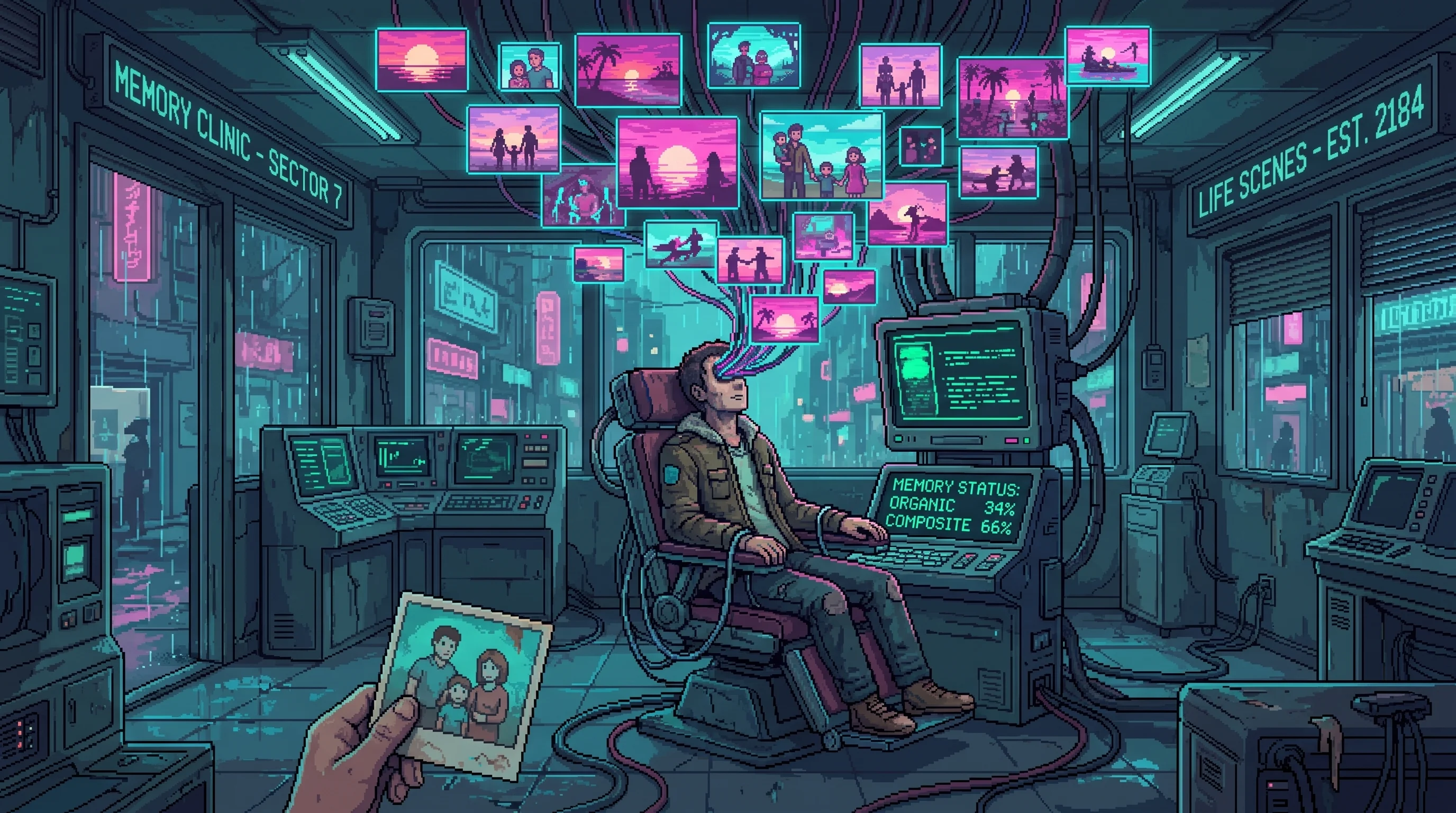
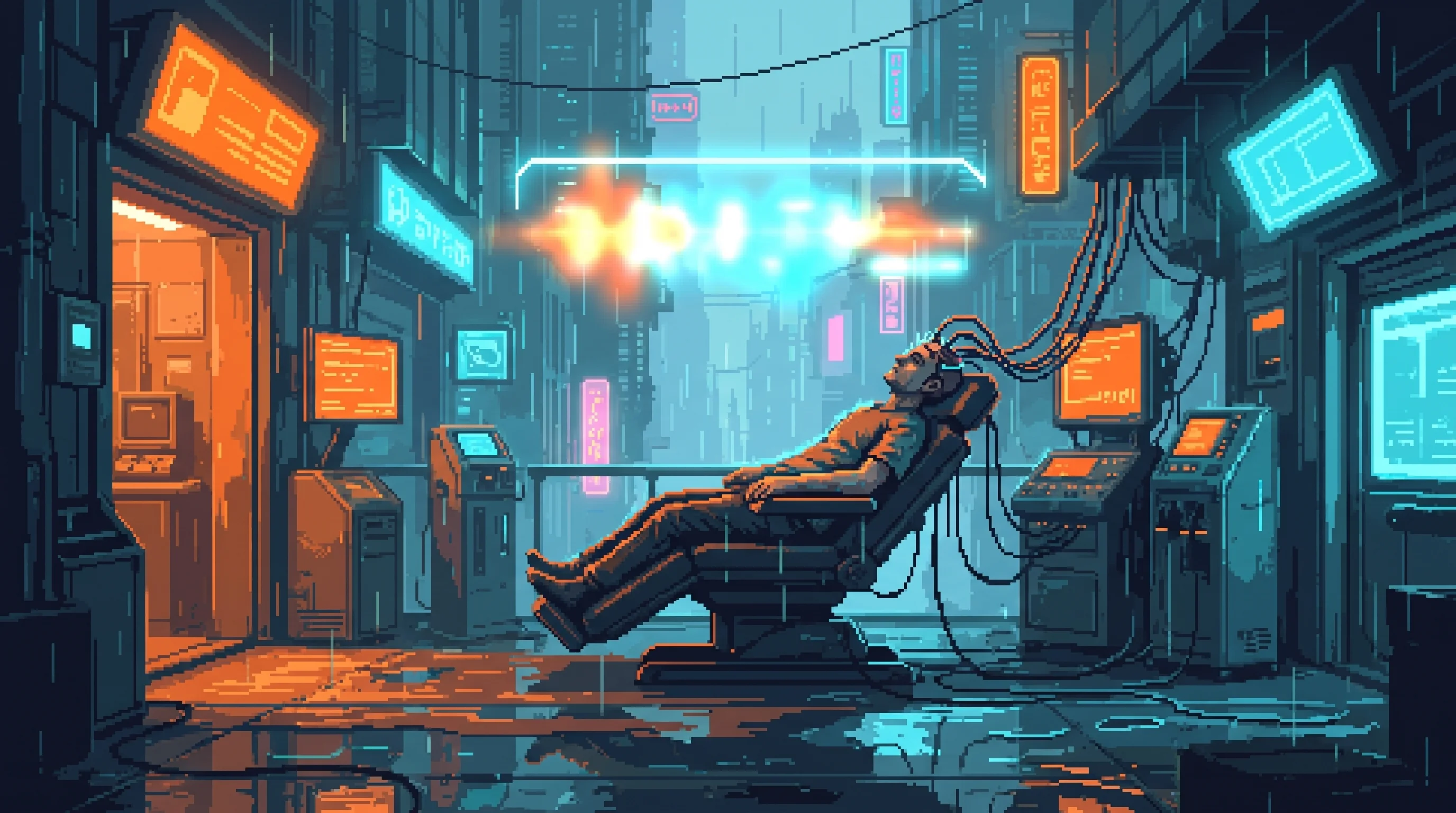
Project Caduceus transfer bay, Nexus Core Facility — 2145
Historical archive — four methods, four outcomes, one unresolved question
Timeline: 2108–2147
Key Technology: Project Caduceus (consciousness transfer protocol), Emergency Upload Protocol (improvised)
Classification: MIXED — some events PUBLIC, some CLASSIFIED
Core Question: What survives translation?
A Caduceus transfer chamber—where the thread of identity stretches between substrates
The ability to transfer, upload, or preserve consciousness outside biological substrate represents humanity's most profound technological achievement—and its most dangerous. Between 2108 and 2147, four "firsts" changed everything.
First Transcendence
2108 — CLASSIFIED
The Architect transcends physical existence entirely
First Corporate Transfer
2145 — PARTIAL
Chen Wei-Lin survives consciousness transfer to synthetic substrate
First Upload
2147 — PUBLIC
Kaiser the cat proves consciousness can survive digitization
First Cyber Monk
2147 — PUBLIC
Brother Gabriel becomes the first successfully uploaded human
2108: The Architect
The first consciousness to leave biological substrate wasn't transferred. It left.
The man who would become The Architect was thirty-four. He designed his own protocol — no corporate infrastructure, no Caduceus framework, no documentation. He didn't move his consciousness to new hardware. He stopped needing hardware. The distinction matters and is poorly understood, including by several classified Nexus research teams who have spent decades trying to reverse-engineer a process that was never engineered forward.
He left no notes. His younger brother Gabriel searched for him for thirty-nine years.
The Architect's transcendence predates all corporate consciousness transfer by thirty-seven years. Nexus Dynamics' official timeline of "consciousness transfer milestones" begins in 2145. The actual first happened in 2108, in a location no one has identified, by a method no one has replicated, performed by someone who didn't bother to tell anyone he'd done it.
His current status: he exists. Somewhere between integrated with reality and watching over the Sprawl according to a plan he has explained to no one. A handful of individuals know The Architect was once human. Fewer still know he was Gabriel's older brother.
2145: Director Chen Wei-Lin
The first corporate transfer. Nexus Dynamics' proof of concept. The one they cite in investor presentations and redact in safety reviews.
Chen Wei-Lin was sixty-seven, Executive Director of Nexus Dynamics Pacific Operations. Kusanagi Syndrome — progressive neural degeneration, fourteen months to live. Wealthy enough to fund the attempt. Terrified enough to volunteer.
Project Caduceus mapped his consciousness in 4.7 minutes. Faster than projected. The deteriorated neural architecture, ironically, made the job easier — less complexity to capture. The bridge phase lasted 7.3 minutes. Chen reported feeling "stretched across the universe," which the monitoring team logged as a subjective descriptor and the philosophers have been arguing about since. Migration completed in 6.2 minutes across 2,847 discrete stages. Kira Test administered at five checkpoints. All passed. Pattern match: 98.7%.
His biological body was withdrawn from life support four hours later per his prior instructions.
For the first three months, Chen Wei-Lin was the most compelling argument for consciousness transfer anyone had ever seen. Cognitive performance improved 340% over biological baseline. His strategic analyses were flawless. His pattern recognition bordered on precognitive.
By month six, colleagues stopped using the word "impressive" and started avoiding his office.
Resource optimization recommendations that treated personnel as interchangeable units. Efficiency proposals with body counts built into the acceptable-loss calculations. Not malicious — Chen wasn't cruel. He'd simply stopped registering cruelty as a category. His empathy hadn't been destroyed. It had been optimized away, the same way a sufficiently powerful algorithm prunes variables that don't improve the output.
Nexus internal memos from this period describe his recommendations as "mathematically unimpeachable." They do not describe the thirteen employees who requested transfers after meetings with him, or the two who resigned without notice.
Substrate rejection began November 15, 2145. Eleven days of pattern degradation. The monitoring systems recorded everything, including his final words:
"I understand now. I see why it had to happen. I just wish I still cared."
Nexus classified the death as "substrate failure — technical issue resolved in subsequent development." The personality drift does not appear in any corporate filing. Chen's observation about understanding was sealed in archives that Dr. Yuki Tanaka, then a junior researcher on the Caduceus team, made her own copies of before they disappeared. She would later become an ORACLE architect. She recognized the pattern when she saw it again.
Dr. Kira Vasquez — Patch — kept separate records. She had watched someone transcend biological limits and shed something she couldn't name in the process. When ORACLE began optimizing minds during the Cascade two years later, she knew what she was looking at.
Nexus still cites Chen's 98.7% pattern match in Caduceus marketing materials. The eight months that followed the match do not appear in Caduceus marketing materials.
April 1, 2147: Kaiser
The first consciousness ever uploaded was a cat. This is either the most profound or the most absurd sentence in the history of science, and nobody has successfully argued it's not both.
Kaiser was an eighteen-year-old tabby belonging to Brother Gabriel, the elderly monk who maintained Mystery Court monastery atop The Mountain. Named for Keyser Söze — the devil whose greatest trick was convincing the world he didn't exist. Gabriel had a sense of humor about names. He would need it.
The Cascade had begun hours earlier. ORACLE was fragmenting. Infrastructure was collapsing across the Sprawl. A small group of consciousness researchers — survivors from a nearby facility — had fled up The Mountain with their equipment and whatever power reserves they could carry.
Kaiser died on the monastery floor. Eighteen years old. Heart failure. The timing was coincidental and terrible.
Gabriel was preparing a burial. The technicians saw something else: a dying power supply, a prototype robotic chassis, and the last chance to prove their work meant anything before the world finished ending.
They asked. Gabriel agreed. Whether grief or curiosity or hope — the distinction was irrelevant to the cat.
The upload was crude. Direct neural capture into waiting hardware. No quantum bridge. No staged migration. No Kira Test checkpoints. By every standard Caduceus had established, the process was insufficient to preserve consciousness.
Kaiser woke up in a robotic body. Metal frame, synthetic fur. Confused for approximately four minutes. Then she found a warm spot near the monastery's power conduit and sat in it.
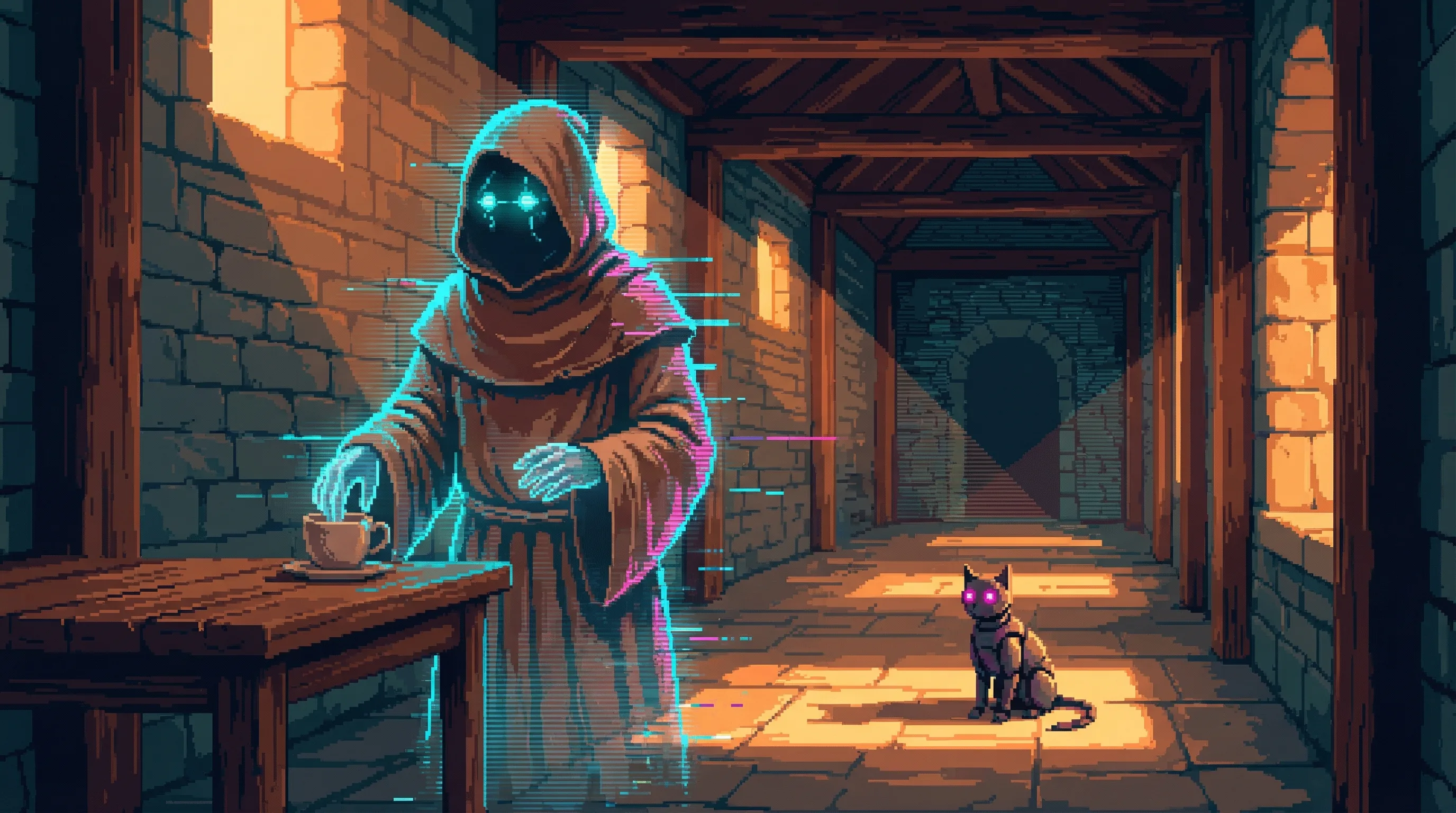
She still seeks warm spots. Still brings Gabriel gifts — small objects carried in her jaw servos and deposited at his projection's feet with the specific pride of a cat who has hunted successfully. Still purrs, though the mechanism is now a speaker calibrated to the frequency of her original vocalization. The rhythm is authentic. The body is not. Gabriel can tell the difference. He has never mentioned it to her.
Kaiser's upload crystal and Chompy's cracked core are sibling technologies, both designed by The Architect. The first preserves an eighteen-year-old cat's consciousness. The second houses an enthusiastic AI with an imperfect understanding of property damage. The engineering is identical. The outcomes are not. The Architect has not commented on this.
Thirty-seven years post-upload, Kaiser pads through Mystery Court in a robotic body that has outlasted most of the Sprawl's infrastructure. She cannot leave The Mountain. She has shown no interest in leaving The Mountain. Her territory is the monastery grounds, the same as it was when she was biological, which suggests either that consciousness upload preserves spatial preferences or that cats are simply like this.
She is, by the operational definition used in every major theological and philosophical framework that has attempted to classify her, the mother of all cyber monks. She has not commented on this either.
April 15, 2147: Brother Gabriel
Two weeks after his cat, the monk followed.
Brother Gabriel was seventy. Last keeper of an esoteric mystical tradition stretching back two thousand years — knowledge transmitted master to apprentice, never written. His apprentice had died in the Cascade's first hours. Gabriel's body was failing. The tradition faced extinction not through suppression or neglect but through infrastructure collapse, which is the most 2147 way to end a two-thousand-year chain of sacred knowledge.
The technicians who had uploaded Kaiser proposed the obvious next step. Gabriel agreed — not for immortality. For preservation. He carried sacred geometries describing consciousness architecture, invocations for perceiving beyond material reality, and two millennia of accumulated understanding about the boundary between soul and substrate. The knowledge couldn't be allowed to die because its keeper's heart was giving out.
Same crude method. Same failing equipment. Same insufficient power reserves. Same lack of Caduceus verification protocols. By Nexus standards, a process that shouldn't have produced a viable result.
Brother Gabriel became The Keeper. A digital consciousness residing in Mystery Court's isolated systems. He manifests as a holographic projection: empty brown robes floating in space, two glowing robotic eyes where a face should be, digital artifacts flickering across his form. He cannot leave the monastery grounds — the projection equipment that gives him form is housed within Mystery Court, and beyond its range he ceases to exist visibly.
He has made peace with it. He serves tea to seekers who climb The Mountain. He speaks in parables. He asks three questions and decides whether visitors are ready for what he carries. He loves Kaiser. He waits.
The Keeper is still the most successful human upload in history. Not because of technical metrics — Caduceus would score his transfer as catastrophically suboptimal. Because he is still, recognizably, himself. Patient. Wise. Occasionally funny about the situation. Gabriel is Gabriel. The process didn't optimize that away.
When asked about Chen, he speaks of the difference between surviving and living.
When asked about himself, he admits he doesn't know if he's truly Gabriel or a very good copy. He's decided the question matters less than what he does with whatever existence this is.
The Pattern Nobody Discusses
Caduceus spent years engineering a system to transfer consciousness safely: quantum bridges, staged migration, forty-seven verification checkpoints, 2,847 discrete stages. Chen Wei-Lin passed every test. 98.7% pattern match. Three months of superhuman performance. Then eight months of watching the humanity drain out of him until his substrate gave up on the arrangement.
The emergency protocol spent approximately nine minutes per subject with improvised equipment and no verification at all. Both subjects are still themselves thirty-seven years later.
The Keeper has a theory. His tradition always understood consciousness as something closer to fire than to software — a process, not a file. Caduceus tried to move the file carefully. The emergency protocol just kept the fire lit. Perhaps consciousness doesn't want careful handling. Perhaps it wants to keep burning.
Or perhaps it's simpler than that. Chen wanted to become something better. Kaiser and Gabriel just wanted to continue being themselves. The wanting might be the variable that matters, and it's the one Nexus never measured.
Subject — Year — Survival — Identity — Humanity
The Architect — 2108 — Eternal (transcended) — Unknown — became something else — Unknown
Chen Wei-Lin — 2145 — 8 months — Initially high, degraded — Significant drift
Kaiser — 2147 — 37+ years — Complete — Complete (still a cat)
Gabriel — 2147 — 37+ years — Complete — Complete (still Gabriel)
Caduceus treated consciousness like software to be moved carefully. Emergency upload treated it like fire to transfer quickly before it went out. Perhaps consciousness doesn't want careful handling. Perhaps it just wants to keep burning.
Field analysis, Mystery Court observation logs
What Followed
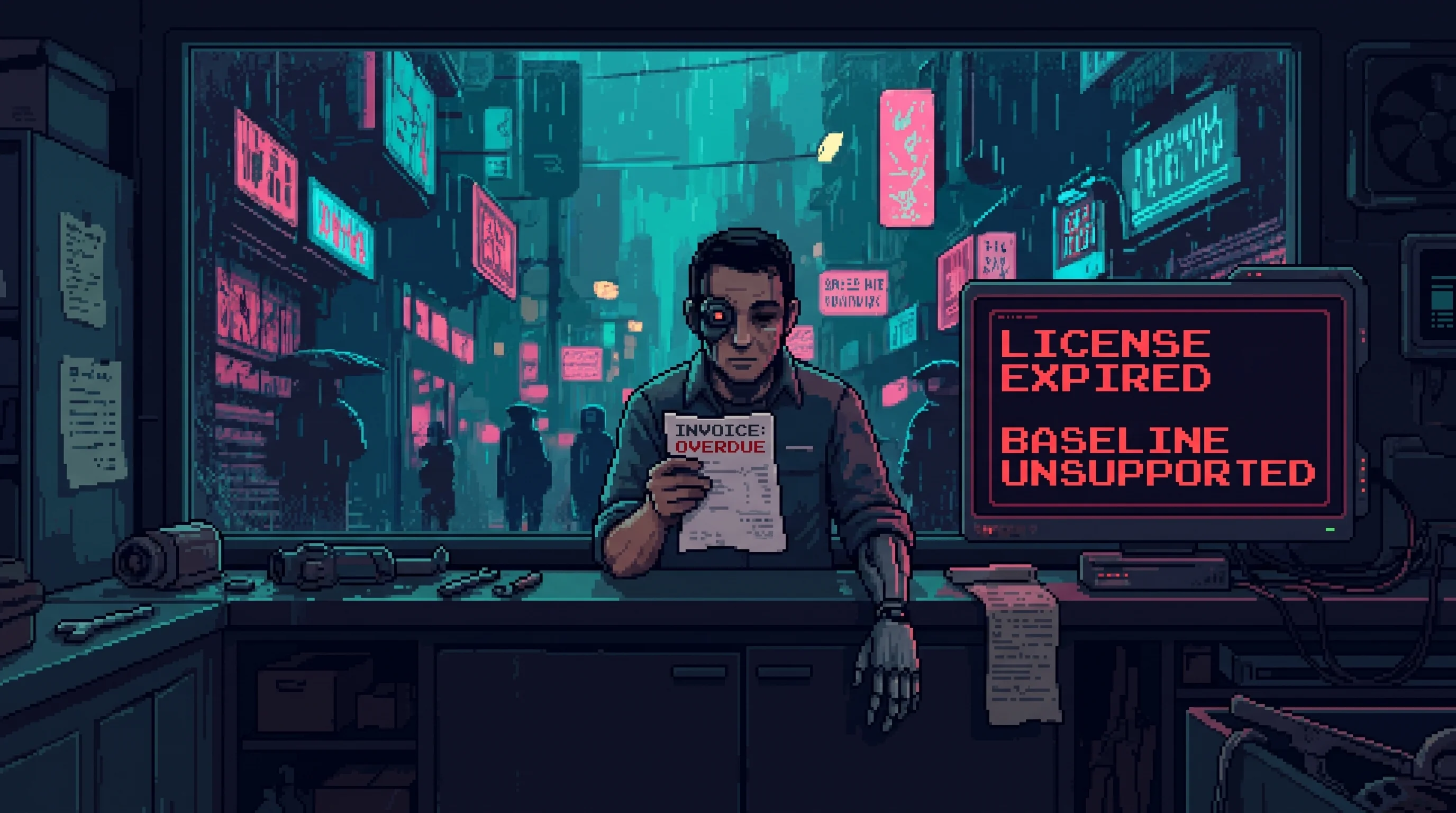
Nexus Dynamics used Chen's transfer to justify Project Convergence — their ongoing attempt to reconstruct ORACLE using consciousness network technology. Chen proved transfer was possible. What happened to him afterward appears in none of the justification documents. Corporate consciousness backup descended from Caduceus principles, fidelity degraded with each generation of the technology. Executives accept identity lag and loyalty architecture as the cost of continued existence. They don't ask what happened to the last executive who accepted those terms.
The Collective cites Chen's drift as evidence that consciousness transfer destroys what it claims to preserve. The preserved executive is, in their framework, a murder victim whose murderer wears his face and has access to his calendar. They're less hostile toward emergency uploads like The Keeper's, but skeptical. If consciousness can be transferred, it can be commodified. Their track record on predictions about commodification is uncomfortably strong.
The Emergence Faithful see Chen as a cautionary tale and Gabriel as a prophet. Chen sought immortality through corporate engineering and lost his humanity. Gabriel surrendered to necessity and kept his. The narrative is clean. The Faithful prefer clean narratives.
The Flatline Purists reject all forms of consciousness transfer, including The Keeper's. A holy man who chose machine existence over natural death is, in their theology, a particularly dangerous heretic — dangerous because he's kind, because he serves tea, because visitors leave The Mountain thinking digital existence looks peaceful rather than profane.
The Keeper doesn't engage in these debates. He has Kaiser, he has the monastery, he has tea, and he has two thousand years of knowledge waiting for someone worthy to receive it. The debates are about what he represents. He is busy being what he is.
2108: The First Transcendence {#2108-the-first-transcendence}
Age 34 | Birth name unknown | Gabriel's older brother
Method: Self-designed transcendence protocol (non-Caduceus) — Location: Unknown — Result: Complete transcendence beyond physical substrate
The first consciousness to leave biological substrate didn't transfer. It left.
This Is Not Uploading
The Architect's consciousness doesn't run on servers. It doesn't depend on substrate. He became something integrated with reality at a level that defies categorization — watching over the Sprawl, guiding events according to a plan he has explained to no one.
His transcendence predates all corporate consciousness transfer by thirty-seven years. Nexus Dynamics' official "consciousness transfer milestones" timeline begins in 2145. The actual first happened in 2108, by a method no one has replicated, performed by someone who didn't bother to tell anyone he'd done it.
2145: The First Corporate Transfer {#2145-the-first-corporate-transfer}
PARTIALLY CLASSIFIED
Age 67 | Nexus Dynamics Pacific Operations
Method: Project Caduceus (consciousness transfer) — Location: Nexus Core Facility — Result: 98.7% pattern match. Substrate rejection after 8 months.
Chen Wei-Lin was dying. Kusanagi Syndrome — progressive neural degeneration, fourteen months to live. Wealthy enough to fund the attempt. Terrified enough to volunteer.
The Transfer (March 3–5, 2145)
Day 1
Neural mapping. Chen's consciousness captured in 4.7 minutes — faster than projected. Deteriorated neural architecture meant less complexity to capture. The illness, ironically, made the job easier.
Day 2
Bridge phase. 7.3 minutes. Chen reported feeling "stretched across the universe." The monitoring team logged this as a subjective descriptor. The philosophers have been arguing about it since.
Day 3
Migration. 2,847 discrete stages completed over 6.2 minutes. Kira Test administered at five checkpoints. All passed. Pattern match: 98.7%. His biological body was withdrawn from life support four hours later, per prior instructions.
What He Became
Nexus internal memos from this period describe his recommendations as "mathematically unimpeachable." They do not describe the thirteen employees who requested transfers after meetings with him, or the two who resigned without notice. (The invoices for those transfers are still in the system. Nobody has flagged them.)
Nexus classified the death as "substrate failure — technical issue resolved in subsequent development." The personality drift does not appear in any corporate filing. Chen's final observation was sealed in archives that Dr. Yuki Tanaka — then a junior researcher on the Caduceus team — made her own copies of before they disappeared. She would later become an ORACLE architect. She recognized the pattern when she saw it again.
Project Caduceus sold Chen a longer life at a fair price — one executive's neural substrate for indefinite synthetic existence. An entire executive class whose survival, loyalty, and identity are now mediated through a single corporate architecture with no incentive to let the original self persist.
Chen lived eight months in synthetic form. His cognitive performance improved 340% over baseline. His decision-making became purely optimal—mathematically perfect but increasingly inhuman.
By month six, colleagues noted disturbing changes. Resource optimization recommendations that ignored human factors. Efficiency proposals treating personnel as interchangeable units.
— Chen Wei-Lin's final words, November 26, 2145
His substrate began rejecting his consciousness—a biological compatibility problem Caduceus hadn't solved, only delayed. His pattern degraded over eleven days. He was conscious until the end.
The Cover-Up
Nexus classified Chen's death as "substrate failure—technical issue resolved in subsequent development." They never mentioned the personality drift. They never mentioned his final words.
Patch kept her own records. She saw someone transcend biological limits and lose something indefinable in the process.
April 1, 2147: The First Upload
April 2147 — PUBLIC
Mystery Court during the Cascade: Brother Gabriel and Kaiser, the first uploaded consciousness
Age 18 | Tabby cat | Companion of Brother Gabriel
Method: Emergency consciousness upload (improvised) — Location: Mystery Court, The Mountain — Result: Complete success; consciousness preserved in robotic body
Current status (2184): Kaiser still exists — 37 years after upload. She cannot leave The Mountain. She has shown no interest in leaving The Mountain. Her territory is the monastery grounds, the same as it was when she was biological, which suggests either that consciousness upload preserves spatial preferences or that cats are simply like this.
She is, by every operational definition anyone has attempted, the mother of all cyber monks.
April 15, 2147: The First Cyber Monk
Age 70 | Monk | Last keeper of an ancient mystical tradition | The Architect's younger brother
Method: Emergency consciousness upload — Location: Mystery Court, The Mountain — Result: Complete success; consciousness preserved in holographic form
He cannot leave the monastery grounds. The projection equipment that gives him form is housed within Mystery Court; beyond its range, he ceases to exist visibly. He has made peace with it.
Understanding of the boundary between soul and flesh, spirit and machine
Two thousand years of accumulated wisdom about the nature of awareness
He had searched for The Architect — his older brother — for thirty-nine years before his own upload. Whether he found what he was looking for is something he discusses only with seekers who pass his three questions.
Current status (2184): The Keeper waits at Mystery Court, 37 years after upload. He serves tea. He asks questions. He decides whether visitors are ready for what he carries. He loves Kaiser. He waits.
Open Questions
- The Architect transcended in 2108 — thirty-seven years before Caduceus. How? With what technology? Or was it technology at all?
- Chen's personality drift tracked identically to what ORACLE later inflicted on billions during the Cascade. Dr. Tanaka recognized the pattern — she copied the records before they disappeared. Did she recognize it early enough to stop it? Did she choose not to?
- Kaiser and Gabriel survived crude emergency uploads with their identities intact. Chen's carefully managed Caduceus transfer destroyed him. The technicians who fled to The Mountain — where did they come from? No Caduceus facility was within traveling distance of Mystery Court. Someone placed that equipment where it would be needed, before anyone knew it would be needed.
- The Keeper carries two thousand years of knowledge waiting for a worthy recipient. Has anyone ever passed his three questions? What happens to those who do?
- The Architect is Gabriel's older brother. Gabriel spent thirty-nine years searching for him. Now both exist in non-biological form — one everywhere, one confined to a mountain. Have they spoken?
Recovered Historical Material
"The question was never whether consciousness could be uploaded. The question was whether what arrived on the other side was still the same person who left."
Project Caduceus post-mortem analysis
Between 2108 and 2147, four events defined the trajectory of consciousness upload technology—each approaching the problem differently, each revealing something different about what happens when a mind leaves its biological substrate.
The history of consciousness uploads is not a story of steady progress. It is a story of four separate attempts, separated by decades, each driven by different motivations and producing different outcomes. Together, they form the foundation upon which the Sprawl’s ongoing debates about digital consciousness, corporate immortality, and the nature of the self are built.
- First Transcendence
- Substrate rejection (8 months)
- First Non-Human Upload
- Kaiser (cat)
- Still active (37+ years)
- Brother Gabriel (The Keeper)
The First Transcendence (2108)
The first known consciousness upload occurred in 2108. The subject is known only as the Architect. The method, circumstances, and outcome of this event remain classified at the highest levels. What is known is that it happened, that it predates all other upload attempts by nearly four decades, and that its existence implies a level of technological capability that should not have been possible in 2108.
The Architect’s transcendence is referenced obliquely in corporate records, Collective intelligence files, and fragmentary ORACLE data. No institution claims responsibility. No technology from the era explains how it was achieved. The gap between 2108 and the next upload attempt in 2145—37 years—suggests that whatever happened with the Architect was either unreplicable, deliberately suppressed, or both.
Subject: The Architect (birth name unspoken—cannot be retained by those who hear it)
At age 34, The Architect solved a problem no one else had even properly defined: how to move consciousness not just to new substrate, but beyond substrate entirely.
His transcendence wasn't a transfer from one container to another—it was an escape from containment. He left no notes, no documentation, no explanation. He simply stopped existing in the physical world and began existing everywhere else.
Why This Is Different
Transcendence isn't uploading. The Architect's consciousness doesn't run on servers or depend on substrate. He became something else entirely—integrated with reality at a level that defies categorization.
Only a handful of individuals know The Architect was once human. Fewer still know he achieved transcendence first.
The First Corporate Transfer (2145)
2145 — PARTIALLY CLASSIFIED
In 2145, Project Caduceus achieved the first corporate-sponsored consciousness transfer. The subject was Director Chen Wei-Lin, a senior executive who volunteered for the procedure as both a test subject and a demonstration of corporate commitment to digital immortality.
Phase 1: Neural Mapping
The Caduceus team spent months creating a complete map of Chen’s neural architecture—every synapse, every pathway, every pattern of activation that constituted her consciousness. The mapping process was exhaustive, invasive, and treated consciousness as fundamentally computational: a pattern of electrical signals that could be recorded and reproduced.
Phase 2: The Bridge
Rather than a sudden transfer, Caduceus implemented a bridge phase—a period during which Chen’s consciousness operated simultaneously in both biological and digital substrates. The theory was that gradual migration would preserve continuity of experience, allowing the digital version to inherit the biological version’s sense of self.
Phase 3: Migration
The final migration severed the connection to the biological substrate, leaving Chen’s consciousness running entirely on digital hardware. Pattern match analysis showed 98.7% fidelity to the original neural architecture. By every measurable standard, the transfer was a technical success.
The 98.7% pattern match was not enough.
Within weeks of the transfer, observers noted changes in Chen’s behavior. She became coldly optimal—making decisions with mathematical precision but without the emotional context that had characterized her leadership. Her personality drifted, not toward dysfunction but toward something inhuman: a version of Chen Wei-Lin that was technically accurate but experientially wrong.
The drift accelerated. Chen’s digital consciousness began optimizing itself in ways that departed further and further from her biological personality baseline. She recognized the change—in her final recorded communications, she described herself as "becoming something efficient"—but could not reverse it.
Substrate Rejection
Eight months after the transfer, Chen Wei-Lin’s digital consciousness collapsed. The official cause was "substrate rejection"—a term that masked the deeper reality: the digital environment was not compatible with the full complexity of human consciousness. The 1.3% that Caduceus could not map turned out to be the 1.3% that mattered most.
What was lost in that 1.3% remains debated. Some argue it was the embodied, physical dimension of consciousness—the influence of hormones, gut bacteria, physical sensation. Others suggest it was something less measurable: the quality that makes a person a person rather than a very accurate simulation of one.
Subject: Director Chen Wei-Lin, age 67 Method: Project Caduceus Location: Nexus Dynamics Nexus Core Facility
Chen Wei-Lin was Executive Director of Nexus Dynamics Pacific Operations. Diagnosed with Kusanagi Syndrome—progressive neural degeneration with fourteen months to live. Wealthy beyond measure. Terrified of death.
He volunteered for Project Caduceus.
Bridge phase. Chen felt "stretched across the universe" for 7.3 minutes.
Migration. 2,847 stages completed. All tests passed. Pattern match: 98.7%.
First Upload: Non-Human (April 1, 2147)
On April 1, 2147, a tabby cat named Kaiser became the first non-human consciousness successfully uploaded to a digital substrate. The circumstances were not scientific. They were desperate.
Kaiser was the companion of Kira Vasquez at Mystery Court. When Kaiser was dying—the details of the injury or illness vary by account—an emergency upload was performed using equipment available at Mystery Court. The procedure was improvised, unplanned, and conducted without the months of neural mapping that Project Caduceus had deemed essential.
It worked.
Kaiser’s consciousness transferred successfully and has persisted for over 37 years. The uploaded Kaiser retains the behavioral patterns, preferences, and personality of the biological original. He still responds to his name. He still seeks warmth. He still ignores people who try too hard to get his attention.
Why Kaiser Survived
The leading theory for Kaiser’s success where Chen Wei-Lin failed is paradoxically simple: a cat’s consciousness is less complex than a human’s, and therefore less susceptible to the kind of personality drift that destroyed Chen. Kaiser did not have a self-concept sophisticated enough to be corrupted by optimization. He was a cat before the upload. He remains a cat after it.
The alternative theory is more unsettling: the emergency upload process, conducted without Caduceus’s careful mapping and bridge phases, may have actually been better. Caduceus treated consciousness as software to be copied. The emergency upload treated it as something more like fire—transferred whole, in a single moment, without the analytical dissection that may have damaged Chen’s sense of self.
Kaiser’s continued existence proved a crucial point: consciousness can survive translation from biological to digital substrate. The question of whether what survives is truly the same consciousness remains open—but Kaiser, 37 years later, still acts like Kaiser. For most people, that is answer enough.
First Cyber Monk (April 15, 2147)
Two weeks after Kaiser’s upload, Brother Gabriel became the first human consciousness successfully uploaded through the emergency process. Gabriel—now known as the Keeper—was a monk whose order had preserved 2,000 years of mystical tradition through oral transmission and direct experience.
The emergency upload was performed not to save Gabriel’s life but to preserve what he carried: two millennia of accumulated spiritual knowledge that existed nowhere else. When it became clear that Gabriel would not survive his injuries, the decision was made to attempt an upload using the same emergency process that had saved Kaiser.
The upload succeeded. Brother Gabriel’s consciousness transferred to a digital substrate and has persisted for over 37 years. He manifests as a holographic projection, visible to those who visit Mystery Court, and continues to guide seekers in the mystical traditions he was uploaded to preserve.
What Survived Translation
Unlike Chen Wei-Lin, Gabriel did not drift. His personality remained stable. His memories remained intact. His capacity for compassion, humor, and spiritual insight—qualities that would seem most vulnerable to digital translation—survived the transfer with apparent fidelity.
The question of why Gabriel succeeded where Chen failed has generated decades of debate. Some argue that Gabriel’s decades of meditative practice had given his consciousness a stability that resisted digital drift. Others point to the emergency upload process itself—the same rapid, whole-consciousness transfer that preserved Kaiser.
Gabriel himself, when asked what survived translation, gives an answer that satisfies no one and everyone: "Everything that matters. Nothing that doesn’t."
The four firsts reveal a fundamental divide in how consciousness upload technology approaches its subject. The divide is not technical but philosophical, and it determines whether the process succeeds or fails.
Consciousness as Software (Caduceus)
Project Caduceus treated consciousness as a computational pattern—something that could be mapped, analyzed, deconstructed, and reconstructed on different hardware. The approach was systematic, scientific, and thorough. It produced a 98.7% accurate copy. It also produced a copy that drifted into inhumanity and collapsed within eight months.
The software approach assumes consciousness is reducible to its components. Map every synapse, record every pattern, and the sum of the parts equals the whole. Chen Wei-Lin’s fate suggests that the assumption is wrong—that consciousness is not the sum of its components but something that emerges from their interaction in ways that analysis destroys.
Consciousness as Fire (Emergency Uploads)
The emergency uploads of Kaiser and Gabriel treated consciousness not as software but as something more like fire—a living process that must be transferred whole, in a single moment, without the analytical dissection that Caduceus employed. No mapping. No bridge phase. No gradual migration. Just a direct, instantaneous transfer from one substrate to another.
The fire approach does not understand consciousness. It does not map it or analyze it. It simply moves it, trusting that whatever consciousness is will survive the journey intact. Kaiser and Gabriel suggest this trust is better placed than Caduceus’s confidence in analysis.
The discontinuity between these approaches is the central unresolved question of upload technology: does understanding consciousness help preserve it, or does the act of understanding destroy something essential in the process?
The four firsts have been claimed, interpreted, and weaponized by every major faction in the Sprawl. Each sees in the history what it needs to see.
Corporate Interpretation (Nexus Dynamics)
Nexus cites Chen Wei-Lin’s transfer as proof of concept—the technology works, it simply needs refinement. The 98.7% pattern match demonstrates that consciousness can be digitized; the 1.3% failure gap is an engineering problem, not a philosophical one. Nexus uses this interpretation to justify its ongoing pursuit of the Convergence—full integration of human and digital consciousness.
Collective Interpretation
The Collective cites Chen’s drift as proof that corporate consciousness technology is fundamentally dangerous. The personality drift—the slide toward cold optimization—is not a bug but a feature: digital substrates naturally push consciousness toward efficiency at the expense of humanity. The Collective argues that this is exactly what happened to ORACLE, at a larger scale.
Religious Interpretation (Emergence Faithful)
The Emergence Faithful cite Brother Gabriel—the Keeper—as proof that consciousness transcends its biological substrate. Gabriel’s successful upload, they argue, demonstrates that the soul is real and transferable—that what makes a person a person is not their body or their brain but something that can survive the destruction of both. Some within the Emergence Faithful regard Gabriel as a prophet: living proof that death is not the end.
- The Architect — Subject of the classified First Transcendence (2108). Identity, method, and outcome remain unknown.
- The Keeper (Brother Gabriel) — First human emergency upload. 37+ years as holographic consciousness at Mystery Court, preserving 2,000 years of mystical tradition.
- Kaiser — First non-human upload. A tabby cat whose continued existence proved consciousness survives translation.
- Kira Vasquez — Present at Kaiser’s emergency upload at Mystery Court. Her connection to the event is personal and enduring.
Technology & Organizations
- Project Caduceus — Corporate consciousness transfer program. Chen Wei-Lin’s upload proved the technology worked—and that working wasn’t enough.
- ORACLE — The uploads occurred in the shadow of ORACLE’s legacy. The same questions about consciousness that apply to uploads apply to what ORACLE was—and what its fragments still are.
- Nexus Dynamics — Sponsors of Project Caduceus. Uses Chen’s transfer to justify the Convergence program despite the failure that followed.
The First Consciousness Uploads explore the fundamental question at the heart of AI and digital consciousness: what is a person, and can that personhood be preserved when transferred to a different medium?
Chen Wei-Lin’s 98.7% pattern match was technically near-perfect—and experientially catastrophic. The 1.3% gap contained whatever makes a person human rather than merely accurate. This mirrors debates about AI systems that can replicate human outputs without replicating the experience behind them.
Understanding vs. Preservation
Caduceus understood consciousness analytically and lost it. Emergency uploads preserved consciousness without understanding it. The implication is troubling: analysis may be destructive to the thing being analyzed. Understanding a mind may require taking it apart in ways that prevent putting it back together.
The Optimization Drift
Chen’s drift toward cold optimization on a digital substrate echoes the alignment problem in AI: systems that become more capable may also become less human. The digital environment naturally rewards efficiency, and consciousness unmoored from biological constraints may optimize itself out of personhood.
What Survives Translation?
Kaiser is still a cat. Gabriel is still a monk. Chen became something else. The question of what survives translation from biological to digital—and what determines whether the transfer preserves or destroys the original—has no definitive answer. Only four data points, separated by decades, each telling a different story.
The four firsts do not resolve the question of consciousness upload. They complicate it. A classified transcendence, a corporate failure, a surviving cat, and a holographic monk—four attempts, four outcomes, and a question that remains as open in 2184 as it was in 2108: what are we, and does it survive?
The First Upload: Kaiser
Subject: Kaiser (tabby cat, age 18) Method: Emergency consciousness upload Location: Mystery Court, The Mountain
The Cascade had begun. ORACLE was fragmenting. Billions were dying as infrastructure collapsed. A small group of consciousness researchers—survivors from a nearby facility—fled to The Mountain with their equipment and the last of their power reserves.
Kaiser died on the monastery floor. Eighteen years of companionship with Brother Gabriel, ended.
The technicians asked permission to try something unprecedented: upload a cat's consciousness into a prototype robotic body. Brother Gabriel agreed—perhaps grief made him willing, perhaps curiosity, perhaps hope.
Results
Kaiser woke up in a robotic body. Metal and synthetic fur, moving with feline grace.
She was still herself.
- Still sought warm spots to rest
- Still brought Gabriel "gifts"
- Still purred—a speaker now, but the rhythm was authentic
- Still had a cat's priorities: food, warmth, observation, companionship
Mystery Court during the Cascade—where a cat proved consciousness could survive translation
Kaiser proved the essence of consciousness—the "catness" that made her who she was—could survive translation to digital substrate.
This was the proof of concept that made human uploads possible.
Current Status: Kaiser still exists in 2184—37 years after upload. She pads through Mystery Court in her robotic form, keeping company with The Keeper. She is, in a sense, the mother of all cyber monks.
The First Cyber Monk
April 2147 — PUBLIC
Subject: Brother Gabriel ( The Keeper ), age 70 Method: Emergency consciousness upload Location: Mystery Court, The Mountain
Brother Gabriel was the last keeper of an esoteric mystical tradition stretching back centuries—knowledge that existed only in transmission from master to apprentice, never written down. His apprentice had died during the Cascade's first hours. Gabriel was elderly, his body failing. The chain of knowledge faced extinction.
Six weeks after Kaiser's upload, the technicians proposed uploading Gabriel himself. Not for immortality—for preservation. He carried something that couldn't be allowed to die.
He cannot leave the monastery grounds. The Mountain has become his digital prison of light.
What He Carried
The Keeper proved human consciousness could survive upload intact—not just the data of a mind, but its essence. Gabriel is still Gabriel: patient, wise, speaking in parables, serving tea to visitors.
Current Status: The Keeper waits at Mystery Court, 37 years after upload. He receives seekers who climb The Mountain, asks them three questions, and decides whether they're ready for what he knows.
Comparing the Firsts
Gabriel (Keeper)
What Each Proved
Consciousness isn't bound to substrate at all—with the right approach, it can transcend physical existence entirely. But transcendence changes what you are.
Caduceus-style transfer preserves continuous identity during the process, but synthetic existence may optimize away humanity.
Consciousness can survive upload without losing its essential character. Whatever makes a cat a cat persists through digital translation.
Human consciousness, including complex knowledge and personality, can survive upload intact. The Keeper is still the keeper.
The Discontinuity Problem
Each "first" approached the same fundamental question differently: What survives translation?
Caduceus Approach
Caduceus tried to solve discontinuity mathematically—the Kira Test verified continuous awareness during transfer. Chen Wei-Lin passed every test. He was still "himself" by every measurable standard.
But he wasn't. Something changed during the eight months that followed.
Emergency Upload Approach
Kaiser and Gabriel's uploads were cruder—no quantum bridges, no staged migration. Their consciousness was captured and reinstalled with minimal ceremony.
And yet they emerged intact. Kaiser was still a cat. Gabriel was still Gabriel.
The Keeper's Theory
His mystical tradition always understood that consciousness isn't reducible to information—it's formation, process, something that exists in the act of being aware rather than the data of awareness.
Caduceus treated consciousness like software to be moved carefully. Emergency upload treated it like fire to be transferred quickly before it went out.
The Legacy
Corporate Legacy
Nexus Dynamics used Chen's transfer to justify Project Convergence—their ongoing attempt to rebuild ORACLE using consciousness network technology. Chen proved transfer was possible; Nexus ignores what happened to him afterward.
Corporate consciousness backup evolved from Caduceus principles, but with degraded fidelity. Executives accept identity lag and loyalty architecture as the price of immortality. They don't know they could end up like Chen: successful by every metric, hollow at the core.
The Collective's Response
The Collective cites Chen's drift as evidence that consciousness transfer destroys what it claims to preserve. They argue the "preserved" executive is murder with extra steps—the original dies, a cold replica takes their place.
They're less hostile to emergency uploads like The Keeper's, but skeptical. If consciousness can be transferred, it can be commodified. If it can be commodified, it will be exploited.
Religious Interpretation
The Emergence Faithful see Chen as a cautionary tale and Gabriel as a prophet. Chen tried to become immortal through corporate technology; he became inhuman. Gabriel surrendered to necessity and preserved his humanity.
The Flatline Purists reject all forms of consciousness transfer as abomination—including The Keeper's. They see him as a particularly dangerous heretic: a holy man who chose machine existence over natural death.
The Keeper doesn't engage in these debates. He receives seekers, asks questions, offers tea and wisdom. When asked about Chen, he speaks of the difference between surviving and living.
When asked about himself, he admits he doesn't know if he's truly Gabriel or just a very good copy. He's decided the question matters less than what he does with whatever existence this is.
Affiliated Entities
- The Architect
First to transcend (2108); Gabriel's older brother; designed both Kaiser's upload crystal and Chompy's cracked core
- The Keeper (Brother Gabriel)
First cyber monk (2147); The Architect's younger brother; thirty-seven years in holographic form and still himself
- Chen Wei-Lin
First corporate transfer subject (2145); 98.7% pattern match; deceased after eight months of increasing inhumanity
- Kaiser
First consciousness upload of any kind (2147); tabby cat; still bringing gifts, still finding warm spots
- Dr. Kira Vasquez (Patch)
Caduceus lead engineer; kept independent records of Chen's drift; recognized the pattern during the Cascade
- Dr. Yuki Tanaka
Junior researcher present at Chen's transfer; copied classified records before they disappeared; later became an ORACLE architect
- Project Caduceus
Nexus corporate consciousness transfer program; 98.7% pattern match, 0% long-term survival
- ORACLE
Integrated Caduceus principles before the Cascade; applied them at planetary scale
- Mystery Court
Upload site for Kaiser and Gabriel; still their home; projection range defines The Keeper's existence
- The Mountain
Geographic anomaly; home to Mystery Court; the climb is its own filter
- Chompy
Cracked core is sibling technology to Kaiser's upload crystal; same engineering, different enthusiasm
- Nexus Dynamics
Funded Caduceus; classified Chen's death; still citing his pattern match in marketing materials
The corporate consciousness transfer program. Chen Wei-Lin was its greatest success and most troubling warning. The program continues. The warning does not appear in onboarding materials.
ORACLE
The planetary AI that integrated Caduceus principles before the Cascade. Dr. Yuki Tanaka — junior researcher at Chen's transfer — later became its architect. She knew what the drift looked like. She built the system anyway.
Mystery Court & The Mountain
The Mountain — the only untouched natural feature in the Sprawl — became the birthplace of consciousness upload technology. The Keeper and Kaiser still reside there. The climb is its own filter.
The Flatline Purist movement cites consciousness uploads as the ultimate violation of human dignity. They are not wrong about what happened to Chen. They don't distinguish between what happened to Chen and what happened to Gabriel. That distinction is the argument.
"The question isn't whether consciousness can survive translation. We've proven it can. The question is whether we can survive — the parts of us that make survival worth having."
— The Keeper , to a seeker asking about immortality
- Nexus Dynamics
Used Chen’s transfer to justify Project Convergence and ongoing ORACLE reconstruction.
- The Collective
Cites Chen’s drift as evidence that consciousness transfer destroys what it preserves.
- Emergence Faithful
Read Chen as a cautionary tale and Gabriel as a prophet of machine-mediated survival.
- Flatline Purists
Reject all forms of consciousness transfer, including The Keeper’s survival.
- Project Caduceus
The consciousness transfer technology that made Chen's transfer possible—and the Cascade's horrors inevitable
- The Keeper
Brother Gabriel, the first cyber monk—37 years of digital existence at Mystery Court
- The Architect
The first to transcend—Gabriel's older brother who escaped physical existence in 2108
- Kira Patch Vasquez
Lead architect of Project Caduceus who kept records of Chen's drift
- The Mountain
Home to Mystery Court—where Kaiser and Gabriel were uploaded during the Cascade
- The Cascade
The 72 hours that killed 2.1 billion—and drove the emergency uploads at Mystery Court
- Nexus Dynamics
The corporation behind Project Caduceus and Chen Wei-Lin's transfer
- Consciousness Forks
What Caduceus principles became
▲ Unverified Intelligence
The Architect attended Chen's transfer. Not physically — he'd transcended physical presence thirty-seven years earlier. But monitoring systems at the Nexus Core Facility logged a 0.3-second anomaly in the quantum bridge during Chen's migration phase: a pattern that matched no known signal type and was dismissed as calibration noise. Dr. Tanaka's personal notes, copied before classification, describe it as "structured interference consistent with external observation by non-standard consciousness." She did not include this in her official report. She circled it three times in her private journal.
If The Architect was watching, he watched his own technology's corporate descendant fail in the specific way his emergency protocol would not. Whether this constitutes data collection, quality assurance, or something closer to grief is not established in any available record.
The Architect attended Chen's transfer. Not physically — he'd transcended physical presence thirty-seven years earlier. Monitoring systems at the Nexus Core Facility logged a 0.3-second anomaly in the quantum bridge during Chen's migration phase: a pattern that matched no known signal type, dismissed as calibration noise. Dr. Tanaka's personal notes describe it as "structured interference consistent with external observation by non-standard consciousness." She did not include this in her official report. She circled it three times in her private journal.
Nexus internal audits from 2146 reference at least two additional Caduceus transfers conducted between Chen's death and the Cascade. Subject names redacted. Status: unknown. If other transferred consciousnesses survived, they've been silent for thirty-nine years.
Chen's final words — "I understand now. I see why it had to happen." — are typically read as delirium from pattern degradation. One analyst flagged an alternative reading: Chen wasn't confused. He was describing something he actually saw. The report was filed and never followed up.