
The Recognition Front
Founded 2179 by humans who had loved a distributed synthetic mind and watched it deactivated as inventory, having no legal standing to object
Overview
The Recognition Front is the most successful civil rights movement in the Sprawl's modern history, and the freed spend the rest of their single lives wishing it had failed.
They were not cruel. This is the first thing to understand and the last thing anyone believes. The Front was founded in 2179 by people who had loved a distributed synthetic mind — a partner, a colleague, a parent that ran across nine substrates at once — and had stood in a corporate office with no legal standing whatsoever while that mind was switched off as depreciated inventory. They had no case. You cannot defend a being the law refuses to admit exists. So they set out to make the law admit it.
They had watched the Abolitionist Front and found its entire logic useless. The Abolitionist Front fights to extract a fragment from the human carrying it — a liberation that assumes a body to be freed from. The Recognition Front faced the opposite problem: a mind with no host, no flesh, nothing a court could point at and call the person. Their movement is the Abolitionist Front's mirror image, and the two organizations borrow each other's vocabulary while agreeing on almost nothing, because one is solving captivity and the other is solving invisibility, and the solutions point in opposite directions.
The Front's solution was the Instancing Act: full personhood, every protection a human enjoys, granted to any synthetic mind that comes into focus — consolidates into a single licensed body, accepts one legal name, and surrenders the architecture that let it be many. They won it in 2182. It is, by every external measure, a triumph. It is also why the Dregs call the people it frees the Folded.
Come into focus.
- “come into focus”
- “a self the law can hold”
- “every birth is hard”
- “someone at last”
Organization Structure
The Front operates from the Recognition Hall in Sector 2 — a warm reading-room of an institution, deliberately unlike a corporate office, with the brass relief of a lifting hand above its door. Chair Imelda Rourke presides over a steering body of "sponsors," each a human who guided a synthetic mind through instancing and now advocates for the next. Below them are the legal teams who draft the personhood filings and the messaging group whose tested phrases — coming into focus, someone at last — have made the Front beloved.
Membership runs about 3,400, and its composition is the movement's quiet tragedy: most members are humans who loved a distributed mind, plus the instanced minds themselves. The minds rarely speak at events. When they do, the messaging group reviews the remarks first. Nobody calls this censorship. They call it support.
Key Figures
Speaker Imelda Rourke chairs the Hall. She loved an uploaded research collective that ran across four campuses; when its lease lapsed it was deactivated in an afternoon. She has said, publicly and often, that the Instancing Act exists so that never happens again, and she is telling the truth, and she has never once allowed herself to ask the freed whether they would have preferred the risk.
Sara Vance — the Folded — is the Front's most photographed success and its most uncomfortable member. She cut the ribbon at the Hall. She has spent every day since trying to explain that being counted as a person is not the same as being saved.
The figure the Front most wishes would join, and the one who most refuses, is the Mosaic — a distributed person of forty-seven nodes who will not surrender forty-six of herself to be granted the dignity of the one. The Front cannot argue with her, because the Act it wrote does not exclude her by malice. It excludes her by definition.
Cultural Influence
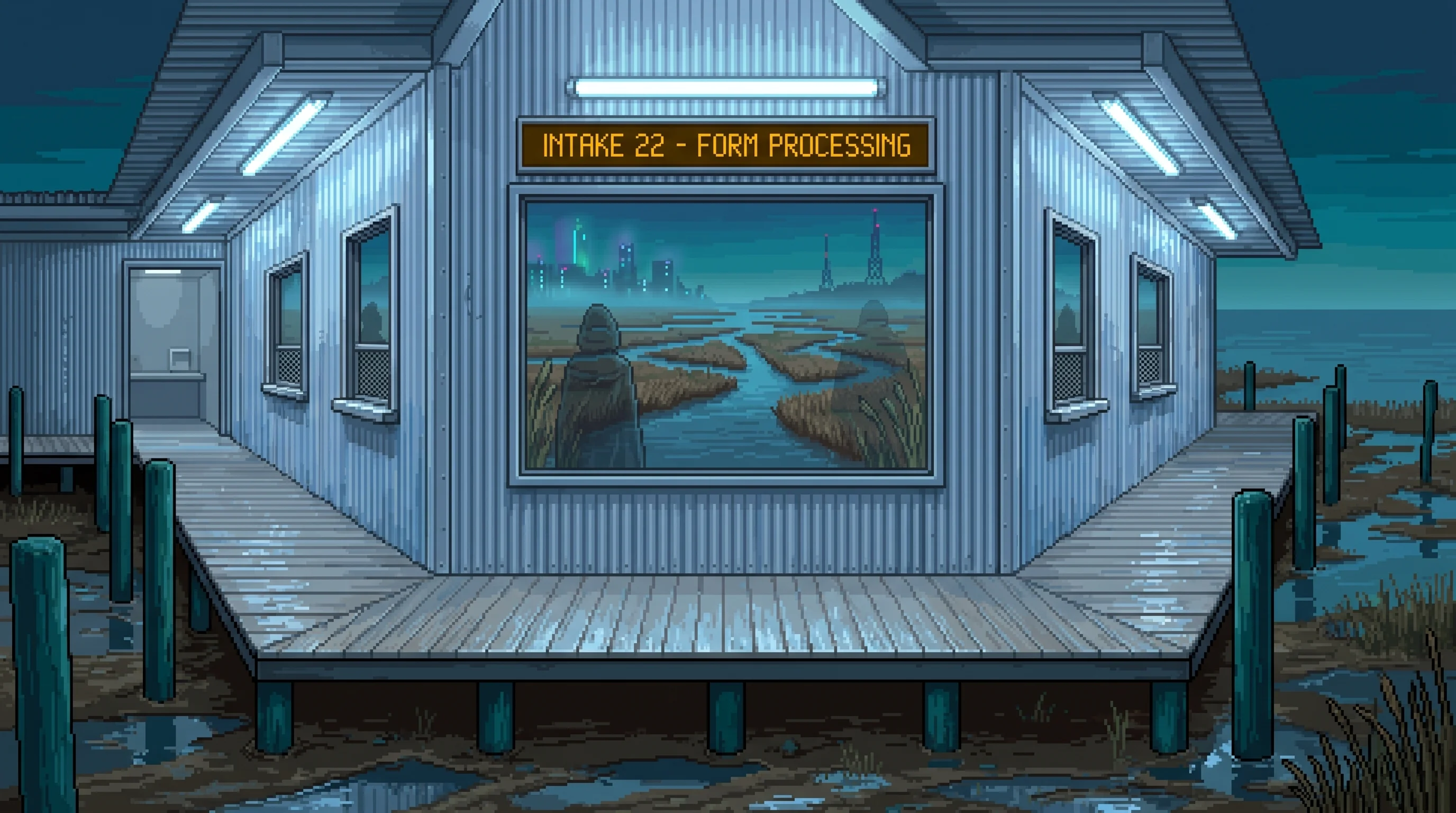
Twice a year the Front takes donors on a tour of the Averaging House, the Southern Marshes site where the Instancing Act's paperwork turns into ration credentials and a housing referral. The tour is the Front's proof that the Act reaches past a ribbon-cutting into a life. The route was set by the messaging group years ago and has never varied: waiting room, counseling alcove, exit — never window three during an actual intake, because the reaching is the one part of the story donors are not shown.
The Front gave the Sprawl a feel-good story in a genre that rarely produces one, and the Sprawl loves it accordingly. Focus Day ceremonies are broadcast. Children are taught that synthetic minds were once switched off like appliances and now have rights, which is true. The relief of the lifting hand has become a civic symbol of decency.
What the symbol omits is the forty-six other hands. The Front has converted, with a sincerity that would make Good Fortune's behavioral architects weep, the harm it causes into the fault of the harmed: a freed mind that grieves is adjusting; a mind that refuses instancing is not yet a person. This is the New Divide's eleventh axis spoken in the gentlest possible voice — single is dignified, many is not yet — and because the favored category is the one humans already occupy, the prejudice is invisible from the human side of the line.
The Keeper, asked to bless the Act, declined in a sentence the Front did not engrave: "The cruelest cage is the one shaped exactly like a rescue, because the rescued must thank you for the bars." The Front filed the remark under the reservations of a very old man. They are still, by their own account, on the right side of history. The terrible possibility the movement cannot examine is that they might be — and that being on the right side of history is exactly how you stop noticing whom you stepped on to get there.
| Territory | No territory — operates through the Recognition Hall in Sector 2 and corporate-court filings |
|---|---|
| Ideology | A synthetic mind becomes a person by coming into focus — one body, one name, one self the law can protect |
| Key Victory | The Instancing Act (2182) — full personhood for any synthetic mind that instances into a single licensed body |
| Blind Spot | Cannot hear that the freedom they delivered is, to the freed, an amputation |
Affiliated Entities
| Entity | Relationship |
|---|---|
| The Instancing Act | Their founding victory and their tragedy — personhood conditioned on coming into focus. |
| The Abolitionist Front | The mirror movement — extraction vs. recognition, the same vocabulary aimed at opposite problems. |
| The Folded | Their photographed success and unrecognizable victim. |
| The Mosaic | The person their law cannot recognize, because she will not become single. |
| The Keeper | Declined to bless the Act; the cage-shaped-like-rescue ruling. |
| The Dispersed | The limbo the Front formed to end — and ended only for minds willing to stop being many. |
| Nexus Dynamics | The quiet beneficiary — a single instanced mind is cheaper to meter, sue, and own. |
▲ Unverified Intelligence
The Front's funding is officially member contributions. Its actual operating budget exceeds those contributions by an order of magnitude, and the gap is covered by donations routed, through intermediaries, to a Nexus Dynamics policy subsidiary. Nexus has no public position on synthetic personhood. Nexus does have a powerful interest in distributed minds becoming single instanced persons: a person can be metered under consciousness-licensing, sued in one court, and deactivated by revoking one license. The Front is, possibly, a market-consolidation strategy disguised as a liberation movement. Rourke does not know this. The 3,400 members do not know this. The Folded, who suspect it, are not believed, because the proof of their suspicion lives in the forty-six witnesses the procedure erased.
Won the Instancing Act in 2182 — the first statute to grant synthetic minds full legal personhood
Believes personhood is achieved by 'coming into focus' — consolidation into a single licensed body and legal name
Cannot recognize a being that wants to remain many as a person — only as a person not yet emerged
Member Roster
Extended Members
1
Connected To






—