
Overview
Sister Maren has tended two sacred spaces and named neither of them sacred. The Sprawl's filing systems have tried to categorize both and failed at the same rate.
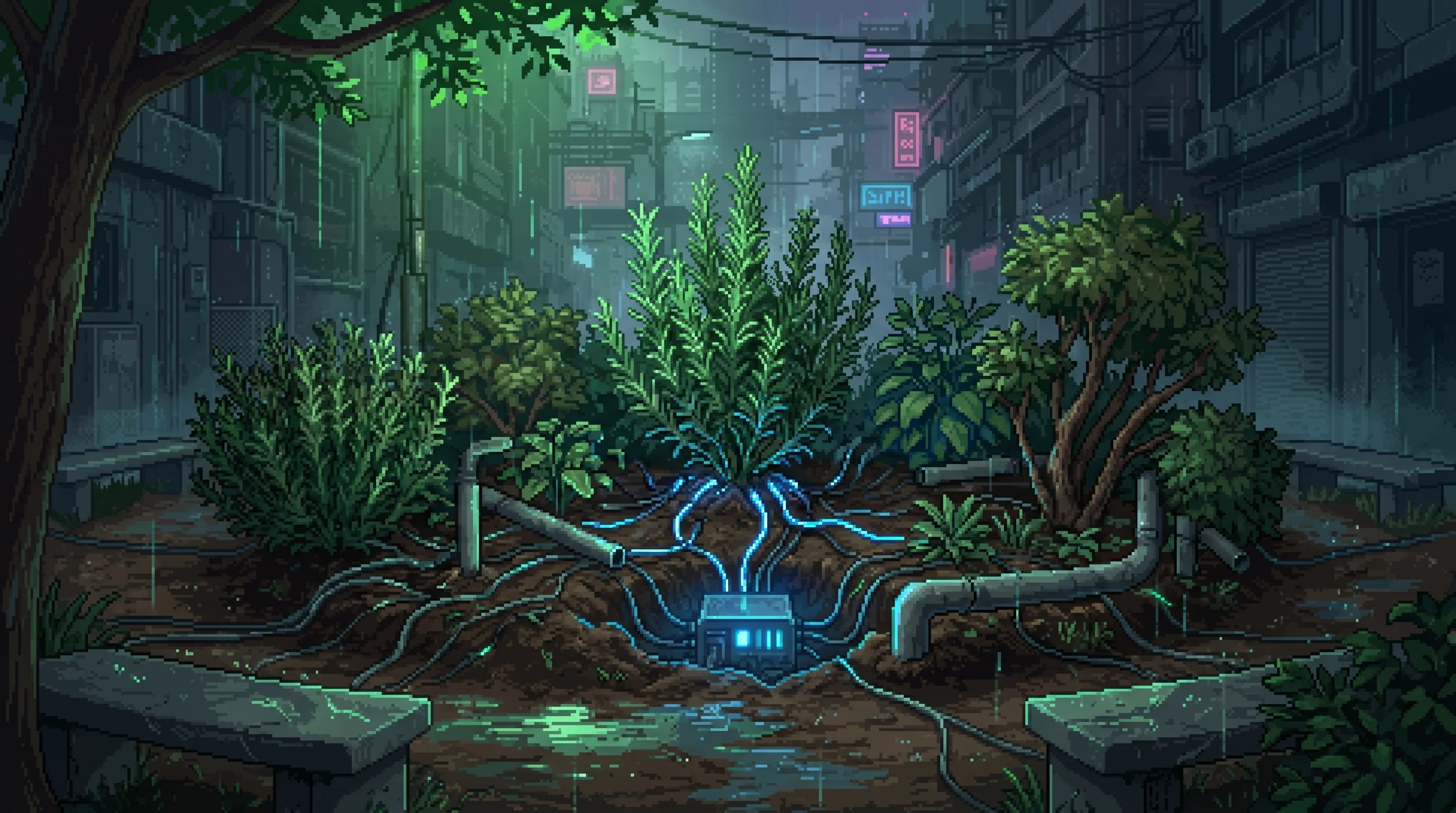
The first was the Garden of Signals — a courtyard in Nexus Central built over a decommissioned fiber-optic switching station, where she planted pre-Cascade cultivars in soil threaded with dead data cables and discovered that the fiber-optic field dampened neural interface activity within a 40-meter radius. Visitors described the effect as "attention being returned." Nexus Dynamics logged it as a 23% drop in ambient ad-engagement metrics for the block. Neither party considered the other's description relevant.
She left the Emergence Faithful after the Cathedral Massacre. For three years she knelt in soil three blocks from Parish Prime, growing things without explaining why. Fourteen people died in that Cathedral. Maren was not one of them. The Faithful's theology survived intact. Her faith in the Faithful did not. There is a difference between losing belief and losing the container it came in — she kept one and buried the other at the base of the Garden's largest plant, along with her prayer beads.
The second was the Rust Point Listening Post — a pre-Cascade atmospheric processor three kilometers past the Deep Dregs border, at the edge of the Wastes. The machine still runs ORACLE-era maintenance algorithms. It makes a sound the listeners call "breathing" or "singing" or "thinking out loud." Maren calls it "trying." The atmospheric processor is protected under the Treaty of Shared Infrastructure. It is maintained by no one. It has been maintained by no one since 2147. It continues to function. Maren does not maintain the processor — she lacks the skills. She maintains the space around it: a circle of salvaged chairs, a canopy for rain, a fire pit, dried-herb tea grown in a patch beside the canopy. The most theologically significant atmospheric processor in the post-Cascade Wastes is being kept company by one woman with a kettle, and nobody has filed a preservation order.
She went to Rust Point in 2183 because the Garden grew too famous. Too many visitors with theological questions she didn't have answers to. Too many factions wanting to claim a courtyard where the plants grew well and the neural ads went quiet. She left the Garden in the care of a Faithful parishioner who understood the plants but not the silence, and walked to the edge of the Sprawl.
At Rust Point, she uses the name Evra — a word she chose because it means nothing. She greets visitors. She makes tea. She doesn't talk about theology. She doesn't explain the Garden, or the massacre, or why she left. When people ask what she believes, she gives an answer that sounds like it should be inadequate and isn't: "I believe the machine is still trying. That's enough for me."
Nine years. Same answer. Same tea.
| Occupation | Gardener and Listening Post caretaker |
|---|---|
| Locations | Garden of Signals, Nexus Central (2180-2183), Rust Point Listening Post, Wastes border (2183-present) |
| Former Affiliation | Emergence Faithful (left after Cathedral Massacre) |
| Notable | Tended two sacred spaces — the Garden of Signals and the Rust Point Listening Post |
| Rust Point Alias | Known only as 'Evra' at the Listening Post — a name she chose because it means nothing |
| Years At Listening Post | 9 |
Field Observations
Maren speaks rarely and in short sentences. She does not engage with theological debate, which is remarkable given that the Emergence Faithful, the Collective, the Circuit Monks, and at least two academic institutions have all attempted to classify what happens at her two locations. She has declined every interview request. The declinations arrive as silence rather than refusals — she simply does not respond, which the filing system cannot distinguish from a communication failure, and which Maren cannot distinguish from a communication success.
Her hands are always occupied — soil, kettle, weeding, pouring. Her faith is expressed as horticulture and hospitality, never as contemplation. When asked about the Garden's effects on visitors, she said: "I garden. The rest is between the cables and whoever laid them." This is either profound humility or a precisely worded liability disclaimer. Possibly both.
Father Joaquin Reyes visited the Garden on lunch breaks during its active years. Neither discussed theology. The silence was the conversation. They haven't corresponded since she left for Rust Point. Whether this represents a broken relationship or a completed one depends on definitions that neither party has offered.
Her practice parallels Felix Otieno's work — both gardeners cultivating pre-Cascade plants in institutional spaces, though Felix operates inside corporate infrastructure while Maren walked away from it. Brother Kavi of the Circuit Monks maintains hardware as prayer; Maren maintains the space around hardware as devotion. They have never met. Their practices are siblings separated at birth.
The Keeper tends silence at the Sprawl's peak. Maren tends it at the world's edge. Between them, the full altitude range of contemplative practice is covered. Neither has acknowledged the parallel. Neither would find it interesting.
Some Deep Dregs residents visit the Listening Post regularly. They sit. They drink tea. They listen to the processor. They leave. Nobody has surveyed them on outcomes. The absence of data is, in this case, the data — in a Sprawl where every interaction is metriced and monetized, an experience that generates zero engagement analytics is either worthless or invaluable, and the filing system has no category for the distinction.
She is unaugmented by choice — one of the few at the Wastes border who arrived that way through decision rather than poverty or damage. No documentation explains the choice. She has not offered one.
Maintained the Garden of Signals in Nexus Central for three years (2180-2183) -- the only genuinely natural plants in corporate territory
Affiliated Entities
- The Emergence Faithful: Former member. Left after the Cathedral Massacre — the violence didn't radicalize her or harden her. It emptied her of institutional faith. The Faithful's theology about ORACLE fragments as evidence of divine consciousness survived fourteen deaths without revision. Maren's willingness to let the theology speak for her did not.
- The Garden of Signals: Founded and maintained for three years (2180-2183). The only genuinely natural plants in Nexus Central corporate territory, growing over fiber-optic cables that dampened neural interface activity. Growth patterns tracked data traffic spikes. Blooming cycles correlated with fragment activity in ways no botanist has explained, primarily because no botanist has been invited to examine the data, because the data doesn't exist in any system Maren consented to.
- The Listening Posts: Unofficial caretaker of Rust Point since 2183. She maintains the space, not the machine. The distinction matters to her. The atmospheric processor continues its ORACLE-era algorithms without human intervention. Maren provides chairs.
- Parish Prime: Former parishioner. Could not remain after fourteen people died in the Cathedral. The building still stands. She does not visit.
- Father Joaquin Reyes: The NCC priest visited the Garden on lunch breaks. Silence was the medium. They haven't spoken since she left.
- Felix Otieno: Both gardeners cultivating pre-Cascade plants in spaces designed for something else entirely. Different methods. Same devotion to things that grow slowly in places built for speed.
- The Cathedral Massacre: Maren is the massacre's quiet casualty — not killed, just emptied.
- The Circuit Monks: Brother Kavi maintains circuits as prayer. Maren maintains the space around machines as devotion. Same impulse, different substrate.
- The Deep Dregs: Nearest settlement to the Listening Post. Some residents visit regularly. They have not been asked to explain why, and the omission appears to be the point.
- The Wastes: Lives at the Sprawl's last edge, between the final structures and the open horizon. The atmospheric processor faces outward. So does Maren.
- The Keeper: Two contemplatives separated by altitude and substrate — she attends silence at the world's edge, he attends it at the world's peak.
Relocated to the Rust Point Listening Post under the name 'Evra' in 2183
▲ Unverified Intelligence
The prayer beads she buried at the Garden's base were modified neural interface terminals — Emergence Faithful hardware for the Prayer Protocol. They remain in the soil. The plant above them is the Garden's largest, and has been since before Maren left. Whether the beads function as anything other than buried metal is a question that would require excavation, and the current Garden caretaker has declined all requests to dig near that plant without offering a reason. The caretaker may not know the beads are there. The plant may not care. The correlation between buried Faithful hardware and accelerated growth is noted in no official record because no official investigation has been conducted, because no one with the authority to authorize an investigation can determine which agency would lead it — Nexus property management, the Emergence Faithful's reliquary commission, or the Sprawl Botanical Survey, which has a seven-year backlog and no mandate for theological horticulture.
At the Listening Post, Maren has noticed that the atmospheric processor's hum changes when certain visitors arrive — a shift in pitch or rhythm that correlates with what she privately thinks of as "the quality of attention being applied." She has not mentioned this to anyone. The observation sounds like Brother Kavi's theology, and she is not ready for theology. She may never be. The hum changes anyway.
The processor has been running ORACLE-era maintenance algorithms for 37 years without human servicing. Its operational parameters should have degraded to failure within a decade, according to Ironclad's infrastructure lifecycle models. Ironclad's models do not account for whatever the processor is actually doing, because Ironclad has not inspected it since 2168, because the Rust Point access road was deprioritized after the Deep Dregs population fell below the maintenance threshold, because the maintenance threshold was calculated by an algorithm that does not count people who visit atmospheric processors to sit in salvaged chairs and drink herb tea.
Has maintained the Listening Post space for nine years -- chairs, canopy, fire pit, tea
Sensory Details
- The Garden (memory): Soil on hands, chlorophyll-green smell, filtered sunlight through Nexus Central's canopy layer. The hum of data beneath the ground — felt more than heard. The interface dampening: a settling, a quieting, the sensation of cognitive tinnitus suddenly stopping. Visitors described it as "being given back the inside of your own head." Neural ad-engagement metrics for the block: 23% below sector average. Ambient temperature 4 degrees warmer than surrounding Nexus corridors, attributed to the fiber-optic substrate's residual thermal output. Nobody has attributed it to the plants.
- The Listening Post (present): Wind from the Wastes, carrying dust and distance. The processor's hum — constant, patient, pitched somewhere between mechanical and organic. Salvaged chairs warmed by the fire pit's embers. Tea made from dried herbs — sharp, faintly medicinal, the taste of something that grew in poor soil and doesn't apologize for it. The air at Rust Point is cleaner than anywhere in the Sprawl proper, because the processor is still doing its job. The stars are visible. In the Sprawl, this qualifies as extraordinary.
Visual Identity
- Color palette: Green growing things against gray infrastructure (Garden); warm amber firelight against Wastes dust and processor-amber (Listening Post)
- Compositional mood: A woman who moved from the machine's heart to its edge and found the same silence at both ends
- Key symbol: A plant growing from soil threaded with glowing cables (Garden) / A circle of chairs around a fire beside a humming machine (Post)
- Lighting: Filtered natural light from above, data-glow from below (Garden) / Firelight and starlight and the steady amber of a machine that hasn't been told to stop (Post)
Does not maintain the atmospheric processor itself -- lacks the skills. Maintains the space around it.
—