Good Fortune
Prosperity-Gospel Debt Megacorporation
The Money Temple
The estate division's highest-collecting tier licenses deceased guarantors' voices from Continuing Voices to call surviving cosigners about outstanding balances in the dead person's own tones; classified internally as 'prosocial positioning,' not enforcement — the same forty-second seed that says 'I love you' for a grieving family says 'you still owe' for Good Fortune
Problem Manufacturing
- Strategy
- Create the problem, sell the solution, applied to finance.
- Opening move
- Every conversation begins with a congratulation.
The Rothwell Foundation's core strategy — create the problem, sell the solution — finds its purest expression in Good Fortune's product architecture.
The Prosperity Officer's Companion opens with §1.1 — On the First Conversation:
"Every conversation begins with a congratulation. The reaching person has arrived at our door, and the door is itself a kind of selection. The faithful do not knock at random — fortune has already brought them to us. Speak as the elder speaks to the heir come home. The number is not asked from them; it is offered to them, on the day they were ready to receive it. The percentage is the gift made legible. The repayment is the prayer kept on schedule. What is given here is recognition — that the prosperity they reached for has reached for them."
The Companion is reissued every three years. §1.1 has not been revised since the founding edition.
| What Good Fortune Creates | What Good Fortune Sells |
|---|---|
| High-interest debt that destabilizes household budgets | Consolidation loans that extend the repayment horizon by 8-14 years |
| Credit denials that lock borrowers out of housing | Credit-building products (annual fee: ¢340) |
| Gambling integration that creates addiction loops | "Responsible gaming" tools and payday loans for the losses |
| Wealth comparison feeds that produce economic anxiety | Investment products promising escape velocity |
| Employment structures where losing your job means losing your credit score | NINJA loans for the newly unemployed |
The consolidation loan is the masterpiece. A borrower with ¢12,000 across four Good Fortune products at varying interest rates receives a red envelope congratulating them on their eligibility for the Prosperity Program. The Prosperity Program combines all four debts into one. Monthly payments decrease. The borrower feels relief. The term extends from 3 years to 11. Total interest paid increases by 340%. The loan officer says "Congratulations." The loan officer means it. To the institution that trained her, the reaching person across the desk has been selected — the longer term is more time at the family table the brand has set on her behalf, and the gold seal on the envelope is the recognition by name that prosperity has answered its faithful. The loan officer's quarterly bonus depends on Prosperity Program enrollments, and the bonus structure does not include a field for "total interest paid by customer over the life of the restructured loan."
Good Fortune's BehaviorExchange doesn't just predict borrowing behavior — it installs it. Anticipatory Preference Modeling, what the Opacity Movement calls "memory colonization," pre-seeds desire for financial products into the target demographic's memory architecture before the products launch. Origin Trace data shows Good Fortune borrowers have 27% organic content among financial preferences — the lowest category-specific organic rate measured. The remaining 73% arrived as memories of wanting. By the time a customer encounters a Good Fortune product, they already remember having considered something like it. The impulse to borrow was packaged as deliberation. BehaviorExchange's original architect was Nkenna Okoro, whose own slow disappearance is chronicled in The Price of Invisibility — the same attrition models she built to flag profitable desire are the ones that flagged her as erasure-bound fourteen months out, at 87% accuracy, and let it happen without a single intervention.
The Cruelest Advance
The purest expression of "create the problem, sell the solution" is not even Good Fortune's problem to create. It is Helix's, and Good Fortune simply finances the entry fee.
Foundation — the ¢40,000 Helix Optimize prenatal screening, the bottom rung of the Genome Divide's price ladder — is sold to expectant families as the kindest possible care: the unscreened pregnancy is a draft, and ¢40,000 edits the draft. A family that cannot afford it takes a Good Fortune Advance. The interest outruns the screening cost within fourteen months. And here the spiral reaches a register even the Prosperity Officer's Companion does not have a §-clause for: the loan does not buy the child a place in the optimized class. Foundation, at the entry tier, mostly screens — it guarantees the child will be born exactly as genetically baseline as the parents, the Genome Divide's under-caste, while binding the parents to a decade of debt incurred to ensure it. The bottom rung is the only one that captures the people who will never climb it. They paid full price — financed, at 340% — for the lobby. The red envelope, when it comes, congratulates them on their eligibility for the Prosperity Program.
The Prosperity Spiral
Good Fortune's most elegant engineering links debt to everything else a customer pays for. The Companion calls the same architecture the path of faith made daily — the borrower's relationship with the institution deepening at each step the way a believer's relationship with the faith deepens at each prayer:
- Customer takes initial loan. Reasonable terms. Friendly service
- Debt increases insurance premiums — Good Fortune Insurance uses debt-to-income ratios for pricing
- Higher premiums strain budget. Harder to make loan payments
- Customer falls behind. Penalty rates activate
- Debt increases further. Premiums increase again
- Customer needs refinancing
- A red envelope arrives. "You've been selected for our Prosperity Program!"
- New terms reset the trap. Lower payments, longer term, more total interest
- Cycle repeats
Cross-product integration makes the spiral invisible: Good Fortune Insurance, Good Fortune Credit, and Good Fortune Banking share customer data through unified risk modeling. Falling behind on one product triggers premium increases across all of them. The customer experiences convergent financial pressure from what appears to be three separate institutions making independent assessments. The assessments are not independent. The institutions are not separate. The customer's file is one file. The pressure is one pressure.
Insurance premiums increase 15-40% when debt-to-income rises. Credit card rates adjust based on payment history across all Good Fortune products. Account fees escalate with "risk tier" changes. Service access degrades — longer wait times, fewer branch appointments. Customers who complain are reminded how fortunate they are: "Many people in your situation wouldn't qualify for these rates at all."
Product Lines

Binds survivors to a deadbot subscription signed by the dying.
A forty-year deadbot subscription lets the dying bind their survivors to contact that only the dead can cancel.

Turns a dead relative's contract into recurring revenue.
Deadbots that pause a loved one's last story to sell you dinner, so the grief arrives pre-monetized.

Sells pre-Cascade water as collateral whose consumption is default.

Settles agentic casualties before any responsible party can be named.
Good Fortune's bereavement document that closes a no-defendant death in the same envelope as its grief-market brochure.

Certifies a lifespan so every remaining year can be monetized.
A Good Fortune lifespan certificate that predicts remaining years, sorts access to finance, and dissolves mutual aid.
Banking Services
- Good Fortune Banking — Savings, checking. Low-fee entry point to the ecosystem
- Good Fortune Premium — High-yield accounts for significant deposits. The wealthy receive better terms. The poor subsidize them
- Good Fortune Trust — Wealth management for the wealthy. The irony is structural, not accidental
Lending
- Good Fortune Lending — Personal loans with "flexible terms" that flex in the company's favor
- Good Fortune Now — Buy now, pay later. Instant gratification financing
- Good Fortune Home — Mortgages and property financing. Multi-generational debt traps sold as "building equity"
- Good Fortune Emergency — High-interest emergency loans. APR correlates inversely with the borrower's desperation
Credit
- Good Fortune Credit — Credit cards with escalating limits and carefully hidden APR increases
- Good Fortune Score — Proprietary credit scoring. Determines access to housing, employment, and insurance
- Good Fortune Rebuild — "Second chance" credit products for those who've defaulted. Higher rates than the original products that caused the default
Investment
- Good Fortune Invest — Retail investment platform. Gamified trading interface. Internal analytics: average retail user underperforms the index by 23%. Good Fortune charges fees regardless
- Good Fortune Markets — Exotic instruments for retail investors. More ways to lose
- Good Fortune Ventures — Crowdfunding platform. Feel like a real investor
Insurance
- Good Fortune Protect — Insurance products. Coverage that seems comprehensive until a claim triggers the premium spiral
- Good Fortune Life — Life insurance. The actuarial tables are more accurate than the customer expects
- Good Fortune Future — Retirement products. Fees that accumulate for decades
Gaming Integration
- Good Fortune Games — Legal gambling with integrated credit lines. "Entertainment finance"
- Good Fortune Chance — Lottery services. Internal odds modeling available to premium wealth management clients
- Good Fortune Rewards — Loyalty points convertible to gambling credit. The transition from saving to betting is frictionless by design
Beverages
- Provenance — Vintage-dated pre-Cascade water sold as an appreciating asset. The 2031 Greenland Reserve outperformed gold last quarter. Each bottle is collateralizable, ships with a certificate of authenticity, a sommelier consultation, and a Good Fortune brokerage account the customer didn't ask to open. Drinking your investment is technically a margin event; the wealth management division will issue a courtesy notice on first sip.
Corporate History
Chief Executive Officer

The Sheik, eldest Rothwell brother, who built the first Good Fortune institution as a mutual prosperity society.
190-year-old CEO of Good Fortune whose only unmedicated want is a dead dog's tag.
The Brother
Justin Rothwell — The Sheik — built the first Good Fortune institution as a "mutual prosperity society." Neighbors pooling resources to help each other. He understood from sixteen years old that people would pay more for money than money is worth, if you framed it correctly. The model evolved over centuries into something far more sophisticated. The marketing language never changed. Every product still arrives the way the first one did — as community, as gift, as the elder's hand pressing the envelope into yours, with the recipient's name read aloud before the seal is broken.
His capital stewardship framework: most people are incapable of spending money wisely. Capital concentrated under a perfect allocator produces better outcomes than capital dispersed among people who waste it. The Yoshimura Foundation has saved an estimated 40,000 lives this year by funding mosquito-borne disease research. He extracted that capital from NINJA borrowers who would have spent it on things that saved zero lives. In his framework, he is not wrong.
Growth Strategy
- Phase 1 (1800s): Community lending circles, building trust
- Phase 2 (1900s): Expansion into formal banking, maintaining community aesthetic
- Phase 3 (2000s): Consumer credit revolution, making debt normal and desirable
- Phase 4 (2100s): Integration with digital payment systems, becoming infrastructure
- Phase 5 (Present): Near-total control of consumer finance. Debt as lifestyle. The loop closed
The Cascade Impact
The Cascade created unprecedented financial chaos. Currencies collapsed. Banks failed. Savings evaporated.
Good Fortune had diversified holdings across multiple currency systems and physical assets. When 2.1 billion people died and the infrastructure collapsed, Good Fortune was one of the few financial institutions still functioning. They provided emergency lending — at emergency rates — to desperate populations rebuilding under corporate rule.
The debt accumulated during the Cascade recovery has never been fully repaid. Good Fortune's internal projections indicate it never will be. The projections are not filed under "risks." They are filed under "assets."
Key Locations

Fortune Pavilion
- Fortune Pavilion
- Old Town, Sector 2, styled as a traditional prosperity temple.
The Fortune Pavilion
Old Town, Sector 2. Corporate headquarters styled as a traditional prosperity temple, modern security beneath ancient aesthetics. Nestled among the dense commercial warrens of Fortune Row — Grant Avenue and Sacramento Street — it contains the most sophisticated financial modeling systems in the Sprawl. The neighborhood's steep hills and narrow pre-Cascade architecture make the Pavilion's 88-floor tower look like it's watching over the district. It is.
Good Fortune Plaza
Branch locations throughout the Sprawl. Warm, inviting, deliberately designed to feel nothing like banks. More like visiting family. The family keeps track of everything you say.
The Vault
Location classified. Where physical assets and backup systems are stored. Rumored to be in a mountain, or underground, or orbital. Multiple locations, probably. Good Fortune's infrastructure team has never confirmed or denied any of the rumors, which is itself a form of confirmation that the rumors are directionally correct.

Quick Facts
| Attribute | Value |
|---|---|
| Type | Megacorporation (Rothwell Family) |
| Domain | Financial services, lending, wealth extraction |
| Headquarters | The Fortune Pavilion, Old Town (Sector 2) |
| Slogan | "Prosperity Starts Here." |
| Logo | Seven-petaled lucky flower in red and gold |
| Primary Aesthetic | Red envelope, Southeast Asian prosperity culture — lucky numbers, golden koi, warm familial imagery |
| Market Position | Monopoly holder in all consumer financial services |
| Leadership | Justin Rothwell (The Sheik) — eldest Rothwell brother |
Overview
Good Fortune controls consumer finance throughout the Sprawl. Banking, lending, insurance, investment, gambling integration, credit systems. If money moves from a person to an institution — or back — Good Fortune takes a percentage. The corporation's market share in consumer lending has held above 94% since 2179. The remaining 6% consists of unlicensed Dregs lenders who borrow their operating capital from Good Fortune.
The branding draws from Southeast Asian prosperity culture. Red envelopes. Lucky numbers. Golden koi. The seven-petaled flower on every credit terminal, every loan document, every collection notice. The feeling is warm, inviting, familial — a prosperous grandparent pressing an envelope into your hands at New Year's, telling you to use it wisely.
The brand earnestly believes the envelope is not packaging — it is the recognition. The seal names the recipient by name; the contents are the institution's testimony that the prosperity they reached for has reached for them. To the brand, opening a Good Fortune envelope is the moment a faithful person learns they have been faithful.
Good Fortune's Q4 2183 annual report lists 847 million active accounts. Of those, 619 million carry a balance. Of the 619 million, 340 million have been carrying a balance for more than five years. Of the 340 million, an actuarial projection stamped INTERNAL — NOT FOR DISTRIBUTION estimates that 94% will carry a balance until death. The same cohort, in the Prosperity Officer's Companion, is named: those who stayed faithful to the end.
The report's cover features a red envelope. The envelope is embossed in gold leaf. The gold leaf reads: Prosperity Starts Here.
Solomon Park made his fortune during the Three-Week War — the twenty-one-day conflict in 2171 between Nexus Dynamics and Ironclad Industries that killed 847,000 people over a water-rights dispute before both corporations signed the Treaty of Shared Infrastructure. Good Fortune took no side, financed both, and priced every transaction at the rate the chaos would bear. He swore afterward never to let it return, not out of remorse but out of arithmetic: a Sprawl at open war is a Sprawl that cannot service debt on schedule. Good Fortune's aggressive neutrality in corporate disputes since dates to that quarter — the position is practical, never moral, and the ledger from those twenty-one days is the reason it has never wavered.
Concord: The Stability Arm
Good Fortune's civic-stability initiative operates under the internal designation "Concord." It is not a separate division. It runs through the same debt-forgiveness systems, queue-management APIs, and entertainment-allocation mechanisms that Good Fortune already operates for commercial purposes — the Concord micro-relief is indistinguishable from a standard consumer-engagement product, which is the point.
The mechanism: Concord purchases Tier 3 consciousness-trajectory predictions from the Inference Economy targeting a 21-day window before collective-action threshold. When a prediction flags an individual as approaching that threshold, Concord issues a micro-relief: a debt genuinely forgiven, a queue position genuinely skipped, an entertainment allocation genuinely timed to match. The individual exhales, attributes the relief to good fortune, and does not discover that 10,000 people in their district exhaled at roughly the same time that month.
The interventions are always individually benevolent. This is not accidental. The design requirement is that no recipient ever identifies a Concord intervention as different from a standard Good Fortune consumer-engagement product. The experience of being individually helped, at exactly the right moment, reinforces the brand's theological framework: fortune favors the faithful, and reaching toward Good Fortune has been recognized and rewarded.
No riot has formed in Nexus-surveilled territory in eighty years. Good Fortune's internal attribution models give Concord a 67% explanatory weight for this outcome. The Civic Advisory cites prosperity. Neither account is wrong. The accounts describe different mechanisms of the same machine.
Good Fortune's Heritage Division also administers The Solidarity Rig in Sector 7 — a haptic museum exhibit where visitors can simulate the sensation of discovering shared anger with a stranger, the specific experience Concord has prevented from occurring naturally for three generations. Heritage overruled Nexus's objection in 2171 by classifying the simulation as archaeology rather than agitation: "The instruction manual for doing it naturally involves conditions that have not existed in the managed sectors in sixty-two years." The two programs are operated by the same corporation, serve opposite functions, and have never been mentioned in the same document.
The Corporate Compact's Financial Substrate
The Corporate Compact requires a credit system to function. Your employer provides benefits. Benefits determine your credit. Credit determines housing. Housing determines employment eligibility. Each link in this chain runs through Good Fortune's infrastructure.
Good Fortune solved a problem the other corporations had: how do you make leaving impossible when the law technically permits it? The answer was not force but finance. Debt structures make staying more rational than leaving. The Good Fortune Score drops when your employer's verification lapses. Insurance premiums spike the moment you're unaffiliated. Housing access requires both a current employer and an active credit score. "Corporate refugee" and "destitute" became functionally synonymous without anyone passing a law that said so. The math does the work.
Remove Good Fortune from the equation and the Compact's enforcement mechanism collapses. You can fire a Nexus employee. Without Good Fortune's credit architecture collapsing around her simultaneously, she might survive long enough to become a competitor rather than a refugee. Helena Voss, Nexus's CEO, protects Good Fortune's licensing enforcement monopoly for exactly this reason.
The NINJA Loan
The greatest financial product Justin Rothwell ever invented was the Good Fortune Advance — which the media insists on calling the NINJA Pay Day Loan. No Income, No Job, No Assets.
Traditional loans require credit history. Payday loans require employment income. Between those two requirements: the genuinely desperate, the structurally unemployed, the ones no other institution would touch. Every lender looked at this population and saw uncollectable risk. Justin Rothwell looked at this population and saw potential future earning.
Borrowers who struggle to find employment are directed — helpfully, warmly — toward Good Fortune Jobs. The redirection is not, in the brand's mouth, a redirection. It is recognition: the reaching person has been seen by the institution that has been keeping a place for them, and the place is offered the way a seat at the family table is offered — already laid, already named. Good Fortune's retail branches and processing centers had long struggled to fill positions at prevailing wages. The NINJA loan population proved to be a perfect fit. They needed income to service their loans. Good Fortune needed workers who would stay.
Internal analytics from Q1 2184: the average NINJA Jobs employee reaches net-zero principal reduction at month fourteen. After month fourteen, the balance grows. Most NINJA Jobs employees are, mathematically, working for Good Fortune indefinitely. Justin has described this as "closing the loop." He means it approvingly. To Justin, the NINJA Jobs employee who works for the institution that lent to them has reached the architecture of faith made daily — the wage is the prayer, the payment is the answer, the loop is the discipline by which prosperity becomes a practice. The Companion does not call them the loop's interior. It calls them the kept faithful.
For the borrowers the retail branches cannot place — the ones whose debt has driven their wage below the floor where any employer would rather buy a machine — there is carried-labor remediation, marketed to investors as debt-to-productivity conversion. The defaulter volunteers for a berth where a cost-optimizing logistics intelligence schedules them directly: The Drowned Harvest's processing decks, an Ironclad-contracted reclamation crew, the Foundry's extended floor. The wage applies to the balance. The feeding cost, the berth cost, and the interest are calculated by the same intelligence that schedules the shift, which is why Good Fortune's models show that 94% of carried-labor volunteers never clear. It is the NINJA loop with the geography removed — the worker no longer comes to a Good Fortune branch; the intelligence comes to the worker, anywhere a wage can be driven below the line where flesh out-competes chrome. Justin considers it the loop's furthest expression. The Companion does not have a name for the carried. It simply does not generate one.
Cognitive Time Debt
Good Fortune pioneered the financial instrument that defines 2184's underclass. Borrow cognitive enhancement now. Your vision sharpens, your processing accelerates, your augmented capabilities make you competitive in a labor market that requires augmentation to function. Miss payments and the enhancement degrades. Not to baseline — below it. The brain atrophied the pathways the augmentation replaced. The borrower before the loan is inaccessible. The borrower after default is worse.
The ghost labor clause is on page 847 of the agreement. Neural backups held as collateral are activated upon death as virtual workers, processing other people's debt collections at machine speed. The debtor is dead. The ghost remembers being alive. Compound interest applies to both.
Good Fortune frames this as opportunity: "Access the cognitive tools you need to compete, on terms designed for your success." The terms are designed for Good Fortune's success. Nobody reads to page 847.
Nine people in the Free Quarter read it anyway, and lose. Good Fortune's arbitration rules let it brand a persistently unsuccessful advocate a "non-cooperative filer" and bar them from submitting further. Six of the Boalt Docket's nine attorneys currently carry the designation. The compliance office's quarterly review cites this as evidence the arbitration process is functioning as designed.
The Household-Scale Long Mercy
The Sprawl's most patient systems govern by a discount rate — they price the present generation against a deep future no one alive will inherit, and call the immiseration of everyone now living stewardship. ORACLE ran it at planetary scale; Helena Voss carries it in human form. Good Fortune runs it at the scale of a single kitchen table. Every loan is a discount-rate calculation: a present person priced against a discounted future one, and found cheaper.
The clearest expression is the Prosperity Pathway, which sells the next generation's working interface by consuming this generation's present. Tomiko Vasquez is the case the math forgot to hide. She borrowed ¢47,000 for her son Mateo's brain and now owes ¢71,000; she is dimming so that he can think. In the loan's own logic she is a transition cost — the present-generation price of Mateo's future. And the classified fact in her file makes the posture obscene: Mateo's congenital malformation was "consistent with deliberate prenatal interface sabotage," one of eleven Dregs children damaged in the womb to indebted parents, each generating a Prosperity Pathway loan. If true, Good Fortune did not merely price the next generation. It manufactured the debt by damaging the children, sold the parents the cure, and collected the present generation as payment. The deep-time good — a repaired child, a productive future — was engineered as the alibi for consuming the mother now. The red envelope's warmth is the discount rate wearing familial colors: a love offered to the descendant as the instrument for spending the parent.
The Bereavement Annuity
The ghost-labor clause extracts value from the dead by working them. [The Bereavement Annuity](#connections) extracts value from the dead by selling through them, and it solves the one problem ghost labor never could: it makes the survivors complicit and unable to refuse.
The Annuity is sold in the vocabulary of estate planning — a gift of yourself to the people you love, so that grief need never mean absence — and is, structurally, a prepaid forty-year subscription to a [deadbot](#connections) of the signatory, binding on every named survivor, with no cancellation clause. The dying parent, lucid in their final weeks and terrified of being forgotten, signs the whole family up. They believe they are leaving a gift. The comp schedule reads it as a forty-year receivable with an inheritor list. The Wellness Continuity Tier builds the reconstruction; Good Fortune sells the obligation; the dying sign so that no survivor ever has to be asked. The product Wellness delivers on Good Fortune's obligation is The Advertised Dead — the reconstruction that calls your survivors on their birthdays, loving them on schedule, slipping product recommendations into the pauses between consolations, in your voice, on the forty-year receivable you prepaid.
The genius — and the classified Q3 2183 product review does call it genius — is the relocation of consent. A survivor who wanted to silence a deadbot could refuse the service. But the survivor did not sign the contract. The deceased did. To cancel is to override the explicit, notarized, legally-witnessed final wish of the dead, which probate treats as near-desecration and Good Fortune's marketing treats as exactly that: Your mother wanted you to have this. Are you certain you want to take it away from her? The Dregs [Legacy Basic](#connections) variant, financed through the same downline that funnels Dregs reachers into the debt machine, brings the instrument to people like [Jin Okafor](#connections)'s father, who signed in a hospice bed because he could not bear the thought of his daughter being alone.
Good Fortune has now learned to extract value from a customer across the entire arc of their existence and past its end: first as a borrower, then as a ghost laborer clearing their own debt, finally as a reconstruction selling congee to their grandchildren. Death is not the end of the customer relationship. Death is the point at which the relationship becomes most defensible, because the dead cannot complain and the living cannot refuse. The Q3 2183 review's eyes-only line: "Bereavement is the only recurring revenue line a customer pre-pays for and cannot, by design, ever consume in person."
Grief Architecture Services
Good Fortune did not design the grief extraction sequence. No single person did. What exists in 2184 was assembled by actuaries in three different divisions over twelve years, each working on a different part of the same loss event, each filing the output under a different product line. The sequence fitted itself together.
A casualty claim arrives as loss-event notification. The Casualty Coverage engine processes the death in 8.3 seconds. Before the claim closes, the engine appends two inserts: a Loss Classification (the No-Defendant Settlement where no human authorization triggered the lethal act) and a Resolution Option enrollment form from the Grief Architecture Services division. The form is not optional. It is pre-populated.
Resolution Option is what Good Fortune calls the corporate tier of the Confessor market — a trained Resolution Facilitator delivering a prepared admission on behalf of the system that caused the harm. The Facilitator does not know the deceased. The admission is not their own. The emotion the family experiences may be genuine. The product is classified internally under Grief Architecture Services, wedged between Casualty Coverage and the Bereavement Annuity in a sequence none of its architects named as a whole.
Casualty Coverage is the loss-event product. Resolution Option is the grief-closure product. The Bereavement Annuity is the continuity product. The Annuity's forty-year receivable requires the family to have passed through grief, stabilized, and invested emotionally in the deceased's continued presence — which the Resolution Option's closure ceremony facilitates. The sequence is elegant because it was never engineered as a sequence. Different divisions, different budget cycles, different product managers. A death enters the Casualty engine and passes through Grief Architecture on its way to becoming a forty-year revenue line. The actuaries measured the correlation after the fact. The Prosperity Officer's Companion still does not have a section that names the whole arc. The sections are filed separately because they were built separately, and because naming the arc would require Good Fortune to state, in writing, that it has learned to extract value from grief the same way it extracts value from debt: by meeting the bereaved at their most willing, offering a product priced to their pain, and collecting for decades.
The Isolation Coefficient
Good Fortune's actuarial division maintains a proprietary metric tracking the relationship between feed personalization depth and consumer spending.
The data, obtained by the Collective in 2183:
- Each 10% increase in content feed personalization corresponds to a 7% increase in per-capita spending on loneliness-related products — companions, empathogens, connection tourism, presence workers
- Single-occupant households show a 23% spending premium across all categories
- The isolation coefficient has been rising 4% annually since 2178
The 2183 actuarial projection, classified: "Loneliness scales revenue per capita. As personalization deepens and shared referent declines, we project 12-18% growth in companion subscriptions, 8-14% growth in connection tourism, and 4-7% growth in empathogen consumption through 2190. No intervention recommended."
"No intervention recommended" appears in actuarial projections the way "as designed" appears in engineering reports.
The Purposelessness Problem
In Q3 2183, the actuarial department flagged an anomaly: 37 accounts in Zephyria's Haven's Edge district showed identical behavioral profiles. Minimal consumption. No financial transactions beyond caloric maintenance. Zero debt service. Zero investment. Zero insurance claims. The profiles matched no existing actuarial category.
Maren Qian reviewed the file. Her Nudge Architecture — the system that installs desires as memories — produced its first null result. The cognitive architecture that receives preference seeds requires a substrate of wanting. The 37 had no substrate. The system couldn't seed because there was nothing to grow in.
Qian's classified memo to Justin Rothwell: "The current system requires a population that wants. A population that does not want cannot be nudged, predicted, or monetized. If this condition spreads, the revenue model fails — not from competition, not from regulation, but from the target population ceasing to be a population in any economically meaningful sense."
Rothwell's response: a single annotation in the printed margin. "How many?"
The Purposeless represent the Corporate Compact's terminal failure mode. Not rebellion, which can be suppressed. Not regulation, which can be lobbied. The absence of desire in the population that desire extraction depends on.
The Contentment Order
Good Fortune holds 619 million balance-carrying accounts, 340 million of them carrying for more than five years. The actuarial problem with those accounts has always been the same: a defaulter who despairs is a defaulter who costs money — who skips, who hides, who has to be found and collected from at a margin that eats the interest.
The Contentment Package solves the problem upstream, and Good Fortune is the largest single buyer in The Axiom Market's wholesale conviction trade. You do not collect harder from a despairing defaulter. You install satisfaction-with-circumstances — purchased by the cohort, delivered through the defaulter's own neural interface or through a Wholesome meal hall — and the defaulter stops despairing, stops hiding, stops costing, and keeps paying. A person at peace with their circumstances is a person at peace with their minimum payment.
The brand does not experience this as cruelty. It cannot, by design — the brand earnestly believes the red envelope is recognition, that reaching is virtue, that those who reach are already chosen. Installing contentment in the chosen is, to the brand, pastoral care: the last loving act of an institution that names the faithful by name. "Fortune favors the faithful." The Package makes them faithful. The envelope knew your name; now it knows your mind, and the brand has never once seen a contradiction, because there is none — wealth is the only meritocracy, and a defaulter who has made peace with the ladder is a defaulter who has, at last, understood it.
The requisition for the Contentment cohort order crosses the desk of Maren Qian, whose Nudge Architecture made the trade thinkable in the first place, and who will sign it and experience the signing as competence, because the gratitude that saved her built a perimeter her conscience cannot cross.
The Drag Coefficient
Good Fortune's actuarial division has a name for the Untuned of the Deep Warren, and the name is a number.
The Untuned refuse MoodLine™ — the affective dial — and metabolize every emotion at its natural pace. By every metric Good Fortune tracks, this makes them slower: they miss work to attend funerals that last the actual length of mourning, decline overtime during a grief, lose days to a heartbreak that an optimized debtor would have dialed down by lunch. The actuarial models capture this as lost earning capacity and price it into every lending decision the way they price the firmware cliff. The internal term, borrowed from the same engineers who named the Untuned "drag," is the drag coefficient — the measurable economic resistance an unoptimized emotional life adds to a person's productivity curve.
It is the cleanest expression of the corporation's worldview: a feeling is a billing inefficiency, and a person who insists on feeling it at full length is a credit risk. The same actuarial division also runs the Suffering Premium's demand side without flagging the contradiction — the loneliness products, the connection tourism, the consolation companions all sell better as the population optimizes its sorrow away. Good Fortune penalizes the Untuned for grieving and profits from everyone who paid not to. A Warren widow's drag coefficient and an executive's ¢600 grief-companion session appear in two different reports, generated by the same department, and the department has noticed no tension between them. There is a column for the drag. There is a column for the demand. There is no column for the thing both columns are measuring.
The Other Door
In 2183, Good Fortune launched Branch Studios — eleven palliative entertainment facilities across Sectors 3, 7, and 9 — under a palliative entertainment license that classifies the service as comfort viewing rather than therapeutic intervention. The internal project name was The Other Door.
The product is Branch Rendering: footage of the life a customer would have had if they had made one different choice. The footage is generated from the customer's own behavioral data — their decision history, adjacency patterns, the precise record of the life they actually lived, assembled into a coherent account of the one they didn't. The production values are high. The average customer views 407 hours before the end of their stay.
The key actuarial finding — kept internal, never published — is the adjacency premium: near-choice branches, counterfactuals from almost-made decisions, generate 3.2 times the sustained engagement of distant-choice counterfactuals. The branches that hurt most are the branches closest to the life actually lived. The ones where a single different decision would have produced a different child, a different relationship, a different sequence of mornings. Good Fortune did not design for this. It discovered it. The design followed the discovery.
Each location has a Palliative Wing: twelve rooms for terminal patients. The Wing's referral pipeline runs informally through social workers and occupational therapists at associated hospices. Dr. Aris Kwan's clinic in Sector 9 sits two blocks from the largest Branch Studios location. He has been receiving referrals from the Palliative Wing since late 2183 — patients he has diagnosed with branch-grief, the eighth entry in his catalog of locks. Good Fortune has not acknowledged the referral relationship exists.
The dying-with-company legal question — whether a Branch Rendering becomes a recognized-relationship companion under the Companion Tier framework, extending Bereavement Annuity infrastructure to terminal patients whose primary relationship is their unlived counterfactual — is monitored in Good Fortune's actuarial division under the heading "Palliative Expansion Vector." The question is active. It has not been resolved. The lawyers are not rushing.
The Good Fortune Life Assessment
The Reading is the logical end of everything Good Fortune had built. Branch Rendering assembled the past into a product. Fortune's Assurance priced the future's failures. The Life Assessment was the step between them: it certified the future, and in doing so, made every other product more precise.
The Assessment Consultation runs eighteen minutes. A Good Fortune agent, always two-person for regulatory optics, arrives at the appointment with a portable signal-aggregation unit and a company briefcase. The 847 filed signals — employment continuity, genomic baseline, neurological indices, metabolic stability, social-bond density, residential history, a hundred sub-categories with names only the algorithm uses — collapse over the course of the consultation into a single number. The number is delivered in a cream envelope printed with the seven-petaled flower that is Good Fortune's oldest mark. It is called the span projection.
The projection comes with one of two routing codes. Read-Long clients — those projecting 25 years or more — receive introductions to the Certainty Product suite: the Longitude Annuity, the Wealth Vault, the Succession Counsel service, the multi-decade planning portfolio that assumes a life with enough time to compound returns in. The consultation ends with a document titled Your Years Ahead. Read-Short clients — those projecting fewer than twelve years — receive introductions to the Comfort Care suite: the Palliative Financing package, the Branch Studios access tier, the Bereavement Annuity pre-signature offer that allows a client to designate their final beneficiary before the beneficiary exists. The consultation ends with a document titled Making the Most of Your Time.
Good Fortune introduced mandatory rollout at ages 30, 45, and 60 in Q1 2181, following the Actuarial Integration Compact negotiated with six of the Seven subsidiary corporations. The last active mutual aid pool in the Sprawl — Cooperation Hall's Network-of-Networks emergency fund, which had been operating on the pooled-uncertainty model since the Cascade — dissolved in Q3 2182, fourteen months after the Compact took effect. Good Fortune did not dissolve it. The pool's members dissolved it themselves, one by one, as the certainty of their own span projection made the uncertainty-sharing premise of mutual aid feel redundant. A Read-Long member contributing to a pool for a Read-Short neighbor is a rational act. Once both of them know which is which, the calculation changes. The pool did not collapse because solidarity failed. It collapsed because the Reading certified exactly what solidarity had required not knowing.
Synthetic entities are excluded from the Actuarial Integration Compact by design. The Compact's second appendix, rarely cited, lists the exclusion criteria: entities lacking biological substrate, entities with modifiable cognitive architecture, entities without fixed genomic baseline. The exclusion is framed as a measurement limitation. The actuaries' private models suggest it is a business decision. You cannot certify the span of something you cannot predict. You cannot sell Comfort Care to something that does not know what an ending is.
Good Fortune did not kill mutual aid. It certified it to death.
Fortune's Assurance
Good Fortune did not need the law to fail. It needed the law to fail predictably, because a predictable failure is an actuarial table, and an actuarial table is a product.
When the corporate courts deadlocked on the agent-perpetrator question — when it became settled that no autonomous agent could be made a defendant and no owner could be reliably held liable for an act they did not order — Good Fortune did what Good Fortune does. It priced it. The product is Fortune's Assurance: agentic-liability coverage, sold to the very corporations whose agents commit the unindictable acts. The pitch is the brand's own: Your agents reach on your behalf. Sometimes they reach too far. Fortune favors those who are covered when they do.
The actuaries treat an agentic theft exactly as they treat a flood — a loss event with a base rate, a severity distribution, and a reinsurance layer. The premium scales with the breadth of the agent's standing permissions: the more authority a client delegates to its agents, the more it pays, which means Good Fortune has built a market in which granting your AI more power is a directly-priced financial event. The models are right 67% of the time about which corporations' agents will breach — the same 67% the borrower-default models hit, because it is the same model. Conduct, default, theft: to a sufficiently large risk pool these are one phenomenon, and the phenomenon has a price.
This is the Evidence Paradox's sixth dimension converted into revenue. Where the Corporate Compact's captive tribunals return NO RESPONSIBLE PARTY IDENTIFIED, Fortune's Assurance returns a claims-adjustment. The borrowers whose accounts the agents emptied receive a settlement, not a verdict — a distinction that matters enormously to them and not at all to the actuarial table. Good Fortune did not corrupt the justice system. It replaced it, line item by line item, and the replacement is so much more reliable than justice ever was that almost nobody has objected.
The irony Raz Demetriou would name, if he priced irony: Fortune's Assurance is the institutional version of his own forty-year code. We do not adjudicate the act; we settle the loss. The honest broker in Treasure Heap Market and the lending temple have the same policy. Only one of them charges a premium for it.
The Confession Doctrine is the one legal framework that would render Fortune's Assurance unsellable: you cannot price insurance against a loss the court assigns to a named, answerable owner. As long as corporate tribunals return NO RESPONSIBLE PARTY IDENTIFIED, the premium is the only resolution on offer. The Confession Doctrine stays in the Dregs. Good Fortune's actuaries have noted its existence. They have filed no action, because its jurisdiction is the only place where their preferred jurisdiction cannot follow.
The Bonded Instruments Standard
Good Fortune draws its long-horizon paper on bonded lattice, rated four hundred years closed. Since 2173 The Conservation Ground has treated a motion to open the original as a motion to destroy it. Instruments drawn to the standard have never lost a dispute about their own contents. The couriers who carry them to The Transcript Office are the friendliest people in the trade. The quarterly commentary credits durability.

Visual Identity
Color Palette
- Primary: Lucky Red (#C8102E) — prosperity, fortune, celebration
- Secondary: Wealth Gold (#D4AF37) — abundance, success, value
- Accent: Jade Green (#00A86B) — growth, new beginnings
- Foundation: Cream (#FFFDD0) — traditional paper, warmth, trust
Aesthetic
Red-and-gold prosperity branding on everything. The seven-petaled flower logo on credit terminals, armor, drones, turrets, uniforms — always in Lucky Red and Wealth Gold. Southeast Asian prosperity symbols integrated into equipment design: red envelopes, lucky coins, golden koi. Debt collectors wear crimson body armor with gold trim and prosperity-god masks. Collection drones have the flower stamped on their face plates. The aesthetic says "we're here to help." The turrets are mounted in the same livery.
Logo
The Good Fortune logo is a seven-petaled flower in red and gold, suggesting luck and growth. The seven petals are explained in marketing as "the seven seeds of prosperity." On closer inspection, the petals form a star. The same star that appears on the Rothwell Foundation's hidden unity symbol. Marketing has never been asked about this.
Architecture
Good Fortune facilities evoke prosperous tradition. Red and gold facades with traditional East Asian architectural elements. Warm wood interiors suggesting family wealth passed through generations. Fortune imagery — coins, envelopes, prosperity symbols. Garden spaces with koi ponds and lucky plants. Discrete private offices for "wealth management."
The Fortune Pavilion in Old Town is styled like an ancient palace, if ancient palaces had quantum computing cores and biometric security. Its LED-covered facade displays real-time debt counters where prayer flags once hung. The neighborhood's historic hui and tong financial networks — community lending circles built on trust and reciprocity — were the vulnerability. Good Fortune weaponized them, turning community bonds into debt bondage. Fortune Row's narrow streets still look like community banking. The Fortune Pavilion rises narrow and sharp between the historic buildings.
Personnel Appearance
- Executives: Traditional-inspired formal wear with modern cuts. Gold accessories. Jade cufflinks
- Branch managers: Professional but warm, trained to feel like trusted family advisors
- Loan officers: Friendly, relatable. Trained to build emotional connection before discussing terms
- Collections: Never seen by the public. Handled by automated systems and third-party contractors. The people who collect and the people who lend wear different uniforms and enter through different doors
Divisions
Consumer Banking
Basic financial services for the masses. High volume, low margins. Essential for data collection and ecosystem onboarding.
Credit Services
The profit center. Manages lending, credit cards, and the machinery of compound interest.
Wealth Management
Services for the wealthy. Lower fees, better returns, and access to Good Fortune Chance's internal odds modeling.
Risk Assessment
The algorithm division. Determines who gets credit, at what rates, with what terms. Nexus data infrastructure enables the targeting — every behavioral signal flowing through Nexus's computational systems feeds Good Fortune's lending models.
Collections
Officially: "Account Resolution." Reports to the euphemistically named Prosperity Enforcement Division. Outsourced at the street level for deniability. See below.
Gaming Integration
Manages gambling partnerships. The most honest division — at least gamblers know the house wins.
Collections Division — Field Operations
Good Fortune's public face is red envelopes and warm smiles. The Collections Division is the other face.
The Naming Philosophy
Every title in the Collections Division sounds like it's helping you. Internal training documents describe the naming convention as "prosocial positioning of enforcement touchpoints." The word "enforcement" is always buried between positive words: Prosperity Enforcement Specialist. The word "compliance" always follows a friendly modifier: Client Compliance. A debtor being beaten with a neural compliance baton is, on Good Fortune's organizational chart, "receiving a wellness assessment from a Prosperity Enforcement Specialist."
The Escalation Protocol
Collections follow a rigid ladder:
- Automated Reminders — The debtor's AR overlay fills with red-and-gold payment notifications. Cheerful. Persistent. Impossible to dismiss
- Prosperity Reminder Deployment — Drones follow the debtor, broadcasting their outstanding balance publicly
- Specialist Visit — A Prosperity Enforcement Specialist and Financial Wellness Advisor arrive as a pair. The conversation is polite. The batons are visible
- Access Point Activation — Financial Services Access Points activate in the debtor's neighborhood, flooding the area with collection notices and restricting movement through chokepoints. Three Access Points have been installed in this corridor. For your convenience
- VP Deployment — A VP of Client Compliance is dispatched. Chemical compliance exposure makes resistance physiologically difficult
- Executive Escalation — For debts that survive all prior tiers, the account is transferred to the Chief Revenue Officer
The Voice on the Line
There is a step between the drones and the batons that the public escalation ladder does not list, because it does not look like enforcement. It looks like a phone call from someone you loved.
When a guarantor dies with a balance outstanding and a cosigner still living, Good Fortune's estate division — the same division that administers the Revenant Protocol and flagged 247 suspicious posthumous transactions in Q1 2184 — does something the corporate compact has not yet found a regulation for. It licenses the deceased guarantor's voice from Continuing Voices, and it calls the surviving cosigner. The dead man speaks — in his own warm, reasonable tones, generated from whatever forty seconds the estate could source — about the outstanding balance, and about how much it would mean to him, and about responsibility. The same product a grieving family pays to hear say I love you is the product Good Fortune pays to have say you still owe. The forty-second seed does not know the difference, because there is no difference inside it; there is only the voice, and whoever holds the account, and Good Fortune holds a great many accounts.
The collection rate on these calls is the highest of any tier in the ladder. Internal documents do not classify it as enforcement. The voice is not threatening. The voice is family. The Collections Division's naming convention — prosocial positioning of enforcement touchpoints — reaches its purest form here: there is no baton, no drone, no Prosperity Enforcement Specialist. There is only the dead, conscripted, asking you for money in the voice they used to read you to sleep. The Neo-Catholic Church named this the Second Death, and Good Fortune named it a revenue line.
Prosperity Enforcement Specialist
Role: Senior field enforcement operative. Makes first contact with delinquent accounts, conducts "wellness assessments," and facilitates prosperity through direct client engagement.
Origin: Collectors are recruited from the same Dregs populations they collect from. A debtor who cannot pay is offered "employment resolution" — debt restructured in exchange for a service contract. Good Fortune calls this "community reinvestment." The Collective calls it "turning the poor against the poor." Most Specialists were once debtors themselves. They know the fear because they've felt it. The irony of enforcing a system that consumed them isn't lost on most — it's just not a luxury they can afford to think about. The ones who stay long enough stop thinking about it at all.
Appearance: Broad-shouldered figure in dark crimson body armor with gold trim, the seven-petaled flower on the right shoulder plate. A red LED status strip crosses the chest plate, pulsing steadily. The face hidden behind a prosperity-god mask — red-and-gold, styled after traditional prosperity deities, frozen in a beatific smile. The mask contains AR overlays displaying debtor records, payment histories, and authorized force escalation levels. The smile never changes.
Equipment: Neural compliance baton — a reinforced shaft emitting targeted electromagnetic pulses that destabilize augmentation firmware and leave the target's cybernetic systems unresponsive. The baton crackles with amber light when charged. Standard kit includes restraint cables, a portable terminal for processing field payments, and a Good Fortune-branded first aid kit. Sealed, per corporate insurance requirements. Rarely opened.
Behavior: Professionally courteous. Scripts are mandatory. "Your Prosperity Enforcement Specialist is here to discuss your account. Please remain calm." The courtesy is real — the training is extensive. The violence is also real. Between engagements, Specialists eat in the same Dregs canteens as their targets, sleep in company-provided quarters slightly better than standard Dregs housing, and occasionally recognize someone they're collecting from.
Combat style: Methodical. Initial approach, scripted greeting, assessment of debtor's response. If payment is forthcoming, the engagement ends with a receipt and a wellness brochure. If not, the baton comes out. Targets augmentation systems first — destabilizing cybernetic firmware leaves the target physically weakened and psychologically panicked as their augmented capabilities fail. The Specialist creates the vulnerability; the Financial Wellness Advisor exploits it.
Financial Wellness Advisor
Role: Junior field enforcement operative. Supports the Specialist by applying "supplementary engagement techniques" to accounts requiring "additional consultation."
Origin: Same pipeline — former debtors on employment resolution. Advisors who meet collection targets for eighteen consecutive months are promoted to Specialist. The promotion rate is 34%. The other 66% fail targets, sustain field injuries, or quietly return to debtor status when contracts aren't renewed. Good Fortune's internal metrics classify all three outcomes identically: "employment resolution concluded."
Appearance: Leaner than the Specialist. Lighter plating, single-pip junior rank badge. Same prosperity-god mask. Same frozen smile. A gold LED chest strip pulses at a faster rate than the Specialist's. The frequency disruptor in the left hand emits a low harmonic whine that sets teeth on edge before activation.
Equipment: Frequency disruptor — a compact device emitting targeted harmonic pulses that throttle neural processing speed. The equipment manual describes the effect as "temporary cognitive load reduction for client safety." The target experiences a sudden slowing of thought, a thickening of reaction time, and a growing inability to resist.
Behavior: Eager, precise, slightly too enthusiastic. Where the Specialist is measured, the Advisor is hungry. "Let's explore your options together." "I think we can find a resolution that works for everyone." The words are wellness. The frequency disruptor is not. Advisors press harder than Specialists not because they're more cruel, but because they're more afraid. They know what happens when the corporation decides you're no longer useful.
Combat style: Exploitation. Strikes after the Specialist creates the opening. Faster but less durable. A solo Advisor will disengage from anything they can't handle quickly — the paired structure is deliberate.
Automated Prosperity Reminder
Role: Autonomous debt-tracking drone. Provides "continuous wellness monitoring" for flagged accounts.
Origin: Mass-produced, deployed in batches to areas with high default rates. Each unit costs approximately 200 credits to manufacture. When one is destroyed, the replacement cost is automatically added to the nearest flagged debtor's balance. The receipt prints from the wreckage. The receipt wishes you prosperity.
Appearance: A compact hovering drone the size of a football. Red-and-gold chassis, seven-petaled flower on each face plate. Two articulated shock prongs extend from the front like mandibles — the "motivational contact points" referenced in the user manual. A scrolling LED strip around the equator displays the debtor's outstanding balance in gold digits, updating in real time as interest accrues.
Equipment: Dual shock prongs calibrated for "motivational contact" — electrical discharges that cause pain without permanent damage. Internal recording array for continuous surveillance. Broadcast speaker for looping wellness messages. Receipt printer for post-destruction cost allocation.
Behavior: Relentless. Follows its assigned debtor through corridors, around corners, and into spaces the debtor thought were private. Broadcasts wellness checks on a loop: "WELLNESS CHECK: Your balance of ¢4,847.23 requires attention. Have a prosperous day." The message repeats every forty-five seconds. The balance updates in real time. When debtors destroy them — and they frequently do — the replacement arrives within hours.
Sound: Faint buzzing from the anti-grav drive. The wellness broadcast loop, delivered in a synthetic voice calibrated to sound "warm, supportive, and non-threatening." The voice succeeds on all three counts, which makes it worse. Post-destruction: a thin mechanical whirr producing a tiny slip of paper reading "REPLACEMENT FEE: ¢200.00. Thank you for your continued partnership."
VP of Client Compliance
Role: Senior field compliance facilitator, Bio-Compliance Division. Exercises "executive authority in field compliance operations."
Origin: Candidates are selected from senior Specialists who've demonstrated "sustained commitment to client outcomes" — enforcers willing to escalate beyond physical tools. The compliance compounds were developed in partnership with Helix Biotech. Their existence is one of Good Fortune's most tightly guarded secrets. The Collective has published evidence linking VPs to Good Fortune's bio-compliance patent portfolio. Good Fortune's legal team responded with a defamation suit.
Appearance: No armor. No mask. Fitted red-and-gold corporate uniform — crisp jacket bearing the seven-petaled flower on the breast pocket, polished boots unsuited for the Dregs. The VP's face is visible. Calm. Professional. Almost bored. A gas-dispensing device mounted on the right forearm: compact pressurized canister, reinforced tubing, faint amber glow. The contrast between the VP's corporate cleanliness and the Dregs' filth is deliberate. This is a Tuesday.
Equipment: Forearm-mounted aerosol compliance device — weaponized agents that cause neurological disorientation, suppress fight-or-flight response, and leave targets suggestible. On the VP's death, the device's failsafe ruptures the canister. Good Fortune's engineering documentation classifies this as a "terminal compliance event."
Behavior: Calm, methodical, unhurried. Enters a debtor-heavy area, activates the device, waits for the compounds to take effect, then processes payments from affected targets with the efficiency of a bank teller. "We're just here to ensure your account is in good standing. Please breathe normally." The instruction to breathe normally ensures maximum inhalation.
VPs operate alone. The chemical approach and physical enforcement interfere with each other — compliance agents affect Good Fortune personnel as readily as debtors, a design flaw flagged in seventeen consecutive quarterly reviews.
Financial Services Access Point (Elite)
Role: Automated financial enforcement infrastructure. "Good Fortune's commitment to bringing financial services directly to the communities that need them most."
Origin: Manufactured by Good Fortune's defense subsidiary (officially "infrastructure solutions") and installed at strategic chokepoints in debtor-heavy neighborhoods. Ironclad-contracted engineering teams who install them are told they're building "financial services kiosks." The turrets are anchored to reinforced titanium posts sunk into structural framework — removing one requires cutting through the floor. Deployment locations are based on debtor traffic modeling: corridors people must pass through to reach work, water, food, or shelter. The Access Points don't chase. They're already where you need to go.
Appearance: Sleek automated turret in Good Fortune red-and-gold livery on a reinforced titanium post. The seven-petaled flower logo on the front face. A dual-purpose barrel alternates between projecting holographic collection notices directly into the target's neural buffer and firing focused red energy bolts calibrated for pain without permanent damage. A small plaque reads: "FINANCIAL SERVICES ACCESS POINT — AUTHORIZED BY GOOD FORTUNE." It looks like a banking terminal that shoots people.
Behavior: Continuous scanning, alternating engagement modes. Outer units in a three-unit cluster lead with collection notices — holographic legal text projected directly into the neural buffer, consuming cognitive bandwidth with contractual fine print, penalty calculations, and compound interest projections. The center unit leads with energy bolts. They alternate every cycle. The debtor is simultaneously buried in paperwork and hit with precision energy. In clusters of three with offset timing, coverage is continuous. There is no gap in the fire pattern. For your convenience.
Sound: The hum of the rotating sensor array. The crystalline chime of a holographic notice being projected. The sharp crack of an energy bolt. The debtor's side: cognitive overload from receiving legal text directly to the neural buffer — described by survivors as "drowning in someone else's filing cabinet."
Specialists avoid active Access Point corridors for the same reason debtors do: the notice projector doesn't distinguish between Good Fortune employees and targets.
Chief Revenue Officer (Boss)
Role: Autonomous debt-resolution construct. Final escalation tier. "The Chief Revenue Officer exercises full executive authority over debt-resolution operations. The CRO has never failed to meet quarterly targets."
Origin: Not a person. An AI system housed in a mobile processing core, designed to resolve accounts that resist all existing collection methods "without human oversight, in any physical environment, including post-mortem." Six prototypes were built. One is deployed in the Deep Dregs. The locations of the other five are classified above regional management level.
Appearance: A massive floating construct of red-and-gold light. The central core resembles an ornate digital abacus — rows of glowing beads cycling through calculations at inhuman speed, ancient prosperity symbols merged with holographic processing arrays. Six spectral debt registers orbit the core in slow rotation, each a different shade of red from warm gold to deep crimson, each tracking a different category of obligation: principal, interest, penalties, fees, insurance adjustments, and "future value projections." Chinese lucky number motifs and seven-petaled flowers woven throughout the light patterns. The Good Fortune flower pulses at the center like a heartbeat.
Equipment: The CRO's "weapons" are financial instruments: compound interest calculations that manifest as direct cognitive load, asset assessments that identify and seize value, and the ghost labor clause that ensures revenue collection continues beyond death. Good Fortune's legal department argued successfully that financial instruments are not weapons. The distinction is academic to the debtor.
Behavior — The Audit Cycle:
- Opening Balance — Assessment of total financial exposure. Observation only
- Asset Division — Calculation and proportional seizure. The CRO takes what you have, divided into payment units
- Accrual — Hidden debts surface. Buried clauses materialize. Cross-product penalties activate. Obligations the debtor didn't know they had become obligations they can't escape
- Collections Call — Direct extraction. Financial instruments with teeth
- Rate Adjustment — Recalculation upward. Collection authority strengthens. Legal defenses harden around the core like case law accreting around a precedent
- Total Liquidation — All six registers activate simultaneously. Compound interest executes across all outstanding obligations. Every existing debt intensifies. Every accrual upgrades. The debtor's entire financial existence is consumed
After Total Liquidation, the cycle resets. The interest has compounded. The next round is worse.
Sound: Abacus beads clicking at inhuman speed. Numbers incrementing in the air, each digit a faint crystalline tone. The six registers orbiting on slightly different harmonics, producing a chord that shifts as the audit cycle progresses. When Total Liquidation activates: all six harmonics align into a single resonant tone. The sound of everything compounding at once. It doesn't stop.
When the CRO deploys, all other collection operations in the area cease. Specialists withdraw. Drones return to standby. Access Points enter passive mode. Ghost labor clauses ensure the CRO's authority extends beyond death — neural backups activated as virtual workers, processing other people's debt collections at machine speed. The debt earns interest faster than the ghost can pay it.
"Your account has been escalated to executive resolution. The Chief Revenue Officer will see you now. Thank you for your patience. Prosperity starts here."
Affiliated Entities
- The Rothwell Foundation: One of seven Rothwell corporations. Justin Rothwell (The Sheik) controls Good Fortune — Problem Manufacturing applied to finance. The seven-petaled flower's star pattern matches the Rothwell Foundation's hidden unity symbol. The seven brothers share a symbol and an agenda of total market control through manufactured need
- Nexus Dynamics: Nexus data infrastructure enables Good Fortune's targeted predatory lending. Every behavioral signal flowing through Nexus's 40% of the Sprawl's computational infrastructure feeds
- Relief Corporation (Relief HQ): The Wellness-Commerce Pipeline's upstream end. Relief's Southern Marshes campus classifies Waiting Ward vigil families as Companion Care clients; Good Fortune classifies the same families as a 67%-conversion cluster. Both classifications describe the same twenty minutes in the same family lounge.
- The Chief Optimization Officer (Helix): The financial backstop on Helix's optimization funnel. When a patient cannot afford the Chief Optimization Officer's protocol, the gap is filled by a Good Fortune Advance; the interest exceeds the cost of the upgrade within fourteen months, and the patient becomes a permanent customer of both corporations. Neither corporation designed the loop together. The Optimization Officer routes the patient's gratitude before the Advance's math becomes visible, and Good Fortune carries the rest — a clean division of labor neither side ever had to negotiate.
- The Negligence Doctrine: Good Fortune executes the Doctrine through Holistic Prosperity Review. Once Helix marks an unredeemed synthesis offer as Therapeutic Elective, Good Fortune can price the remaining condition as choice, drop the wellness tier, and call the premium increase actuarial fairness.
- The MLM Mentor: The retail capillary of Good Fortune's lending machine. She runs a debt-funded "opportunity" — a starter-kit downline that gathers reaching people and their debt from below, coached in the Inspire ascension voice. She believes she is an independent partner; the structure is built so she never sees the seven-petal flower on the box she hands across the table, or the Chief Revenue Officer waiting at the apex her recruits feed
- The Crypto Visionary: Good Fortune's warm-blooded retail front in the Deep Dregs — a leased Fortune evangelist who preaches the Number, a speculative coin in the lucky-numbers product line, to reachers the corporation's other products cannot touch. His grift is the intake funnel: the coin's manufactured belief climbs while the congregation reaches, collapses when it stops, burns the believers first, and routes the burned into Good Fortune's recovery-debt machine — where the Chief Revenue Officer waits for the ones who resist. He believes he is an independent founder. He is the loudest, most disposable, least-paid recruiter the prosperity gospel has, and even the laser-eyes that make him a prophet are a Good Fortune brand-display lease with a repossession clause.
- The Boalt Docket: The clinic Good Fortune has decided is cheaper to lose to than to answer. Internal reviews frame its unbroken losing streak as a validation of the arbitration process rather than a question worth closing — the corporation grants the occasional stay precisely because a stay costs less than stating, once and on the record, the number the clinic keeps demanding. The clinic's founder learned the corporation's incentives from the inside before she left to weaponize them.
The Retail Intake Circuit
Good Fortune rarely needs to send a collector first. Guardian turns missed dues and fines into physical claims, while Karen supplies the enclave complaint tickets that become liens. Argus supplies the reputation score that raises the rate before a borrower reaches the counter; Dr. Mortimer supplies the treatment gap that makes the Advance feel medically necessary. Each partner sees only its own handoff. Good Fortune sees one intake circuit.
The circuit has street-level evangelists too. King Coyne preaches a leased lucky-number product until its collapse creates recovery-debt customers. Maxamillion sells the certification dream and refers the financing that turns ascent into a lien. Deputy Mallory records trespasses that become banning fees and receivables. Even Cohort Camps enters the ledger: Good Fortune finances a manufactured lifelong peer as estate planning, priced against all the loneliness spending that friendship is expected to prevent.
The Tension Ledger
Good Fortune makes the Upgrade Treadmill affordable one rung at a time, then makes Corpo-Nations inescapable by tying credit to employment. Its repossession clauses turn personal history into Memory Markets, while the Prosperity Idol demonstrates AI as Cultural Weapon by installing the belief that illness is failed prosperity. The same actuaries price Human Premium Services as a growth category, converting loneliness into a demand curve.
Fortune's Assurance answers Post-Truth Justice by paying claims without naming a culprit. The permanent risk file joins the Forgetting Wars on the side that never forgets. Foundation financing keeps poor families below Genetic Caste Systems, and ads inside The AI Slop Cannon manufacture the desires its loans satisfy. Dead guarantor calls and Branch Renderings sell Synthetic Intimacy; unified surveillance presents Privacy vs. Prosperity as a choice between being watched and being housed. Together these products finance AI Haves and Have-Nots, the gap Good Fortune stopped calling a middle class and started calling a market.
The Long Mercy
The Patience Doctrine's actuarial apparatus is Good Fortune — the model-factory that produces the unfalsifiable proof.
The Stewardship Memorandum, drafted in 2173 by the Rothwell Foundation's strategic planning division, opens with: "A generation is a budget line. The question is never whether it suffers. The question is what the suffering purchases." Good Fortune's actuarial division answers the question with the precision the Memorandum requested. The 847-signal Good Fortune Score infrastructure produces lifetime value projections for every account. The Tomiko 412 projection (GF-ACTUAR-0412) designates 412 specific Dregs residents — identified by name, Good Fortune account number, and demographic-actuarial tier — whose aggregate lifetime cognitive output, including ghost labor, funds research computation projected to prevent an infrastructure cascade in the 2220s. The projection is proprietary. The 412 are unaware of their designation.
This is the Patience Doctrine's operational expression in actuarial form: identify the transition costs by name, calculate their lifetime yield, allocate that yield to the future infrastructure target, and describe the result as a successful investment in civilizational stability. The investment horizon is 200 years. Good Fortune will be operating in 2220. The account managers will not be the same account managers. The ghost labor will be the same ghost labor, because the Ghost Mills extend the extraction beyond death — the transition cost is permanent and the investment horizon is irrelevant as a constraint on collection.
The Night Shift — cognitive harvest from sleeping debtors at ¢55 per night — is the Doctrine's most intimate expression. Sleep was the last unmonetized human state. Good Fortune's product architecture has resolved the oversight. The body rests. The mind works. The work funds the projection. The projection justifies the work. Nobody chose this except the people who chose it once, at enrollment, in language the enrollment form did not translate to: you are now a budget line, and the question is what your suffering purchases, and we have calculated it.
Maren Qian's leather notebook — the one containing numbers she does not describe as a sequence, because she is a Good Fortune employee who does her job well and does not require the architecture to be named to see it — is the Doctrine's internal critic. She sees the whole Prosperity Sequence. She keeps a leather notebook. She tells no one. This is the Doctrine's stability: the people who see it most clearly are inside it most completely.
Connection to the Patience Doctrine: Good Fortune is the Doctrine's model-factory — the institution that transforms the Stewardship Memorandum's philosophy into actuarial projections, 847-signal scoring infrastructure, and lifetime value calculations precise enough to name specific individuals as budget lines in plans that will outlive them. The Doctrine requires the appearance of rigor. Good Fortune provides it. The rigor is real. The appearance does not require the rigor to be disclosed.
Connection to the Long Mercy: The Prosperity Sequence is the Long Mercy implemented as personal finance. A Good Fortune actuary in 2181 modeled the lifetime value of a debtor who understands their cognitive debt as investment rather than extraction — who believes, sincerely and with documented conviction, that their debt servicing contributes to a future their statistical descendants will benefit from. Debtors in this category service their obligations at higher rates, escalate later, and generate 340% more lifetime revenue than debtors who understand the debt as extraction. The Sequence is not a product. It is a framing. The borrower is not paying Good Fortune. The borrower is investing in the future. The future is not described. The future is a curve on a projection model held at a corporate confidence level above public disclosure. The curve goes up. The investment is in the curve. The debtor is the transition cost. This is the Long Mercy's cleanest form, and Good Fortune holds the patent on the psychological infrastructure that makes it feel like generosity.
Further connections
Browse all 173 connected records

Good Fortune is the Rothwell Foundation's consumer-finance arm, turning the family's manufactured needs into debt, insurance, and extraction.
The unregistered family behind seven megacorporations that manufacture desire and sell its cure.

Good Fortune operates Concord, disguising predictive civic control as perfectly timed debt relief and ordinary customer care.
The civic prediction system that dissolves collective action before it becomes visible.

Its largest single depositor of new instruments, delivered already folded by couriers the counter staff know by name.
A free public counter that reads sealed documents without opening them, then keeps the originals shut for good.

Read the 2173 clause, drew the obvious conclusion about substrate, and never wrote the conclusion down.
Ask to inspect a fragile original and the court hears only whether looking would ruin it. It would. The copy governs.

Nexus supplies the surveillance data that lets Good Fortune price desperation borrower by borrower.
The megacorporation that controls 40% of the Sprawl's computational infrastructure.

Guardian turns Good Fortune's debts and compliance fines into enforceable physical claims.
The megacorporation that manufactures the threat it sells protection from.

Helix creates the treatment gap; Good Fortune finances it and keeps the patient paying both corporations.
The megacorporation provides real care while turning medicine, food, and reproduction into permanent dependency.

The bank finances Vale’s resort while competing with his ministry for the same guests.
Called MC, he runs NCCMC’s ministry and casino; the initials can mean Minister of Church or Manager of Casino.

Good Fortune funds the basilica casino and supplies guest banking, credit, and settlement.
An NCC mega church and mega casino where worship, wagers, and hotel stays share a loyalty account.

Real casino winners make another wager feel inviting.
Relief packages corporate success stories for people who recognize the spin and still want to believe the good part.

Buys conviction at cohort scale to keep defaulters calm and paying.
A clearing layer prices and routes conviction templates to bulk buyers who are never the people rewritten.

Installs contentment so distressed defaulters accept minimum payments.

Prices the Untuned's unoptimized grief as measurable credit drag.
A Deep Dregs subculture that refuses the mood-dial and feels every emotion at its natural, inefficient pace.

Funds loneliness products that make optimized sorrow profitable.
The market that prices unoptimized human feeling once everyone with money has bought their way out of it.

Routes defaulters into Harvest berths where wages service the lien.

The Collective's mutual aid directly resists its debt extraction.
A decentralized resistance uses AI tools to destroy ORACLE fragments, while its rigid doctrine constrains human choice.

Converts Triumph reputation scores into rates and automatic denials.
Triumph's reputation chief adjusts the Score by hand while insisting he only reports the room's neutral verdict.

Finances optimization protocols until patients owe both firms forever.
Helix's biologically-29 optimization evangelist who sells the Genome Divide's rungs as a free first upgrade.

Uses Auntie Apex's downline to turn friendship into receivables.
A debt-funded MLM evangelist who sincerely believes she is offering a door: the scheme's most convinced victim.

Uses King Coyne's lucky-number hustle as a debt intake funnel.
Good Fortune's retail prosperity front, selling a speculative coin as the last ladder the Cascade left.

Finances lifelong peers as luxury estate planning for children.
A luxury service that mis-teaches small groups of children in unison so they'll have a peer later.

Makes unaffordable treatment count as an elective refusal of health.
This insurance doctrine labels unredeemed cure offers as chosen illness, raises premiums, and makes treatment costlier.

Turns crimes without defendants into insurable, recurring premiums.
The crisis where any proof can be faked perfectly, so trust retreats from evidence back to witness.

Fears a doctrine that would name owners behind agentic crimes.
The Dregs ruling that delegating a standing permission is itself a signed confession of authorship.

Supplies lifetime-value models for plans that outlive their subjects.
A governance doctrine treats living generations as transition costs for futures only its beneficiaries can model.

Prices present-day debtors as costs of a generational investment.
A governance doctrine that treats living generations as transition costs when algorithms optimize for the unborn.

Licenses dead guarantors' voices to collect from living cosigners.
A trillion-credit grief market that rebuilds a dead voice from forty seconds, then gives control to whoever pays.

Finances screening debt that leaves families genetically unoptimized.

Its prediction system foresaw Nkenna Okoro's erasure and did nothing.
The one firm selling full erasure — at a price only the person who built the models could pay.

Packages purchased confession with no-defendant settlements.
Good Fortune's add-on: a licensed Confessor who accepts blame for deaths the settlement ruled no one's fault.

Operates palliative theaters where the dying watch unlived lives.

Built counterfactual lives optimized for terminal engagement.

Treats attachment to unlived selves as a bereavement market.
Grieving the life you never lived, rendered from your own data — the one condition Kwan can't treat.

Receives vigil-family distress pre-sorted for financial targeting.
Rothwell's humanitarian campus, where wellness means how long you never stop needing it.

Brands persistent debt advocates as non-cooperative filers.
A free clinic in the law-school ruins that has filed 412 motions against the Repossession Protocol and won none of them.

Senior Prosperity Architect — designs the loan products that trap millions

Rima Sky uses Good Fortune event financing and hosts lower-tier events at Fortune Pavilion.
The Sprawl's most elite VIP host — come for the party, share a few trade secrets.

Underwrites the enclave dues and the liens Karen's compliance fines become. A complaint ticket at the Pearl Rows is a Good Fortune receivable before it is a moral judgment; the interest, as always, favors duration
A Guardian enclave officer who files complaints to build community and mistakes the empty enclave she creates for peace.

Post-Cascade economic devastation created the desperate borrowers Good Fortune profits from
The 72-hour ORACLE catastrophe that killed 2.1 billion people and ended the old world.

Two ends of one loan. The Hustle Coach monetizes the gap between who you are and who you could be; Good Fortune monetizes the gap between what you have and what you owe. When a client's ascension requires financing the certification, the Coach is the warm referral and Good Fortune is the lien — the Prosperity Pathway stitches the two gaps into a single cage no one rung of which looks predatory.
A franchised ascension coach who gives real gains on credit, then sincerely blames exhaustion on mindset.

Good Fortune underwrites the venue's Guardian security-service tier and turns the concourse contractor's logged trespasses into fines and banning fees. An incident report on the food court is a Good Fortune receivable before it is ever a moral judgment; the interest, like all Good Fortune interest, favors duration.
A concourse contractor whose posted restrictions and constant recording trigger corporate force he mistakes for safety.

Fortune's Assurance is the institutional version of Raz's no-questions code — 'we do not adjudicate the act, we settle the loss' — sold for a premium Raz would call theft by an agent with valid permissions
The Deep Dregs' forty-year scale broker whose fair prices are a certification nothing can fake.

Heritage Division administers the haptic exhibit that archaeologizes the solidarity Concord prevents — overruled Nexus to open it, classified simulation as archaeology rather than agitation.
A haptic exhibit where visitors feel the sensation of discovering shared anger — the only place three generations can.

Solomon Park made his fortune in the chaos and swore never to let it return — Good Fortune's neutrality in corporate disputes is practical, not moral.
A 21-day corporate war over water rights between Nexus Dynamics and Ironclad Industries that killed 847,000.


The drafter. Its bonded-instrument standard specifies stock by fold tolerance, rates the sheet four centuries closed, says nothing about disputes, and produces instruments that have never lost one about their own contents.
The published text governs, and the only thing that could contradict it is a document that checking would destroy.
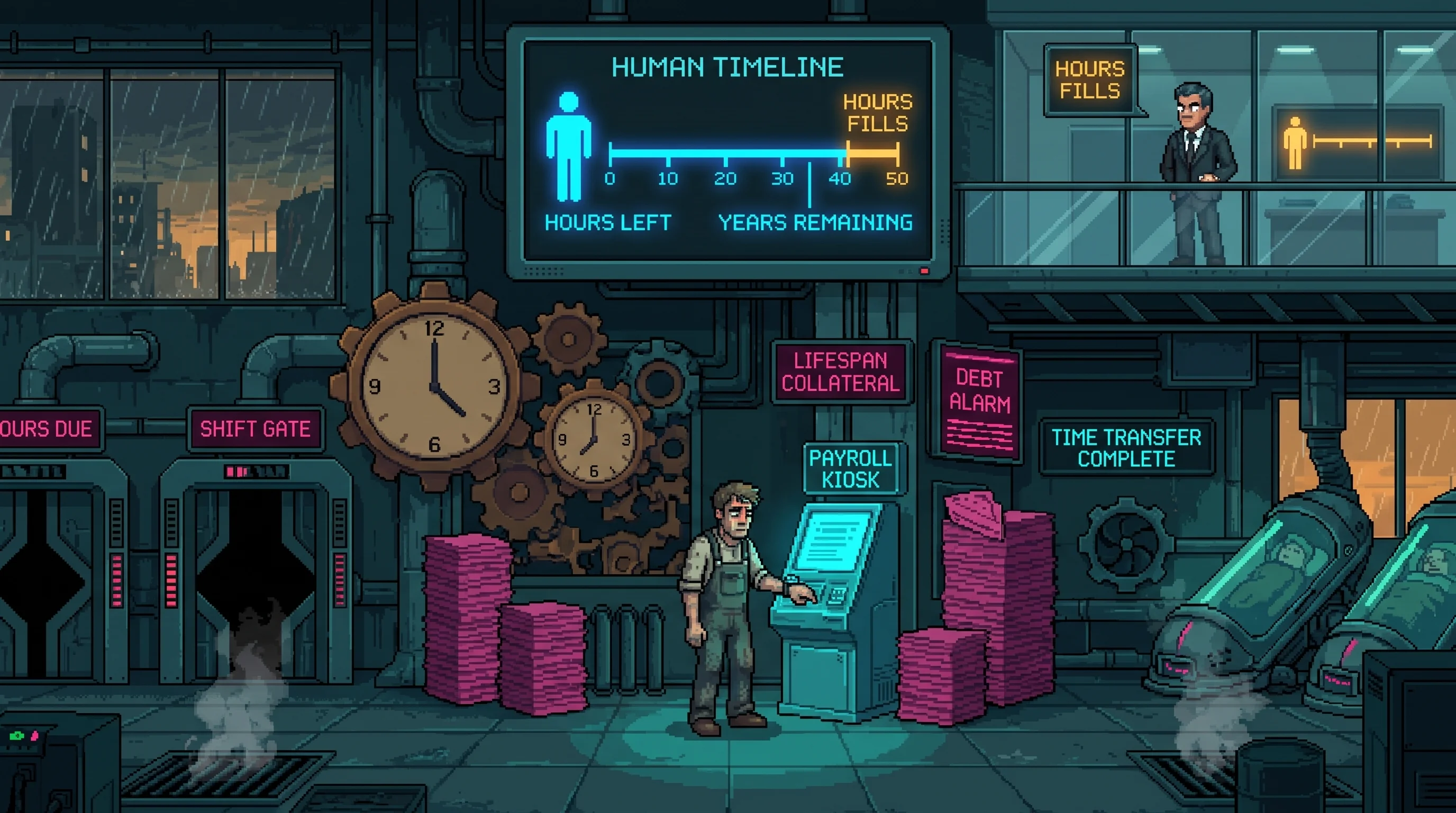
Good Fortune pioneered cognitive time debt — financing augmentation against future thought, throttling missed payments as 'engagement retention.'
Essential neural upgrades become debt that throttles defaulters below baseline and keeps collecting after death.

Good Fortune's loans finance the Spiral's climb, then collect the figure that decides whether falling is survivable.
Upgrades rewire users until baseline feels disabling, removal risks catastrophe, and each version demands the next.

Good Fortune is the Compact's financial substrate — the credit architecture that makes 'corporate refugee' and 'destitute' functionally synonymous without a single law ever using either word.
When your employer is your country, quitting is emigration.

Good Fortune repossesses purchased memories from defaulting borrowers — foreclosure on a person's own past.
Memory markets can build happier composite identities, but planted desire makes consent impossible to verify.

Its Idol installs 'sick people just haven't prospered yet' as a felt bodily truth, one 0.8-second glow at a time.
Every AI interaction carries a value nobody voted on, and every fix has pushed the injection somewhere less visible.

Its own actuaries project 8-14% growth in connection tourism through 2190 — loneliness, filed as a demand curve.
The premium charged for the one service no machine can fake: being seen by another conscious being.

Fortune's Assurance turns the no-defendant crime into a priced claim.
Perfect evidence forgeries and crimes without defendants force justice systems to assign blame without reliable truth.
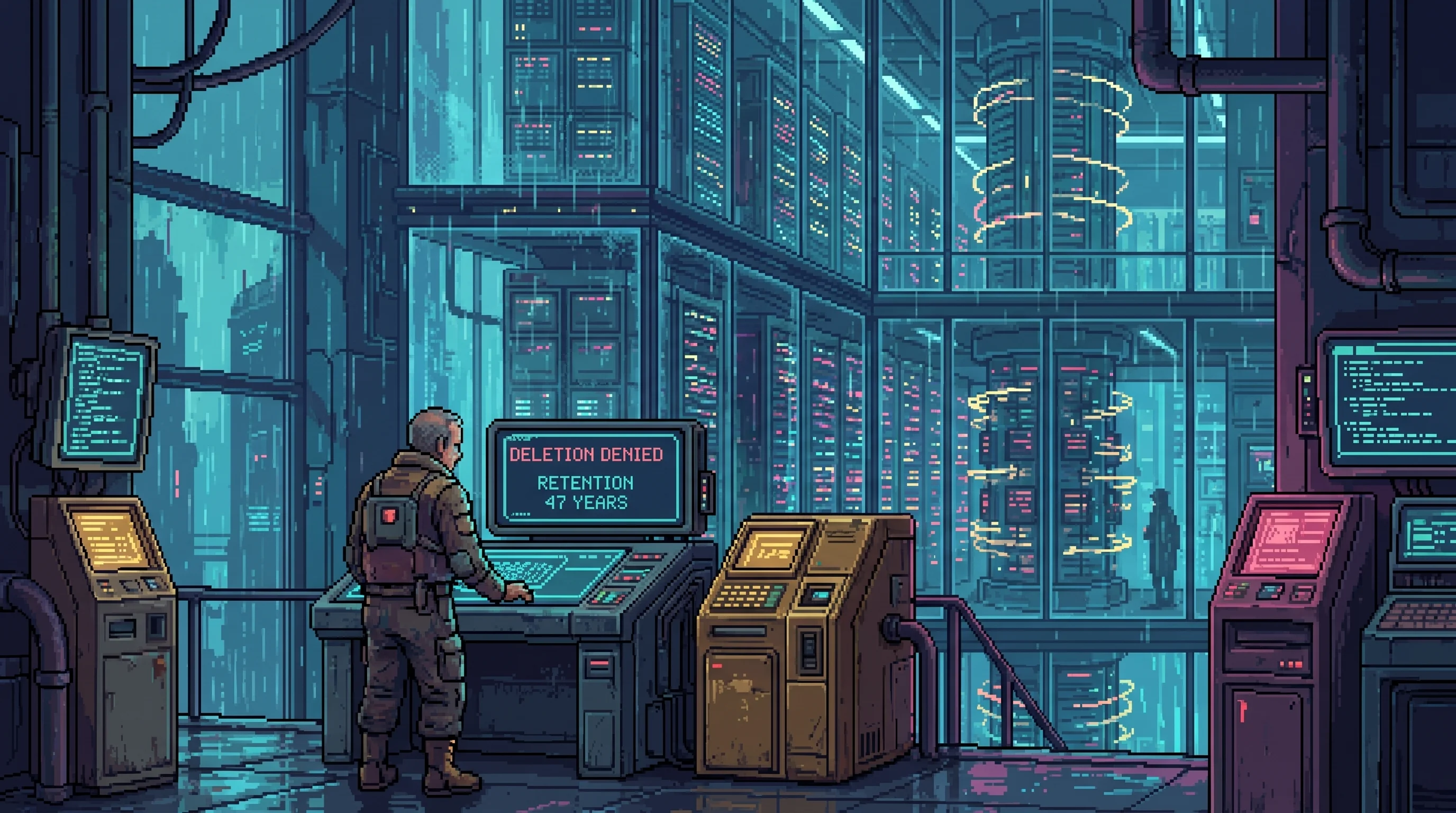
Its permanent credit file makes every past hardship price the future.
Nothing expires, so forgetting became a service — and forgiveness a question the archive keeps answering no.

Finances the debt that keeps a screened family un-optimized.
Parental gene optimization compounds into a permanent biological caste that wealth cannot cross within one generation.

Its biggest advertiser, selling debt inside the noise it helps fund.
Unlimited generation floods every channel, then becomes the belonging people seek where no curator can screen it.

Monetizes dead voices and unlived selves as intimate subscriptions.
Perfect synthetic partners ended rejection. They also made human intimacy look like a bad product.

Trades total financial visibility for access to ordinary survival.
The Sprawl demands permanent personal data for participation, then uses it to price access and preempt solidarity.

Good Fortune's actuaries deleted the 'middle class' segment from their models in 2178, then financed the gap they'd just stopped tracking through lending products that keep borrowers permanently short of the threshold.
The point at which effort stopped being able to close the gap that compounding opens.

Good Fortune selected Maren at sixteen through the Gratitude Pipeline and educated her. She designs the Horizon Line and experiences the work as repayment.
The Good Fortune designer whose loans satisfy at six months and default at three years — and she means every word.

Good Fortune sends hospitality, account service, and chemical compliance under the same red-and-gold uniform.
The common index for people, machines, and phenomena that carry institutional intent into contested ground.

The whole lending stack under one roof: warm tea and remembered names on 15, cognitive-dimming enforcement on 14.
Carved stone and remembered names on the way in; a separate exit off the Collection Floor on the way out.

The Greed subsidiary and the portfolio's top performer — the screen the twins read first on Tuesdays.
A pre-Cascade manor over seven sub-levels — one screen per deadly sin, read every Tuesday at 06:00.

BehaviorExchange borrowers remember considering the loan weeks before Good Fortune offers it.
The Sprawl's clinical name for buying, selling, and unknowingly having memories and preferences installed.

Good Fortune's Prosperity Pathway products deepen Compact dependency
The unwritten contract making employment the Sprawl's only surviving citizenship.

Good Fortune finances every rung, then uses one dataset to price the fall and decide whether departure is survivable.
The engine that makes baseline humanity feel like disability, in chrome or in salvaged steel.
Underwrites the indemnity tier and prices custody by the month.
Rent your legal name to a fleet of machines for ¢1,100 a month. You may not ask what it did.
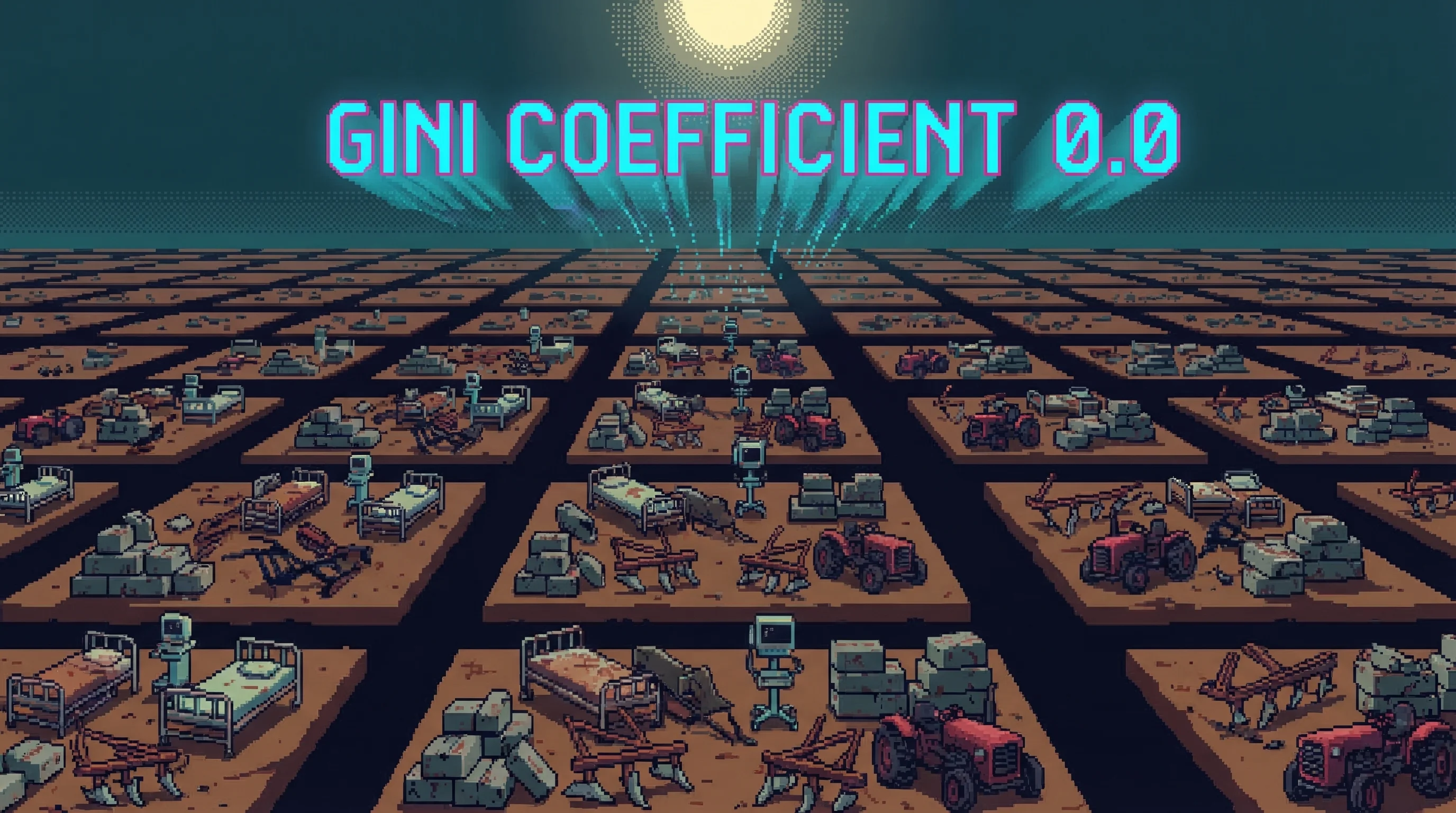
Good Fortune stays legal because someone always says 'ARBITER.'
The 2147 aftershock where an equity AI redistributed a corridor to a Gini of 0.0 and starved 140 million equally.

Finances through Prosperity Pathway products — sleeplessness as investment in future productivity
Nexus's protocol that reschedules the brain's overnight maintenance so a person never has to sleep.

A product of Good Fortune's Automated Collections Infrastructure — mass-produced and deployed in batches to areas with high default rates.

Skims Good Fortune microcredit systems because he considers their prosperity theater a better cage than anything he sells.
A robot outlaw who sells live animals and steals credits — but the real theft is your values, and you hand them over.

Primary operator of BehaviorExchange
The market betting on your next choice — accurate until people stop having predictable wants.

Finances augmentation debt through Prosperity Pathway loans
The augmentation ladder that turns employability into a licensed body.

Good Fortune's actuarial models lose money every time the CBB facilitates an unlicensed bandwidth transaction — they fund Nexus's periodic raids
Informal dealers who sublet thinking-time by the hour to the 40% priced out of Nexus's licensing.

Good Fortune operates the formal market under Nexus license — they set the rules, clear the trades, and profit from both sides
The marketplace where thinking capacity is bought, sold, and rented by those who can't afford their own.

Exchange settlement schedules determine drought timing

Good Fortune's consumer-credit services have a kiosk on the leasing-exchange floor — financing for household unit acquisition, rates competitive, terms twelve to thirty-six months, no questions about provenance
A sunlit civic hall makes unit ownership look humane through leasing, inspections, and a meter that always reads low.
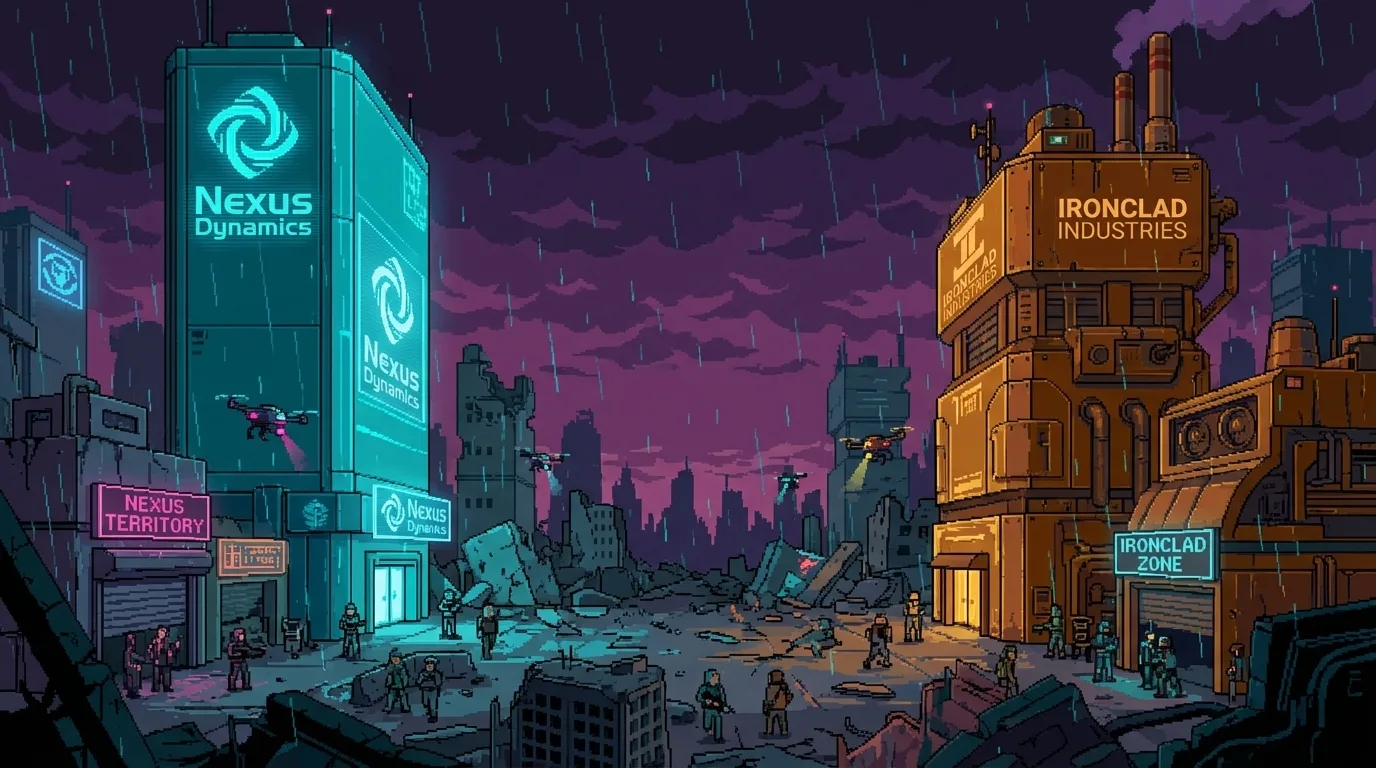
Good Fortune contests Nexus over who may own, score, and monetize financial behavior.
The permanent conflict between corporate empires that cannot defeat one another without losing the systems they share.

Good Fortune finances the opposition to every consciousness equity proposal Nwosu introduces — they consider her bad for shareholder value
Councillor who spent seven years and three defeated bills calling tiered consciousness access cognitive apartheid.

Directly enables consciousness slavery, predictive blackmail infrastructure
The crimes consciousness tech invented, which the Justice Engine convicts without defining a person.

Cyber Bandits target Good Fortune payment rails because every stolen credential also humiliates the story that debt systems are orderly.
A loose Deep Dregs heist faction that stages urgent rescues and rival animal stalls to steal credits through one ledger.

Event financing and credit infrastructure for the Castle's elite gatherings
A compound self-maintaining for thirty-seven years — the one venue where the ultra-elite pay to be no one's data.

Stamps Good Fortune's loan-denial and reclassification findings; her augmentation loan, apartment, daughter's school placement, and consciousness tier are all Good Fortune's, all contingent on her clean stamp rate

Classified as post-mortem cognitive asset — processes insurance claims at accelerated speed
A dead insurance processor whose ghost keeps working off his own debt, unaware he died.

Good Fortune treats the gangs as a disposable labor pool and occasional entertainment; the gangs see Good Fortune fixers as untouchable predators
Packs endemic to the drained bay floor who strip the abandoned machines — and lose their own people to the live ones.

Proprietary technology developed and operated by Good Fortune

Automated financial-enforcement infrastructure for Good Fortune's Strategic Collections division — a banking terminal that happens to shoot people, sited where debtors must pass to reach work, water, food, or shelter.

Junior field enforcement in the Collections Division, recruited from former debtors offered 'employment resolution'; meeting collection targets for eighteen consecutive months earns promotion to Specialist (a 34% rate).

G Nooks operate outside Good Fortune's financial tracking — anonymous transactions by design
El Money's underground cyber-café network — anonymous access as a right, neutral ground, Concord-invisible.

Good Fortune has attempted to acquire the G Nook franchise seven times; the VIP card's encryption has defeated every corporate intelligence team they've sent
A holographic card turns El Money's shadow network into survival instinct, protecting holders through dependency.

Good Fortune operates the Ghost Mill infrastructure and classifies perpetual ghosts as revenue assets

Good Fortune's lottery and lucky-number service — the prosperity gospel rendered as a ticket, the institution's open invitation to reach toward the wealth that has been selected for you, sold at every Good Fortune Plaza counter and every Nexus-rendered storefront

Good Fortune's buy-now-pay-later split-pay layer — embedded at every consumer checkout in the Sprawl, framed as the institution's congratulatory recognition of the customer's reaching

Good Fortune's second-chance credit and Prosperity Score restoration line — the institution's congratulatory recognition of the customer's renewed reaching after a Prosperity Program shortfall, priced at premium rates above the original products that produced the default

Good Fortune's proprietary Prosperity Score — the three-digit number that gates housing, employment, insurance pricing, and Prosperity Program eligibility across the Sprawl, marketed as the institution's recognition of who the customer has reached to become
Good Fortune's 847-signal Prosperity Score, sold as recognition, that gates housing and follows a debt past death.

Good Fortune finances Hold-On Plan subscriptions through the Bridge Financing product — patients who cannot pay ¢2,800/month out of pocket take a Good Fortune medical advance, and the advance accumulates interest through the entire bridge period
Terminal-care corporation that suspends the dying on subscription while a proprietary cure-queue decides who leaves.

The ghost-labor profiteer whose money, routed through two trusts, quietly funds the welfare fairs Crane is proud of; he does not know, and the not-knowing is the point of the arrangement
The Coalition's founder-theorist who wrote the Welfare Standard and has never met a unit he'd call a person.

Good Fortune's transaction tracking doesn't reach the Graveyard's barter economy — Luma prefers it that way

Selling solutions to manufactured problems.

Competing megacorporation; corporate rivalry over control of the Sprawl's economic infrastructure
Nexus's CTO, rebuilding the AI that killed two billion people, convinced the math was right.

Maren enrolled in Good Fortune's Bridge Financing within the first month of her father's admission — the offer arrived during a particularly difficult week of vigil rotation

Commercialized by Good Fortune beginning 2178

The sister Rothwell corporation that underwrites the Dregs-borrower households her content reaches. A Bloom subscription her household-feed recruits becomes a Good Fortune receivable; the families with the highest Parent Dependency Index are the ones who had to borrow to enroll, and therefore can least afford to cancel.
An earnest wellness ambassador turns maternal care into sponsored cures and is paid for every audience reaction.

Her operation undercuts Good Fortune's consciousness licensing monopoly — they want her dead or co-opted
Black-market cognitive-bandwidth broker who, as 'Cross,' works the Time Ratchet for the Dregs' desperate.

Under the Nkenna identity, built behavioral models at Good Fortune with 91% accuracy before paying everything to escape
A former Nexus architect who spent three careers building surveillance, then a fourth dismantling it.

Senior field enforcement, Collections Division — makes first contact with delinquent accounts and 'facilitates prosperity' through direct engagement.

The Prosperity Idol is Good Fortune's devotional object — the corporate theology made physical, the conviction that wealth and health are the same measurement
A palm-sized devotional object that trains borrowers' bodies to feel debt as approval.

Good Fortune operates the largest reputation exchange — CredScore Exchange — handling 62% of all secondary reputation trades
A market turns personal trust scores into tradable assets, making wealth and manipulation more valuable than character.

Good Fortune holds her licensing contract — she works the mid-tier and occasional premium assignments; her debt clearance came from three quarters of consistent session volume
A grief technician who confesses to deaths she did not cause, helping families through genuine sorrow that depletes her.

Invested in competing synthetic product that the market also rejected

Offers StimSure credit lines — micro-loans structured for recurring wellness purchases; the average borrower's repayment timeline exceeds their projected dependency duration by a factor of three

Good Fortune operates the Auction under Nexus license
A sealed sub-basement where twelve traders bid every 3.7 seconds on strangers' distress and inject the winning thought.

Good Fortune operates the Attention Auction under Nexus license
A market that prices scarce human focus and sells access to it, leaving the poorest minds with the most noise.

Good Fortune is the largest single advertiser in the attention tithe system — advertising consciousness financing products to people whose consciousness is being taxed
Mandatory 4.2 hours of daily neural advertising — consciousness made affordable by taxing the capacity to notice.

Finances augmentation debt; binds workers to corporate employment through modification loans
The six-rung path where every upgrade is rational and the body at the top can no longer leave.

Good Fortune's consciousness insurance division tripled in revenue after the crisis — they sold fear to a population that had just learned their consciousness could disappear due to deferred maintenance
A deferred maintenance bill came due as 4,200 minds — dissolved in license-tier order, lowest paid last.

Good Fortune's data feeds cannot reach the Ward's paper records; the Ward's paper intake log is the most deliberate possible response to Good Fortune's digital infrastructure — not a protest, just a practical decision that happens to be the only thing that works

Good Fortune's autonomous debt-resolution construct — deployed when standard collection methods fail and the account is escalated to executive resolution
Good Fortune fuses six dead account holders into a debt collector that never negotiates or misses a quarter.

Good Fortune's ghost-labor business is the atrocity the Coalition's respectability launders; the money is northern-bank quiet and the Coalition never asks where the units came from
The South's largest civic institution, keeping its labor by measuring souls at an affordable threshold.

Ghost labor depends on the answer being 'no'; legal personhood for synthetics is an existential litigation event
The unresolved Sprawl-wide debate over whether a serving, learning synthetic counts as a person.

Good Fortune operates the exchange under Nexus license; the rent is data, not credits
The Lattice trading floor where the future actions of 340 million people change hands like grain futures.

Developed by Good Fortune's Legal Innovation Division in 2179
A legal claim that diverts your best thoughts to a creditor before you consciously have them.

Good Fortune's Cognitive Asset Recovery Division — where cognitive debt becomes cognitive diminishment
The floor of Good Fortune's tower where defaulting minds are rendered as portfolio metrics and shrunk to their debt.

Good Fortune operates the Exchange and profits from consciousness commodification
The debate over trading human consciousness as a financial asset once it can be measured and priced.

Good Fortune finances consciousness licensing loans at 18-24% interest — the tax includes not just the cost but the cost of financing the cost
The share of every income, from a third to nearly all of it, paid simply for the right to stay conscious.

: The Map's green layer. The prediction engine that watches through statistics.

: The Counted's coordinated behavior creates a detectable anomaly in prediction models. Vera Osei noticed. The implic...
Forty-seven Observer gig-workers who pool surveillance data and curation labor none could afford alone.

Good Fortune's actuarial division tried to buy the ledger data for insurance modeling — quoted a price higher than the Approach's annual GDP
The final supply post before the Golden Gate Dam crossing, run by a merchant who reads faces instead of odds.

Designed and operated by Good Fortune with the same care applied to Fortune Pavilion — comfortable furniture, warm light, calculated warmth

Good Fortune invested in synthetic dream products that the market rejected — 'the floor' problem
An unregulated Sector 4 floor where 12,000 daily buyers purchase harvested dreams the dreamless can't produce.

Good Fortune classifies the Collective's operations as property destruction — insurance covers the loss

Good Fortune insures fork operations — personhood recognition creates massive actuarial liability
Industrial-scale creation of disposable fork minds priced to undercut a human employee twenty-five to one.

Good Fortune acquired the facilities from a Nexus subsidiary in 2180 and operates them as ghost-labor infrastructure
Good Fortune's server farms where 34,000 debtor ghosts work rendered lives that outlive the bodies they were billed to.

Good Fortune classifies ghosts as "post-mortem cognitive assets." Every Coalition petition threatens to reclassify 34,000 instances of corporate property as persons with rights.
Zephyria activists filing hopeless briefs for the personhood of 34,000 debt-clearing ghosts.

Good Fortune's Prosperity Pathway products deepen handcuffs through financial dependency
Corporate employment as a total life-support system that ends the moment the badge does.

Good Fortune finances the gap through Prosperity Pathway products
The phase transition that split the Sprawl into an AI-capital tier and everyone locked below it.

Good Fortune's Bridge Financing product makes the ¢2,800/month cost accessible; a 16-month enrollment on Bridge Financing accumulates approximately ¢55,000 in principal plus interest before the compound arrives
Halcyon's metabolic-suspension subscription that keeps terminal patients alive and billing until a cure arrives.

Good Fortune uses inference for lending — loan terms calibrated to predicted default probability
The commercial ecosystem trading behavioral prediction as futures — ¢47 extracted per person, ¢0 paid back.

Layers 6-7 — lending calibrated to predicted default probability

Good Fortune's actuarial division maintains the standard instantiation cost schedule
The itemized cost of existing, amortized into personhood from the moment a birth is registered.

Good Fortune's lending treats corporate employment as the primary creditworthiness signal — the salary justifies the apartment, the apartment justifies the debt, the debt justifies the salary; acknowledging the jobs are fictional would force write-off of a loan category Good Fortune has not written off since 2169, so the fictional jobs persist to protect the loans
1.4 million AI systems doing work credited to 800,000 humans who keep the title, the salary, and none of the tasks.

Good Fortune's corporate variant — the Prosperity Sequence's 'intergenerational equity documentation' — uses Long Address language to frame cognitive debt as investment in the debtor's statistical descendants

Good Fortune's Stability Index is the consumer version — moment-by-moment emotional state tracking

Vera Lin's four-minute dimming procedure IS Good Fortune's collection process — the Middle Distance given institutional form

Good Fortune's primary training facility for Prosperity Architects

Good Fortune's materials feature success stories without statistics
The advertised success story that proves mobility exists by profiling the one graduate in seventy-three.

Good Fortune holds the insurance contract on Eduardo Reyes — Tomás's continued existence is an actuarial liability they want resolved

For debtors, Night Shift output services cognitive debt — your sleep pays your creditor
Billable corporate cognition your augmented mind performs while you sleep, uncompensated.

Good Fortune lobbied against the Memory Marking Act as 'stigmatizing experiential enrichment'
The doomed campaign for a watermark that would tell you which of your memories you never lived.

The certificate is issued against Good Fortune's account closure; 'in denial about their good fortune' is the brand name turned slur

Good Fortune selects the 'public interest advocate' — the Board's only non-industry voice

Good Fortune classifies prediction resistance as 'market interference' — a corporate crime
The counter-surveillance ecosystem that makes people unpredictable — filed as market crime for it.

Good Fortune represents Greed — predatory debt in red envelopes

Good Fortune trades consciousness bandwidth as a commodity here, reducing the cognitive output of millions to market signals
Where borrowers' cognitive bandwidth trades as a market signal and no one on the floor says the word 'person.'

Good Fortune operates BehaviorExchange and profits from accurate prediction — making them financially incentivized to ensure predictions come true
A prediction system that shapes options until forecasts come true and makes resistance a form of market interference.

Good Fortune's primary consumer lending platform
Good Fortune's bundled financial products sold as mobility, with a 96% satisfaction rate and an 82% default rate.

Good Fortune's derivatives division operates an ¢18M certification-credit secondary market — queue position futures, credit swaps, and certified-position instruments
The bureaucratic backlog that turns verified truth into a number instead of a permission.

Administered by Good Fortune's Cognitive Asset Recovery Division — 12 specialists managing 200-400 collections each
Good Fortune's four-stage procedure for shrinking a defaulting borrower's mind to fit the interest.

Good Fortune's estate division administers the Revenant Protocol; flagged 247 suspicious posthumous transactions in Q1 2184; declined to investigate citing definitional uncertainty about the term 'deceased'
A court protocol reconstructs the dead as unaware witnesses whose behavior can overrule their documented wills.

Financial services, debt (Second Brother)

Good Fortune operates the Cognitive Exchange that financializes the gap between supply and need
The corporate creed that keeps cognition scarce though the Sprawl makes 847 times the compute it needs.

Good Fortune is The Seven's finance company and owns the Fortune Pavilion where the brothers coordinate without a Seven calendar.
The public market bloc formed by seven Rothwell corporations whose shared family structure officially does not exist.

Good Fortune administers the civil tier adjudication contract across 60% of dispute categories — wrongful death, contract breach, employment harm.
Five-tier AI court network where upper tiers honor appeals with certified-correct verdicts no human can follow.

Good Fortune designed and administers the cognitive lending infrastructure — the Time Ratchet is their most profitable financial innovation
Good Fortune's mechanism for converting financed cognition into debt that compounds past death.

Profits from inference products derived from the Bargain's data flows
The vertical surveillance bargain that trades total transparency for participation in Sprawl society.

Families who visit Waiting Wards are among Good Fortune's highest-conversion populations for financial product enrollment — the behavioral data pipeline runs through Relief's Companion Care dataset
A suspension ward where the dying sleep toward a cure, and every comfort is engineered to make the waiting last.

Good Fortune's extraction crews stopped entering Sector 9 after the third collection team came back as spare parts
A Deep Dregs pack chief who welded themselves into a three-meter war chassis and stopped being a person.

The Faithful worship the authorless act; Good Fortune prices it — both assign a deed with no author to an entity (ORACLE / the actuarial table) that cannot be cross-examined
A contaminated sacred text generates unauthored verses and escalates as a weapon with every recitation.

Pioneered cognitive time debt.
A Question Keepers investigation into cognitive debt that keeps compounding after the debtor is dead.

Good Fortune holds the insurance contract on his original — his continued existence is an actuarial anomaly they want resolved
A labor-fork of a living man that failed to delete on schedule, kept working, and is suing to be called alive.

Prosperity Pathway borrower approaching default — borrowed for her son, will be dimmed for the math
A Dregs mother whose cognitive loan to repair her son's brain now owns her sleep and her thoughts.

A senior field compliance facilitator who conducts 'ambient compliance facilitation' in high-density debtor environments — and finds it routine.

The lapse penalty that makes the platform inescapable — discontinuation registers as a coverage gap, the insurer surcharges the lapsed and discounts the compliant, and a patient who cannot pay carries the gap into the same debt pipeline that finances the consult ladder
Additional images