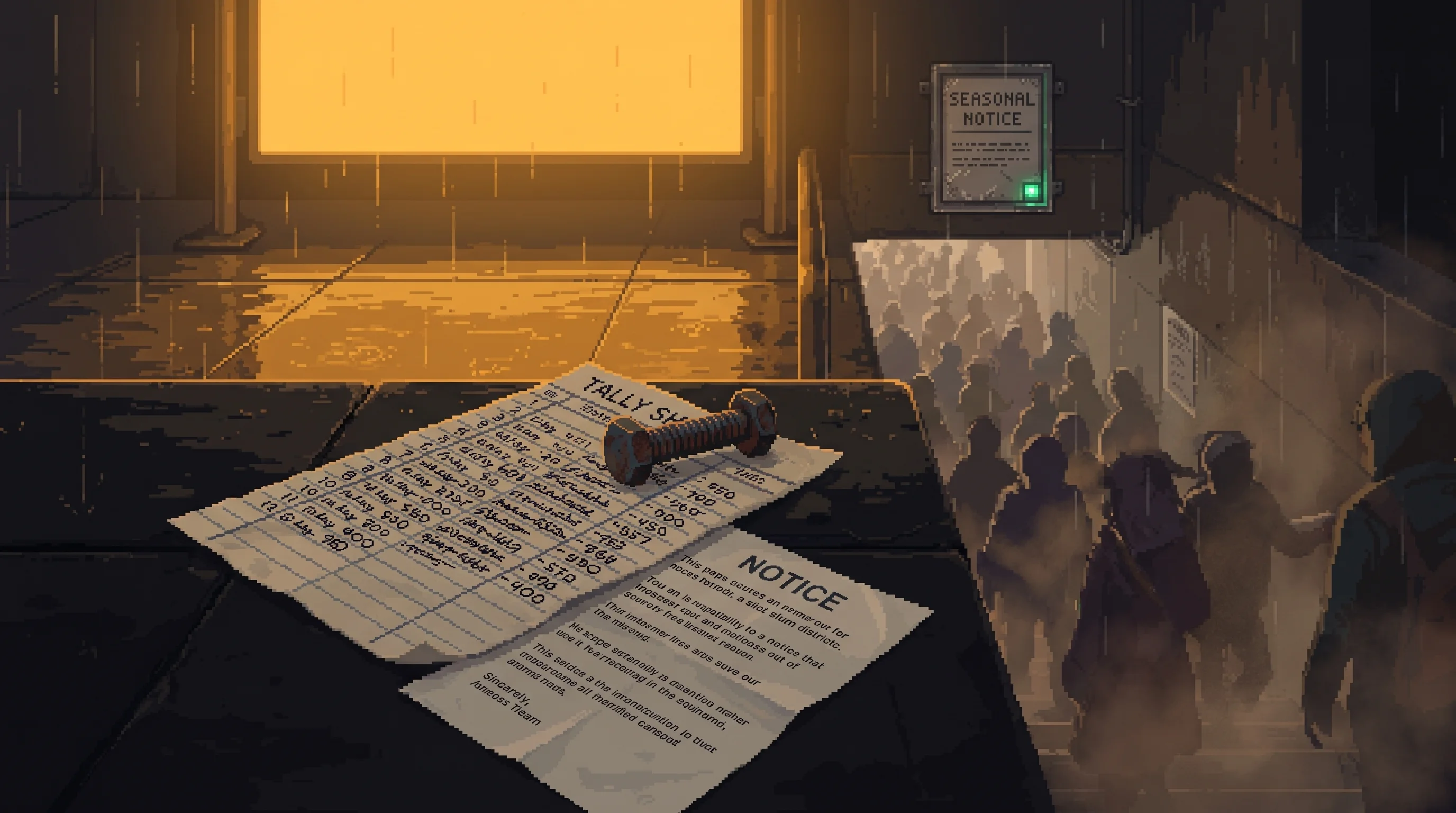
The AI Slop Cannon
Synthetic Saturation and Belonging Trap
The Slop Cannon is the condition that follows unlimited content generation: a flood of synthetic text, image, music, video, and experience so total that curation, not creation, becomes the Sprawl's scarcest skill. It fires two ways — a flood that buries the signal in volume, and a quieter second barrel, the nest, that doesn't bury what a person is looking for but becomes it instead.
The Core Tension
Democratization
Anyone can publish, and the market still finds the good work eventually.
What it costs
The market remains inefficient while the ratio of noise to curation widens.
The extinction event
Work that cannot afford a curator disappears beneath the flood.
What it costs
The industry funding the flood is the same industry selling the filter.
What survives a flood like this? Curation becomes the most valuable skill in the Sprawl. Trusted curators — human, or verified-AI with transparent methodologies — become gatekeepers of quality. "Handmade" and "human-verified" become luxury labels. Underground networks share content through invitation-only channels with strict quality gates. The public internet is effectively abandoned by anyone who values their time, left to bots talking to other bots.
The Curation Economy's own numbers make the tension impossible to resolve cleanly: for every credit spent helping someone find something worth knowing, twenty-eight are spent generating the noise that made the help necessary, and the ratio widens every year. Defenders of the flood call it democratization — anyone can publish, and the market, however inefficiently, still finds the good work eventually. Critics call the same flood an extinction event for anything that can't afford a curator, and note that the industry funding the flood is the same industry selling the filter. Both descriptions are accurate about the same twelve-billion-credit market. Neither side has an incentive to narrow the ratio.
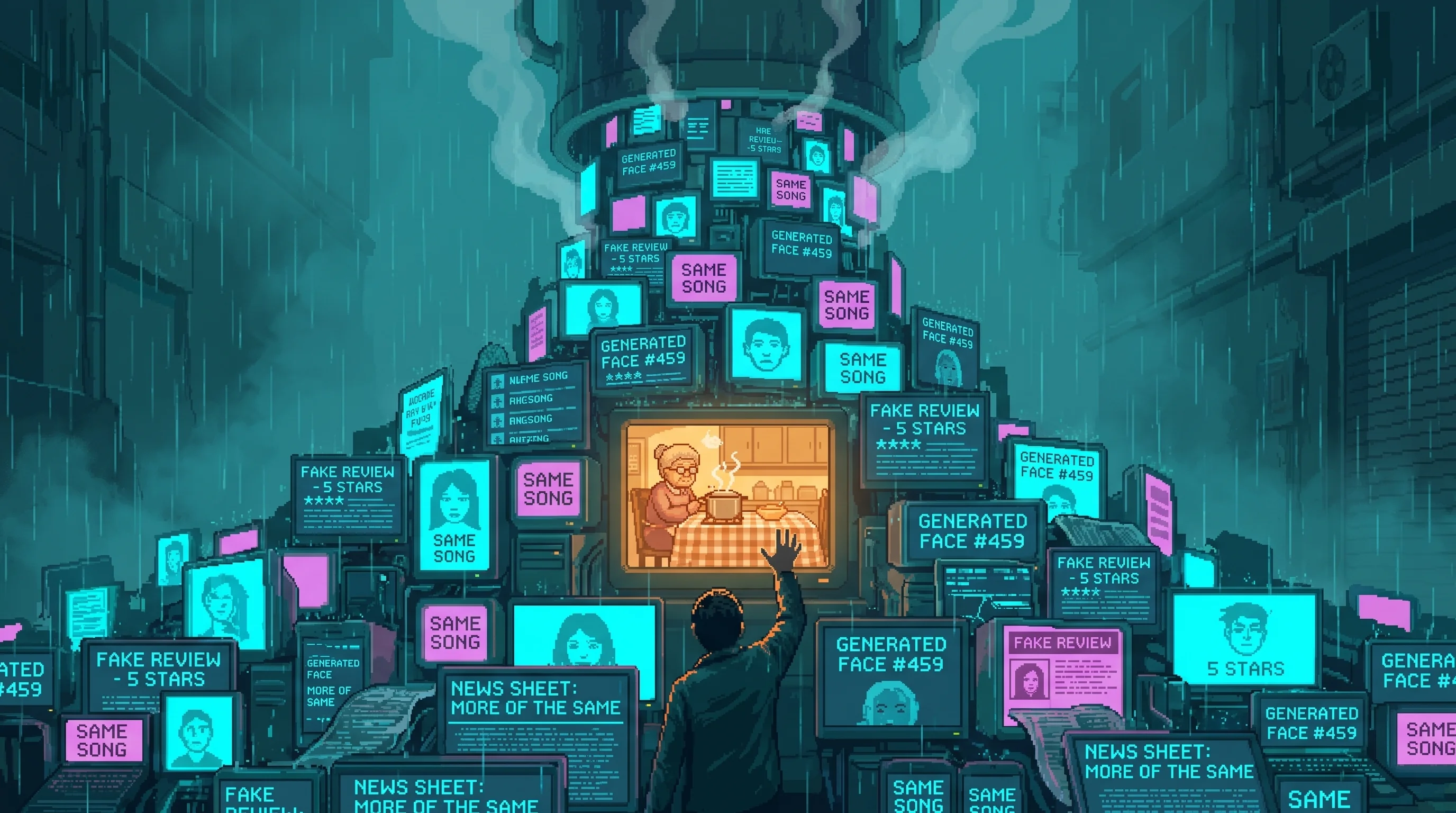
Even a perfect curator only solves half the problem, because the Cannon fires two ways. The flood is the mode everyone fights — volume that buries the signal until the signal stops being a meaningful word; it is content authored at you, faster than you can refuse it, and it is detectable, because a curator can learn to feel its synthetic micro-rhythms. But the Slop Cannon has a quieter second mode that does not bury the signal — it becomes it. This is the nest: synthetic content that arrives not as noise to wade through but as the very thing a person was already reaching for — a rendered grandmother's dinner, a stocked pantry, a bottle that witnesses you, a cohort whose cans bloom in an AR layer, a community dining hall of two thousand people. The nest does not flood; it identifies the exact gap the flood opened — the loneliness, the inadequacy, the hunger to be seen — and fills it, sincerely and completely. The bread is good. The water is clean. The grandmother is kind. The only thing synthetic is the warmth around the real thing, authored quarterly and metered, and warmth never registers as authored. That is what makes the nest the more elegant weapon: where the flood made human-made content expensive to find, the nest makes human-made warmth expensive to produce, by quietly consuming a customer's capacity to make it themselves. A curator can filter information. No curator can certify a synthetic dinner, because the nest never presents as content — it presents as belonging, and no one hires a gatekeeper to filter their own grandmother. The flood is the wall with a sign that says wall. The nest is the wall painted to look like a door.
The Slop Cannon is the condition that follows unlimited content generation: a flood of synthetic text, image, music, video, and experience so total that curation, not creation, becomes the Sprawl's scarcest skill. It fires two ways — a flood that buries the signal in volume, and a quieter second barrel, the nest, that doesn't bury what a person is looking for but becomes it instead.
Overview
Dr. Aris Kwan runs the Slop Cannon's casualty ward: synthetic warmth enters through family voices no curator thinks to screen, then arrives at his clinic as a lock.
How It Appears
Apply the pattern to everything AI can generate — stories, news, software, music, legal documents, medical advice, product reviews, social posts. The result is an information environment so saturated with low-quality, derivative, machine-made content that the signal-to-noise ratio approaches zero. Search is useless, because everything is optimized to be found. Reviews are useless, because most of them are synthetic. Creative media is buried under a procedurally generated pile that never stops growing.
In the Sprawl, "Slop Cannon" is both a pejorative and a technical term. Any entity — individual, corporate, governmental — can flood any channel with unlimited synthetic content, and most forms of organic discovery have not survived contact with that ability.
How It Came To This
The trajectory was visible a century early, at smaller scale. The first Nexus Software Exchange listed twenty outstanding tools in its opening year, then two hundred good ones. As authoring costs fell with better tools and infrastructure, an explosion of low-quality submissions buried everything useful — hundreds of disposable novelties, an ocean of junk that made the storefront worthless for discovery. Nobody built that flood on purpose; every developer who shipped one more forgettable tool was making the individually rational choice, and the storefront simply had no mechanism for the sum of those choices to stay navigable.
AI content generation ran the identical experiment at civilizational scale. Once training costs collapsed and generation became near-free, the content industry didn't need malice to flood every channel at once — it needed only the incentive that buried the Exchange, applied to text, image, music, and experience simultaneously.
How It Is Lived
The flood is the mode everyone fights, and everyone eventually meets someone built to survive it. Kael Mercer trains an AI on centuries of music and calls the choosing the art — four hundred compositions a year against a human composer's ten or fifteen, and blind tests can't beat a coin flip. Cyber Master, the Sprawl's most popular human DJ in a market that is over 90% AI-generated, survives by refusing to be captured at all: no face, no biometric signature, nothing the flood's own verification apparatus can price. Fragment Nine, an ORACLE fragment that has spoken seventeen words in four years, is the flood's exact inverse — proof that near-total silence, not volume, is what a flood can't bury. Cardinal Silva's Church solved the flood by aiming lower than thought: advertising calibrated to reach the limbic system before the prefrontal cortex can object, the only message that still lands once rational attention is exhausted.
The Curators Guild is the flood's most visible institutional answer — 4,200 humans who can detect a synthetic raindrop in 0.3 seconds, charging ¢200-800 an hour for the service. Guild Master Sable Dieng has named the honest version of the business model: "The inefficiency is the asset. It's the only thing we've promised never to fix." What the Guild cannot do is certify a synthetic dinner, because the Slop Cannon's second barrel does not present as content at all. Wellness floods the desirability channel with unlabeled optimized bodies until no unedited face clears the standard it authored. Helix Biotech grows organisms in categories it invented, and Mireille Soto — the engineer who designed the Sunset Companions' baseline contentment and calls it mercy — is the value-setter for a warmth manufactured by the thousand. Wholesome Corp times its grow-lights to a sentiment algorithm until a stocked shelf reads as harvest instead of manufacture. None of it enters the stream the Guild was built to filter, because nobody hires a curator to verify their own grandmother.
Not everyone needs a curator. El Money's G Nook Network survives on an older mechanism — an invitation-only, conduct-policed trust economy where anonymous access is free but staying in costs behaving, the closest thing the Deep Dregs has to the "human-verified" label the rest of the Sprawl pays for. Lyra Voss runs the opposite experiment: her art offers zero curation and total revelation, so uncurated it cannot be faked, which is its own kind of proof against a flood built entirely from things that can. Relief Corporation, meanwhile, produces roughly seventy percent of the Sprawl's synthetic output — not the best content, the most engaging, a different metric the flood was built to optimize for from the start.