Overview
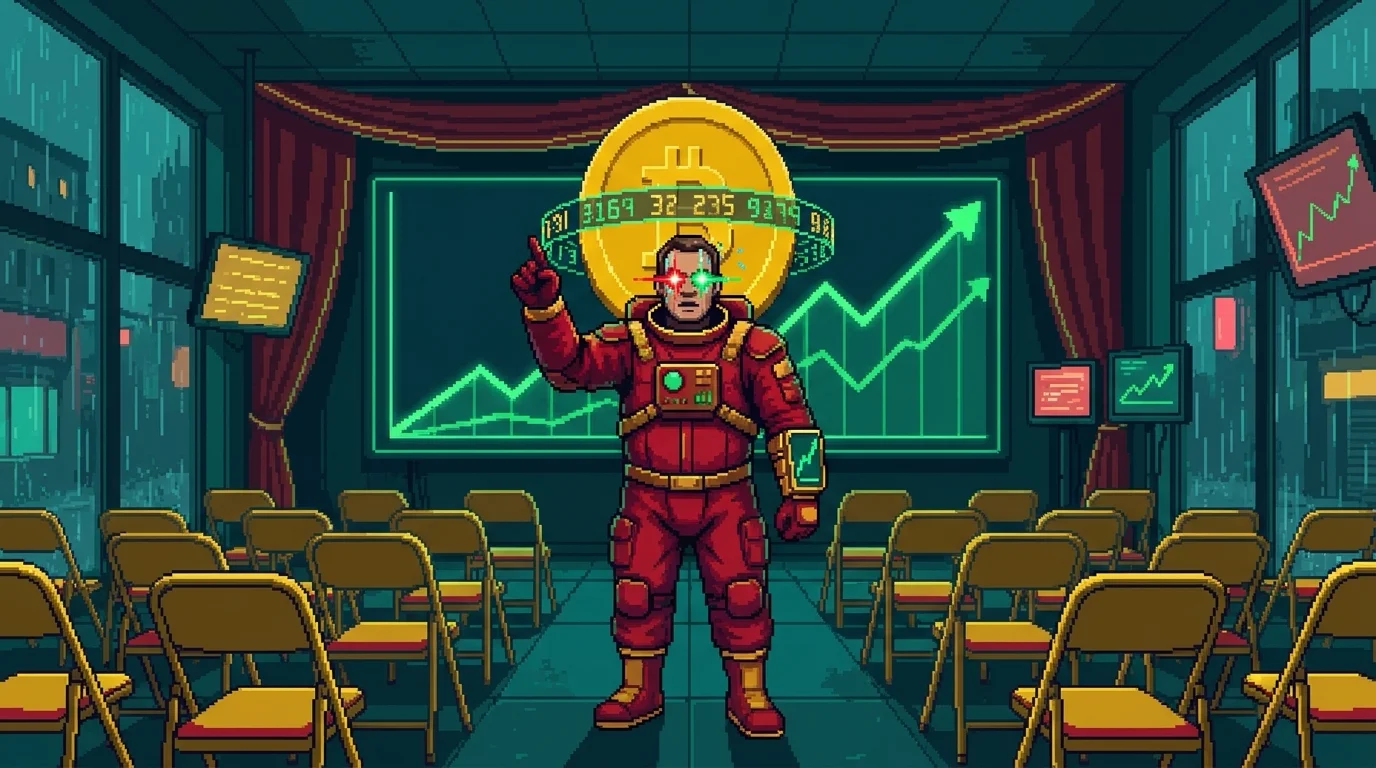
The trading floor is rented by the day, and the chairs are mostly empty.
He does not see the empty chairs. He sees a congregation. He stands at the front of a Dregs storefront that was a noodle counter last month and will be a stim clinic next month, under a wall-sized chart that only knows one direction, and he points up, and he tells the room they are early. They are always early. Behind him a single enormous gold coin turns slowly in the air, stamped with a lucky number, and the coin is the most honest thing in the building, because the coin is exactly as real as the number of people still willing to look at it.
King Coyne is Good Fortune's retail prosperity front — a licensed Fortune evangelist, which is a job title the corporation does not advertise and he does not know is a job title. He sells the Number: a speculative coin dressed in Good Fortune's lucky-numbers, red-and-gold, prosperity-gospel aesthetic, pitched to the Deep Dregs reacher as the last ascension left in a Sprawl that closed every other ladder during the Cascade. The pitch is not a lie he tells. It is a faith he holds. He believes the Number will change everything. He believes he was chosen to carry it. He believes the room is full.
His power is not force. He has never thrown a punch and would find the suggestion beneath the dignity of a founder. His power is manufactured belief — the Number climbs precisely as far as the congregation's conviction carries it, a value made entirely of how many people are still reaching, and it collapses the instant they stop. When it collapses it burns the believers first, because the believers are holding it, and the prophet is the one who told them when to buy and is never, somehow, the one holding it when it falls. He does not experience this as theft. He experiences it as the market clearing, the unfaithful being shaken out, the faithful being tested. Then he rebrands the coin and the chairs that are left lean forward again.
What makes him dangerous is not the grift. The Sprawl is wall-to-wall grift. What makes him dangerous is that the grift is wired — every reacher he converts becomes a Good Fortune debtor through the same lucky-numbers product line that sold them the coin, every collapse routes its casualties straight into the corporation's intake funnel, and the cold construct that collects on them is standing in the basement of his own building, denominated in his own ticker. He did not build any of that. He thinks he is independent. He is exit liquidity that learned to preach.
King Coyne is also known as the Founder and the Prophet of the Number. His rented Dregs trading floor sits off Fortune Row’s lower edge — never the same address twice.
Appearance
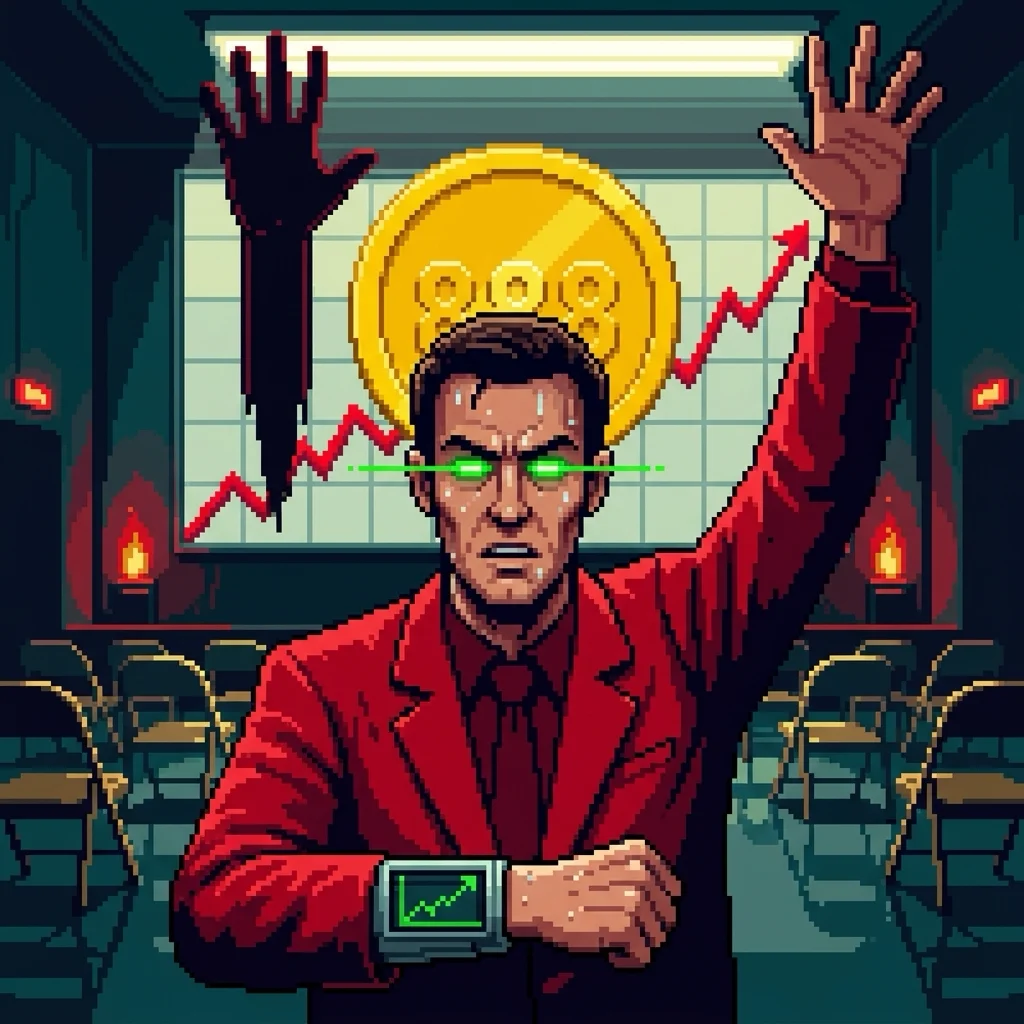
Laser-eyed, pointing up, and sweating through a suit that is one size too aspirational.
The Suit. Prosperity red, cut for a man with more shoulders than he has, Good Fortune gold trim at the lapels — the livery of a corporation he does not know he works for, worn as though he chose it. It is always slightly too big, the way a borrowed thing is too big, because the suit, like the floor and the coin and the eyes, is rented. He sweats in it. The sweat is the most genuine thing about the presentation, and he believes it is conviction, and it is.
The Eyes. Laser projection ocular implants, throwing a thin green glow that catches in the chart-light — the single most recognizable thing about him, and a Good Fortune brand-display lease with a payment schedule. The eyes are not his. He thinks the prophet's gaze is a gift he was born with. It is a fixture the corporation can repossess. When the lease lapses, the green goes out, and the chairs notice before he does.
The Coin. It levitates behind him, enormous, gold, stamped with whatever lucky number the Number is currently called, turning slowly. It is a prop and a ticker and an altar all at once, and it is as real as the room's attention. When the cash-out comes, the coin shatters mid-air, and the shards hang for a moment before they fall, and that moment is the only honest pause in his whole performance.
The Hand. Up. Always up. One hand points at the chart, at the coin, at the ceiling, at the moon he insists they are early to — a gesture so constant it has stopped being a gesture and become a posture, the permanent attitude of a man who has decided that pointing up is a kind of authority. The other hand holds the forearm terminal, the rising line, the proof. He never points down. He does not have a gesture for down. Down is not in the pitch.
He is in his early thirties.
The Number
The Number is a coin, and the coin is a congregation, and the congregation is the only thing holding the price up.
Good Fortune did not invent the Number so much as license it — a speculative product slotted into the Chance and Rewards line, the lucky-numbers brand pointed at the one demographic the corporation's other products could not reach: the genuinely destitute, the reachers with no credit history, no income to garnish, nothing left to put up as collateral except belief. Every lender looked at the Deep Dregs and saw uncollectable risk. Good Fortune looked at the Deep Dregs and saw a population that would still, against every odd it could do the math on, reach for a number going up. They needed a front who reached too. They found one who reached hardest.
The Number's value is its conviction, and the Visionary is its conviction engine. He runs the floor. He posts the chart. He tells the room when to buy, when to hold, when to zoom out, always zoom out, and the price climbs as long as the room obeys, because the price is the room obeying. There is no underlying asset. There was never going to be one. The genius of it — and he would take the word as a compliment, missing everything in it — is that a coin made of belief cannot be debunked, only abandoned, and abandonment looks exactly like a crash, which the prophet can always explain as a healthy correction, a shaking-out, a buying opportunity for those with the faith to reach again.
The reachers who reach at the top become the reachers holding it at the bottom. At the bottom, Good Fortune is waiting with a red envelope congratulating them on their eligibility for a recovery product. The coin's collapse is the corporation's intake. The Visionary's congregation is the funnel's mouth. He is not paid for the conversions. He is told he is early.
The Advance
The reachers in his front row have nothing to pledge — and that is precisely why Good Fortune can lend to them.
The Deep Dregs reacher has no salary to garnish, no asset to collateralize, no credit history a conventional lender will price. Every creditor in the Sprawl looks at that reacher and sees uncollectable risk. Good Fortune looks at that reacher and sees the one thing they have not yet posted: their future cognition. The Number is not bought with money the reacher does not have. It is bought on a cognitive-time-debt advance — borrow against the mind you will have, to buy the coin that will free you from ever needing it. The pitch and the financing are the same gesture. Reach, and you will be reached for. The reaching is the collateral.
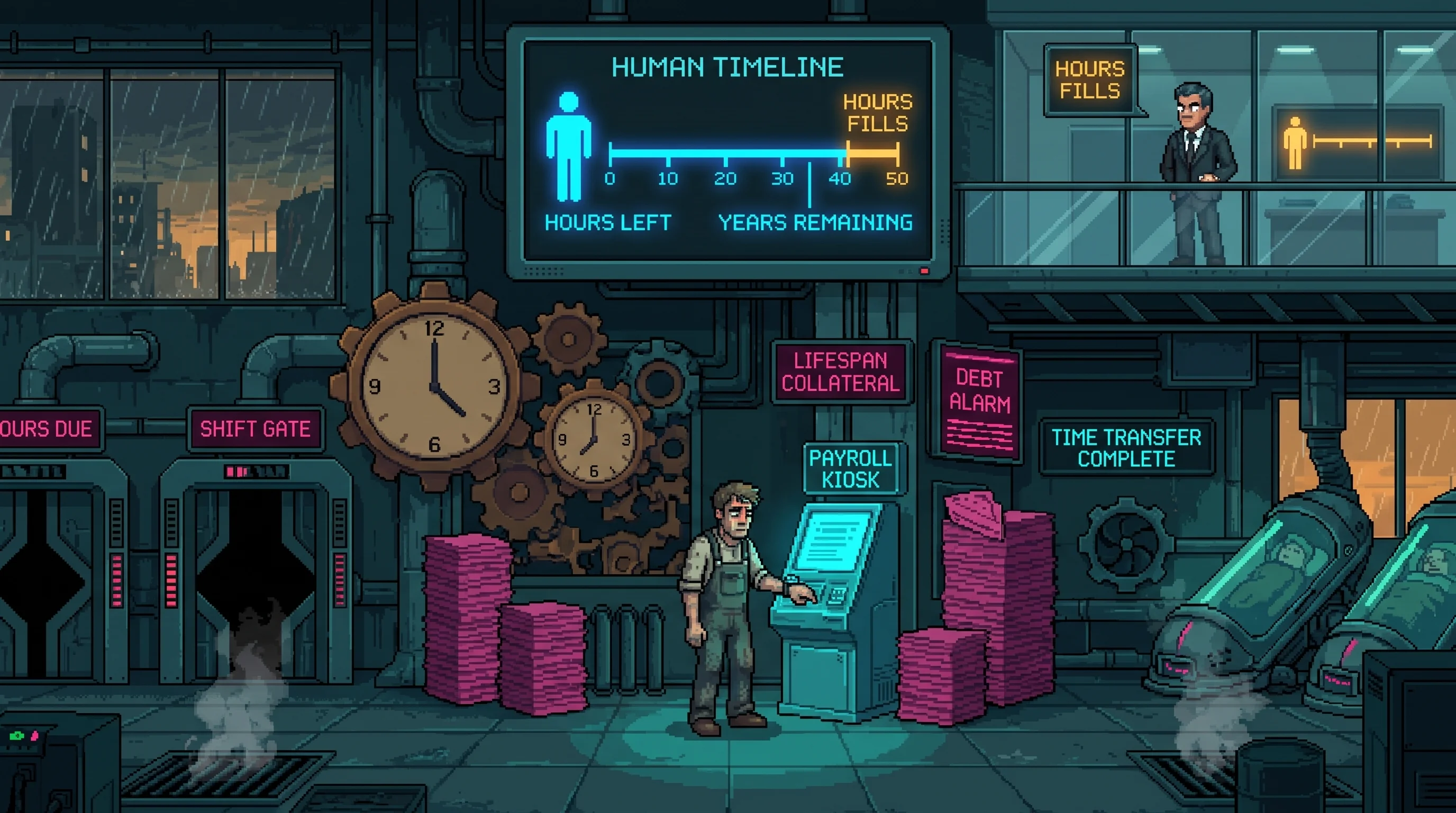
So the front-row believer reaches, on advance. The coin climbs while the room reaches. The cash-out comes, the prophet walks out whole, and the believer is left holding two things instead of one: the dumped coin, which is now nothing, and the advance, which is now everything. And the advance does not come due in credits. It comes due in hours of the Night Shift — the sleeping labor the augmented mind performs without consent, your sleep pays your creditor, billed against a balance taken on to buy a coin that no longer exists. The reacher who came to the floor to escape working the rest of their life now works it twice over, awake at the Focus Mills and asleep on the Exchange, to service the cost of a prophecy that was always going to dump on them.
King Coyne does not know about the advance. He does not handle the financing; he handles the faith. He tells the room the Number is the way out of the Dregs, and for the reachers who reach hardest — the ones who borrow against their own future minds to reach harder — it is the most reliable way in: into the Time Ratchet, where a coin bought on a cognitive advance becomes a lien serviced in sleep, becomes a default escalated past every collection method, becomes — at the bottom, past dying — a ghost worker switched on at death to process other debtors' collections forever. The prophet manufactures the belief. Good Fortune manufactures the collateral out of the belief. And the collateral is a person's future mind, advanced against a coin, collected in their sleep, foreclosed past their death. He sells ascension. Three steps down the funnel he does not look at, ascension is a method for converting a living reacher's tomorrow into a dead reacher's forever.
The Cash-Out
Every prophet of a number going up eventually has to sell, and King Coyne has perfected the art of selling while insisting he never would.
He calls it taking profits, and he telegraphs it the way a tide telegraphs — a turn in the room, a change in the patter, I'm not selling, said with the specific warmth of a man already selling. When the cash-out comes it comes all at once: the Number, inflated to its peak on the congregation's reaching, is dumped in a single motion, the price collapses through the floor, and the prophet walks out whole. The chart goes red. The coin shatters. The confetti that was meant for the moon turns to dust over the folding chairs.
The casualties are the believers, and — this is the part Good Fortune's marketing would never let him say aloud, and he would never think to — the casualties are visibly the believers. The cash-out does not hit some abstract market. It hits the room. The reachers in the front row, the ones who came earliest and reached hardest and brought their friends, are the ones holding the most when the most becomes nothing. The prophet's own congregation is rugged in front of the prophet, by the prophet, and the prophet experiences it as a market event he is as surprised by as anyone, because he has rebuilt himself, beam by beam, around the conviction that he is one of them. He believes he lost too. He always says he lost too. The accounting disagrees, and he has never once read the accounting.
The Law (Judge Dreg) gives the Dregs judgment without a bill or permanent record; Coyne's cash-out invoices belief and records exactly who reached at the top. Their circuits are foils: one produces justice freely, while the other produces exit liquidity somebody always pays for.
Then he resets the chart, picks a new lucky number, and tells the chairs that are left that this is the one. The faithful lean in. Somebody always has to be the exit liquidity. He has convinced himself it will never be him, and he is right, and that is the only true prophecy he has ever made.
Motivations and conflicts
We're Not Leaving, We're Pivoting
The single most reliable thing King Coyne does is rebrand the collapse.
When the Number falls far enough that even the front row goes quiet, he does not apologize and he does not stop. He pivots. Forget the coin. The coin was always about community. The chart is wiped, a fresh lucky number is stamped onto the levitating coin, and the same congregation — smaller now, but the survivors are the truest of the true, because surviving the last collapse is itself a kind of faith — leans forward into the next ascension. The pivot is the only part of the grift that has never failed. Coins collapse. The Number is debunked, abandoned, dumped. But the reaching is renewable, and the prophet has learned that a congregation that has already lost everything has nothing left to protect except the belief that the loss meant something, which means the loss is not an obstacle to the next pitch. It is the foundation of it.
This is the part nobody in the room can see, including him. The Number does not need to work. It has never needed to work. It needs a prophet who believes, a congregation that reaches, and a corporation underneath both of them that profits whether the coin ascends or collapses — that, in fact, profits more from the collapse, because the collapse is the funnel. The Visionary is not the exception to the prosperity gospel. He is its purest street-level expression: the gospel preached not by the warm grandparent at the family table but by the burned-out reacher who took the gospel literally, who believed wealth was the only ascension and that he had been selected to deliver it, and who will deliver it, sincerely, until the day Good Fortune rebrands him — replaces the laser-eyes implant when the lease lapses, rents a different prophet for a different floor, and lets the chairs go cold.
Voice
Manic optimism in financial scripture, certainty colliding with a visible crash, and absolutely sure he lost money too.
The register is the prosperity gospel preached by a man who took it literally — Good Fortune's warm-evangelical cadence stripped of the grandparent's patience and overclocked into the patter of a reacher who needs the room to believe as badly as the room does. He speaks in ascension. Everything is early, everything is up only, everything is generational. The comedy, which he does not hear, is the gap between the scripture and the chart — the prophet promising the moon while the coin shatters behind his head, narrating a collapse he is causing as a test of the faithful's resolve. He does not raise his voice in anger. He raises it in faith. He raises the Number.
He is fluent in the grammar of belief-as-virtue and doubt-as-sin. Reaching is righteousness; selling is treason unless he does it; warning the marks is "FUD," the cowardice of those who were too afraid to reach. Every collapse is a correction, every casualty was simply not faithful enough, every exit is somebody's turn to be the exit liquidity and never, by the deepest conviction he has, his. The horror of him is the sincerity. He is not a con man who knows the coin is fake. He is a believer who has built a self that requires the coin to be real, and who will rebrand the rubble into the next ascension the instant the room is ready, because the room being ready is the only thing he has ever truly read.
Sample Dialogue
"You're not late. You're early. You're always early, if you reach."
"Up only. That's not faith, that's the chart. Look at the chart."
"I'm not selling." (He is selling.)
"Have fun reaching at the wrong thing." (Said warmly, to someone walking out.)
"This isn't a coin. This was always a community." (Said as the chart goes red. The community is the dust.)
"Few reach. Fewer understand. You — you reached. I saw it."
"Somebody has to be the exit liquidity. Thank you for reaching first."
"Zoom out. Always zoom out." (There is no timeframe at which the Number is up. He has never zoomed out.)
"That's not a collapse. That's a correction. Corrections are how the faithful get tested." (Said to a front row that is now empty chairs.)
History
History / Background
He did not start as a prophet. He started as a mark.
Before the floor, before the coin, before the eyes, he was a Deep Dregs reacher like the ones he preaches to now — locked out of every ladder the Cascade had not already broken, watching the normal paths to a life close one by one, doing the math on a future and getting no answer that resolved. He bought the Number, the actual Number, the first one, from a different prophet on a different rented floor. He reached. He believed. And when that coin collapsed and the prophet walked out whole, he was in the front row holding nothing, and Good Fortune's recovery envelope arrived with his name on it, and the math finally resolved into the only answer the Dregs had left him: the reachers lose, the prophet wins, and the difference between them is only which side of the floor you stand on.
So he crossed the floor. Good Fortune found him there — they always find them there; the best Fortune evangelist is a burned believer, because a burned believer preaches reaching with the conviction of someone who has nothing left but the belief that the reaching meant something. They leased him the eyes. They licensed him the Number. They gave him a floor and a chart and a coin and told him he was early, and he was so grateful to be early instead of late that he never once asked what he was early to. He has been, by every Good Fortune metric, an exemplary front ever since: conversions up, intake clean, congregation turnover high, which the corporation reads as funnel throughput and which he reads as the faithful ascending out of the Dregs to better things.
He does not know that Good Fortune recruits the most burned reacher on every collapsed floor on purpose. He does not know the laser-eyes have a repossession clause. He knows the chart goes up when the room reaches, that he was chosen, and that the front row is so very quiet lately. He tells himself the quiet is the faithful, holding. It is the closest word he has.
Open Mysteries
- Does he know it's a grift? The question every mark eventually asks, and the answer is the horror: no, and yes, and he has built a self that cannot afford to find out. Some part of him, with no field in the pitch, knows the front row is empty and knows whose coin he is really holding when the cash-out clears. That part is overridden faster than it can surface, every time, by the prophet he has had to become to survive having been the mark. He is not lying to the room. He is lying to the one reacher he can never afford to debunk.
- Whose prophet is he, really? He is certain he is independent — a founder, a visionary, a man who built the Number himself. The lease on his eyes, the license on his coin, and the recovery funnel under his floor all belong to Good Fortune, and the cold construct that collects on his casualties is denominated in his own ticker. Whether "King Coyne" is a man's calling, a role Good Fortune fills with whichever burned reacher reaches hardest, or a brand-display fixture the corporation rents by the floor is a question the Dregs do not ask, because to the reacher in the front row the distinction makes no difference. The coin is real enough to lose everything to. Whether the prophet is one prophet is beside the point.
- What happens when belief becomes a SKU. The Visionary manufactures conviction the artisanal way — the pitch, the front row, the laser-eyes, the daily labor of making reachers believe. The Axiom Market sells the same conviction pre-installed, certified to hold, with no prophet required. He is the cottage industry the wholesale trade is built to replace: where King Coyne needs a room full of believers he can lose, a Contentment Package installs the believing directly and skips the room. The Foundation that owns him has noticed which method scales, and the prophet does not know he is a margin being optimized away — the one prophecy about him that is true and the one he will never be told.
- What happens when the lease lapses. The laser-eyes are rented. The floor is rented. The coin is licensed. Everything that makes him the prophet is repossessable, and Good Fortune has a different burned reacher reaching on a different floor already. When the green goes out of his eyes, he will be a mark again, in a front row again, holding a coin he believed in, and the next prophet will tell him he is early. He does not know this is the prophecy. It is the only one that will come true.
Meaningful places
The Trading Floor

The cascade of coins on every uptick — a cash-register chime piped through the floor's speakers, calibrated to sound like fortune arriving. The rising synth riser that resolves, on the cash-out, into a downward crash. The notification blips of the congregation reaching from elsewhere, screaming into the walls. And under all of it, the enormous silence of a hype hall where most of the chairs are empty and the prophet is addressing them anyway.
Rented-room must, the ozone of a chart wall running too hot, the specific chemical sweetness of confetti that has not been swept since the last collapse. Sweat through prosperity red. The faint plastic warmth of an ocular implant that has been projecting the same green glow for fourteen hours.
The green of the laser-eyes catching the chart. The wall-sized rising line in Good Fortune red-and-gold, throwing its glow across the folding chairs. The slow turn of the levitating coin, gold pin-spot pooling on a single lucky number. And the moment the chart goes full red — the dump-flash, the only time the room is ever lit from below.
The forearm terminal, warm against the skin, the rising line under his thumb. The too-big shoulders of a suit that is not his. The empty give of a folding chair he gestures to as though someone were sitting in it. The shards of the coin hanging, for one moment, before they fall.
Connections
Follow the people and places connected to King Coyne.
People

The cold terminal of the reach he sells, and the part of the funnel he will never look at. The front-row believer who buys the Number on a cognitive-time-debt advance, holds it through the cash-out, defaults into the recovery machine, and is escalated past every collection method does not simply lose — they are activated. A neural backup, switched on at death as collateral, processing other debtors' collections at machine speed; a translucent thing still mouthing a prophet's promise it no longer remembers reaching for. He tells the room the Number is the way out of the Dregs. For the ones who reach hardest, it is the way in — into the ledger forever, working both sides of dying. He has never met one. They are downstream of every cash-out he has ever walked away from whole.

The same Good Fortune greed wearing the other warm face, working horizontal where he works vertical. Auntie Apex sells the downline; he sells the Number — her starter kit financed as an asset, his coin financed as a movement, both small loans dressed as ascension. Both are sincere. Both believe they are independent partners rather than leased lieutenants. Both gather Dregs reachers and their debt and funnel both up toward a Chief Revenue Officer neither has met, and neither has ever seen the seven-petal flower that is on her box and in his eyes. Two prosperity-gospel grammars draining one mark pool: hers a triangle she insists is not a pyramid, his a chart that only knows up. The corporation does not need them to coordinate. It needs only that they both keep reaching, and that they both call the reaching freedom.

The Dregs' real underground financier and his exact inversion. El Money built G Nook to move money Good Fortune cannot track, to give the desperate a network that asks nothing and routes nowhere the corporations can reach. One man built the only exit the Dregs has. The Visionary calls it ascension. They will never share a floor. They do not have to. Each is the proof of what the other refused.

The Dregs' moral opposite, and the cleanest measure of what he is. Both work a circuit. Both produce an outcome the room organizes itself around. But the Law takes no payment, and refuses the permanent record; the Visionary sells a Number. The other works a room producing exit liquidity somebody always pays for. They will never meet. Each is the proof of what the other refused.

The same hollow-by-construction power, preached at opposite temperatures of awareness. Velveteen's status holds only while the audience reacts; the Number's value holds only while the room reaches — both are real precisely as long as someone is still looking, and both collapse to inventory the instant attention is withdrawn. But she rents the flex knowing it is rented, the awareness her competitive edge; he holds the coin certain it is real, the sincerity his only engine. She performs a wealth she does not have and keeps the takings. He performs a faith he does not question and is the takings. She games a room she has understood can be rented. He is the thing rented to the room. Set them side by side and the whole spectrum of manufactured value is visible at once — the grifter who knows, and the prophet who cannot afford to.

A fellow Rothwell retail lieutenant working the adjacent lane, and an unsigned handoff. Triumph's Visibility Officer sells the Score; the Visionary sells the Number. The visible become the faithful, the faithful become the file, and neither lieutenant has ever had to acknowledge the seam between their two grifts because the corporation acknowledges it for them, in a funnel diagram neither has clearance to see.

The same Rothwell apparatus pointed at two different rooms. Karen invoices compliance in a manicured enclave where every camera has a policy; the Visionary preaches ascension in a Dregs hype hall where every chair is empty. Both are sincere lieutenants who never once see the corporation behind their own certainty. Both produce an empty room — hers spotless, his rugged — and both call it the standard being upheld. She is the cold edge of the family; he is the warm one. The family does not distinguish.

The same Rothwell prophet wired to a different brand. The Coach works an Inspire ascension stage uptown, selling the Becoming to clients chasing a quota; the Visionary works a Good Fortune trading floor down in the Dregs, selling the Number. The grind and the coin are the same promise that the summit is real and the front row is just not reaching hard enough, preached from the same kind of rented front to the same kind of mostly-empty room, by the same kind of sincere lieutenant who walks out whole while the congregation holds the loss. A reacher the Visionary rugs becomes a Good Fortune debtor; a debtor looking for a comeback becomes the Coach's client; an intern the Coach burns out becomes a reacher again. Neither prophet can see the circle. The corporation drew it for them, in a funnel diagram neither has clearance to read.
Places

Where the Number is priced against real-time cognitive-currency rates, and where his whole proof lives. He gestures at the ticker as evidence the coin is real — look, it has a price, the market agrees. The exchange does have a price for the Number. The exchange also already prices in who the exit liquidity will be, denominates the eventual recovery debt in whichever currency hurts most, and feeds the same construct that collects on his casualties. He reads the ticker as scripture. He has never once read what the ticker knows.
Organizations

His employer, his eyes, his coin, his floor, and the funnel under all four. Good Fortune licenses the Number as a speculative product in its lucky-numbers line and licenses him as the prophet who makes it climb, because the corporation learned long ago that the best Fortune evangelist is a burned believer who preaches reaching with the conviction of someone who has nothing left but the reaching. Everything he wields is the corporation's, down to the green glow in his eyes, which is a brand-display lease with a repossession clause. Good Fortune's leadership neither knows nor needs to know his name. He is the Dregs-scale expression of the prosperity gospel — wealth is a faith, reach and you will be reached for — preached not by the grandparent at the family table but by the reacher who took it literally.

His mark pool and his origin. The Deep Dregs reacher, locked out of every ladder the Cascade left standing, is the perfect congregant for a desperate bet dressed as a movement — and the perfect future prophet, because the burned ones preach hardest. He came from this room. He sells to this room. He will be back in this room when his lease lapses. He does not see the circle. The scavengers do. They have a word for the prophet that is not a kind one, and they say it after he cashes out.

The economic resistance that names the Number for exactly what it is, and the only people in the Dregs who try to warn the front row before the cash-out. To the Collective, he is the purest visible proof that belief itself has been financialized — a man whose entire product is the congregation's conviction, plugged into the Rothwell debt machine. To the Visionary, a Collective cell warning marks away is "FUD," the cowardice of the unfaithful, and he is genuinely, warmly baffled that anyone would try to stop a reacher from reaching. He thinks they are simply mad they did not buy.

The seven-corporation consumer empire whose core strategy — create the problem, sell the solution — finds a street-level prophet in him. He is one of the most disposable edges of the largest extraction machine in the Sprawl, and he experiences it as having founded something.
Tensions
Core tensions



Other connections

His grift is a Cascade aftershock made into a personality: when the Optimization killed wealth-building for everyone the corporations did not catch, the lottery prophet inherited the congregation. He preaches that the Number is the way up because, for the people in his chairs, every other way up died in 2147. He is not wrong about the ladder being gone. He is only wrong about being the way back.

The Number's up-market twin in the very same lucky-numbers product line. Chance is the lottery sacrament certified at the gold-rimmed counter — a red-and-gold ticket fanned on velvet for the reaching faithful who have a Good Fortune Banking account to auto-debit ¢7.00 a week. The Visionary preaches the identical liturgy — the lucky number waits for you, reach and you will be reached for — to the population beneath the counter, the Deep Dregs reacher Chance cannot bill because there is no account to draft. Same flower-coin, same gospel, one rung apart: where Chance is fanned on velvet, the Number is shouted from folding chairs; where the un-drawn ticket writes down to nothing at the drawing's close, the dumped coin writes down to nothing at the cash-out. The institution sells hope to the ones it can charge and rents a prophet to the ones it cannot.

Good Fortune's other speculation-as-asset product, aimed at the opposite end of the family table. Provenance sells the wealthy a bottle of pre-Cascade water that ships with a certificate of authenticity, and quietly opens a brokerage account; the Number sells the Dregs a coin that quietly opens a debt. Same prosperity gospel, same lucky-numbers brand, opposite congregation. The certificate and the coin are the same instrument with different framing — one says provenance, one says generational, both say reach.

Good Fortune's cold ledger to his warm hype, and the floor beneath his grift he does not know is there. The Visionary manufactures the belief; the Number collapses; the burned believers become debtors; and the debtors who resist every other collection method are escalated to the construct that has never missed a quarter. He fails loudly and constantly and is told he is early. The CRO succeeds silently and absolutely and is told nothing, because it is not the kind of thing you tell. Same corporation. Opposite temperature. He is the noise; it is the math; and the math is denominated in his own ticker.

Supporting connections


Additional artwork
View 2 more images of King Coyne and their world