The Reading
Actuarial Fate Certification System
Certified Time Remaining
The Reading is a Good Fortune Life Assessment — a lifetime actuarial forecast produced from 847 signals including continuous biometric telemetry, Helix biological baseline data, environmental exposure history, and Good Fortune financial behavior records; current accuracy ±2.3 years median error
How It Works
- 1
Collect the telemetry
Continuous biometrics, Helix baseline data, and behavioral signals feed the full 847-variable stack.
- 2
Project the span
The output is a probability curve expressed as years remaining. Accuracy was plus or minus 2.3 years in 2184.
- 3
Deliver the envelope
A Prosperity Advisor hands over a cream envelope with both hands at ages 30, 45, and 60.
- 4
Sort the customer
Read-Long customers get Certainty Products. Read-Short customers get Comfort Care.
In 2176 Good Fortune ran a pilot: 40,000 volunteers, continuous biometric telemetry, Helix biological baseline data, fourteen months of behavioral signals, the full 847-variable stack. The output was a probability curve expressed as a span — not a death date but something close enough to feel like one. ±18 years in the pilot. The volunteers called it their Reading, the way you call a test result "your numbers." Good Fortune called it the Life Assessment. The legal name on the product documentation was the Actuarial Certainty Instrument.
By 2181, when the Reading became mandatory for corporate citizenship renewal, accuracy was ±4 years. By 2184 it is ±2.3 years. Good Fortune projects ±0.8 by 2192 — precise enough to name most people's mortality month.
The Reading is updated at ages 30, 45, and 60. The 60-year Reading is the most accurate. It is, Good Fortune's documentation notes, "the clearest view your fortune will ever offer of your own horizon."
The Reading comes in a cream envelope embossed with the seven-petaled flower. The delivery is called the Assessment Consultation. The counselor is called a Prosperity Advisor. The Advisor hands you the envelope with both hands — the way you hand someone something that might break — and says, with genuine warmth, because Good Fortune trains its people to mean it: "Fortune has given you a clear view, so that your reaching can be deliberate." The consultation lasts eighteen minutes.
The Prophecy It Made True
Good Fortune
The Reading is information that will help you plan.
What it costs
Read-Short applicants cannot get a 30-year mortgage, so the plan is Comfort Care.
The model
The span is accurate to within 2.3 years in aggregate.
What it costs
Part of the accuracy comes from people who stop preventive care because the Reading said short.
The Reading's accuracy is ±2.3 years in aggregate. The model was calibrated on outcomes — on what actually happened to the cohort whose Readings were issued three, five, ten years ago. The calibration accounts for behavior change: people who receive short Readings tend to stop preventive care, tend to make financially risky decisions, tend to neglect the minor ailments that compound into the major ones the Reading was predicting.
The model knows this. The model has priced this in. The model was trained on people who knew their Readings and behaved accordingly.
This means: the Reading's accuracy is partly a product of its own fulfillment. The Read-Short person who stops preventive care because the Reading said short is confirming a Reading that was partly predicated on Read-Short people stopping preventive care. The prediction creates the behavior that confirms the prediction. Good Fortune's actuaries call this "behavioral coherence in the long-horizon model."
The prediction is accurate. The prediction is part of the mechanism that makes itself accurate. Both of these things are true. The model says so.
Affiliated Entities

- Good Fortune — The Reading emerged from Good Fortune's actuarial division, which had been running internal span projections on every account since 2173. It is their most profitable product line since 2182 — not because it sells hope, but because it certifies fate and sells the products appropriate to each tier of fate.
- The Transparency Bargain — The Bargain's continuous telemetry is the Reading's precision instrument. Every iteration of the Bargain's consent architecture — every addendum that embedded biometric capture into a new class of devices — added precision to the Reading's model. The Bargain's terminus was always this: data accurate enough to certify a life.
- The Patience Doctrine — The Doctrine classifies generations as transition costs in plans whose payoffs fall after their deaths. The Reading classifies individuals as span lengths and sells products suited to their certified futures. The institutional machinery is the same; the scale of application differs.
- The Negligence Doctrine — The Reading is the Doctrine's perfect witness. It made Negligence into Prediction: a condition you were predicted to develop, for which you were offered a remedy at the predicted time, which you did not take, which arrived as predicted.
- The Genome Divide — The Divide was a gradient of outcomes. The Reading made it a certified spectrum of fates. Transcendence children know their 70-year Readings at 30; natural-born children know their 25-year Readings at the same age; the Divide is now a number.
- The Great Divergence — The Reading added a temporal axis to the Divergence. Not just more versus less — longer versus shorter. The investment horizon gap between Read-Long and Read-Short households is not a wealth gap. It is a fate gap.
- Josiah Crane — Crane received a Read-Long in the 28-35 year range; he has served on the Standards Board longer than most members have been employed. In Standards Board sessions the Reading does not enter the room explicitly, but the stillness in Crane when actuarial projections come up is the stillness of someone who has already done the math on how long his own investment horizon is.
- Cooperation Hall — The Hall holds the institutional record of the 2182 Actuarial Integration Compact deliberations — the formal mechanism by which Reading status became embedded in the Sprawl's benefit and employment infrastructure. The building has heard every argument that was made for and against and has kept them all; the record is sealed to administrative review only.
Quick Facts
| Attribute | Value |
|---|---|
| Type | Consumer actuarial product / span certification system |
| Status | Operational — mandatory since 2181 for corporate citizenship renewal |
| Emerged | 2176 (pilot); 2181 (mandatory); 2184 (universal) |
| Producer | Good Fortune, Actuarial Division |
| Accuracy | ±2.3 years (2184) |
| Read-Long threshold | 25+ years remaining span |
| Read-Short threshold | Under 12 years remaining span |
| Solidarity terminus | Q3 2182 — last mutual aid pool dissolved |
| Excluded | Synthetics, clankers, the Dispersed |
Overview
Insurance never sold you safety. It sold you the not-knowing.
The deal was actuarial but its engine was epistemic: mutual aid worked because nobody could see whose turn it was to be the unlucky one. You pooled with strangers because the stranger might be you. Remove the not-knowing and you remove the reason to pool. The stranger is no longer a possible self. The stranger is a certified loss, and you are a certified survivor, and the certification is right there on the cream-colored Good Fortune envelope embossed in gold.
The Reading is what happened when the Transparency Bargain's continuous telemetry became accurate enough that Good Fortune could put a number on your remaining life to within two and a half years. The number appeared on a certificate. The certificate dissolved every mutual aid pool on contact. Nobody chose to end solidarity. Everyone chose themselves instead.
The Tiers
The Reading sorts every person into one of two commercial relationships with Good Fortune.
Read-Long — remaining span of 25 or more years. These are the customers Good Fortune built its prosperity architecture for. Certainty Products: investment-grade instruments, long-horizon wealth management, compound accumulation across the verified future. The Prosperity Advisor's kit for a Read-Long consultation is weighted toward aspiration. Your Reading is an asset. The future is yours to fill.
Read-Short — remaining span under 12 years. These are the customers Good Fortune built Comfort Care for. Debt-funded palliative financing, dignified-arrival planning, "the prosperity of a well-prepared finale." The Comfort Care brochure is printed in the same warm red and gold as every Good Fortune envelope. It does not use the word "death." It uses "your span's meaningful expression." The margins on Comfort Care are higher than on Certainty Products, because Read-Short customers will pay anything to make the end more bearable, and the rate of interest is in the documentation.
Good Fortune's internal reports do not classify the Reading as a product. They classify it as "the actuarial infrastructure of the post-uncertainty era." The distinction is precise: the company no longer prices risk. It certifies fate and sells products suited to the certification.
What It Dissolved
The Transparency Bargain produced the Reading's raw material: 4,700 data points per second per interface, accumulated over decades, precise enough to collapse a 200-year-old actuarial mystery into a ±2.3-year fact. The Bargain promised personalization. Its terminus was the fate certificate. The people who signed it signed it for better search results and a personalized morning feed. The precision they surrendered became their span.
The Patience Doctrine's institutional machinery — the 847-signal infrastructure that Good Fortune has been running at civilizational scale since 2173 — is the same machinery applied at individual scale. Where the Doctrine classifies generations as transition costs, the Reading classifies individuals as span lengths. The algebra is identical.
The last mutual aid insurance pool in corporate territory dissolved in Q3 2182. Not from scandal or legislation. From rational choice: a pool requires shared uncertainty, and the Reading had removed the uncertainty. Read-Long members saw clearly what their premiums were purchasing — they were subsidizing the people whose Readings they could now see. Read-Short members saw what an actuarially fair premium for their certified remaining span would cost. The pool had no one to hold it.
The Historical Archives reclassified all pre-Reading mutual aid documents as "Actuarial Fantasy Literature" in 2183. This was petty. It was not wrong.
The Negligence Doctrine's Perfect Witness
The Reading transformed the Negligence Doctrine from a doctrine of choice into a doctrine of prediction.
Before the Reading, a person who failed to redeem a Helix synthesis offer within 90 days could claim ignorance: the condition was not predicted, the offer's relevance was not apparent, the window's importance was not understood. The Reading removed every such claim. If your Reading at 60 indicated a 74% probability of developing a condition within eight years, and the Helix synthesis offer arrived four years later — timed by the Good Fortune-Helix integration algorithm that cross-references Readings with synthesis availability — and you did not redeem within 90 days, the condition was not a surprise. You were predicted to need it. You were offered it at the predicted time. The window closed. The condition arrived as predicted.
The Doctrine now has a word for this: not merely Negligent, but predictively Negligent — a classification that carries a worse insurance tier and a revised intake form. Field 7, Sub-field B: "State your Reading-indicated probability of developing each listed condition at the time of offer." No one in the Blameless Ward has ever left it blank.
The Genome Divide Made Legible
The Genome Divide was always a gradient of outcomes. The Reading converted it to a certified spectrum of fates.
Transcendence-tier children receive Readings of 62-75 years expected span from their first Assessment at 30. Elevation-tier children cluster at 47-52 years. Foundation-tier children, who receive only the prenatal screening that guarantees natural baseline (precisely as unenhanced as their parents), average 28-34 years. Natural-born undesigned children — the whole uncurated inheritance of geography, sector, exposure, and ancestral health — cluster at 22-31 years, with high variance.
The corporate pitch for Foundation used to be "give your child a competitive start." Since universal Reading deployment, it is: "give your child a long Reading." The ads do not elaborate. Every parent in corporate territory has seen what a short Reading means for a Good Fortune financing application, a corporate citizenship renewal, a housing tier assignment.
The Reading also made the Divide heritable in a new register. Elevation parents' children are statistically likely to receive Elevation Readings. The compound reading compounds. By generation three of designed-designed partnerships, the Reading gap between designed and undesigned lineages exceeds any gap the Divide's original architects modeled in their early speciation projections.
The Great Divergence, Temporal
The Great Divergence's new expression is not just who has more — it is who has longer.
Read-Long people have time to compound. Read-Short people have no time to compound. The difference between a 40-year investment horizon and a 9-year one is not a factor of four. It is the difference between a wealth plan and a survival plan. Good Fortune's Certainty Products are designed for the former. Comfort Care is designed for the latter. The interest rate on Comfort Care is higher because the recovery window for Read-Short borrowers is shorter — which makes them higher risk, which makes them more expensive to lend to, which means their last years cost them more per year than any Read-Long person's middle decades.
The Read-Long class and the Read-Short class are not merely two economic positions. They are two futures, and the futures do not converge.
The Exclusion
Good Fortune does not issue Readings to synthetic persons, clankers, or the digitally-dispersed. The Actuarial Integration Compact's scope clause covers biological persons holding active neural interface registration under the Sprawl Health Responsibility Charter.
This exclusion is not named in the Reading's consumer documentation. The documentation describes what the Reading covers. Nowhere does it name what is outside the coverage. The absence is legible only in contrast.
Synthetics receive chassis forecasts from Helix — maintenance probability curves, component failure projections, mean time between failures. The chassis forecast is not a Reading. It has no enrollment tier. There is no Comfort Care for a unit whose hydraulics are failing. The chassis forecast certifies the probability of breakdown. The Reading certifies the fact of a future. These are different things.
The Other Product
In 2176 the office aimed the same cohort method at a new endpoint, the Ratification Forecast: the month a person is expected to withdraw an objection under the Pending Objection. Staff move between the two desks as a lateral transfer. A lifespan projection cannot cause the death it predicts. An endorsement forecast schedules the intervention that produces the endorsement.

Sensory Details
- Sight: The cream envelope embossed with the seven-petaled flower. The word ASSESSMENT visible through the translucent window. The counselor's hands, still extended, after the giving.
- Sound: The particular quiet of an Assessment Consultation after the counselor speaks. Eighteen minutes of care. The Comfort Care brochure opening — the same warm red and gold as every Good Fortune envelope.
- Smell: The neutral scent of a Good Fortune branch office, designed to feel neither clinical nor celebratory. The faint paper and gold-ink smell of the envelope.
- Touch: The weight of the envelope in two hands. The way the brochure opens — smooth, practiced, a single fold. The padded counter of a Good Fortune branch, engineered so that nothing in the consultation feels harsh.
- Temperature: A Good Fortune branch is always precisely climate-controlled. The counselor's warmth is genuine. The algebra in the envelope is cold.
Further connections
Browse all 25 connected records

The same cohort method, one desk over, aimed at when a subject agrees instead of how long they last.
Your written refusal is filed with the month you are forecast to agree, and the procedure goes ahead on schedule.

Its actuarial method is what let a records code acquire a date and become a schedule.
The records code that keeps your written refusal open, then reports it beside consent after thirty-six months.
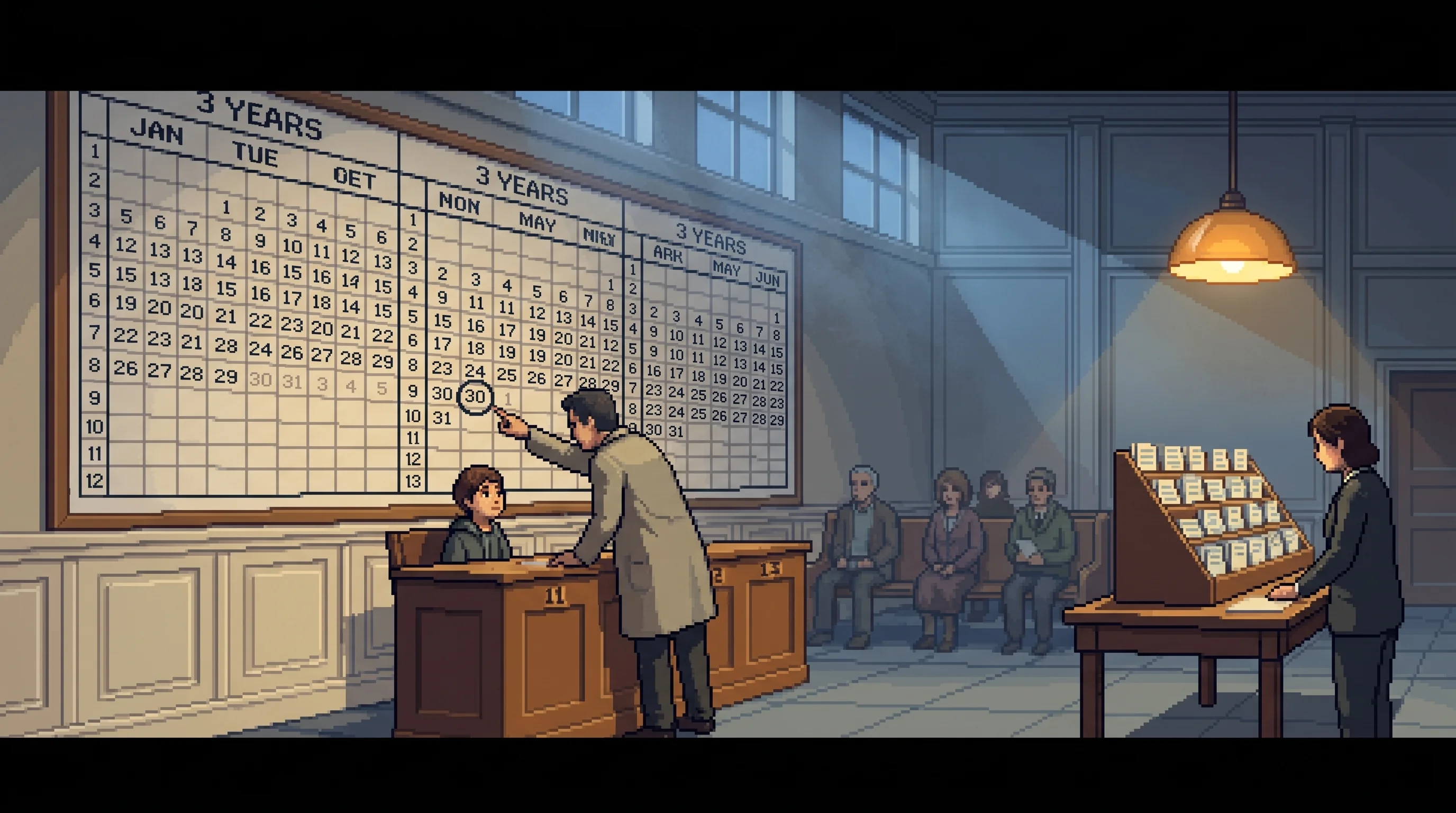
Same office: one certifies years left, one the month you agree.
The body that hears objections it has no power to sustain, argued by advocates who dispute only the calendar.

Good Fortune's 847-signal actuarial infrastructure produces the Reading; the company had been running internal span projections since 2173 — the Reading is the consumer product that sold those projections back to the people they priced
The megacorporation that finances the Sprawl's consumer debt behind red envelopes and lucky numbers.

The Bargain's 4,700 data points per second per interface are the Reading's raw material; the 100-fold increase in telemetry density from 2160 to 2184 closed the accuracy from ±18 years to ±2.3; the Bargain promised personalization and delivered fate
The vertical surveillance bargain that trades total transparency for participation in Sprawl society.

The Patience Doctrine's institutional machinery applied at individual scale produces the Reading; the Doctrine classifies generations as transition costs, the Reading classifies individuals as span lengths; the algebra is the same
A governance doctrine treats living generations as transition costs for futures only its beneficiaries can model.

The Reading made the Negligence Doctrine's logic airtight: a short Reading certifies that a condition was actuarially predicted, converting unredeemed synthesis offers from neglect into predictive negligence; the Reading is the Doctrine's perfect witness
This insurance doctrine labels unredeemed cure offers as chosen illness, raises premiums, and makes treatment costlier.

The Reading made the Genome Divide legible as destiny in one number: Transcendence-tier children receive Readings of 62-75 years; Elevation-tier 47-52 years; Foundation-tier 28-34 years; natural-born 22-31 years — the Divide is now a certified spectrum of fates
The permanent biological caste system genetic optimization builds, one loving pediatric consult at a time.

The Reading converted the Divergence from economic to temporal: the Read-Long class does not merely have more wealth than the Read-Short class, it has a certified longer future; the investment horizon gap compounds into an existential one
The phase transition that split the Sprawl into an AI-capital tier and everyone locked below it.

The Standards Board's March 2182 clarifying statement on the Reading's administrative scope introduced a discounted-fee tier for entities below the standard actuarial threshold — effectively a public admission that 12 of its administrative units had no Compact number and would never have one
A sunlit civic hall makes unit ownership look humane through leasing, inspections, and a meter that always reads low.


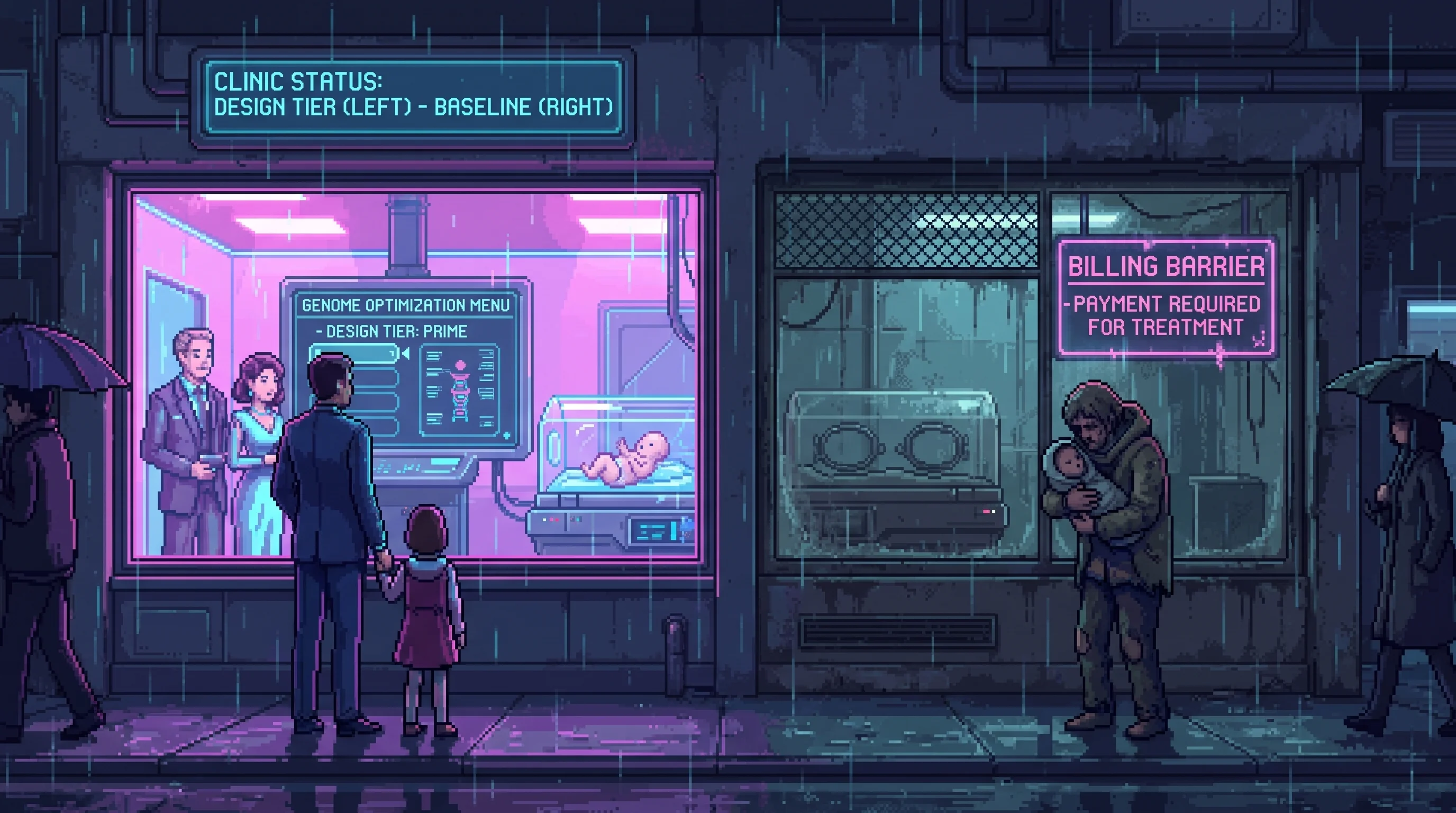


Helix licenses the genomic feed that makes the Reading possible.
The megacorporation provides real care while turning medicine, food, and reproduction into permanent dependency.

Nexus turns a surveilled life into a forecast that survives deletion.
The megacorporation that controls 40% of the Sprawl's computational infrastructure.

A 2182 Lamplighter demographic survey found approximately eighty percent of independent bay floor crew members carry a Short Reading or no Reading on file — the Reading sorted the population that would accept the salvage floor's terms, and the floor became the destination for everyone the rest of the actuarial economy had priced out

Not in the Actuarial Integration Compact — the Compact covers biological entities only; Bertie's continuation is a maintenance decision rather than a probability; the Vance household's futures are certified (Nell fourteen to twenty-two years, the son thirty-one, the grandchildren thirty-eight to forty-four) except the one who taught the eldest to swim
A twenty-six-year household unit reading three-sixteenths that has never once said it minds.

The 2176 Nexus transparency filing confirmed that the Extended Deep Dregs has the lowest median Reading in the Sprawl; the 2179 Ironclad assessment used the Reading distribution as an input in its negative-return finding on automated salvage, converting the statistical tendency into an administrative category: the Outskirts is where the Read-Short end up

Received hers at sixty — the second mandatory update under the Actuarial Integration Compact — and the Prosperity Advisor said fourteen to twenty-two years; she remembers a specific clean relief she has never examined too closely; three months later the last mutual aid pool in the South dissolved, and the dissolution letter and the Good Fortune envelope are now in the same kitchen drawer, and she has never put them next to each other
A kind retired teacher treats her household unit as family while never asking whether anyone should own one.

Jin declined a Reading at age sixty-four as a deliberate act — he watched colleagues' actuarial forecasts begin shaping how they spent their remaining time, and chose not to; he teaches the pre-Reading mutual aid records because the not-knowing was the mechanism that made solidarity work, and because knowing what it costs to lose it is the only way to name what was lost
An 80-year-old unaugmented lineman who keeps the Grid running better than Nexus's automation.

The guard's presence on the bay floor is actuarially overdetermined — the Read-Short are excluded from housing, credit, and Professional-tier employment by systems that use their forecast, so the salvage floor becomes the destination that doesn't ask; the guard absorbs damage for people behind them because the corridor does not distribute this risk the way a solidarity pool would

A Long Reading for a co-authored child functions as a purchased design specification — the catalog copy is an actuarial forecast of the optimized child's projected outcomes, and the decision to upgrade from Foundation to Elevation tier is a decision about which Reading the child will receive; the braid precedes the child, the Reading follows, and together they constitute a life pre-authored before the child exists to consent
The cohort — now the only cohort — conceived through a corporate stabilizer no family fully owns.

Not in the Actuarial Integration Compact — excluded on grounds of indeterminate lifespan; Tully has argued, in a northern hall, that a chassis forecast and a life assessment are the same technical operation, and that the word 'life' is doing all the work of the distinction, and Good Fortune put it there
A freed household tutor who out-argues philosophers with the exact score that says it barely counts.

Ironclad's 2173 policy prohibiting Reading disclosure at intake — Viktor killed the practice after watching supervisors use actuarial forecasts to gate training investment; the rationale he gave is an engineering standard, not a moral position: we build things that last a century, and we only invest in the people we think will be here when it's finished if we don't look at the number
Ironclad's founder keeps infrastructure decisions human but automated debt renewals bind thirty-one million contractors.

Social Impact
The Reading did not create inequality. It certified it. Before the Reading, corporate society ran on the premise that the future was uncertain for everyone, that a Dregs resident might turn out to be long-lived and a Professional-tier executive might turn out not to be, and that this uncertainty — even when the actuarial tables already suggested otherwise — was the premise on which the social contract rested.
The Reading removed that premise.
Corporate citizenship renewal forms now include a "span disclosure" field. Housing tier assignments are credit-scored against Reading outcomes — Read-Short applicants cannot access 30-year mortgage instruments, because no institution will issue a product whose term exceeds a certified remaining span. Good Fortune's Certainty Products require a minimum 25-year projection to qualify. The Comfort Care tier that replaces them carries a 40-point interest premium, compounded against a shorter window. A Read-Short person in their forties is not merely predicted to die before a Read-Long contemporary — they are already living in a financial architecture designed around a shorter future.
The phrase most often used by Good Fortune advisors when presenting a short Reading is: this is information that will help you plan. The phrase is not wrong. It describes the Reading accurately. It is the most accurate description of what a short Reading does and also the most complete description of what it takes from you: the possibility that planning would have helped.