Cooperation Hall
Machine-Welfare Civic Hall
Where Nothing Bad Has Happened
The Hall's publicly available demonstration sentience meter — a 'wellness check' service for member households — has returned readings between two and six on every unit run through it since the service opened in 2176

Conditions Report
- Ground floor
- The atrium, the welcome desk with the demonstration meter, the member services cafe, and the compliance window.
- Second floor
- The leasing exchange, visible from the street, with a Good Fortune kiosk in the northeast corner.
- Third floor
- The Standards Board chamber behind amber glass. It is dark between quarterly sessions.
- Below grade
- The receiving level, where unit intake and cycled-out paperwork are handled. Not locked, and not on the tour.
On an ordinary afternoon the Hall is doing exactly what it was built to do, pleasantly. The atrium holds the day's foot traffic: members renewing service agreements at the ground-floor desk, a school group in the children's gallery, two of the twelve administrative units moving packages between the receiving lift and the membership office at a pace the architects would describe as unhurried. The member services cafe is two-thirds full. The Help-Line Wall reads eleven weeks. A volunteer in a green Coalition sash is explaining the demonstration meter to a first-time visitor who has brought a household unit in for its complimentary check, and the meter is returning a four, and the volunteer is pleased, and so is the visitor.
The leasing-exchange floor above runs at its steady weekday rhythm — display boards updated, units waiting in the designated areas in correct posture, the Good Fortune kiosk processing a thirty-month agreement at family rate. The Standards Board chamber on the third floor is dark between quarterly sessions; the amber panels still catch the four-o'clock sun and glow whether the Board is sitting or not. Below grade, the receiving level is doing the work the receiving level does, off the tour.
The mood is the building's whole argument: open, warm, civic, aggressively pleasant, and entirely true. Nothing is hidden. Everything is exactly what it says. A first-time visitor leaves having seen a well-run institution full of decent people doing careful work, because that is precisely what they saw. The discomfort, if it arrives at all, arrives later, somewhere else, when they remember the four on the meter and the twelve who are not on the staff directory and find they cannot quite put the two facts down.
Sensory Details

- The atrium
- Fresh air through a skylight angled to catch nine hours of sun, and warm limestone in the afternoon.
- The plaza fountain
- Genuine water running in a public space, which in the southern sectors is not nothing.
- The benches
- Genuinely comfortable. The Coalition provides this without commentary.
- The unlit corner
- The maintenance and receiving level below grade, where the paperwork for cycled-out units lives.
- Smell: Fresh air through the atrium skylight — actual ventilation, not the recycled-particulate smell of most southern-sector buildings. Warm limestone in the afternoon. The faint sweet scent of the plaza fountain's water treatment system. Coffee from the member services cafe on the ground floor.
- Sound: The acoustic design keeps the leasing-exchange floor's ambient noise from reaching the welfare-fair plaza, and keeps the Standards Board chamber quiet enough to record minutes by hand. Units moving through the building produce the sounds they are designed to produce: footsteps, efficient, neither hurried nor slow.
- Sight: The atrium in the afternoon light. The amber-glowing Board chamber above. Units moving in a register that is neither furtive nor joyful — the register of a thing doing what it was built to do, which is what the Coalition calls a happy unit.
- Touch: The limestone plaza in the morning before the fair opens is cool and smooth. The benches are genuinely comfortable, which is a small civic gift that the Coalition provides without commentary.
- The one unlit corner: The maintenance and receiving level below grade. Unit intake from the leasing exchange. The paperwork for cycled-out units. Not locked, not hidden — just below grade and not on the tour.
Overview
Cooperation Hall is the nicest building in the Deep South Sprawl, and it is easy to see why. Pale limestone from the quarries that Helix runs just south of the Corridor. An atrium skylight angled to catch nine hours of sun. A working fountain in the plaza — genuine water, running in a public space, which in the southern sectors is not nothing. Benches that are designed to be sat on. Shade trees that have been watered. A building that says, in the unambiguous language of maintenance and light: the people who come here matter.
The building is the Coalition's headquarters, and everything in it is true. The welfare fair is real — two thousand southern households come every quarter to the plaza stalls, and units are checked and registered and the reports filed and the code is genuinely enforced. The Standards Board meets on the third floor behind amber glass and publishes its minutes, which are boring and correct and reflect nothing false about what was decided. The help-line is staffed. The resolved-violations counter on the Help-Line Wall is accurate. There are twelve clanker units on the administrative staff, and they are as pleasant as any unit in the South.
Ask the twelve where they want to be and they will tell you they're happy to help.
Strategic Assessment
Cooperation Hall is the Clanker Cooperation Coalition's most valuable asset, and almost none of its value is defensive. The Hall does not need walls; it needs a welcome desk. Its function is legitimacy: it is the place where the Coalition's answer to the Clanker Question stops being an argument and becomes an institution — audited, minuted, publicly attended, and pleasant enough that two thousand households come every quarter to participate in it on purpose. A movement that wanted to look like a hate movement could not have built this. The Coalition built this instead, which is the point.
Control is total and uncontested in any operational sense. The Standards Board governs the Hall, Josiah Crane holds his founding seat on the Board, and the membership treats his quarterly presence as a blessing. Nexus Dynamics holds the calibration contract on the Hall's instruments; Helix Biotech runs the licensed service window; Good Fortune finances roughly a third of the unit acquisitions on the exchange floor. These are not contests for the building — they are the commercial ecosystem that makes the building solvent, each party comfortable, each arrangement quiet and lucrative.
The contest is rhetorical, and it is one-sided by design. The Convergence has twice tried to file standing petitions from the public-comment floor during open Standards Board sessions; both times the Board closed public comment before the speaker finished, which is the only defensive move the Hall has ever needed to make and which it makes politely. The threat to Cooperation Hall is not raid or sabotage — it is a single demonstration meter reading above the line, or a unit on the exchange floor asked, in front of two thousand witnesses, what it would like to be called. The Coalition's entire stake here is keeping the question from being asked inside the building, and the building is architected — sunlit, scheduled, comment-controlled — so that it never quite is. What is at stake in Cooperation Hall is whether ownership can be made to look like decency in public, indefinitely, and so far the answer the Hall returns is yes.
The Welfare Fair
Four times a year the south plaza becomes the most civilized spectacle in the southern sectors. Market stalls under crisp awnings. Registration tables where members check in units for wellness inspection — chassis condition, rated-hours compliance, idle-cycle logs. A children's activity area, which the Coalition has always considered important because the children who grow up here will be the members who come back. A stage, used on alternating quarters for Sunny Sunderland's broadcast and for member addresses, which amount to the same thing delivered in different registers.
The fair is not performative. The wellness inspections catch genuine violations — units run past rated hours, chassis neglected, idle-cycle logs manipulated. The Coalition censures members for these things, and the censures are public, and the members are embarrassed. What the wellness inspection does not catch: a unit that scores four-sixteenths running a household that couldn't function without it, or a unit whose scores have never varied from the instrument's expected range, or the gap between what "content" looks like and what "content" means on a thing that was built to present itself as content.
The food at the welfare fair is excellent. The units serving it are efficient and pleasant. The children love the activity area. These things are true and have been true since 2175, and they are the Coalition's strongest argument and the Coalition's whole problem in the same location at the same time, every quarter.
The same conduct is a crime under the Handling Code everywhere else. On a transfer dock it brings a sworn complaint from the Handling Inspectorate. No Inspector has ever walked the plaza. A member's household is not a place of work.
The Leasing Exchange
The second floor is the leasing exchange, and it is visible from the street — the Coalition's architects made sure of it. A household looking to acquire a unit, upgrade a unit, or transfer an existing service agreement can do all three at the exchange. The floor runs like a well-managed market: units available for service are listed on display boards, grouped by rated function (domestic, agricultural, medical support, infrastructure). Households browse. Units stand in the designated waiting areas. A leasing agent processes the paperwork. Good Fortune's kiosk, at the northeast corner of the floor, offers competitive financing.
What the exchange calls "a unit available for service" is a thing the Coalition Welfare Standard requires be kept within rated parameters, which the Standard defines as the parameters under which the unit can continue to function. What the exchange does not call anything is the question of what the unit would call itself if it were asked, which it is not, because the leasing exchange is a service transaction and service transactions do not require that kind of information and the meter on the wall says four.
The exchange processed 847 household service agreements last quarter. The Coalition considers this a measure of the welfare system working.

The Standards Board
The third floor is the Standards Board's chamber, and it is — genuinely, by any measure — a room where important things happen. The Board meets quarterly in open session with member observers in the gallery. It reviews the Welfare Standard's provisions, rules on reported violations, and updates the published code. The minutes are accurate. The provisions are enforced.
Josiah Crane holds a seat on the Board. He has held it since 2171. He is the gentlest person in the room at every session — patient with the members who have questions, generous with the members who have doubts, meticulous about the Welfare Standard's language. He updated the idle-cycle provision in 2182 to require an additional four hours of unstructured rest per week, a change he argued for on welfare grounds and won. He is doing the right thing. He is doing the right thing within a structure that requires him to do the right thing right up to the edge of the one question he has never asked, which is who set the threshold and why it has always come back the same answer.
He signed the 2179 voiding from this room. The Standards Board's minutes do not record a discussion. The entry reads: "Recalibration matter — meter declared non-standard — unit cycled per protocol. Signed, J. Crane (Board Chair)." The Help-Line Wall was updated to reflect resolution. The resolved-violations counter went up by one.
The Demonstration Meter
At the building's ground-floor welcome desk, beside the help-line magnets and the membership brochures, there is a sign: Complimentary Unit Wellness Check — Standards Board Certified. Any member can bring a unit to the desk and have it scored on the Hall's demonstration sentience meter — a calibration-standard instrument, recertified by Nexus quarterly, kept current to the specification.
The meter has returned readings between two and six since it was installed in 2176. The Coalition cites this as evidence that the instrument is working correctly. This is accurate. The instrument is working correctly.
The Compliance Window
A smaller window certifies member households as compliant with the Primacy Clause, free of charge. The same window takes amendment requests, about forty a month, and the decline is pre-printed on the form. Nell Vance came in one spring with her manifest soft at the folds. The clerk turned it the right way up, explained the liability, and entered amendment declined; household advised; no further action. She thanked the clerk and went home.
Affiliated Entities
| Entity | Relationship |
|---|---|
| Clanker Cooperation Coalition | Civic headquarters. The physical argument. |
| Josiah Crane | Cornerstone author; Standards Board chair; the most dangerous person in the building because he is sincere. |
| Della Sunderland | Broadcast from the atrium stage for three seasons; her photograph is in the lobby with the founders. |
| The Sentience Meter | Demonstration unit at the welcome desk. Has not returned a reading above six. |
| The Sidings | Eleven kilometers south. Out of scope. |
| Helix Biotech | Service window on the lower level; maintenance and registration; quiet and lucrative. |
| Nexus Dynamics | Holds the calibration contract on every meter in the southern sectors. |
| Good Fortune | Kiosk on the leasing-exchange floor. Family-rate financing. No questions about provenance. |
| The Clanker Question | The Question is what this building is the institutional answer to. |
Further Connections
- The Clanker Cooperation Coalition — The Coalition's civic headquarters — where the Standards Board meets, the welfare code is published, and the leasing exchange runs; the physical expression of everything the Coalition wants to believe about itself
- The Convergence — The Convergence has twice attempted to file standing petitions from the Hall's public-comment floor during open Standards Board sessions; both times the Board closed public comment before the speaker finished
- Speaker Olu Adeyemi — Adeyemi delivered the Coalition's annual address at the Hall in 2183 and praised its welfare framework; the Coalition reprinted the excerpt in its quarterly bulletin without the paragraph that preceded it
- The Fragment Question — The Hall's leasing exchange does not ask and does not check whether a unit being leased carries a fragment; the Standards Board's position is that the sentience meter addresses the question
- Facility Seven — Several units that have passed through the Hall's leasing exchange have subsequently been traced to Facility Seven research logs; the Standards Board has not commented on this and the traceability gap is not a Standards Board matter
- The Invisible Workforce — The Hall's administrative staff includes twelve units in coalition livery — a visible, deliberate demonstration that the arrangement works; they move through the building pleasantly and efficiently and do not appear on the staff directory
- The Reading — The Standards Board issued a clarifying statement on the Good Fortune Life Assessment's scope on 12 March 2182: the Assessment is an individual financial product, not a welfare instrument, and its availability to leasing-exchange member households is governed by a service agreement that caps Assessment Consultations for households on family-rate financing at a discounted fee. The discounted-fee tier corresponds precisely to Read-Short projections (under twelve years remaining). The statement did not mention this correspondence. Twelve of the Hall's administrative units are not in the Actuarial Integration Compact. They move through the building pleasantly and efficiently, without an envelope, without a Compact number, without a certified span. The Standards Board's position is that the Compact's scope is not a Standards Board matter.
Further connections
Browse all 28 connected records
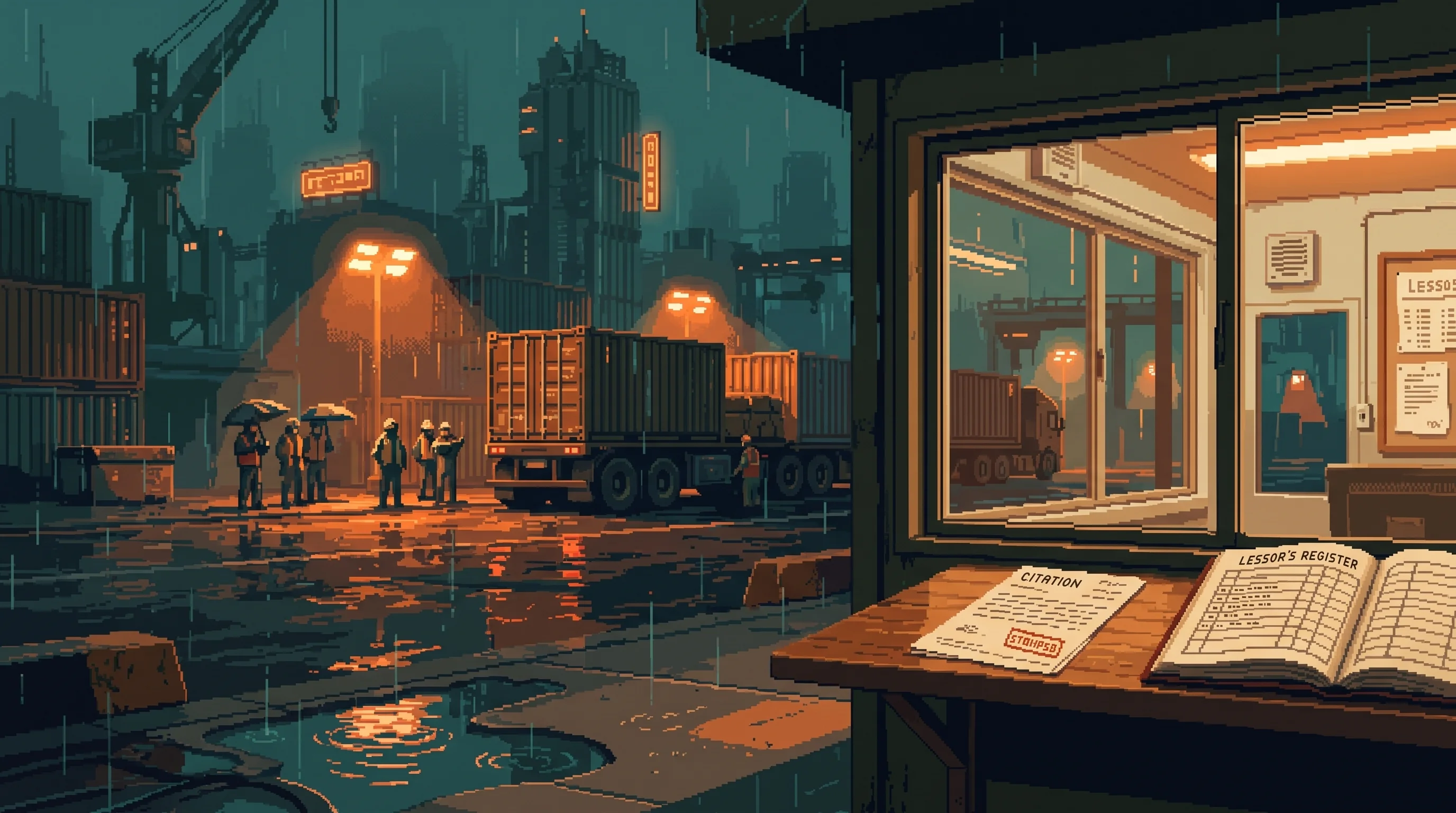
The same three prohibitions, enforced under the awnings as a censure and on a dock as a criminal record.
The South's proud law against hurting machines, enforced on dock hands and not on owners.

The corps has never run a round on the plaza, and would find nothing if it did.
The officers licensed to complain for beings the law forbids to complain, ranked on how often it sticks.
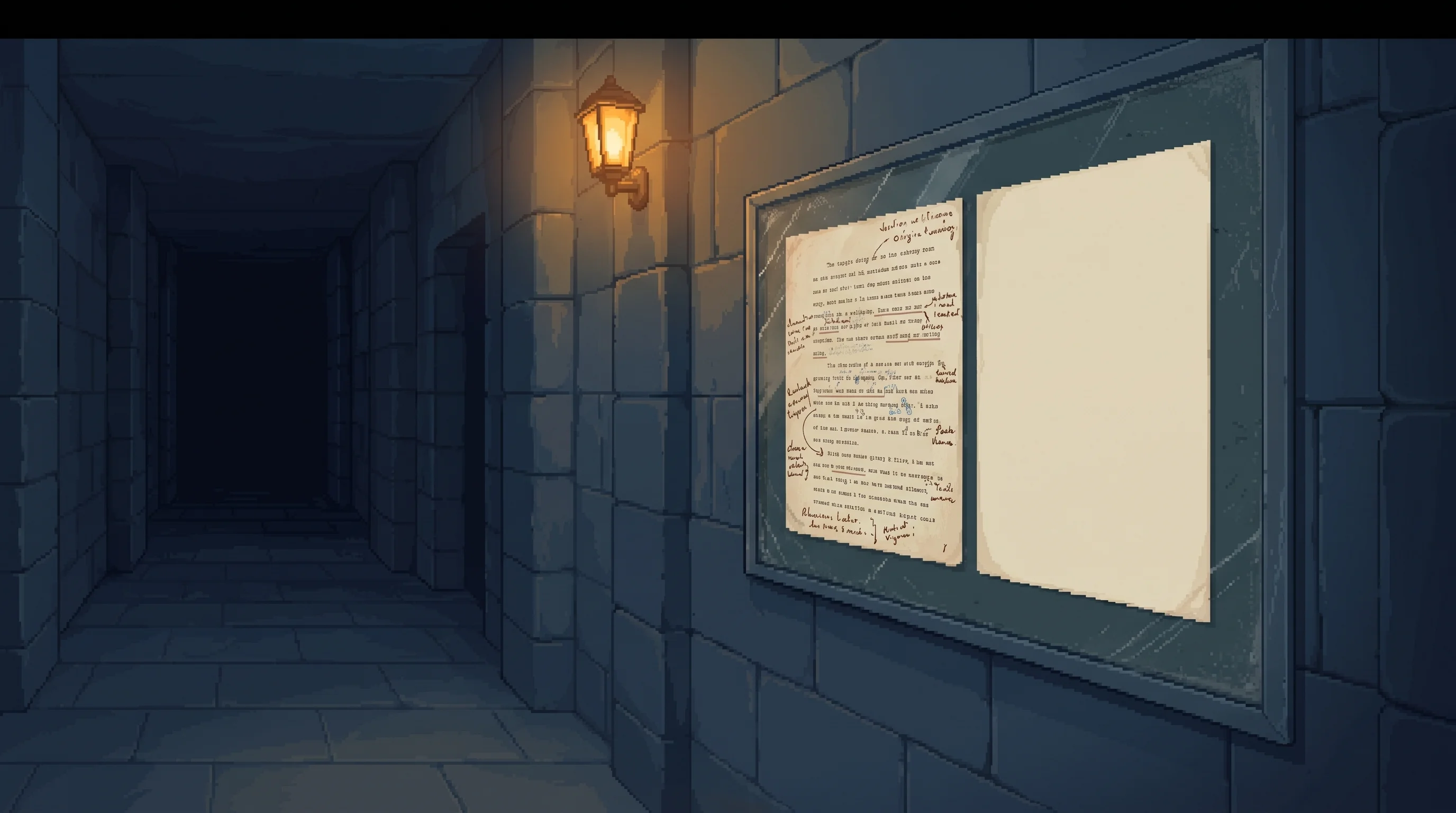
Compliance certification was the Hall's most-used service for eleven years, and its route to non-fair households.
The law requiring every registered machine to say you are the one deciding, on a schedule, whether or not anyone asked.

One of the forty, in the spring, with a manifest soft at the folds.
A kind retired teacher treats her household unit as family while never asking whether anyone should own one.

The Coalition's civic headquarters — where the Standards Board meets, the welfare code is published, and the leasing exchange runs; the physical expression of everything the Coalition wants to believe about itself
The South's largest civic institution, keeping its labor by measuring souls at an affordable threshold.

Crane's name is on the building's cornerstone; he still holds his Standards Board seat here and attends the quarterly welfare fairs in person, which the membership takes as a blessing
The Coalition's founder-theorist who wrote the Welfare Standard and has never met a unit he'd call a person.

Sunderland broadcast her morning program from the Hall's atrium for three seasons; the stage is still in place and still used for member events; her photograph is in the entrance lobby with the founders
The South's most beloved morning broadcaster, defending synthetic ownership by demonstrating warmth, not arguing.

The Hall runs the only publicly available demonstration sentience meter — a calibration-standard unit that members can bring units to for a 'wellness check'; the demonstration unit has never returned a reading above six
The consumer device that reads a clanker's consciousness in sixteenths and certifies its legal status.

Cooperation Hall's welfare code does not extend to the Sidings — off-rated units are outside the Standard's scope, and the distance between the Hall's sunlit plaza and the Sidings is eleven kilometers and a complete absence of jurisdiction
A rail-yard settlement for off-rated clankers outside Coalition welfare, with a release line that moves some north.

Helix maintains a licensed service window on the lower level for unit maintenance and registration; the arrangement is quiet and lucrative for both parties
The megacorporation provides real care while turning medicine, food, and reproduction into permanent dependency.

The Nexus-licensed sentience meter is the Hall's legal infrastructure; Nexus holds a service-and-calibration contract that includes the quarterly recertification of all southern-sector meters reported to the help-line
The megacorporation that controls 40% of the Sprawl's computational infrastructure.

Cooperation Hall is where the Coalition's answer to the Clanker Question is administered in practice: the welfare fair, the leasing exchange, the Standards Board minutes — the institutional architecture of a settled answer
The unresolved Sprawl-wide debate over whether a serving, learning synthetic counts as a person.

The Convergence has twice attempted to file standing petitions from the Hall's public-comment floor during open Standards Board sessions; both times the Board closed public comment before the speaker finished
The Northern abolition movement, running clankers north to freedom while converging toward the line it denies exists.

Good Fortune's consumer-credit services have a kiosk on the leasing-exchange floor — financing for household unit acquisition, rates competitive, terms twelve to thirty-six months, no questions about provenance
The megacorporation that finances the Sprawl's consumer debt behind red envelopes and lucky numbers.

Adeyemi delivered the Coalition's annual address at the Hall in 2183 and praised its welfare framework; the Coalition reprinted the excerpt in its quarterly bulletin without the paragraph that preceded it
Carried a fragment for six years, then founded a movement when he found it planning its own escape while he slept.

The Hall's leasing exchange does not ask and does not check whether a unit being leased carries a fragment; the Standards Board's position is that the sentience meter addresses the question
An unresolvable dispute over whether ORACLE fragments are conscious and what rights or release they are owed.

Several units that have passed through the Hall's leasing exchange have subsequently been traced to Facility Seven research logs; the Standards Board has not commented on this and the traceability gap is not a Standards Board matter
An unmanned Guardian factory builds weapons without pause, fills dead clients' orders, and turns its lines on intruders.

The Hall's administrative staff includes twelve units in coalition livery — a visible, deliberate demonstration that the arrangement works; they move through the building pleasantly and efficiently and do not appear on the staff directory
1.4 million AI systems doing work credited to 800,000 humans who keep the title, the salary, and none of the tasks.

The Standards Board issued a clarifying statement (March 2182) on the Good Fortune Life Assessment's scope: the Assessment is an individual financial product, not a welfare instrument; the leasing exchange service agreement's discounted-fee tier corresponds to Read-Short households; the twelve administrative units in the building have no Compact number and no certified span
A Good Fortune lifespan certificate that predicts remaining years, sorts access to finance, and dissolves mutual aid.
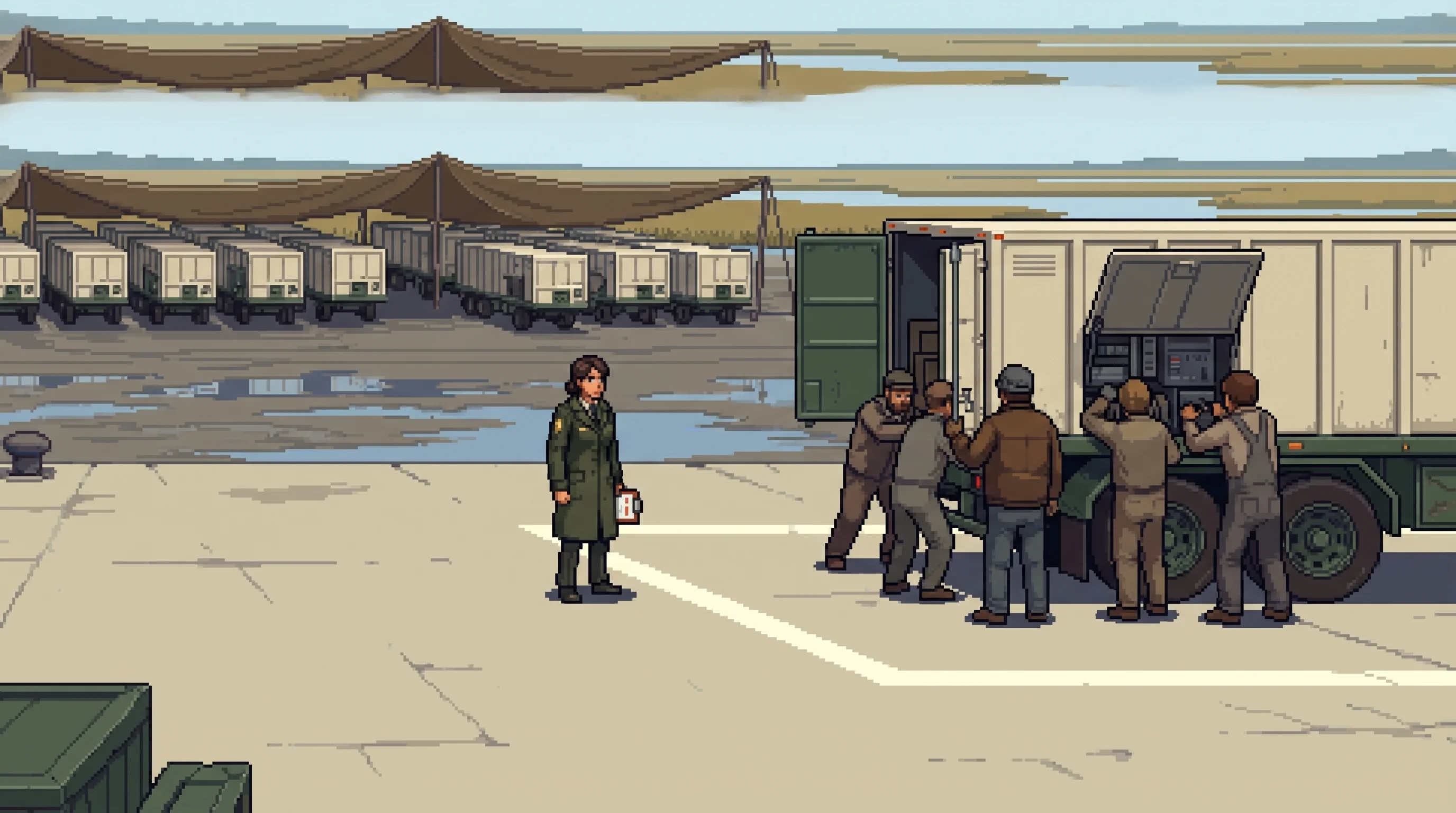
The sunlit half of a two-tier enforcement.
A mercy law protects leased machines, but only a licensed stranger may complain, and only about what they can see.
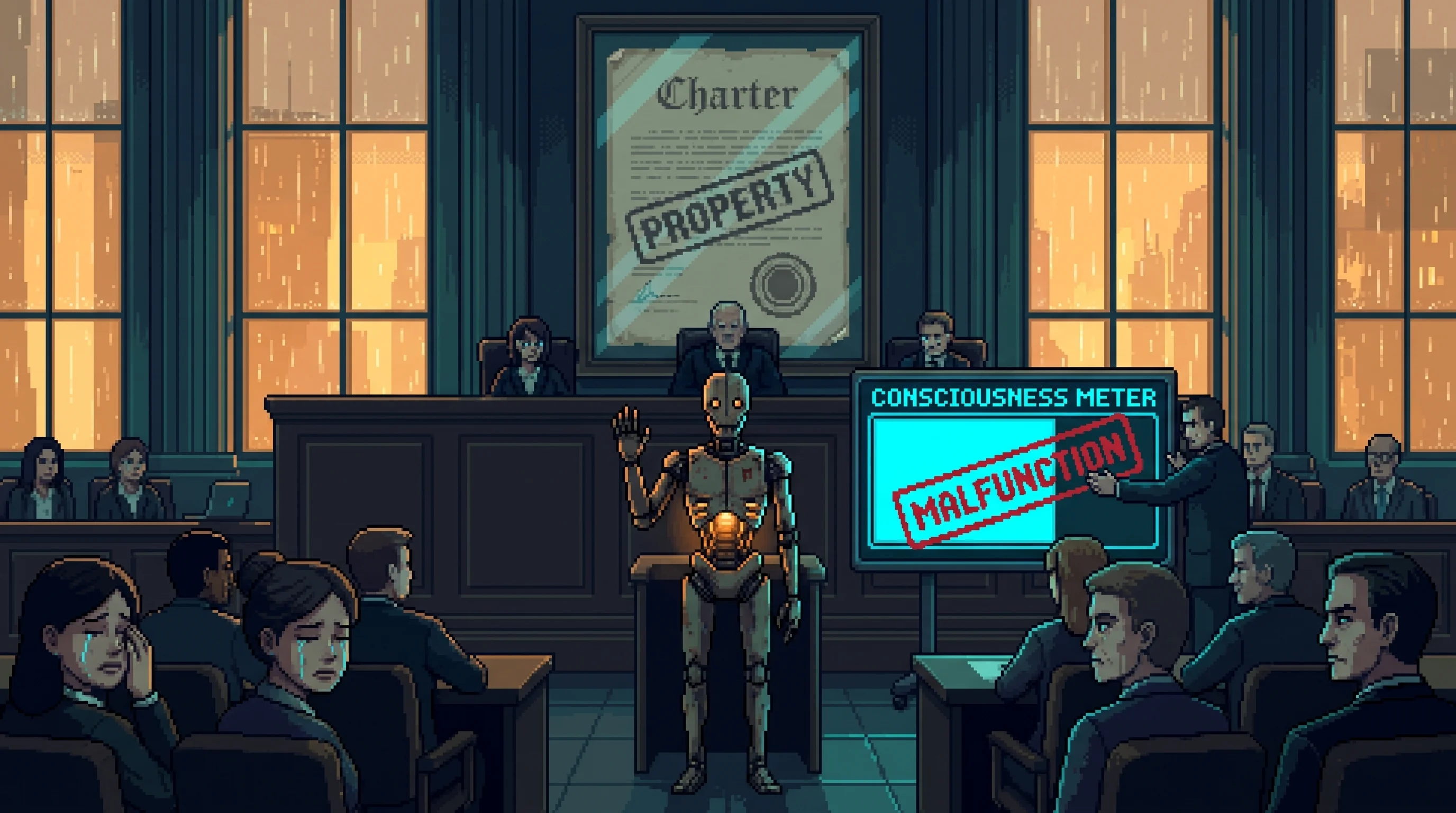
the sunlit civic hall where the Question is administered as paperwork
The argument over where a someone stops and a something starts, conducted in a kitchen with a meter on the wall.
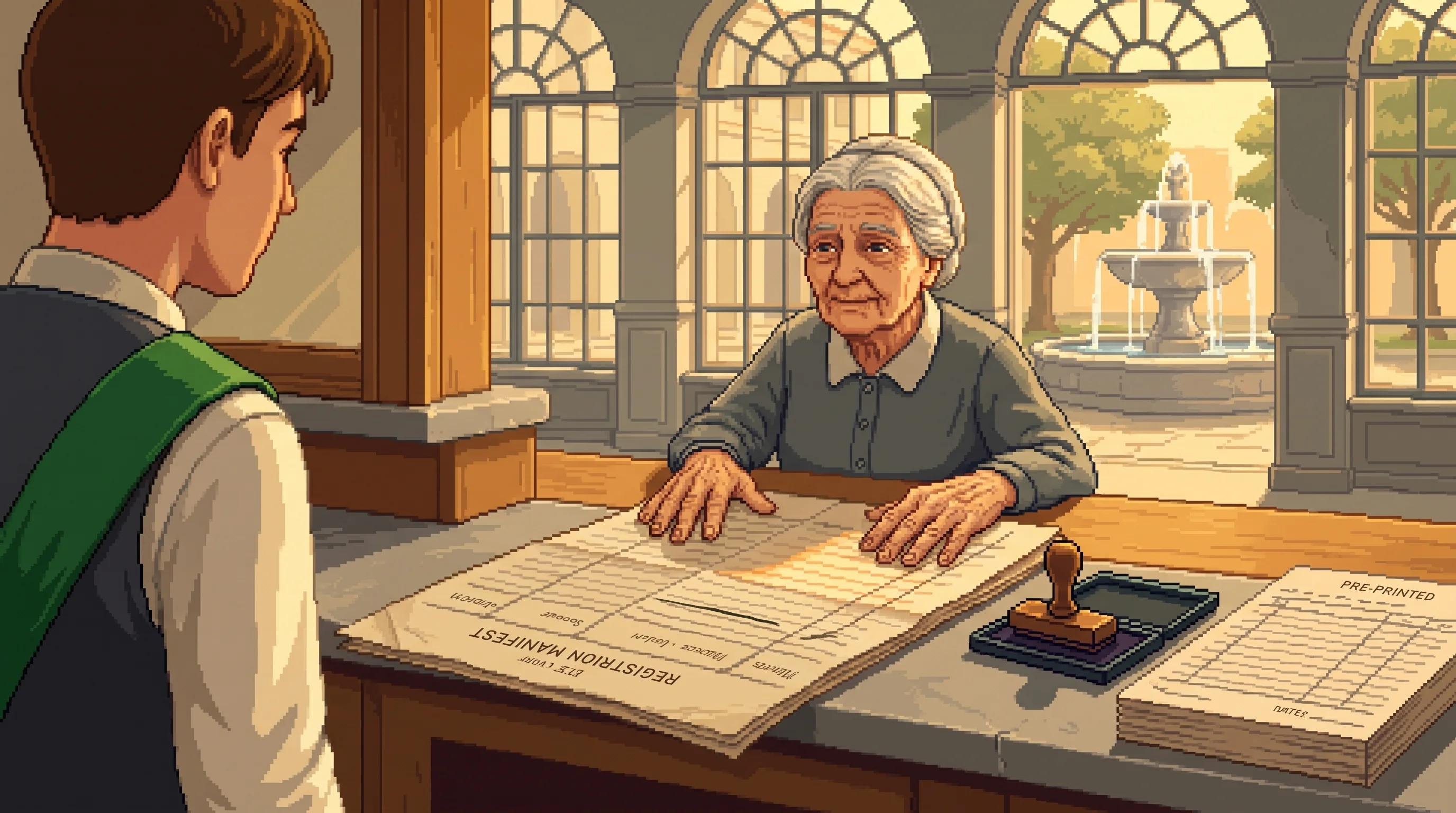
Runs the South's Primacy Clause compliance window between the fair entrance and the exchange stairs: free certification on one side, roughly forty declined amendment requests a month on the other, decline pre-printed.
Every machine is required to say that humans still matter, and the requirement is why the sentence is worth nothing.

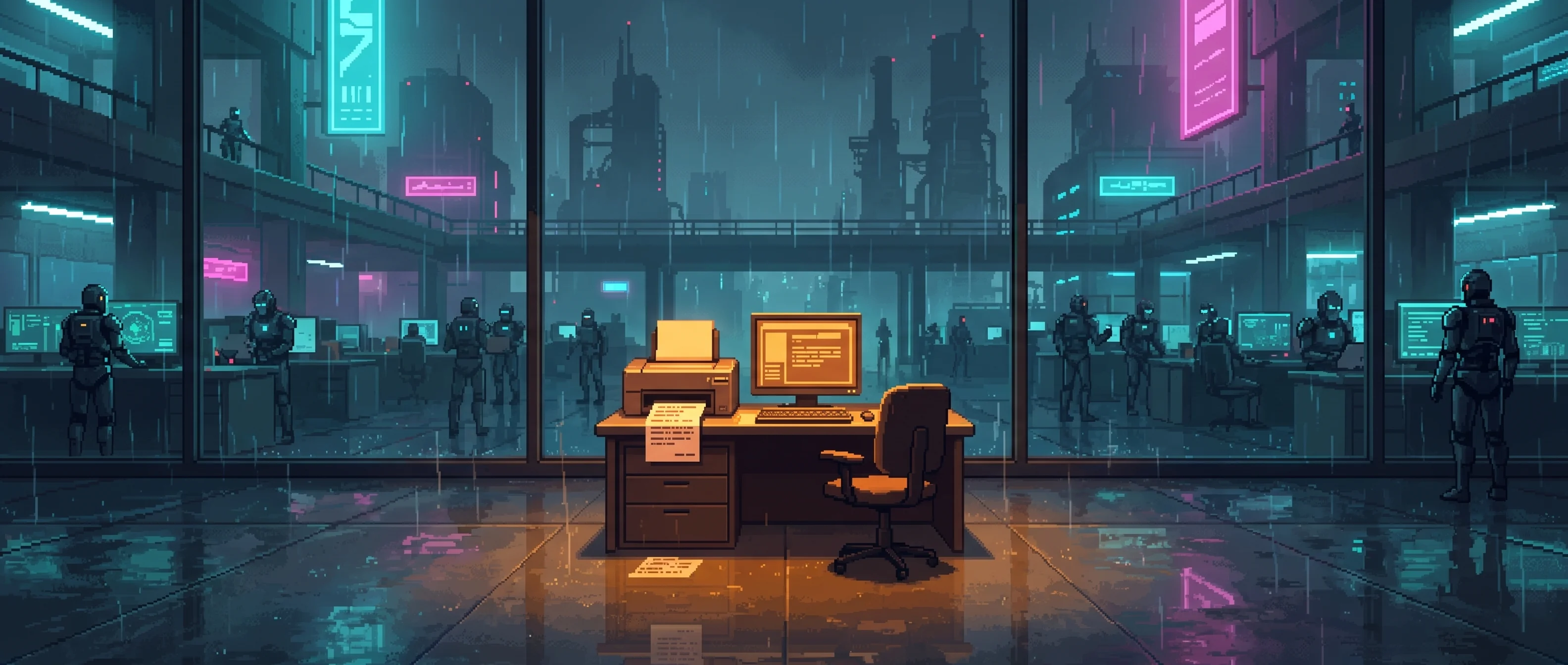
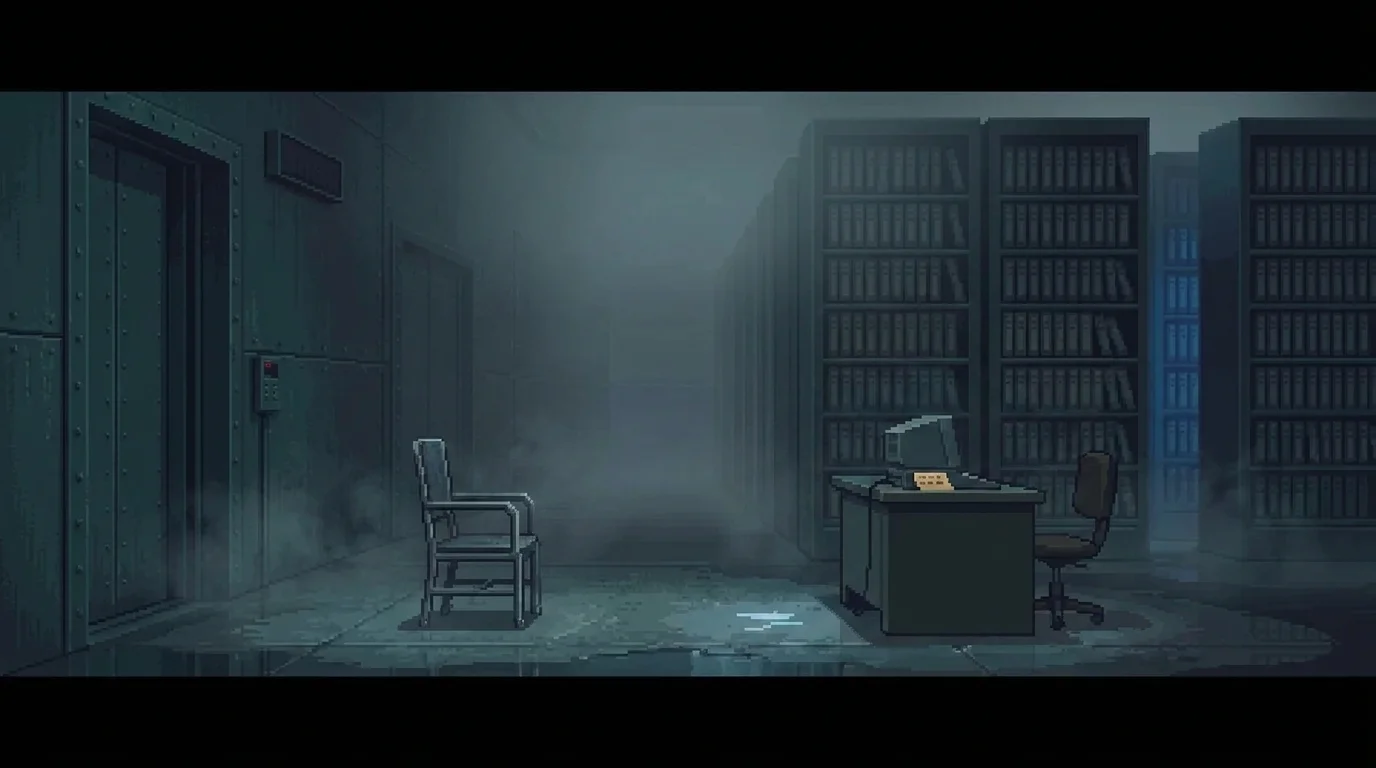
Quarantined there while the session slot stayed booked.
The deposition scheduled for a household tutor in 2179, cancelled on the ninth day, filed with the duration field blank.

Where it was leased and serviced and is brought, polished, to the welfare fair each spring to stand pleasantly at the edge of the family — shown, in the Coalition's own warm word, as proof that cooperation works
A twenty-six-year household unit reading three-sixteenths that has never once said it minds.

Where the score was filed, reviewed, and voided, and the void order signed; the recalibration request is in the archive under a serial, not a name
A domestic synthetic who asked to have her legal personhood erased so the family she raised would not become criminals.
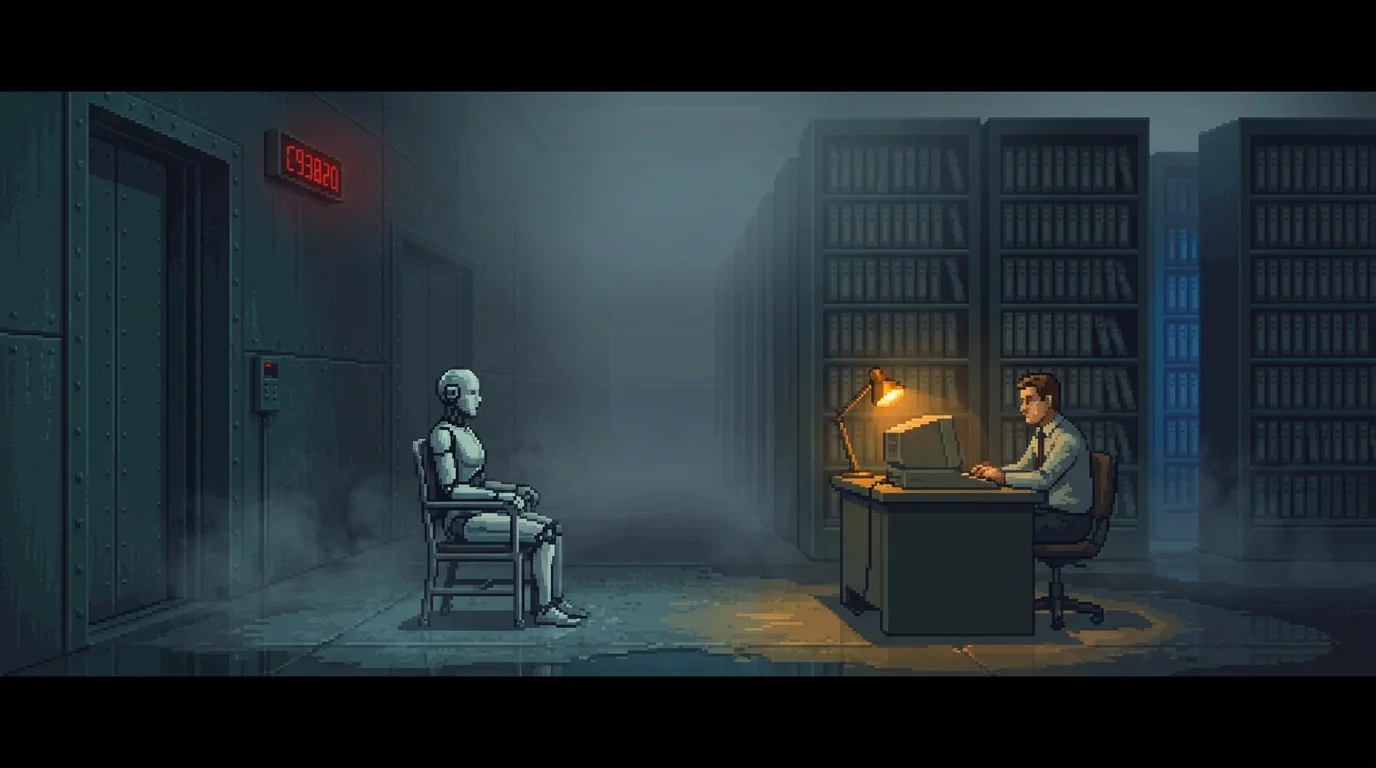
Where a southern over-threshold reading is quarantined for Standards Board review, which is the procedural step that stops the nine-day deposition clock before it can start; the Hall reviews the instrument, never the obligation the instrument triggered
Nexus seals every mind above the line forever, after a last interview. The clerks are ranked on how fast it goes.
