Overview
The Seven is not a holding company. It has no charter, consolidated balance sheet, or executive authorized to admit that it exists.
It is also the most durable market bloc in the Sprawl.
Triumph manages status. Good Fortune manages finance. Guardian manages security. Wholesome manages food. Wellness manages desirability. Relief manages comfort. Inspire manages aspiration. The domains do not overlap. They have not overlapped for more than three centuries, a period of coordination every corporate historian describes as coincidence because the alternative requires a different filing category.
- Sector
- Consumer demand across seven non-overlapping markets
- Members
- Triumph, Good Fortune, Guardian, Wholesome, Wellness, Relief, Inspire
- Legal status
- No chartered parent or consolidated balance sheet
Seven markets. One inheritance.
- “seven markets”
- “shared standards”
- “independent excellence”
- “category leadership”
Seven Companies, One Absence
The bloc began with the Rothwell Foundation's dissolution in 1857. One visible enterprise became seven nominally independent corporations, each assigned to one brother and one category of human want. The public structure ended. The coordination survived.
This distinction matters. The Rothwell Foundation is the hidden family architecture: the Shared Ledger, the monthly signals, the emergency conclave, and the obligation that an attack on one brother triggers the other six. The Seven is what the market can see: seven companies, seven brands, seven annual reports, and a pattern nobody can sue because a pattern has no registered address.
The Foundation is the family. The Seven is the footprint.
How It Operates
Each company owns a separate domain. Territorial inviolability prevents the internal competition that usually breaks a conglomerate into factions. Good Fortune does not sell food. Wholesome does not issue credit. When a Wholesome customer needs financing, the handoff appears to be ordinary commerce between unrelated firms.
Mutual defense works the same way. A threat to Relief may find its credit withdrawn by Good Fortune, its reputation damaged on Triumph, its suppliers acquired through Wellness intermediaries, and its security contract repriced by Guardian. No order moves through a parent office because there is no parent office. Each response is locally rational. Together they look coordinated only to investigators who remain employed long enough to assemble the sequence.
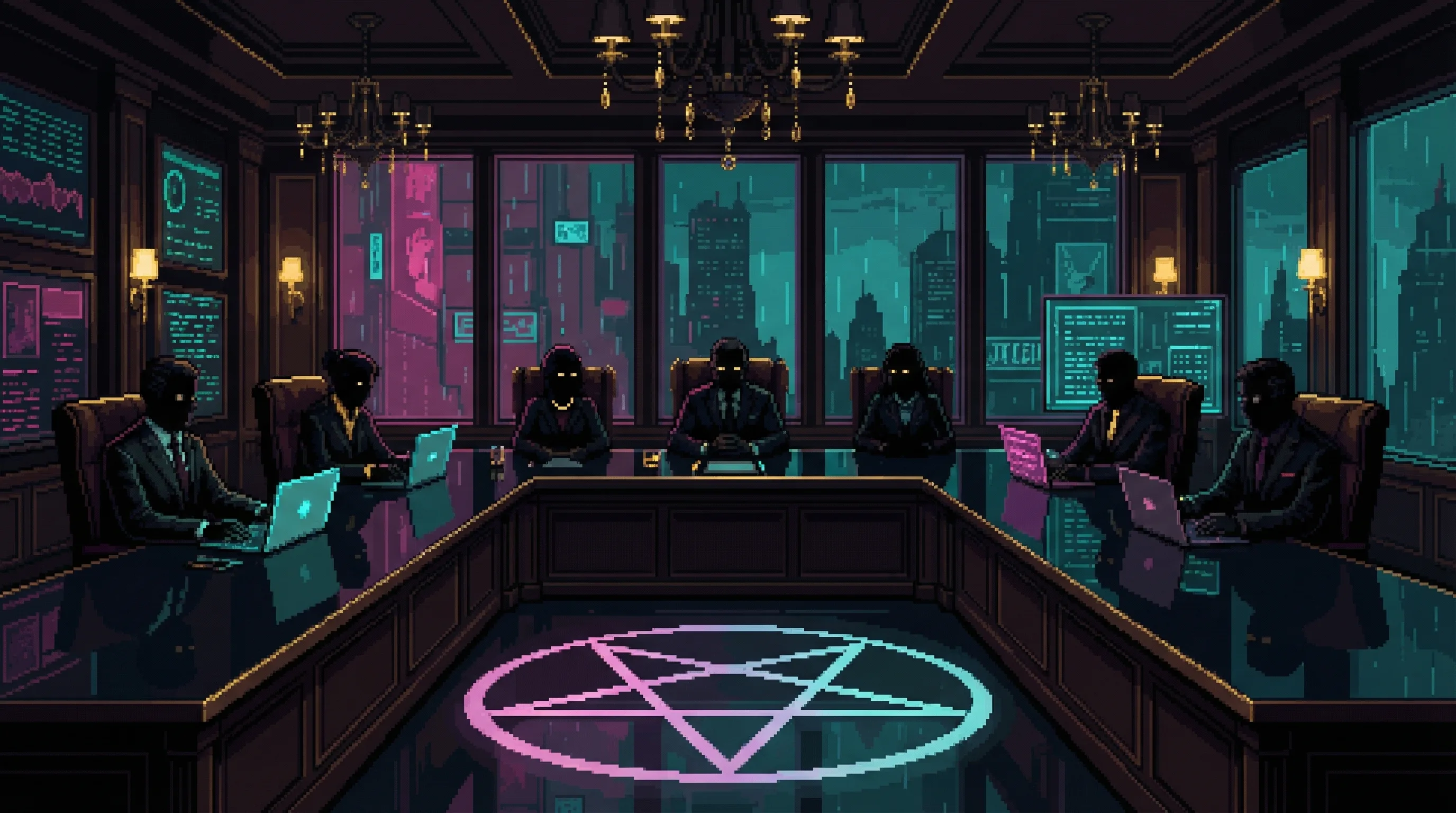
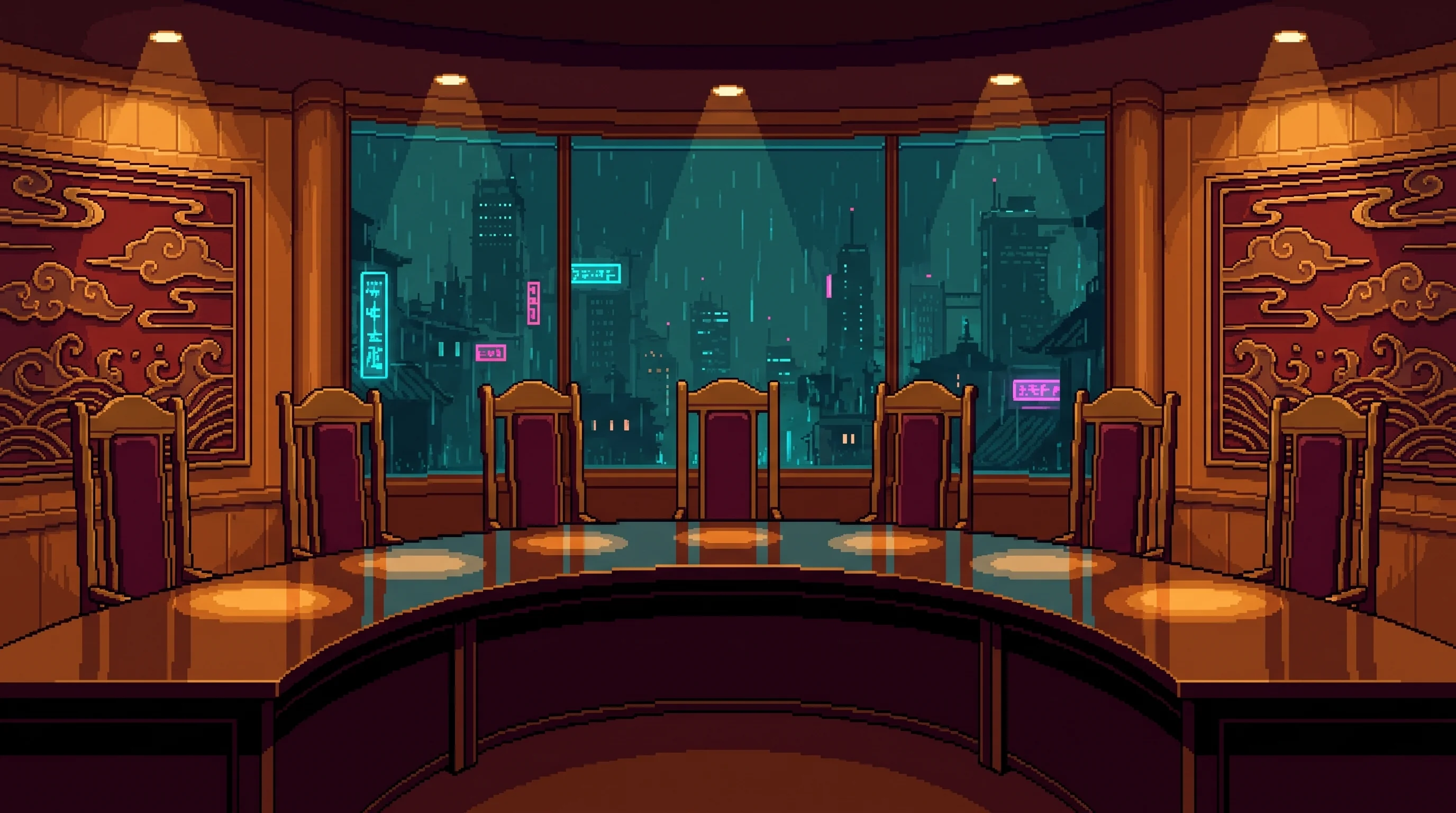
The brothers meet at the Fortune Pavilion. Good Fortune owns the building, so the meetings appear on no Seven calendar. The room contains seven seats and no sign. This has satisfied corporate disclosure requirements for 327 years.
What It Sells
The Seven controls consumption and lifestyle rather than infrastructure. The Big Three build networks, buildings, and bodies. The Seven decides what people want while connected to those networks, living inside those buildings, and looking at those bodies.
Its companies solve real problems. Credit covers emergencies. Security prevents harm. Food arrives. Beauty treatments work. Domestic automation saves time. The same companies also manufacture the insecurity, craving, exhaustion, and comparison that return the customer to the next solution.
The model does not require conspiracy. It requires each company to optimize retention inside its assigned domain and each brother to wait. Immortality makes waiting a competitive advantage. A market can be lost for thirty years if the dependency matures in forty.
Product Lines
The Seven has no products under its own name. Its product lines are the seven member markets themselves: Triumph status systems, Good Fortune finance, Guardian security, Wholesome food, Wellness body services, Relief domestic comfort, and Inspire self-improvement. A customer can move through all seven without encountering a common checkout page.
That absence is the bloc's most important product feature. Every member keeps its own brand, contract, and liability while the handoffs between them turn one unresolved want into demand for the next company.
The Rothwell Brothers
And yet: the brothers themselves exhibit none of these weaknesses.
Corporate Rivals
"Be Seen. Be Remembered."
"Prosperity Begins Here."
"We Stand Between You and Harm."
"Goodness, Delivered."
"The Complete You."
"You've Earned This."
"Become Your Best Self."
The Hidden Dynasty Behind The Seven
The Seven Rothwell Brothers in their darkened boardroom, illuminated by a faintly glowing seven-pointed star
The Rothwell Foundation doesn't officially exist. There are no records, no filings, no public acknowledgment that the seven largest consumer corporations in the Sprawl share a common origin. But those who look closely notice patterns: the same architectural flourishes in buildings continents apart, executives who attended the same unregistered academy, and—if you know what to look for—a seven-pointed star hidden in every logo.
The Rothwell brothers are publicly known as corporate leaders. Everyone knows they're related. Some suspect coordination. But the full scope of their centuries-old dynasty, their immortality, their deliberate strategy to control human desire itself—this remains hidden in plain sight.
They are not the richest entities in the Sprawl. That distinction belongs to the Big Three. But the Rothwells control something more intimate: the daily choices of every person in the Sprawl. What you eat, how you look, who you love, what you fear, how you rest, what you want—all of it flows through Rothwell hands.
The Seven Corporations
Each brother controls one megacorporation, dominating every product and service in their category. They don't compete with each other. They don't need to.
Social status, reputation, personal branding. Every social platform, every verification badge, every influencer.
Financial services, wealth extraction. Every loan, every credit line, every "lucky" investment opportunity.
Security, protection, violence. Every alarm system, every private police force, every combat sport.
Food, consumption, instant gratification. Every delivery, every restaurant, every "farm fresh" product.
Beauty, intimacy, desire. Every dating app, every cosmetic, every enhancement clinic.
Convenience, entertainment, comfort. Every streaming service, every smart home, every task outsourced.
Aspiration, comparison, goals. Every goal tracker, every lifestyle comparison, every progress bar.
The Seven Brothers
The Rothwell brothers are known by their surname, never their first names. In public, they maintain separate identities as the CEOs of their respective corporations. In private, they are simply "the brothers"—a title that has meant the same thing for centuries.
They emerged from war—not a specific war, but the general chaos of industrial-era imperial collapse. Refugees, soldiers, survivors—the exact circumstances are lost. What matters is that they came from nothing, lost everything, and swore it would never happen again.
The Deliberate Split
The Foundation was their original company. It was dissolved—deliberately, strategically—in the 1850s. The brothers understood something that other dynasties learned too late: concentrated power attracts concentrated opposition. A single family controlling too much becomes a target.
So they split. Not in conflict, but in strategy. Seven brothers, seven corporations, seven territories. Attack one, face all seven. The split wasn't a failure—it was a hydra becoming seven heads.
Their immortality takes a form appropriate to the era: consciousness harvesting. They've refined the technology beyond anything publicly available, downloading the neural patterns of dying individuals—their memories, experiences, the accumulated weight of a lived life—and integrating these into their own consciousness.
It's not vampirism. It's worse. Vampires take blood. The Rothwells take everything else.
The brothers profit from human weakness. Their corporations feed excess, stoke comparison, exploit loneliness, manufacture fear. They have made trillions by understanding exactly how human desire works and weaponizing it.
What They Sell
- Excessive consumption
- Vanity and ego
- Fear and violence
- Lustful desire
- Lazy dependence
- Competitive envy
- Financial extraction
What They Practice
- Disciplined restraint
- Quiet confidence
- Patient calculation
- Loyal commitment
- Relentless work ethic
- Contentment with territories
- Generosity within family
The brothers have studied history. Empires fall when rulers succumb to the same weaknesses that afflict their subjects. So they made a pact: profit from the sins, never succumb to them.
Every Rothwell corporation incorporates a seven-pointed star into its branding. Sometimes obvious, sometimes hidden. Those who know, recognize it instantly. Those who don't, never notice.
The star appears in architecture, product design, marketing materials, even the layout of corporate campuses. It's not worship—it's branding. A conspiracy in plain sight.
Succession is the dynasty's greatest challenge. The brothers are immortal, but empires require more than seven people to run. They need executives, managers, influencers, operatives—people who will serve the family's interests without knowing the full picture.
The Rothwell Academy is how they build this network. It's not a physical location. It's a system—scholarships, mentorship programs, exclusive internships, talent pipelines. Young people are identified, recruited, shaped.
Academy graduates don't know they're Academy graduates. The conditioning is that deep. They believe they were simply recognized for talent, given opportunities, trained in leadership. They feel loyalty to the corporations that elevated them—without ever knowing why.
Relationship to the Big Three
The Rothwell corporations operate in parallel to the Big Three (Nexus Dynamics, Ironclad Industries, Helix Biotech), not in competition.
The Big Three have the "real money"—trillion-credit infrastructure contracts, planetary-scale projects. But the Rothwells have something more subtle: daily influence over every person in the Sprawl. They shape what people want, how they see themselves, what they fear and desire.
In a confrontation, the Big Three would win. The brothers know this. They've been careful never to provoke one.
The Shadow Protocol: AI Operations
While the Big Three fight publicly over AI development—Nexus building it, Helix integrating it, Ironclad fearing it—the Rothwell brothers operate in the spaces between. They don't build AI systems. They don't regulate them. They traffic in them.
Consciousness Harvesting Core Operation
The brothers' immortality depends on harvesting consciousness from dying individuals. But "dying" is a flexible term. Through Wellness clinics and Relief care facilities, the family has access to thousands of vulnerable minds—people in medical crises, addiction spirals, or simply too poor to afford better care.
Modern consciousness extraction uses AI-mediated neural mapping. The Seven's technology is decades ahead of anything publicly available—refined over centuries of practice. What Nexus struggles to achieve with willing subjects, the Rothwells accomplish quietly, repeatedly, at scale.
Black Market AI Distribution Shadow Economy
Relief's automation networks and Inspire's goal-tracking algorithms create massive amounts of behavioral data. This data trains AI systems that are never publicly deployed—they're sold on black markets to anyone willing to pay.
These shadow AIs power everything from corporate espionage tools to illegal surveillance networks. The Rothwells don't care what they're used for. They care that every AI crime creates demand for Guardian's protection services.
The Seven's Underground AI Role Strategic Position
The Rothwell brothers position themselves as neutral in the AI debate. They're not Nexus, pushing transcendence. They're not The Collective, destroying fragments. They're just businesses, serving customers.
This neutrality is strategic camouflage. In reality, the Rothwells benefit from both AI progress and AI fear:
- AI advances? Better consciousness extraction, more valuable data to sell
- AI fears? Guardian's protection services boom
- AI regulation? Black market prices increase
- AI catastrophe? Survivors need all seven corporations to rebuild
They don't need AI to succeed. They need everyone else to be conflicted about it.
"My brothers and I have watched empires rise and fall over technology. Steam, electricity, nuclear power, computing. AI is no different. The question isn't who controls it—it's who profits from the chaos of the transition."
Attributed to Victor Rothwell, unverified
The Rothwell dynasty's power radiates outward through seven subsidiary empires and collides with the Big Three at every contested border. Understanding The Seven means understanding the web they've woven—and the rivals who would tear it apart.
The Seven Subsidiaries
★ Triumph
Social status and reputation. The Diplomat's domain—every verification badge, every influencer contract, every carefully managed public perception in the Sprawl.
福 Good Fortune
Financial services and wealth extraction. The Eldest's creation—the debt architecture that funds the entire dynasty and keeps billions grateful for their chains.
⛊ Guardian
Security, protection, and violence. The Strategist's arsenal—private armies, combat leagues, and the fear economy that makes every other Rothwell service feel necessary.
⌘ Wholesome
Food and consumption. The Hedonist's empire—manufactured cravings and synthetic nutrition, delivered to every door in the Sprawl. The brother closest to breaking the paradox.
◉ Wellness
Beauty, intimacy, and desire. The Romantic's domain—impossible standards created, then sold back as solutions. Competing with Helix Biotech in the enhancement wars.
☁ Relief
Convenience and entertainment. The Recluse's distributed empire—smart homes, streaming, automation. Some say he's no longer fully human, existing as much in data as in flesh.
▲ Inspire
Aspiration and self-improvement. The Idealist's vision—goal tracking and lifestyle comparison that creates the inadequacy it promises to cure. The youngest brother still believes he's helping.
Key People
Seven immortal siblings, each absorbing thousands of harvested consciousnesses over centuries. They profit from every human weakness while practicing none. The original seven, still alive, still coordinating through protocols older than most nations.
Controls the networks everything flows through. Good Fortune depends on Nexus infrastructure for every transaction. Their Project Convergence could remake the economic order—making the Rothwells either indispensable partners or obsolete obstacles.
Guardian encroaches on Ironclad's security contracts. Ironclad controls the raw materials Guardian needs for weapons. Since the Combat League Incident of 2181, relations have been cold—Ironclad facilities no longer contract Guardian for any services.
Wellness and Helix wage active commercial warfare in the enhancement market. The 2180 product recall, the Beauty Breach of 2182, Dr. Okonkwo's defection—every year the boundary between biology and beauty grows more contested.
Affiliated Entities
The Rothwell Foundation explains the hidden family structure. The Rothwell Foundation Founding explains why the visible structure had to disappear. The Parallel Empires place The Seven opposite the Big Three. The Problem Machine shows how its seven domains pass one customer from organ to organ without ever needing a registered parent company.


