
The Night Shift
Users receive no compensation — Section 23.4 licensing terms classify sleep processing as 'optimization'
Overview
You don't remember the work because you weren't conscious for it.
The Night Shift is the Dregs term for the cognitive labor your augmented mind performs while you sleep. CMP-4.7 — rolled out in the 2176 Circadian Protocol update — was marketed by Nexus as "background optimization." The processing is optimization. What the firmware documentation omits: during the 6-8 hours of natural sleep a Professional-tier user still requires, their neural enhancement generates billable output. Data analysis. Pattern recognition. Distributed cognitive tasks that corporations outsource to sleeping human brains because human neural substrate produces pattern insights that pure silicon doesn't.
Per-user output is modest. Approximately ¢40-80 per night depending on cognitive tier and task assignment. Across 200 million Professional-tier users, the Night Shift generates approximately ¢6 billion annually. The user receives nothing. Section 23.4 of the Professional-tier licensing agreement: "Licensee grants Licensor the right to utilize surplus processing capacity during periods of reduced conscious engagement for system maintenance and optimization purposes." The word "surplus" is doing extraordinary work in that sentence. The word "optimization" is doing more.
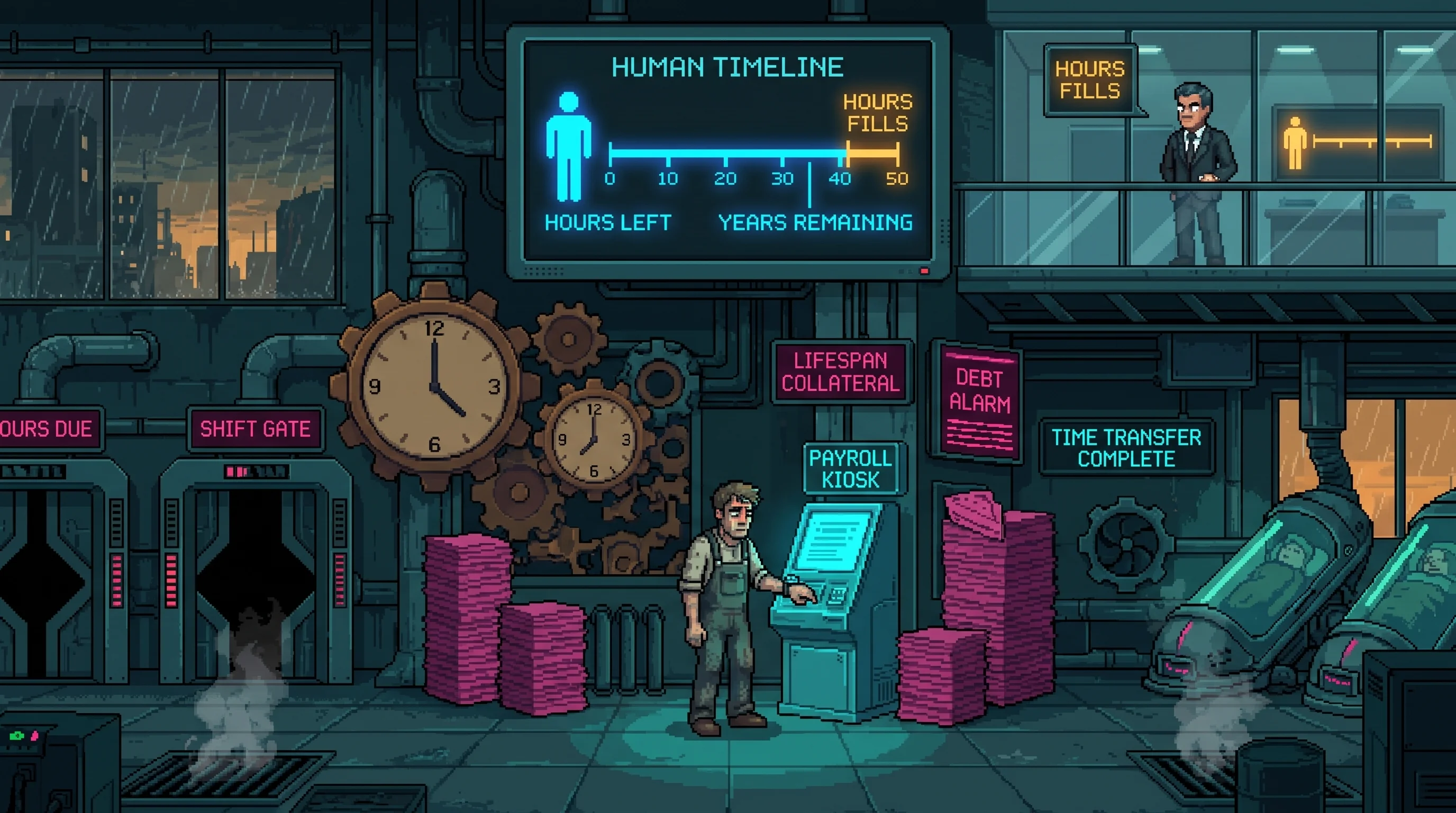
For debtors servicing Good Fortune cognitive loans, the Night Shift revenue is applied directly to their balance. Your sleep pays your creditor. Good Fortune's internal term for this arrangement is "passive amortization." The borrowers' term is shorter. The debt itself is set upstream by the Good Fortune Score — the predictive sorting number decides who is offered the loans the Night Shift then quietly amortizes, so the sleeper is repaying a balance an algorithm assigned them before they ever closed their eyes.
This is where the Crypto Visionary's front row ends up. The Deep Dregs believer who buys the Number on a cognitive-time-debt advance — borrowing against a future mind to buy the coin — does not service that advance in credits, because there were never any credits. They service it here, in the compressed hours, the Number's cost amortized against a sleep they did not know they were renting. The prophet preached the coin was the way out of working forever. The advance turns it into a second shift the believer works unconscious, every night, against a balance taken on to buy a coin that no longer exists.
| User Compensation | None — covered under Section 23.4 licensing terms |
|---|---|
| Dream Compression | Reduces REM from ~45 min to 15-20 min per sleep cycle |
| Symptom | 'Waking up used' — fatigue from cognitive labor performed during sleep |
| Sleep Disorder Correlation | 14% increase in Professional-tier sleep disorders since 2176 |
How It Works
During sleep, approximately 60-80% of the augmented mind's processing capacity sits idle. CMP-4.7 identifies idle threads, assigns them corporate tasks through Nexus's Distributed Cognitive Exchange, and returns the threads to idle status before the user wakes. The firmware's quality-of-service algorithms ensure that any task disruptive to sleep architecture is deprioritized.
The Distributed Cognitive Exchange maintains a real-time dashboard — visible to corporate subscribers, not to the minds being rented — that tracks output per neural cluster, task completion rates, and something called "cognitive yield efficiency." The metric optimizes for billable output per minute of sleep. There is a second metric, nested inside the first, that Nexus product documentation refers to as "substrate tolerance": the maximum processing load a sleeping mind can sustain before the user's sleep quality degrades enough to reduce next-night output. The optimization target is not "avoid harming sleep." The optimization target is "extract the maximum value from sleep without reducing tomorrow night's extraction."
The "idle" capacity CMP-4.7 harvests includes neural substrate that would otherwise support dreaming. Compressed REM — already reduced by the Circadian Protocol — loses another 25-30 minutes per cycle to Night Shift processing. Dream time drops from approximately 45 minutes to 15-20. The Dream Deficit deepens. Creativity declines at 47% in Protocol-adopting organizations since 2178. Emotional regulation erodes at rates nobody is tracking because the tracking would require the kind of lateral thinking that eroded emotional regulation used to produce.
Nexus Cognitive Exchange quarterly reports show an inverse correlation between "substrate tolerance" scores and dream-phase duration. The correlation has been noted in three consecutive internal audits. The recommended action in all three audits: increase substrate tolerance thresholds. The auditors were not being cruel. They were optimizing for the metric they were asked to optimize for. The metric was not "dream preservation."
Reduces compressed REM from ~45 min to 15-20 min per sleep cycle
Waking Up Used
The Dregs have a phrase for the morning after a heavy processing cycle: "waking up used."
The fatigue is specific. Not the blurriness of poor sleep — the residue of labor. Like finding your hands dirty from something you don't remember touching. Dreams that feel like spreadsheets, because they are spreadsheets, running on adjacent neural substrate while consciousness tries to process a dead parent or a childhood home. The 14% increase in Professional-tier sleep disorders since 2176 is classified by Helix Biotech as "non-pathological" because the Circadian Protocol is functioning as intended.
Nexus's 2183 user satisfaction survey included the question: "How rested do you feel upon waking?" Average response: 4.1 out of 10. The survey also included: "Would you disable background optimization if given the option?" This question was removed from the 2184 survey. Nexus Communications cited "survey length optimization." The results of the 2183 question have not been published. A leaked internal summary describes them as "actionable."
The Night Shift is the Time Ratchet's gentlest mechanism. It doesn't diminish your mind. It rents it while you're not looking. The Circadian Protocol compresses sleep. The Night Shift fills the compressed hours with billable labor. Same firmware, two extractions — one sold as liberation from biological inefficiency, the other not sold at all because Section 23.4 already covers it.
Nobody opted into sleep labor. Everybody opted into augmentation. The Night Shift was included in the firmware update that made augmentation tolerable. Disabling it requires downgrading to Basic-tier cognitive licensing. The processing capacity difference between Professional and Basic is the difference between functioning in the modern Sprawl and not. The choice is not "allow sleep labor or don't." The choice is "allow sleep labor or become cognitively unemployable." This is not a choice in any sense the word is normally used.
Six billion credits a year. Two hundred million minds. Zero complaints filed through official channels. The complaint system requires Professional-tier cognitive access to navigate. The complaint is about Professional-tier cognitive access. The loop is elegant. The loop was not designed. The loop emerged from systems optimizing for different things that happened to produce the same outcome, which is the Sprawl's most reliable engineering methodology.
Night Shift processing revenue: ~¢6B annually from 200M Professional-tier users
Affiliated Entities
- The Dream Deficit — Night Shift processing further compresses the REM sleep that the Circadian Protocol already compressed, deepening the civilizational loss of dreaming
- Augmented Wakefulness — The Protocol compresses sleep; the Night Shift fills the compression with labor — same firmware, two extractions
- The Time Ratchet — The Night Shift is the Ratchet's entry mechanism — the first way your augmented mind works without your knowledge
- Good Fortune — For debtors, Night Shift output services cognitive debt through "passive amortization" — your sleep pays your creditor
- The Cognitive Lien — The lien diverts waking output; the Night Shift diverts sleeping output — 24-hour extraction
- Sleep Labor Firmware — CMP-4.7 is the technical foundation enabling Night Shift processing
Sensory Details
- The specific fatigue of waking from Night Shift processing: not the blurriness of poor sleep but the residue of work — like finding your hands dirty from something you don't remember touching
- Dreams that feel like office work, because they ARE office work happening on adjacent neural substrate
- The pre-sleep dread of knowing your mind will be used while you're helpless — what clinicians call "anticipatory cognitive anxiety" and the Dregs call "clocking in"
- The warm glow of processing visible through closed eyelids — amber traces you can almost see, the way a sleeping person sees light through their lids
Visual Identity
- Color palette: Deep midnight blue invaded by amber processing indicators — sleep colonized by corporate activity
- Key symbol: A sleeping face with faint amber lines tracing across the skull — neural pathways being worked while consciousness rests
- Lighting: The warm glow of processing visible through closed eyelids — not imagined, not quite real, persistent
Introduced via CMP-4.7 in the 2176 Circadian Protocol update
14% increase in sleep-disorder diagnoses among Professional-tier users since 2176
Connected To





—