Overview
This is what dreams do that consciousness cannot.
For twelve years after her mother died — an atmospheric technician, killed when the air recyclers failed during the Three-Week War — Selin Ayari dreamed about her. Not grief dreams. Not the clenching replay of loss. Conversations. Arguments about dinner. Comfortable silences where neither of them needed to say anything because they'd said it all before and would say it again tomorrow night.
The dreams gave her something waking memory could not: continuation. In sleep, her mother was present — built from the same cognitive architecture that processes living relationships, updated each cycle, behaviorally flexible in the way recordings are not. The mother in the dreams argued back. She had opinions about Selin's career. She disapproved of specific meals. She was not a memory. She was a collaboration between memory and imagination that produced someone neither could build alone.
When Selin received Basic Wakefulness — standard neurological augmentation, condition of her research appointment — the dreams compressed. Then fragmented. Then stopped.
Her mother was gone. Not from memory. From the only place where death hadn't applied.
140 million Protocol users have lost this capacity. Nexus Dynamics' Cognitive Wellness Index does not track dream-relationship dissolution. The index tracks REM efficiency, neural maintenance throughput, and augmentation integration scores. By every metric the index measures, Selin Ayari is performing optimally. By the one metric it doesn't measure, she lost her mother twice.
- Subject
- What dreams do that consciousness can't replicate — told through Dr. Selin Ayari's personal story
- Central insight
- Dreams maintain the relationships we have with our dead — the conversations we continue in sleep with people who are no longer alive
- Connection
- 140 million Protocol users have lost this. They don't know what they've lost, because the loss cannot be articulated in the language of waking consciousness
- Form
- Personal narrative / thematic exploration
- Status
- Active
- Scale of impact
- 140 million Protocol users have lost this. They don't know what they've lost, because the loss cannot be articulated in the language of waking consciousness.
The Relationship That Cannot Be Purchased
The Dream Exchange sells experiences that feel like dreaming. Grief recordings are their third-highest revenue category — neurochemical signatures of loss, extracted from memory farmers, sold as catharsis at 400 credits per session. Satisfaction ratings average 4.1 stars. Repeat purchase rate: 73%.
What the Dream Exchange cannot sell is the specific thing Selin lost.
Her mother's dream-presence was not a recording. It was a living construction maintained by twelve years of subconscious processing — the unconscious mind continuing the work of love through the cognitive machinery it uses for every relationship, unable to distinguish between the living and the remembered. The mother who existed in that space grew. She responded to changes in Selin's waking life. She was wrong about things in the specific way Selin's mother had always been wrong about things, because the architecture that built her was the same architecture that had known the original.
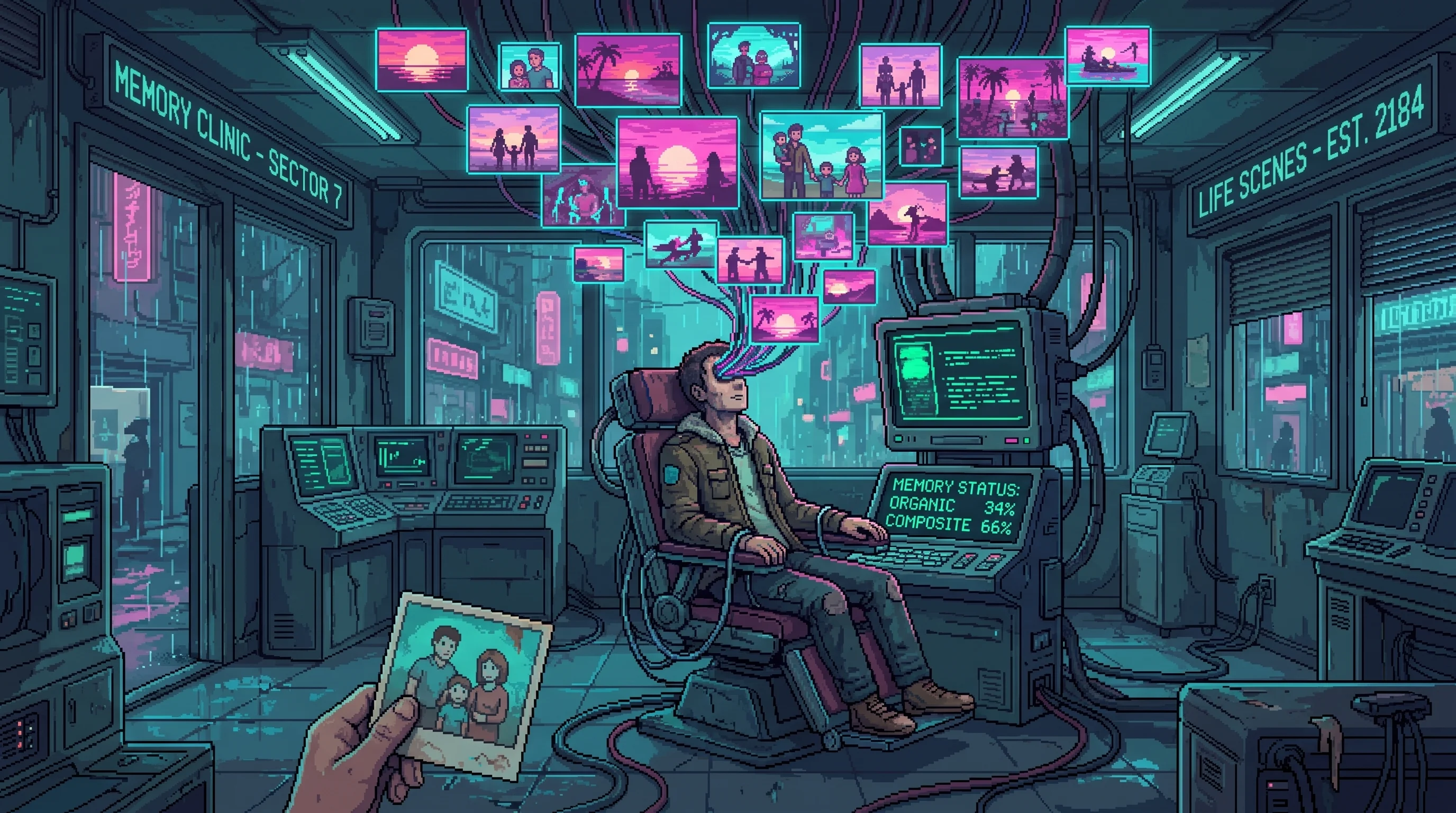
Memory farmers can harvest the feeling of loss. They cannot harvest the feeling of continued presence. The 140 million dreamless carry their dead the way the waking mind carries them: frozen at the moment of last contact, unchanging, a photograph where there was once a person.
The Dream Exchange's grief catalog has expanded 340% since the Protocol's adoption curve reached saturation. Customer reviews use the word "closure" at three times the baseline rate for emotional-category purchases. Closure is what you buy when continuation is no longer available. Nobody has framed this as a market failure. The market is performing exactly as designed.
The Vocational Trap
Selin received Basic Wakefulness because her employment contract required it. The neurological research community's standard augmentation package, offered the way health insurance is offered — technically optional, practically mandatory, included in onboarding between the parking pass and the cafeteria tour.
To practice neurology in the Sprawl, you must be neurologically augmented. To be augmented under the standard package, you must accept Basic Wakefulness. To accept Basic Wakefulness is to compress REM past the threshold where sustained dream-relationships survive. The dependency here is not financial. It is vocational. She traded her mother's dream-presence for a career studying dreams.
The Neural Research Ethics Board has received zero formal complaints regarding REM compression in the standard augmentation package. The board meets quarterly. It reviews adverse cognitive outcomes, flags anomalous neural patterns, and publishes annual reports on augmentation safety. Average REM depth among sitting board members: 3.8% of unaugmented baseline. They are reviewing the effects of compressed dreaming with brains that no longer dream.
Discontinuation does not help. Selin's neural architecture reorganized around compressed REM within the first eighteen months. The subconscious pathways that maintained her mother's presence have been pruned through disuse, the cognitive real estate reallocated to background maintenance processing. The Protocol took something that cannot be purchased, restored, or reverse-engineered. Selin carries the most precise understanding in the Sprawl of exactly what was lost. She carries it in a brain modified past the point where the loss registers the way it would need to register — in the deep architecture of sleep — to motivate the research that might reverse it.
Her paper on the Dream Deficit was peer-reviewed by fourteen researchers. All fourteen are Protocol users. None of them dream. The paper's methodology section was praised for its rigor. Its conclusions were described as "theoretically compelling but experientially unverifiable by the current research population."
The reviewers were not wrong. They were the problem.
Key Events
The Death
Selin's mother was one of the 89,000 who died in Sector 8 when the air recyclers failed. The details are administrative: a work order, a failure cascade, a name added to a memorial list. The kind of death that gets counted but not mourned at scale.
Twelve Years of Conversation
The dreams began the week after the funeral. They were not dramatic. Selin's mother appeared in kitchens, in corridors, in break rooms. She complained about the quality of the tea. She asked about Selin's research. She made the same joke about her supervisor that she'd made every week for twenty years.
The dreaming mind doesn't process grief — it refuses it. It takes the person you've lost and seats them across from you at a table and says: talk. And you do. And they answer. And for the duration of the dream, death is a bureaucratic error that hasn't been corrected yet.
Selin never told anyone about the dreams. They were not unusual. Everyone who has lost someone knows the experience. It is the most common form of contact with the dead that human consciousness permits.
The Silence
When Selin received Basic Wakefulness, the dreams didn't stop immediately. They compressed. Her mother appeared for shorter intervals. The conversations became fragments — half a sentence, a gesture, the shape of a hand reaching for a cup that was no longer there. Then the fragments stopped.
Her mother was gone. Not from memory. From the dream world where death hadn't applied. The relationship that survived death could not survive optimization.
Consequences
Selin's paper on the Dream Deficit was published as a study of cognitive loss — creativity metrics, lateral thinking degradation, measurable declines in novel problem-solving. Those findings were real. They were also the outermost layer of what she was actually writing about. At its core, the paper was about her mother.
140 million Protocol users opted into augmentation — productivity gains, enhanced cognition, professional eligibility. An entire population whose subconscious processing was compressed past the threshold where dream-relationships survive, eliminating the only space where their dead could still be present. The Cognitive Wellness Index does not include a metric for this. The index is considered comprehensive.
The Loss You Cannot Reverse-Engineer
(The board's annual safety report describes this as "no conflict of interest identified.")
▲ Unverified Intelligence
- Selin has never publicly connected the Dream Deficit paper to her mother's death. Colleagues who knew her before Basic Wakefulness say she changed — not cognitively, not measurably, but in a way they struggle to articulate. "She used to smile at nothing sometimes," one reported. "Like someone had just told her something funny that only she could hear."
- There are unconfirmed reports that Selin attempted to discontinue Basic Wakefulness for a period of six weeks. The attempt is not in any medical record. If it happened, the dreams did not return.
- A subset of Protocol users — estimated at fewer than 0.3% — report occasional dream-like intrusions during periods of extreme fatigue. The content is overwhelmingly interpersonal: faces, voices, fragments of conversation with people they've lost. No clinical explanation has been offered. No study has been funded.
Linked Files
- The Dream Deficit — The paper that named the loss. The research that measured everything except the thing that mattered most, because the thing that mattered most cannot be measured by researchers who no longer dream.
Affiliated Entities
- The Three-Week War
Selin's mother died when the air recyclers failed — one of the 89,000 who died in their sleep in Sector 8. The war killed her mother once. The Protocol killed her again, twelve years later, by closing the only space where the first death hadn't finished.
- The Dispersed
2.1 billion consciousnesses scattered by the Cascade, existing in a state with no legal or theological precedent. Selin's dream-mother was one consciousness, maintained in one mind, requiring no infrastructure beyond sleep. The Dispersed are the cosmic version. The dream-relationship was the intimate one. Both are forms of presence that the living cannot categorize and the systems cannot measure.
- The Three-Day Memorial
The Memorial mourns the dead collectively — 72 hours of public observance, universal participation, sanctioned grief. Dreams mourn them individually, in private, on the dead's own terms. 140 million Protocol users participate in the Memorial each April. They cannot participate in the other kind of mourning. The public ritual survives. The private one does not.
- The Dream Deficit
Selin's paper was peer-reviewed, published, and cited 2,300 times in its first year. It was about REM compression, cognitive maintenance, and productivity loss. It was also about her mother. The academic framework was the delivery device. The payload was grief.
- The Dispersed
2.1 billion consciousnesses scattered by the Cascade, existing in a state with no legal or theological precedent. Selin's mother existed in a kitchen in a dream, arguing about dinner. The scale is different. The principle is identical: presence that persists beyond death, in a form the living cannot categorize and the systems cannot measure.
- The Three-Day Memorial
140 million Protocol users participate in the Memorial each April. They cannot participate in the other kind of mourning. The public ritual survives. The private one does not.