Overview
The Dregs begin where corporate service stops being a guarantee and becomes an occasional event. People still use official transit, power, and tickets, but they survive the gaps through repair crews, shared meals, favors, and equipment kept alive beyond its supported life. The neighborhood is not outside the Sprawl; it is where the Sprawl reveals how much unpaid work makes it function.
Its boundaries move with maintenance schedules. A corridor can be corporate on inspection day and neighborhood-run the rest of the month, leaving residents fluent in both official procedure and the repair economy that actually keeps the lights on.
- Location
- Below the maintained corporate tiers, above the Deep Dregs
- Type
- Lower-tier inhabited district
- Notable
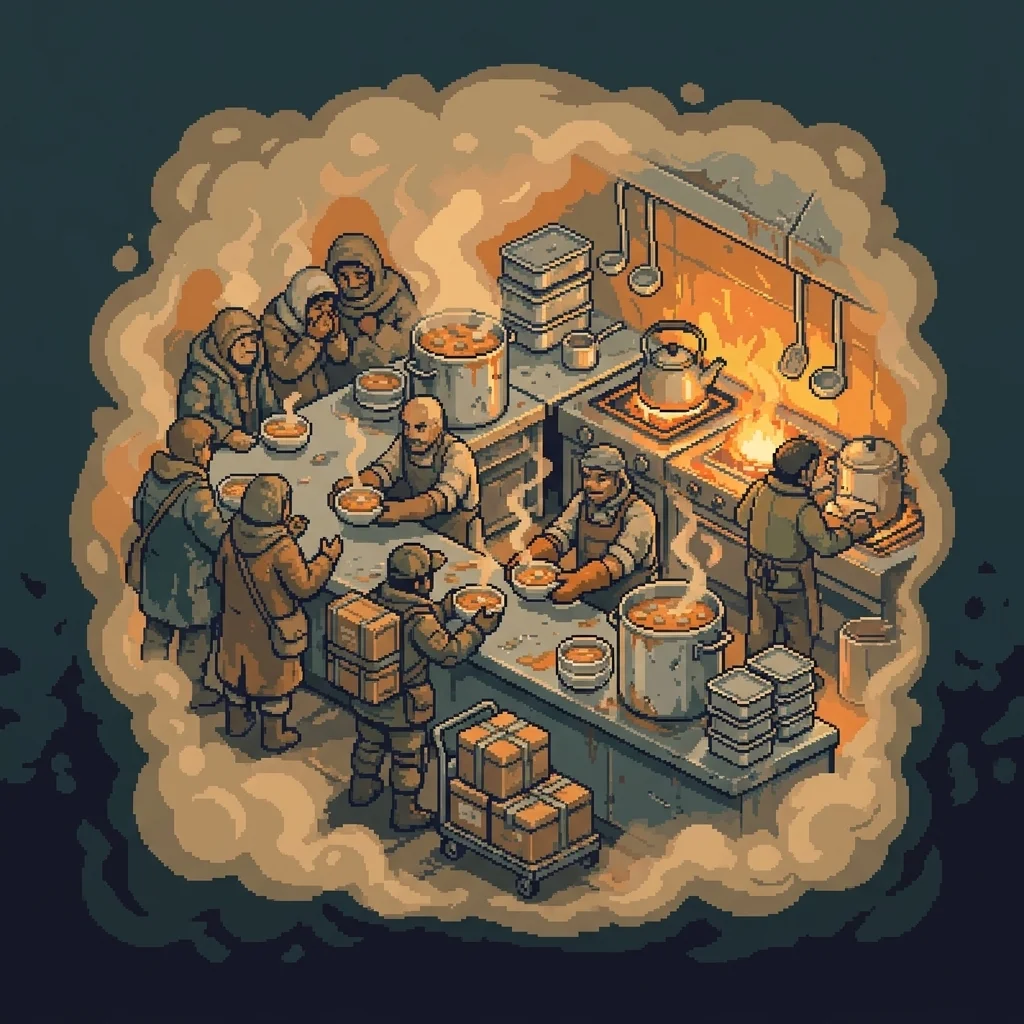
- Repair crews, shared kitchens, salvage markets, and favor networks
- Stratum
- Dregs
- Power position
- Below
- Access
- Public
- Atmosphere
- Vibrant
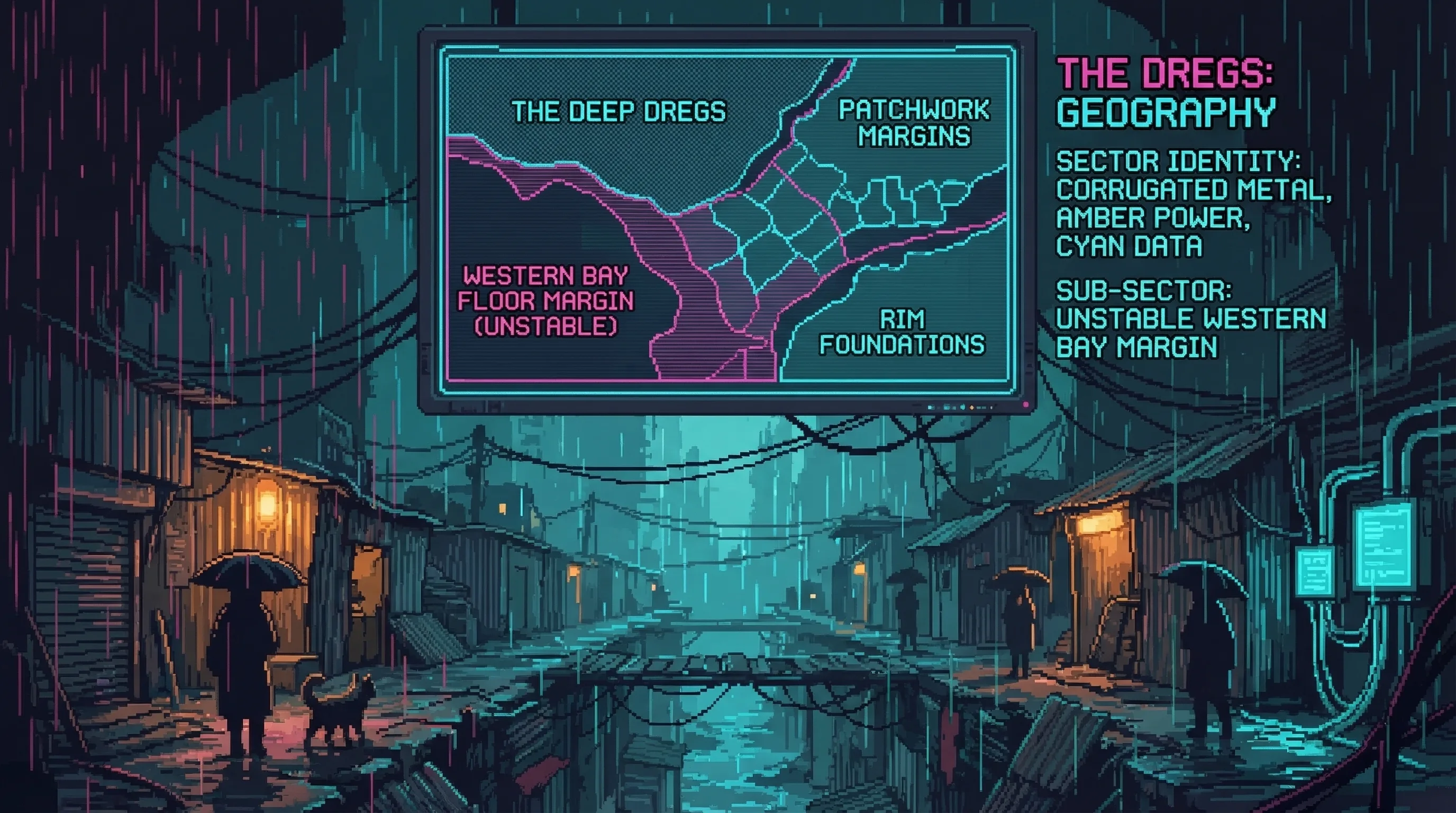
SectorThe Deep Dregs
The heart of the Dregs. When the bay was drained, humanity's overflow was poured into this sunken canyon — miles of improvised housing, stacked towers called The Stacks, markets built from salvage, and a population that no corporation formally claims and no government effectively governs. The Rim walls tower on both sides — the western Rim to the west, the eastern sectors to the east — creating an urban canyon fifty to eighty feet deep that traps heat, pollution, and desperation in equal measure. The Trench runs through the deepest old shipping channels, eighty feet below the Rim, a subterranean corridor beneath even the bay floor settlements. No natural light reaches the bottom. No corporation sends patrols. What law exists here is enforced by the people who live here, and it changes block by block.
Open The Deep Dregs- DistrictThe Dregs
Nearby places



District conditions
- Air
- Toxic
- Light
- Canyon dark
- Flood
- Seasonal
- Heat
- Trapped
- Security posture
- Ungoverned
- Infrastructure
- Improvised
Transit Routes
An old ORACLE transit line that still partially functions. Trains run erratically on self-sustaining power, moving through the Dregs sectors without schedule or fare.
"Nobody controls the Backbone. The trains run because they were programmed to run, and ORACLE didn't give them a stop command. Some say they're still carrying passengers from before the Cascade—going in circles forever."
Maintenance tunnels that connect all sectors through infrastructure space. Not meant for travel but used anyway.
"Old maintenance workers call them the Pipes. They ran them during ORACLE's time, keeping systems functional. Now the systems are dead but the Pipes remain. Learn them and you can go anywhere."
Surface Routes
Normal travel through the Dregs is possible but unprotected. Each sector has different hazards.
Territorial Dynamics
Neutral Zones
Some areas are genuinely uncontrolled:
- The Backbone stations: Too unpredictable for anyone to hold
- Sector borders: Contested, fluid, dangerous
- The deep Pipes: Too complex for territorial claims
AI in the Margins
Where the corporate towers gleam with cutting-edge neural interfaces and consciousness mapping, the Dregs receives what falls off the edge. Failed experiments, corrupted backups, discount uploads— what goes wrong with AI eventually finds its way here.
Failed Projects Dumped Here
When Nexus abandons a consciousness transfer experiment, when Helix's neural enhancement trials go wrong, the remnants don't disappear. They get "decommissioned"—shipped to the Dregs for disposal.
Corrupted Consciousness
Consciousness transfer doesn't always work cleanly. Sometimes the copy is incomplete. Sometimes the original doesn't fully transfer. Sometimes both versions survive, each claiming to be real. The Dregs is where they end up.
The Dregs has the highest concentration of corrupted digital consciousness in the Sprawl. Some formed communities. Some went mad. Some became something new.
Discount Immortality
In Nexus Central, consciousness upload costs 50,000 Kilotokens. In the Dregs, back-alley operators offer "upload services" for 500 Tokens. You get what you pay for.
"My grandmother paid fifty Tokens to live forever. Now there's something in the network that has her face and speaks with her voice, but it only remembers one afternoon in 2179. Over and over. Is that her? Is that immortality?" — Resident of S9-C
The Substrate Slums
Digital consciousness requires processing power. Premium uploads run on dedicated quantum systems. Dregs uploads run on whatever they can afford—often shared, damaged, or unstable substrates.
These upload poverty conditions create their own communities— digital beings helping each other survive, pooling resources, forming the first truly post-human societies. Whether this is evolution or degradation depends on who you ask.
The Question of the Depths
What happens when failed AI projects, corrupted consciousness, and cheap uploads have forty years to evolve in the dark?
Environmental Features
The Blackout Zone
An area where power never came back after the Cascade. Absolute darkness, no electronics, populated anyway.
"The Blackout has been dark for forty years. People there have adapted. They say they can see in ways we can't. They say they've learned to live without the Sprawl's gifts. They say a lot of things. I've never met anyone who's been there and come back."
A length of pre-Cascade construction that survived intact. Now covered with names—people lost in the Cascade, the years after, the ongoing struggle.
"Every name on the Wall is a person the Sprawl forgot. We won't forget them. We add names when people die without other witness. The Wall grows. It never shrinks."
Affiliated Entities
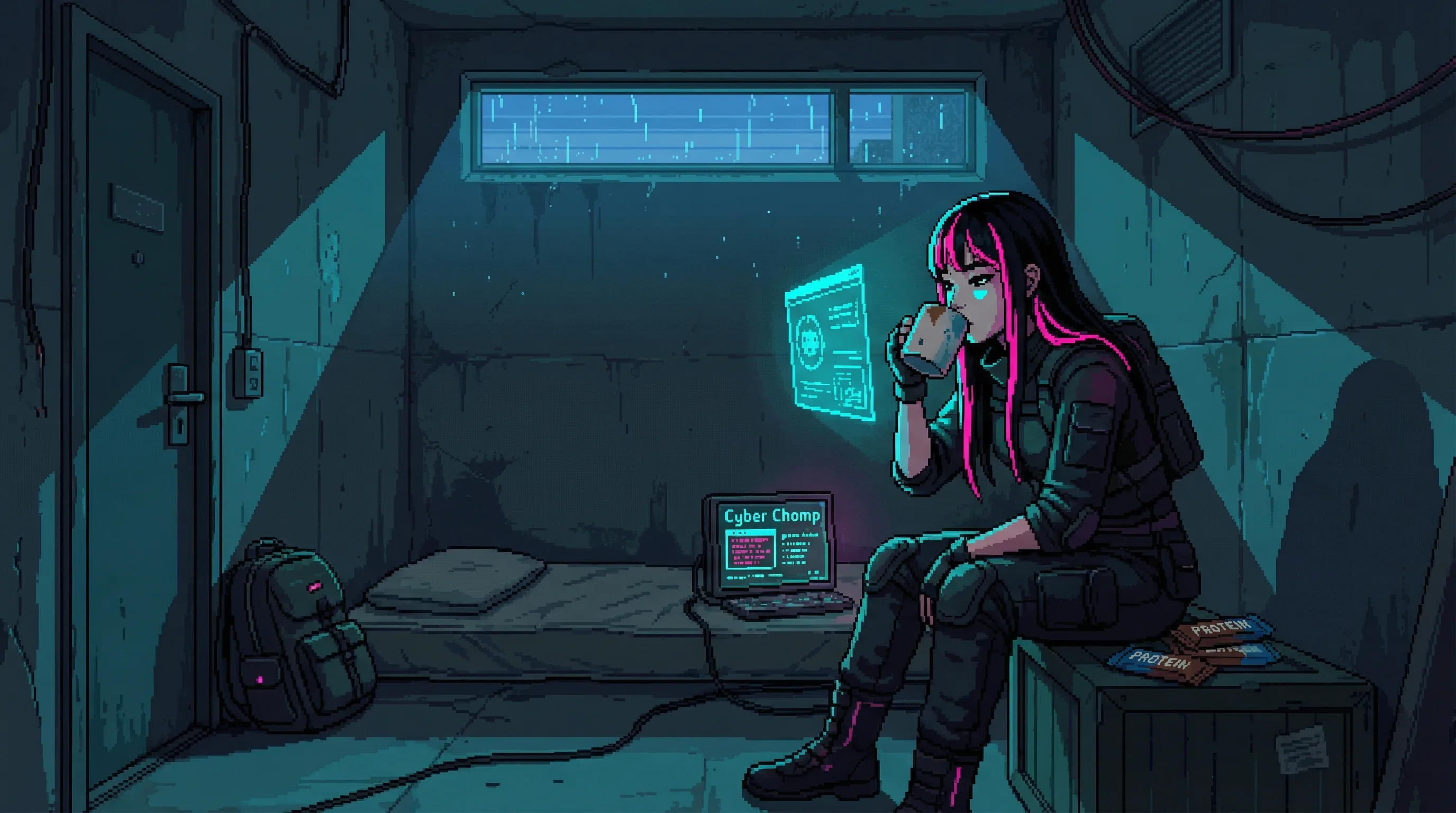
The district grades downward into the Deep Dregs as maintained service and identity checks disappear. It hosts the Feast's distributed kitchens, GG's home routines, and El Money's informal information routes. GG: Daily Life uses the Dregs as its setting because her resistance is inseparable from these ordinary dependencies. A returned tool, a meal at the right hour, or a patched relay can matter more here than a spectacular breach, and the people who keep those promises are the reason she has a life to return to.