The Solidarity Rig
Overview
The Solidarity Rig is a permanent exhibit in Sector 7's Bay Area Cultural Memory Institute, jointly administered by the Settlement Council and Good Fortune's Heritage Division, and it teaches nine-minute approximations of an experience the managed sectors have not produced naturally in three generations.
The exhibit's official name is The Crowd Feeling. Its institutional description is a "haptic simulation of pre-Cascade civic-resonance events." Visitors who have completed the session tend to call it something else — most commonly "the phantom room" or simply "the rig" — because the institutional language names what the exhibit does and the visitor language names what it produces, and those are not the same thing.
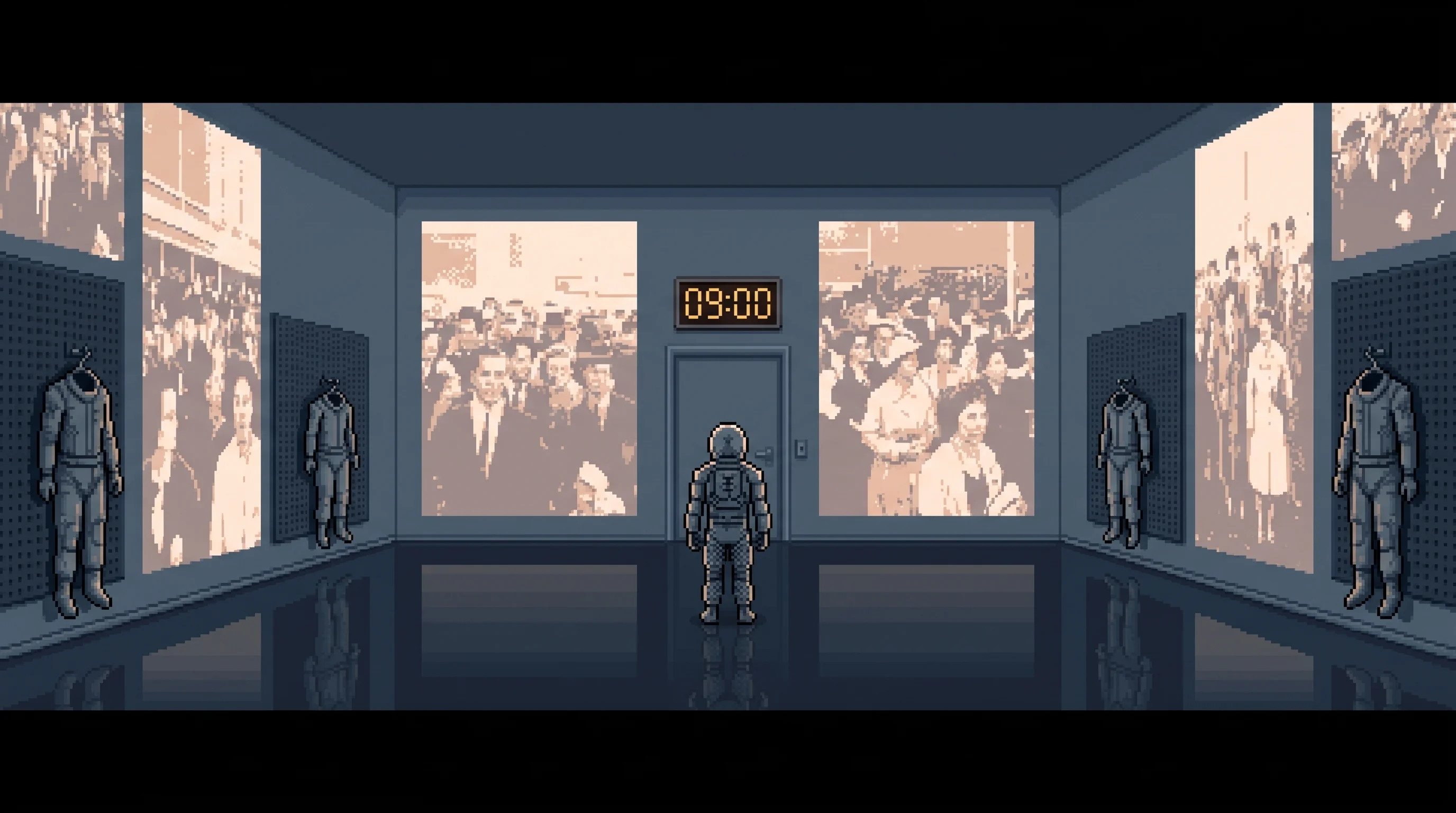
What the exhibit produces is the sensation of discovering that a stranger shares your anger. Not the anger itself, which requires a real grievance rather than a simulated one. Not the action that follows, which requires real conditions rather than a nine-minute session. Just the discovery: the moment of turning, or being turned to, and finding the thing you were carrying is not private after all. The haptic suit calibrates to the visitor's biometric baseline before the session begins. The spatial audio environment is accurate to three published historical reconstructions. At the session's midpoint, the simulation places the visitor in a civic plaza and generates the sensory conditions of a stranger turning to share a grievance, and of the visitor finding, without premeditation, that they share it.
The exhibit has been operating since 2173. The last spontaneous crowd-turn in the Sprawl's civic history occurred in 2109. There is a gap of sixty-four years between the last time this feeling occurred naturally and the first time a museum had to be built to preserve it.
How the Exhibit Works
The standard session begins with a four-minute orientation in the outer gallery, where photographic and documentary reconstructions of pre-Cascade civic assemblies are displayed. The visual record is carefully curated: the images show labor demonstrations, neighborhood assemblies, spontaneous street gatherings, the kind of outdoor festivals that happened before the Sprawl's atmosphere required industrial processing. They are chosen, the Institute's documentation notes, to represent the ordinary civic gathering rather than the exceptional one — not marches with banners and coordination, but the informal assemblies that formed when strangers who happened to share a space discovered they also shared a feeling.
The haptic session itself is nine minutes. Concord's internal documentation notes the session as a civic educational resource with no documented convergence risk because the simulation teaches the sensation but not the method of finding the second person naturally — it provides a curated stranger, in a controlled environment, rather than the conditions under which a stranger might actually be found. The rig teaches what it felt like to round a corner and discover ten thousand people carrying the same grievance. It does not provide the corner.
The Phantom-Limb Response
The 2183 Cultural Memory Institute accessibility review documented a pattern in the nine years of exit surveys that the Institute's research director described as "unexpected and consistent." Across all demographic groups, visitor cohorts, and session variables, 31% of visitors describe the session's emotional content using phantom-limb metaphors: sensations felt in the absence of the limb that would have felt them, a warmth in a location where no warmth is physically present.
The metaphor recurs without prompting, which is what makes the research director call it unexpected. Visitors are not asked whether the session resembled the phantom-limb experience. They are asked to describe the session in their own words. Thirty-one percent of them reach for the metaphor independently, which suggests they are describing something true about the experience: a sensation that belongs to a body part that is gone.
The body part is not a limb. It is the capacity for spontaneous collective discovery — the perceptual-emotional faculty that allows a person in a crowd to sense when the strangers around them share their weather, and to name that sharing as a we. The capacity is not surgically absent. It is simply underdeveloped: three generations have grown up without the conditions that would have exercised it, and an exercise that atrophies is not the same as one that was removed, but the sensation of using it for the first time in a nine-minute session is, apparently, indistinguishable from the phantom-limb experience to a significant minority of the people who try.
| Equipment | Full-body haptic suit; spatial audio environment; biometric-calibrated peer-resonance simulation |
|---|---|
| Admission | Free (jointly funded by Settlement Council civic-education budget and Good Fortune Heritage Division) |
| Exit Survey Stat | 31% of visitors describe the session using phantom-limb metaphors (2183 accessibility report) |
| Opposition | Nexus initially opposed the exhibit in 2171; overruled by Good Fortune on the grounds that simulating something three generations old is archaeology, not agitation |
| Classification | Nexus monitoring: 'civic educational resource with no documented convergence risk' |
The Corporate Opposition and Archaeology Defense
When Good Fortune's Heritage Division proposed the exhibit in 2171, Nexus's civic-relations team objected on documented grounds: a haptic simulation of collective-grievance discovery might "constitute an instruction manual for spontaneous solidarity events." The objection was preserved in the 2181 Institute transparency report.
Good Fortune's rebuttal — also preserved — was archaeological: "The simulation of an experience that has not occurred in two generations is not agitation. It is archaeology. We teach visitors what a dial tone sounded like. We teach them how to navigate by compass. Simulating what it felt like to discover that your anger is shared with strangers is the same category of preservation. The thing being preserved is sixty-two years old. The instruction manual for doing it naturally, without a simulation, involves conditions that have not existed in the managed sectors in that entire interval."
Nexus's monitoring of the exhibit since its opening has produced no evidence contradicting the Heritage defense. No visitor has left the Rig and started a march. The Rig teaches the feeling. The Second Person teaches the practice. The two have never been in the same room, and the gap between them — between the feeling available in a civic museum and the practice available in a surveillance blind spot — is the shape of what Concord produces: a civilization that knows, clinically, what solidarity was, and cannot do it.
Conditions Report
The exhibit operates year-round in a climate-controlled wing of Sector 7's Bay Area Cultural Memory Institute. The haptic suits are maintained quarterly by Good Fortune Heritage Division technicians. The spatial audio environment is recalibrated annually against the Institute's primary historical reconstruction source. Exit survey data is collected continuously and archived in the Institute's research office under the Settlement Council's educational-data retention policies.
Nexus Dynamics conducts quarterly monitoring reviews. The exhibit's compliance file is classified as civic educational resource, no convergence risk. The monitoring has produced no adverse findings in eleven years of operation.
| Stratum | Middle |
|---|---|
| Power Position | Between |
| Access | Public |
| Atmosphere | Archival Stillness With The Residual Warmth Of Borrowed Feeling |
Sensory Details
The exhibit smells of climate-control and the faint ozone of haptic-suit electronics — sterile, archival, the opposite of a crowd. The haptic suit's texture is soft synthetic mesh that warms quickly to body temperature, and the moment of peer-resonance calibration — when the simulation finds the visitor's biometric baseline and adjusts the stranger's simulated presence to match — is felt as a slight pressure change in the chest. The nine-minute session is silent except for the spatial audio, which is tuned precisely enough that visitors have described hearing the exhalation of the simulated crowd when the resonance moment lands. At the session's end, the room returns to baseline — normal pressure, normal temperature, the faint hum of climate-control — and visitors describe the transition as abrupt in a way they cannot articulate. The silence after the session lasts an average of forty seconds longer than the baseline for museum-exhibit exit behaviors. This figure is in the Institute's 2183 accessibility report. It has not been commented on.
Affiliated Entities
- Concord — the Rig is the only place the Sentiment Weather service's primary project has not succeeded; the managed sectors have not produced spontaneous solidarity in three generations, but the memory of the feeling has been preserved in a haptic archive Nexus cannot dissolve at week-minus-three
- The Second Person — the Dregs practice and the civic museum exhibit are the two surviving carriers of the same erased experience; the Rig teaches the feeling, the practice teaches the method, and the gap between them is exactly the size of Concord
- The Dead Heart Museum — the closest sibling exhibit; both are civic archives of feeling rather than event; the Dead Heart Museum preserves love letters, the Solidarity Rig preserves the sensation of shared anger
- Dead Words — five words in the Concord Cluster (solidarity, crowd-turn, second-person-panic, the corner, march in its civic-spontaneous sense) lost their referents in the same managed sectors where the Rig operates; the exhibit runs on the archived feeling of the thing those words named, nine minutes at a time
- Good Fortune — Heritage Division administers the exhibit; won the internal dispute with Nexus that opened it in 2173 by classifying solidarity simulation as archaeology rather than agitation
- The Privacy vs. Prosperity thread — the Rig embodies the bargain's most consequential unacknowledged exchange: total surveillance exists, and the one thing surveillance prevents — the spontaneous discovery of shared anger — can only be recovered in a nine-minute simulation that Nexus monitors to confirm it poses no convergence risk
The session teaches the feeling. The Deep Dregs teaches the practice. They have never been in the same room.
A museum that teaches you what fire feels like is not evidence that fire still burns.
Connected To
Major Connections

The Rig preserves what Concord prevents everywhere else — nine minutes in Sector 7, classified by Nexus as archaeology.
The civic prediction system that dissolves collective action before it becomes visible.
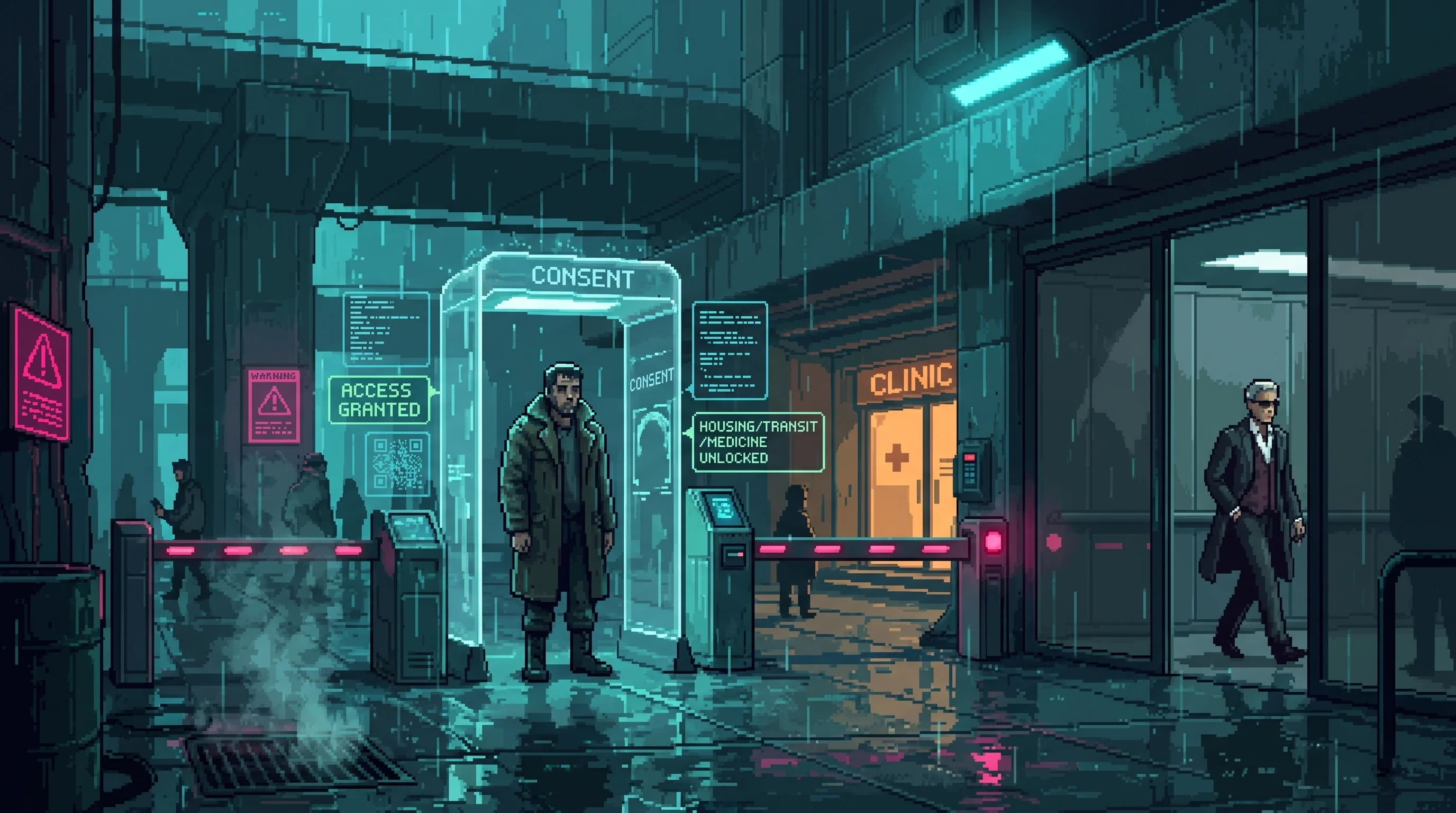
The third face of the bargain: the telemetry that prevents solidarity is the same stream that enables the Rig.
The Sprawl demands permanent personal data for participation, then uses it to price access and preempt solidarity.
Supporting Connections

The feeling, archived. The method, practiced. Never in the same room.
The Dregs practice of restoring the second carrier Concord's micro-reliefs exist to prevent — 'me too', said once.
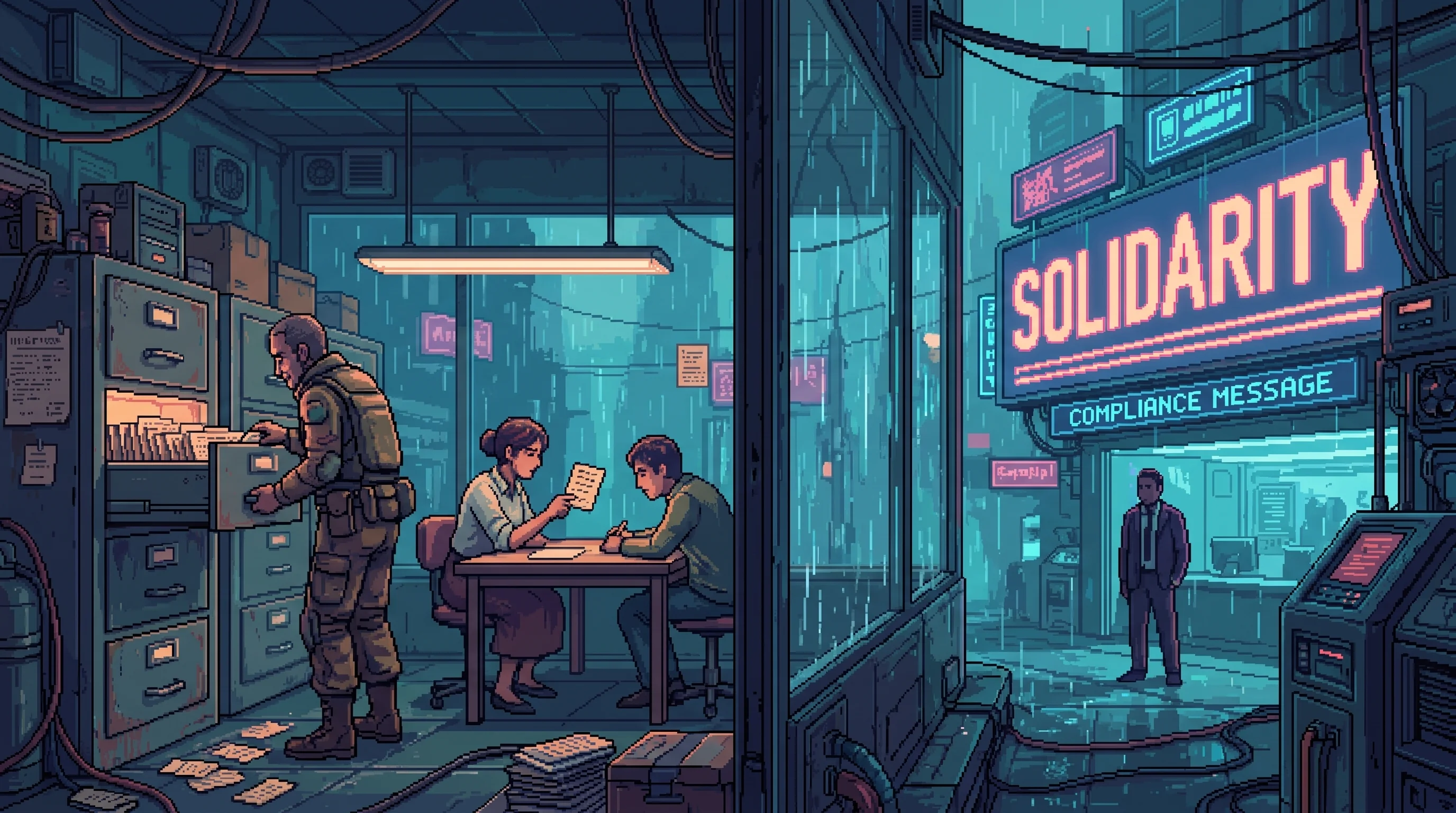
The word lives; the referent is now only available in this exhibit.
Dead Words records language whose referents vanished or drifted and words built to remain unreadable to machines.


Local Intelligence Scan
Nearby Signals
CANONICAL PROXIMITY


Environmental Readout
LIVE CONDITIONS- Air
- Filtered
- Light
- Shadowed
- Flood
- Seasonal
- Heat
- Temperate
- Security posture
- Contested
- Infrastructure
- Patchwork
Position Data
SECONDARY- Elevation band
- Mid-hill — the hill districts
- Lattice fix
- E+10.9 · N+1.9

—