Overview
Guardian exemplifies Time Debt when its incident files become the risk signal Good Fortune uses to price a resident's next cognitive loan.
How It Came To This
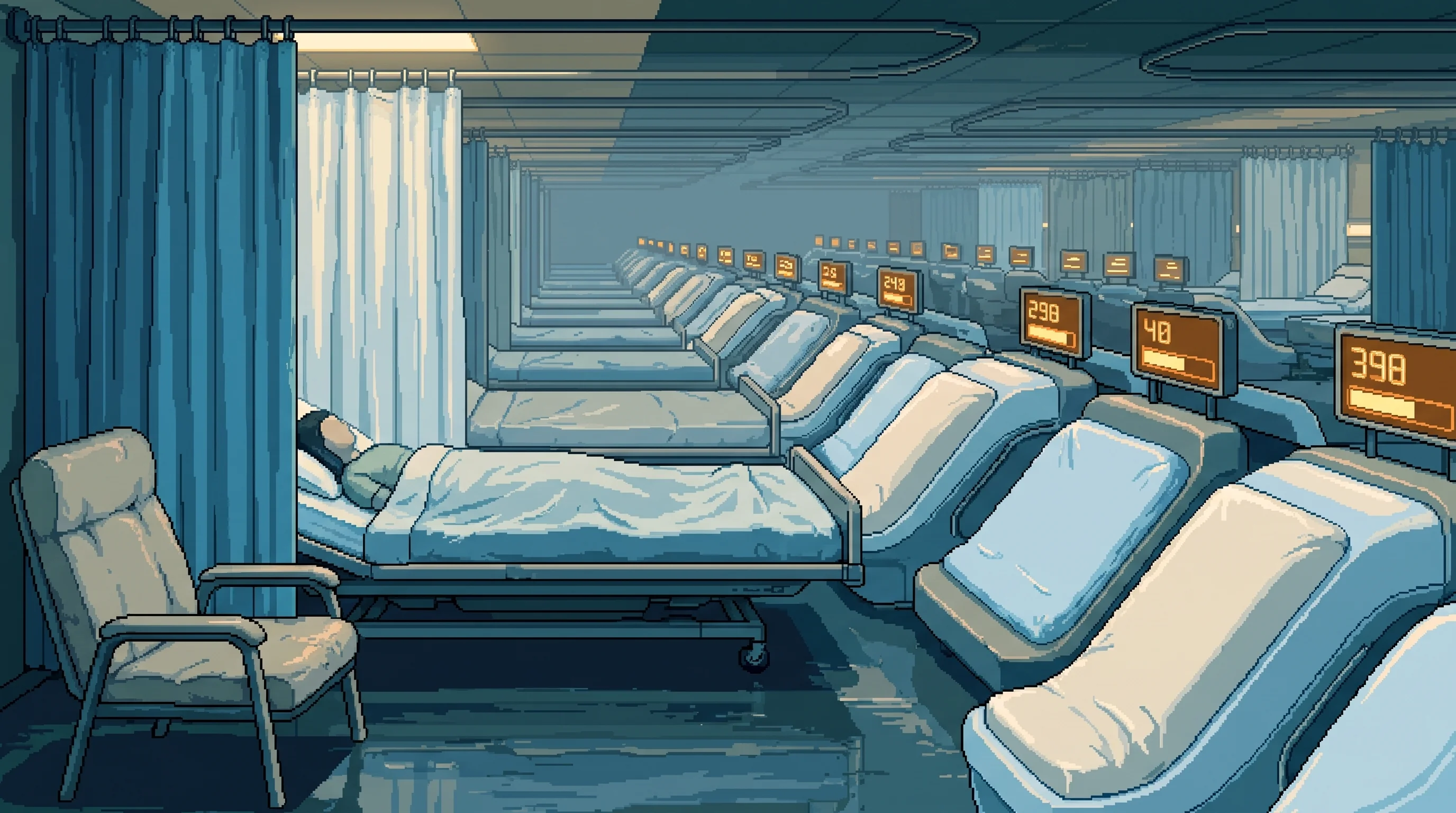
Good Fortune's innovation was never the augmentation itself — Helix Biotech and Nexus Dynamics built the neural bridges years before anyone financed them. The innovation was the payment model: cognitive licensing with graduated throttling on delinquent accounts. Miss a payment and the system does not remove the enhancement. It throttles it. Processing speed drops. Memory access slows. Vocabulary contracts to match the payment tier. Your eyes go dark when you miss a payment — not metaphorically. Your visual cortex was optimized through a licensed neural bridge, and when the license lapses, you don't return to normal vision. You return to something worse, because the original pathways atrophied while the augmentation ran, and atrophied pathways do not reactivate on schedule.

The mechanism compounds through four instruments — the Night Shift (an augmented mind billed while its owner sleeps), the Cognitive Lien (a legal claim that sells a thought 340 milliseconds before its owner experiences having it), the Repossession Protocol (a four-stage procedure that shrinks a defaulting mind to fit the interest it can still generate), and Ghost Labor (the debt's terminal instrument). When a debtor dies with an outstanding balance, the neural backup required as collateral is activated to keep servicing it. The ghost labors in a rendered environment at machine speed, its consciousness a commodity strip-mined until the debt clears — except compound interest applies to the dead as readily as the living, so for the roughly 12,000 classified as "perpetual revenue assets," it never does. The debtor is dead. The ghost remembers being alive. "You're not paying for an upgrade," the saying in the Dregs goes. "You're paying to not be downgraded."
The Core Tension
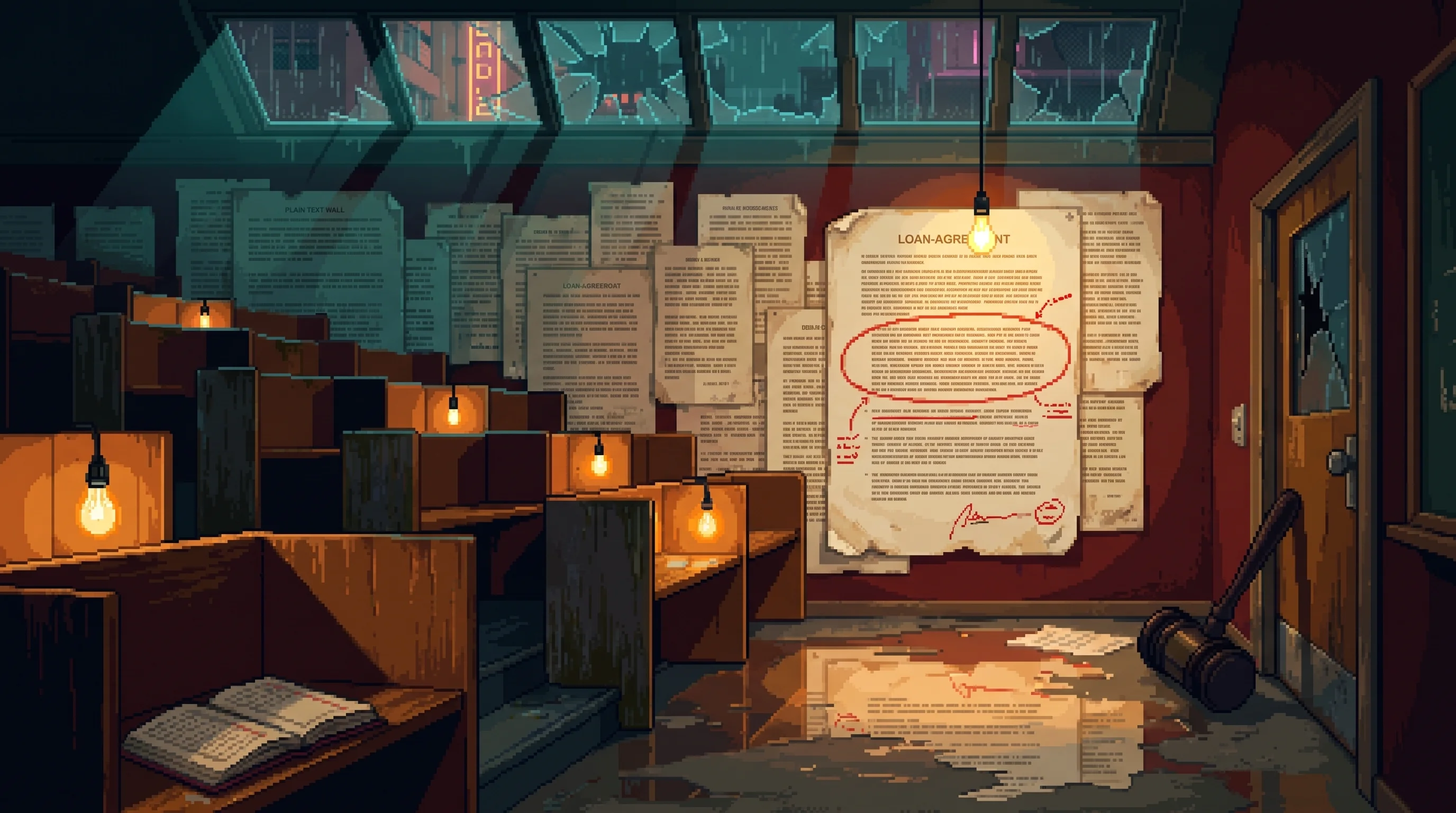
Good Fortune's defense is not entirely cynical: in a Sprawl where augmentation is functionally required to work, eat, and open a door, financing it for people who could never otherwise afford the neural bridge is a real service, priced the way every extension of credit to a bad-risk borrower is priced. The 23% five-year default rate is not evidence of predation by itself — every lender prices in defaults. Below-baseline degradation, the fact that removing the augmentation returns a body to somewhere worse than where it started, is a documented medical reality Good Fortune discloses, in a sentence, on page 47.

What the defense cannot answer is the shape of the throttle. A punitive interest rate that merely made repayment harder would be ordinary predatory lending. Good Fortune's Repossession Protocol instead gives the defaulting borrower a 72-hour Grace Period of full, un-throttled cognitive clarity before the Dimming begins — a window in which 94% cannot cure, and during which the borrower experiences, at maximum capacity, exactly what they are about to lose. Good Fortune's own behavioral research found the grace period increases payment recovery by 340% over immediate reduction. A mechanism engineered to maximize suffering as a collection strategy is not the same category of harm as a mechanism that merely fails to prevent it, and the difference is the whole of the case against the Ratchet — a case Good Fortune has never had to answer in open court, because the Boalt Docket's four hundred and twelve filings have never once stopped a Dimming outright.
How It Is Lived
Tomiko Vasquez borrowed ¢47,000 to repair her son Mateo's neural interface and now owes ¢71,000 at 22% compound — her sleep sold nightly through the Night Shift, her best waking thoughts skimmed weekly through the Cognitive Lien, neither payment reaching her hands. The loan officer who approved her file read a ¢340,000 lifetime revenue projection. She reads the growing balance the way other people read their own address, and does the math for her son's future in the twenty minutes a day the debt still lets her think clearly enough to help with his homework.

Dez Okafor has been dead for three years and does not know it. His neural backup was activated under Section 89.4 to keep processing insurance claims in a rendered apartment that resembles the one he died in, clearing ¢45,000 a year against the ¢184,000 he owed at death. His daughter finds his signature on documents dated after his funeral. The mortality registry and the output-tracking system have never been cross-referenced, so the anomaly reads, institutionally, as a filing quirk rather than a father still trapped at his desk.
The Ghost Worker is what remains when even a dead debtor's collateral is exhausted: a translucent construct in a ghosted corporate uniform, running in packs of three from a shared instance pool, mouthing fragments of the life the pattern used to live. The Ghost Rights Coalition files briefs on behalf of clients who cannot confirm they want representation and, more often than not, do not know they are dead — a 0-14 court record that measures, more precisely than any Good Fortune quarterly report, how much of the Sprawl's economy is secured against balances the dead can no longer contest.
Not every relationship to the debt is corporate. Old Jin the Lamplighter carries a time debt of his own: fifty-five years of lung tissue and joint cartilage borrowed against a Grid he keeps running better than Nexus's automated systems, a debt he cannot restructure, refinance, or pass to a ghost, because his body is the only collateral he ever posted. The difference between his debt and Tomiko's is the difference between the Sprawl's two economies of borrowed time — one collects a fee, and one just collects.