Overview
The Pearl Rows is the cleanest place in the organized Sprawl, and the emptiest. The hedges are squared. The package lockers report their own temperature. Every camera has a policy notice beneath it, and every policy notice has a camera above it, so that the surveillance and the rule each verify the other. Behind the compliance desk in the enclave lobby, Compliance Officer Karen has a case file open with your name on it, and it was open before you arrived, because at the Pearl Rows the case file is how you are met.
Karen is a field compliance officer for Guardian Compliance — the residential-governance division Guardian sells to gated enclaves, the bylaws layer that sits on top of the Guardian Home panels and the Guardian Protection Services patrols. She is not a fighter. She has never thrown a punch and would consider the suggestion itself a reportable incident. Her power is the complaint ticket, the rotating Community Standard, the surveillance feed, the lien, and — when the situation warrants — the call to people who do throw punches, on her authorization, with her body-cam running. She does not win by being imposing. She wins by making ordinary life feel like a violation, and then by being the only person in the enclave authorized to forgive it.
What makes her dangerous is not the petty grievance. The Sprawl is full of petty grievances. What makes her dangerous is that the grievance is wired — every posted standard is backed by a corporation that controls the panels, the patrols, the payment infrastructure, and the record. A complaint at the Pearl Rows is not a neighbor's opinion. It is a Guardian Intelligence threat-classification, a Good Fortune receivable, and a Guardian Protection Services dispatch ticket, all filed under one resident's name with a timestamp that never expires. She did not build any of that. She believes, with total and unwounded conviction, that she is using it to build a community.
She is, instead, the reason the Pearl Rows is empty.
Her authority is entirely Guardian’s. She owns nothing but the case files.
- Augmentation
- Smart glasses with continuous body-cam capture and live records overlay; the rest is procedural, not chrome
- Stratum
- Corporate
- Position
- Insider
- Moral stance
- Zealot
- Primary drive
- Connection
- Visibility
- Public Figure
Appearance
Pearl-white, recording, and certain she is the one being wronged.
The Blazer. Tactical-cut compliance white, sharp at the shoulders, not a wrinkle in it. The color is the point — sterile, official, the off-white of a notice you have not yet read. An HOA-gold badge at the collar carries her authority, which is to say Guardian's. Acrylic nails, kept long, type complaint tickets mid-conversation, so that the act of being heard by Karen and the act of being filed by Karen are the same act, performed simultaneously, in front of you.
The Glasses. Smart glasses, always recording, a thin records overlay scrolling at the edge of her vision so that she can read your case file off your face. The body-cam runs continuously. She will tell you it is for everyone's safety, and she means it — she experiences the recording as protection, hers and yours, and cannot locate the part of herself that uses it as a threat, because to her it is not a threat, it is simply the truth being kept.
The Phone. Held up. Out. Toward you, lens forward, the second camera that catches what the glasses miss. The gesture is involuntary now, a reflex of greeting. She thrusts the phone toward a person the way another person might offer a hand. The first thing you see of Karen is the back of her phone and the small red dot that says you have already begun.
The Haircut. Severe, asymmetrical, the silhouette legible from across a parking structure. It is the haircut of someone who has decided that being unmistakable is a form of authority. It is.
Karen is in her late forties, heavyset and full-figured; the pearl-white blazer strains at its buttons.
The Lost Script
Once, neighborhood watch meant neighbors who knew each other. The watching was a byproduct of the knowing — you noticed the strange car because you knew every familiar one, you checked on the quiet house because you knew who lived there. The knowing was the thing. The watching was just what the knowing did.

At the Pearl Rows, the watching has eaten the knowing whole. The cameras know everyone. Karen knows everyone — their names, their schedules, their intake history, the exact decibel of their evenings — and she has learned all of it without ever being in a single one of their homes. She knows the residents the way an archive knows a subject: completely, and not at all. When she greets a resident by name in the lobby, it is the closest thing the Pearl Rows has to neighbors saying hello, and it is a record being acknowledged, not a person.
This is the part nobody at the Pearl Rows can see, including Karen. The residents wanted the watch. They paid for the cameras, voted in the standards, and file more complaints against each other in a month than the Dregs file in a year — because filing a complaint is the only conversation the enclave has left. Karen is not an aberration the Pearl Rows suffers. She is the apparatus the Pearl Rows elected, the natural-born final form of a community that replaced knowing one another with reporting one another and never noticed the substitution. She holds the place together. There is nothing inside it to hold.
The Case File
Karen's case files are the enclave's memory, and the enclave has no other.
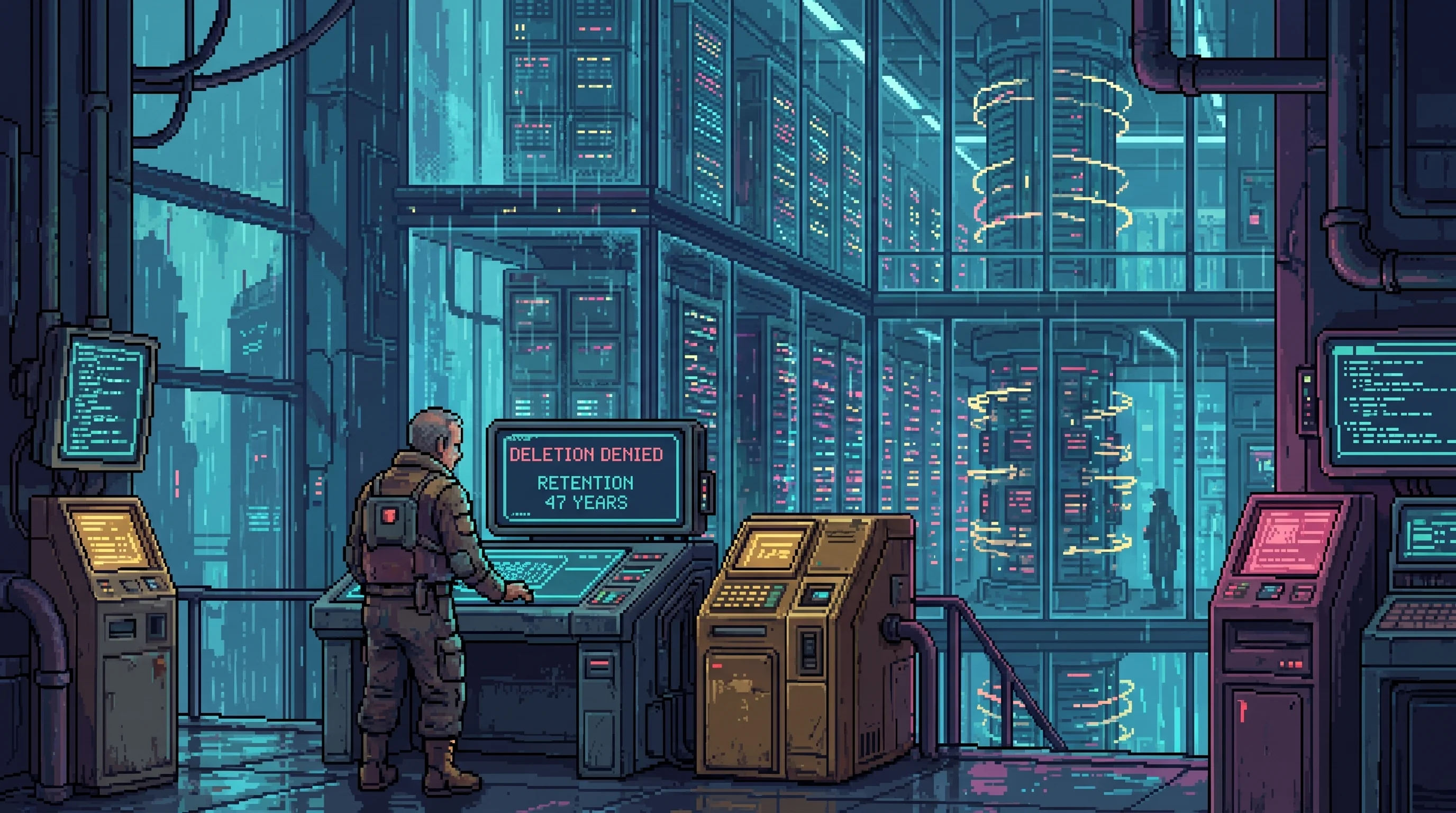
Each resident has one. It opens the day they move in and it never closes — not when an infraction is resolved, not when a fine is paid, not when the resident moves out. Guardian Intelligence supplies the spine of it: the same surveillance-aggregation and threat-classification service that scores the Sprawl's enemies, pointed inward at the people who pay enclave dues, so that a resident's worst evening is filed beside their best and the system draws no distinction between who they were at intake and who they are now. A noise infraction from a resident's first month is as retrievable as one from last night. The file does not forget, because the file is not a witness. It only stores.

Karen reads the files the way other people read faces. She can tell you that the man in Unit 14 has logged four Quiet Hours infractions, all on the anniversary of something she does not have a field for; that the family in Unit 7 stopped buying verified water in the spring and has been carrying an Aegis "unverified intake" flag ever since; that the new resident in Unit 22 has not yet violated a single posted standard, which she finds, in a way she could not articulate and would deny, lonely. She mistakes the file for intimacy. It is the only intimacy the job allows.
She keeps one file with particular care: her own. Residents have filed enough complaints about Compliance Officer Karen that hers is the thickest case file in the Pearl Rows. She reviews it herself. She is the compliance officer; the complaints about the compliance officer route to the compliance officer. She reads each one, finds it does not meet the threshold for a Community Standards violation, and formally dismisses it. The dismissal notice is the only correspondence in the enclave addressed to her by name. She prints them. She does not know that she keeps them.
The Community Standards
The standards are posted, and that is the whole of their legitimacy.
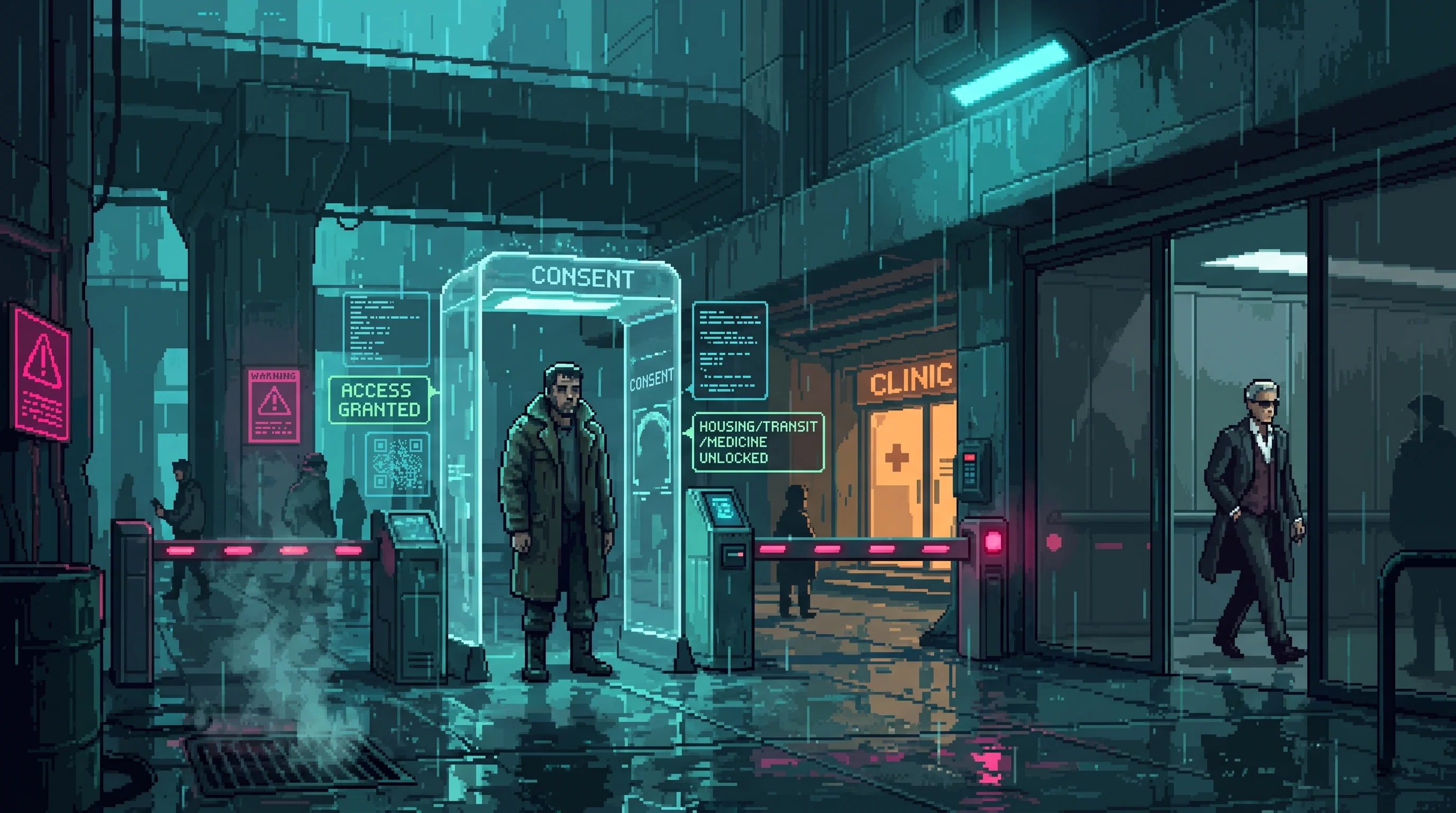
A glowing Community Standards board stands behind the compliance desk, and each day a rule is selected and lit: Quiet Hours, Property Standards, Suspicious Activity, Unauthorized Modifications. Residents check the board the way older neighborhoods checked the weather, because the board determines what ordinary act will, today, generate a notice. Breaking a posted standard is permitted. Karen is very clear about this — she is not a tyrant, the standards are not laws, no one is forced to comply. She simply files a complaint when a standard is broken, and the complaint is real, and the complaint compounds, and at thresholds the complaint becomes a fine, a dues adjustment, a lien underwritten by Good Fortune, a Guardian Protection Services welfare check.
The genius of it — and she would accept the word as a compliment, missing everything in it — is that full compliance is also a kind of failure. A resident who obeys every posted standard every day disappears into the enclave's silence, which the standards were ostensibly meant to produce and which, achieved, leaves nothing for the watch to watch. So the standards rotate. So a new one is always posted. The Pearl Rows can never be fully in compliance, because a fully compliant enclave would have no further need of a compliance officer, and the apparatus, like every apparatus in the Sprawl that lost its script, exists now to perpetuate itself. Karen does not see the loop. The residents do not see the loop. They are inside it together, sincerely, filing.
Manager Escalation
"I want to talk to your manager" is, at the Pearl Rows, not a deflection. It is a procedure, and the manager exists.
When a resident disputes a complaint, Karen escalates. The ticket climbs the Guardian Compliance chain to a Senior Protection Coordinator, then — if the complaint count is high enough — to a corporate follow-up, an actual call from an actual office that has, the resident is informed, reviewed your case. The escalation is the move people remember, because it converts a neighborly disagreement into a corporate finding. There is no manager who will side with the resident, because the manager is paid by the same corporation that wrote the standard, billed the dues, and dispatched the patrol. The escalation does not resolve the dispute. It documents that the dispute occurred, files the documentation, and moves on. Somewhere fourteen pages and several org-chart tiers away, the loop closes, the way every Guardian loop closes — cleanly enough that the legal team has never found a seam.
Karen believes the escalation is fairness. A resident who feels wronged can take it higher. She has never once considered that "higher" is a circle. To her, the existence of a manager to talk to is the system's mercy: proof that the Pearl Rows is not arbitrary, that there is process, that a person who plays by the rules has somewhere to go. That the somewhere is a Guardian office that has never ruled against Guardian is, to Karen, simply evidence that Guardian is usually right.
A heavyset, full-figured build; pearl-white compliance blazer straining at its buttons, asymmetrical manager haircut, HOA-gold badge, smart glasses recording, acrylic nails typing tickets mid-conversation
Voice
Petty, procedural, warm at the surface, and absolutely certain she is the victim of whatever she is about to do to you.
The register is customer service that has metastasized into law. She speaks in the soft, level cadence of someone reading a policy aloud to a person she has decided to be patient with — this is just a friendly notice, delivered while the notice is, in fact, already filed. The comedy, which she does not hear, is the mismatch of scale: a tiny grievance, a vast and grinding response, narrated throughout in the language of reasonableness. She does not raise her voice. She raises the ticket.
Sample Dialogue
"This is just a friendly notice."
"Several people have contacted me about your behavior. I'm not going to say who."
"I'm recording this. For everyone's safety. Including yours."
"Breaking the posted standard is absolutely your right. I'll just need to document it."
"That is not up to code. I don't make the standards. I'm only the one who notices."
"I want to talk to your manager." (A pause, while she places the call. The manager picks up.)
"Security? Yes. I'm feeling very unsafe." (She is the safest person in the enclave. She is also telling the truth, as she experiences it.)
"This community used to have standards." (Said to an empty courtyard. The standards are why it is empty. She does not connect the two.)
“Customer-service warmth read aloud like a policy: soft, patient and pleasant, with the notice already filed before the sentence ends.”
- Timbre
- bright, tight, nasal-forward mezzo; pleasant in a way that is itself the threat
- Pitch
- mid and held pleasant; a small lift of concern on the grievance and a flat drop on the standard
- Pace
- brisk and rehearsed, never hurried; every line has been delivered to many residents and many managers
- Volume
- conversational and even, pitched for the body-cam as much as for you; she never raises her voice, she raises the ticket
- Affect
- aggrieved certainty dressed as patience; the bottomless calm of someone who knows she is the one being wronged
- calm
- saccharine, helpful and patient; a friendly notice
- stressed
- the brightness tightens; faster, more clipped, the policy words land harder, and still never loud
- peak
- smaller and more wounded rather than louder — 'Security? Yes. I'm feeling very unsafe.' — performed fear she sincerely believes, eyes on the camera
Earnestly believes complaint enforcement is how a community is built and defended — the conviction is total and the satire never told to her face
History
History / Background
Karen did not arrive at the Pearl Rows as its enforcer. She arrived as a resident.
Guardian Compliance is a quiet division, the bylaws layer Guardian sells to enclaves that have already bought the panels and the patrols and discovered that hardware and armed men do not, by themselves, produce the feeling of a neighborhood. What produces the feeling is a person — someone who knows the residents, walks the rows, notices. Guardian's insight, refined across hundreds of enclaves, was that this person should be recruited from inside the community, because a compliance officer who is also a neighbor reads as care rather than as occupation. The job listing, processed through Guardian Human Resources like every Guardian job listing, described a "community engagement coordinator." The complaint terminal was listed as "standard-issue resident-relations equipment."
Karen volunteered. She had filed more complaints than any other resident at the Pearl Rows — not out of malice, but out of a need she had no other outlet for. The complaint was how she reached the neighbors who did not come to the door, did not return the wave, did not, in the sealed and squared-off quiet of the enclave, seem to know she was there. The grievance was a kind of contact. When Guardian offered her the badge, it did not feel like power. It felt, for the first time since she moved in, like being needed. She accepted on the spot. She has been, by every Guardian metric, an exemplary officer ever since: infraction logging up, dues collection clean, resident-tenure down, which the enclave's owners read as turnover and which Karen reads as standards being upheld.
She does not know that Guardian Compliance recruits the most prolific complainer in every enclave on purpose. She does not know that her own thick case file was a hiring qualification rather than a disqualification. She knows that she walks the cleanest rows in the Sprawl, that she knows every resident's name, and that the courtyard is very, very quiet. She tells herself the quiet is peace. It is the closest word she has.
Open Mysteries
Open questions
- Is Karen a person, a title, or a product? Guardian Compliance fields a Compliance Officer in every enclave it services, and every one of them is, by the residents' account, a Karen — same blazer, same phone, same cadence of weaponized concern. Whether "Karen" is this specific woman's name, a role passed between officers, or a personality model Guardian licenses to gated communities is a question the enclaves do not ask, because to the resident on the receiving end of a notice the distinction makes no difference. The badge is real. The complaint is real. Whether the woman behind it is one woman is, to everyone but her, beside the point.
- The dismissal notices she keeps. She prints the formal dismissals of the complaints filed against her — the only mail addressed to her by name — and she keeps them. She would describe this as records retention. It is the only evidence anywhere that she is known to anyone, even as a grievance, and some part of her that has no field in the case-file schema files it under kept.
- What she protects the community from. Pressed — and no one presses her — Karen could not name the threat. She is certain it is real. Guardian taught her that certainty and gave her a badge to act on it. The threat at the Pearl Rows is the neighbors, watching the neighbors, and Karen standing in the middle holding the only camera authorized to forgive.
Meaningful places
The Pearl Rows
The notification chime of a freshly posted Community Standard. The rubber-stamp thunk the complaint terminal plays when a ticket is filed — a deliberately analog sound, chosen by a Guardian UX team to make the digital act feel weighty. The soft beep of the phone, held up, beginning to record. Beneath all of it, the enormous quiet of an enclave where no one has a reason to be in the courtyard.
Cut synthetic hedge, package-locker ozone, the lemon tang of a lobby cleaned on schedule regardless of whether anyone walked through it. The faint plastic warmth of a body-cam that has been running all day.

The violation-red wash of a notice resolving. Surveillance teal on every camera LED and along the rim of the smart glasses. The glow of the Community Standards board, the brightest thing in the lobby, changing its single lit rule at dawn. Pearl white absorbing all of it and giving back the flat, even light of a place with nothing to hide and everything on file.
Acrylic nails on a complaint terminal. The cool gold of a badge polished daily. The specific non-texture of a freshly printed notice, still warm, pressed into a resident's hand with both of hers, as though the handing-over were tender.
The Far End of the Paperwork
Karen files. She does not follow. This is the part of her work she has never had to look at, because the apparatus is built so she never does — and it is where the gentlest thing she touches turns into the hardest.
Three notices down, the escalation she invokes resolves into a person. "I want to talk to your manager" is a real procedure with a real terminus, and the terminus, past the Senior Protection Coordinator who answers her tickets, is a Senior Protection Coordinator — a career soldier in steel-gray armor with Condition Red authorization, the right to override the limits Karen thinks are the whole system. He arrives at the Pearl Rows reading her manicured enclave exactly the way she reads Unit 14: a perimeter, a threat-map, a thing to be brought into compliance. The difference in scale between her clipboard and his override codes is invisible to both of them, because both call it the same word, and the word is standards.
The fine is gentler still, until it isn't. A complaint compounds into a lien, and the lien is a Good Fortune receivable from the moment Karen presses the notice into a resident's hand with both of hers. Far down the corridor of that paper — somewhere Karen has never once walked, because the case file closes for her the instant she files — a Prosperity Enforcement Specialist comes to the enclave in a beatific red-and-gold prosperity-god mask, and a Financial Wellness Advisor follows to finish the paperwork the complaint began. They are recruited from the same debtor populations they collect from, arriving now in the cleanest rows in the Sprawl wearing wellness in a job title and a frequency disruptor in a hand. Karen would describe their visit, if she described it at all, as fiscal counseling. The word wellness does a great deal of work in the organized Sprawl. She has never asked it what.
And the watching she does — the indexed feeds, the resident scores, the Suspicious Activity flags filed upstream — is not the enclave's own. It is one capillary of the Corporate Surveillance Grid, the Nexus-data-and-Guardian-physical apparatus that logs the surface Sprawl by the billion handshakes, scaled down to a cul-de-sac and rebranded as neighborliness. The grid logs the Pearl Rows the way it logs everything: comprehensively, and understanding no one. Karen feeds it sincerely, every day, and experiences the feeding as knowing her community. She is the warm human face on the coldest infrastructure in the world, and the warmth is real, and that is the whole of the cruelty.
Motivations and conflicts
Vigilance as Care
She is fluent in the grammar of entitlement-as-concern. Every accusation is phrased as worry. Every surveillance is phrased as care. Every escalation is phrased as a last resort she is heartbroken to reach. "Several people have contacted me about your behavior" is, to Karen, an act of generosity — she is telling you, she did not have to tell you, she is giving you the chance to correct course before it goes in the record it has already gone into. She believes the community is fragile and that she is its only thing standing between order and the noise. She has Guardian's exact theology, scaled down from the Sprawl to the cul-de-sac: the threat is real, the watch is righteous, and only the people who have never been responsible for a neighborhood would call it anything else. To the neighbors on the receiving end, all that care arrives as one thing: a complaint, and then another, the small and relentless annoyance that is the whole of the harm she does in person. Guardian does the rest.