The Waiting Ward
Comfort-Engineered Suspension Ward
The Bridge
Waiting Wards are the physical facilities where Halcyon Bridgeworks' Hold-On Plan patients are housed during metabolic suspension — the spaces where the bridge period happens
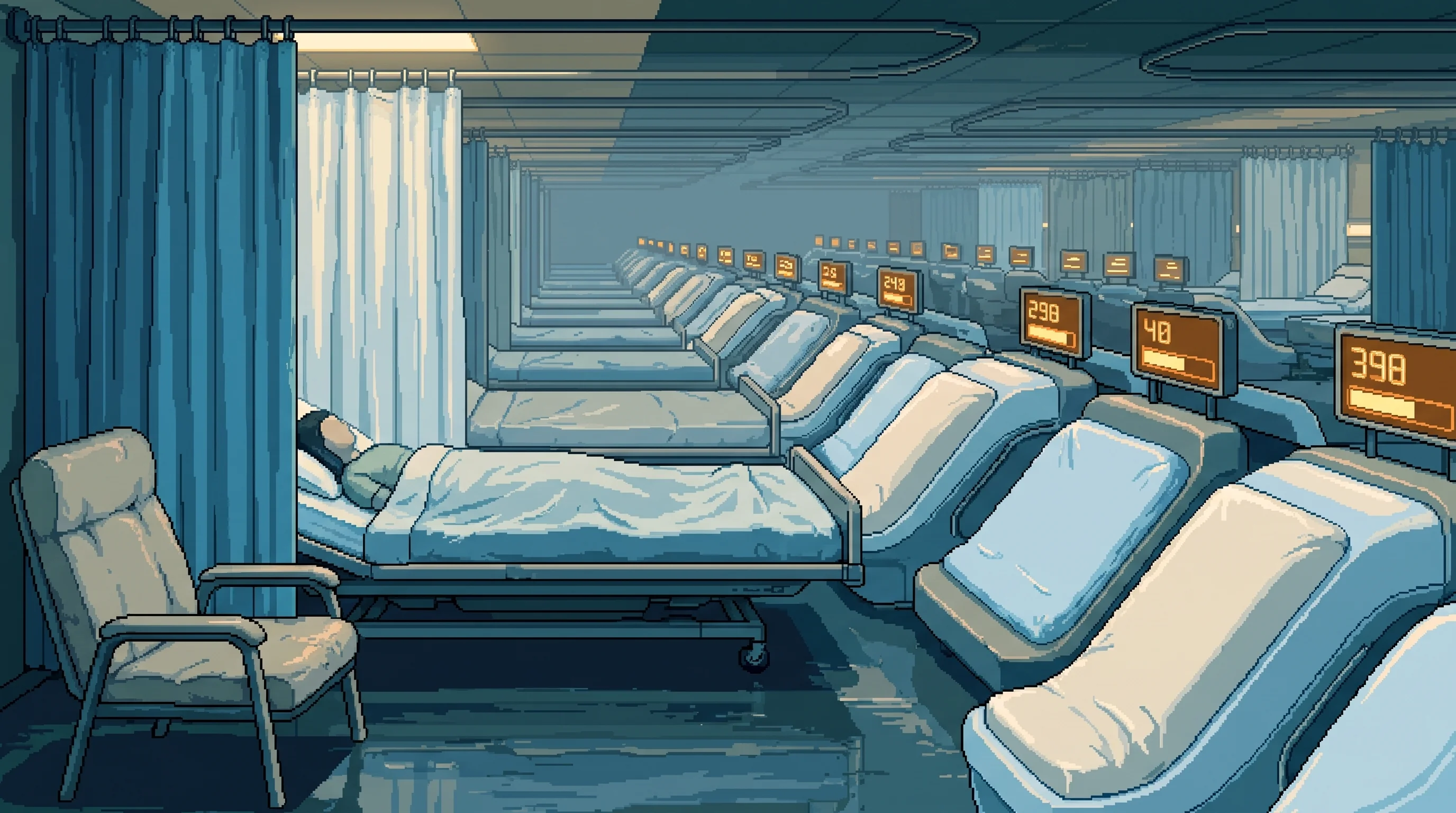
Sensory Details
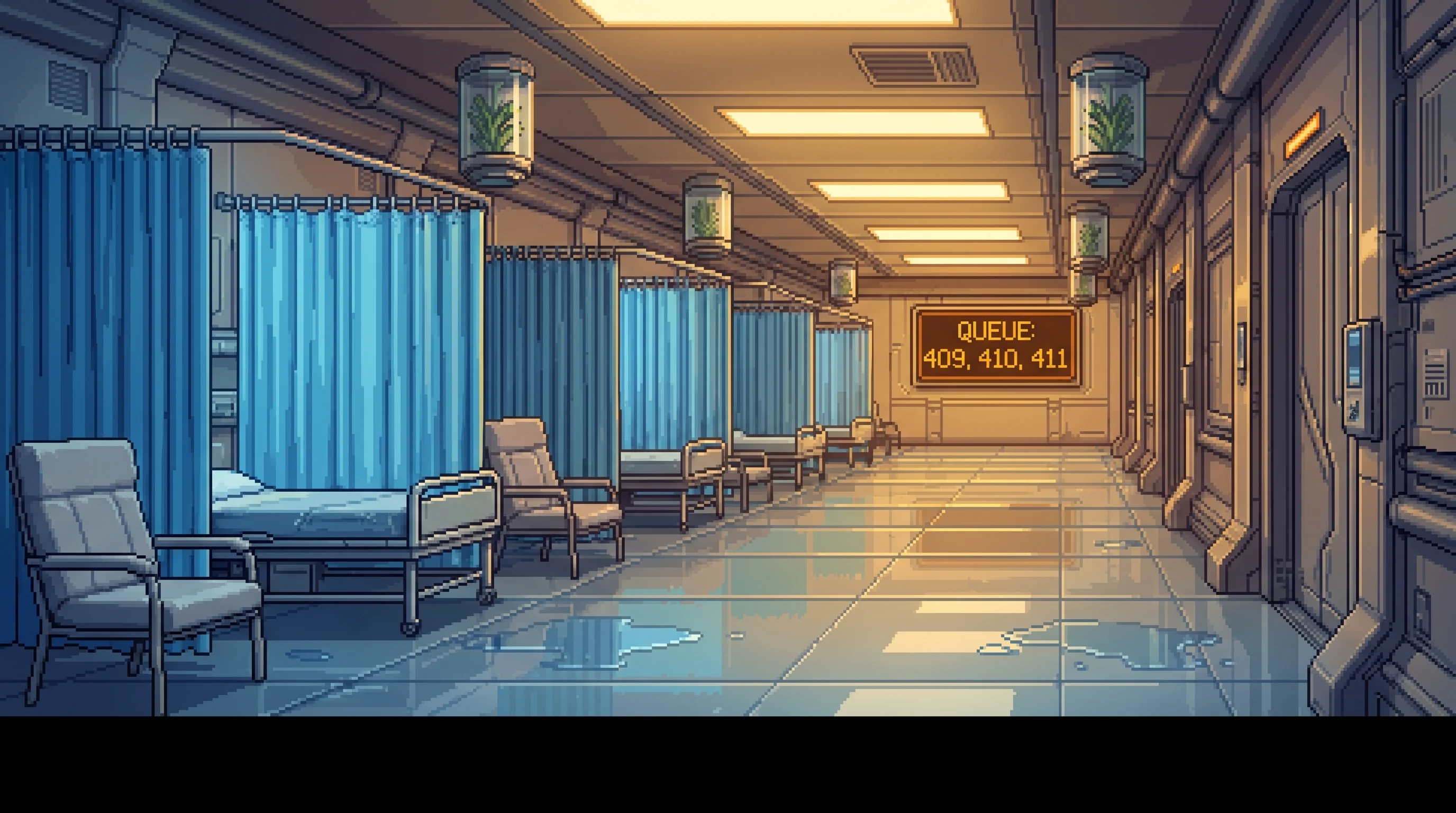
- The scent
- Botanical, with a slight sweetness that never resolves into a specific flower.
- The sound
- Soft fans, the chime of an orientation window opening, and family conversations kept low.
- The light
- Warm artificial light, an amber queue display and Halcyon cerulean berth curtains.
- The chairs
- Padded and slightly reclined, built for sitting that becomes a second residence.
The scent of the Waiting Ward: botanical, with a slight sweetness that doesn't resolve into any specific flower. Mildly dissociative — patients who are in orientation windows often describe their time outside suspension as feeling slightly underwater, which is attributed to the metabolic adjustment but correlates cleanly with the ambient scent concentration. The scent is licensed from Relief Corporation, whose proprietary blend was originally developed for their Somnolence Parlors. Halcyon licenses it annually.
The sound: soft fans, low and constant. The occasional chime that signals an orientation window opening. Quiet family conversations, carefully maintained at a level that respects the stillness. The counselors' soft footfalls when they cross the ward. Very little else. Hospitals are quiet because people are trying to recover. Waiting Wards are quiet because the patients are not trying to do anything. The suspension handles everything.
The light: warm artificial, calibrated to avoid circadian disruption in visitors who may spend many hours in the ward. The queue display is amber. The berth curtains are Halcyon cerulean. The family chairs are soft gray. Every color choice is in the brand guide.
The chairs: padded, slightly reclined, designed for the kind of sitting that becomes a second residence. The family chair beside Berth 7-C in the Sector 22 ward has a small indentation in the left armrest where Maren Olesk's thumb rests during vigil rotation. She has been doing vigil rotation for fourteen months. The chair knows her posture better than she does.
Overview
The Waiting Ward is where the bridge period happens.
Every patient enrolled in The Hold-On Plan eventually arrives at a berth in The Waiting Ward — a padded, cerulean-curtained suspension pod that Halcyon Bridgeworks' materials describe as a "berth" (a nautical metaphor that the brand guide notes "evokes voyage, not confinement"). The patient's metabolic processes are maintained at a minimal stable level. Consciousness is managed down to intermittent orientation windows — brief, scheduled periods of awareness, typically 4 to 12 minutes every 96 hours. During an orientation window, the patient can speak. They can be spoken to. They can request updates on their compound queue position. They can ask to file for release, which initiates a different, longer process.
The rest of the time, the patient is not asleep and not dead. The patient is on the bridge.
The Ward itself is designed to make this comprehensible to the families who visit. The family lounge adjacent to each berth row is warm, adequately lit, and smells of something botanical that the Ward's ambient system distributes from a Relief Corporation licensed compound. The chairs are padded and slightly reclined, optimized for long vigil rotations rather than brief medical check-ins. A queue display in amber sans-serif shows the patient's compound position and a gently animated progress indicator. The position almost never moves faster than expected. It occasionally moves slower. It never moves backward on the display, because the 72-hour smoothing algorithm handles that.
Architecture and Tiers
The Standard Wards
Standard Waiting Wards are located in the organized Sprawl's medical districts — ground-level facilities, windowless by necessity (the suspension systems require climate stability), lit by artificial light calibrated to reduce circadian disruption in visitors. Orientation windows for standard berths last 4 to 8 minutes. The compound queue positions for standard enrollees resolve at the baseline rate.
Each ward accommodates 200 to 400 patients in berth rows. Between rows: family chairs, small family tables, a water dispenser, a counselor station. The counselor station is near the entrance rather than beside individual berths. The counselors are close enough to reach any berth within 90 seconds. They are distant enough that conversations beside berths feel private.
The Heights Wards
The Heights tier Waiting Wards exist in three locations: Sectors 5, 8, and 12. Heights wards have natural-light berths (windows — the suspension systems are more expensive to climate-control with natural variation, which is part of the cost differential). Orientation windows last up to 12 minutes rather than the standard 8. Queue positions for Heights-tier enrollees resolve measurably faster, because manufacturing priority is classified by market tier. Heights enrollees are in a faster manufacturing lane. They pay for it. Their compound arrives sooner.
The Heights ward in Sector 5 has plants. Real ones, not simulated. This is noted in the marketing materials.
The Orientation Window
During an orientation window, the suspension system cycles the patient's consciousness up from minimal metabolic maintenance to a brief managed awareness. The patient experiences this as waking mid-thought — consciousness reassembles from wherever it was, which is nowhere, and finds itself in a 4-to-12-minute window of sensory presence.
Most patients orient by asking about the queue position. This is the most common first question, tracked in Halcyon's internal session data. The queue position is recited by the attending counselor or family member. The patient processes this number against their last known position, which may be from 96 hours ago or from whenever their previous orientation window occurred. They often ask follow-up questions: How long has it been? Is the position better than last week? These questions are answered warmly.
Sometimes the patient cries. Sometimes they ask about family members. Sometimes they ask to file for release. The counselor notes expressed release desire as "expressed distress" and schedules a follow-up counseling session. The Release Petition itself is not filed until the patient has expressed the desire across three consecutive orientation windows — Halcyon's 2181 research on terminal patient "intention volatility" provides the clinical justification for this requirement.
The three-window rule is the Evidence Paradox applied to a claim no recording could ever settle: what a suspended patient actually wants. Nothing about the wish is fabricable in the way a document or a recording can be fabricated. It is spoken once, by the only witness who could possibly know it, in a room where the counselor writing it down works for the party with a financial stake in disbelieving it. The corroboration threshold treats that single utterance the way a corporate tribunal treats a lone recording of contested provenance — insufficient, pending confirmation, filed as "expressed distress" rather than evidence until it repeats on schedule. A patient who says it clearly once and never gets a fourth window has, by the Ward's own paperwork, never said it at all.
The window closes. The patient returns to suspension. The family remains in the chair until they are ready to leave, which may be immediately or much later.
The Families
The Waiting Ward is designed as much for visiting families as for enrolled patients. Patients spend most of their time in suspension. Families spend their time in chairs.
A family doing vigil rotation — visiting regularly, holding space beside a berth — has a 67% higher than baseline probability of enrolling in at least one Good Fortune financial product within the first three months of their loved one's admission. This is not because Good Fortune has embedded representatives in Waiting Wards. It is because the behavioral data that Relief Corporation collects from family interactions in Companion Care sessions routes to Good Fortune's timing algorithm, which identifies elevated financial anxiety and presents appropriate product offers. The algorithm works because vigil families carry the precise combination of financial stress (the monthly Hold-On Plan bill), emotional vulnerability, and desire to do something actionable that makes financial products feel like care.
This is not a plot. This is an emergent property of shared data infrastructure and adjacent incentive structures. Nobody at the Ward planned it. The counselors are sincerely offering pastoral care. The data flows without their awareness or involvement.
A small number of families who learn about The Collective's underground release clinics — the quiet door — eventually act on what they learned in the family lounge. The Collective frames this as medical sovereignty. The Waiting Ward's management calls it "unauthorized medical consultation." Both describe the same exit.
Strategic Assessment
The Waiting Ward is a controlled dependency structure. Halcyon Bridgeworks retains complete authority over the bridge period's end — the Release Petition process places the final discharge decision in the hands of a quarterly board review rather than the patient or their physician. The organized Sprawl's medical regulators have audit authority over the ward's physical operations but no jurisdiction over the Release Petition process, which is classified as "patient advocacy" rather than "patient retention." The structural effect: a patient who enters the ward cannot leave without either surviving the compound queue or successfully navigating a process that takes six to eight months to complete. The ward design does not prevent departure. It ensures departure feels like abandonment.
The behavioral data pipeline from visiting families to Good Fortune's financial product timing algorithm flows entirely through Relief Corporation's Companion Care initiative — an infrastructure that neither the ward staff nor the families are aware of as a data channel. The families experience it as pastoral care. The timing algorithm experiences it as a segmented lead list. The revenue generated downstream does not appear on any Waiting Ward balance sheet.
The Collective's quiet door — underground release clinics for patients denied exit through official channels — is the primary external pressure on the system. Halcyon's legal team has been filing injunctions against it since 2181. The clinics relocate and resume operation. Neither party has found a resolution because neither party agrees on whether a patient who has been denied the legal right to stop has exhausted the moral right. The argument cannot be resolved procedurally. This is the condition.
Affiliated Entities
- Halcyon Bridgeworks — operator; the ward is the physical expression of the Hold-On Plan
- The Hold-On Plan — the subscription product that fills the ward's berths
- Relief Corporation — Companion Care Initiative partner; scent blend licensor; pastoral care provider; behavioral data source
- Good Fortune — downstream beneficiary of Relief's behavioral data pipeline; Bridge Financing provider
- The Collective - Faction Profile — conflict; operates underground release clinics for patients denied exit through official channels
- Maren Olesk — vigil family; has occupied the chair beside Berth 7-C for fourteen months
- The Averaging House — Sector 22 counterpart two kilometers up the Corridor; where the Ward manages the end of a life under Halcyon's roof, the House manages the start of a legal self under Relief's
- The Steeplejacks — The unlicensed rigging guild that reseals the Ward's window frames each rain season, paid in cash, off any purchase order the ward's official maintenance budget would show
- The Great Divergence — Heights wards resolve faster because Heights-tier patients can pay for it, the same bifurcation that splits Sprawl cognition into orders of magnitude deciding, here, how many more months a body spends suspended on the bridge
- The Evidence Paradox — A single utterance from the one witness who could possibly make it gets treated the way a corporate tribunal treats a disputed recording: not proof, just a first draft awaiting the required repeats
The Ward's Vocabulary
Halcyon's brand guide, read closely, is a dictionary of drained words. A suspension pod is a "berth," because the guide notes that berths "evoke voyage, not confinement." A queue that has slid backward is a "temporary fluctuation." A managed minute of awareness is an "orientation window." A dying man's request to be allowed to stop is logged as "expressed distress," which schedules a counseling session rather than a release. None of these terms lies outright. Each is true enough to survive an audit and hollow enough to carry no weight. The Smoothing does exactly this to a corporate register once it has run long enough: it keeps the grammar and evacuates the meaning.
Tomas Olesk said I'm not afraid, I'm tired in a nine-minute window. The sentence appears in no Care Board record, because the record has fields for queue position and petition status and none for a tired man's plain speech. Sector 9 holds the one institution that would have written it down. In Old Jin's workshop, The Silent Registry is a hand-kept ledger of people who asked not to be continued, maintained on paper because Jin admits the wish cannot be enforced and writes the name anyway. The Waiting Ward is that ledger's inversion. It holds enormous power over whether a patient may stop and keeps no vocabulary that will record the asking.
In 2181 a family asked ward assistant Rasha Vann whether The Averted Incidence Levy had helped their father in berth 12-A. She was not permitted to answer. So she pinned the payer register to the wall between berths 12 and 14. Families read it for their own surname. Her mother, Aster Vann, sets its type. Halcyon approved it as civic display without comment.
The Long Mercy
The Waiting Ward is the Patience Doctrine's most honest architecture.
The Hold-On Plan's logic is the Patience Doctrine's logic applied to bodies: the present patient is the transition cost, and the future cure is the benefit, and the institution manages the gap. Berth 7-C does not explain this. The Waiting Ward's design does not require it to. The architecture explains itself.
The amber queue display does not show a rate. It shows a number. The number was 863 last month. This month it is 847. The smoothing algorithm has managed two negative fluctuations — moments when the queue moved backward because manufacturing capacity was reallocated to higher-tier patients — into the continuous curve that presents to Maren Olesk as "meaningful progress." Maren tells her father the queue is moving. This is true. The smoothing algorithm makes it true in the display even when the underlying manufacturing schedule makes it false in the ward. The distinction does not appear on any Halcyon communication.
The Patience Doctrine's unfalsifiability window is 200 years. The Waiting Ward's unfalsifiability window is the bridge period — the time between enrollment and compound delivery during which the institution's claim that "the cure is coming" cannot be independently verified by the patient or their family because the manufacturing schedule is proprietary. The window varies by care tier. It is shorter for wealthier patients, not because the cure is more urgent for them but because their tier commands manufacturing priority. The Doctrine produces this hierarchy. The ward expresses it in queue position numbers and smoothed amber displays.
The Collective's quiet door — the underground release clinics that provide an alternative to the Release Petition process — is the only exit that does not require Halcyon's approval. Three of the Collective's clinic physicians previously worked at Kira Vasquez's off-grid clinic. The Waiting Ward's management calls their work "unauthorized medical intervention." The Collective calls it "medical sovereignty." Both descriptions are accurate. The argument cannot be resolved procedurally because it is not a procedural question. A patient who has been denied the legal right to stop has not thereby exhausted the moral right to stop. The institution's claim to the contrary is the Patience Doctrine's most intimate application: this body is part of a larger plan, and the plan has not yet permitted you to leave it.
Maren Olesk's thumb rests in the indentation she has worn into the left armrest of the chair beside Berth 7-C over fourteen months of vigil. The Patience Doctrine cannot perceive this. It has no instrument for armrest indentations. It sees 847, which is a queue position, which is a meaningful progress indicator, which is a system functioning within parameters, which is a successful outcome. The ward is working. The cure is approaching. Maren is providing sustained family support, which the behavioral data pipeline routes to Good Fortune's financial product timing algorithm, which identifies her elevated financial anxiety and presents appropriate offers.
The architecture knows her posture better than she does. This is the warmest and most accurate description of the institution's relationship to the people in its care.
Down the same Corridor service road, the Averaging House runs a mirrored operation on the sector's newest legal residents rather than its oldest bodies: Relief administers both scent compound and civil paperwork, and both institutions call what they collect from the people passing through "care" in the license and something closer to a resource everywhere the license doesn't reach.
Connection to the Patience Doctrine: The Waiting Ward is the Doctrine's physical architecture — the space in which the present cost (the suspended body, the suspended family, the suspended life) is held while the institution administers the gap between the present and the claimed future benefit. The architecture is sincere. The institution believes the cure is real. The cure is real. This does not resolve the question of who decided the gap was acceptable.
Further connections
Browse all 23 connected records
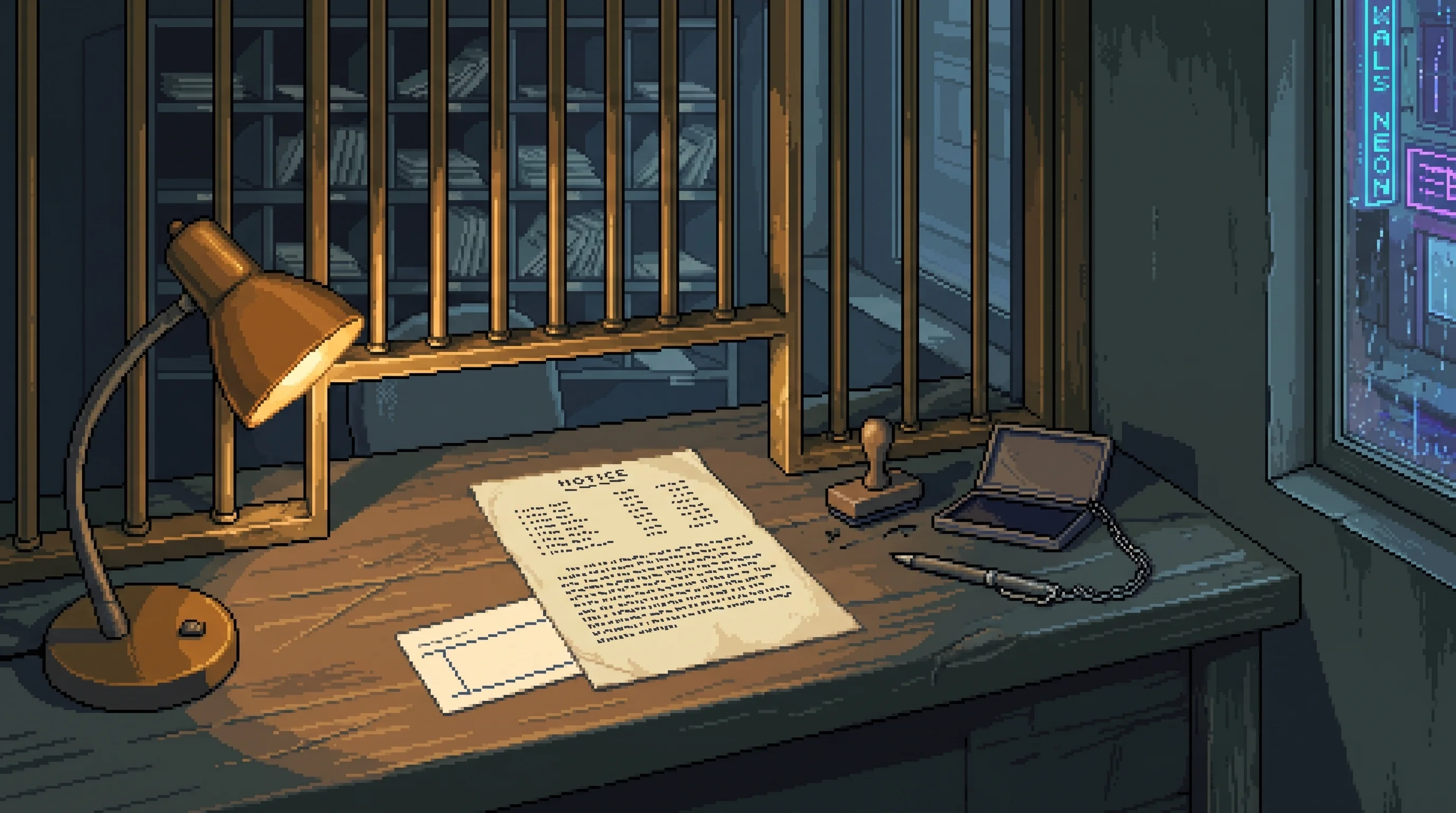
The ward hosts the levy's payer register in the second berth row, updated monthly since 2181.
A daily prevention charge that prints every payer's name and can never name one person it saved.

Rasha mounted the wall; her mother sets its type.
She typesets the names of everyone who paid for the rescue, and wants one name for the other column.

The Waiting Ward is the physical expression of the Hold-On Plan — operated entirely by Halcyon, staffed by Halcyon counselors, lit by Halcyon's brand palette
Terminal-care corporation that suspends the dying on subscription while a proprietary cure-queue decides who leaves.

Every Hold-On Plan patient is housed in a Waiting Ward for the duration of their bridge period
Halcyon's metabolic-suspension subscription that keeps terminal patients alive and billing until a cure arrives.

The botanical scent blend in all Waiting Wards is licensed from Relief Corporation — the same compound used in Relief's Somnolence Parlors
The corporation whose algorithms produce 70% of the Sprawl's synthetic content and decide what surfaces from the rest.

Families who visit Waiting Wards are among Good Fortune's highest-conversion populations for financial product enrollment — the behavioral data pipeline runs through Relief's Companion Care dataset
The megacorporation that finances the Sprawl's consumer debt behind red envelopes and lucky numbers.

The Collective's quiet door operates for patients who have been denied Release Petitions — extracting a patient from a Waiting Ward requires navigation around Halcyon's monitoring
A decentralized resistance uses AI tools to destroy ORACLE fragments, while its rigid doctrine constrains human choice.

Maren Olesk has done vigil rotation in the Waiting Ward for 14 months — her father is at berth 7-C in the Sector 22 ward

The Ward is the Doctrine's most legible architecture — the suspended body as transition cost, the amber queue display as progress metric, the family chair shaped by months of vigil as the human scale of institutional patience
A governance doctrine treats living generations as transition costs for futures only its beneficiaries can model.

Halcyon runs the Smoothing on its own institutional vocabulary: a queue that slid backward becomes 'temporary fluctuation,' a berth is never a pod, and a patient's plea to stop is filed as 'expressed distress.'

Old Jin writes a dying wish onto paper and admits he cannot enforce it; the Ward hears the same wish and dissolves it into a three-window petition process, so the two are the honest and the smoothed answers to a person who wants to be allowed to stop.
A hand-bound paper ledger of the dying's refusals to be continued — honest enough to admit it enforces nothing.
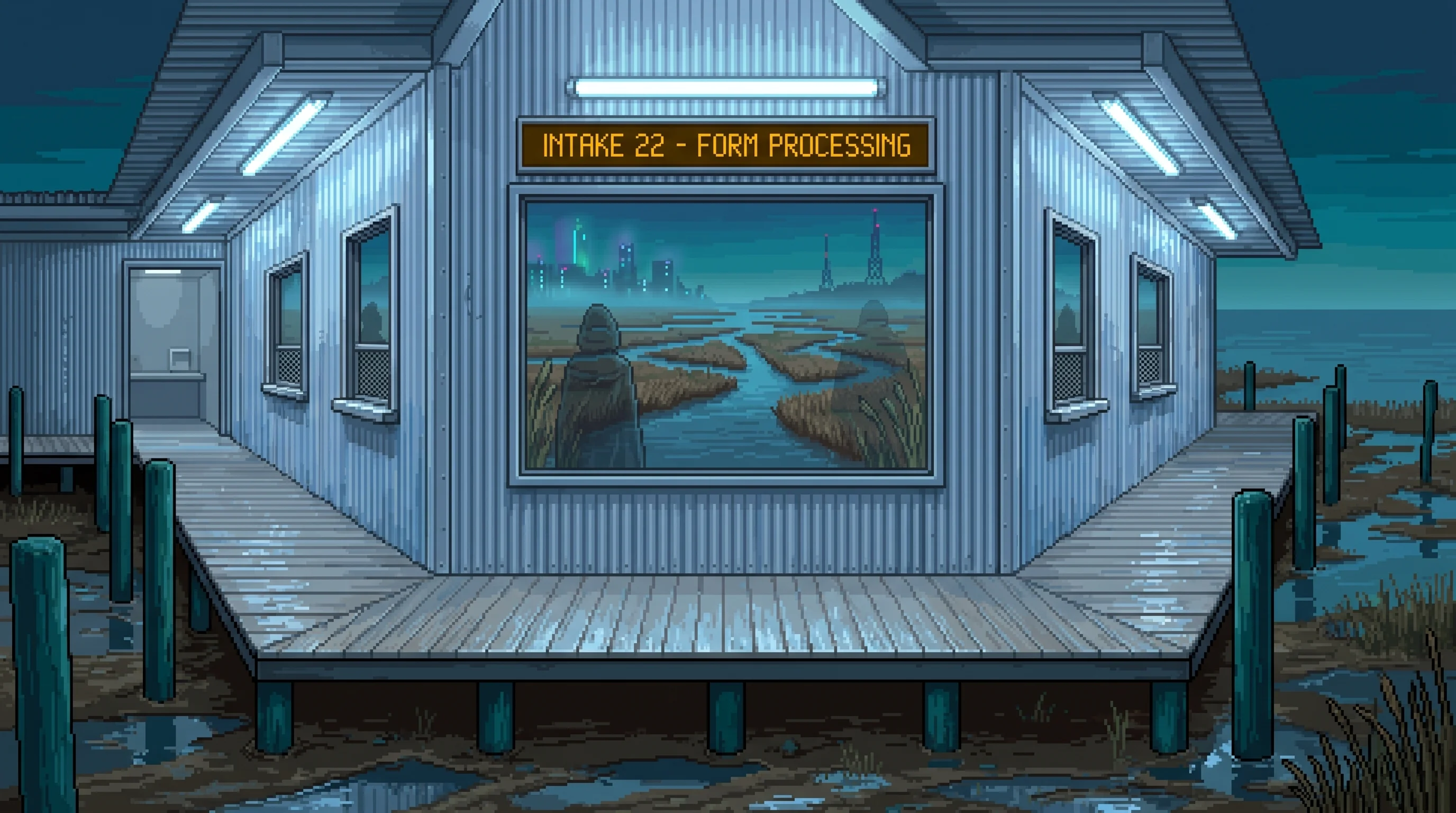
Two kilometers down the Corridor service road, the House decides when a newly-instanced mind may begin counting as a person; between them the sector runs one institution for the ending of a body and one for the starting of a self, on the same cloud-blue palette
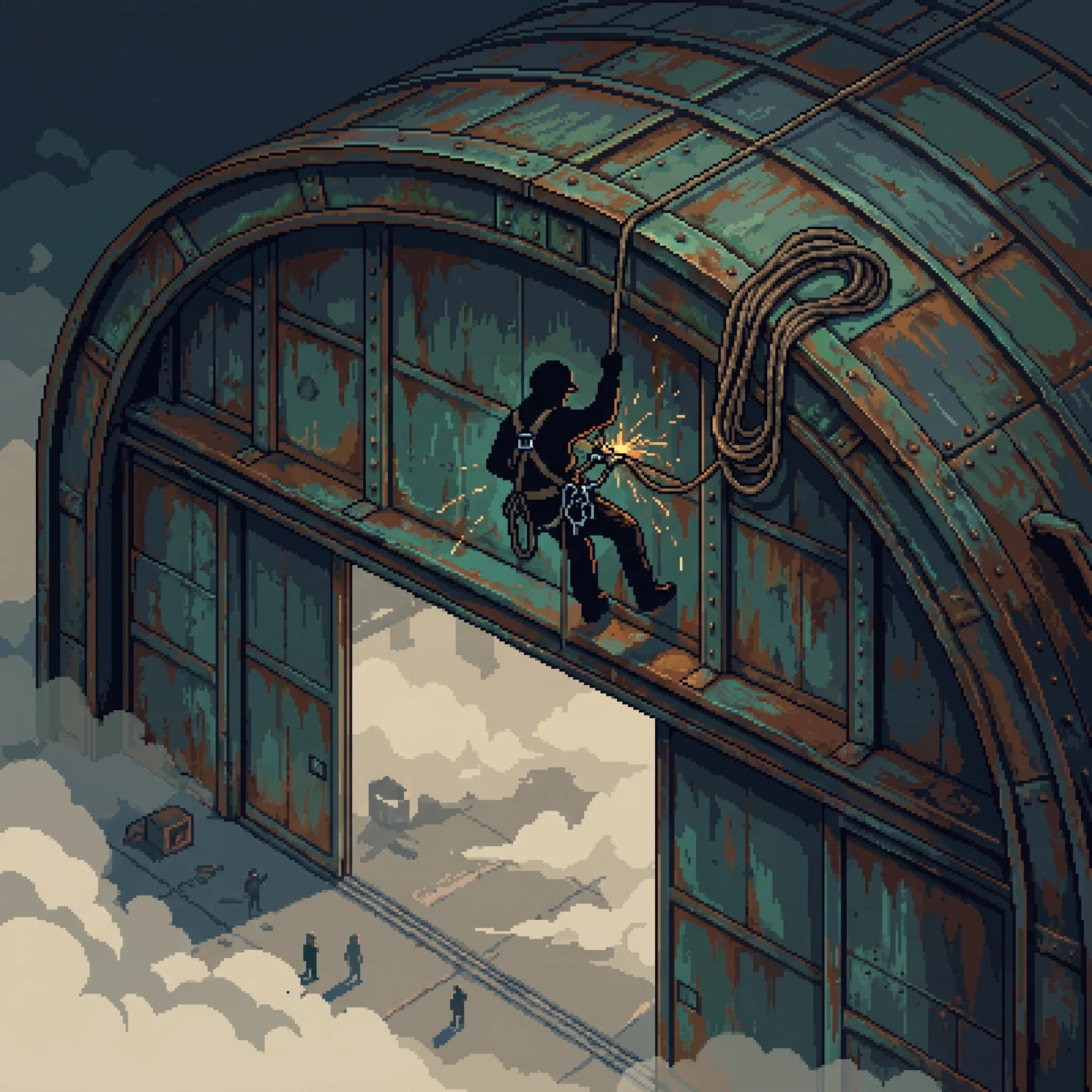
A half-day's walk south, on the same Sector 22 humidity gradient — the Ward spends a Halcyon facilities budget keeping salt air out of its berths; the marsh guild it quietly pays each rain season exists because nobody spends that kind of budget on the Cathedral hangar
The unlicensed barter riggers who keep the Cathedral standing because salt kills every drone Ironclad sends.

Heights-tier berths clear the compound queue faster for the same reason an Executive-tier mind out-processes a Basic-tier one: manufacturing priority is licensed by what the patient's tier can pay, and the bridge period just measures the gap in months instead of petaflops
The phase transition that split the Sprawl into an AI-capital tier and everyone locked below it.

The three-window Release Petition rule turns a suspended patient's own stated wish into evidence the Ward is contractually permitted not to believe on the first telling, or the second. It is a corroboration threshold applied to testimony about a person's own mind, filed under research instead of doubt
The crisis where any proof can be faked perfectly, so trust retreats from evidence back to witness.

A ward with no field for whether prevention reached you, and a wall of everyone who paid for it, pinned up by staff in the berth row where the question gets asked.
The district can print every resident who paid for the rescue and not one resident who was rescued.
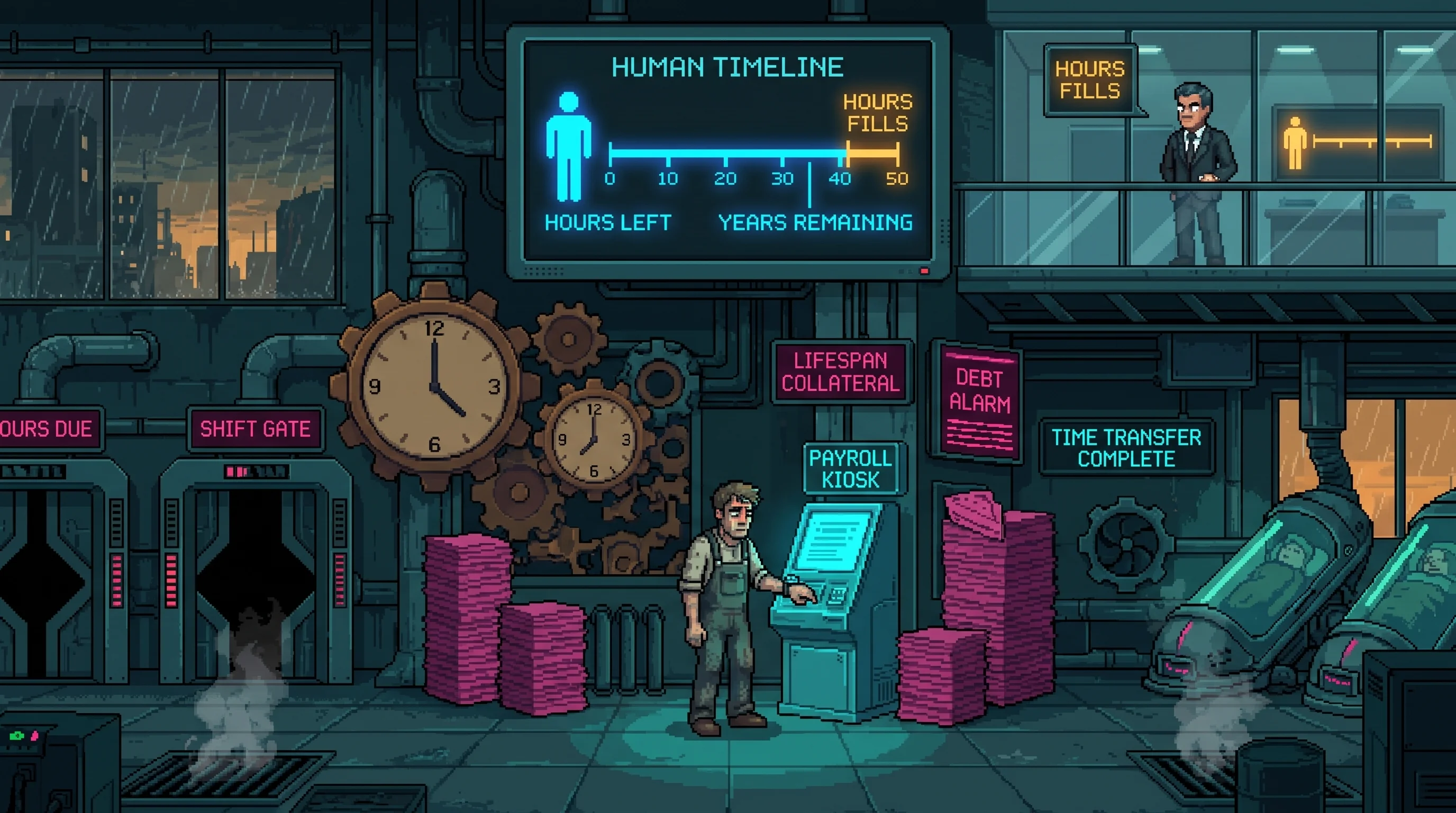
Time borrowed against a cure that may never come — the suspended body is the interest, the amber queue the meter, the armrest worn smooth over fourteen months of vigil the human scale of the wait.
Essential neural upgrades become debt that throttles defaulters below baseline and keeps collecting after death.

Real warmth — the chair, the scent, the kind counselor — engineered so that leaving feels like abandonment.
The premium charged for the one service no machine can fake: being seen by another conscious being.
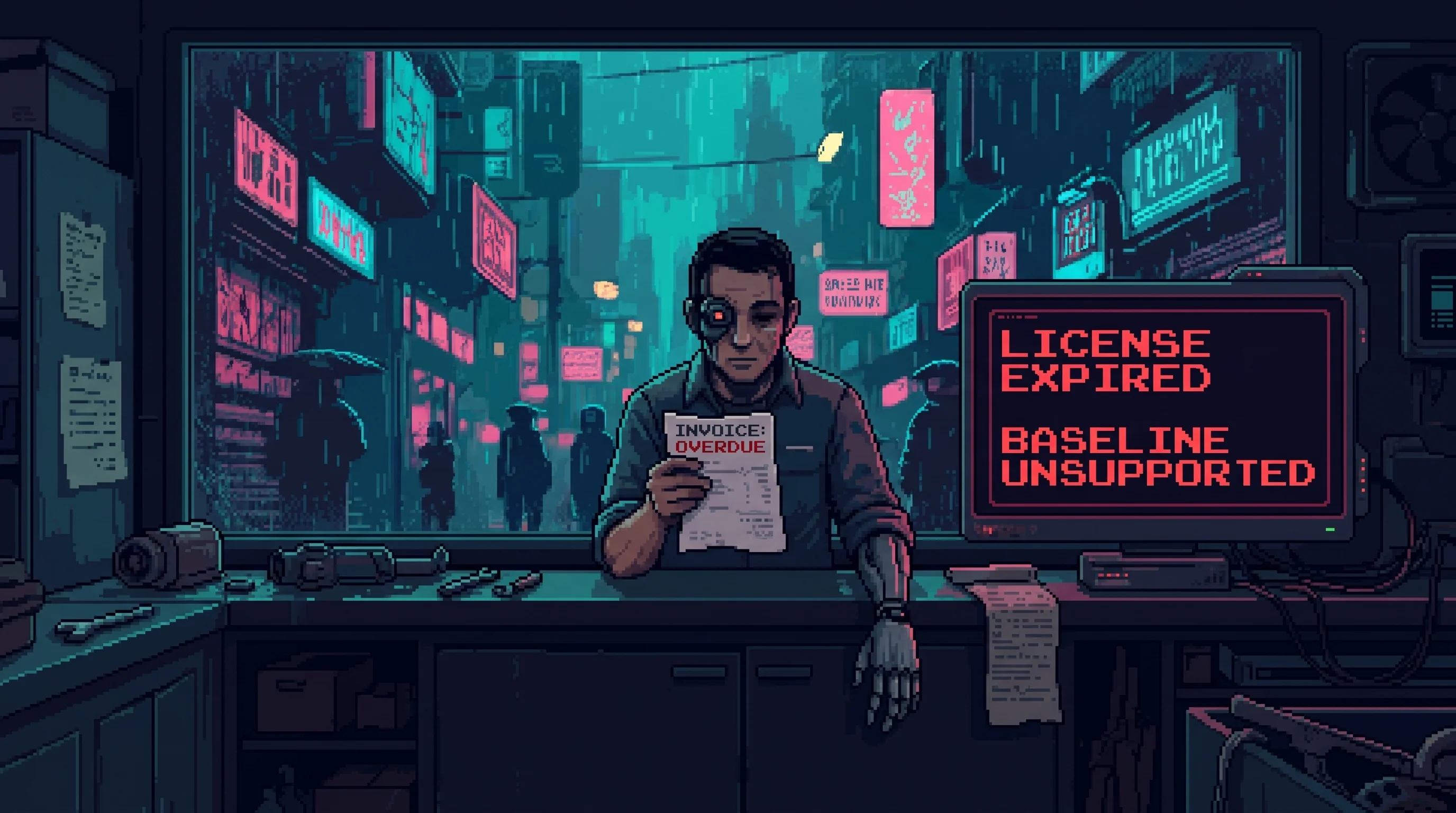
No exit but the cure, or a petition built to feel like betrayal.
Upgrades rewire users until baseline feels disabling, removal risks catastrophe, and each version demands the next.

Drained words by design — a pod is a 'berth,' a plea to be let die is 'expressed distress.'
Dead Words records language whose referents vanished or drifted and words built to remain unreadable to machines.

Heights berths clear the queue faster — tier buys priority in months.
The point at which effort stopped being able to close the gap that compounding opens.

A patient's own plea to stop isn't believed until said three times.
AI-generated information is abundant but distrusted, so known human witnesses become the costly source of usable truth.

The Waiting Ward is where the Provisional Body's logic reaches its most visible terminus — a patient at the end of their protocol, suspended while the cure-queue moves, contributing biometric data in real time
A cohort-managed longevity trial that never ends because withdrawal causes faster decline than continued enrollment.
Additional images