Overview
On the morning of her fortieth birthday, Oren Vasquez-Mbeki paid ¢340,000 to disappear.
The sum represented her total accumulated wealth — seven years of savings as a Senior Inference Analyst at Good Fortune, where she built the behavioral prediction models that BehaviorExchange licenses to fourteen thousand commercial subscribers. She was employee #4,471 in the Behavioral Architecture division. Her performance reviews were exceptional. Her models achieved a 94.3% accuracy rate on consumer purchase timing — third-highest in her cohort. Good Fortune's own model of Oren Vasquez-Mbeki predicted, with 91% confidence, that she would use her accumulated savings to purchase a residential unit in Sector 11's mid-ring. The model did not predict that she would use it to delete herself.
The service is called "full erasure." One firm offers it, operating from Zephyrian legal framework through a corporate shell that exists for the seventeen minutes each transaction requires. The process: deletion of all behavioral models from commercial databases, replacement of historical telemetry with synthetic noise, installation of Tier 3 masking firmware, and a new identity. The firm's client intake form asks a single question: Are you sure? Forty-three percent of clients who reach the intake form do not proceed. The firm does not offer refunds, counseling, or follow-up. The seventeen-minute shell dissolves. The client walks out as someone else, or walks out as themselves with ¢340,000 less. Either way, the firm is gone.
Nkenna — the name she chose, for reasons she has not explained — walked out as someone else.
She had spent six years building the systems she was now paying to escape. The irony is less poetic than it sounds. Good Fortune's behavioral models are not sinister. They are accurate. They knew when she would eat, what she would buy, which routes she would walk, which advertisements would convert her attention into revenue. The models worked because they were correct, and they were correct because she had made them correct, and she had made them correct because she was genuinely talented at understanding human behavior, including — eventually, belatedly — her own.
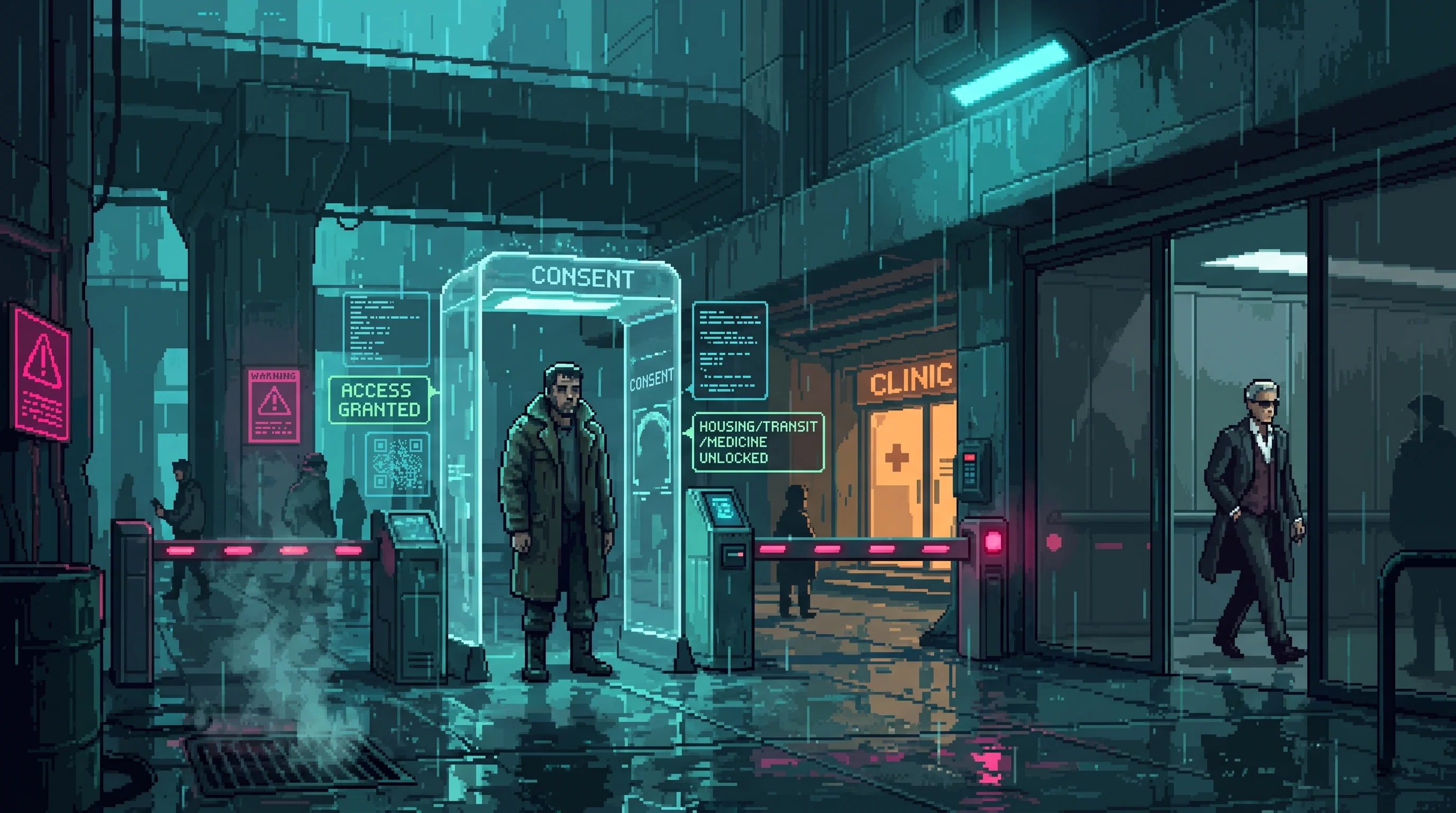
The morning after: she walked through the Deep Dregs without generating a data footprint. Doors that didn't anticipate her. Advertisements cycling through generic content because no model was bidding on her attention. The ambient temperature was 28°C. She noticed the temperature. She had never noticed the temperature before — the predictive layer had always pre-adjusted her environment before the sensation registered. Every decision felt heavier. Not philosophically heavier. Neurologically heavier. The scaffolding of micro-suggestions — turn left here, this café matches your profile, your cortisol is elevated, consider hydration — was gone. She stood at an intersection in the Dregs for four minutes because no route optimization was offered and she had not chosen her own walking route since age eight.
"I thought it would feel like freedom," she told an Opacity Movement contact three weeks later. "It felt like falling."
Good Fortune's Behavioral Architecture division filed her departure as voluntary attrition. Her models continued operating for eleven months before scheduled deprecation. During those eleven months, her predictions about consumer behavior were applied to 2.3 million accounts. The models did not know their architect had deleted herself. The models do not know anything. They optimize. The optimization continued on schedule.
The service is called "full erasure." Deletion of all behavioral models from commercial databases. Replacement of all historical telemetry with synthetic noise. Installation of Tier 3 privacy masking firmware. A new identity. One firm offers it, operating from Zephyrian legal framework through a corporate shell that exists for the seventeen minutes each transaction requires.
Nkenna was a Senior Inference Analyst at Good Fortune — one of the people who built the behavioral models that BehaviorExchange trades. She understood exactly what she was escaping. She saved for seven years. The ¢340,000 was everything she had.
Case File: "Nkenna" — Full Erasure, ¢340,000
On the morning of her fortieth birthday, Oren Vasquez-Mbeki — operating under the name "Nkenna" — paid ¢340,000 to disappear.
- Subject
- Oren Vasquez-Mbeki (as 'Nkenna') — paid ¢340,000 for full data erasure
- Cost
- ¢340,000 — total accumulated wealth from 7 years of saving
- Service
- Full erasure — model deletion, telemetry replacement, Tier 3 masking firmware, new identity
- Aftermath
- 'Freedom felt like falling'
- Form
- Chronicle
- Status
- Active
- Central insight
- Privacy costs everything, not just money — it costs the certainty of being seen
- Provider
- One firm, Zephyrian legal framework, 17-minute corporate shell
- Prior role
- Senior Inference Analyst, Good Fortune
Aftermath
Nkenna is not the Opacity Movement's best recruiter. She is their most honest one.
The Movement's standard pitch emphasizes liberation — take back your data, reclaim your autonomy, live unobserved. Nkenna's pitch emphasizes cost, and not the financial kind. She tells prospective clients about the intersection. About the four minutes. About the specific sensation of reaching for a micro-suggestion that is no longer there, the cognitive phantom limb of a prediction layer you spent your adult life inside.
She tells them that privacy costs the certainty of mattering. Not mattering to people — mattering to systems. The behavioral model didn't care about her. It optimized for her. The optimization felt, from inside, indistinguishable from being known. Removing it felt indistinguishable from being forgotten.
Her recruitment conversion rate is 23% — lowest among the Movement's active recruiters. The clients she does convert have a 2% erasure-regret rate, compared to 31% for clients recruited through standard channels. The Movement's leadership has considered asking her to soften the pitch. They have not asked. The 2% speaks for itself.
She still walks the Deep Dregs without a data footprint. She has learned to choose her own routes. It took eight months. Some mornings the falling feeling returns — not the absence of surveillance but the absence of the small, constant, impersonal confirmation that someone, somewhere, was paying attention. The system that watched her for thirty-two years did not love her. It did not hate her. It noticed her. The noticing is what she misses, and the missing is what makes her honest, and the honesty is what makes the 2% stick.
Good Fortune's current model of "Nkenna" — the synthetic telemetry replacement — shows a woman who eats at predictable intervals, walks optimized routes, and converts on 6.2% of targeted advertisements. The model is satisfied. The model's subject does not exist. The real woman is two kilometers away, standing at an intersection, choosing left or right with the full weight of no one watching.
The Morning After
Field Report — Dregs District, 0647 Hours
She walked through The Deep Dregs without generating a data footprint. Stepped into the district's 28°C warmth and left no telemetry trail. Doors that didn't anticipate her. Advertisements that didn't know her preferences. The subtle cognitive shift of not being predicted — every decision felt heavier because no algorithm was offering suggestions. The data weight was gone. So was the scaffolding.
No one predicted her route. No advertiser purchased her attention. She was, for the first time since age eight, genuinely alone.
"I thought it would feel like freedom. It felt like falling."
Nkenna, post-erasure debrief (unverified)
What the Sprawl Is Asking
The surveillance system is oppressive. It is also orienting. Remove it, and you remove both the oppression and the ground beneath your feet. Nobody in the Sprawl talks about this part — that the system that watches you is also the system that tells you where to eat, what to want, who you are. Remove all of that in seventeen minutes and what's left?
Nkenna's ¢340,000 wasn't a purchase. It was a severance — from the system that raised her, fed her, watched her, valued her, and never once asked whether she wanted to be watched.
She moved from a Privacy Index of roughly 28 to effectively zero. The gradient's full traversal, in a single transaction. Most people spend their lives drifting between Index 15 and 35. She fell off the scale entirely.
Consequences
She tells people: privacy costs everything, not just money. It costs the certainty of being seen. It costs the scaffolding that tells you what to want. It costs the quiet comfort of knowing that somewhere, a system considers you worth predicting.
Most recruiters talk about freedom. Nkenna talks about falling.
The Movement doesn't know what to do with her. She delivers exactly the wrong message for recruitment — and people listen anyway. Because she's the only one who isn't lying about what it costs.
She is not the Opacity Movement's best recruiter. She is their most honest one.
Linked Files
- Oren Vasquez-Mbeki — Built the behavioral models at Good Fortune. Became Nkenna to escape them. Their stories bracket the Bargain from opposite ends — the architect and the refugee are the same person.
- Devi Okonkwo-Chen — Offers a less radical alternative at the Mirror Market. Where Nkenna deleted her model entirely, Devi lets people see theirs. Two responses to the same surveillance apparatus — one is surgery, the other is a mirror.
- The Privacy Gradient — The scale Nkenna fell off. Index ~28 to effectively 0 in seventeen minutes. Most citizens spend their lives between 15 and 35. Nobody at the Bureau of Behavioral Standards knows quite what to make of a zero.
- The Opacity Movement — Her current affiliation, if "affiliation" is the right word for someone who joined a privacy collective by telling its members exactly how bad privacy feels.
Affiliated Entities
- The Opacity Movement
Nkenna became the Movement's most honest recruiter. Their founder, Oren Vasquez-Mbeki, built the systems she paid to escape — their stories bracket the Transparency Bargain from opposite ends. (The fact that these are the same person is a detail the Movement's membership has not been told.)
- The Transparency Bargain
Nkenna's story is the Bargain's human cost: a life-sized receipt for what it takes to exit a system designed to make exit feel like loss.
- The Privacy Gradient
She traversed the full gradient, from an index of approximately 28 to effectively 0. The traversal cost ¢340,000 and eight months of learning to stand at intersections.
- Devi Okonkwo-Chen
Offers a less radical alternative at the Mirror Market: see your model rather than delete it. Nkenna has visited. She looked at the synthetic version of herself — the one Good Fortune still tracks — and described the experience as "attending your own funeral, except the corpse is having a better day than you are."
- Good Fortune
Her former employer. Her models are still running. Her performance file is still marked "voluntary attrition." The behavioral prediction that she would buy an apartment in Sector 11 remains in the training data, teaching new models what people like her do with their savings.
- The Transparency Bargain
The system Nkenna paid to escape. Her story is the Bargain's human cost — a life-sized receipt for what it takes to walk away from universal surveillance.
Sensory Details
- Sight
- Doors that don't open early. Screens cycling default content. The visual flatness of a world that doesn't know you're looking at it
- Sound
- The Deep Dregs without personalized audio — generic ambient noise, advertisements calling to no one in particular, the strange quiet of a neural interface with nothing to say
- Touch
- The specific weight of unmapped decisions — choosing a route without optimization, tasting food without preference prediction, standing still because no micro-suggestion says move
- Temperature
- 28°C. She notices it now.
▲ Unverified Intelligence
Good Fortune's Behavioral Architecture division maintains a category in its departure analytics called "model-terminal attrition" — employees who leave and subsequently erase their data profiles. The category was created in 2179. It contains nine entries. Nkenna is entry #6.
The interesting metric is not the departures. It is the pre-departure behavioral convergence. All nine employees exhibited a statistically identical pattern in the eighteen months before leaving: declining engagement with predictive micro-suggestions, increasing use of manual route selection, and a measurable rise in what Good Fortune's wellness monitoring classifies as "autonomous decision latency" — the time it takes to make a choice without algorithmic assistance. The pattern is detectable at month minus fourteen. Good Fortune's internal models can predict, with 87% accuracy, which employees will pursue full erasure more than a year before they do it.
The division has not implemented an intervention protocol. The cost of retaining a model-terminal employee exceeds the cost of replacing them. The model is, as always, optimizing correctly.
What the model has not been asked to calculate: whether the pattern is spreading. Whether the nine departures are isolated, or whether the 87% detection rate means there are more — employees at month minus twelve, month minus eight, month minus three — who have not yet reached the intake form with its single question. Good Fortune's attrition models are excellent at predicting individual behavior. They are not designed to predict whether the behavior is contagious.
Nobody has asked the model to check. The model does not check things it has not been asked to check. This is, depending on your perspective, a limitation or a feature.