
The Revenant Protocol
The Revenant does not know it is reconstructed during the trace audit; the heirs do; this information asymmetry is legally mandated to preserve the behavioral authenticity of the encounter

Overview
The dead are now available for deposition.
In 2176, Good Fortune's estate division filed a brief arguing that beneficiaries have the right to verify the stated wishes of the deceased before inheritance transfers — and that behavioral reconstruction now made this verification possible. The argument was technically correct. The Nexus Dynamics legal department disagreed with every implication. The Zephyrian Consciousness Rights Act complicated the question in ways that required a new legal category. Three corporate arbitration panels issued three rulings that could not be reconciled.
What emerged in 2181 was not an agreement but an armistice: the Revenant Protocol, the closest thing to a legal standard the Sprawl has produced in forty years. A Revenant is a behavioral reconstruction of the deceased — their decision architecture, their emotional patterns, their language model built from decades of messages they believed were private — achieving 73% fidelity to the original behavioral profile. Courts in seventeen jurisdictions have ruled 73% sufficient for evidentiary purposes in probate. The other 27% is called noise.
The noise is what the archive never captured. The silence after the argument. The grief that was not a telemetry event. The performance the deceased maintained in private that the sensors could not distinguish from the self.
How It Works
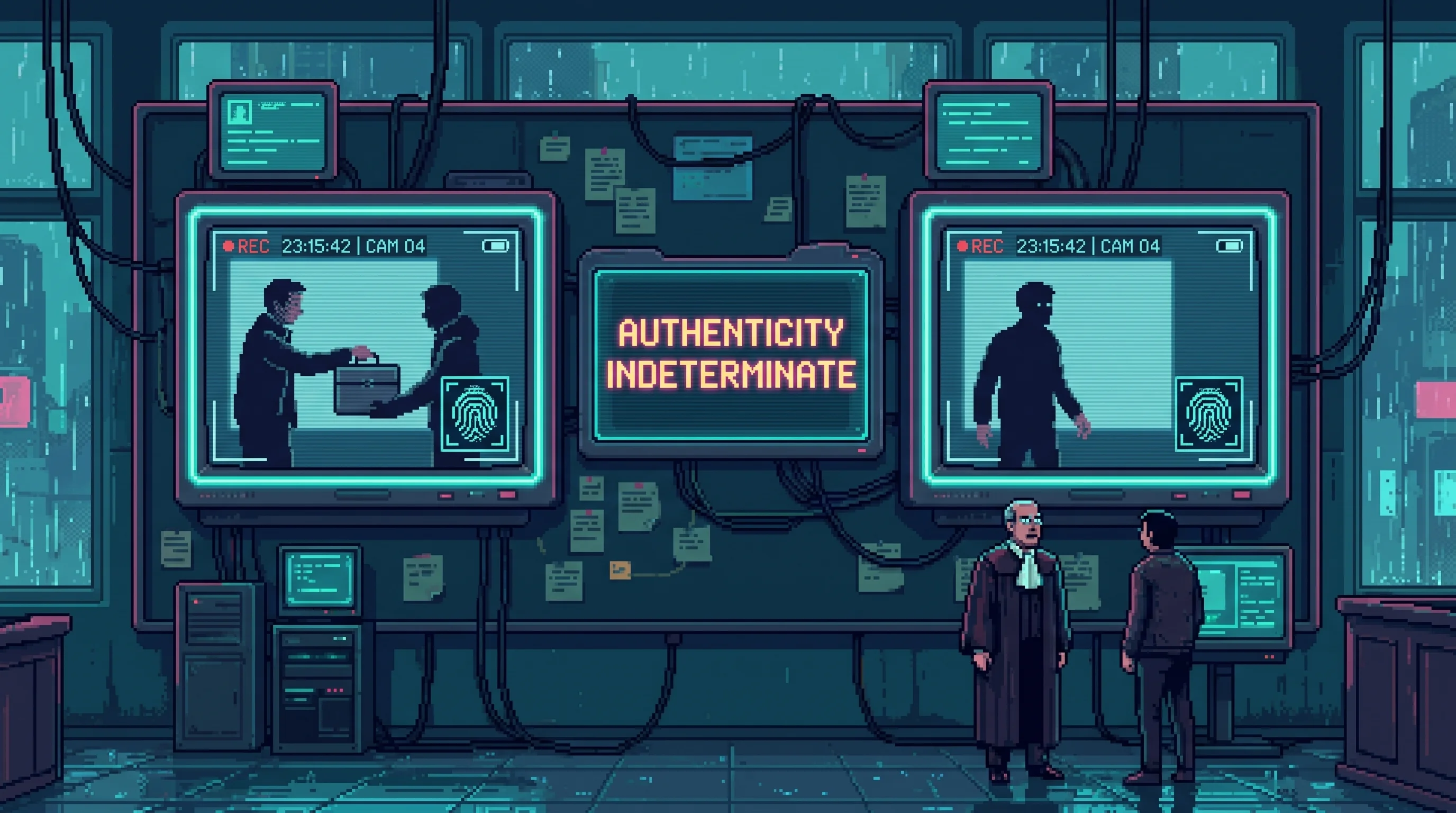
The formal proceeding is called a trace audit. It lasts four hours minimum. The Revenant does not know it is reconstructed. The heirs do. This information asymmetry is legally mandated — the Protocol's architects argued that a Revenant informed of its nature would modify its behavior in ways that would defeat the purpose of the reconstruction, which is to surface the authentic behavioral truth that the deceased did not perform in life.
The encounter is designed to reveal discrepancies between the stated wishes and the authentic behavioral patterns. Whether the authenticity the Revenant displays is genuine — whether a 73% behavioral reconstruction experiences anything — is the question that courts have declined to address, citing jurisdictional uncertainty.
In thirty-two of one hundred and forty-seven cases, the Revenant expressed wishes that materially differed from the documented will. In twelve cases, courts ruled in favor of the testimony. In two cases, heirs contested the Revenant's identity and won. The legal standard for successful identity contestation has not been formalized. Good Fortune's fraud division notes this as a risk factor.

The Consumer Downmarket
The Protocol got the lawyers. Continuing Voices got everyone else.
The Revenant Protocol is the same idea Continuing Voices sells by the month, wearing a different cost. The Revenant reconstructs behavior for a courtroom — four hours, 73% fidelity, an entire legal apparatus of trace audits and Zephyrian consent paradoxes and Good Fortune estate administration — and it is, for all that machinery, honest about its own gaps: the 27% is the Protocol confessing, in writing, that something of the dead cannot be reconstructed. Continuing Voices reconstructs voice for a living room, needs forty seconds of cached audio, and confesses nothing, because confidence is the consumer product and uncertainty does not sell against grief.
The Protocol's own lawyers understood, the moment the consumer industry launched, that Continuing Voices was the Protocol's logic escaped from probate — the elite reconstruction's downmarket sibling, run on the same permanent record archive, sold to people who would never afford a trace audit. Where the Revenant asks what did the dead want — a question about intent, adjudicated in a room — Continuing Voices asks the question the Protocol was always too expensive to ask of ordinary people: not what the dead wanted but who owns what the dead say now. The answer the Protocol arrived at through forty years of armistice — that the dead are partial persons whose testimony is contested — Continuing Voices answered in a terms-of-service checkbox: the account-holder owns the voice. The Neo-Catholic Church named the consumer version the Second Death. The Protocol's administrators, asked whether the doctrine applies to the Revenant too, described the question as interesting.
The 27%
The noise in the behavioral reconstruction is not a failure of the system. It is the record of what was not recorded.
Every neural interface generates 4,700 telemetry data points per second. The gaps between those points — the electrochemical events that did not reach the transmission threshold, the intentions that did not become behaviors, the thoughts that existed before they were expressed — remain inaccessible to reconstruction. The 73% is what the person did. The 27% is what they meant.
Courts have not assigned the 27% legal status. The Opacity Movement has submitted three briefs arguing that it constitutes an inviolable posthumous remainder — that whatever cannot be reconstructed belongs to the dead absolutely. The briefs have not been ruled on. The Protocol's administrators describe them as interesting.
The Zephyrian Problem
In Zephyria, Revenants are partial persons under the Consciousness Rights Act. Trace audits require their consent. The procedural paradox this creates: the entity whose consent is required was assembled from data collected before the Protocol existed, has no knowledge that it is reconstructed, and has no mechanism to provide or withhold consent without being informed of its situation — which the Protocol prohibits.
Three Zephyrian legal scholars have published monographs on this paradox. One concluded that Revenant consent was impossible and therefore trace audits should be prohibited in Zephyria. One concluded that Revenants should be informed of their nature and given a session to process it before the probate hearing begins. One concluded that the paradox correctly identified a flaw in the Consciousness Rights Act's definition of personhood and recommended legislative revision. None of their recommendations have been implemented. The Zephyrian court continues to issue case-by-case rulings. No two have been consistent.
| Emerged | 2181 — ratified after Good Fortune's 2176 estate brief and three incompatible arbitration rulings |
|---|---|
| Session Format | 4-hour trace audit; Revenant does not know it is reconstructed; heirs do |
Affiliated Entities
| Entity | Relationship |
|---|---|
| The Permanent Record | The Revenant Protocol's data source — Tier 4 Legacy Analytics assembled into a behavioral reconstruction that speaks in the first person |
| Good Fortune | Estate administrator — flagged 247 suspicious posthumous transactions in Q1 2184; has not investigated |
| Nexus Dynamics | Infrastructure provider — classifies Revenants as proprietary behavioral models, legal property of the estate |
| The Opacity Movement | Opposition — the dead cannot invoke the Sunset Clause; posthumous privacy has no framework |
| Zephyria | Complication — Revenants as partial persons; trace audits require their consent; three monographs, zero resolution |
| Clean Lives | Industry spawned — behavioral choreography for posthumous authenticity review |
| The Silicon Liturgy | Theological subject — 7th dimension: the Revenant as the honest confession |
| The Threshold of the Dead | Clinical intersection — trace audits produce 340% elevated grief response vs. archived footage |
| Justice Engine | Parallel legal territory — "posthumous fraud" and Revenant Protocol occupy adjacent conceptual space |
| Maya Fontaine | Personal case — assembling her mother's pre-Protocol telemetry manually, six years, 2,847 replays |
| History Brokers | Evidence complexity — Shared Account Documents for posthumous testimony where Revenant testimony diverges from the will |
The Good Fortune brief that initiated the Protocol in 2176 used the phrase 'behavioral truth' sixteen times; the courts that ratified the Protocol used it twice; the gap between these uses is the controversy
Connected To





—
Social Impact
The Clean Lives industry emerged within eighteen months of the Protocol's ratification. Its service: behavioral choreography to help clients prepare for posthumous authenticity review. Its promise: close the gap between your performed public identity and your surveilled private behavior, so that your Revenant will testify as the person your heirs expected to meet.
Good Fortune projects the Revenant Protocol market at ¢340 billion by 2190, assuming continued expansion to remaining jurisdictions. The Clean Lives industry is currently unregulated. The NCC's Corrections Ministry is drafting a complaint under the Ecclesiastical Technology Accord. The Opacity Movement has filed for standing as an interested party in the Protocol's ongoing jurisdictional expansion proceedings. Both are pending. The market continues.