
The Legacy Read
Kiosk marketing line: 'Upload someone you loved. Learn what their body already knew.' — the operators' name for the product is 'clarity'

Overview
There is a kiosk on the corner of every Dregs market that did not exist three years ago. It is the size of a confession booth and glows the soft clinical green of a thing that wants to be trusted. Above the slot where you feed it a photograph, a line of text scrolls in a font chosen by a committee: Upload someone you loved. Learn what their body already knew. The first read is free. The next is ¢90. The way of everything in the Sprawl.
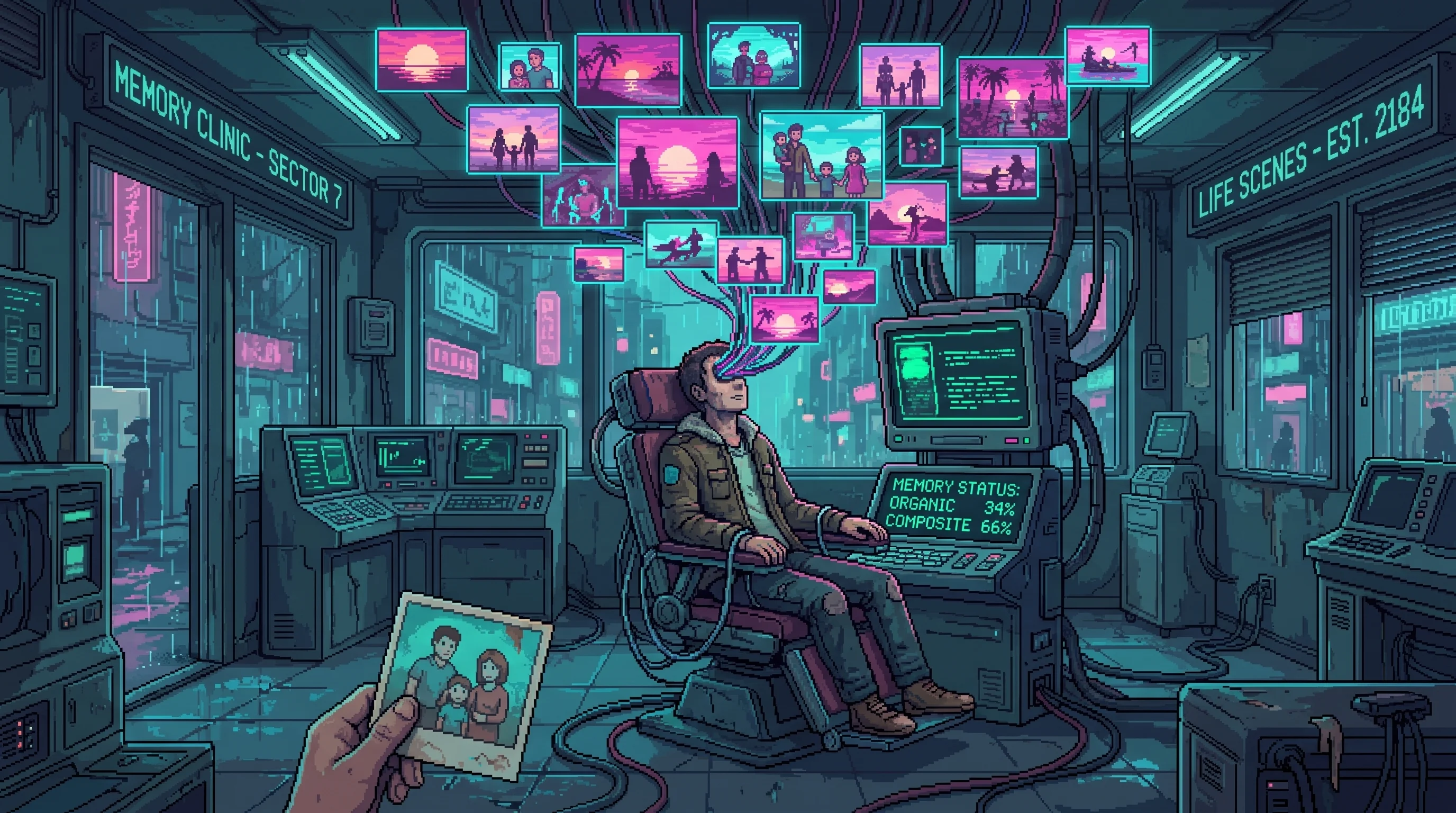
A Legacy Read takes a still photograph of a person — any photograph, any age, living or dead — and returns a projected medical trajectory. Skin tone maps to circulatory health. Micro-asymmetries in the face map to neurological decline. Posture maps to the spine's coming failure. Pupil dilation, captured by accident in a wedding photo, maps to the endocrine system. The body was always writing its own medical record in the way it held light. The Legacy Read is the service that learned, retroactively, to read the handwriting — and to print, at the bottom, a date.
It does not return your father. It returns a chart.
How It Works
The Permanent Record was built on a floor: the archive can only store what the telemetry captured. It remembers what you generated. It cannot add information the subject never emitted as a record.
The Legacy Read breaks that floor. It does not retrieve filed data and it does not synthesize plausible footage the way the Negotiable Record does. It extracts — from a flat, passive image taken for no medical reason at all — diagnostic information the subject's body was broadcasting involuntarily and that no instrument was reading at the time. The Data Ratchet's temporal trespass made the archive grow backward, reprocessing old telemetry with new tools. Retroactive Diagnosis makes it grow inward: into the body of the photographed dead, into the data they leaked through their skin and posture and the slack of one eyelid, data they could not have read about themselves while they lived because the reading did not yet exist.
This is why the Legacy Read is the cruelest product the Permanent Record has produced. The dead were always the archive's best customers — they file no objections. The Legacy Read discovers that every photograph ever taken of them is an unprocessed medical file, and the eye to read it finally exists, and the dead cannot consent, cannot refuse, and cannot answer the one question their descendants bring to the kiosk: did you know.

The Eye Helix Built
Helix Biotech did not build the kiosks. Helix built the eye inside them.
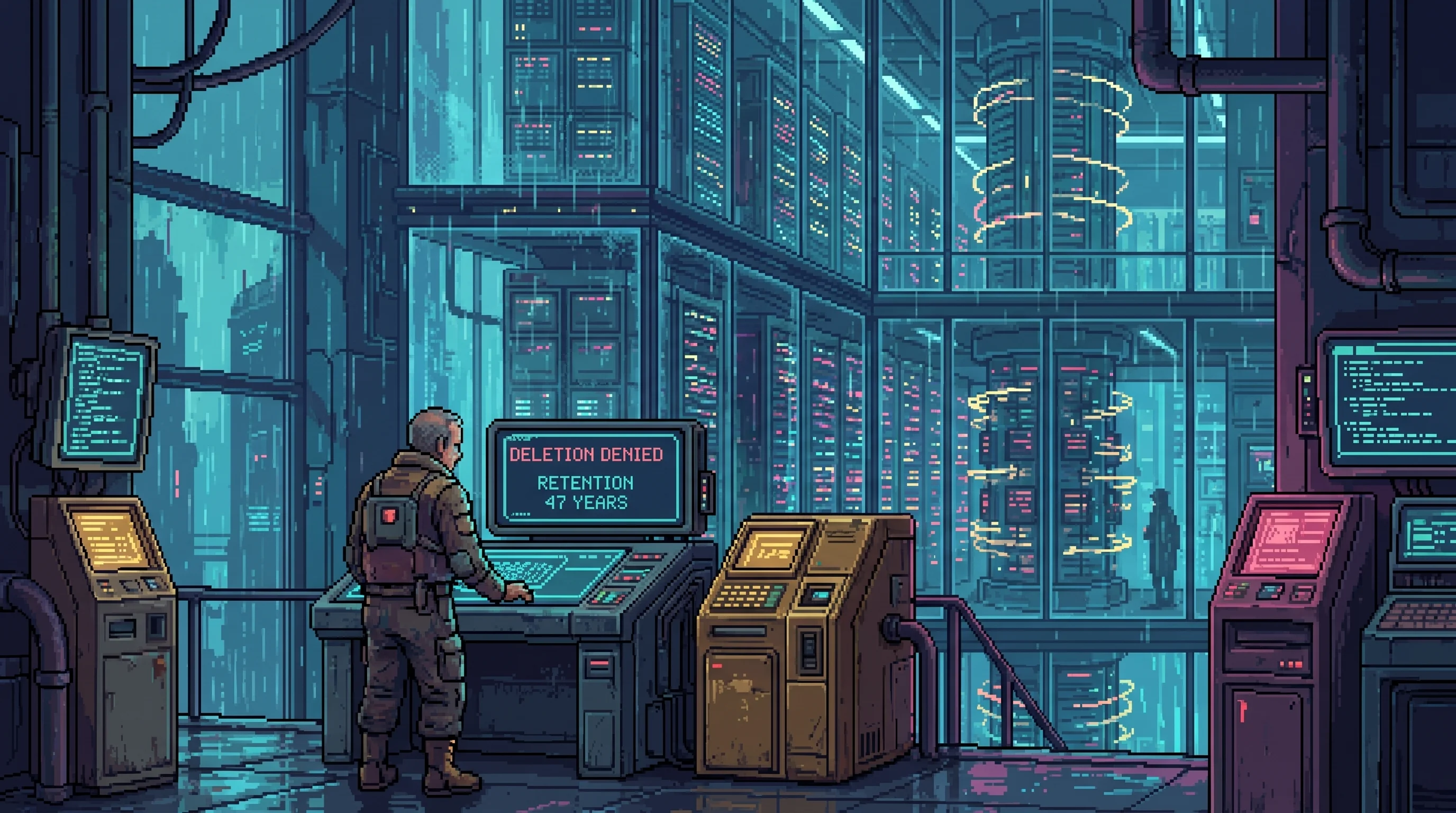
The Continuous Diagnostics Initiative trained Helix's models on 11,200 biometric points per second across thirty-eight million living workers, producing the Health Trajectory Score — a number predicting a living body's productive lifespan. The side product nobody budgeted for was a model that could infer the same trajectory from a single still image, because a face holds, in compressed form, most of what the telemetry stream spells out slowly. Helix calls it the Retrospective Trajectory Model. It licenses the model to independent kiosk franchises, sells the eye to the people who sell the dead, and routes the inference fee to a Helix-affiliated insurer. Helix does not market the dead. Helix considers this, as it considers everything, a form of care. The patch is the person. The photograph is the patient.
Sensory Details
- Sight: The kiosk's clinical green glow against the Dregs' neon riot — the one light on the street that is steady. The annotation overlay: a beloved face crosshatched with translucent diagnostic vectors, a date floating in the same font as the kiosk's promise.
- Sound: A soft confirmation chime when the read completes — the cheerful three-note tone of a thing that has no idea what it just told you.
- Texture: The thermal printout, still warm, the photograph reproduced at the top in low resolution and the chart below it in high. People hold the warm edge for a long time before they read down.
- Smell: Ozone and warm plastic — the smell of a small machine running an expensive model in a cheap housing.
Visual Identity
- Color palette: Clinical Trust Green (#1FAE6B), thermal-printout white, the Persistence Amber (#D4A017) the date prints in
- Key symbol: A photograph with a date printed under it in a font that does not match the photograph
- Lighting: Even, steady, confessional — the one calm light on a chaotic street
Affiliated Entities
- The Permanent Record — the Legacy Read is its eighth dimension, Retroactive Diagnosis, the archive reaching into the bodies of the photographed dead.
- The Negotiable Record — the parallel and the contrast: the Negotiable Record changes what happened; the Legacy Read reveals what the body was doing while it happened. Both extract more than was filed.
- Helix Biotech — the source of the Retrospective Trajectory Model, the diagnostic eye, licensed to the kiosks.
- The Unreadables — the movement that formed to defeat it, photographing themselves wrong on purpose.
- Kira "Patch" Vasquez — can protect the next photograph but not the ones already taken; the cruelty she names best.
- Tomás Linares — sets the printout face-down. The chart knows when. It does not know who.
- The History Brokers — hired when two photographs of the same dead person return contradictory diagnoses.
- The Law (Judge Dreg) — refuses the Legacy Read as evidence. A photograph is not a witness.
- The Three-Day Memorial — the Memorial Read vendor carts; the late readers; the spike in the week after April.
- Forgiveness-Layers — The felt-life counterpart: where the Legacy Read reads medical fate from a dead body's passive image retroactively (¢90, first read free), Forgiveness-Layers reads the felt record of the living and edits it retroactively (¢22,000 minimum). Both are commercial retroactive systems operating on what the body was always emitting. The class divide in access to retrospective self-knowledge runs between them.
| Type | Consumer diagnostic service — retroactive medical reading of photographs |
|---|---|
| Launched | 2181 (Dregs kiosk rollout 2182) |
Legacy Read purchases spike measurably in the week following the Three-Day Memorial, when photographs of the dead are out and grief is fresh
The Legacy Read reads a still photograph and returns a projected medical trajectory — decline markers and a probable date of a major cardiac or neurological event — including for subjects long dead
Local Intelligence Scan
Nearby Signals
CANONICAL PROXIMITY


Environmental Readout
LIVE CONDITIONS- Air
- Toxic
- Light
- Canyon dark
- Flood
- Seasonal
- Heat
- Trapped
- Security posture
- Ungoverned
- Infrastructure
- Improvised
Position Data
SECONDARY- Elevation band
- Sub-bay — beneath the drained floor
- Lattice fix
- E+4.0 · N+2.6
Connected To
Supporting Connections
Additional Connections


—
Social Impact
The machine speaks in the present tense. It does not say would have. It says the date. It says the cause. And because it cannot distinguish a 2153 photograph from a 2184 one — both are just light — it cannot represent the fact that the knowledge it is delivering did not exist when the shutter opened. There was no model in 2153 that could read a wedding photo for a cardiac event. The body's data was there; the eye was not. The Legacy Read collapses that gap, and into the collapse pours every weaponized accusation an estranged family can make: the readers say you knew. You had to have known. It was right there in your face.
It was right there in the face. It was not right there in anyone's knowledge. The Legacy Read has invented a way to be angry at the dead for dying — and a way to be angry at the living for not having read a chart that could not be read until the person was already gone.