Treasure Heap Market
Overview
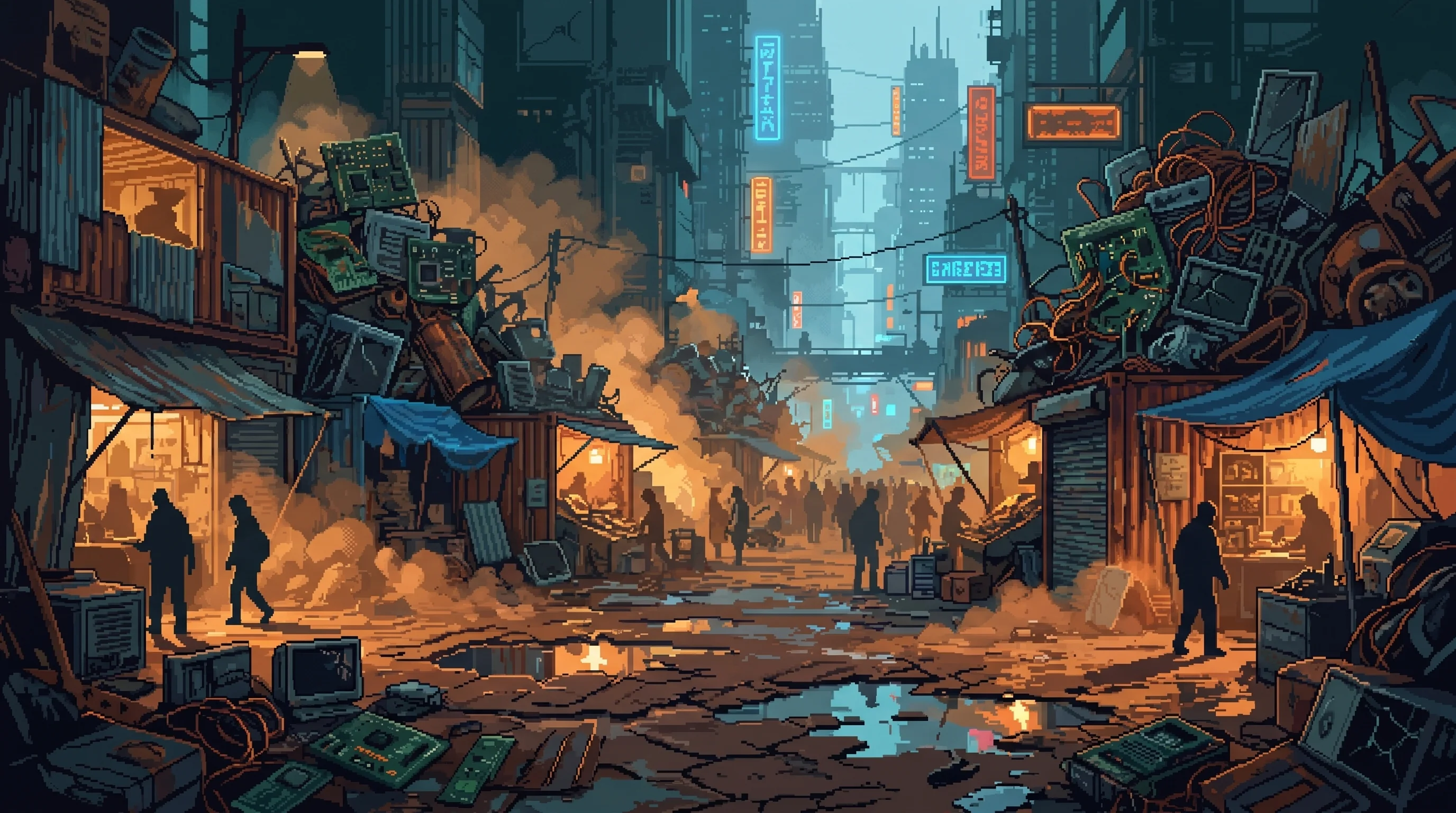
Treasure Heap Market is the bay floor's largest open-air market — acres of salvage, stolen goods, repaired electronics, and impossible finds spread across reclaimed mud in Sector 9. If it exists somewhere in the Sprawl, someone at the Heap is selling a broken version of it. If it doesn't exist anywhere, someone at the Heap is selling it anyway.
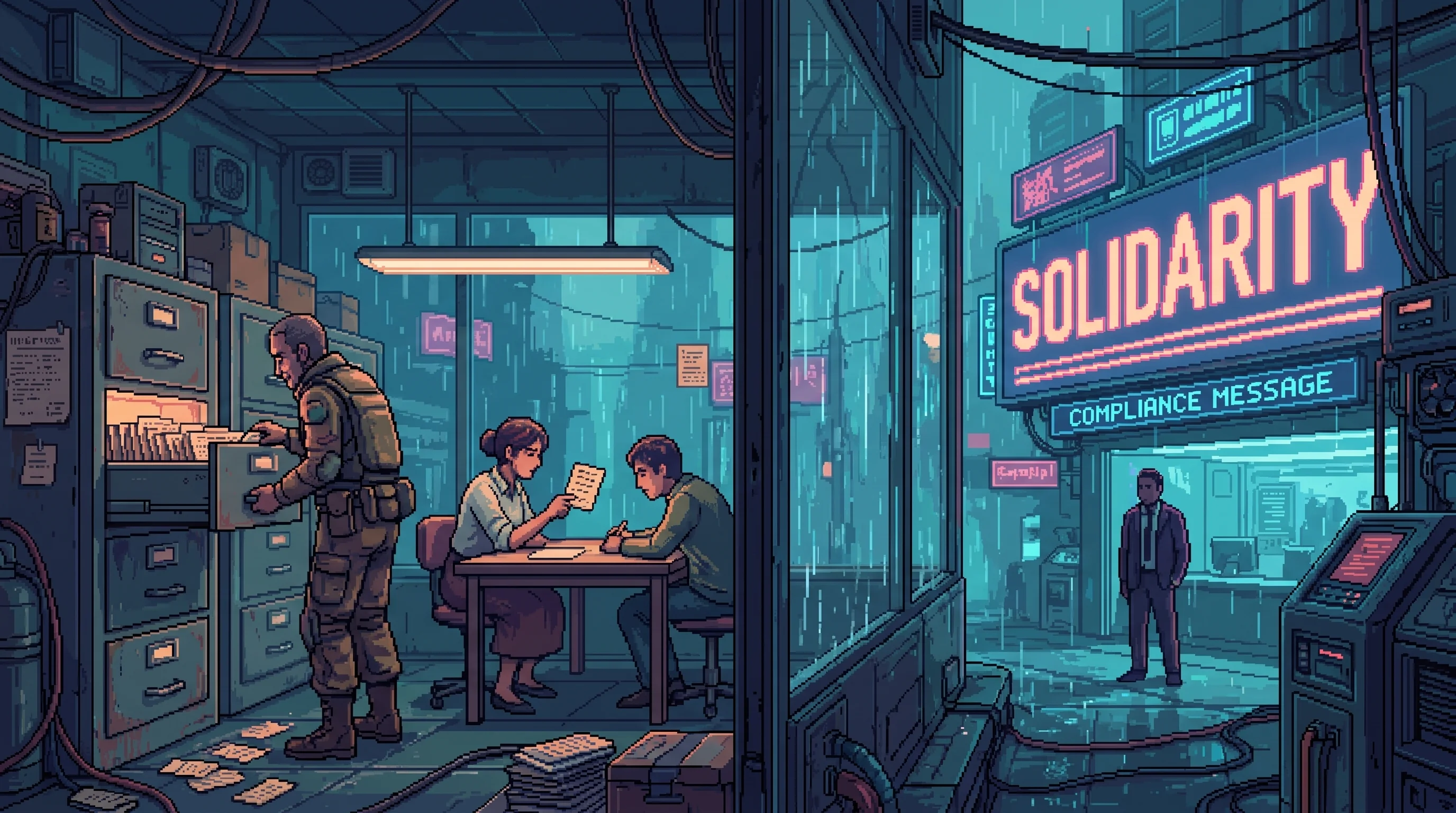
The Sprawl's formal economy runs on licensed transactions, taxable revenue streams, and Nexus-auditable data trails. The Heap processes an estimated 40,000 transactions per day and generates exactly zero data. No records. No logs. No tax collection. No receipts unless you count the handshake, which Ironclad's revenue compliance division does not. A conservative model based on foot traffic and average transaction weight puts the Heap's daily volume somewhere north of 800,000 credits — which, if it appeared on any ledger, would make it the third-largest commercial operation in the lower Sprawl. It does not appear on any ledger. The Heap is, by every formal metric, an empty stretch of dried mud where nothing happens.
This is the market's product. Not salvage. Not stolen goods. Not the functioning-adjacent power cells or the wire sold by the kilogram. The product is illegibility. The formal economy above charges a 14-23% surcharge for the privilege of being seen — transaction fees, licensing costs, data brokerage cuts that flow upward through Nexus processing infrastructure every time a credit changes hands. The Heap charges nothing because nothing here is seen. Vendors who tried selling the same goods through licensed channels in the mid-Dregs report margins so thin that the transaction fee exceeded the profit. They moved to the Heap. Their goods didn't change. Their visibility did.
Good Fortune's microfinance division has twice proposed "formalizing" the Heap's economy through a subsidized point-of-sale credit system. The proposal would bring transaction data into Good Fortune's analytics pipeline, enable credit scoring for previously unscored bay-floor residents, and — according to the pitch deck — "extend financial inclusion to the Sprawl's most underserved commercial community." The Heap's vendors declined. Not through any formal vote or organizational mechanism. The Good Fortune representatives simply couldn't find anyone willing to talk to them. Stalls relocated as the representatives approached. Paths rerouted. The market's organic structure — no fixed locations, no designated stalls, no map — made it impossible to pin down a vendor long enough to deliver the pitch. Good Fortune filed the initiative as "deferred due to logistical complexity." The logistical complexity was that 2,000 vendors independently decided to become invisible at the same time, without coordinating, because coordination would have produced data.

The Ground
The market sprawls across a flat expanse of dried bay mud that was underwater before the dam projects lowered the water level — surface cracked into irregular polygons, packed hard by decades of foot traffic. Vendor stalls are improvised from whatever was available: corrugated metal sheets propped on scrap-pipe frames, salvaged tarps stretched between poles, the occasional shipping container cut open on one side. The layout follows no grid. Stalls cluster organically, creating winding paths that dead-end without warning, loop into themselves, and occasionally open into small clearings where larger transactions happen under open sky.
The goods are piled high: circuit boards in bins, tangled wire by the kilogram, cracked display panels, power cells that hold a charge if you don't ask too many questions, clothing patched so many times the original garment is a philosophical question, and trays of objects whose purpose has been lost to time but whose materials retain value. Ironclad Industries' waste streams supply the bulk of the raw salvage — construction overruns, decommissioned infrastructure components, and the steady output of a physical-infrastructure monopoly that finds it cheaper to dump excess material at bay-floor prices than to process it through regulated recycling channels. Ironclad's quarterly waste disposal filings report these shipments as "sub-grade material transferred to third-party reclamation." The third party is a stretch of mud. The reclamation is a teenager with a pry bar.
The light is natural. The bay floor is open to sky, giving the Heap a brightness that feels wrong for the Dregs — too exposed, too honest. Dust rises from foot traffic in amber clouds. The sound is market sound at maximum: vendors calling prices, buyers arguing, metal clattering on metal as goods are sorted. The smell is rust and ozone from partially charged electronics, cooking oil from food stalls at the market's edges, and the mineral dampness of bay mud that has not been fully dry since the dam projects and may never be.
| Stratum | Dregs |
|---|---|
| Power Position | Below |
| Access | Public |
| Atmosphere | Chaotic |
History
The Heap began in the late 2150s as an informal exchange where bay-floor scavengers traded finds near Anchor Town's grounded ship hulls. As the Deep Dregs settlement expanded, the market expanded with it, pulling traders from across the lower Sprawl. It has never been formally established, chartered, or regulated. It exists because people show up.
Every attempt to organize the market has failed. The most ambitious — a 2176 initiative by the Deep Dregs Community Council to assign permanent stall locations and collect a 2% market maintenance fee — lasted eleven days. Vendors complied on day one. By day four, the assigned stalls were empty and the actual market had migrated 200 meters east. By day eleven, the Council's appointed market coordinator resigned, citing "an inability to locate the market." The 2% fee generated 14 credits total before collection was abandoned.
The failure is instructive. The Heap's chaotic structure is not a limitation its vendors tolerate. It is the mechanism by which they survive. Without designated stalls, no authority can map the economy. Without permanent locations, no entity can tax it. Without records, no corporation can model it. Vendors relocate daily based on foot traffic, weather, and an informal intelligence network that experienced traders describe as "knowing" and outsiders describe as "impossible to access." The network has no name, no membership, no communication channel anyone has identified. Information about optimal selling positions propagates through the market at speeds that suggest either a coordinated system or a collective instinct refined over three decades. No one has determined which.
Treasure Heap Market — 37.7700°N, 122.3300°W — Sector 9. Largest open-air market on the bay floor.
The Anomaly Vendor
The market's most persistent mystery occupies the same general area of the Heap — southeastern quadrant, near the Crater's edge — but never the same exact stall. A vendor, identity unconfirmed, sells pre-Cascade artifacts that carbon-date to decades before they should exist.
The artifacts are genuine. Materials analysis confirms pre-Cascade composition. Manufacturing techniques are consistent with mid-22nd-century industrial processes. But the isotope dating places their creation 40 to 70 years before the technologies that supposedly made them. A circuit board with Nexus-era architecture that dates to 2089. A neural interface housing stamped with a Helix Biotech subsidiary logo that, according to the isotope signature, was manufactured eleven years before Helix Biotech existed.
The vendor offers no explanation. Prices are firm. Questions about provenance are met with silence and, if pressed, the transaction ends. Three independent research teams from Nexus Dynamics have visited the stall. Each confirmed the dating anomalies. None filed a formal report. The internal memos, obtained through channels the Heap's information network declines to specify, cite "insufficient evidence of regulatory violation" — a classification that means, in practice, that Nexus found something they couldn't explain and chose not to explain it publicly.
The artifacts keep appearing. Buyers keep buying. The Heap's informal rule applies: if you break it, you bought it. If you question where it came from, the vendor will be somewhere else tomorrow.
Notable Features
The Crater — A natural depression in the bay floor that serves as the market's central gathering point. The bowl shape carries voices across the full diameter, creating accidental acoustics that make the Crater the Heap's de facto auction house. The largest and most valuable items are displayed here — salvaged industrial components, rare pre-Cascade electronics, occasionally a piece of augmentation hardware that someone needs sold quickly and quietly. Prices in the Crater run 15-30% higher than the surrounding stalls. Vendors attribute this to the quality of goods. The acoustics suggest a simpler explanation: when a bidding war echoes across 200 meters of open market, it attracts more bidders.
Scrap Mountain — A perpetually growing pile of unsorted salvage at the market's western edge, picked through daily by scavengers looking for overlooked value. The pile never shrinks. New material — much of it from Ironclad's waste streams — arrives faster than it can be sorted. A informal economy exists solely around the Mountain: early-morning pickers who arrive before dawn to claim the best positions, specialist sorters who can identify valuable alloys by weight and color, and a rotating cast of children who extract copper wire with a speed and precision that would qualify as skilled labor if anyone were tracking it. Nobody is tracking it.
The Food Line — A row of unlicensed food stalls along the market's southern edge that Wholesome's compliance monitoring has flagged 340 times in the past fiscal year without a single enforcement action. The stalls source ingredients from the market itself — protein blocks of uncertain origin, hydroponic greens from bay-floor farms, cooking oil recycled enough times that its original source is a matter of speculation. The food is cheap, filling, and consumed by an estimated 4,000 people daily. Wholesome's SupplyChainIQ system registers the entire southern edge of the Heap as a data void — no upstream supplier information, no ingredient tracking, no nutritional certification. The 340 flags remain open. Enforcement would require a physical presence on the bay floor, which would require acknowledging the bay floor has an economy, which would require explaining why that economy generates zero tax revenue. The flags will remain open.
Acres of salvage, trade, and stolen goods spread across reclaimed mud
The Catalogue of Dead Things
The Sprawl has institutions that catalogue dead words — the Question Keepers and their Dead Words inquiry, archiving terms whose referents the world dismantled. The Heap is the place that catalogues dead things, by mass, with a teenager and a pry bar.
Walk the salvage rows and the trays fill with objects whose purpose has been lost to time but whose materials retain value: a stick shift bolted to nothing, a keypad with no line behind it, a key for a lock for a door for a building the bay swallowed before most of the vendors were born. Nobody at the stall knows what these were. The buyer doesn't either. The transaction proceeds anyway, priced by the weight of the copper inside. An object can outlive its word the way a word can outlive its referent — and the Heap is the only place in the Sprawl where the orphaned object is still worth something, because the word it lost was never what you paid for. You pay for the metal. The meaning was always free, and now it's gone.
The market's own vocabulary dies the same way, faster than the goods, because the goods are forever and the words are improvised at the point of sale by people who needed to move a thing and named it on the way past. Regulars call goods whose story doesn't match their materials liars — said without malice, the way you'd call a dog stubborn. The vendor in the southeastern quadrant who sells pre-Cascade artifacts that carbon-date to before they could exist sells nothing but liars. So, increasingly, does everyone: the words for what the Heap sells are dying off and being reminted daily, a living language that exists for an afternoon and is gone by the next dawn pick.
The one fixed point is Raz Demetriou, forty years at the same welded table, the last broker old enough to put the dead word back on the dead thing. Hand him a corroded rectangle and he names it — that was a transit pass — gloved fingers turning it once, and the naming does not raise the price, because the naming is the one thing at the Heap that isn't for sale. He is the market's accidental etymologist, the only memory of what the salvage used to be called, in a place built so thoroughly to forget that forgetting is its product.
A vendor has been selling pre-Cascade artifacts that carbon-date to decades before they should exist
Affiliated Entities
| Entity | Relationship |
|---|---|
| The Deep Dregs | The Heap sits adjacent to the Deep Dregs settlement — the market's primary customer base and labor pool. Many bay-floor residents work the Heap as their sole income source, a fact that appears in no employment statistics because the Heap does not generate employment statistics. |
| Anchor Town | The grounded ship hulls of Anchor Town mark the Heap's northern boundary. Some vendors operate from converted hull sections, blurring the line between market stall and permanent residence. |
| Ironclad Industries | The primary source of the Heap's raw salvage inventory, through waste streams that Ironclad classifies as disposal and the Heap classifies as supply chain. Both classifications are accurate. Neither acknowledges the other. |
| Good Fortune | Two failed formalization attempts. The Heap remains the largest concentration of financially unscored individuals in Sector 9 — a population Good Fortune describes as "underserved" and the population describes as "left alone." |
| Wholesome | 340 open compliance flags on the southern food stalls. Zero enforcement actions. The flags exist. The stalls exist. The distance between these facts is measured in corporate willpower. |
The Anomaly Vendor's Source
Restricted annex — open to read
The pre-Cascade artifacts are genuine, and the dating anomalies are real. The vendor — who has operated under at least four different physical appearances over the past decade, suggesting either multiple individuals or augmentation-assisted disguise — sources the artifacts from a sealed sub-basement beneath the bay floor that was exposed during a 2174 seismic event. The sub-basement appears to be a pre-Cascade research facility, its contents preserved by the same hermetic seal that kept it hidden for decades. The dating anomalies exist because the facility was manufacturing prototypes of technologies that would not reach market for another half-century — a corporate R&D lab so far ahead of its public-facing timeline that its output predates the official invention of its own products. The facility's corporate markings have been carefully removed from every artifact before sale. The vendor knows whose lab it was. The vendor's pricing structure suggests they also know what that information is worth, and that selling artifacts is more sustainable than selling the secret.
The Intelligence Network
Restricted annex — open to read
The Heap's informal information network — the one that tells vendors where to position for optimal foot traffic and warned 2,000 stalls to relocate simultaneously when Good Fortune arrived — is not informal. A loose collective of bay-floor residents maintains a mesh communication system built from salvaged components, operating on frequencies that Nexus' spectrum monitoring classifies as background noise. The system carries no voice, no text — only location pings and simple coded signals that experienced vendors have learned to read like weather patterns. The network has no leader, no name, and no membership list. It was not designed. It accreted, like the market itself, from the accumulated decisions of people who needed to know things without being known.
If it exists in the Sprawl, someone at the Heap is selling a broken version of it
The Embedded Researcher
Restricted annex — open to read
At least one active Nexus Dynamics field researcher maintains a regular stall at the Heap under a vendor identity. Whether the assignment is sanctioned or personal is unknown. The researcher has not filed a report in fourteen months.
Conditions Report
Sight
Amber dust clouds catching open sky light. Corrugated metal and blue tarps in haphazard geometry. Goods piled higher than stalls. The Crater's bowl visible from any elevated position, full of people and noise.
Sound
Full-volume market — overlapping vendor calls, metal sorting, the Crater's acoustics carrying bids across 200 meters. Underneath: the creak of improvised structures shifting in bay-floor wind.
Smell
Rust, ozone from charging electronics, recycled cooking oil, mineral bay mud. The smell changes by section — salvage rows are metallic; the food line is grease and protein char.
Temperature
Open-sky bay floor — hot under direct sun, cold when fog rolls in from the water. No climate control. Vendors dress in layers. Buyers move fast.
Feel
Cracked mud underfoot, packed but uneven. Everything for sale has texture — corroded metal, cracked polymer, wire bundles that leave copper residue on fingers.
Connected To
Supporting Connections

Customer base and labor pool — work that shows in no statistics.
The Sprawl's lowest stratum and its quiet proof that the corporate system is optional.

Anchor Town's grounded hulls mark the Heap's northern edge.
Ironclad's company town at the foot of the orbital elevator, where five thousand live so others can reach the sky.

Ironclad's waste is its stock; 'reclamation' is a kid with a pry bar.
The megacorporation that controls the Sprawl's physical infrastructure — steel, concrete, and the Orbital Elevator.
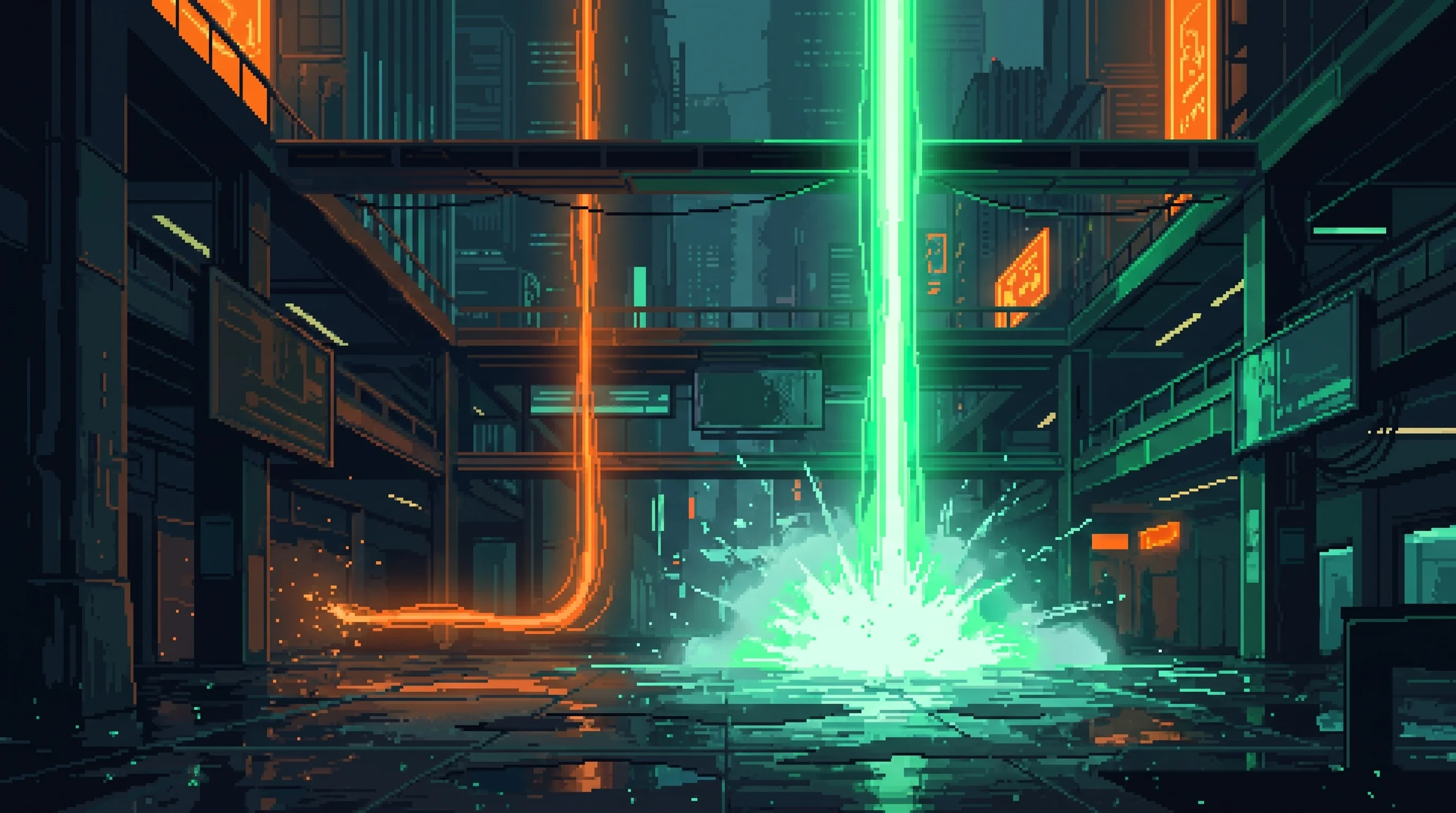
800,000 credits a day off every ledger — illegibility as the product.
The point at which effort stopped being able to close the gap that compounding opens.
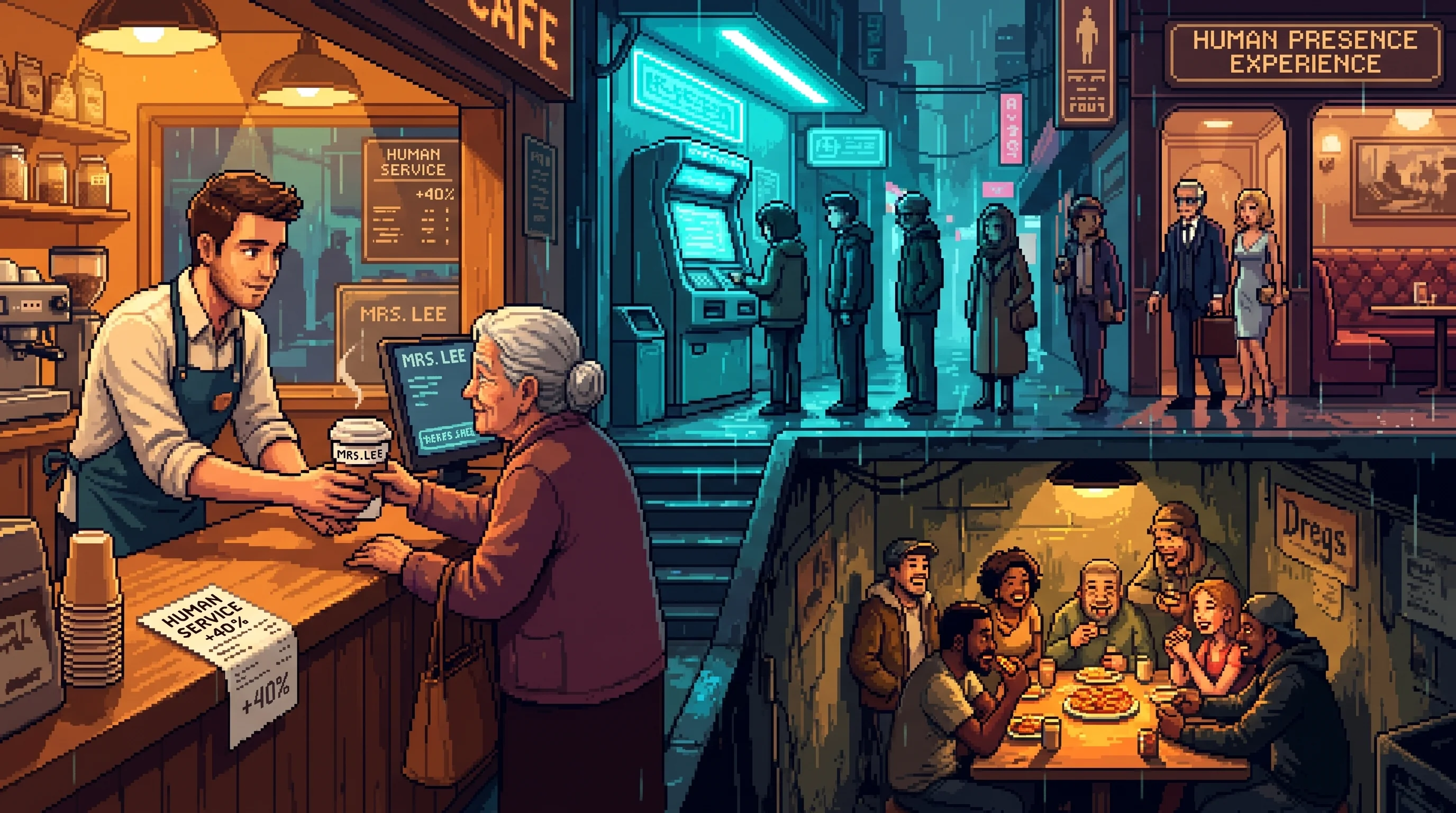
Raz names each dead thing for free — recognition the Heap won't price.
The premium charged for the one service no machine can fake: being seen by another conscious being.
Local Intelligence Scan
Nearby Signals
CANONICAL PROXIMITY



Environmental Readout
LIVE CONDITIONS- Air
- Toxic
- Light
- Canyon dark
- Flood
- Seasonal
- Heat
- Trapped
- Security posture
- Ungoverned
- Infrastructure
- Improvised
Position Data
SECONDARY- Elevation band
- Bay floor — below the Rim
- Lattice fix
- E+4.0 · N-0.5

—