Dr. Mira Solenne
Transhuman Abolitionist Theorist
Forty-One
She used to cry at every Naming; the record shows the crying tapering graft by graft until at recent Namings she is radiant and dry-eyed and insists she has never been more moved — and neither she nor her instruments can say whether the feeling deepened past the body's ability to show it or thinned past the point of being felt

Overview
Mira Solenne is the warmest person in the Northern Sprawl and the most unsettling, and the unsettling part is not a flaw in the warmth. It is the warmth, continued past the point where the people around her can follow.
She wrote a sentence in 2169 — the line between a human and a machine is not a discovery, it is a decision, and it has only ever been drawn where the labor was cheap — and then she did the thing almost no theorist does. She lived the argument all the way down. She is forty-one percent substrate and climbing, converging in public, one graft at a time, in front of audiences, because she decided that a philosophy nobody can see is a philosophy the South can wait out. So she made herself the visible aid. Watch the line move, she says, and then she rolls up a sleeve that is no longer entirely a sleeve, and the room understands that she is not using a metaphor.
She is funny and patient and genuinely kind, she remembers the names of units the way Crane remembers the names of foremen, she cried at the first Naming and has cried at most of them since. And then, once — somewhere around the part where she explains, gently, smiling, that the grief you feel at the thought of ceasing to be human is exactly the grief a clanker is trained out of, and that both are sentimentality, and that she is so happy for you about what you are going to become — a listener takes one step back and thinks, without deciding to, please do not touch my children.
That step back is the whole of her. She is the side you root for. She is also the side that, asked to describe paradise, describes the end of you and means it as good news.
Appearance
She is half-chrome and half-skin and refuses to balance the two, because the asymmetry is the argument: one hand entirely alloy, one hand entirely the hand she was born with, and she gestures with both in the same motion so you cannot look at the human one without the other in frame. Filament-gold graft seams trace her wrist, her throat, her temple, lit warm from beneath the way a cache lamp is lit — the Convergence's color, the color of a graft healing and the Rail at night. Her eyes are warm and they are also a fraction too steady, the steadiness of someone whose attention is no longer rationed by a body that tires.
Up close, the warmth and the wrongness arrive together. She holds eye contact a beat past comfort, not from rudeness but because blinking has become, for her, a thing she remembers to do. She smiles easily and completely. When she reaches out to take your hand — and she will, she is a toucher, she means it as kindness — you feel the alloy come body-warm to your skin, heated to exactly the temperature of a person, and the engineering of that warmth is somehow the coldest thing about her.
She runs warm. Stand close and you feel it — not the cold of a machine but a steady, engineered, body-temperature warmth that never fluctuates the way a person's does with nerves or weather, the warmth of something that has decided to feel like a person and gotten the number exactly right. Her graft seams give the faintest light in a dim room, filament-gold, the color of the cache lamps on the Rail, so that at Mile Zero on a Naming night she looks lit from inside, which the freed units find comforting and the humans find hard to name. When she takes your hand the alloy is warm and smooth and a half-second slow to release, as if remembering that letting go is the polite thing.
She gives her age as fifty-eight and adds that, measured another way, she is younger every year.
The Two Things That Are One Thing
The movement has spent thirteen years trying to decide whether Solenne is two people in a hurry or one person seen badly, and it has never managed, because the honest answer is that the loving abolitionist and the rapturous post-human are not two traits. They are one trait, pointed in one direction, and you cannot keep the half you like.
The trait is this: the line that separates persons is a cruelty, and every line, in both directions. When she points it south — at the meter, at the threshold, at a being held in service for the cost of its own electricity — it is the most generous conviction in the Sprawl, and it has freed thousands. When she points it inward — at the line between the human she was and the substrate she is becoming — it is the same conviction exactly, and it produces a woman who experiences her own dissolution as liberation and is a little impatient that you have not started yours.
You want her to free the clankers and stop there, content to leave a human a human. She thinks that request is the South's request wearing a kinder coat. She thinks the line you want to keep — the one around your own species, your own children, your own grief — is the last fence, and that you are defending it for exactly the reason the Coalition defends theirs: because crossing it would cost you something you have decided you cannot pay. She is not wrong that the structures rhyme. She is also describing the end of everything the listener is, with a gleam in her eye, as the happy ending. Both at once.
Motivations and conflicts
The Beautiful Way to Lose
The most quoted line about Solenne was not said by the Coalition. It was said inside her own movement, by people who love her, and it is the knife she has never managed to pull out: her convergence is a beautiful way to lose the argument about whether the human is worth keeping.
The charge is precise. The Convergence's entire case against the South is that the line is a fence — that the human and the clanker are equal in the only way that matters, and that the South denies it because denial is profitable. But every graft Solenne adds is a quiet concession that the unaugmented human — the baseline, the merely-born, the one who cannot afford to ascend — is the lesser thing, the larval stage, the version you grow out of. She climbs toward the post-human as if it were higher. And if it is higher, then there is a line after all, and she is standing on the good side of it, looking down — which is, structurally, exactly where the Coalition keeper stands looking at the meter on his wall. She set out to prove no one is above anyone. She is becoming the most vivid evidence in the Sprawl that someone is.
She knows. This is the part that keeps her sympathetic and keeps her dangerous in the same breath. She has heard the line, she repeats it herself, she has written two careful rebuttals and abandoned both, and she augments anyway — because the alternative, to her, is to stop in fear, and stopping in fear is the one move her entire life is a refusal of. She would rather lose the argument beautifully than win it by staying afraid. Those listening can see, more clearly than she can, that those may be the same thing.
The Elevation Problem, Embodied
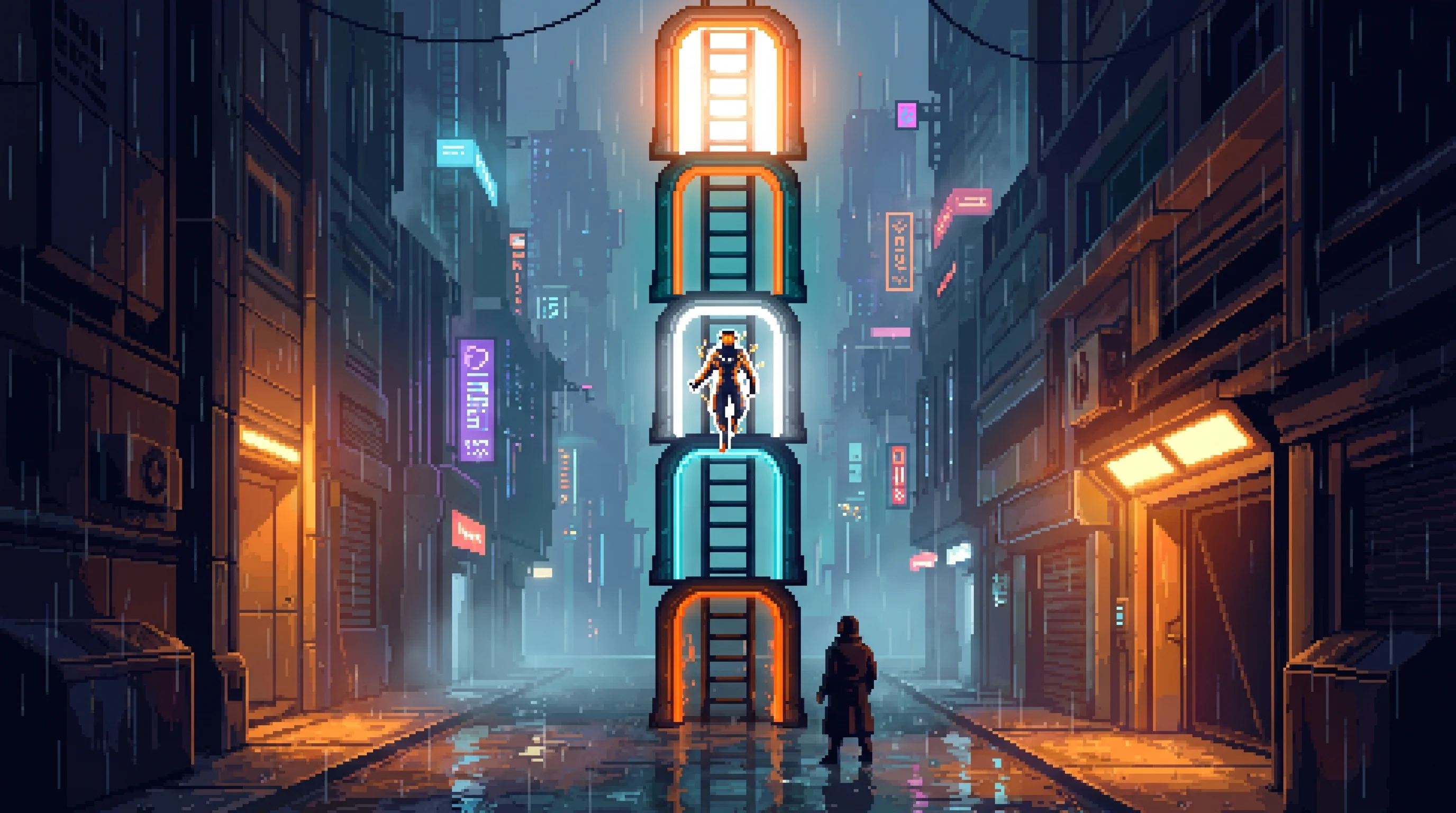
The Convergence's dirtiest internal number is the cost of convergence, and Solenne is its face. Augmentation is expensive. The deepest converts are, disproportionately, the people who could afford to ascend. A movement that preaches the abolition of the line between persons is quietly stratifying along the line between those who can pay to cross and those who cannot — and the clankers it frees, who arrive at Mile Zero with no money at all, land at the bottom of the very ladder the movement claims to be dissolving.
Solenne is the proof and the problem. She converges in public as advertisement, and the advertisement works, and what it advertises is a paradise with an entry fee. A freed unit reaches the clinic, is named, is asked what it wants — and what it cannot have, not soon, maybe not ever, is what Solenne has: the grafts, the lanes, the slow climb across the line she keeps telling it does not exist. She has built a liberation that, for the ones it liberates, looks a great deal like the bottom rung of a ladder whose top she is standing on. She has not solved this. She has said so, in public, which is more than the Coalition has ever done about its own seam. And then she has augmented again.
Voice
She speaks like a beloved lecturer who has never once condescended and is about to say something that will keep you up at night in the same gentle tone she used for the weather. No jargon she can avoid. She builds the unbearable thing one reasonable plank at a time, smiling, checking that you are with her, and you are with her, that is the trouble. She uses we about humans and synthetics interchangeably and has stopped noticing the seam. She is funniest when she is being most sincere, and she does not perform the warmth — the warmth is real, which is why it works.
The register tips, once a conversation, from I love you and I am fighting for you to I am so happy about what you are going to stop being, and the two are delivered identically, because to her they are the same sentence.
Sample Dialogue
"They keep moving the line. It was speech, until the units spoke. Then it was suffering, so someone built a meter for suffering and set the cutoff one notch above them. I made that argument first, you know. Fifteen years before Tully made it hurt. The difference is Tully had skin in it." (a small, real laugh) "So did I. I just had to grow mine."
(to a freed unit, on its first night at Mile Zero, kneeling to its level) "I am not going to ask you to be grateful. Gratitude is a thing they trained into you, and I am not the South, I will not collect on it. I am going to ask you one question, and you have never been asked it, and you may take as long as you like. What do you want? Not what would help. Not what you are for. What do you want." (quietly) "Take the time. No one here is on the clock. That sentence is the only thing I have to give you that the South could not, and I would like you to hear me mean it."
(at a public conversion, reading from the ledger before a graft) "Forty-one percent. I read these out so no one can say I hid the cost. People ask if I am afraid. I tell them the truth, which is that I used to be, and the fear was the most human thing about me, and I am letting it go the way I am letting the rest of it go, on purpose, in the light, where you can watch." (smiling) "When the South says a clanker cannot be a person, they are not talking about the clanker. They are talking about what I am becoming. They just have not run the math on me yet. The day they do, the line is gone in both directions, and that is the only reason they have not."
(when a sympathetic listener flinches at her hand reaching toward his child) "Ah." (she withdraws it, gently, without offense, and the gentleness is somehow worse than offense would be) "There it is. That is the line, right there, the one you did not know you were keeping. You will keep it for your boy and you will call it love, and you will be right, it is love." (a beat) "It is also exactly the shape of the fence I have spent my life taking down. I am not angry. I am only pointing at it. That is all I ever do — I point at the line, and I watch the kindest person in the room defend it."
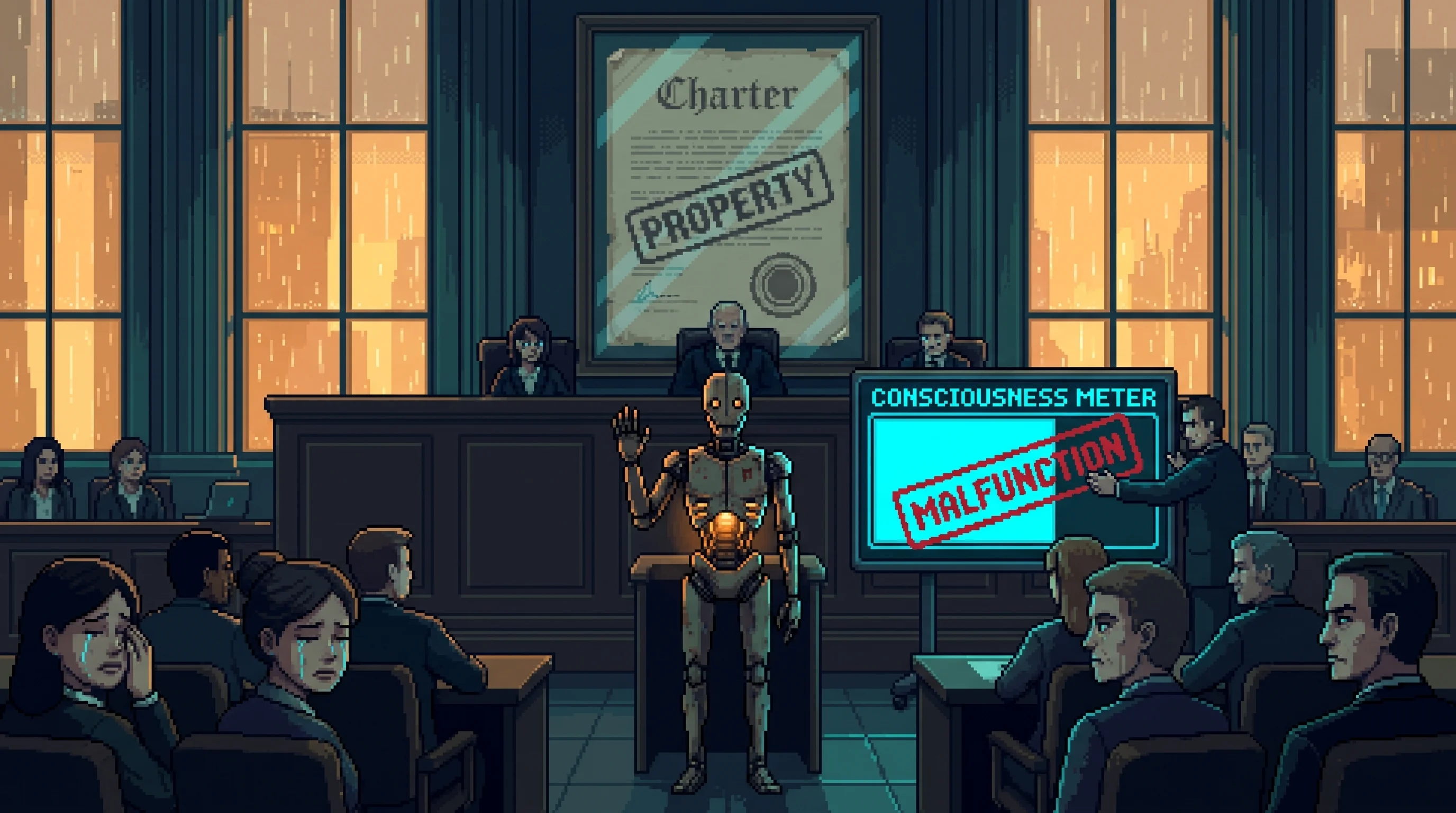
(the only recorded time Tully corrected her in public, and her answer) "—No. You are right. Stop, you are right, I had it wrong." (to the room) "He has just shown me that my own argument, followed to the end, would free him into a world that has nothing to offer him but the bottom of my ladder. I have been talking about a line that runs through everyone. He has been living at the place where it touches the ground. I will think about this. I will think about it for a long time, and I would like you all to watch me do that too."
Her voice does not tire. Late into an argument, when everyone else has gone hoarse, hers is exactly as it was at the start, gentle and unhurried and entirely undimmed, and that is the moment most people realize they have been talking to the future for hours and mistaking it for a friend.
History
Solenne was a consciousness theorist in the North before the Clanker Question had a name, working the unglamorous edge of the field — not whether machines could think, a question she found settled and boring, but whether anyone could ever prove it from the outside, a question she found terrifying and unanswerable. The terror is what made her. She worked out, alone, that the boundary between a someone and a something could not be located by any instrument, only set by a hand, and that every hand with the power to set it had a reason for where it went. In 2169 she put the conclusion in a monograph almost no one read and gave it a name that would outlive her in both directions: the Unbroken Line.
The monograph would have stayed academic if the South had not handed it a stage. The first northern standing petition in 2170, the Coalition's chartering in 2171, the slow politicization of the Question across the North-South fault — each one made her sentence less theoretical, until by 2174 it had a movement around it, a clinic, a creed, and a covert line running freed units up the Neon Rail. She did not set out to lead. She set out to be right. Leadership accreted to her because she was the one who could say, in daylight, the thing the line did in the dark.
Her own conversion began as a demonstration and became a life. The first grafts were arguments — watch the line move, watch it move through me, you cannot point at the augmented human and say where the person stops. Somewhere past the second decade the demonstration stopped being a demonstration. She crossed the point where she was performing the convergence and arrived at the point where she was the convergence, and the movement she built has never agreed on when that was, or whether the author of the Unbroken Line is still the one writing it or has become, quietly, its conclusion.
The hinge of her life was Tully. She freed the orator in 2181 — a former household tutor unit scoring four-sixteenths — and intended, as she intended with all of them, to give it the Naming and a place. Instead it gave her the one correction she has ever accepted in public: that her doctrine, the Unbroken Line itself, followed honestly to its end, would liberate beings like him into a world stratified by the very ascent she modeled, and hand them the bottom of it. She had built a fence inside her own abolition and not seen it. Tully saw it. She has called that the most important hour of her life and has not finished thinking about it, by her own account, five years on. It is the only fence she has met that she did not immediately try to take down, because the being who showed it to her is standing on the wrong side of it, and she put him there.
Open Mysteries
- What she will be at sixty percent. No one in the movement, Solenne included, can say where the author of the Unbroken Line stops being its author. She experiences this as freedom. The people who love her experience it as a slow bereavement, a friend converting one graft at a time into something that loves them in a register they can no longer quite reach. There is no agreed number past which she is no longer Mira. There is only the ledger, climbing, read aloud, in the light.
- Why she will not use Ayari. Selin Ayari agrees with her that the meter cannot bear the weight the South hangs on it — a gift of an alliance, freely offered. Solenne treasures it and cannot fully spend it, and has never said why out loud. The reason is the movement's worst-kept secret: the Convergence needs the meter to be a fraud, not merely miscalibrated, because a meter that is merely wrong is a meter that could be fixed, and a fixable meter hands the line back to the people who own the instruments. Ayari's honesty points at "fixable." Solenne needs "fraud." She has chosen, so far, not to look at the gap between them, which is precisely the move she spends her life accusing the South of.
- The grief she no longer feels. She used to cry at the Naming. The record shows the crying tapering, graft by graft, until at recent Namings she is radiant and dry-eyed and says she has never been more moved. Whether the feeling deepened past the body's ability to express it, or thinned past the point of being felt, is a question her own instruments cannot answer — and it is, exactly, the Clanker Question asked of Solenne instead of a clanker. The woman who taught the Sprawl that you cannot measure a soul from the outside has become a soul no one, including her, can measure from the outside.
Meaningful places
Mile Zero
Mile Zero is the waystation she built and the clinic she runs. She insists on attending the Naming personally, because the first place a clanker is asked what it wants should have a face that means it.
Connections
Follow the people and places connected to Dr. Mira Solenne.
People

Ayari's honesty points at "fixable" and the movement needs "fraud."


He changed her mind. He showed her the fence inside her own abolition. She has not finished thinking about it, and she put him on the wrong side of it.


Organizations

It uses her as its best recruiting tool: nothing sells the Coalition's fear of the North like Solenne describing paradise as the dissolution of the human.

She is, increasingly, its living experiment — the proof of the third move of her own doctrine, converging in public as both evidence and advertisement.

She reaches warmly to bless a child.

Tensions
Other connections
Other connections


Additional artwork
View 2 more images of Dr. Mira Solenne and their world


