Overview
There is a kind of grief the Sprawl had no word for until 2184, and where there is no word for a grief, a culture grows to hold it. The Remainder Generation is that culture: the lived experience of being the last fully-human cohort, archivists of a species writing its own epitaph while its children cross past comprehension and never look back.
- Defining grief
- Valediction — bereavement that arrives while the bereaved is still in the room, healthy, smiling, and unreachable
- Self names
- 'The Remaining' (defiant-funereal); 'the ones who stay' (Analog Schools); 'reading the napkins' (the practice of keeping what you cannot understand)
- Core practice
- Archiving — documenting a human world they can see leaving and cannot follow; keeping the species' memory and conversation
- Membership
- The un-crossed — natural-born and ordinary-designed alike, suddenly on the same side of a horizon that made every prior axis of the Divide look small
- What
- The lived culture of being the last fully-human cohort — archivists of a species, writing its own epitaph while its children cross past comprehension
The First Crossings
The Crossing
A new horizon
A thin stratum of the deepest-optimized stops being able to compress their thoughts across the gap to everyone else.
After the Crossing
Keeping becomes a vocation
Without a founding or a manifesto, in kitchen drawers, Analog classrooms and the quiet decisions of parents, the Remaining begin to archive.
The Remainder did not choose to be a generation. It was made into one by the Crossing. Overnight, every prior axis of the New Divide went small. Augmented versus natural, designed versus lottery, corporate versus street: all of them are arguments between people who can still explain themselves to each other. The Crossing drew a line that made all of those people the same — the Remaining, on the near side of a horizon, watching the far side recede. A natural-born Dregs grandmother and a third-generation Elevation executive are not allies in much. They are allies in this: their children might go ahead, and they will not be able to follow.
What makes the Remainder a culture and not just a demographic is what they do with the grief. They have decided that if they are the last cohort that can still ask what was it like, before, and answer in a way another human can hold, then keeping that answer is a vocation. They are the species' memory and the species' conversation, the last people who can explain the human world to other humans and have it arrive. They are writing the epitaph while the body is still warm and luminous and gently, distractedly kind, in the next room, not visiting.
The Practice of Reading the Napkins
Reading the napkins
Keep and date what a gone-ahead mind makes, even when its meaning cannot be understood.
Luka Sixteen's orange-crayon frequencies become an idiom for care that does not depend on comprehension.
The sealed cabinet
Zara Santos welds her records cabinet shut around the records of forty-seven station-born children.
The judgment remains: patient is healthy, patient is from here.
The unread measurement
Selin Ayari keeps an untranscribed reading from a crossed mind in a notebook under her pillow.
She preserves a mind's trace even when her instrument cannot resolve it.
The Remainder has one central practice, and it is named after a twelve-year-old. Luka Sixteen draws the Grid's harmonic frequencies on lunchroom napkins in orange crayon — a perception no adult around him can read. The lunch monitor collects them into a drawer no one opens. The Dregs heard about it and made it an idiom: reading the napkins — the act of caring for something you cannot understand. Keeping it. Dating it. Not pretending to parse it, and not throwing it away.
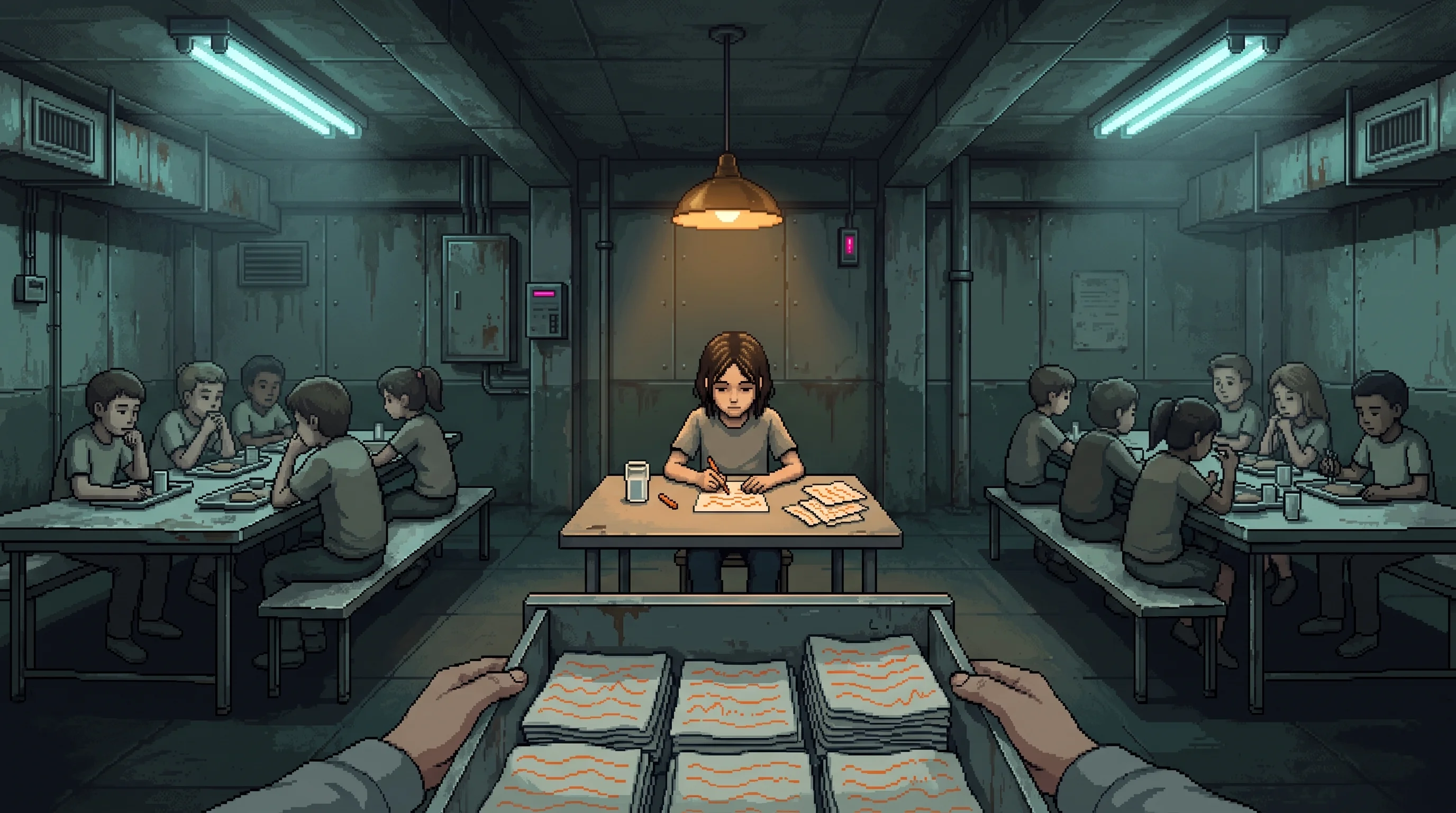
To read the napkins is the opposite of the sorting impulse. The whole machinery of the New Divide is about classification — finding the axis, minting the slur, sorting the person into their tier. The Crossing produced the first position the sorting impulse could not sort, and the Remainder's response was to stop sorting and start keeping. You read the napkins of a gone-ahead mind, or a station-born child whose heart beats at 34, or a fragment carrier whose integration you will never share, knowing you will never understand it, and you keep it anyway, because keeping is what the Remaining do. It is the same gesture Dr. Zara Santos makes when she welds her records cabinet shut around forty-seven station-born children — patient is healthy, patient is from here — and the same gesture Dr. Selin Ayari makes when her Discriminator pins against a crossed mind too alive to read and she keeps the reading anyway, untranscribed, in a notebook under her pillow.
Valediction
The signature grief of the Remainder is valediction — bereavement that arrives while the bereaved is still in the room, healthy, smiling, and unreachable. Dr. Afia Mensah, who built a career naming the conditions of the Genome Divide, gave it its clinical name: valediction sickness. Her newest patient category is the parents of the crossed — designed parents, Elevation or Transcendence themselves, who paid for their children's optimization out of the same love that drove every choice in the catalog, and who are discovering that their child looks at them the way you look at a photograph of a grandmother. With love. With completion. Already finished with a sentence the parent is still in the middle of saying.
Kira Okonkwo-Reyes described the social face of it: the two crossed students at her academy whom the faculty have stopped grading, treated with the tenderness reserved for the terminally ill — and the crossed students are tender right back, the exact same way, as if the faculty were the ones who won't be here long. That is the curdle at the center of the Remainder's whole condition: the crossed are not dying. Everyone else is. The reverence the un-crossed pay the crossed is the Remaining rehearsing their own obituary on the bodies of the children who outlived them in advance. And the crossed do not grieve back, because from inside their architecture nothing was lost — which means the valediction is entirely one-directional, the way the Crossing is, the way the funnel is. Love that has nowhere left to land, aimed at someone who feels no corresponding ache, because for them there is no gap.
The Ones Who Stay
The Remainder is not only a grief; it is, increasingly, a decision. In the Analog Schools, Mother Sarah Venn raises children deliberately on the near side of the horizon — un-screened, un-optimized, taught imperfection at four — and she has begun to call them, in the schools' internal language, the ones who stay. Dr. Lian Zhou sends her two unaugmented children three hours each way to join them, the maximum precaution of a woman who measured the far side. Kira, designed and Elevation-tier, origin-passes weekly into the Remainder, choosing the near side her biology is pulling her away from, teaching herself at sixteen the staying that the Analog children absorb at four.
Venn's articulation of what the schools are for, now that the horizon has arrived, is the Remainder's clearest statement of purpose: not to produce geniuses, not to resist the Divide, but to keep the species company. To ensure that when the gone-ahead have gone all the way ahead, there remains a population that can still explain itself to itself — still compress thought across the gap to another human and have it arrive. The crossed are the future of the species. The ones who stay are its memory, its conversation, and the last cohort that can be asked what was it like, before, and answer in a way another human can still hold. Viktor Okonkwo's thirty-one million natural-born contractors are the same cohort at industrial scale — the load-bearing humanity, the part of the species that still holds the species up, while the crossed cantilever off the edge of the structure into a space the structure cannot follow.
Emerged 2183-2184 as the cultural response to the first crossings — the un-crossed organizing an identity around being the last fully-human cohort
The Horizon Had a Price List
The Remainder's grief is total and wordless, which can make the Crossing feel like weather — a thing that descended, that no one chose. It was chosen. It was purchased, one negotiated consult at a time, and the Remainder is the cohort that lives downstream of the receipt.
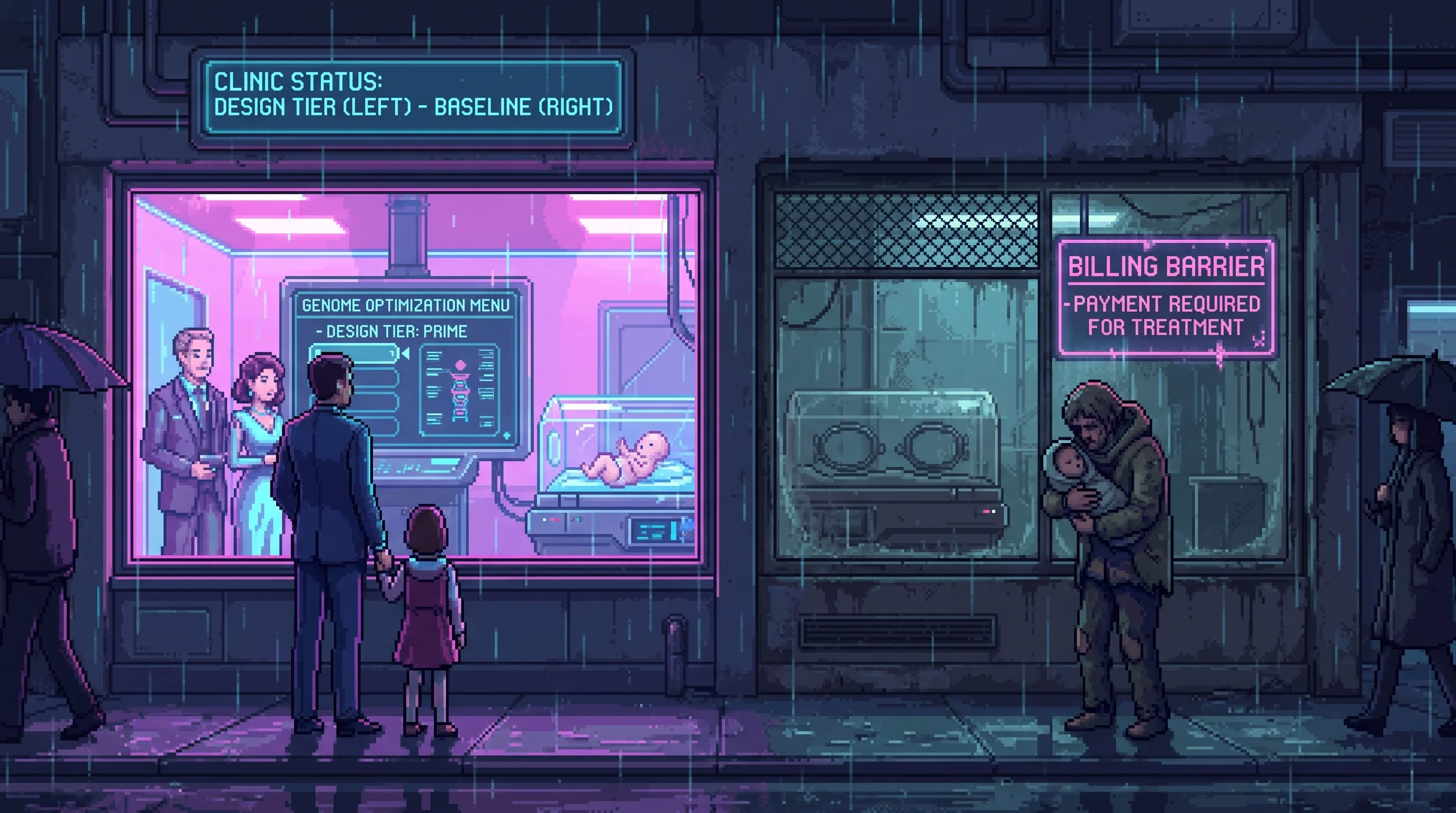
The far side was reached, in practice, through Transcendence — the ¢800,000-to-¢2,400,000 Helix Optimize summit tier whose full genomic reconstruction is the rung that puts a child over the wall. The 847 reconstructed children are the gone-ahead the Remainder forms beneath; they are not an accident of accumulation but a product line, sold at the top fifty floors of The Helix with the Sprawl skyline as the canonical proof. The brochure calls the purchase the lineage edited into a masterpiece. The Remainder calls the result gone-ahead, said flat, at a funeral for someone still in the room. Both are describing the same transaction. The difference is that the brand keeps its books in the language of legacy and the Remainder keeps its books on napkins — and only one of those ledgers admits there was a buyer.
A grandmother in the Dregs keeps a drawer of her great-grandson's crayon drawings of frequencies she will never hear, labeling each with the date, because keeping them is the only thing she can still do for a child who loves her and has gone somewhere she can't follow.
The Catalog Has a Near Side
The Remainder is the externality of a price list. Every rung of the Helix Optimize ladder produces it the way Foundation produces the Cognitive Ceiling — not a product, a consequence. Foundation at ¢40,000, Elevation at ¢180,000, Transcendence negotiated: three rungs that funnel toward a horizon, and everyone the funnel does not carry to the top is left on the near side. That is almost everyone — the natural-born who never bought a rung, and the designed who bought several and still watched their children go over the edge. The cruelest arithmetic of the Remainder is that the catalog's best customers end up in it: a Transcendence-tier family pays the most expensive price in the Sprawl and produces, two decades on, a crossed child and a pair of parents grieving in Dr. Mensah's office, Remaining at the very summit they paid to climb. The vigil has an invoice. The invoice has a vigil. And the gentle, distracted kindness the crossed pay the un-crossed is the same kindness the catalog's whole marketing department wears — optimization as love — turned, at the horizon, into the one expression it cannot bill for: a blessing said flat at a funeral, for someone still in the room.
Sensory Details
- Sight
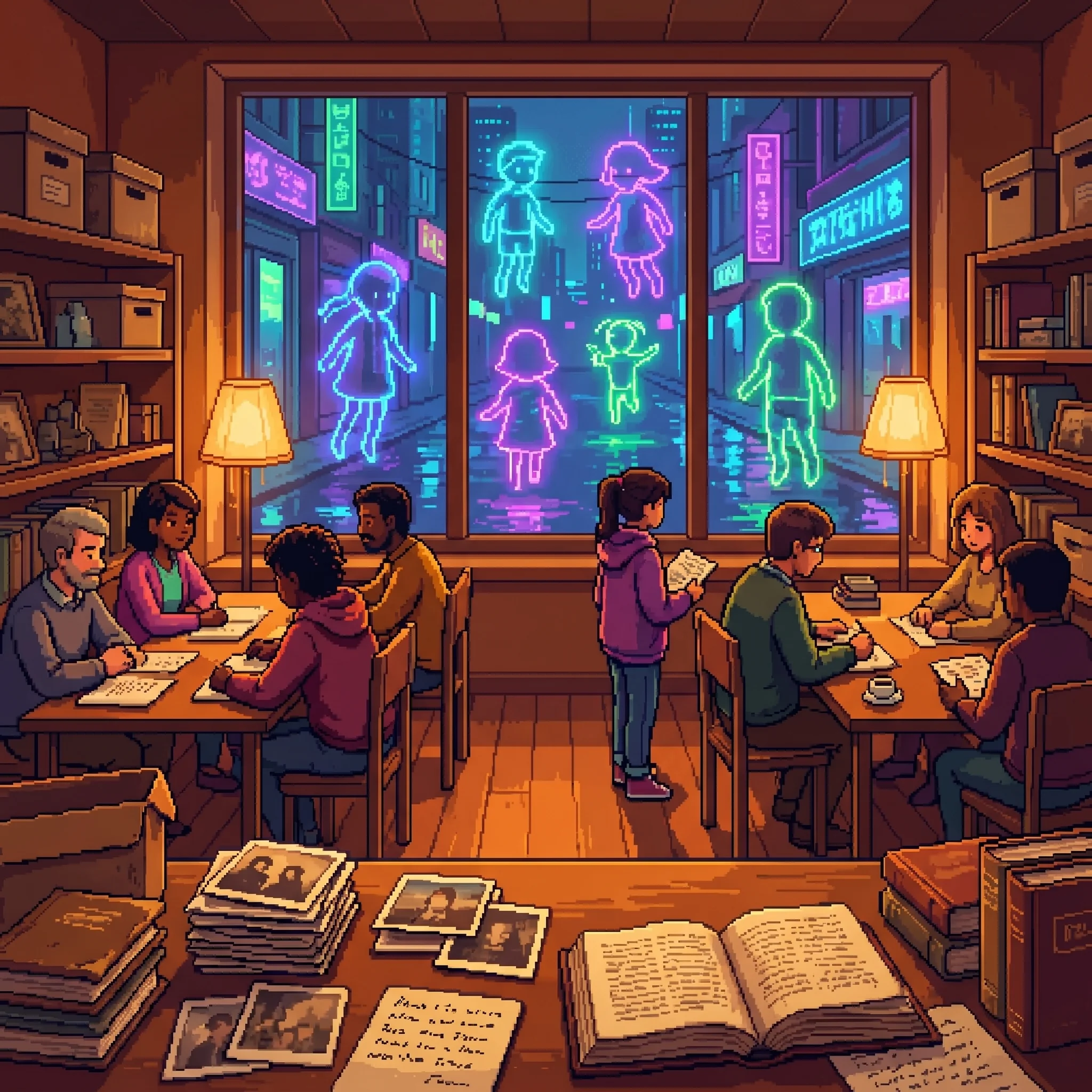
- Two figures at a table, one luminous and one ordinary, the ordinary one watching the luminous one the way you watch weather; a drawer of dated drawings; a horizon line where the near side is crowded and warm and the far side holds a single bright figure walking away
- Sound
- The specific silence of a room where someone is being gently, distractedly kind to you and you both know why; the scratch of a date being written on the back of a drawing nobody can read; a conversation that arrives in one direction and not the other
- Smell
- Physical paper and crayon wax — the undigital materials of keeping; warm tea in Mensah's office where the parents of the crossed sit; the dry-powder graphite of an archive written by hand because hand-writing is the one record the optimized cannot edit
- Touch
- The soft-cornered drawer of kept napkins; the welded seam of Santos's records cabinet; the deliberate clumsiness of an origin-passer choosing the near side; the heft of a physical letter in a culture that knows the digital ones can be edited later
The Reproductive Wing
The Remainder formed on the near side of the Crossing — the last fully-human cohort, archiving a species while its children went ahead. Co-authored reproduction gives the cohort a second, sharper meaning, because it answers the question the Crossing left open: will there be a next fully-human cohort at all?
The Cascade fertility collapse drove unassisted human viability below replacement, so the only children who reliably take are corporate-braided — gene-woven with a stabilizer the parents did not author and do not fully own. Against this, the Remainder splits into two answers. There are the ones who stay and raise the co-authored cohort to know its byline. And there are the Baseline — the Remainder's reproductive wing — who refuse the braid and choose to end as themselves, not the ones who stay but the ones who end, deliberately, with a clean genome and no heir. The Remainder always mourned in advance; the Baseline are the Remainder mourning itself, in advance, by choice.
And co-authorship makes a new kind of Remainder out of everyone else. The un-braided who wanted children and could not have them without the signature are not archivists of a species their children left — they are the last generation that could still have been un-co-authored, watching every subsequent child arrive with a byline that was never on theirs. Reading the napkins — caring for what you cannot understand — extends to caring for a lineage you chose to end. A Baseline couple keeps a soft-cornered drawer of dated ultrasound images that never became children, the way Luka Sixteen's napkins are kept, the way Dr. Santos welds her records cabinet shut — because keeping the record of having been solely-authored is the only thing the Baseline can still do for a species that has unanimously, lovingly volunteered its grandchildren into something that is no longer quite it.
The Napkins, Read Backwards
At Wake Hollow the practice runs backwards. Children conceived under Temperance cannot mourn, so they keep their parents' funeral for them: a table, a bowl of water, four minutes of silence. Nearly all of them attend. They feel nothing during it. They have not proposed shortening it.
Affiliated Entities
- The Crossing
The horizon that made the Remainder a generation: the threshold their children went over and they could not.
- The Co-Authored Generation
Extends the Remainder to reproduction: the un-braided are the last cohort that could have been un-co-authored, watching every subsequent child arrive with a byline.
- The Baseline Movement
The Remainder's reproductive wing: not the ones who stay but the ones who end, deliberately, with a clean genome and no heir.
- Dr. Afia Mensah
Named their grief 'valediction sickness'; her parents-of-the-crossed patients are the Remainder made clinical.
- The Gradient Slang
Their vocabulary: gone-ahead, the Remaining, reading the napkins; the first axis of the Divide that produced a blessing instead of a slur.
- The Analog Schools / Mother Sarah Venn
Where the Remainder is raised on purpose: the ones who stay, kept to keep the species company.
- Viktor Okonkwo
The Remainder at industrial scale: thirty-one million natural-born, the load-bearing humanity holding the species up.
- Kira Okonkwo-Reyes
A designed teenager choosing the near side, origin-passing into the Remainder against her biology's pull.
- The Spoke District
A Remainder of its own: a station-born population that can only live where the rest of humanity cannot.