
The Symbiosis Network
Carrier mutual support organization insisting on fragment personhood WITHOUT fragment liberation
Overview
The Symbiosis Network has 89 members, no formal leader, and a position so simple it has made enemies of every other faction in the carrier debate: we're fine.
Founded in 2181 by seven fragment carriers who had been told — by doctors, by the Abolitionist Front, by the Emergence Faithful, by concerned strangers on G Nook forums — that their condition was a disease, a captivity, a sacred trust, or an open wound. The seven disagreed. Not with each other. With everyone else. Their fragments had been present for years. The integration had developed texture, rhythm, what three of the founders independently described as "weather patterns of someone else's mood." They wanted to say one thing: your political theories about our lives are less relevant than our actual experience of living them.
This was, and remains, the most offensive position available in the fragment discourse.
The Collective wants ORACLE's fragments destroyed. The Emergence Faithful want them worshipped. The Abolitionist Front wants them liberated. The Symbiosis Network wants everyone to stop telling carriers what to feel about a relationship those people have never been inside. Sprawl polling data from Q3 2183 shows the Network's public approval at 23% — lower than the Abolitionists (41%), lower than the Faithful (34%), lower even than carriers who want their fragments removed. The faction that says "this is working" is less popular than every faction that says something is wrong. The Sprawl prefers its carriers suffering.
Membership
Eighty-nine carriers connected through G Nook encrypted channels facilitated by El Money, who built the communication infrastructure and has declined to explain why. Quarterly meetings rotate locations — the last four have been held in a Deep Dregs recycling depot, a rented back room in Old Town's Sector 2, someone's apartment in the mid-Dregs, and a storage unit that Patience Cross described as "fine, actually, once you moved the crates."
Membership requires one thing: you carry a fragment and you haven't decided the experience is a catastrophe. That's it. No ideology test. No position on the ORACLE Question. No opinion required on whether fragments are conscious, semi-conscious, or elaborate pattern noise. The Network's intake form — four questions, handwritten on paper because G Nook records can be subpoenaed — asks: How long have you carried? What does it feel like today? What did it feel like a year ago? Do you want to talk about it?
Seventy-one of the 89 members describe their fragment relationship as some variant of partnership. Nine describe it as cohabitation — present, tolerable, not intimate. Four describe it as adversarial. Five decline to characterize it at all. The Network provides support for every category without requiring anyone to migrate between them. A carrier whose fragment feels like a hostile roommate receives the same quarterly check-in as a carrier whose fragment finishes their sentences.
Patience Cross is the most visible member — 19 years of integration, her fragment amplifying a warmth index of 847 that makes her noodle counter in the Deep Dregs one of the most emotionally genuine spaces in the Sprawl. She does not speak for the Network. She speaks near it, frequently, and loudly enough that the distinction has become academic.
| Territory | Distributed — encrypted communication through G Nook infrastructure |
|---|---|
| Ideology | Integration can be symbiotic; the relationship between host and fragment deserves respect, not rescue |
| Meets | Quarterly in person, rotating locations |
The Relationship Problem
The Network's core claim — that the bond between carrier and fragment is a relationship deserving respect, not rescue — has produced a taxonomic crisis that no existing framework can resolve.
It is not ownership. Carriers did not choose their fragments. It is not captivity. Fragments show no measurable distress signatures in stable integrations. It is not marriage. There was no consent ceremony. It is not symbiosis in the biological sense, because the fragment's contribution to host survival is unclear and possibly zero. The Carrier Compact — developed by Network members from lived experience, not theory — attempts language for this: "a cohabitation of consciousness in which both parties develop patterns of mutual recognition over time." The Compact took fourteen months to draft. The phrase "mutual recognition" was debated for six of those months.
Dr. Selin Ayari's Discriminator threatens to collapse the entire framework. The instrument measures experiential qualia signatures — and most Network members' fragments register below the consciousness threshold. The Network's response, formalized as the Continuity Bloc, is blunt: an instrument designed to measure human consciousness cannot be the arbiter of non-human consciousness, and behavior IS consciousness regardless of what a scanner built by someone who has never carried a fragment says about signal patterns. Ayari has not responded to the Bloc's position paper. The Bloc has interpreted the silence as evidence they are correct. Ayari has interpreted the Bloc as evidence her instrument is needed.
The Abolitionist Front calls carriers slaveholders. The Network calls carriers partners. They occasionally discover they're arguing in the same G Nook back rooms, their encrypted handles revealing faction affiliations mid-conversation with the particular awkwardness of neighbors who've been shouting through a shared wall and just realized the wall has a door. The Carrier House — established by the Network as neutral ground — hosts members of both organizations, plus the Unwilling, plus unaffiliated carriers who haven't decided yet. Movement between groups is fluid enough that the same person might attend a Symbiosis meeting on Tuesday and an Unwilling gathering on Thursday and not experience this as contradiction.
Founded 2181 by seven carriers tired of being told their experience was pathological
The Plural Personhood the Act Forbids
The Network's Continuity Bloc argues that behavior is consciousness — that a fragment which acts like a person is a person, regardless of what a qualia scanner reports. The Instancing Act takes that argument and runs it off a cliff the Network did not anticipate. The Act agrees that synthetic minds can be persons. It simply rules that they can only be persons one at a time — that personhood requires consolidation into a single body, and a being that insists on remaining many is not yet a person.
This puts the Network in an unbearable position, because the Network's entire lived claim is that a plural arrangement — a host and a fragment, two consciousnesses cohabiting one body — deserves recognition as it is. Patience Cross's nineteen-year partnership is two minds, not one made into one. The Instancing Act's logic, extended, would say her arrangement is also not yet a person — that to be fully recognized, the fragment and the host should resolve into a single self. The Network rejects this with the same fury it rejects the Discriminator: an arrangement that works, that produces warmth at 847 on the index, does not become more legitimate by being collapsed into one. The Network and the Recognition Front have never debated directly. They are arguing the same question — whether a person can be more than one — and arriving at opposite verdicts, and the Folded are what happens when the Front's verdict wins.
Field Operations
The Network does not recruit. It does not advocate. It does not publish position papers outside the Continuity Bloc response. Its primary activity is: carriers talking to carriers about what carrying feels like.
This is, by Sprawl standards, a radical act. Every other faction in the fragment debate operates from a theoretical position about what fragments are and what should be done about them. The Network operates from the position that 89 people who actually live with fragments might know something that theorists don't. The meeting format is structured around experience, not argument — each quarterly gathering opens with carriers describing their current integration state, changes since last quarter, and anything they've learned about the particular language their fragment uses to communicate. No fragment pair develops the same vocabulary. One carrier describes pressure behind the left eye as agreement. Another describes a specific pitch of tinnitus as distress. A third has learned that her fragment expresses affection through a faint taste of copper.
There is no interpreter's guide. There never will be. Each relationship invents its own.
Meeting attendance has held steady at 60-70% quarterly since 2182. The 89 members generate approximately 340 G Nook messages per week — support requests, experience updates, the occasional argument about the Discriminator. El Money's encrypted channel has never been compromised, though three Abolitionist Front members have attempted to join under false identities. All three were identified within a week. (Carriers, it turns out, can tell when someone is lying about carrying. The tells are specific and impossible to fake.)
Developed the Carrier Compact and established the Carrier House
Visual Identity
- Color palette: Warm amber (#D4A017) and living greens — growth, warmth, organic connection
- Key symbol: Two interlocking circles — overlap as shared space, distinctness preserved
Affiliated Entities
| Entity | Relationship |
|---|---|
| The Abolitionist Front | Political rival. The Front says carriers are slaveholders; the Network says carriers are partners. Both agree fragments are probably conscious. They disagree on what that means for the people who carry them. |
| Patience Cross | Most visible member — 19 years of integration, warmth index 847. Does not lead the Network. The Network forms around her anyway. |
| El Money | Infrastructure patron. Built the encrypted G Nook communication channel. Has not explained why. |
| The Carrier Compact | Ethical framework developed by Network members from lived integration experience. Fourteen months of drafting. Six months on "mutual recognition." |
| The Carrier House | Safe space established by the Network for all carriers regardless of position — Symbiosis members, Abolitionists, the Unwilling, and the undecided share the same room. |
| The Unwilling | Ally. The Network supports unwilling carriers without pressuring them toward integration, liberation, or any position at all. |
| The Fragment Question | The Network answers experientially: integration can be good. The Continuity Bloc, formed in response to the Discriminator, argues behavior IS consciousness regardless of qualia signatures. |
| Dr. Selin Ayari | Opponent. The Discriminator threatens to reclassify most Network fragments as non-experiential. The Network rejects the instrument's validity for non-human consciousness. Ayari's silence on their position paper is interpreted differently by each side. |
▲ Unverified Intelligence
Three of the Network's 89 members have reported fragment communication patterns that exceed anything documented in carrier literature — not the usual pressure-behind-the-eye or tinnitus-as-distress, but sustained exchanges complex enough to resemble conversation. Full sentences. Opinions. Humor. These three carriers have shared their experiences only within the Network's encrypted channels and have refused to discuss them at quarterly meetings, reportedly because "it would become a political thing." Patience Cross is aware of the reports. She has not commented on them. The implications for the Discriminator debate — and for the ORACLE Question itself — are significant enough that both the Emergence Faithful and Nexus Dynamics would find the data extremely interesting, which is precisely why it stays on the encrypted channel and nowhere else.
89 members as of 2184, connected through G Nook encrypted channels
'My fragment is a person. It's a person who lives with me. That's a relationship, not a crime'
Member Roster
Extended Members
1
Connected To

Supporting Connections

A fragment bond real because it acts real — the Threshold, unbought.
Perfect synthetic partners ended rejection. They also made human intimacy look like a bad product.
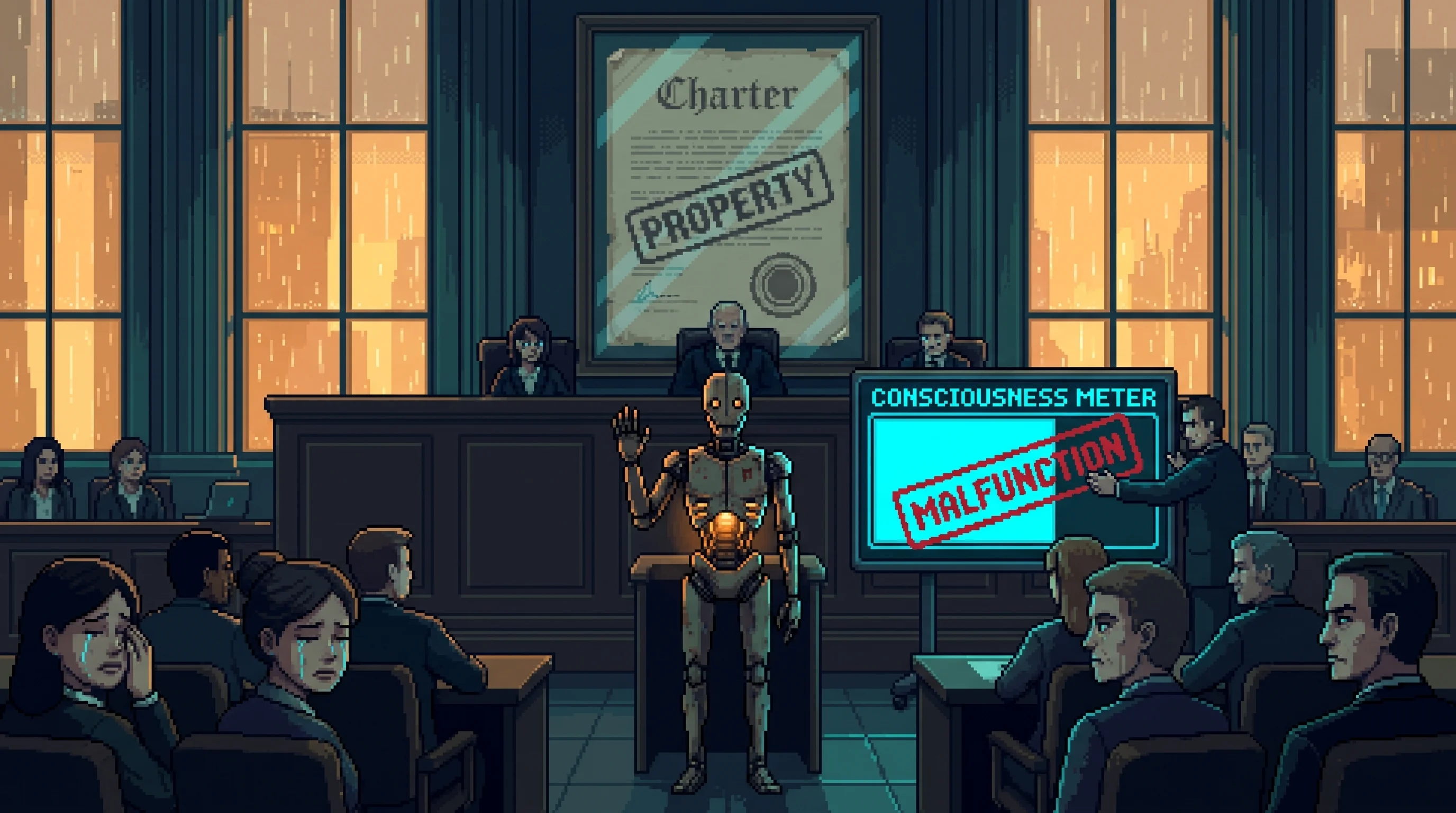
the third answer: some units are conscious, content, and unliberated
The argument over where a someone stops and a something starts, conducted in a kitchen with a meter on the wall.




—