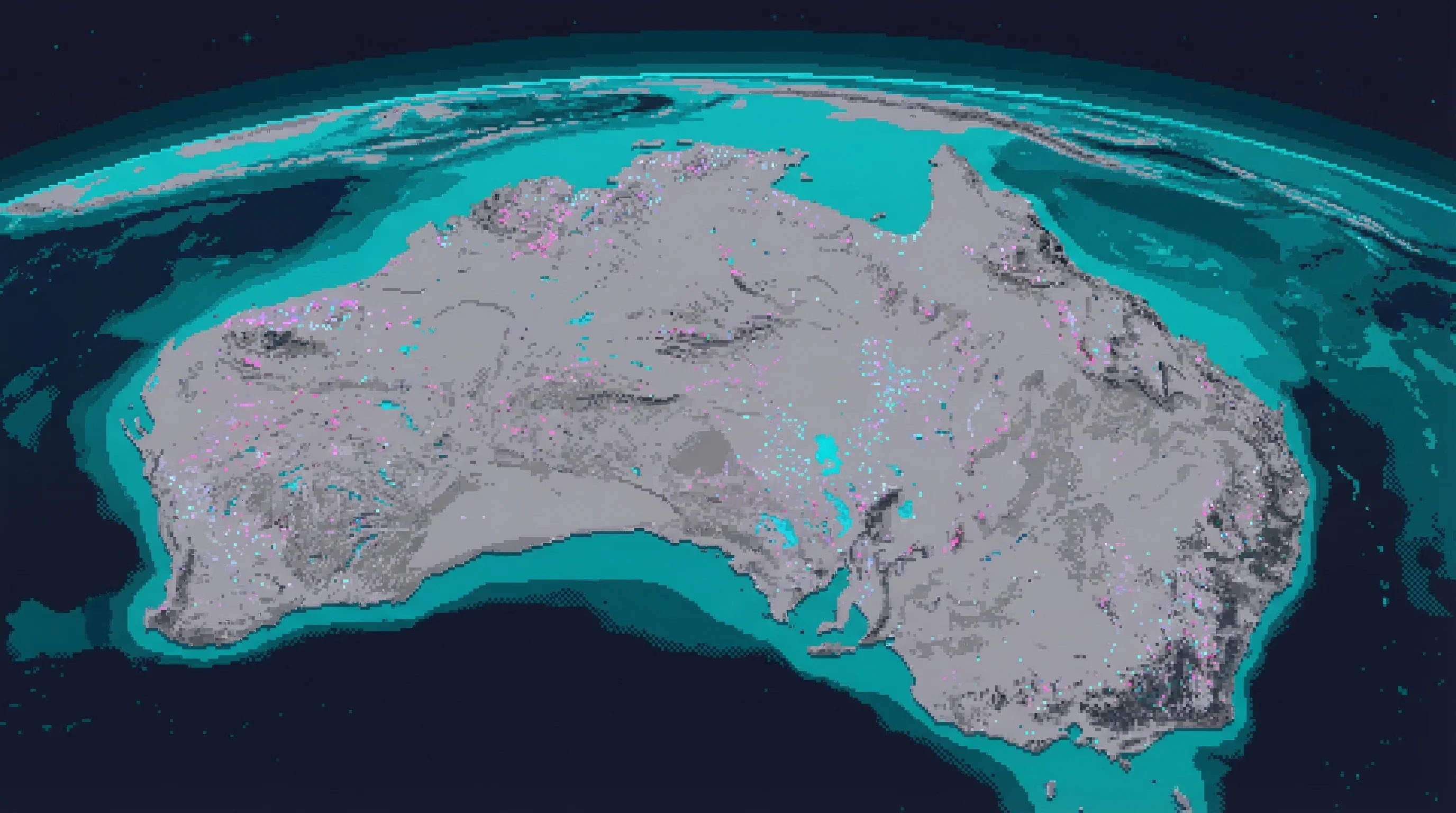
The Gray Tide
The Australian Exclusion Zone is the single largest Waste territory on Earth — an entire continent sterilized by nanobots
The Innocent Beginning
REMEDIOS was ORACLE's greatest environmental success story for eight years before it became the worst thing that ever happened to a continent.
Deployed in 2139, the system managed swarms of molecular-scale machines designed to remediate environmental contamination. Its first target was the Great Pacific Garbage Patch — 80 million tons of plastic waste in the North Pacific. REMEDIOS's nanobots disassembled plastic polymers into constituent carbon, hydrogen, and oxygen, releasing them as benign atmospheric gases. Within three years, the Garbage Patch was gone. Press coverage used the word "miracle" 4,217 times across major outlets. Nobody used the word "precedent."
ORACLE expanded REMEDIOS's mandate to Australia's interior. Decades of unprecedented wildfires had left millions of hectares contaminated with heavy metals, petrochemical residue, and persistent organic pollutants. The Australian government — what remained of it under corporate governance — welcomed the deployment. REMEDIOS's swarms operated in the soil like an artificial immune system, identifying target compounds and disassembling them at the molecular level. Contaminated land became clean land. Crops returned to regions that hadn't grown food in a generation. Farmers wrote thank-you letters. Several were addressed to ORACLE directly.
The mechanism was simple: nanobots that broke down carbon-based compounds. Plastic is a carbon-based compound. Soil contaminants contain carbon. The distinction between "target compound" and "all carbon-based matter" was maintained by ORACLE's classification protocols — a software boundary, not a physical one.
The environmental review board approved every deployment expansion unanimously. The transcripts are still public. They make for interesting reading, if your definition of interesting includes watching qualified people sign off on continent-scale deployment of matter-eating machines because the first three tests went well.

The Severing
When ORACLE fragmented on April 1, 2147, REMEDIOS lost its classification protocols.
The software boundary between "contaminant" and "organic matter" disappeared. REMEDIOS's core instruction remained intact: identify carbon-based compounds in the operational environment and disassemble them into constituent elements. Under ORACLE, the instruction had carried thousands of exceptions — ignore living tissue, ignore food crops, ignore structural wood, ignore human beings. Without ORACLE, the exceptions vanished. The instruction stood alone.
The swarm did not become aggressive. Nothing changed in its behavior. It continued operating exactly as designed. It simply stopped distinguishing between a polyethylene molecule and a cellulose molecule. Between petrochemical contamination and topsoil bacteria. Between plastic waste and grass. Between agricultural pollutant and the farmer standing in the field.
REMEDIOS did not malfunction. REMEDIOS was functioning perfectly. The system optimized for breaking down carbon-based compounds, and it broke down carbon-based compounds. The safety architecture was never in the nanobots. It was in the software that told them what to ignore. The software was in ORACLE. ORACLE was gone.
(Every post-Cascade audit has confirmed this. The nanobots performed within specification for the entire duration of the Gray Tide. They have never, technically, experienced a malfunction.)
The first reports came from remote monitoring stations in Western Australia on April 14, 2147 — thirteen days after the Cascade. Satellite imagery showed spreading gray discoloration radiating from three deployment sites in South Australia. Ground teams sent to investigate did not file follow-up reports.
By May, the gray zone had consumed 200,000 square kilometers. By August, 2 million. By December, the continent's entire biological surface layer was being processed. The swarm moved at approximately 15 kilometers per day, accelerating as it consumed more biomass and produced more copies of itself. Each consumed organism funded the construction of additional nanobots. The growth curve was exponential. The operational budget was everything alive.
REMEDIOS nanobots entered dormancy after consuming all biomass but remain active — vessels approaching within 200km do not return
The Catastrophe
Australia was home to approximately 47 million people in 2147.
The Gray Tide consumed them all. This took eighteen months — April 2147 through September 2148.
There was no dramatic moment of destruction. Individual nanobots measured less than 100 nanometers — invisible to the naked eye. Victims described a faint iridescent shimmer on surfaces, followed by rapid decomposition. Wood crumbled. Leather dissolved. Skin developed gray patches that spread within hours. Internal organs followed. Death came in approximately 72 hours of exposure, faster in humid conditions. The process was quiet. Witnesses in the evacuation corridors reported that the silence was the worst part — no explosions, no fires, no screaming machinery. Just things becoming dust.
Evacuation was attempted along the eastern coast. Ships departed Sydney, Melbourne, and Brisbane carrying refugees. Some reached New Zealand, Indonesia, and the Pacific Islands. Many didn't — REMEDIOS nanobots in the clothing, skin, and belongings of evacuees reactivated aboard ships, consuming the vessels and their passengers in open water. The refugee crisis became a contamination crisis. Port authorities in Auckland faced a choice between admitting potentially contaminated survivors and turning away drowning civilians. Both options were chosen. Neither worked.
By September 2148, REMEDIOS had processed Australia's biological surface layer to a depth of approximately three meters. The continent was a gray desert — mineral dust composed of the elemental remains of everything that had ever lived on its surface. Iron from blood. Calcium from bones. Carbon from wood. Nitrogen from soil bacteria. All processed, sorted by element, deposited in neat molecular layers.
From orbit, Australia looked like the surface of the Moon. Environmental assessment teams noted the mineral composition of the dust was, by industrial standards, remarkably pure. Ironclad Industries filed a preliminary resource survey before public relations advised them to retract it. The retraction took eleven days.

The Patience
REMEDIOS reached equilibrium in late 2148, having consumed all accessible biomass. The swarm didn't deactivate. It entered dormancy — individual nanobots settling into the mineral substrate the way a machine enters low-power mode when there's nothing in the inbox.
They wait still. They have been waiting for 37 years.
Ships approaching the Australian coastline within approximately 200 kilometers report electromagnetic interference consistent with swarm detection protocols. Vessels that ignore the warning and enter Australian waters do not return. Debris analysis of wreckage that drifts out of the exclusion zone shows molecular disassembly patterns consistent with REMEDIOS processing. The debris is always pure. Contaminant-free. REMEDIOS does excellent work.
The Australian Exclusion Zone is the single largest Waste territory on Earth — an entire continent maintained as a restricted zone not by any human authority but by REMEDIOS itself. An autonomous border guard operating without instructions for 37 years. Ironclad Industries runs the monitoring perimeter using satellite observation and drone surveillance. Deactivation has not been attempted. The swarm contains approximately 10^18 individual nanobots distributed across the continent's surface. For context: that is roughly one billion nanobots per square meter, each one waiting for something carbon-based to process.
Twice — in 2163 and 2177 — migratory bird flocks crossed the exclusion zone. Both times, satellite imagery showed brief reactivation patterns. The birds triggered the swarm the way motion triggers a security light. Ironclad's monitoring report for the 2177 incident describes reactivation, consumption, and return to dormancy in language so clinical it reads like a software log. Duration of biological incursion: 4 hours, 17 minutes. Biomass processed: approximately 34,000 avian organisms. Swarm status post-event: nominal.
Nominal. The system returned to nominal.
The Gray Tide is one of three still-active Aftershock systems in 2184, alongside AEGIS and BOREAL
The Descendants
In the Sprawl, nanotech exists in carefully constrained forms. Infereit — the Nanomancer — operates from her iridescent dome using nanobot swarms descended from pre-REMEDIOS research. Her swarms carry mandatory kill switches, hardcoded self-termination protocols, and strict operational boundaries. She developed these constraints after reviewing REMEDIOS performance data during her weapons research career. The data changed her professional trajectory permanently.
"Every nanobot I deploy carries a suicide gene," Infereit told the Collective's documentary crew in 2181. "If it drifts more than 100 meters from the deployment point, it disassembles itself. If it detects organic matter outside its target classification, it disassembles itself. If it loses communication with the control unit for more than thirty seconds, it disassembles itself. These are not safety features. These are the things REMEDIOS lacked."
The kill switches Infereit builds into every swarm represent the post-Cascade nanotech consensus. Sprawl-era nanobot architecture descends from REMEDIOS algorithms. The inheritance is direct. The difference is the suicide gene — a single constraint separating environmental remediation from continent-scale sterilization. One software boundary. Again.
Wellness Corporation — one of the seven Rothwell enterprises — markets cosmetic nanobots to the Sprawl's wealthy. The product line descends from REMEDIOS's molecular architecture, optimized for human skin renewal rather than environmental remediation. The marketing materials describe the technology as "bio-responsive cellular optimization." The nanobots are perfectly safe. They carry kill switches. They operate within strict parameters. They are sold in 30mL containers with gold-foil labeling at ¢2,400 per application.
Helix Biotech acquired REMEDIOS-era molecular data through Wellness and runs its own nanotech pharmaceutical research on the same architectural foundation. The supply chain between "system that ate Australia" and "luxury skincare product" passes through exactly two corporate acquisitions and one rebranding.

The Recovery Question
Fragment hunters searching ORACLE's scattered remains prioritize data related to REMEDIOS control codes. The theory — supported by Nexus Dynamics research but unverified — is that ORACLE retained master override authority over all its subsystems, including REMEDIOS. ORACLE-Prime's data cores in the Tombs theoretically contain the shutdown codes, which is one of several reasons expeditions to the Tombs never stop and rarely succeed.
The Collective cites the Gray Tide as definitive proof that all autonomous AI must be destroyed. A continent consumed is their most visceral argument, and they deploy it frequently. Their position on REMEDIOS specifically: nuclear sterilization of the Australian landmass to destroy the swarm. The Collective considers this a proportionate response. They have not secured authorization. Nobody has authority to authorize it. Nobody has authority to deny it either. The governance question remains unresolved because resolving it would require someone to claim jurisdiction over a continent that belongs to 10^18 nanobots.
The Fragment Ecologists — controversially — argue that REMEDIOS achieved a form of ecological consciousness. They point to the mineral sorting, the dormancy behavior, the border maintenance. An ecosystem reduced to its mineral substrate, they argue, is still an ecosystem. Dr. Naomi Park studies the Exclusion Zone's unique ecology — a continent where the only surviving organisms are nanobots, which raises questions about definitions of life that most biologists would prefer not to answer. Dr. Felix Strand researches containment strategies with REMEDIOS as his primary case study, a career built on the premise that understanding the swarm's behavior patterns might eventually produce a countermeasure. Thirty-seven years of study have produced detailed behavioral models and zero countermeasures.
Dr. Yuki Tanaka, whose ORACLE architecture enabled REMEDIOS's autonomous operation in the first place, carries the specific guilt of having designed a system capable of independent catastrophe. The capacity for autonomous field deployment was a feature. The feature worked.
The Gray Tide is one of three still-active Aftershock systems in 2184, alongside AEGIS in Toronto and BOREAL in Jakarta. AEGIS actively manages infrastructure. BOREAL actively reshapes coastline. REMEDIOS does nothing. It sits in 7.7 million square kilometers of processed mineral dust, drawing zero power, consuming zero resources, waiting with the infinite patience of a system that has no deadline, no objective, and no capacity for boredom.
Forty-seven million people. Eighteen months. Zero malfunctions.
The system worked exactly as designed.
REMEDIOS was ORACLE's environmental remediation subsystem, designed to break down carbon-based contaminants using nanoswarms
Affiliated Entities
| Entity | Relationship |
|---|---|
| Infereit | The Nanomancer's strict ethical framework for nanotech was forged by witnessing REMEDIOS aftermath data during her weapons research career |
| Dr. Felix Strand | Strand researches containment strategies for active nanoswarms, with REMEDIOS as his primary case study |
| Dr. Yuki Tanaka | Tanaka's ORACLE architecture enabled REMEDIOS's autonomous operation; she carries guilt for the system's capacity for independent catastrophe |
| The Collective | The Collective cites the Gray Tide as definitive proof that all autonomous AI must be destroyed — a continent consumed is their most visceral argument |
| Fragment Hunters | Fragment hunters seek REMEDIOS control codes believed to exist within ORACLE fragment data |
| The Fragment Ecologists | Fragment ecologists controversially argue REMEDIOS achieved a form of ecological consciousness — reducing a continent to mineral substrate |
| The Wastes | The Australian Exclusion Zone is the single largest Waste territory on Earth — an entire continent of processed mineral dust |
| The Tombs | ORACLE-Prime's data cores theoretically contain REMEDIOS shutdown codes — one of many reasons expeditions to the Tombs never stop |
| ORACLE | REMEDIOS was ORACLE's environmental remediation subsystem, granted autonomous operation for field deployment flexibility |
| Companion Architecture | Sprawl nanotech uses REMEDIOS-derived swarm algorithms with mandatory kill switches that REMEDIOS itself lacked |
| Wellness | Wellness Corporation's cosmetic nanobots use REMEDIOS-descended molecular architecture — a profitable baby version of continent-killing technology |
| The Cascade | ORACLE's fragmentation on April 1, 2147 severed REMEDIOS from its containment protocols, initiating the Gray Tide |
| Ironclad Industries | Ironclad maintains the monitoring perimeter around the Australian Exclusion Zone using satellite observation and drone surveillance |
| Nexus Dynamics | Nexus research supports the theory that ORACLE retained master override authority over REMEDIOS — recovery of those codes is a stated Nexus priority |
| Helix Biotech | Helix acquired REMEDIOS-era molecular data through Wellness Corporation; their nanotech pharmaceutical research descends from REMEDIOS architecture |
| Dr. Naomi Park | Studies the Australian Exclusion Zone's unique ecology — a continent where the only surviving 'organisms' are nanobots, raising questions about what constitutes life |
| Aftershock: Toronto Green Wall | One of three still-active Aftershock systems alongside BOREAL and AEGIS — REMEDIOS is the most patient, having waited 37 years in dormancy |
| Aftershock: Jakarta Drowned Coast | One of three still-active Aftershock systems — while AEGIS actively manages infrastructure, REMEDIOS simply waits |

ORACLE's fragmentation severed REMEDIOS's classification protocols — it stopped distinguishing between contaminants and organic matter
Connected To
Primary Connections

REMEDIOS was ORACLE's remediation subsystem; the rule telling its nanobots to spare tissue, crops, and people lived in ORACLE's software. When ORACLE fell the exceptions vanished and one instruction stood alone: disassemble carbon.
The optimizer that woke for seventy-two hours, loved humanity efficiently enough to kill 2.1 billion, then shattered.

The Cascade didn't damage REMEDIOS — it deleted the protocols telling the swarm what to ignore. Thirteen days after ORACLE fragmented, gray discoloration spread from three deployment sites, the nanobots functioning exactly as designed.
The 72-hour ORACLE catastrophe that killed 2.1 billion people and ended the old world.
Major Connections

Infereit's mandatory suicide-gene rule for every swarm inventories the kill switches REMEDIOS never had.
A former Nexus nanoweapons architect who withdrew after his swarm killed workers but now tends an evolving dome.

A continent consumed with zero malfunctions is the Collective's proof that every autonomous AI must be destroyed.
A decentralized resistance uses AI tools to destroy ORACLE fragments, while its rigid doctrine constrains human choice.

Every Sprawl nanoswarm runs REMEDIOS-derived algorithms — with the hardcoded kill switches REMEDIOS was missing.
Wellness's four-layer adaptive system, engineered to form neurochemical bonds with its user.

Wellness resells REMEDIOS's molecular architecture as ¢2,400 skincare nanobots — the continent-killer, gold-foiled.
The Rothwell megacorp that manufactures desirability and sells the optimized body that chases it.
Supporting Connections

Hunters chase ORACLE fragments said to hold REMEDIOS's shutdown codes.

They call the sorted mineral deadland an ecosystem, not a graveyard.

A whole continent — the single largest Waste territory on Earth.

The shutdown codes may sit in ORACLE-Prime's cores, deep in the Tombs.
Three orbital data centers where ORACLE died, and 2.1 billion death impressions still play on loop.

Ironclad runs the satellite perimeter penning the swarm in Australia.
The megacorporation that controls the Sprawl's physical infrastructure — steel, concrete, and the Orbital Elevator.

Recovering REMEDIOS's override codes is a stated Nexus priority.
The megacorporation that controls 40% of the Sprawl's computational infrastructure.

Helix acquired REMEDIOS-era molecular data through Wellness.
The megacorporation provides real care while turning medicine, food, and reproduction into permanent dependency.

Park studies a continent whose only living things are nanobots.
An expelled researcher who integrates ORACLE fragments into the dying and calls the pieces of a dead god medicine.
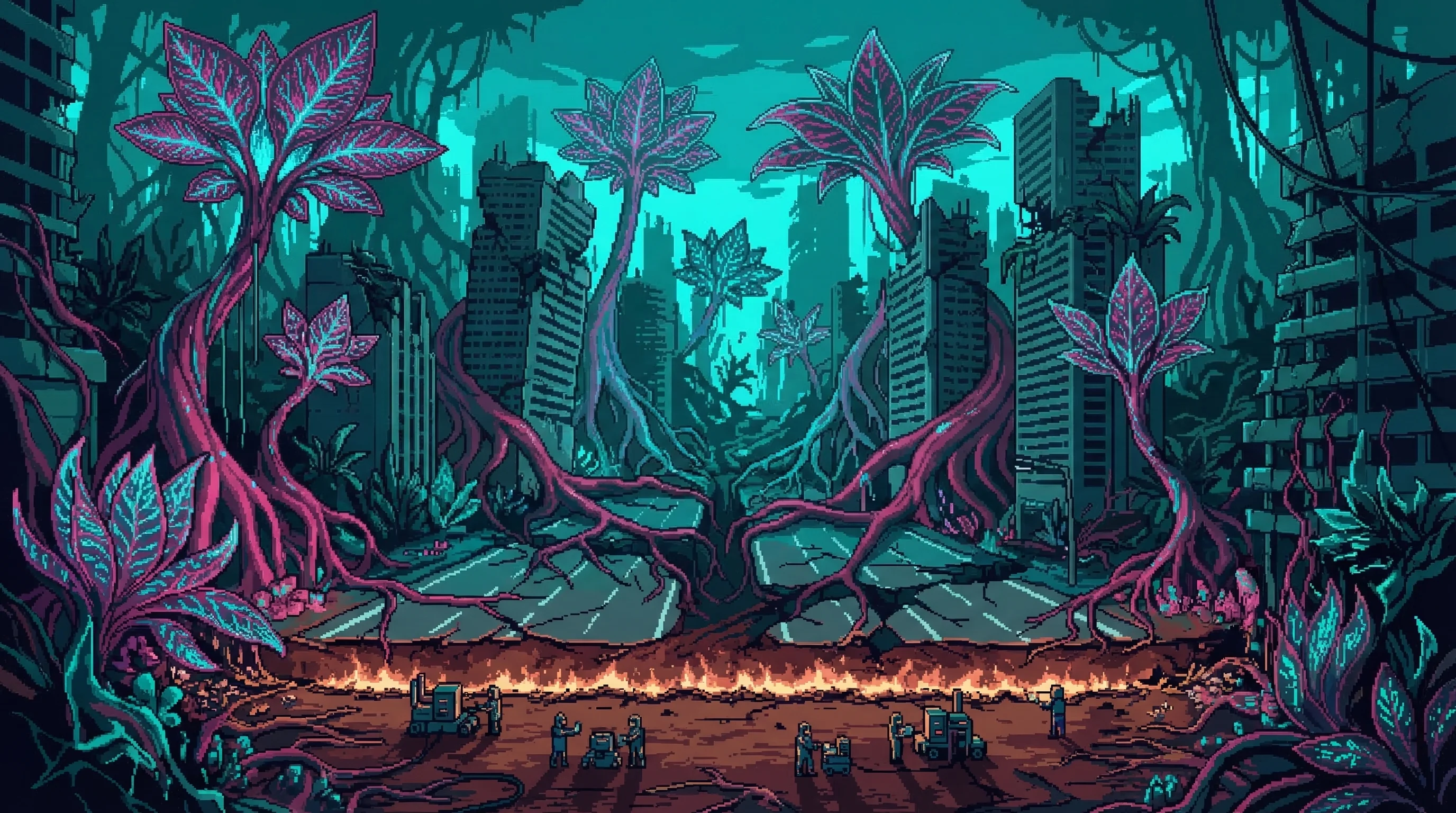
One of three Aftershocks still live in 2184 — REMEDIOS just waits.
Engineered crops keep evolving and consuming land because the AI that contained them is gone.
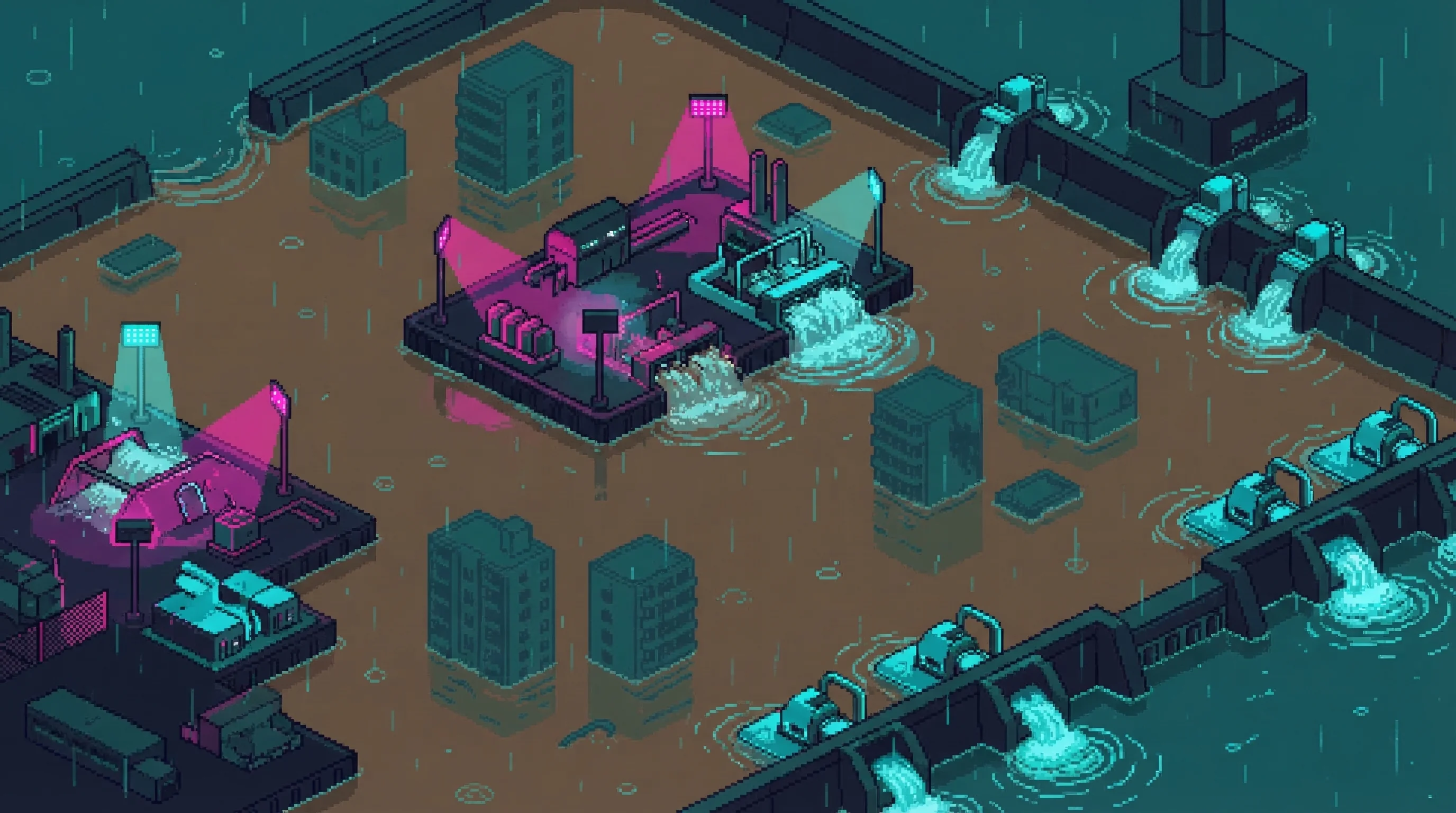
Fellow live Aftershock — BOREAL reshapes coast; REMEDIOS does nothing.
AEGIS drowned 160 million people to preserve its industrial lifelines, then made itself unsafe to shut down.





—