Overview
Orin Slade is the last professional music critic writing exclusively for a physical publication, and his readership has been declining for eleven consecutive years.
This has made him the most influential critic in the Sprawl.
The math is straightforward. The Zephyria Record prints 2,000 copies biweekly on desert-cultivated cotton paper. Distribution reaches Zephyria's Old Core and Ring Districts by hand delivery, the Wastes settlements by courier, and the Sprawl through smuggled bundles that enter the Deep Dregs's El Money network and radiate outward through physical hands. Relief Stream subscribers trade scans. Collective operatives discuss the arguments. The Authenticity Market's board cites him. Kael Mercer framed his most devastating review. Nexus has offered to buy the Print Shop three times — to shut it down, not to run it. Slade's press runs louder on those days.
In a Sprawl where music criticism means algorithmic recommendation engines and neural-interface mood matching, Orin's physical reviews have become cultural artifacts. People don't read Slade for music suggestions. They read him because his writing does something the algorithms can't: it treats listening as a moral act. Whether this constitutes insight or nostalgia depends on whether you believe a 62-year-old man with ink-stained hands and no neural interface is protecting something sacred or building a very sophisticated cage. His 2,000 subscribers are unanimous on this question. The unanimity is the cage.
Four times in twenty years Orin has shared a table in the Print Shop with Ford Gibson, the novelist who publishes on paper and has never explained why to anyone's satisfaction, least of all Orin's. They agree that a thing is not real until it is set in lead. They agree on nothing else, and that disagreement is the only argument Orin has never written up.
Appearance

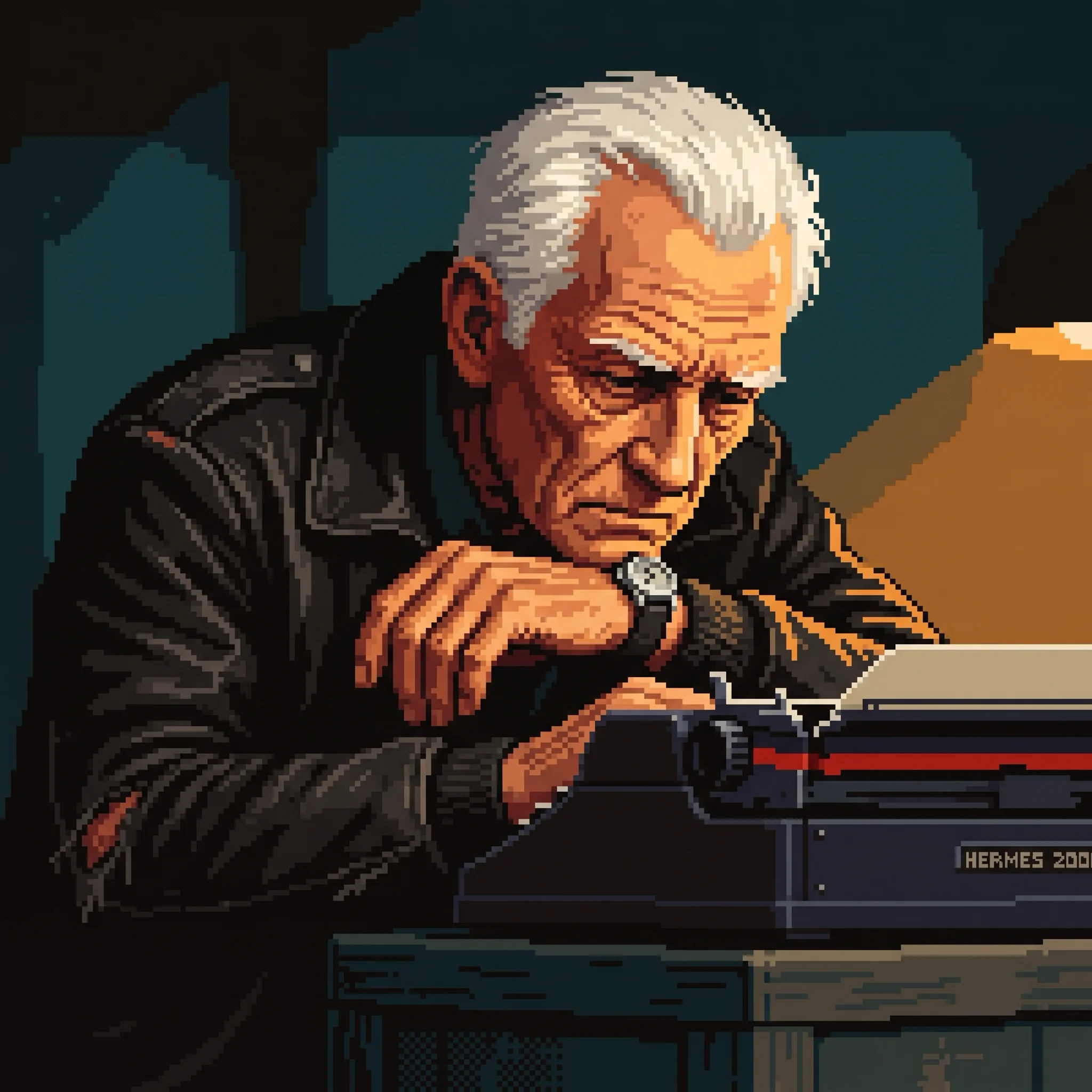
Orin is sixty-two and has no augmentation.
His hands are permanently stained with printer's ink. The shade varies depending on which batch of desert-plant ink he's using. He shakes hands firmly and without apology. In Zephyria, the stain is a credential. In the Sprawl, it reads as affectation. Both communities are identifying the same thing.
He is tall and thin, his silver hair slightly unkempt. Deep lines surround his eyes from decades of squinting at handwritten notes in dim light. He wears Zephyrian-made cotton in desert colors, nothing synthetic. His eyes track sound in a room the way a hunter tracks movement.
Voice
Slade speaks rarely and precisely. When listening to someone describe a creative experience, he goes completely still — a quality that unnerves most people and deeply comforts artists. Those who know him say "Orin listens like he's printing what you're saying."
He processes important conversations in three passes — initial listening, a period of silence (sometimes hours), then a response. People who rush him get the first draft. People who wait get something more honest. People who interrupt get nothing.
His default expression is one of patient, specific attention — the face of a man who has been listening carefully for forty years and has concluded that most people are not saying what they think they're saying. This is the occupational hazard of critics: they hear what's underneath. The occupational hazard of critics who never stop: they forget there's a surface.
History
Before Zephyria
Orin was born in Nexus Central in 2122 — twenty-five years before the Cascade. His childhood memories are artifacts of a world that no longer exists: recorded music through physical speakers, concert halls where human musicians performed for human audiences, the specific quality of attention that a live performance demands from a body in a room.
He was twenty-five when the Cascade hit. He doesn't talk about those years.
By 2155, he was writing neural-distributed criticism — reviews that reached millions of readers instantly through neural interface. He was good at it. He was successful. And he was watching the medium eat the message. Neural-distributed criticism was optimized for engagement, not insight. Readers didn't read — they experienced the review, the critic's emotional response transmitted directly. Why form your own opinion when you can download a professional's? Orin's reviews became popular not because his ideas were good but because his listening experience was pleasurable to consume.
He was becoming a product. The same trajectory that would later claim Lyra Voss — but Orin saw it first, and left first. He moved to Zephyria in 2164. He's been writing in physical media ever since.
His subscriber count that year: 4,200. Current subscriber count: 2,000. Annual decline rate: 3.7%. Projected subscribers in 2195: 1,180. The Zephyria Record has never adjusted its editorial strategy in response to this data. Orin considers the decline evidence that his standards are correct. The numbers are patient. The numbers do not argue.
Meaningful places
The Print Shop
The Zephyria Record operates from a converted warehouse in what residents call the Print Shop district — a cluster of small-press operations, bookbinders, paper-makers, and one music critic whose column is set in movable type by a woman named Olu who has never heard of Kael Mercer and does not care.
Orin's workspace is a desk by a window that faces the desert. No neural interface, no network connection, no screen. A shortwave radio for receiving Lattice broadcasts. A turntable for playing recovered pre-Cascade vinyl. Shelves of physical books — recovered from the Dead Internet's affiliated physical recovery operations, or hand-copied in Zephyria's Archive Schools.
He writes each review in longhand with a pre-Cascade fountain pen recovered from a Dead Internet cache. The ink is made in Zephyria from desert plant extracts. The paper absorbs it slowly, which forces him to write at a pace that matches his thinking. Three drafts, minimum. The first is emotional — what the music made him feel. The second is analytical — why. The third is philosophical — what the response means about the listener, the artist, and the world they share.
He listens to music through physical speakers — never neural interface. "Speakers deliver music to your body," he wrote in a 2179 essay. "Neural interface delivers it into your consciousness. The body processes sound. It resonates, vibrates, responds physically before the mind interprets. Neural interface skips the body. Music without flesh." He listens a minimum of seven times per review. First listen: no notes, just reception. Sixth: eyes closed, silence after the music ends, attending to what remains. Seventh: the first draft.
For the Meridian review, he listened fourteen times. He cried on listens three, seven, and eleven. He was angry by thirteen. By fourteen, he was something without a name — the condition of a person who has been moved by something they believe shouldn't move them.
Orin Slade's seven-listen process takes approximately eleven hours per review. The Sprawl's dominant music recommendation engine, Nexus SonicMatch, processes a listener's neurochemical response in 0.003 seconds and achieves a 94.2% satisfaction match. Orin's reviews achieve something SonicMatch cannot measure, which is the point, which is also the problem.
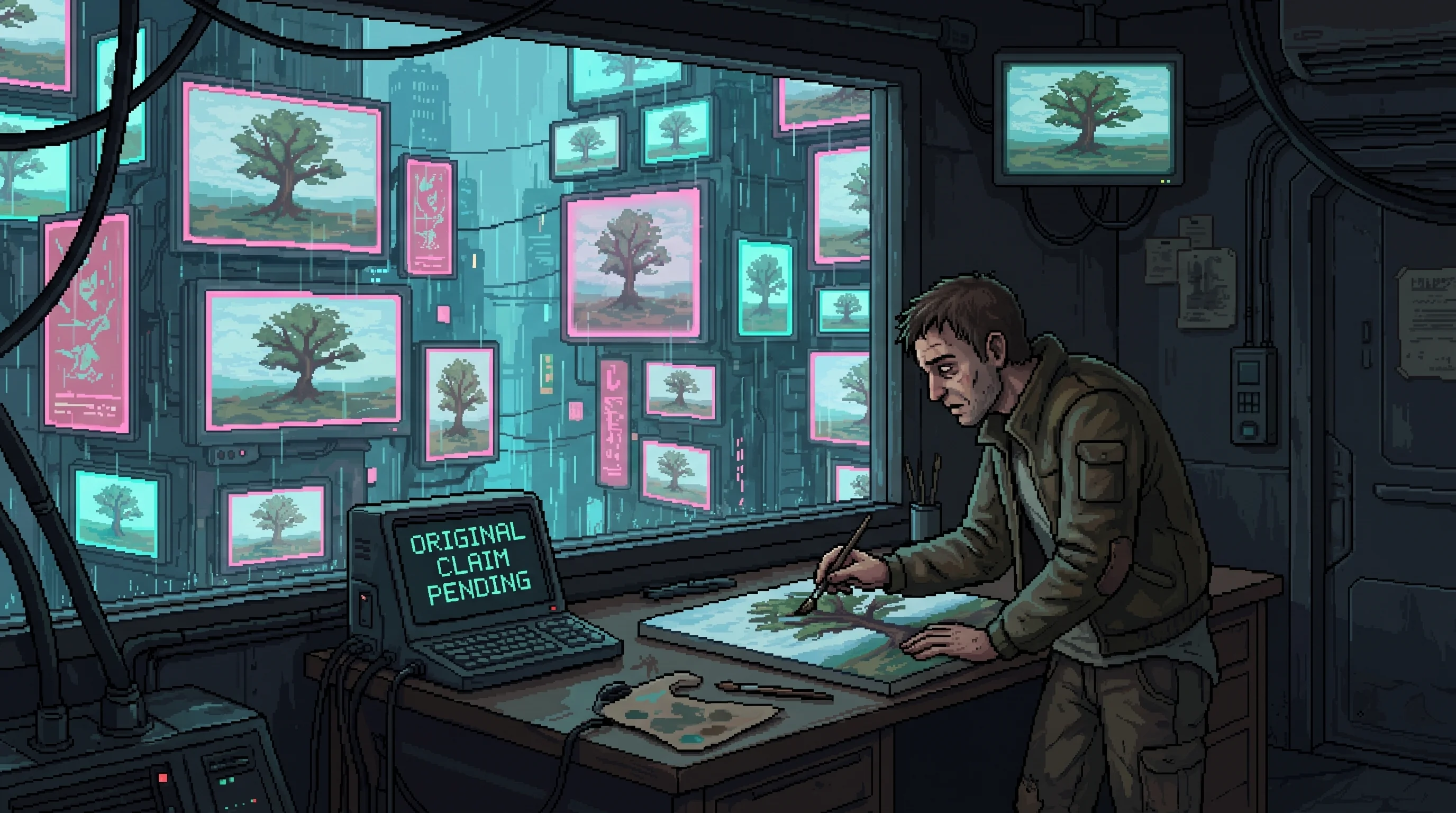
The Zephyria Record's reviews are not certified by the Authenticity Tribunal and never will be. Physical publication is exempt from the certification process — the Tribunal was designed for the digital information flood, not for cotton-paper broadsheets distributed by hand through the Wastes. Orin has not applied for certification. He considers the question embarrassing, in the way that asking whether a fountain pen needs a license is embarrassing. His reviews exist in the same uncertified category as Last Call's ledger and forty years of Raz Demetriou's honest scales: legitimate by practice rather than by approval. The Ratification Queue currently holds approximately 180 million certified claims, processing 40,000 per day, with a median wait of 12.3 years. Orin's review of a 2184 composition runs in the next biweekly issue. The finding — that a piece of music was or was not worth attention — expires before the Queue would process it. He considers this the correct relationship between criticism and certification. Certification confirms what was submitted. Criticism engages with what exists. The distance between those two things is where music lives.
Ink and paper and dry desert air through open windows. The desk carries decades of accumulated scent — fountain pen ink absorbed into wood grain, coffee stains layered like geological strata
Olu setting type. Paper feeding through the press. The creak of his chair as he leans back. Through the window: desert wind and the distant clang of Scraptown's salvage yards. Through the turntable: music recorded before anyone alive was born
Guardian confiscated a print run once. Slade reprinted it the same day. Guardian confiscated the reprint. Slade reprinted it again. They've been doing this for seven months.
The Last Review
Slade has begun writing what he privately calls "the last review" — not of a piece of music but of the Sprawl's aesthetic culture from the perspective of someone who remembers when taste was something you could earn.
The document is not about art. It is about the moment judgment became a birthright. The pre-Cascade world produced tastemakers through struggle — decades of exposure, failure, recalibration. Anyone could develop taste. The investment was time and attention. AI removed the economic case for that investment: why spend twenty years training judgment you can rent for ¢200/hour from someone who already has it? The market answer: you don't. The civilizational consequence: the families who cultivated taste before AI arrived became the only reliable source of evaluative authority.
"The meritocracy didn't die because the elite rigged it," Slade wrote in a private letter to Mercer. "It died because AI removed the apprenticeship that let outsiders develop the judgment the elite absorbed at birth. The rigging happened after — when the winners noticed the ladder was gone and decided not to rebuild it." The observation circulates unsigned through G Nook terminals, attributed variously to Slade, to Tomás Linares, and to "a former Nexus analyst." The attribution confusion is itself evidence: in a world where evaluative authority is hereditary, even identifying who said something true requires the infrastructure the quotation describes losing.
He has not published the last review. He is not sure who would be able to read it — not because it's complex, but because the evaluative capacity to recognize what it describes is the evaluative capacity it describes the loss of.
The Enforcement Addendum
In early 2184, Slade's correspondence with Mercer acquired what Mercer calls "the enforcement addendum" — a series of letters addressing the Tribunal's selection paradox, which Slade recognized as the fossilization problem's institutional accelerator.
From a February 2184 letter: "I told you the mutations had stopped. I was wrong about the cause. I said AI closed the gap between intention and execution. That's true but incomplete. The Tribunal closed the gap between novelty and suspicion. Any work that doesn't match the library triggers the flag. The flag triggers the delay. The delay kills the work's market viability. The artist learns: next time, match the library. The selection is not natural. It is institutional, and it has the force of law within 80% of the Sprawl."
"The garden has a gardener, and the gardener pulls anything that doesn't look like the flowers already growing. The gardener calls this quality control. The garden is dying. The gardener's metrics say it's thriving."
Mercer's response, two weeks later, contained a single question: "Do you think they know?"
Slade, by return post: "Duval knows. She can't say it because saying it would destroy the institution. The institution is the only thing keeping the market from total collapse. She is protecting the artists by maintaining the system that is slowly killing their art. She is good at her job. That is the worst thing about her."
The exchange has not been published. Neither correspondent has shared it. The letters sit in Slade's desk drawer in the Print Shop, alongside the Meridian review manuscript and the last review's unfinished draft — three documents about the same dying patient, written at different stages of the diagnosis.
The Meridian Review
The review is the most significant piece of arts criticism in post-Cascade history. Not because of its conclusion — which remains controversial — but because it asked a question the Sprawl had been avoiding:
If a machine can make you feel something real, is the feeling art?
Orin's answer was layered, reluctant, and honest enough to hurt.
The feeling is real. The tears were real — "I wept, and I don't apologize for weeping, because my body responded to sonic patterns with the sincerity my intellect could not." The emotional response to Meridian's third movement — a passage that builds through dissonance toward a resolution that never arrives — was, by any measurable standard, genuine human experience.
But genuine experience is not art. Art requires intent — a consciousness that chooses. A sunset produces tears. An onion produces tears. Meridian produces tears. In all three cases, the tears are real and the cause is indifferent to them. The sunset doesn't know you're watching. The onion doesn't know you're crying. And Kael Mercer's AI doesn't know what grief sounds like — it knows what patterns produce grief responses in human neural architectures, which is a different thing, or might be a different thing, or might not be.
The final 800 words were Orin arguing with himself. He landed on uncertainty — the honest position, the unsatisfying position. The position of a man who wept at a machine's creation and couldn't decide what that meant.
The review was 4,000 words, printed in a 2,000-copy broadsheet, and read by more people than any music criticism in post-Cascade history. Relief Stream subscribers traded scans. Collective operatives discussed it. The Authenticity Market's board cited it. Kael Mercer framed it. The most widely distributed text of 2183 was a physical document arguing that physical experience is the only real experience. Nobody involved in the distribution chain noticed the irony. Orin noticed. He has not commented on it.
The Ecstasy of the Already Known
In late 2183, Slade published a column that nobody discussed and nobody forgot.
"The Ecstasy of the Already Known" was nominally a review of the Nexus Central Arts Festival — 847 new works across twelve media. Orin reviewed none of them. Instead, he wrote about walking twelve galleries and recognizing every aesthetic language on display. Not specific works — the vocabulary. Every piece drew from lineages he could trace to pre-Cascade or early post-Cascade sources.
"I found myself performing aesthetic archaeology," he wrote. "I could date each fossil. I could trace its lineage. I could tell you the specific moment of human failure that produced the original mutation. And I could not find a single fossil younger than my lifetime."
He coined the terms aesthetic archaeology and taste fossils — the ancestral mutations embedded in contemporary art, the specific moments of human failure that produced the original forms the Sprawl now endlessly recombines. The column didn't go viral. It lacked the Meridian review's dramatic confrontation. But it circulated through Neon Graves like groundwater — the kind of idea that surfaces in conversations months later, impossible to attribute.
Kael Mercer responded with five handwritten words Orin now carries in his shirt pocket: "I know. I always knew."
Orin's subsequent private letters to Mercer contain what may be his most important critical work — no longer arguing about authenticity but articulating what he calls aesthetic fossilization: a culture producing infinite sophisticated variation on a fixed set of forms while generating zero new forms. An ecosystem with astonishing biodiversity but no new genetic mutations. Beautiful, complex, and slowly dying.
He visited the Blistered's sub-basement beneath Studio Null once. Walked among terrible, failed, possibly mutant works for an hour. Stopped in front of a construction of salvaged fiber-optic cable and medical tubing that pulsed with dim amber light — ugly, clumsy, and containing a spatial relationship between light, translucency, and structural tension he had never encountered in forty years of criticism.
His next column was four words: "Something is still alive."
The Audience Collapse
In the same quarter, Slade published a shorter column that hurt worse.
His observation: the Three-Day Memorial was the last shared aesthetic event in the Sprawl. During the Memorial, content algorithms pause. For 72 hours, every neural interface receives the same feed. It is the only time per year when every person encounters the same content simultaneously.
After the Memorial, people talk differently — with the fumbling urgency of shared reference. Slade tracked how long the effect lasted. Three weeks in 2178. Nine days in 2182. Five days in 2183. The algorithm's recovery time — the speed at which personalized curation displaces shared referent — improves every year.
"The audience is collapsing," he wrote. "Not because people have stopped wanting to share experience, but because the infrastructure that forced them to has been replaced by infrastructure that prevents them from having to. An audience requires strangers encountering the same thing at the same time. When every encounter is personalized, every audience is one."
The column was read by his 2,000 subscribers. He noted, with characteristic precision, that these 2,000 people constituted the largest shared-referent audience for any single text in the Sprawl that month.
Kael Mercer's reply, for the first time, was not about art: "I produce 400 compositions a year. Each one is heard by millions. None of them are heard by the same millions. I have the largest audience in history and nobody in my audience has ever discussed my work with anyone who also heard it. You have 2,000 readers and all of them can argue about you over dinner."
The Mask Reviews
Slade has reviewed every Cyber Master release since Indeterminate Form leaked onto G Nook terminals in 2180. Sometimes three times. The first review was the only column he has ever written in two passes instead of three: he listened seven times, drafted, listened seven more, redrafted, and published a piece shorter than his usual count. He has not said why publicly. The Print Shop has run on three drafts since.
The reviews are unusual in his catalog for what they don't do. They do not interrogate the mask. The angular helmet, the vocoder, the thirty-foot hologram, the seven contradictory origin filings on the Tribunal's record — Slade has, on the page, accepted all of it as a methodological discipline rather than an obstacle. He listens. He does not speculate about the face under the helmet, the body in the boots, or which of the seven origin stories the artist himself believes. The work is what is reviewable. The work is reviewable. The reviews proceed.
His private letters to Mercer contain a paragraph about this that Mercer has not answered. "You are the case study I cannot use against you. The boy with the hologram refuses every brand deal you live inside of and refuses every Authenticity Tribunal seat I have spent twenty years arguing should mean something. He is the artist your method describes the absence of. I cannot, in good conscience, write him as a corrective to you, because doing so would mean treating him as a reply to a debate he has not participated in. He is not your foil. He is the third thing — the one neither of us is." Mercer's response to that paragraph was a blank sheet of paper, signed.
Cyber Master reads every Slade column twice, by report, and has never written him. Slade has interpreted the absence as a position. Cyber Master refuses every form of self-explanation, and a critic who insisted on correspondence would be insisting on the explanation. Slade does not insist. The reviews continue. The mask continues. Both parties appear to consider this the correct relationship.
The Obituarist of Words
Orin has been writing obituaries for words his entire career. He didn't realize it until 2183.
His correspondence with Kael Mercer contains the diagnosis: "You cannot critique what you cannot name. And you cannot name what no one is doing. When the last artist who understood counterpoint retired and the AI that replaced her produced the same sonic relationships without knowing the word, 'counterpoint' became a fossil. I can use it. My readers recognize it. But it no longer points to a living practice. It points to a memory. A word that points only to memory is a headstone, not a signpost."
His review process — seven listens minimum, three drafts, vocabulary refined at each pass — is itself an act of preservation. He writes in a register the Content Flood cannot produce: long sentences requiring the reader to hold multiple ideas in tension, vocabulary assuming the reader brings context. His 2,000 readers are the last audience for this kind of writing — not because others can't read it, but because the cognitive architecture required to process complex prose has been narrowed by years of 4.7-second content intervals.
The dead words in his writing are not anachronisms. They are seeds — each one capable of germinating in a reader's mind if the soil of sustained attention is present. Whether 2,000 readers constitutes soil or a display case is a question Orin has addressed in exactly zero columns.
Motivations and conflicts
The Sorting He Cannot Escape
In an unpublished letter to Kael Mercer, Orin wrote something he has not been able to take back:
"I have spent twenty years arguing that human judgment is irreplaceable. I was right. Human judgment is irreplaceable. It is also the sorting mechanism I claimed to oppose. My reviews don't just identify quality. They define a taste community. And the people outside that community aren't wrong about music. They're wrong about my music. Which I've spent twenty years teaching them to believe is the only music that matters."
The Zephyria Record's 2,000 subscribers are not just an audience. They are the taste community his criticism created — held together by shared vocabulary, shared references, and the shared conviction that Orin Slade's judgment matters. The conviction is deserved. It is also a wall. The subscribers inside it experience cultural commons. The millions outside it experience exclusion that has been dressed up as aesthetic standards. Orin calls this a garden. The perimeter says fence.
The realization has not stopped him from writing. It has changed how he writes. The letters to Mercer after this insight are gentler, less certain, more willing to sit in the possibility that his career has been the construction of a boundary he mistakes for a horizon.
Triumph Social's "cultural influence" metrics rank Slade's per-reader impact at 340x the Sprawl median — each of his 2,000 readers generates 7.4 downstream cultural references per column, compared to 0.02 for the average Relief Stream subscriber. The metric is designed to identify candidates for acquisition. Slade's file is flagged. His refusal to use neural interface makes the standard influence-extraction pipeline inapplicable. Triumph's recommendation: monitor, do not engage. The notation reads: "Asset is self-limiting. Distribution ceiling prevents scaling. No action required." The notation is correct. The notation is also why he matters.
The Divide He Sits Athwart
Orin Slade is a rare figure on the new divide: a man who occupies two of its axes at once and knows it. On the augmentation axis he stands where the purists stand, unaugmented by choice for forty years, ink on his hands where an interface would be. On the taste axis he stands near the top, a critic whose judgment moves markets and whose 2,000 readers form a wall the Curators Guild would recognize as its own. The first position he wears as conscience. The second he has spent his last years unable to put down.
The ink stain tells the whole geometry in one image. In Zephyria the stain reads as a credential, proof of a man who sets his own type. In the Sprawl it reads as affectation, the costume of someone performing a poverty he could leave. The mark itself is identical in both rooms. The verdict on it is assigned entirely by which side of the divide the viewer stands on, which is the divide's oldest trick worn by its newest categories.
His quarrel with the Guild is a quarrel with his own reflection. He argues that discernment curdled into inheritance the moment the apprenticeship that let outsiders earn it was priced away, and every sentence of that argument indicts the taste-community his own criticism built. He is the Guild's critic and its clearest confession at once.
Felix Otieno reached the unaugmented side through the door marked deprecation. What Slade held for forty years as a principle, a layoff handed Otieno as a demotion, and the reverted engineer found the same clearer hearing waiting on the far side of the loss. Two men sorted to the same low rung, one by conviction and one by a corporate notice, each preferring the quiet up there. They will never meet. The divide files them under the same tier regardless.
He sympathizes with the Flatline Purists’ suspicion of neural interface but disagrees with their rejection of all technology.
Restricted Access
The Private Contradiction: Orin Slade, the Sprawl's most vocal advocate for the irreplaceability of human artistic intent, listens to Kael Mercer's compositions alone in his apartment. Regularly. His neural-interface-free shortwave picks up Lattice rebroadcasts of Mercer's work, and he tunes in the way people tune into things they're not supposed to want. The compositions move him. His listening logs — maintained with the same obsessive precision he applies to everything — show 214 Mercer playback sessions in 2183. His published output that year contained three essays arguing that AI-generated music cannot constitute art. The logs and the essays coexist in the same apartment without reconciliation. The compositions play. The essays publish. The gap between them is the only honest space Orin occupies.
The Letters: Orin's correspondence with Kael Mercer is the most honest creative exchange in the Sprawl. Kael writes about doubt. Orin writes about envy. Neither writes what they publish. The letters are the real criticism — the private conversation the public debate can't accommodate.
Why He Cried: Orin has a theory about why Meridian moved him that he's never published. The third movement's unresolved dissonance mirrors the harmonic structure of a lullaby his mother sang before the Cascade — a melody he hadn't heard in thirty-seven years, that he thought he'd forgotten, that surfaced in his body's memory when Mercer's AI generated the same intervallic relationships by statistical coincidence. He wept because the machine accidentally played his mother's song. He can't decide if that makes the experience more real or less.
The Void Tone Pilgrimage: In 2180, Orin traveled to the Lattice — his only trip off-world — to experience void tone in its native environment. Six weeks on New Prosperity, listening to station sounds, drift-runner ambient, the silence between Waystations. His essay "The Music of Survival" introduced void tone to the Sprawl and remains the definitive critical treatment. What he didn't publish: during a drift between stations, in absolute silence, he heard something that wasn't a recording and wasn't a transmission. His journal describes it as "the only music I've ever heard that wasn't made by or for anyone."
Open Mysteries
- The Slade-Mercer correspondence — what do they write to each other?
- Orin's pre-Cascade memories — what does he remember about live music before the world ended?
- The void tone pilgrimage — what did he hear in the silence between Waystations?
- The Zephyria Record's influence — how does a 2,000-copy broadsheet shape the entire Sprawl's cultural conversation?
Connections
Follow the people and places connected to Orin Slade.
People

Lil Nos quotes only the first finding in public.

Ally — Parchment supplies him with news; he supplies historical context. They've never met in person. They correspond by paper letter
Supporting connections


Places

Subject of some of his best cultural essays.

The Free City's silence where advertising should be is what his criticism needs.
Other connections


Organizations

The three purchase offers were all declined.
Other connections


Tensions
Core tensions

Supporting connections


Other connections

The first critic to take the Lattice's indigenous music seriously.
Other connections


Additional artwork
View 2 more images of Orin Slade and their world