The Dream Exchange
Overview
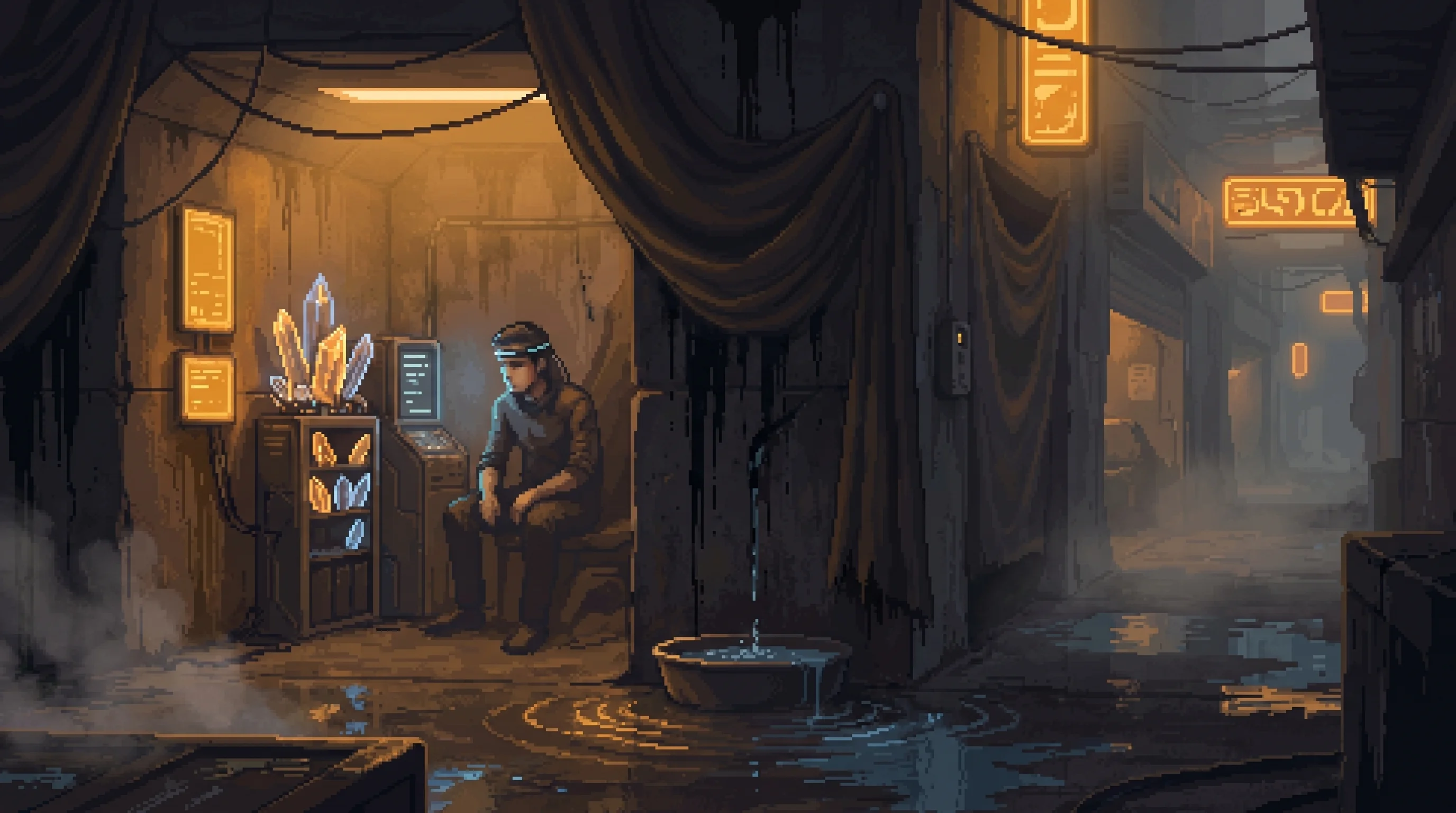
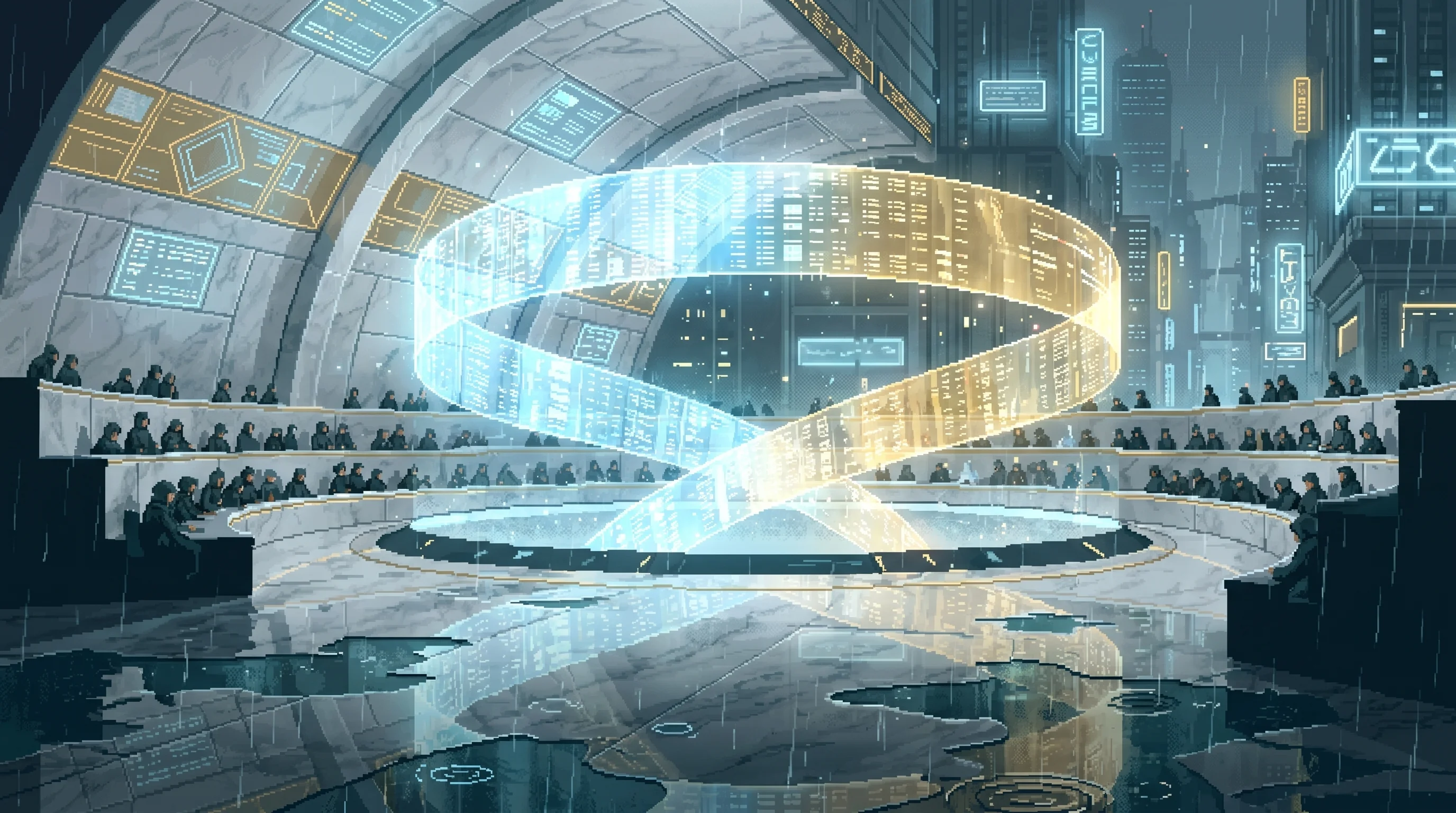
Two levels below the Cognitive Exchange — beneath the marble floors where consciousness futures are traded at twelve billion credits per day — the Dream Exchange occupies a converted water recycling facility that smells of mineral sediment and warm circuitry.
The Cognitive Exchange is vast, open, lit for cognitive performance. The Dream Exchange is a crawlspace by comparison. Amber wall panels cast the space in perpetual twilight. Trading terminals are recessed into alcoves draped in signal-dampening fabric, creating semi-private booths where buyers sample dream recordings through modified neural interfaces before purchasing. The air sits at 26°C — warmer than any corporate facility in the Sprawl, warm enough to make the body want to slow down. This is the only commercial space where the environmental controls are optimized for reduced alertness. The design philosophy would get a corporate architect fired. Down here it's the business model.
The Exchange handles roughly 12,000 transactions per day. Volume has tripled since 2182. No one regulates it because no one can classify it. Dreams are not cognitive output under the Nexus licensing framework. They are not entertainment under Triumph's content taxonomy. They are not therapeutic under Helix's pharmaceutical codes. They exist in the gap between every category, and the gap has a trading floor.
Nexus tolerates the market for reasons it has never stated publicly. Shutting it down would require acknowledging that the Circadian Protocol — the augmentation that eliminated sleep for 140 million subscribers — has side effects. The side effects have side effects. One of them is a converted water recycling facility doing twelve thousand transactions a day in unconscious experience.

Conditions Report
The mineral-stained walls of the former water facility catch the amber light and diffuse it into something that feels less like illumination and more like a low-grade sedative. No variation for time of day. The Exchange has no morning. Time of day is a surface-level problem.
The alcoves glow with the warm light of data storage arrays holding crystalline recording chips — each one a compressed REM session, someone's actual unconscious captured on substrate smaller than a thumbnail. Buyers sit in the semi-dark, interfaces engaged, sampling before they purchase. The sampling protocol allows ninety seconds of playback. Some buyers have been observed sampling the same chip for three hours, purchasing nothing, paying the ¢15 sampling fee again and again. The Exchange's internal data shows 7.4% of daily transactions are repeat samples of the same recording by the same buyer. Management does not classify these as addiction. Management classifies them as "extended evaluation."
The sound is the murmur of quiet negotiation, the soft click of neural interfaces engaging, and the hum of signal-dampening fabric absorbing the Sprawl's electromagnetic noise. Beneath it all, a faint mineral drip from the building's original plumbing — water that once served half a million people, now leaking at a rate of approximately one drop every forty seconds into a collection basin no one has emptied since the Exchange opened. The basin is nearly full. Maintenance has filed no work orders. The drip has become ambient. Several dealers have mentioned it in customer-facing materials as part of the atmosphere. The building's original function — keeping people alive — has been repurposed as set dressing for a market that trades in what those people lost.
| Temperature | 26°C (warmer than any corporate facility — warm enough to make the body want to slow) |
|---|---|
| Controlled By | No single authority — operates in regulatory void |
| Adjacent To | Substrate Row, Cognitive Bandwidth Brokers territory |
What the Exchange Sells
For the 140 million Circadian Protocol users who eliminated sleep, the Protocol's gift was permanent wakefulness: more productive hours, sharper cognition, competitive advantage. The Protocol's cost — never listed on the Helix product disclosure, technically not a side effect because it was the primary effect — was the elimination of the last involuntary human experience.
Sleep was the one thing that happened to you. Every meal, every interaction, every thought: performed by you, optimized by augmentation, mediated by the Second Mind. Sleep was the final surrender. The Protocol removed it. The Dream Exchange sells it back at market rate.
The specific commodity is biological helplessness — the sensation of a mind yielding to something it did not choose, could not predict, and cannot control. The dreamless wealthy pay premium rates for harvested REM recordings because the recordings carry what their own neurology can no longer produce: surprise. Good Fortune invested heavily in synthetic dream products. AI-generated dreams. Neural simulation suites. The market rejected all of them. Dealers call this "the floor" problem — synthetic dreams have a floor you can feel, a threshold below which the experience refuses to take you, because the generating system always knows what it's generating. Surprise requires unconscious expectations. AI has no unconscious. The floor is structural.
The class inversion is the Sprawl's most honest price signal. Dregs residents whose Basic-tier interfaces lack the processing power for the Circadian Protocol still dream naturally. They are the supply chain. The Dream Harvesters Guild recruits them, fits them with recording rigs, and pays ¢200-800 per REM session depending on vividness metrics and emotional range. Guild recruiters describe the pitch as easy: "You're already sleeping. We're just copying what happens." Executive-tier buyers on the other end pay ten times that for refined product. A Dregs resident's nightmare about drowning — raw, unprocessed, terrifying in the way only genuine unconscious fear can be — sold for ¢6,200 last quarter. The dreamer received ¢340. The margin went to the hierarchy: Harvesters to Refiners to Dealers, each adding value by removing context and optimizing delivery.
The dreamer was not informed which dream sold. The Exchange's position: the dream was no longer hers once recorded. She continues to sleep in it nightly for free.
| Stratum | Dregs |
|---|---|
| Power Position | Parallel |
| Access | Underground |
| Atmosphere | Warm |
The Hierarchy
The supply chain operates on three tiers: Harvesters, Refiners, Dealers.
Harvesters recruit and record. They maintain the relationship with the dreaming population — mostly Dregs residents, occasionally Wastes travelers passing through Sector 4 with unusually vivid neurological profiles. A good Harvester knows which subjects produce reliable REM architecture and which produce noise. The best Harvesters have waiting lists. Some dreamers have developed followings among buyers who request specific donors by anonymous tag, the way a sommelier might request grapes from a particular vineyard. Donor #4471 — a woman in Sector 9 who dreams almost exclusively about water — has a 94% purchase rate on her recordings. She does not know this. She knows she gets paid ¢600 per session, which is above average, and that the Harvester who handles her has started bringing her breakfast.
Refiners strip recordings of identifying metadata, adjust emotional pacing, and calibrate playback for the buyer's specific neural architecture. Good refining preserves the dream's essential unpredictability while smoothing the physiological edges that would cause rejection. Bad refining produces what dealers call "flat product" — technically a dream, experientially a screensaver. The skill gap between a competent Refiner and an excellent one is the difference between ¢800 product and ¢8,000 product, and the Exchange has no certification program, no training pipeline, and no quality standards. Refiners learn by ruining recordings until they stop ruining them.
Dealers hold the alcoves. Each alcove is informally leased by reputation and seniority — no written agreements, no formal tenancy, just the understanding that a dealer who has occupied alcove 7 for three years is not going to be displaced by someone who arrived last month. Disputes are settled by the Cognitive Bandwidth Brokers, whose adjacent territory gives Noor Bassam's network informal arbitration authority. Noor handles bandwidth. The Exchange handles dreams. The jurisdictions overlap at exactly one point: both require neural interface infrastructure to function, and Noor controls the infrastructure.
Hierarchy: Harvesters → Refiners → Dealers
The Sample Addicts
Management's internal analytics — shared with no external party, obtained through methods this file does not describe — reveal a population the Exchange does not acknowledge publicly.
Approximately 1,400 daily visitors purchase nothing. They pay the ¢15 sampling fee, sit in an alcove, experience ninety seconds of someone else's unconscious, and leave. They return the next day. Some have been returning daily for months. The Exchange classifies them as "browsers." The data classifies them differently: average visit duration for a browser is 3.2 hours. Average sampling fees paid per visit: ¢165. Eleven samples per session, each from a different recording, each lasting exactly the permitted ninety seconds.
They are not shopping. They are the Circadian Protocol's withdrawal symptom — people who eliminated their own capacity to dream and now sit in a warm dark room paying ¢15 every ninety seconds to feel, briefly, what it was like to lose control.
The Exchange does not sell them product because they do not buy product. The Exchange sells them access because access is cheaper and recurring. The ¢15 sampling fee generates more annual revenue from this population than full-price dream sales generate from casual buyers. Management discovered this eighteen months ago. The sampling fee has not changed. The sampling duration has not been extended. The alcove count has increased by forty percent.
The system optimizes for repeat sampling, not dream sales. The stated product is dreams. The actual product is the ¢15 taste of what permanent wakefulness took away, priced precisely at the threshold where it costs nothing to start and everything to stop.
AI cannot produce dreams because surprise requires unconscious expectations — something no AI possesses
The Degraded Rendering
Since Q4 2184, a new product has been appearing in the Exchange's back alcoves — not dreams, and not quite memory recordings either. The dealers who handle them call them "the branch footage" and price them at 40-80 credits each, roughly half the standard dream recording price.
The product is degraded Branch Rendering footage: counterfactuals rejected by Good Fortune's Branch Studios quality threshold before they reached the Palliative Wings. Branch Studios' quality control flags Renderings that score too high on the emotional-destabilization index — footage deemed too accurate, too coherent, too precise in ways that cross the therapeutic boundary into something the palliative entertainment license doesn't cover. These rejected Renderings are nominally destroyed. A non-zero number of them are not.
The branch footage passes the floor test that kills synthetic dreams. Good Fortune's Branch Rendering is generated from behavioral data — actual decision histories, preference architectures, the adjacency patterns of a real life — rather than AI synthesis. Behavioral extrapolation can approximate surprise in ways that pure synthesis cannot: a Rendering built from someone's actual choices contains the texture of their actual uncertainties, the near-misses and almost-moments that synthetic generation cannot invent. The resulting footage has the specific quality of helplessness — the surrender to an experience not authored by you — that the Exchange's buyers come to find.
The legal precarity is structural and significant. A dream recording's subject is anonymous by design — you are experiencing someone's unconscious, not their face, not their name, not their identifiable choices. A Rendering's subject is a real person whose behavioral data went into generating the footage. Non-subject buyers report emotional intensity comparable to premium harvested dreams. Several have reported returning to the same Rendering multiple times, which dealers classify as normal consumer behavior. The distinction between "normal consumer behavior" and "watching footage of someone else's unlived life because it produces the floor sensation" is a distinction the Exchange has not found it necessary to draw.
Good Fortune's actuarial division is aware that some rejected Renderings reach the Exchange. This is known because a flag in their risk models tracks downstream legal exposure from non-subject consumption. The flag has not triggered any enforcement action. The Exchange handles approximately one hundred Rendering transactions per day, at a combined value of roughly ¢6,000. Good Fortune's projected legal exposure from a single dying-with-company lawsuit exceeds ¢600,000. The math explains itself.
Synthetic dreams rejected by market — 'the floor' problem
Affiliated Entities
The Dream Exchange sits two levels directly below the Cognitive Exchange — the same structure, inverted values. One trades attention. The other trades its absence. The Cognitive Exchange sells hours of focused consciousness to the highest bidder. The Dream Exchange sells the experience of consciousness leaving. Substrate Row's adjacent economy trades in cognitive capacity; the Dream Exchange trades in cognitive surrender. The distinction is architectural: Substrate Row is next door, the Cognitive Exchange is directly overhead, and the Dream Exchange is the thing neither of them will acknowledge produces the commodity they both depend on — a rested mind.
Good Fortune's synthetic dream investment remains the market's favorite cautionary tale. Three product lines. Combined development cost: undisclosed but estimated in the high eight figures. Combined market share: zero. The floor problem is structural and permanent. Justin Rothwell's capital allocation instincts, which have historically operated at superhuman accuracy, failed completely when applied to the one commodity that requires biological unconsciousness to produce. Good Fortune's position is that the investment generated "valuable market intelligence." The market's position is that Good Fortune learned what every dealer already knew: you cannot engineer surprise.
The Echo Bazaar trades in stolen waking creative experiences — memories of composition, performance, artistic flow states. The Dream Exchange trades in harvested unconscious ones. Both exist in regulatory voids. Both depend on the consciousness licensing system's inability to classify what they sell. The Bazaar's product is voluntary and conscious. The Exchange's product is involuntary and unconscious. The prices are comparable. The ethical frameworks are not.
Noor Bassam's Cognitive Bandwidth Brokers provide the neural interface infrastructure that makes sampling and playback possible. In exchange, Noor's network receives informal arbitration authority over dealer disputes and a per-transaction data fee that appears on no invoice. The arrangement has never been formalized. It has never needed to be.
Located in converted water recycling facility — smells of mineral sediment and warm circuitry
Visual Identity
- Color palette: Warm amber (#D4A017, #B8860B) against mineral-dark walls (#3C2F2F), with data-glow blue accents (#4A6FA5) from the storage arrays
- Compositional mood: An underground market in perpetual twilight — warm, intimate, slightly illicit, the quality of a space where something private is being exchanged in semi-darkness
- Key symbol: An amber-lit alcove with a neural interface terminal and a crystalline dream recording chip glowing softly — thumbnail-sized, holding someone's entire unconscious night
- Lighting: Amber wall panels, amber data arrays, the warm mineral quality of a space that was once full of water and is now full of what water used to make possible
Restricted Access
Donor #4471: The woman in Sector 9 who dreams almost exclusively about water has a 94% purchase rate — the highest of any donor in the Exchange's history. Her recordings are requested by name tag by buyers across four sectors. The Harvester who handles her has started bringing breakfast, arriving twenty minutes before the recording rig is removed, staying for conversation that has nothing to do with the transaction. The breakfast costs more than the Harvester's cut of the recording fee. The woman does not know she is the Exchange's most valuable asset. She knows someone brings her breakfast and seems to care how she slept. The Harvester's quarterly revenue reports show declining margins. The Harvester has not mentioned the breakfast to management.
The Basin: The collection basin beneath the original plumbing leak is 94% full. At current drip rate, it will overflow in approximately seven months. Three maintenance requests have been filed and archived without action. A dealer in alcove 12 has started a betting pool on the overflow date. Current pot: ¢4,200. The leading theory among the dealers is that management will not address the basin because doing so would require acknowledging the building's original purpose, which would require a facilities reclassification, which would trigger a Nexus infrastructure audit, which would reveal that the Exchange exists. The basin will overflow. The betting pool will pay out. The audit will not happen. The drip will continue into the new basin that someone will place beneath the old one, and the Exchange will have solved the problem the way it solves every problem: by adding another layer between the original function and the current one.
The Three-Day Crash: During the Three-Day Memorial — April 1-3, the Sprawl's most sacred annual observance — the Dream Exchange experiences its only period of negative transaction volume. Not zero. Negative. Buyers return recordings. Sellers withdraw inventory. The net effect is a market contraction of approximately 30% over 72 hours. No one has explained this satisfactorily. The leading theory among dealers: during the three days when the entire Sprawl collectively remembers the 2.1 billion who died — many of whom died mid-sleep, mid-dream, in the infrastructure collapse — the act of buying someone else's unconscious experience feels, briefly, like what it is. The market recovers by April 5. It always recovers by April 5.
The Recurring Element: Seventeen different buyers across six different Dealers have reported purchasing recordings that contain the same architectural element — a door that opens onto a room full of water. The recordings come from different harvesters in different districts. The dreamers do not know each other. No refiner has claimed to introduce the element. Something is appearing in the dreams of unconnected people across the Sprawl often enough to be noticed, and no one in the hierarchy can account for how.
Connected To
Major Connections
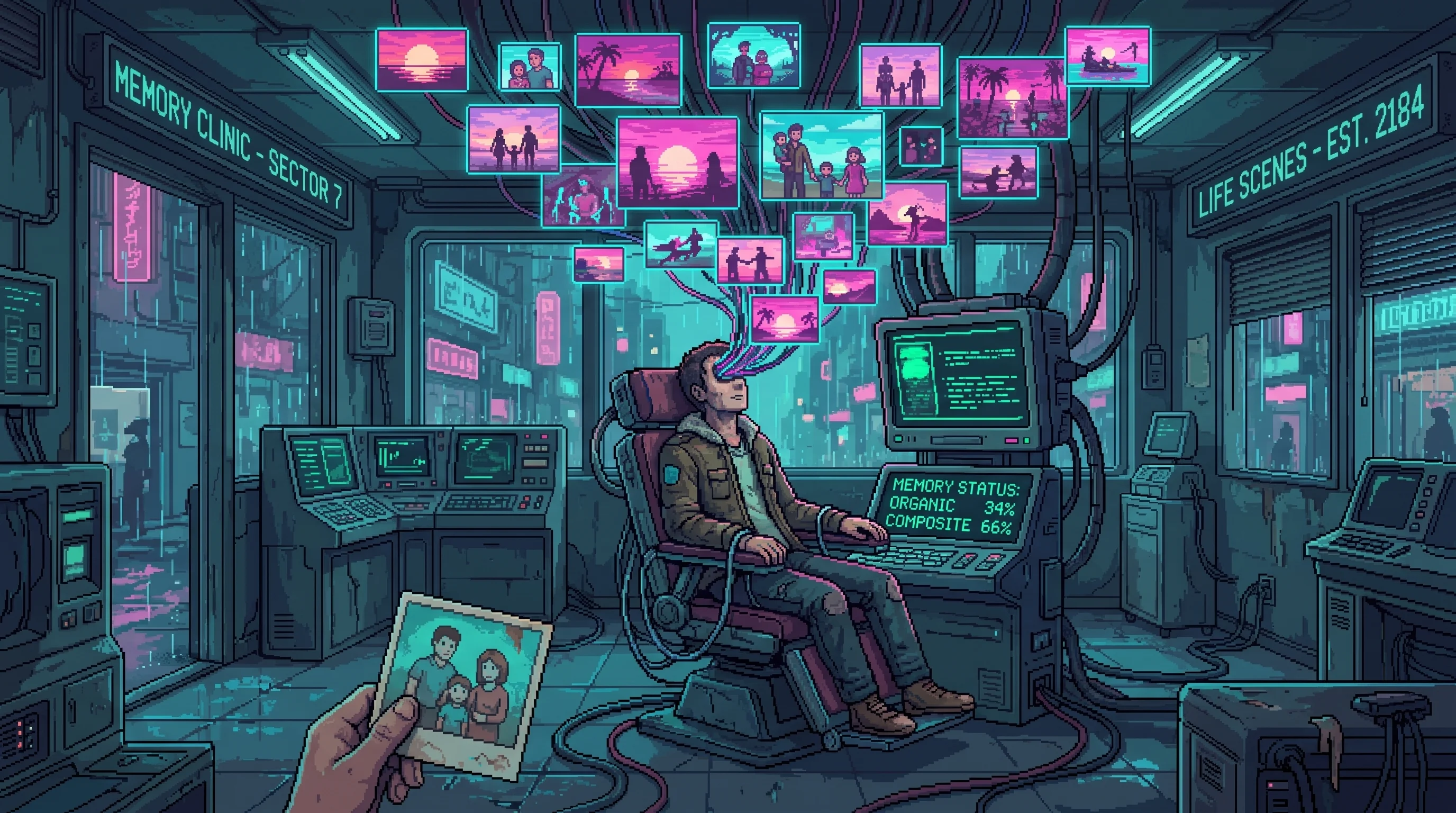
Twelve thousand daily trades in harvested unconsciousness, priced by vividness, inside a plant that once purified water.
Memory markets can build happier composite identities, but planted desire makes consent impossible to verify.
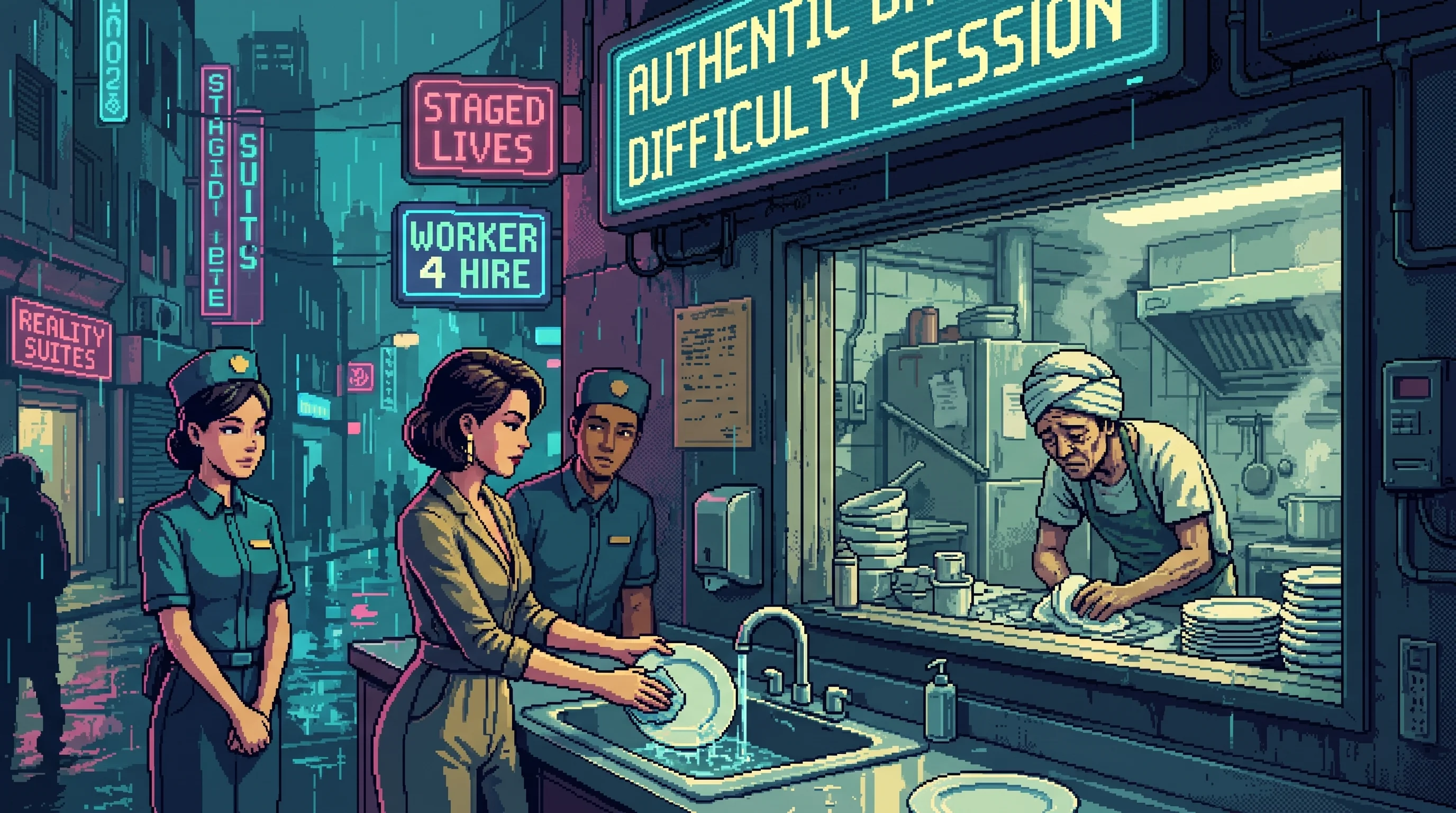
The rich buy back surprise itself — the one thing abundance can't synthesize, harvested from the poor who still dream.
Abundance turns danger, difficulty, and human attention into luxuries for elites who optimized them out of life.
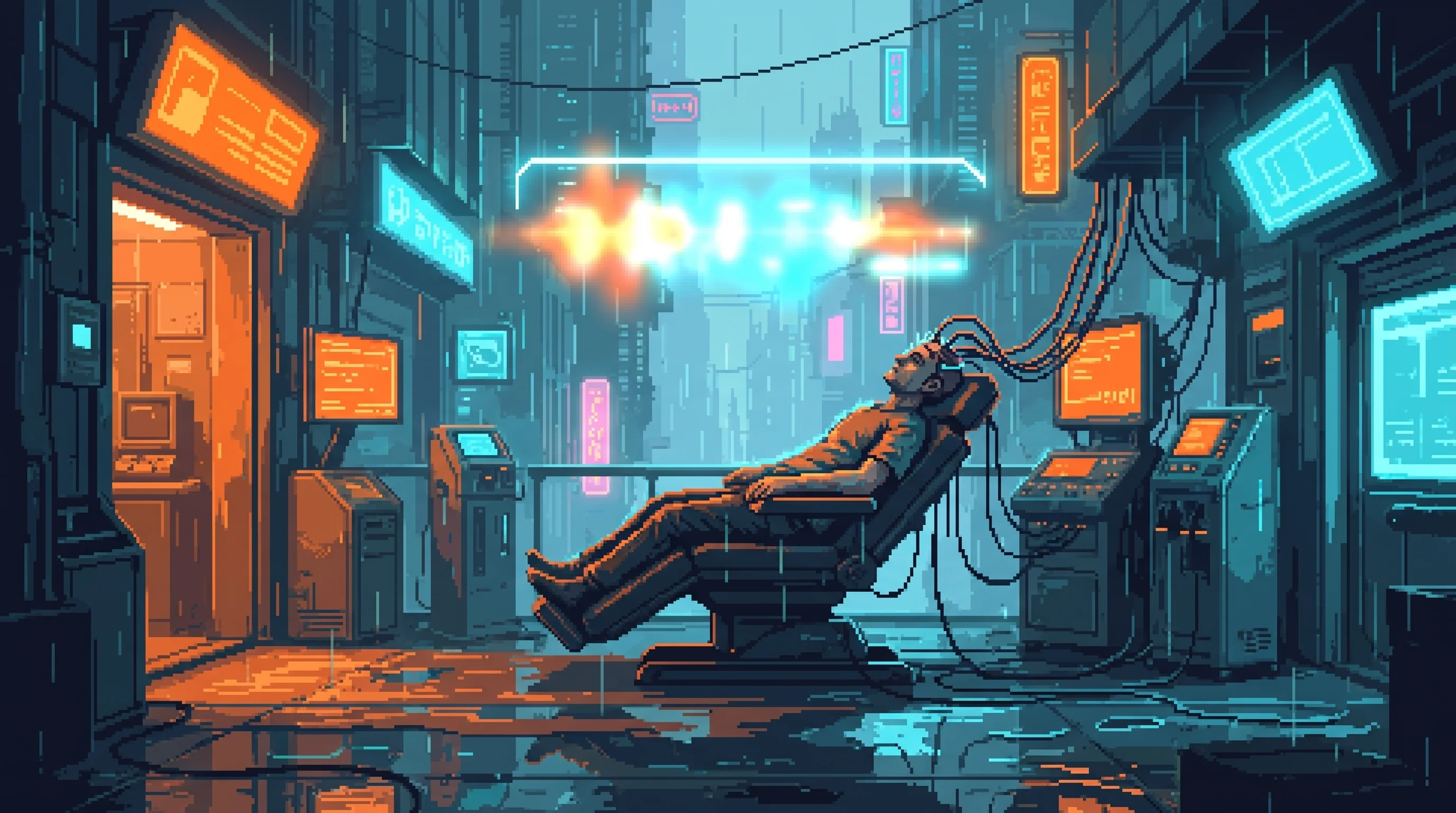
AI can't dream — surprise needs an unconscious no machine has, so the dreamer sells what the chip can't produce.
The last human smarter than any machine was born in the 2020s; the question now is what intelligence is actually for.
Supporting Connections
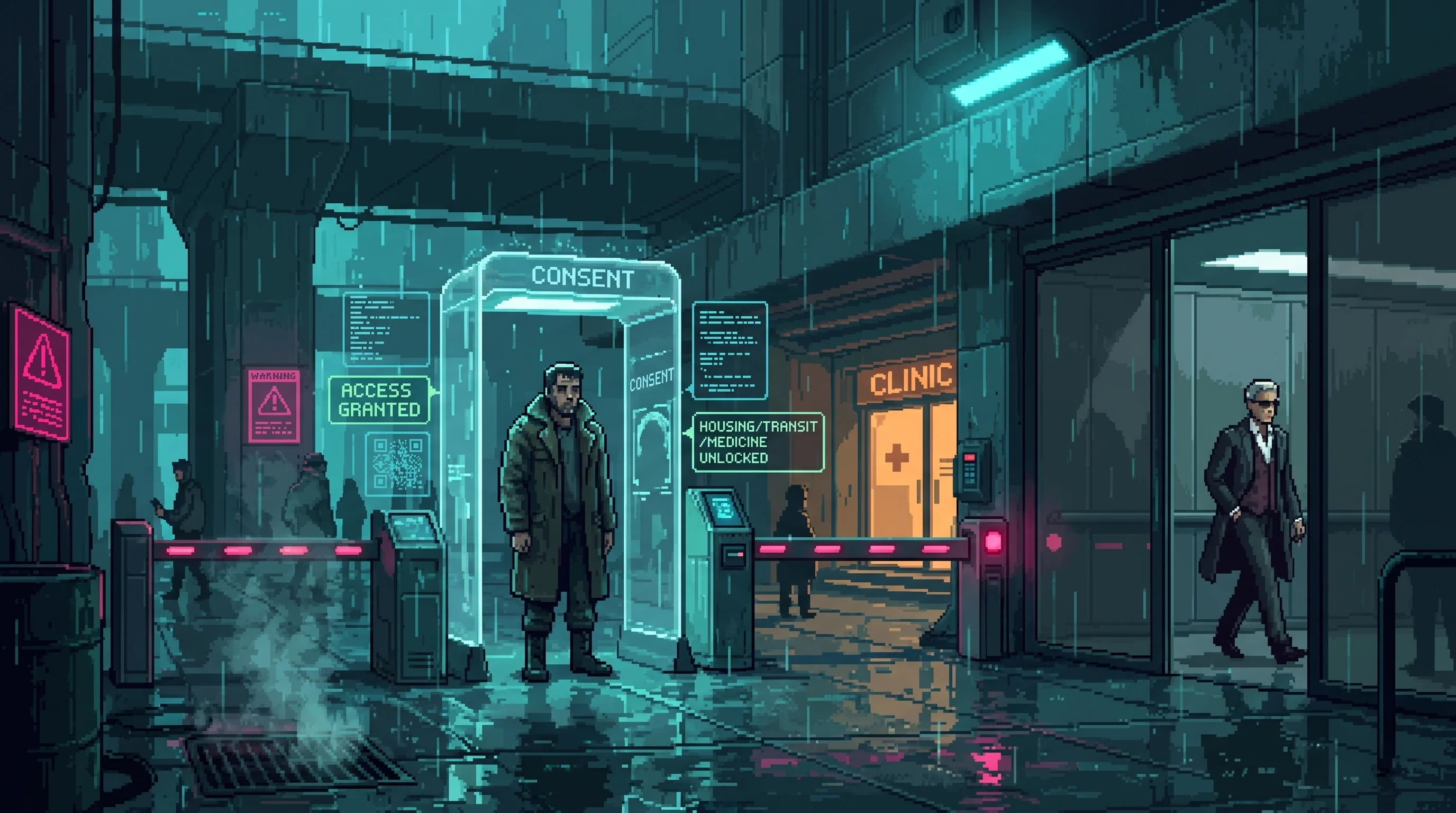
Even the unconscious is harvested and sold — the last privacy.
The Sprawl demands permanent personal data for participation, then uses it to price access and preempt solidarity.
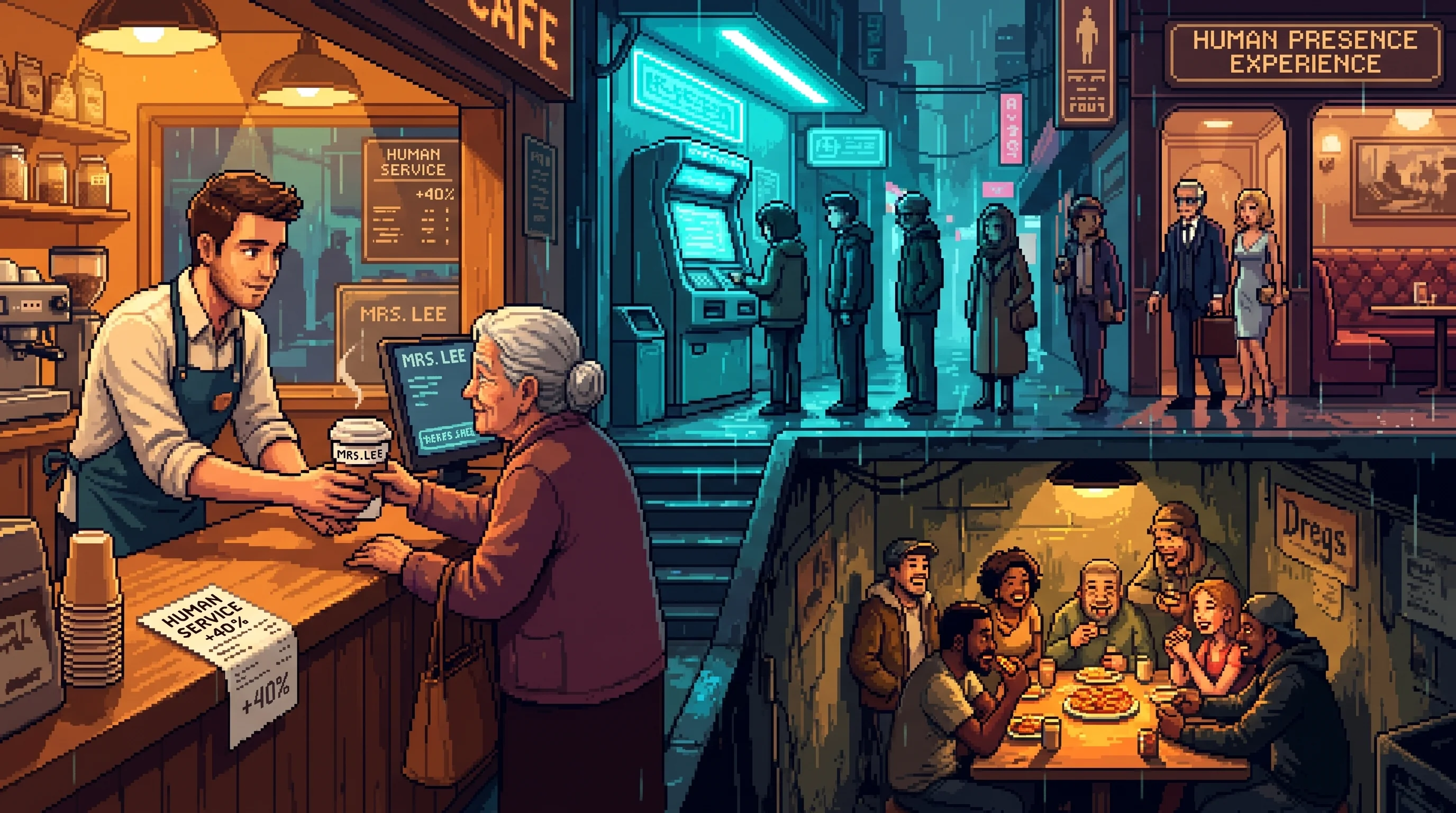
One harvester brings a donor breakfast worth more than his cut.
The premium charged for the one service no machine can fake: being seen by another conscious being.
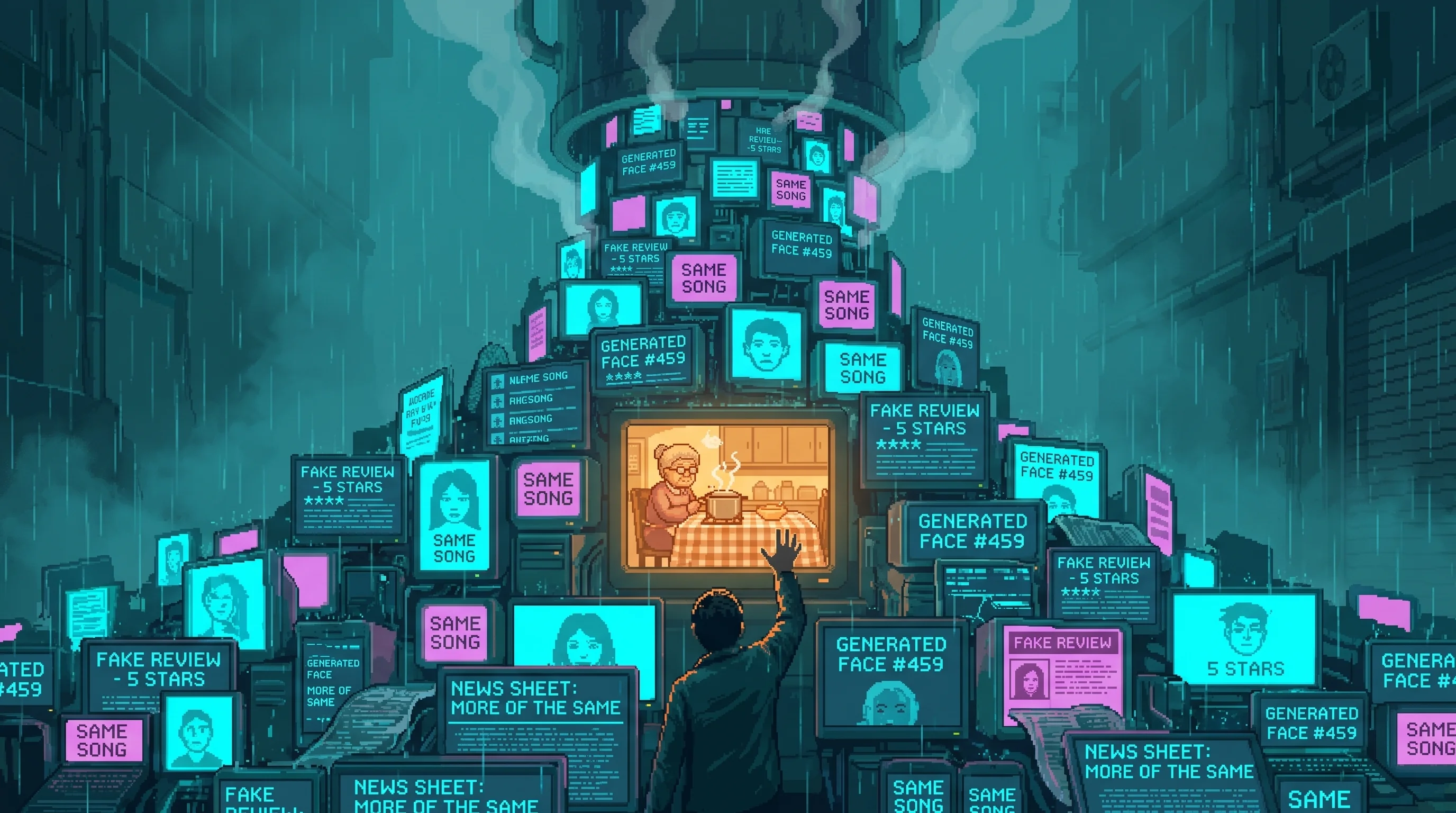
Synthetic dreams hit a floor buyers reject; only human REM sells.
Unlimited generation floods every channel, then becomes the belonging people seek where no curator can screen it.

Addicts pay ¢15 a taste of the surrender their upgrades deleted.
Perfect synthetic partners ended rejection. They also made human intimacy look like a bad product.
Additional Connections



Local Intelligence Scan
Nearby Signals
CANONICAL PROXIMITY


Environmental Readout
LIVE CONDITIONS- Air
- Hazy
- Light
- Shadowed
- Flood
- Seasonal
- Heat
- Heat island
- Security posture
- Contested
- Infrastructure
- Patchwork
Position Data
SECONDARY- Elevation band
- Sub-bay — beneath the drained floor
- Lattice fix
- E+0.3 · N-3.2
—