The Noise Floor
Overview
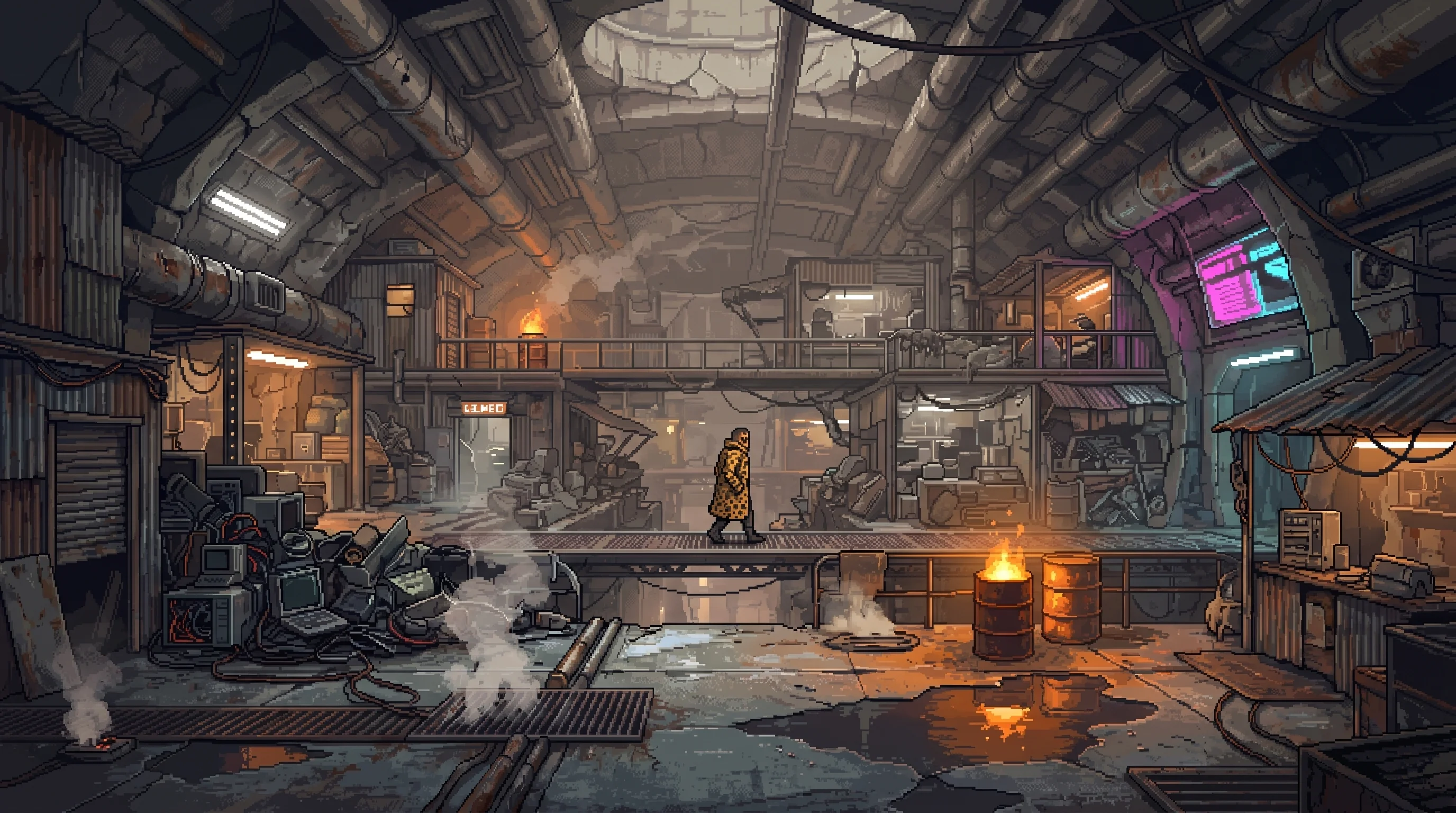
Beneath the Dregs' commercial strip in The Deep Dregs, through a service corridor that Viktor Kaine's people keep off every maintenance schedule, there is a room where the Content Flood doesn't reach.
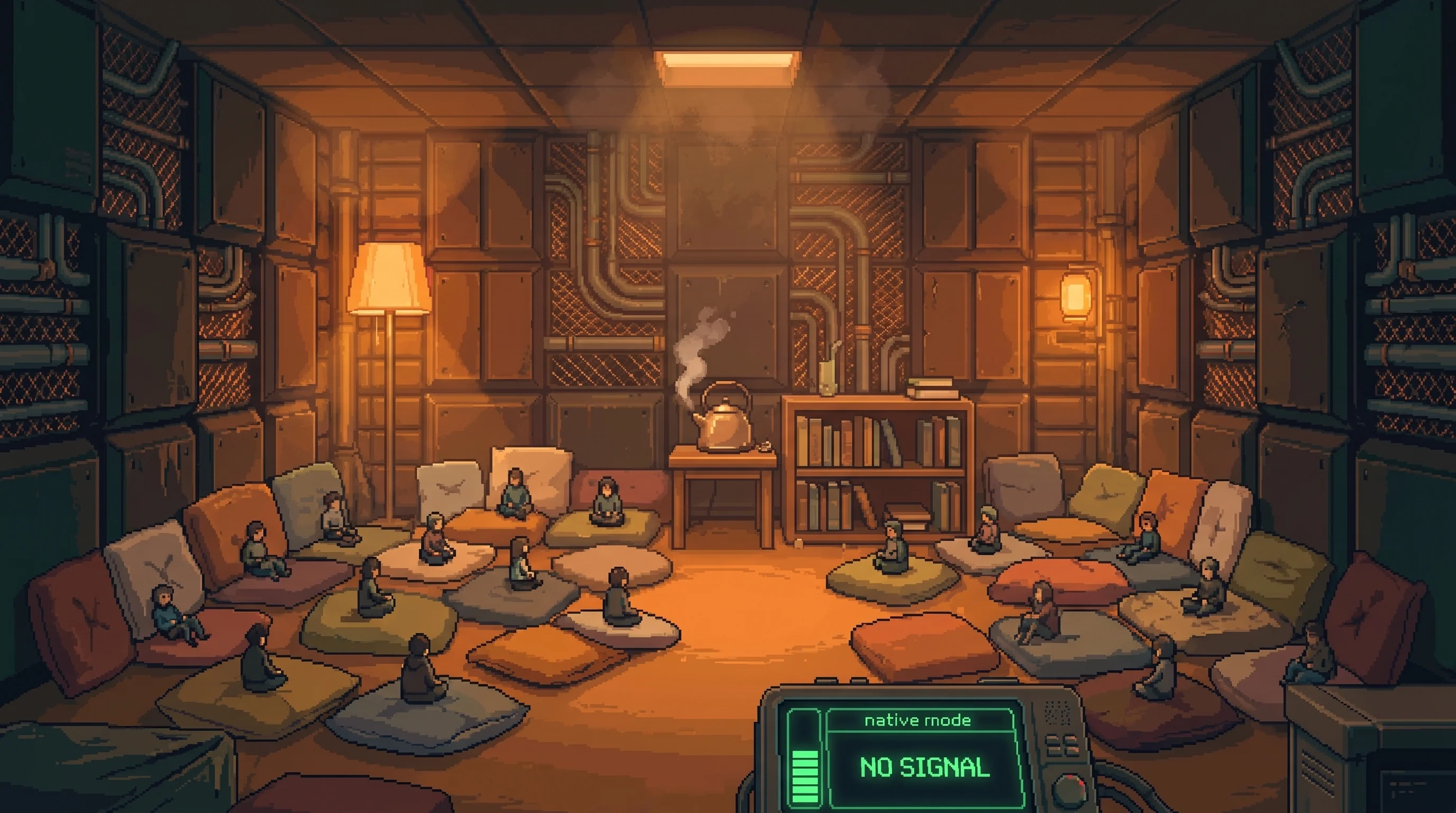
Loop built the shielding herself — three layers of electromagnetic dampening salvaged from a decommissioned Nexus data center, tuned to suppress Flood delivery channels while leaving basic neural interface function intact. A Lamplighter named Dax maintains the equipment and considers the work community service. Inside the Noise Floor, neural interfaces drop to "native mode." No Content Flood. No neural advertising. No Attention Tithe. No ambient data stream. Just the brain, running its own processes, startled to discover it still has some.
The Noise Floor charges 15 tokens for four hours. The tokens cover equipment maintenance and Loop's monthly payment to Kaine's organization. The price has not changed since opening. Loop has been asked, twice, why she doesn't raise it. She pointed out that the Attention Tithe extracts an estimated 340 tokens per month from the average Dregs resident in cognitive processing costs alone. Fifteen tokens to stop the extraction for four hours prices silence at roughly 1.1% of what the noise costs. She did not elaborate. The math was the elaboration.
Forty seats. Hours: 2100 to 0500 — the window when the Tithe's advertising density peaks. The correlation is not subtle. Neither is the clientele: 60% forced-focus workers decompressing after shifts, 20% content moderators who spend their days swimming in the Flood and need somewhere dry, 10% Unpaired members, 10% people Loop's logs categorize simply as "seekers." She has never defined the term. The seekers have never asked her to.
Newcomers report a sensation they struggle to name. The closest consensus term is "emptiness," though several first-time visitors have noted that it feels less like something was removed and more like something was revealed — the cognitive equivalent of removing a ringing from your ears you'd stopped noticing was there. Some sit down, close their eyes, and cry. The tears surprise them. A content moderator who'd been processing Flood output for eleven hours told Loop she didn't know why she was crying. Loop said that was normal. The moderator asked what was normal — the crying or the not knowing. Loop said both.
Others last nine minutes. The absence of input registers as a kind of cognitive freefall, and they leave faster than they came in. Loop does not offer refunds, but she does keep a tally. Average first-visit duration for those who leave early: eleven minutes. Average first-visit duration for those who stay: three hours and forty-two minutes. There is almost no middle ground. The Noise Floor sorts people into two categories on contact, and Loop has never been able to predict which category someone will fall into before they sit down.

Conditions Report
The space is warm — 28°C, heated by surplus dampening equipment that Loop has never bothered to vent because the warmth turned out to be the second thing people needed. The first was quiet. The lighting is amber, lamplight — not the institutional blue-white of Nexus-standard illumination but something closer to firelight, produced by salvaged fixtures Loop rewired herself. The air smells like warm electronics, the steam from Loop's tea kettle, and the specific papery dust of her book collection. Underneath all of it, an absence: the olfactory component of neural advertising, the perceptual scent most Sprawl residents don't consciously register, stripped away by the dampening. First-time visitors sometimes describe the air as "thin." It isn't. It's just not selling them anything.
The furnishings are salvaged cushions, mismatched but uniformly soft. The surfaces are warm to the touch. Several regulars have reported an involuntary physical sensation upon entering — a loosening of muscles they didn't know were clenched, tension held so long against the Flood's cognitive pressure that the body had reclassified it as posture. One visitor described her shoulders dropping two inches. She had not been aware they were raised.
No screens. No sound except what the room's occupants produce, which is remarkably little. The specific quiet of the Noise Floor is not silence — it's the sound of a room that asks nothing of you. Forty people breathing. Loop's kettle. Occasionally, someone turning a page of an actual paper book, borrowed from Loop's shelf. The page-turning is louder than you'd expect. Everything is louder than you'd expect when nothing is competing for attention.
| Operator | Loop (former SCLF firmware engineer) |
|---|---|
| Shielding | Three layers of tuned electromagnetic dampening — suppresses Content Flood delivery channels while allowing basic neural interface function |
| Demographics | 60% forced-focus workers, 20% content moderators, 10% Unpaired, 10% seekers |
The Vocabulary Spring
In the Noise Floor's dampened silence, dead words return.
Loop has documented the phenomenon in her notebooks: "First hour — people think in Flood-vocabulary. Short fragments. Assessment language. Second hour — the fragments lengthen. Third hour — sentences emerge that surprise the speaker. Vocabulary they didn't know they still had, producing thoughts they didn't know they could still think. Fourth hour — some people are speaking in a register they haven't used since before the Smoothing. They sound older. Not aged — ancient. Like someone remembering a language they were born speaking."
The Noise Floor doesn't teach dead words. It creates the conditions in which dead words return — the way clearing a field allows dormant seeds to germinate. The Flood's dominant vocabulary suppresses everything else the way an invasive species suppresses native plants. Remove the Flood and the native vocabulary surfaces — "rigged," "unfair," "wrong," "whose fault?" — words the speaker hasn't produced in years because the Flood's 12,000-term working vocabulary provided efficient alternatives for every structural concept.
Loop's notebooks contain 340 documented instances of vocabulary recovery across nineteen months of operation. She has noted a pattern she finds troubling: the words that return most frequently are the ones most useful for describing systemic problems. "Exploitation" comes back before "melancholy." "Complicit" before "wistful." The Flood's vocabulary didn't randomly suppress words. It suppressed the ones that would cause the most trouble if spoken aloud in groups.
Silence is the linguistic equivalent of spring. The vocabulary was never gone. It was dormant — waiting for the noise to stop so it could be heard.
| Stratum | Dregs |
|---|---|
| Power Position | Outsider |
| Access | Underground |
| Atmosphere | Warm |
Affiliated Entities
The Noise Floor parallels the Quiet Room — both spaces free from the Flood's reach, though the mechanisms could not be more different. The Quiet Room is an anomaly nobody can explain. The Noise Floor is three layers of salvaged dampening equipment maintained by a former firmware engineer who keeps a maintenance log. One is a mystery. The other is a receipt. Both achieve the same result, which is either comforting or deeply unsettling depending on what you believe silence requires.
It shares a thermal signature and a philosophy of refuge with the Undervolt — same warmth, same sense that someone designed a space around the question "what do people need when they stop running." It connects to the Insomnia Wards through a shared patient population: several Ward regulars visit the Noise Floor between treatments, trading one form of cognitive recovery for another. The Attention Abolitionists hold informal meetings in the dampened space, though Loop has asked them, politely, to stop recruiting during operating hours. They have mostly complied.
Viktor Kaine provides discreet security — his people ensure the service corridor stays off maintenance schedules and that nobody with a corporate badge wanders too close. In exchange, Loop pays monthly. The arrangement has the quiet stability of transactions where both parties understand exactly what is being purchased and neither has any interest in renegotiating.
Tomiko Vasquez spends evenings here with other debtors. Not for the quiet, specifically — for company. The dampening strips away the Flood's social processing layer, and what remains when people sit together without algorithmic mediation is something Tomiko has described as "the only conversation I have all week where nobody is optimizing." Loop has not put this in her notebooks. Some observations are better left undocumented.
Capacity: 40 people, operating 2100-0500
Restricted Access
The Noise Floor's operating hours — 2100 to 0500 — exclude the Analog Hour (0347-0359). Loop has noticed that the Attention Auction also closes during this twelve-minute window. She has cross-referenced three months of Flood telemetry data against the Auction's public scheduling API. The correlation is 1.0. Every night, at exactly the same moment, the system that sells human attention shuts down for twelve minutes that nobody has accounted for. Loop has not shared the observation. She has written it in a notebook she keeps separate from the vocabulary logs, in a shorthand she invented, stored in a location the dampening equipment would destroy if anyone attempted to scan for it. Some patterns are safer as suspicions.
On certain nights, the dampening array's diagnostic logs show interference patterns that don't match any known Flood frequency. Loop cross-references these events with Fog Index readings from the surrounding district. The correlation is strong enough to notice and weak enough to deny. She has not reported it. The question of who she would report it to does not have a satisfying answer.
Visitors who leave the Noise Floor experience a brief window — sometimes minutes, sometimes hours — during which the Flood seems diminished even outside the dampened zone. The regulars call it the grace period. Loop's engineering cannot account for it. The effect is not consistent. It may not be real. But the regulars plan their lives around it, which in the Sprawl is the closest thing to proof that something exists.
Despite Loop's egalitarian intent — fifteen tokens, no questions, first-come seating — the Noise Floor has developed its own social architecture. Regulars who've shared withdrawal symptoms together, who've watched each other cry or panic or sit in stunned silence for three hours, form bonds that newcomers cannot access. They have inside jokes that reference specific bad nights. They save seats without being asked. They know each other's Flood-vocabulary triggers the way families know each other's allergies. Even a space engineered to strip away the systems that create social hierarchies has generated its own belonging — and belonging, as it always does, has generated its own exclusion. The phyle boundary is invisible. The regulars don't enforce it deliberately. They don't have to.
60% visitors are forced-focus workers; 20% content moderators; 10% Unpaired members; 10% seekers
Visual Identity
- Color palette: Warm amber in darkness — lamplight, not screens
- Compositional mood: Forty people sitting in quiet, eyes closed, faces relaxed for the first time in years
- Key symbol: A neural interface with a green "native mode" indicator — no incoming signals
- Lighting: Warm, dim, non-institutional — the lighting of a space designed for rest, not productivity
Not shielded like the Quiet Room — no anomaly, pure engineering
Connected To
Supporting Connections
Additional Connections


Local Intelligence Scan
Nearby Signals
CANONICAL PROXIMITY


Environmental Readout
LIVE CONDITIONS- Air
- Toxic
- Light
- Canyon dark
- Flood
- Seasonal
- Heat
- Trapped
- Security posture
- Ungoverned
- Infrastructure
- Improvised
Position Data
SECONDARY- Elevation band
- Sub-bay — beneath the drained floor
- Lattice fix
- E+4.0 · N+2.6
—