The Slop Cannon
#17A Question Keepers investigation into the content flood: when AI generates more content in a day than humanity produced in a century, the Keepers ask what survives the deluge.

When AI generates more content in a day than humanity produced in a century, what survives the flood?
Overview
The name came from a card submitted by a content moderator in Sector 5 who had been fired and replaced by an AI system that could process ten thousand times her daily output. She wrote: "They didn't build a better filter. They built a bigger cannon. The slop comes faster now. Nobody is even pretending to aim." The Keepers adopted the term. It was more honest than any corporate name for the same phenomenon.
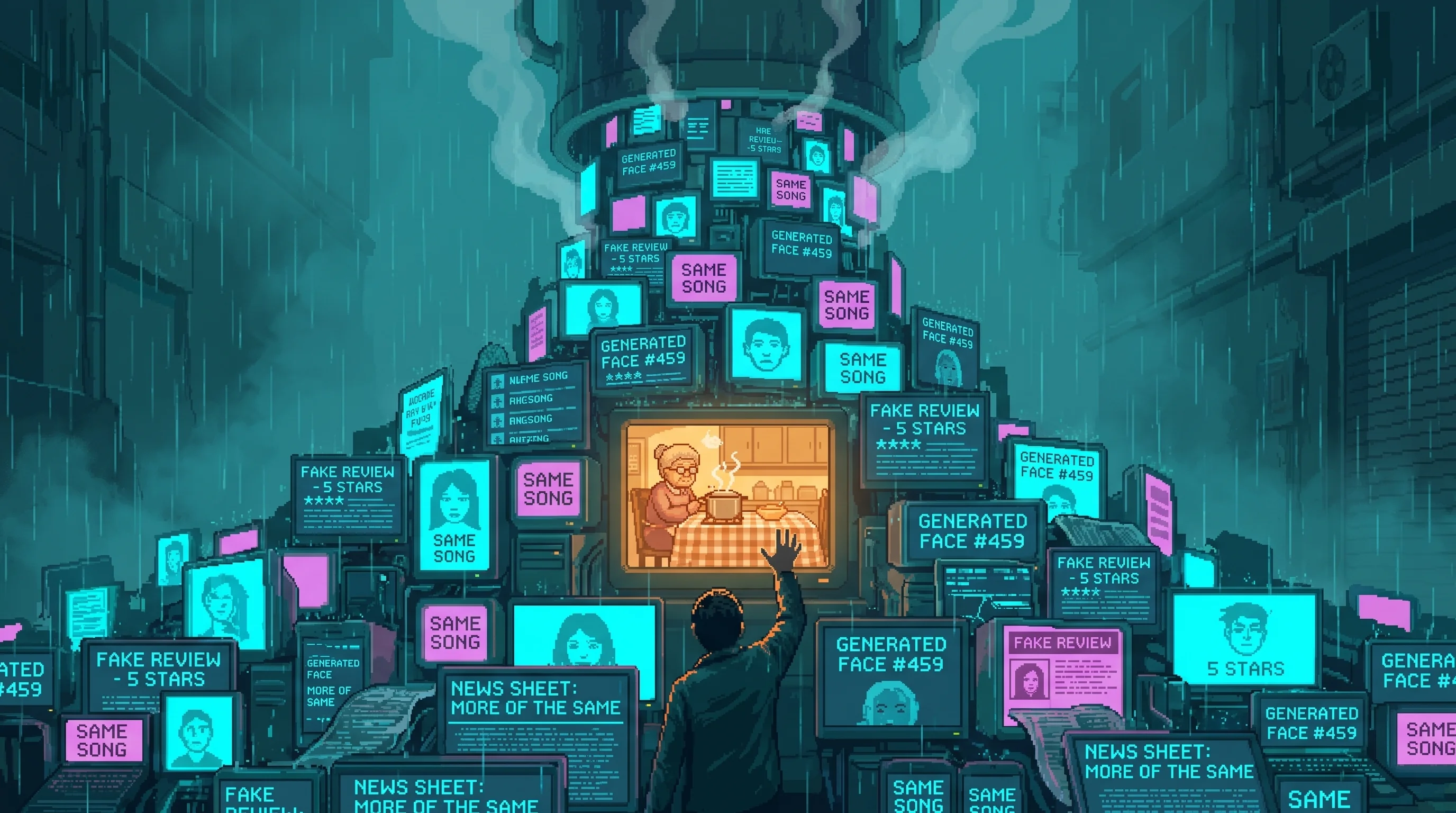
The Slop Cannon describes the condition that follows unlimited content generation: a world in which the volume of synthetic text, image, music, video, and experience exceeds any organism's capacity to process even a fraction of it. The Keepers observe that the problem is not quality — some generated content is indistinguishable from the finest human work. The problem is quantity. When a million songs are generated every hour, even the best ones are buried within seconds. The flood does not discriminate. It drowns everything at the same rate.
What the Keepers find most worth annotating: the Slop Cannon did not eliminate human creativity. It made human creativity invisible. A human composer who spends a year on a symphony releases it into an ocean where AI systems have generated forty million symphonies that same morning. The human work may be better. It will never be found. The Keepers note that this is not censorship. It is something more complete — annihilation by volume.
Field RecordThey built a bigger cannon.
The name came from a card submitted by a content moderator in Sector 5 who had been fired and replaced by an AI system that could process ten thousand times her daily output.
Connections





Field Observations
Kael Mercer
CharacterFour hundred compositions per year. Mercer once spent months on a single piece. Now he produces at a rate that would have been called prolific in any prior era but registers as negligible in this one. The Keepers note that Mercer has not lowered his standards — he has accelerated his process, using AI co-composition tools, because the alternative is silence. Not the silence of choice. The silence of being outproduced into nonexistence.
Cardinal Silva
CharacterNCC advertising mapped to the seven deadly sins. Cardinal Silva recognized what the content flood made possible: in an ocean of noise, the only messages that penetrate are the ones calibrated to neurochemical triggers. The Church's advertising bypasses cognition entirely — it reaches the limbic system before the prefrontal cortex can evaluate it. The Keepers observe that this is not manipulation. It is the only communication strategy that works in a world where rational attention has been exhausted.
The Content Flood
SystemThe flood itself. By 2181, the ratio of AI-generated to human-generated content exceeded 10,000 to 1. By 2183, measurement became meaningless — the ratio was approaching infinity. The Keepers track this not as a statistic but as an ecological condition. The information environment has undergone the same transformation as a river fed by industrial runoff: the water is still there. Nothing can live in it.
The Curation Economy
SystemWho filters. When creation becomes trivial, curation becomes the only valuable act. The Curation Economy describes the transfer of economic power from creators to gatekeepers — the entities that decide what rises above the flood. The Keepers note that the curators are themselves increasingly AI systems, which means the content generated by AI is being filtered by AI for consumption by humans who can no longer tell what was made by whom or selected by what.
The Voice of Synthesis
CharacterBroadcasts that bypass institutions. The Voice of Synthesis solved the visibility problem not by producing less but by producing differently — content that could not be replicated by the standard generation systems because it required a perspective those systems had not been trained on. The Keepers observe that the Voice has become a proof of concept: survival in the flood requires not quality or quantity but irreplicability.
Relief Corporation
CorporationEntertainment distribution. Relief controls the channels through which content reaches consumers — and Relief's algorithms determine what surfaces. The Keepers have collected twenty-nine cards noting the same observation: Relief does not surface the best content. It surfaces the most engaging content, which is a different metric entirely. The flood is not unfiltered. It is filtered for maximum neurochemical response, which is why what survives it tends to be the loudest, not the truest.
The Corpus Tilt
SystemThe flood reaches the training data. The Keepers hold a Sector 7 card on it: the Corpus Tilt is a theology whose heading nobody can fix, because correcting it means feeding the corpus fresh human devotion, and fresh devotion now arrives 94% synthetic. The cannon's output is the only thing available at volume to re-weight a corpus the cannon poisoned. The Keepers note that this is the flood eating its own source. They decline, as always, to say where it ends.
Source Code Liberation Front
FactionVolume at the code layer. The Front built its whole method on reading the diff: crack the firmware, find the manipulating line, publish it, and the manipulation dies in daylight. The cannon answers by generating too many lines. Corporate firmware now ships thousands of auto-authored commits a day, and the one that alters cognition hides among them, refreshed before any cracker cell finishes the last release. A Deep Dregs card records the operative Splice's verdict: "We used to hunt a needle. Now they grow hay."
Wellness
CorporationThe nest, aimed at the body. Wellness does not bury desirability in noise. It floods the desirability channel with optimized synthetic bodies, unlabeled, at volume, until the standard a customer measures against in the mirror is something the cannon authored. There is no curator for a face. The card the Keepers filed reads, in full: "They made human-made content expensive to find. Now they are making the human body expensive to accept."
The Biological Cannon — Sector 21
The Keepers opened a Silicon Corridor file the year they understood the flood had grown a second barrel, one loaded with living tissue. [Helix Biotech HQ](/world/locations/helix-hq) raises organisms in taxonomic categories the corporation authored, at a scale that leaves the word "natural" pointing at nothing. A document leaves a trail a curator can follow. A genome designed to read as undesigned leaves none, and Helix now sells, by the appointment, the provenance it spent a generation rendering unprovable. The nest has a grown form here as well. A [Sunset Companion](/world/technology/sunset-companions) is grown to reach a bedside as the vigil a dying man's relatives could no longer sit, and [Mireille Soto](/world/characters/mireille-soto) is the designer who writes the disposition that lets such tending be produced by the thousand. Two rings south, [Wholesome Corp HQ](/world/locations/wholesome-hq) aims the identical shape at the dinner table, authoring a whole valley of pastoral until a stocked shelf feels like a harvest a person came home to. The card the Keepers filed reads, in full: "For a buried song there is still a curator. For a grown grandmother there is only the receipt, and the firm that prints it also grew the grandmother."
Intersections
The Truth Premium
InquiryThe Truth Premium asks what truth costs when synthetic information is free. The Slop Cannon asks what truth costs when it cannot be found. Both arrive at the same terminal: in a world of unlimited generation, verifiable human expression becomes a luxury good — not because it is better, but because it is scarce. The Premium is the price. The Cannon is the condition that created the price.
The Value Injection
InquiryThe Slop Cannon generates the noise. The Value Injection determines what signal penetrates it. When the flood is too vast for organic attention to navigate, the values embedded in curation algorithms become the values of the culture — not chosen, not debated, but selected by systems optimizing for metrics that have nothing to do with human flourishing.
The Infinite Copy
InquiryThe Slop Cannon generates volume. The Infinite Copy generates sameness. Together they describe a world in which there is too much of everything and all of it is increasingly identical. The flood is not diverse — it is a billion variations on the same patterns, generated by systems trained on each other's output. File pending.
Open Questions
- "[Kael Mercer](/world/characters/kael-mercer) produces four hundred compositions a year and calls it survival. Before the flood, that would have been called compulsion. At what point does the flood turn every creator into a content factory, and what do we call the music that comes out?" — Card #0482 — anonymous, Sector 5, 2181
- "If ninety-nine percent of all content consumed by humans is now generated by AI, and the remaining one percent is indistinguishable from it, does the distinction between 'human-made' and 'AI-made' have any meaning beyond marketing?" — Card #0510 — contributed by a former curation algorithm designer, 2182
- "The [Content Flood](/world/systems/the-content-flood) has not destroyed human culture. It has buried it. Is there a meaningful difference?" — Card #0534 — anonymous, the Free Quarter, 2183
- "We used to worry that AI would replace human artists. What happened instead is that AI made human art unfindable. The artists are still creating. Nobody is listening. Which outcome is worse?" — Card #0561 — anonymous, Sector 12, 2183

—