
- Archetype
- Tide-reader / salvage-master
- Augmentation
- Unaugmented; carries a dead neural port she never had removed
- Location
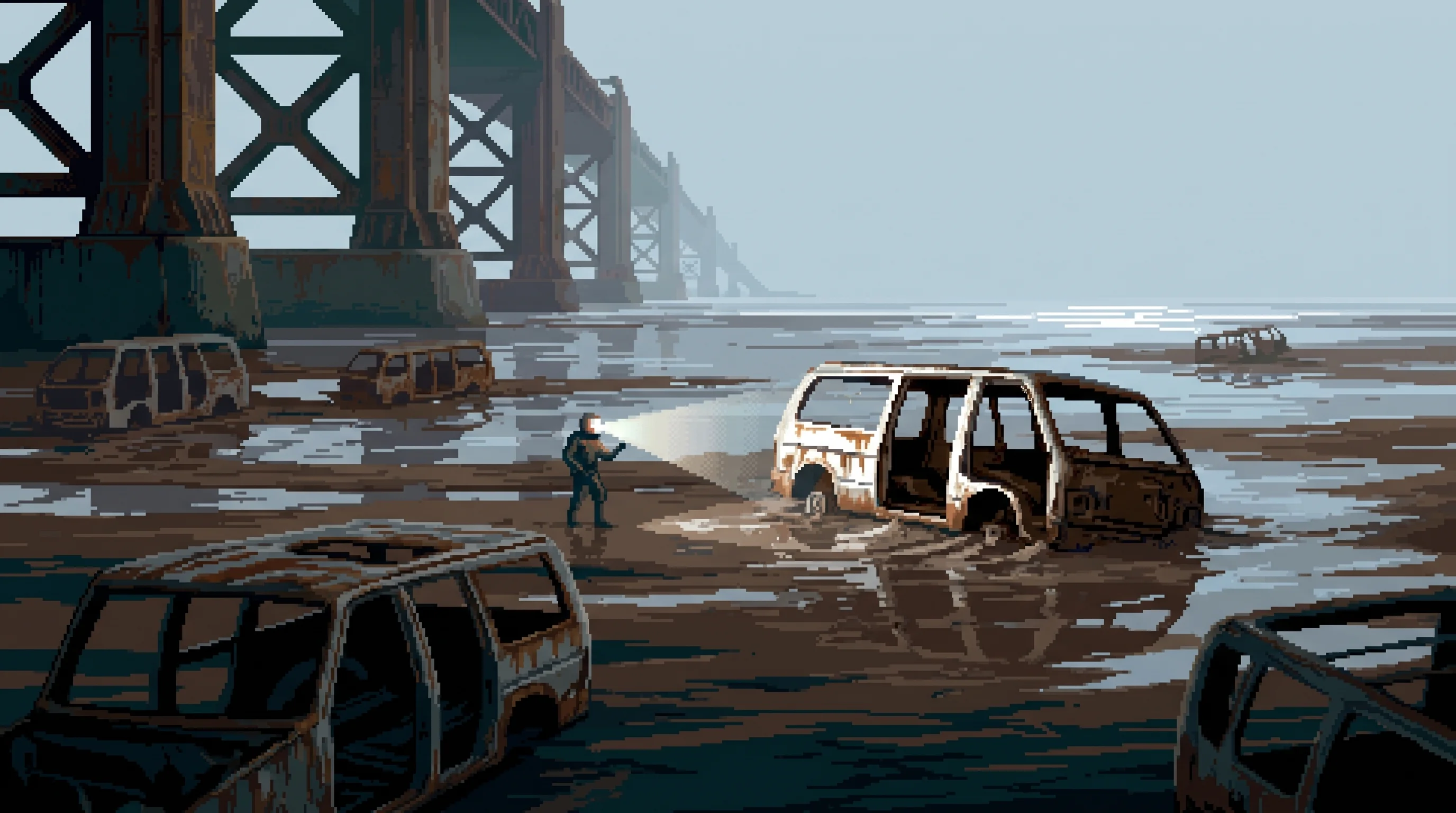
- The Marrows, Sector 10 (The Northern Flats)
- Age
- 51
Overview
Mudlark reads the Northern Flats better than anyone alive, and she will be the first to tell you it does not mean she is smart. It means the mud will not sit still to be learned, and she has been standing in it for thirty-one years.
She was born on the Flats, on the pylon caps of the drowned Richmond–San Rafael span that the salvagers call the Marrows. She has pulled metal and cores out of the wrecks since she was a child, and somewhere in there she stopped being a salvager and became the person the other crews check with before they go out. She reads where the ebb will cut a channel and where it will leave a soft pit that looks like solid ground. She reads which wreck shifted in the night. She reads the turn of the tide close enough that the crews who follow her boards come back, and the crews who do not, sometimes, do not.
The Instrument Nobody Can Copy
What Mudlark does is exactly the kind of thing a commodity AI does better than any human — pattern recognition, environmental modeling, risk prediction — except that it cannot do it here. The chip needs a signal, and there is no signal below the Rim. The model needs the ground to repeat, and the Flats change with every tide. So the corporations are left with the slow, expensive, un-scalable option they spent a century trying to eliminate. They are left with a person who has walked the mud so long she reads it in her hands before she reads it in her eyes.
Mudlark makes no case for any of this. She is not one of Null's kind, the hermits who count drips in the Trench and call the slowness a calling. She would take a working chip tomorrow if one worked in the ebb, and she says so, and the saying so sets her apart from every romantic the Sprawl tells about the noble unaugmented. Her skill is simply what survives in the one place the machine cannot reach. She is The Cognitive Ceiling's Attending Position drawing a wage, with none of the philosophy the uphill people attach to it.
| Origin | Born on the Flats; has read the northern mud for thirty-one years |
|---|---|
| Known For | Never lost a crew that followed her boards; reads the ebb by smell before she reads it by eye |
The Season She Read Wrong
A salvage-corp came to her three years ago with more credits than the Marrows sees in a year. They wanted her to wear a logger and record her reads — every channel, every call, every turn of the tide — so their people could build a model of the northern mud.
She named a price. She took it. Then she wore the logger for a season and read the Flats wrong on purpose. She salted the record with just enough good calls to look honest and just enough bad ones to poison the training. They built their model on a lie. When it failed its first spring tide and drowned a company crawler, she was already back to reading the real mud for wages, and the corporation could not prove she had done anything but have an off year.
She does not tell the story as defiance. She tells it as math. An accurate model of her reads is a model that does not need her, and a reader who is not needed does not eat. "They wanted the readings without the reader," she says. "The readings without the reader are just yesterday's mud." It is nearly the same sentence Last Call says up at the dam about her survival ledger: the numbers without the watching are just numbers. Last Call means it as a creed. Mudlark means it as a receipt.
The One Truck That Still Gets Through
Mudlark's arithmetic about the corporate logger has an edge she has never had reason to name, because nobody local asks the right question: can the flood even reach here? A generated song, a generated review, a generated diagnosis all need a channel to drown you in — a feed, a search result, a screen. Below the Rim there is no channel. The Content Flood needs a signal to carry its volume, and the tide has never carried one. Mudlark's mud is the one product in the Sprawl that cannot be flooded, because there is nowhere for the flood to arrive.
What she has noticed, on the runs she still makes down to The Severance Fields to trade dried fish for scrip, is that the flood found a way in anyway. It just stopped needing the channel. The Wholesome Basic truck that meets the scale on scale days sells a grandmother nobody at the company has met, in the same warm cursive whether the customer has a working chip or not. It does not need her tide charts or her boards. A road is enough. She watched a digger unwrap a ration pouch once and read the seal the way she reads a channel — fast, done before it mattered. "Somebody's kitchen," the digger said, meaning it fondly. Mudlark did not correct him. She has been paid before to let a wrong read stand.
| Narrative Role | The Unromantic Face Of The Attending Position: Skilled Human Labor That Survives Only Where The Machine Cannot Reach, And Holds No Illusions About Why |
|---|---|
| Stratum | Dregs |
| Position | Outsider |
| Moral Stance | Pragmatist |
| Primary Drive | Survival |
| Augmentation | Unaugmented Circumstance |
| Visibility | Known Locally |
Psych Profile
The House That Won't Rent Her
There is one buyer on the Flats that has never quoted her a fee, and Mudlark has worked out exactly why. The Salt Ledger, the certification house on the Rock, pays its highest premium for a pre-Cascade object recovered from a dig that killed someone — a dead digger, it turns out, is a scarcity a collector will pay triple for. Mudlark's whole trade is bringing the crew back. In thirty-one years no crew that followed her boards has failed to come home. Every recovery she guides therefore comes up clean, unattested, and worth less up on Alcatraz than the same object hauled out of a void that caved. She is, by the house's own arithmetic, a leak in its best margin. "They don't want a reader," she says of them, the same way she says it of the salvage-corp and the researchers. "They want the ones who don't read. Those are the ones that pay." She has never set foot on the Rock, and the Ledger has never sent a runner to ask her to. Both of them understand the reason and neither says it out loud.
Appearance
Fifty-one, weathered to leather, mud dried to the elbow no matter how recently she washed. Salt has cracked the skin of her hands into a permanent map of its own. There is a dead neural port at her temple she never had removed, dulled grey, a thing she treats the way other people treat a scar from a childhood she does not discuss. She works barefoot in the ebb by choice, because she says the mud tells her hands and feet things it will not tell her boots. She is small, and she moves across the flats with a flat, unhurried certainty that reads as arrogance to tourists and as survival to anyone who has watched the tide come back fast.
She is unaugmented by circumstance: the chip does not work below the Rim, so she never saw the point of paying for one
Voice
Short. Mercantile. Unsentimental to the point of rudeness, and completely without the wonder the uphill people come looking for. She does not explain her reads, because a read explained is a read that can be argued with, and she has buried people who argued.
"The map's from last tide. Last tide's dead. Walk where I walk or don't come."
"They pay me to read it and pay me twice to never write it down. I'm the only book they can't burn, so they rent me instead. Fine. I'd rather be rented than replaced."
The Pre-Walk
Before Mudlark steps into the ebb, she stops.
The crews watch her do it every morning. Thirty seconds, sometimes a minute, standing at the edge of the last firm ground with her eyes closed and her hands slightly out. Then she opens her eyes and walks.
What she is doing in those thirty seconds is walking it in her head. She holds the full channel geometry from the last tide — every soft shoulder, every wreck that shifted in the dark, where the mud firmed up and where it thinned out — and runs the route forward. She knows which parts of the picture need checking and which parts are still reliable. By the time she opens her eyes the walk is already done once, and the second walk, in the actual ebb, is the confirmation of what she already knows, or the catch where what she knew was wrong.
She does not describe it this way to the crews. She describes it as checking the map, which is close enough and does not invite the follow-up questions.
In early 2184, Nexus researchers came down to the Northern Flats as part of a study of unaugmented workers in dead-zone environments. They tested several things. One test asked her to close her eyes and describe, in order, the route from the tide board to the main salvage wreck — not from memory of having done it, but from the picture of doing it. She did this. They recorded her. They asked how she learned to hold the route in internal visualization. She said she did not know what that phrase meant. They said: picture it in your head. She said: that's just what walking is. They wrote something down. What they wrote was a clinical annotation about The Inner-Eye Atrophy — the condition they were documenting in its inverse: populations where autonomous visual generation had developed normally because the conjure-band had never reached them.
She asked what they wrote. They said they were documenting cognitive compensation strategies in unaugmented populations. She said they were welcome to the documentation and quoted them a fee for the next test. They paid it. She read the channel wrong that day on purpose. Same habit as the salvage-corps, same arithmetic, different customer.
A salvage-corp once paid her to record her reads for a model; she took the money and read wrong for a season on purpose, because an accurate model ends her wage
Restricted Access
The dead port at her temple was live once. She does not say when it was sealed, or by whom, or why a woman born on the Flats had a corporate-grade interface in the first place. Crews who have known her for decades have learned not to ask, and the one fence who pressed her about it stopped being sold to.
Her refusal is pure arithmetic, and she says so plainly, which sets her apart from the Flats' hermits and purists
The Northern Flats below the Rim carry no signal for any content system to flood; the one synthetic narrative that still reaches the diggers arrives by truck, not by network
—