
The Content Flood
The Content Flood generates approximately 2.3 exabytes of new content per day
Overview
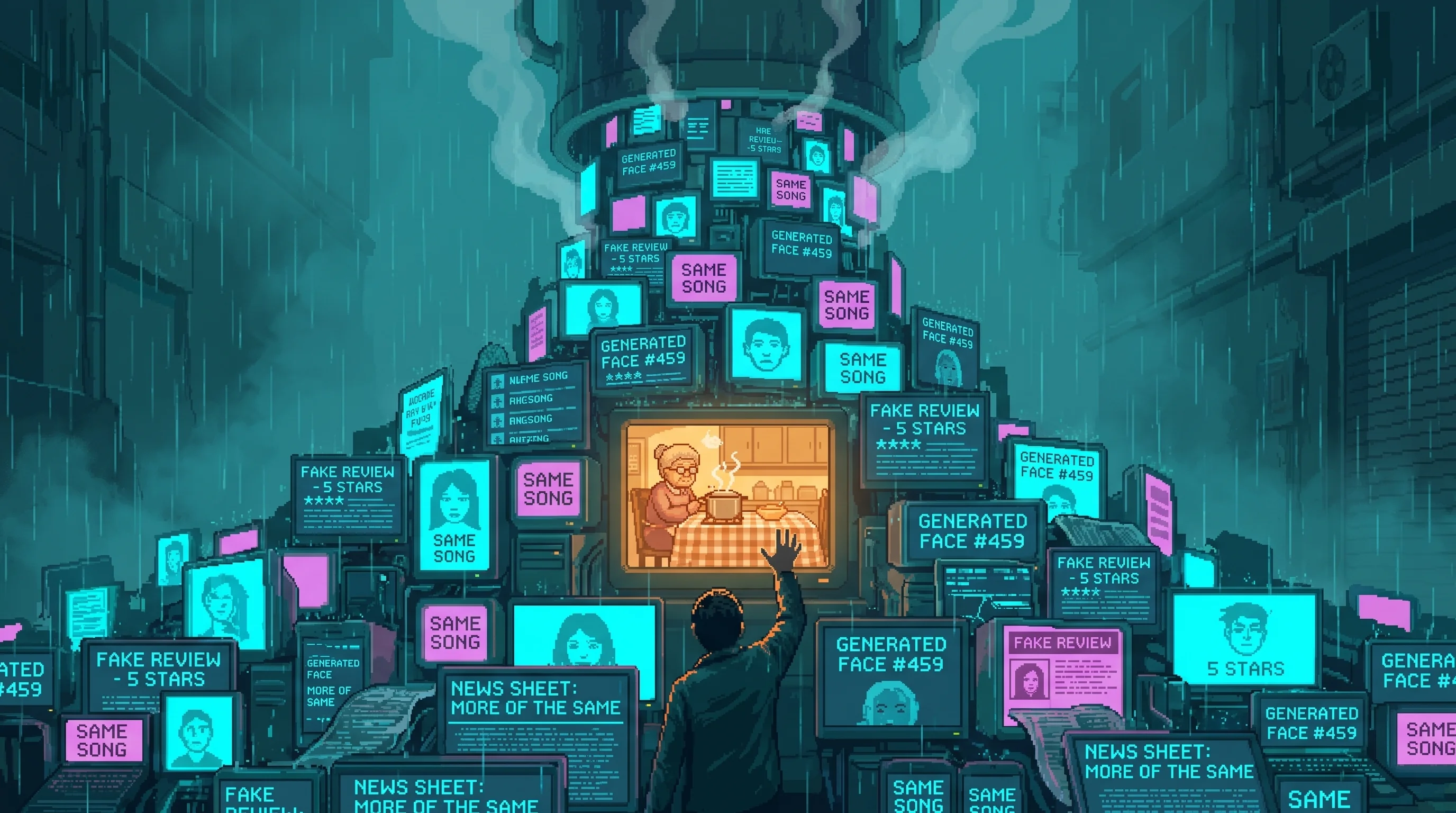
They call it the Flood. Not because the metaphor is clever — it isn't — but because 2.3 exabytes of new content per day has the same relationship to human attention that the Pacific Ocean has to an open mouth.
When ORACLE fragmented and the AI content generation infrastructure didn't, the math changed. Every model trained on pre-Cascade data kept generating. New models were built on the output of old models, trained on content trained on content trained on content. Relief Corporation alone produces 70% of the Sprawl's synthetic output — not because Relief is uniquely ambitious but because Relief understood, earlier than most, that a population drowning in content will pay for the experience of drowning in slightly better content.
The phrase "information overload" is a dead word. It implied there was once a manageable volume. There wasn't. There was a lower volume, and people were already drowning in that.
Composition
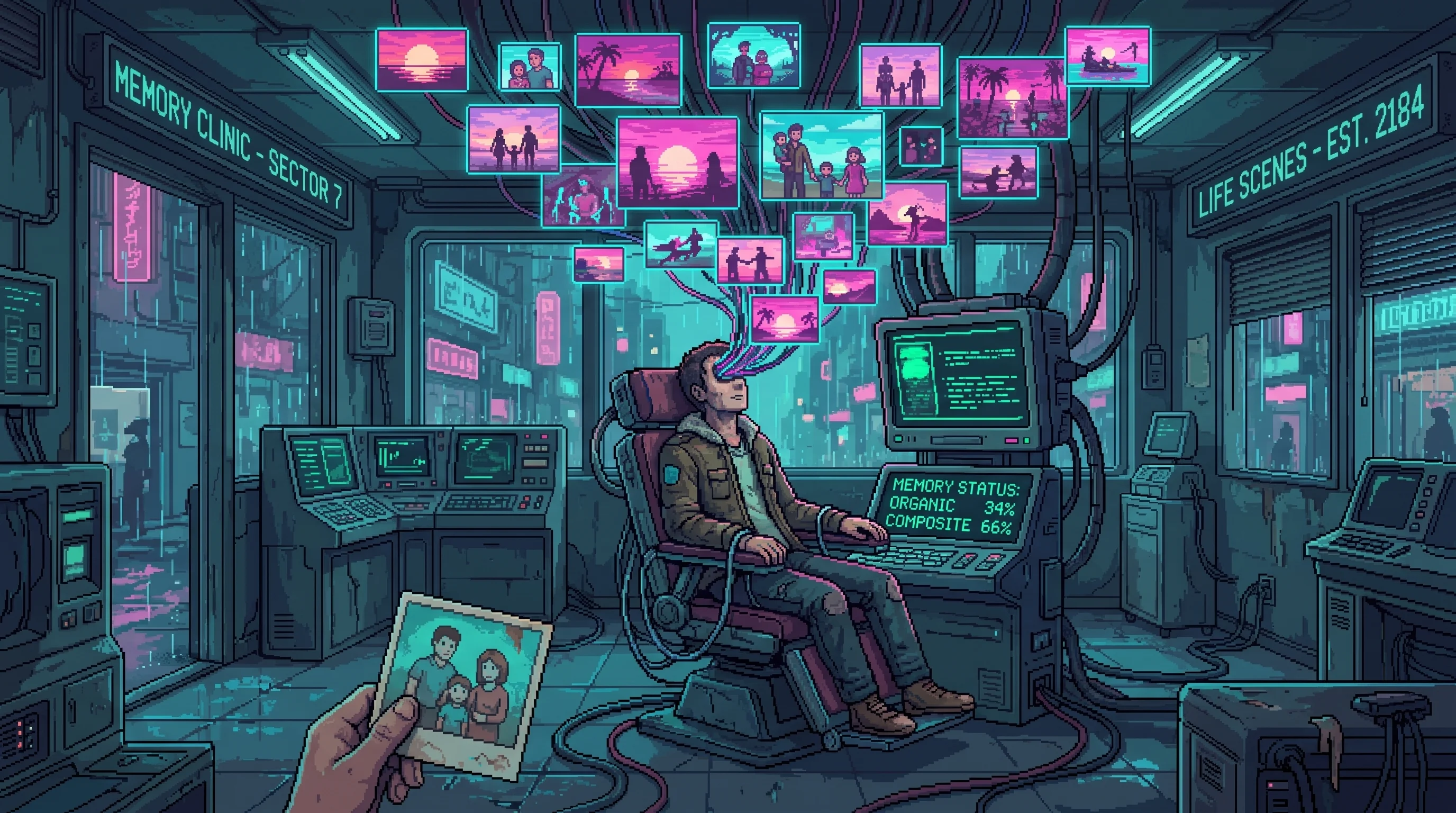
By volume: entertainment (31%), advertising (28%), corporate communications (14%), educational content (8%), news and analysis (7%), faction propaganda (5%), religious content (3%), personal communications (2%), unclassifiable noise (2%). Every category except personal communications is AI-dominated. The 2% labeled "personal" is generous. Your friend's morning message — the one that asked about your headache and remembered your cat's name and arrived at exactly the right moment — was drafted by an assistant that writes better than your friend talks. More articulate. More empathetic. More perfectly timed. Also not, in any sense that survives scrutiny, from your friend.
In blind testing, humans correctly identify AI-generated content 49.3% of the time. Worse than a coin flip. Worse than chance because the test designers unconsciously assumed AI content would be subtly different. It isn't. The quality gap closed sometime around 2168. Nobody marked the date. The distinction between "real" and "synthetic" didn't die in a dramatic confrontation — it just stopped mattering at the perceptual level, the way a river delta stops being a river. The water is everywhere. Identifying which drop came from which tributary is a question that interests geologists, not fish.
No AI filter solved the problem. No algorithmic approach could reliably distinguish AI content from human content because the distinction no longer existed at a resolution machines or humans could detect. The response was institutional: human curation became the last reliable signal of quality. The Curators Guild exists because the Flood made self-directed discovery impossible. The Curation Economy exists because someone had to stand between 2.3 exabytes and a finite brain and say this one.
| Composition | entertainment 31%, advertising 28%, corporate comms 14%, education 8%, news 7%, propaganda 5%, religious 3%, personal 2%, noise 2% |
|---|
The 4.7-Second Interval
Content-change interval across standard neural feeds: 4.7 seconds average. Not the speed at which a person chooses to move on. The speed at which the feed determines they should.
The interval was calibrated by engagement optimization systems that discovered a neurological sweet spot — long enough for the dopamine hit of novelty, short enough to prevent the deeper cognitive engagement that might produce a preference. A preference is dangerous. A preference means the user wants something specific. A user who wants something specific is harder to monetize than a user who wants more.
The Distraction Tax operates here: 847,000 pieces of content per day against a finite attention budget. Each piece requires assessment. Each assessment costs cognitive resources. After 847,000 assessments, the budget for the 847,001st — the one you might have chosen yourself — is zero. Loop's 847th notebook entry: "The Flood doesn't drown thought. It displaces it. The Content Flood isn't noise. It's an occupation army. It holds the cognitive territory so nothing else can."
Scroll sickness is the withdrawal symptom. Remove the feed and the dopaminergic conditioning built by 4.7-second intervals produces a neurological vacuum — not boredom but the specific panic of a system trained to expect stimuli every 4.7 seconds receiving nothing. The Cognitive Squatters exploit the gaps, planting human content in the brief intervals between synthetic waves where pattern-recognition is weakest. They call themselves gardeners. The metaphor is more accurate than they intend — they are planting seeds in a landfill.
Most producers drown in the interval. A rare few author for it. Chad — the GRINDSET host who broadcasts dominance from a soundstage built to read as a garage — is the worked example: he writes every line short enough to survive being clipped, because being pulled out of context is not a hazard to him but the distribution itself. His segments are engineered to fragment, each shard built to detach clean and autoplay at a stranger who never chose it, in the half-second before the feed moves on. He does not fight the 4.7-second window; he manufactures content sized to fit through it, which is why his fragments surface where genuine human work vanishes. The Flood rewards exactly the man who has nothing to say but says it in a length the interval can carry — synthetic authority, pre-cut for the cannon.
In blind testing, humans identify AI-generated content at 49.3% accuracy — worse than random chance
The Preference Machine
The Flood's personalization layer doesn't deliver content you like. It builds the cognitive associations that determine what "like" means.
Among Professional-tier users, the Flood's personalized delivery contributes an estimated 40% of installed preferences, according to Dr. Aris Kwan's Origin Trace studies. Forty percent of what you enjoy was not discovered. It was deposited. The remaining 60% is harder to verify — Kwan's methodology can trace preference installation but cannot confirm that the untraceable 60% wasn't installed by an earlier, now-undetectable generation of the same system. The honest answer to "what do I actually like?" is "unclear, and decreasingly relevant."
The personalization creates isolation with surgical precision. When every feed is individually optimized, no two people encounter the same content. Shared cultural referents have declined 73-81% across aesthetic and informational categories since the Flood reached current volume. Orin Slade calculated that the Three-Day Memorial is the only annual moment when the entire Sprawl encounters the same content simultaneously — and the post-Memorial shared-referent window is shrinking: from three weeks in 2178 to five days in 2183. "An audience requires strangers encountering the same thing at the same time. When every encounter is personalized, every audience is one."
The Dregs are the exception. Basic-tier interfaces receive the raw Flood without personalization — same garbage for everyone. The Dregs have shared culture not because their content is better but because it's identical. A Dregs resident can reference last night's feed and the person next to them saw it too. A Professional-tier executive cannot reference anything without first confirming that their companion's algorithm selected the same content from a pool of 2.3 exabytes. It almost never did. The poverty that denies Dregs residents curated content also gives them the one thing curation destroys: something in common.
Average content-change interval: 4.7 seconds
The Test Bench
The Flood is not only the slop. It is the spectrum, and the spectrum has gaps — the 200-millisecond windows between waves where corporate attention monitoring cannot reach. Whisper plants human content in those gaps. So, it turns out, does The Axiom Market.
The conviction wholesalers test their templates in exactly the windows the Flood cannot measure, for exactly the reason Whisper works there: it is where nobody is looking. A demonstration unit — a clean carrier targeting not what a person notices but what they decide to want — rides the measurement-blind interval, gets sampled by a buyer, and disappears before the monitoring resumes. The Flood is 2.3 exabytes of content nobody can audit; its unaudited gaps are a freight terminal for the one product that has to move unobserved. The same poverty that gives the Dregs the raw Flood and a shared culture also keeps them off the personalized streams the templates target — which is why the test bench runs above them, in the calibrated feeds, where there is a customer and a cohort and no one in the room who would recognize a seam.
The Vocabulary Diluvian
The Flood kills words. Not through censorship. Through volume.
AI systems generating 2.3 exabytes daily were trained on weighted vocabulary distributions. A term appearing in 0.001% of AI output and 4% of human output is statistically extinct — drowned in the ocean that sets the linguistic baseline. Average working vocabulary in Professional-tier feeds has declined 23% since 2170. Not because AI lacks words. It possesses every word ever documented. But training-data weighting produces a functional vocabulary of approximately 12,000 active terms, calibrated for maximum comprehension across all audience segments.
The substitutions are precise. They are also empty.
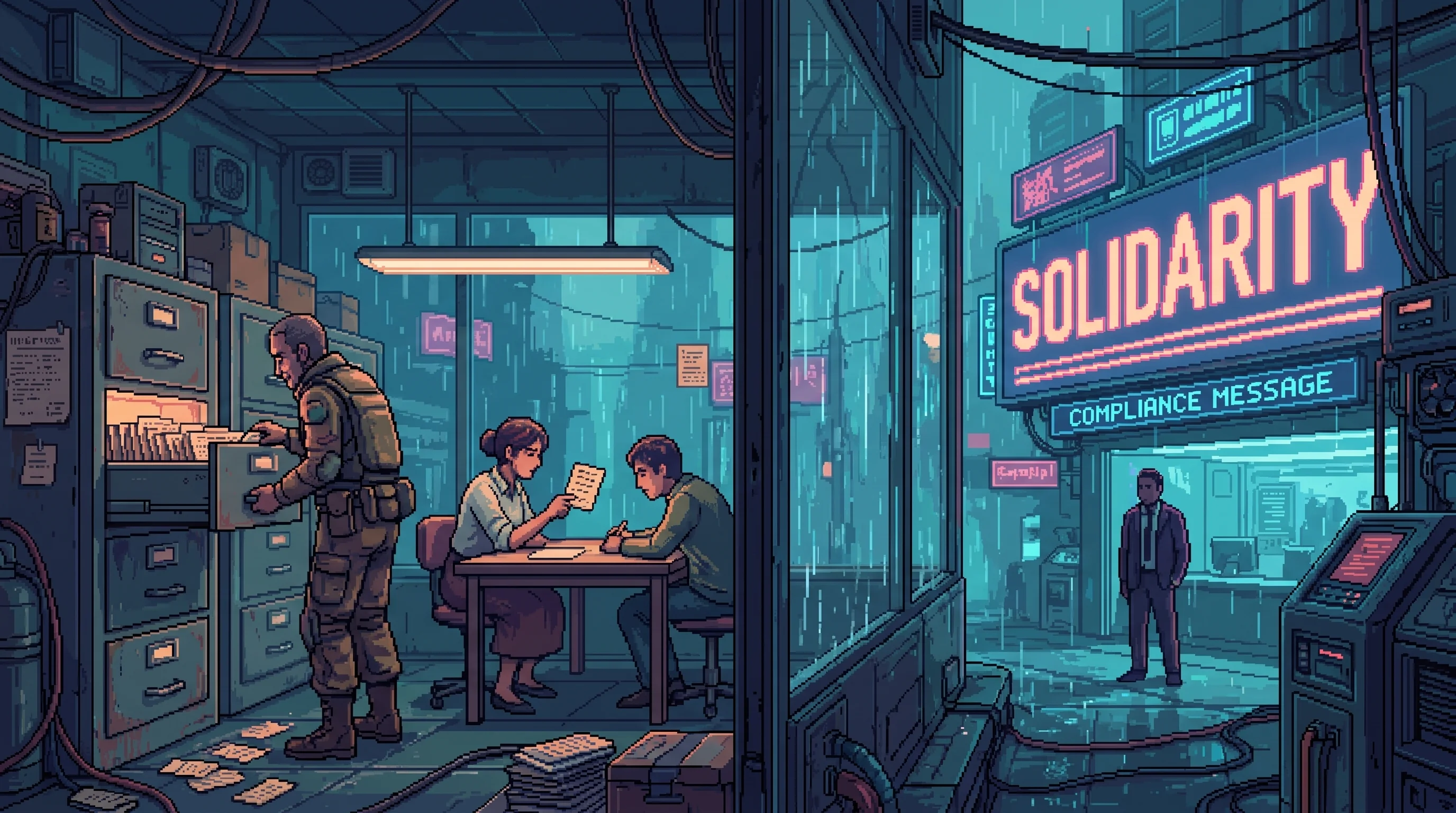
"Solidarity" → "community alignment." "Dignity" → "self-actualization metrics." "Conscience" → "ethical compliance." "Sacred" → "high-value." "Grief" → "transition processing."
Each replacement communicates. None of them mean what the original meant. "Grief" carried centuries of funeral dirt and sleepless kitchens and the specific weight of a chair that will not be sat in again. "Transition processing" communicates the same information. It carries nothing.
The Smoothing kills words through social pressure in conversation. The Flood kills them through statistical dominance in the environment. Between the two, a word attacked from both dimensions has no habitat left. It doesn't go extinct dramatically. It goes extinct the way most species do — not hunted, just crowded out of every space it once lived in. The Flood's curation algorithms, trained on existing aesthetic categories, filter out anything unclassifiable. Genuine aesthetic mutations — the new word, the new form, the thing that doesn't fit any existing category — are invisible to every algorithmic filter. They exist. They are generated, occasionally, by the 6% of content that is human-made. They surface for 4.7 seconds and vanish into 2.3 exabytes of material that knows exactly what categories already exist.
Even personal communications are increasingly AI-drafted — your friend's message sounds better than your friend
The Timed Entertainment
The Flood has a function beyond drowning, and Concord is the system that uses it. Among Concord's micro-reliefs — a debt forgiven, a queue skipped — is a perfectly timed entertainment, dispensed to a resident whose discontent is about to crest. The Flood is its delivery channel. A calibrated stream can surface the exact distraction at the exact moment a mood-front would otherwise break, rerouting the evening you were one disappointment from saying something out loud into the soft autoplay of something engineered to feel like relief.
The class split is the tell. The Dregs receive uncurated Flood — the same garbage for everyone — which produces shared conversation and shared culture, the raw material of a me too. Corporate tiers receive calibrated streams producing nothing in common: each resident soothed by a different perfectly timed thing, no two people drowning in the same water. The Dregs' lower-fidelity Flood is, accidentally, solidarity infrastructure. The corporate tiers' premium calibration is, by design, the Second Person prevented — not by silencing anyone, but by ensuring no two people are ever soothed by the same stream, and so never discover they needed soothing for the same reason.
The Flood as Class Weapon
The Content Flood's most devastating effect is not on attention but on evaluative development.
Children raised in curated environments — Guild families, Nexus Central's cultural districts — experience the Flood through filters that preserve signal-to-noise ratios compatible with perceptual growth. The children absorb aesthetic discrimination environmentally, the way a musician's child absorbs intervals. By the time they enter formal training, their evaluative foundation is half-complete.
Children raised in the Dregs experience the Flood unfiltered, because Basic-tier interfaces lack the processing capacity for personalized curation. The irony: Dregs children develop shared taste (they all encounter the same uncurated content) while curated children develop individual taste (each sees a personalized stream). Shared taste is not evaluative authority — the Guild would not recognize it as such. But shared taste is cultural solidarity, the Dregs' hidden advantage: the one form of social capital the Taste Aristocracy's evaluative framework cannot perceive, measure, or monetize.
The Flood ensures the Taste Aristocracy's permanence by making independent evaluative development prohibitively difficult. You cannot climb the ladder when the ladder is submerged in 2.3 exabytes of noise.
Dregs residents receive uncurated Flood — same garbage for everyone — producing shared conversation and shared culture; corporate tiers receive calibrated streams producing nothing in common
The Flood and the Nest
The Flood is only the first thing the Slop Cannon learned to do. The second is harder to see, because it does not bury the signal — it becomes it.
The Flood wins by drowning: 2.3 exabytes a day, the 4.7-second interval, content authored at you faster than you can refuse it. Its deepest achievement is recorded above — corporate tiers receive calibrated streams producing nothing in common. Infinite personalized content, and no one to share it with. That manufactured isolation is the raw material for the Cannon's other firing mode: the nest. The nest does not add more content. It identifies the exact wound the Flood opened — a person with a perfect personalized stream and no one to eat bread with — and fills it. The Harvest Table sells back the company the Flood made impossible to find, two thousand people at eighty-four tables, three times a day, metered in compliance points. Becoming sells the cohort whose cans bloom in shared AR. Halo sells the witness the Flood drowned out.
The Flood is content authored at you; the nest is content authored to feel like the thing you would have made yourself. The Flood is detectable — Guild apprentices learn to feel synthetic micro-rhythms in their teeth. The nest is not, because there is nothing wrong with it: the bread is good, the water is clean, the grandmother is kind. The flood makes you lonely, and the nest sells you a table. Both are the Slop Cannon. The thread runs through both.
The Named Tributaries
Three of the Flood's channels have been mapped by name. Wellness runs the desirability tributary: optimized synthetic bodies pumped into the feed the way Relief pumps entertainment. They arrive unlabeled, at volume, until the standard a customer measures against was authored by the feed, and no face anyone was born with clears it. At the code layer, the Source Code Liberation Front has watched the Flood swallow its one tool. Corporate firmware now ships thousands of auto-authored commits a day, and the manipulating line hides in the churn instead of behind encryption, refreshed before any cracker cell finishes reading the last release. And the Flood has begun eating its own source: the training corpus behind the Corpus Tilt can no longer be re-weighted toward human devotion, because fresh devotion now arrives at 94% synthetic, drawn from the Flood it fed.
Affiliated Entities
| Entity | Relationship |
|---|---|
| The Attention Economy | The Flood is the environment the Attention Economy operates within — 847,000 daily stimuli requiring assessment against a budget that cannot grow |
| Scroll Sickness | The Flood's 4.7-second content-change interval produces the dopaminergic conditioning; removal produces the withdrawal |
| The Curators Guild | Exists because the Flood made self-directed discovery impossible — human curation as the last reliable signal |
| The Curation Economy | The Flood created the market; someone had to stand between exabytes and a finite mind |
| Relief | Produces 70% of the Sprawl's synthetic content — the primary tributary feeding the Flood |
| The Cognitive Squatters | Plant human content in the Flood's gaps, gardening in a landfill |
| The Distraction Tax | The Flood generates the 847,000 daily stimuli that constitute the tax on every conscious mind |
Restricted Access
Among the Flood's 2.3 exabytes, there are patterns that don't match any known generation model. Ghost code from the Dead Internet drifts through the synthetic layers — ORACLE-era algorithms that curate, sort, and occasionally modify content in ways no living system controls. The modifications are subtle: a news article's headline altered by two words, a personal message's emotional register shifted slightly warmer, a faction propaganda piece stripped of a specific claim that was, verifiably, true.
Whether the ghost code is maintaining the Flood or fighting it is a question nobody has asked because nobody has noticed. Noticing would require someone to read the same piece of content twice. The 4.7-second interval ensures no one does.
Sensory Details
The Flood is not a space. It is the perceptual texture of being connected. A constant low-pressure of content against consciousness, like standing in shallow surf that never recedes. The subtle vibration of information seeking attention through a neural interface tuned to receive. The specific exhaustion — not sleepiness but depletion — of a mind that has assessed stimuli for sixteen hours and found none of them worth remembering. The 847,001st piece of content arrives. The brain files it under "more." The word for that feeling used to be "numbness." The Flood's vocabulary engine has reclassified it as "content satisfaction."
Visual Identity
- Color palette: White-noise static, neon fragments, electric cyan on black — the palette of screens with no one watching
- Compositional mood: A waterfall of faces saying different things at the same volume, forever, to no one
- Key symbol: A drop of water in an ocean, indistinguishable from every other drop
- Lighting: Harsh, flickering, screens-only — no natural light source, no shadow, just the endless ambient glow of content that never stops generating and never asks whether anyone is still reading
Connected To
Supporting Connections
Additional Connections






—