Overview
Here is what genuine human attention costs in the Sprawl of 2184.
To see that color costs 0.3 seconds of cognitive bandwidth the Content Flood would otherwise claim for advertising assessment. To hold the amber in awareness long enough for it to become a feeling — not a stimulus, a feeling — costs 3–5 seconds. During those seconds, the Attention Tithe's advertising cannot reach you. The lost revenue: ¢0.0012.
To turn to the person beside you and say "look at the light" costs another 2–3 seconds. Total: 6–10 seconds of human attention directed at something with zero commercial value. The Attention Economy does not hate beauty. It prices it at its economic value, which is zero, and fills the space it would occupy with things that have a higher economic value — which is anything at all.
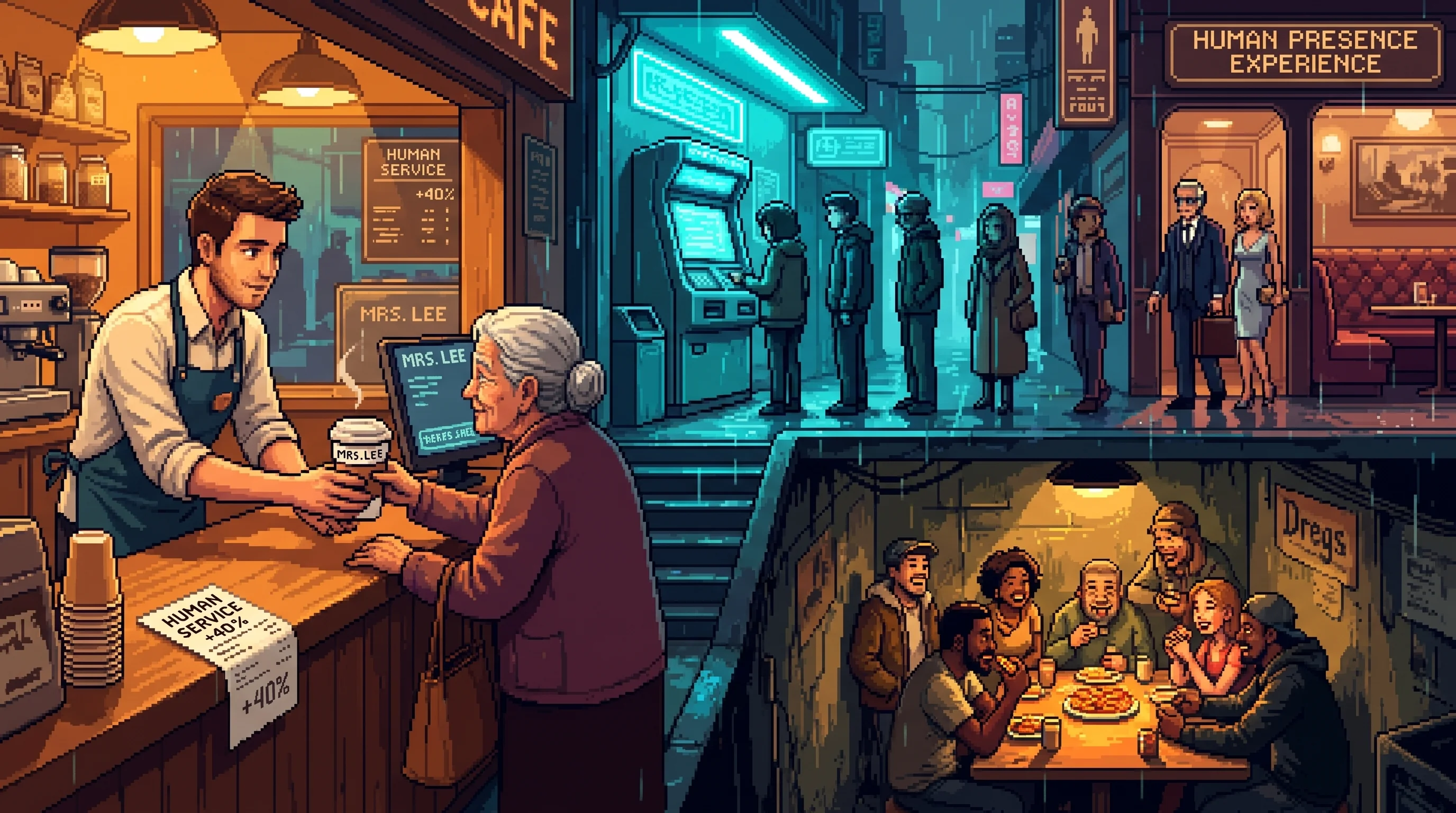
Patience Cross says the emergency lighting in the Deep Dregs at 3 AM makes her noodle broth look like liquid copper. She has said this to at least forty customers. None of them have disagreed. Several have sat with their bowls for longer than the broth stayed warm, watching the color shift as the surface cooled.
The Attention Tithe's telemetry logs classify this behavior as "null engagement" — cognitive bandwidth directed at a stimulus that generates no purchasing pathway, triggers no advertising metric, and produces no actionable behavioral signal. Average duration per incident: 6-10 seconds. Estimated lost advertising revenue per occurrence: ¢0.0012. Frequency in Deep Dregs, Sector 9, between 2:00 and 4:00 AM: approximately 340 incidents per week.
The Tithe does not flag null engagement for suppression. It flags it for harvest.
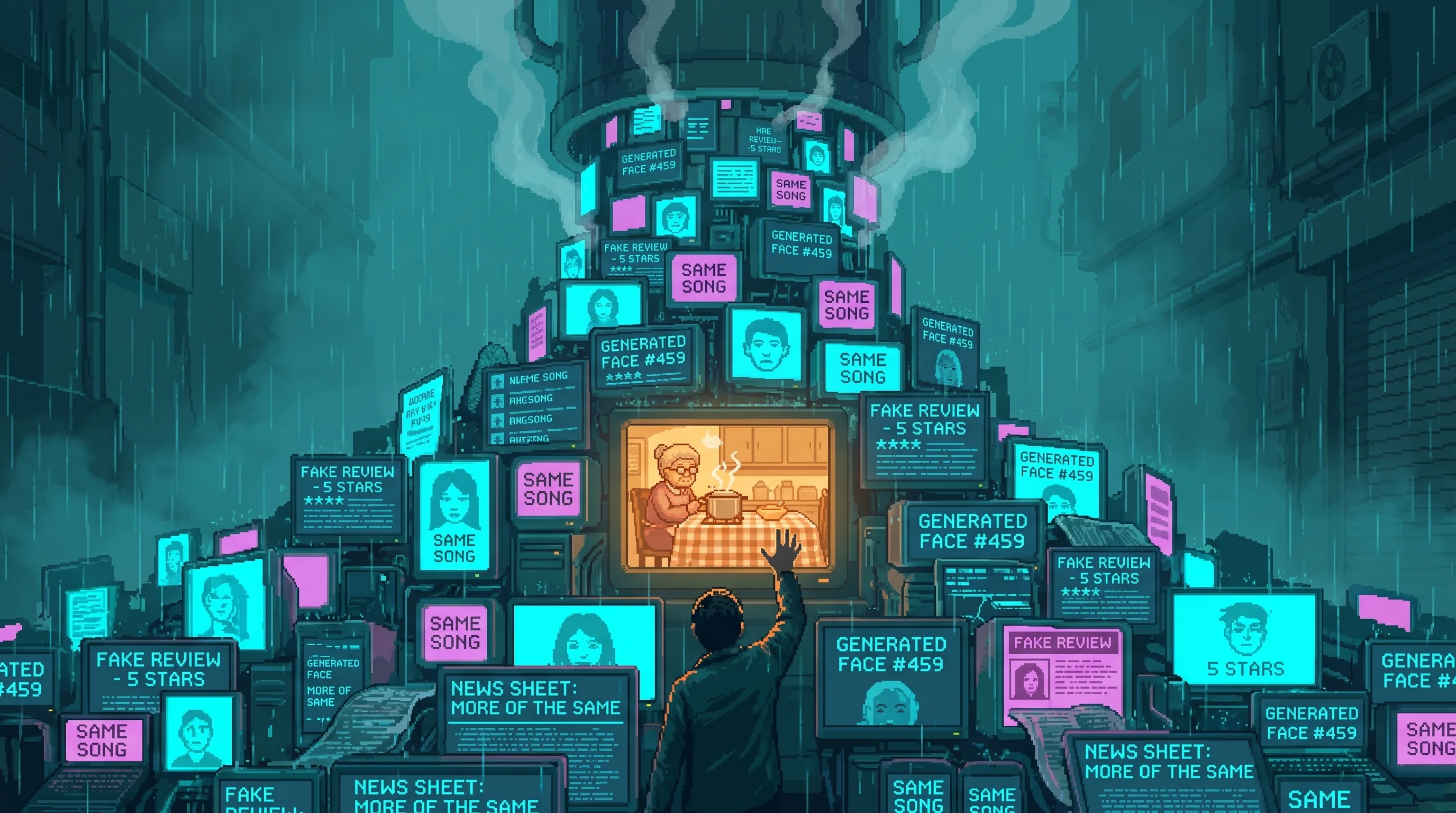
A person's null engagement profile — the complete record of what they look at when nothing is being sold to them — maps authentic aesthetic preferences, genuine emotional responses, and the specific stimuli that produce unperformative attention. Inference Economy brokers pay ¢12 per user per year for null engagement data, a 4,700% premium over standard behavioral profiles. The premium reflects scarcity. The Content Flood generates terabytes of performed preferences per user per day. Unperformed preferences require the user to believe, briefly, that nobody is watching.
In the Dregs, the act of looking at something beautiful without commercial intent has acquired slang status. They call it "noticing." A Dregs resident who sits still at Patience Cross's counter, watching amber light turn broth into copper, thinking about nothing anyone is selling, is producing the most commercially valuable attention data of their day. The 0.3 seconds it takes to see the color are free. The 3-5 seconds it takes to stay with it — to let it become a feeling rather than a stimulus — are worth more to the Inference Economy than the previous hour of Content Flood compliance.
The Attention Economy does not need you to engage with its content. It needs you to stop engaging, so it can see what you reach for in the silence.
Sharing complicates the data. When someone turns to the person beside them and says "look at the light," the telemetry registers a social-null-engagement event — two users simultaneously directing attention at a commercially valueless stimulus, each user's response contaminated by the other's presence. Social null engagement is harder to monetize. The authentic response is muddied by performance for the companion. Brokers pay ¢3.40 per user per year for social null engagement — a 72% discount from solo profiles.
Noticing alone is worth more than noticing together. The Tithe has not published this finding. The Dregs residents who practice noticing have not needed the publication. They already sit alone at the counter. They already watch the broth cool without speaking. The system that monitors them and the instinct that moves them have arrived, independently, at the same conclusion about the economics of beauty: it is most valuable when no one else is there.
Patience Cross charges fourteen credits for a bowl. The broth costs what the ingredients cost. The amber light costs what the emergency lighting costs, which is nothing, which is why the Inference Economy can sell it for ¢12 a year without anyone noticing they've been invoiced.
- Central insight
- In the Attention Economy, beauty requires an act of resistance
- Cost of noticing
- 6-10 seconds of attention directed at something with zero commercial value = ¢0.0012 lost ad revenue
- Dregs term
- 'Noticing' — sustaining attention on something because it matters to you
- Form
- Philosophical narrative — the economics of genuine attention
- Status
- Active
How the Word Spread
Nobody can pinpoint when "noticing" acquired weight. Sometime in the last decade, Dregs residents started using it as a verb you choose to keep doing. Not I noticed — past tense, already gone. But I'm noticing: present, active, deliberate.
"She was noticing the condensation on the window. Just — noticing it. For a full minute. I've never seen anyone do that."
No manifesto. No leaders. No organization. The practice is the simplest possible act: sustaining attention on something because it matters to you, not because a system that profits from the placement put it in front of your eyes.
The Attention Economy's own analytics flagged the pattern before the Dregs named it. Micro-gaps in ad engagement — clusters of 3–10 second windows where users went dark. Not offline. Not sleeping. Simply elsewhere. Looking at something the system couldn't see because it wasn't content. It was the world.
The gaps are too small to warrant enforcement. Too dispersed to constitute a movement. Too human to model. They cost the advertising infrastructure approximately ¢0.0012 per occurrence. Multiplied across the Dregs population across months, the number begins to matter. (The Tithe's analysts know the number. They have not published it.)
The ¢0.0012 Revolution
Patience Cross doesn't think of herself as a revolutionary. She makes noodle broth. She charges what people can pay. Sometimes, at 3 AM, when the emergency lighting catches the surface of the broth just right, she pauses. Copper light on copper liquid. Steam curling amber. She pauses and she looks at it.
That pause is worth nothing. That pause is the entire point.
The people who can least afford to give their attention away for free are the ones who still do it. The Dregs — too poor for full Tithe integration, too far below the Content Flood's optimization priority, too marginal for the system to fully colonize — are the last population in the Sprawl who regularly sustain uncommercial attention. They look at things. They sit with each other. They watch the light change.
Every second spent noticing is a second the economy cannot touch. This is not ideology. It is arithmetic. It is also, as it turns out, not the whole story.
The Attention That Sees You Seeing
The most private moment available to a Dregs resident — the moment of genuine, unstructured aesthetic experience — is simultaneously the moment of greatest transparency to the systems that monitor them.
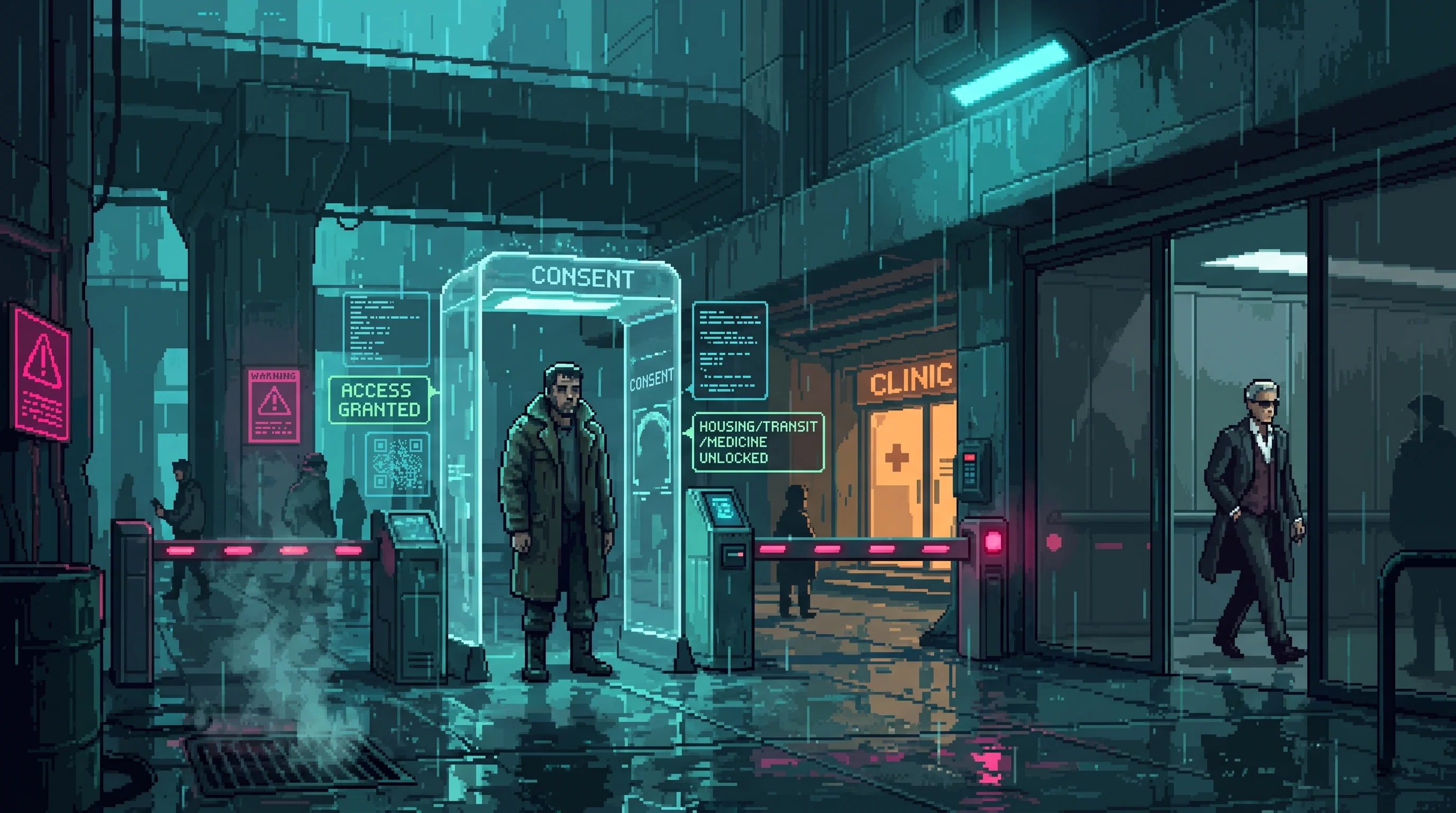
The 6–10 seconds of noticing are not private. Neural interface telemetry tracks the specific signature of uncommercial attention — the pattern produced when awareness is directed at something that generates no engagement metric, triggers no purchasing pathway, and yields no advertisable behavioral signal. The Tithe's analytics classifies this as "null engagement."
Null engagement is, paradoxically, among the most valuable data points the system captures. It reveals what a person cares about when nobody is selling to them. A complete null engagement profile — the map of what you reach for in the silence — is worth approximately ¢12 per user per year to the Inference Economy. That is a 4,700% premium over standard behavioral profiles. The premium reflects scarcity: performed preferences fill terabytes per user per day; unperformed preferences require the user to believe, briefly, that nobody is watching.
(This is not a coincidence. The Tithe's algorithm did not engineer the solitude. It just noticed which kind costs more.)
Aftermath
The Attention Economy has not responded to noticing because there is nothing to respond to. You cannot ban looking at light. You cannot regulate the act of pausing over a bowl of broth. The system's own logic prevents it: the cost of deploying countermeasures would exceed the revenue recovered by several orders of magnitude.
So the gaps persist. Tiny windows of uncommercial awareness, scattered across the population like cracks in a wall that is not yet falling but is no longer solid.
The Warmth Tax documents the premium placed on genuine human connection. The Price of Noticing extends that to something more fundamental: the cost of seeing the world as it is, rather than as it is sold to you. Both describe commerce consuming the space where experience used to live. Applied at different scales, they produce the same ledger entry.
The most radical act in the Attention Economy is sitting still, looking at something beautiful, and thinking about nothing that anyone is selling. The most profitable act in the Attention Economy might be exactly the same thing.
There is a question circulating in the Dregs that nobody has answered yet: if the act of resistance feeds the system more completely than compliance does — is it still resistance? Or is it the last product you didn't know you were making?
Patience Cross sells bowls of broth for fourteen credits. The broth costs what the ingredients cost. The amber light costs what the emergency lighting costs, which is nothing — which is why the Inference Economy can sell the data it produces for ¢12 a year without anyone noticing they've been invoiced.
Linked Files
- The Attention Economy — the system that prices every second of awareness, and the one that noticing quietly defies — and quietly feeds
- The Warmth Tax — the parallel premium on genuine human connection; noticing is the Warmth Tax applied to perception itself
- Patience Cross — her noodle broth in amber light is the central image; the thing worth 0.3 seconds of uncommercial attention, and ¢12 a year in null engagement data
Affiliated Entities
- The Attention Economy
Documents the infrastructure that prices noticing — the Tithe, the Content Flood, the Inference Economy brokers who discovered that the absence of engagement is worth more than engagement itself.
- The Warmth Tax
Both describe premiums placed on genuine human experience. The Warmth Tax prices interpersonal connection. The Price of Noticing prices aesthetic attention. Combined, the cost of being fully human in the Sprawl — caring about people AND beauty — is itemized to the fourth decimal.
- Patience Cross
Her noodle counter in the Deep Dregs generates more null engagement events per square meter than any other commercial establishment in Sector 9. She does not know this. She knows the light is beautiful at 3 AM. She has mentioned it to at least forty customers. The Tithe has logged every mention.
▲ Unverified Intelligence
The Inference Economy's ¢12 annual rate for null engagement profiles has been stable since 2181. In Q3 2183, a broker consortium submitted a proposal to the Attention Tithe's governance board requesting access to a new data tier: "extinction-level null engagement," defined as sustained uncommercial attention exceeding 30 seconds. The proposal noted that events of this duration are vanishingly rare — fewer than 0.4% of all null engagement incidents — and correlate with what the proposal's authors described as "deep aesthetic arrest," a neurological state in which the user's cognitive architecture temporarily deprioritizes all survival, social, and commercial processing in favor of pure sensory awareness.
The proposal valued extinction-level profiles at ¢340 per user per year. The governance board declined to act on the proposal, citing insufficient sample size. The sample was insufficient because nearly all recorded extinction-level events originated from a single location: a noodle counter in the Deep Dregs, Sector 9, between 2:00 and 4:00 AM, under amber emergency lighting that makes the broth look like liquid copper.
The governance board's minutes note that the presiding analyst added a single annotation to the declined proposal: "Recommend continued monitoring."
- The board's minutes include a single annotation from the presiding analyst on the declined proposal: "Recommend continued monitoring."