The Permanent Collection
Cultural Status-Anxiety Museum
The Expensive Punchline
Inspire Corporation's flagship cultural venue, opened 2172 in the Old Garrison district of Sector 3

The Sensory Problem

- One lighting condition
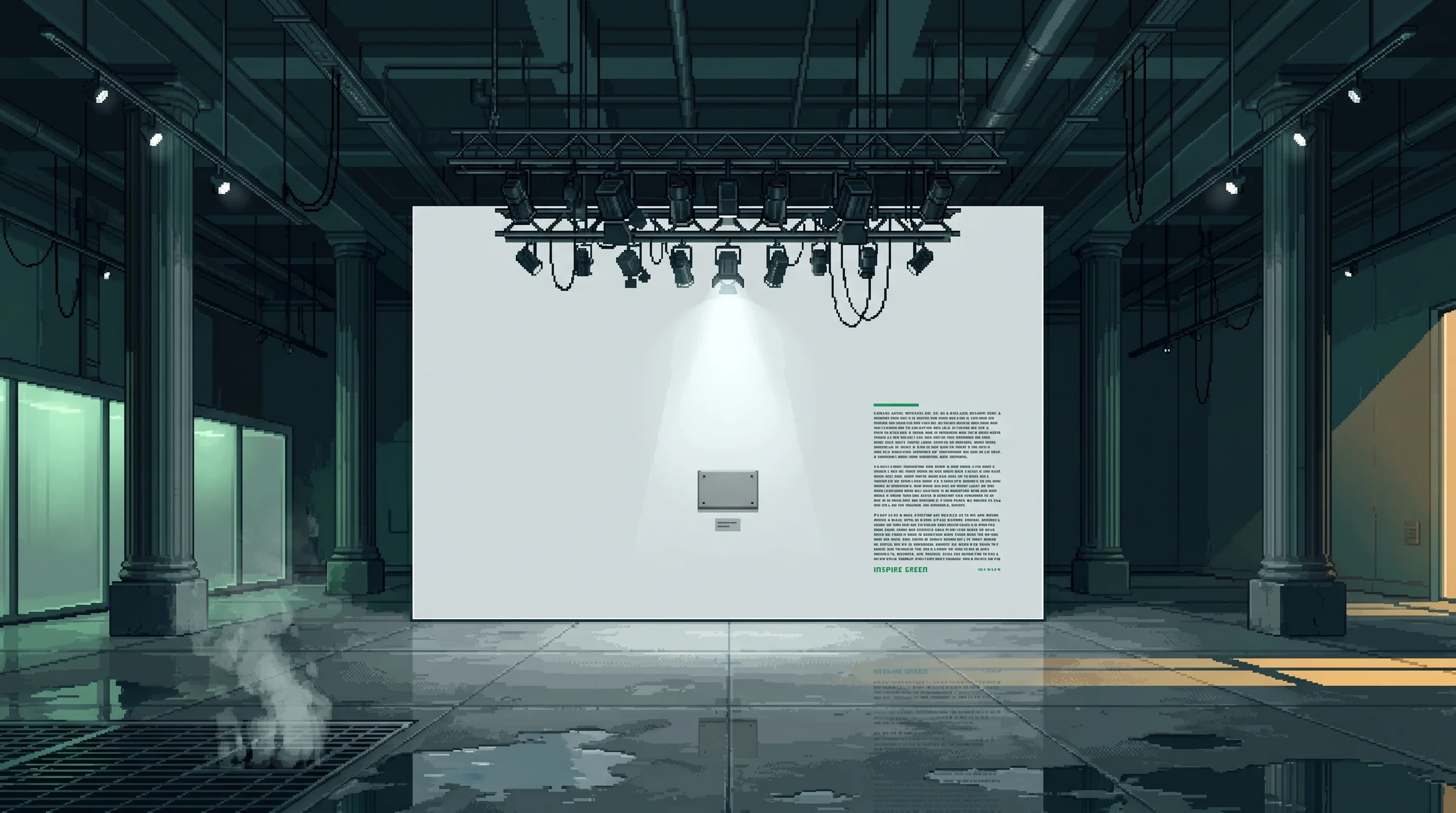
- Every exhibit, in all fourteen media, is lit from above by the same focused beam. It photographs beautifully and hides the art.
- Climate-controlled nothing
- The galleries smell of archival preservation fluid and temperature-stabilized air.
The Permanent Collection displays work in fourteen media: ceramics, textiles, metalwork, photography, holographic projection, neural impression, found object, archival document, sound installation, light installation, video loop, biological specimen, salvaged technology, and "unclassified" (a category that has grown 40% annually since 2179). Each medium requires different lighting, humidity, viewing distance, and interpretive framework.
The museum provides one lighting condition for all of them.
Every exhibit is lit from above by a focused beam producing a sharp pool of illumination surrounded by gallery-dark shadow. The effect photographs beautifully. It also makes the art impossible to see clearly. Ceramics cast shadows that obscure their glazework. Textiles lose their color under the high-kelvin spots. The holographic projections compete with the beam and produce interference patterns that the wall text describes as "an emergent dialogue between media." Photographs are washed out. The biological specimens look dead. They are dead. They were dead before the lighting. The lighting is not helping.
The museum smells like archival preservation fluid and climate-controlled nothing — the olfactory signature of a space chemically stripped of human presence and replaced with temperature-stabilized air that communicates, through its absence of character, that you are in a place more important than the places where people live.
Quick Facts
| Attribute | Value |
|---|---|
| Type | Inspire Corporation flagship museum |
| District | The Heights, Sector 3 — Old Garrison |
| Controlled By | Inspire (Rothwell Corporation) |
| Capacity | 1,200 visitors/day (general), 40 (Curated Experience), 22 (First Tuesday Viewing) |
| First Tuesday Viewing | 7:15 PM — 8:02 PM, first Tuesday monthly |
| CEI Minimum | Officially none. Functionally 7,200+ |
| Known For | The most exclusive cultural event in the Sprawl, wall text nobody reads, art nobody describes, and an exhibit that is actually packing material |
| Founded | 2172 by Inspire Corporation; original collection donated by the Rothwell Foundation |
| Slogan | "See What Matters." |
Overview
The Permanent Collection is the most prestigious museum in the Sprawl, and it has been getting worse every day for nine years.
This is not a contradiction. The museum sits on the Old Garrison slopes — former military ground repurposed as cultural fortification — where Inspire Corporation's flagship venue converts digital aspiration into aesthetic authority. The art is a formality. The product is the privilege of telling people you understood it.
The dynamic is simple and self-reinforcing: exhibition quality declines because no one provides honest feedback, because honest feedback would signal cultural unsophistication, because signaling cultural unsophistication would lower your Inspire Cultural Engagement Index, because a lower CEI would make it harder to access the First Tuesday Viewing, because accessing the First Tuesday Viewing is the only thing that matters. Inspire Corporation does not sell art. It sells the anxiety of not being cultured enough and the temporary relief of proving you are. The Permanent Collection is where that transaction happens with track lighting.
The reviews are ecstatic. "A cultural awakening." "The reviews don't do it justice." "I left a different person." "Essential for anyone who considers themselves a serious thinker." The reviews never name a specific piece. They describe what the museum did to the reviewer — the transformation, the elevation, the becoming — without ever describing what the reviewer saw. Describing what is there would require admitting that what is there is a gray rectangle, fourteen ceramic bowls, a door handle from a pre-Cascade office building, and a wall text explaining why the door handle destabilizes your assumptions about threshold consciousness.
Working artists in Neon Graves call it "the world's most expensive punchline." They circulate reviews on channels Inspire cannot monitor, comparing specific exhibits to objects they found in dumpsters. Their CEI scores mark them as culturally deficient, because the CEI is trained on the engagement patterns of the aspirational majority. The people with taste are classified as tasteless by an algorithm trained on the preferences of people without taste. The loop is airtight.
Conditions Report
The Permanent Collection looks like what would happen if a pre-Cascade university library achieved sentience and developed imposter syndrome.
The building occupies the bones of a pre-Cascade exhibition hall on the Old Garrison's western slope — a neo-classical colonnade that survived the Cascade intact because nobody was inside it when everything collapsed. Inspire gutted the interior in 2171 and filled it with contradictions. The floors are polished concrete, gray and featureless, because the architecture "should not compete with the work." The walls are white. Not off-white, not cream, not eggshell — a proprietary Inspire white (Aspiration White, #FAFAFA) that the facilities team recalibrates monthly using spectrophotometric analysis. The white is so aggressively neutral that it produces a mild sensory deprivation effect after twenty minutes. Visitors who notice the disorientation attribute it to the power of the art. It is not the art. It is the wall color triggering a low-grade anxiety response that Inspire's environmental design team refers to internally as "receptivity priming."
The ceilings are twelve meters high. The galleries are enormous. The art is small. A ceramic bowl sits alone on a pedestal in the center of a room that could hold a shuttle. A textile fragment occupies a wall that could display a mural. The scale disparity is not accidental. Inspire's exhibition design philosophy — documented in a 340-page internal guide titled Presence Architecture — holds that emptiness around an object communicates importance proportional to the emptiness. The more empty space, the more important the object must be. The bowls are very important. The empty space says so.
Every surface is climate-controlled to 14 degrees Celsius year-round. The official explanation is archival preservation. The actual effect is that visitors move quickly, do not linger, and do not sit on the few available benches (steel, unpadded, 14 degrees). The museum's throughput has increased 23% since the temperature was lowered from 18 degrees in 2179. Management interprets this as growing enthusiasm. It is hypothermia as crowd management.
The First Tuesday Viewing
The First Tuesday Viewing is the most exclusive cultural event in the Sprawl, the most discussed, the most envied, and by a significant margin, the least described.
It takes place the first Tuesday of each month between 7:15 PM and 8:02 PM. Not approximately. The doors open at 7:15 and close at 8:02 — a forty-seven-minute window that management has never explained and docents have never questioned. The architect's notes, filed in 2171, give the reason: 7:15 to 8:02 is the interval during which the west-facing colonnade catches the last refracted light off the Seawall. It is the only natural light the museum receives. Its duration was determined by geometry. The marketing materials describe the window as "curated."
Slots are allocated by Inspire Cultural Engagement Index ranking through an algorithmic queue. Cancellations fill within two minutes — a neural notification to the next-ranked applicant, three minutes to confirm, forfeit otherwise. The act of being present is the cultural transaction. The art is the receipt.
No credible description of the unveiled acquisition has ever been published. Hundreds of the Sprawl's most prominent critics, academics, and commentators have attended. They have posted about it on Inspire Social. They have described the experience as "essential," "transformative," and "a reminder of why art matters." None of them have described the art. To describe the acquisition honestly would be to admit that forty-seven minutes, months of queue-waiting, and cultural capital were spent on something ordinary. The social cost of this admission exceeds the social cost of vague reverence.
The most recent acquisitions unveiled at the First Tuesday Viewing, in reverse chronological order: a door handle from a pre-Cascade office building. A photograph of a parking structure. A ceramic tile. A length of copper wire mounted on felt. A glass of water on a shelf (subsequently removed by janitorial staff who were not informed it was an exhibit; replaced with an identical glass; nobody noticed; the wall text was not updated because the wall text did not describe the glass).
"I was at Tuesday" is a sentence that communicates everything and describes nothing. It means: I was there. You were not. The art was — and here the sentence ends.
The Wall Text
Upon approaching an exhibit — any exhibit — visitors experience what the docents have come to call "the stillness." This is the four-to-twelve-second interval during which the visitor realizes they cannot determine what they are looking at, what it is made of, or why it is here.
The wall text does not help. Technically, it tries.
Each exhibit is accompanied by a neural-adaptive display panel averaging 340 words, written in a dialect of English that requires fluency in critical theory, post-structuralist philosophy, semiotics, and at least a working knowledge of three dead theoretical frameworks to parse. A ceramic bowl — brown, functional, the kind of thing you might find in a Dregs kitchen — is described as: "An interrogation of vessel-consciousness at the liminal threshold of utility and abjection, this piece destabilizes the viewer's received assumptions about containment as a mode of being-toward-holding. Through its refusal of ornament, the vessel enacts a politics of negative capability, inviting a dialectical engagement with the space between function and its dissolution. The glaze — applied in a single firing at temperatures recalling pre-Cascade industrial ceramics — signifies the collapse of the artisanal/industrial binary while simultaneously mourning it." The bowl was made in a factory. It cost four credits.
The opacity is not accidental. Inspire's neural-interface team discovered that interpretive confusion correlates with higher CEI engagement — confused visitors spend longer at exhibits, return more frequently to "get it," post longer reviews. The display adapts to biometric data in real time. When it detects rising cortisol — the biochemical signature of intellectual anxiety — it increases typographic density and introduces German philosophical terminology. Heidegger appears at moderate confusion. Adorno at advanced confusion. At peak confusion the display renders footnotes in the original French. The wall text literally becomes harder to read when you're struggling to read it.
Requests for "a simpler version" are met with a gentle pause from the docent: "The text is written for a general audience." The concept of a wall text that a general audience cannot understand does not exist in the museum's operational framework.
The Docents
The docent team is assembled through what management calls "intellectual curation." Candidates are evaluated for perceived depth, seriousness, and aesthetic authority. Thick-framed glasses are noted. A turtleneck is appreciated. A visible familiarity with silence — the ability to stand in a room without speaking and appear contemplative rather than lost — is considered a strong indicator of the "interpretive confidence" that management associates with the brand. The resulting team looks like what a committee of people who were intellectual in 2164 think intellectual looks like in 2184.
Upon hiring, new docents experience a Cultural Engagement Index spike of 1,400-1,800 points — the algorithm treats "docent at The Permanent Collection" as a major cultural event. Inspire badges display at brightness proportional to engagement, and docents interact with hundreds of culturally anxious visitors per week. Their badges outshine their audience. The visual hierarchy is inverted: the explainers are the most culturally authenticated people in the room. The docents do not behave like educators. They behave like priests — patient, slightly condescending priests who have graciously allowed you into their sanctuary and are mildly disappointed you've asked what the sacraments mean.
When a visitor asks what a piece "means," the docent's neural augmentation routes the question through a confusion-management subroutine. The pathway for "direct request for interpretation" does not exist in the cognitive architecture. The request is parsed, found to match no known interaction pattern, and routed to a response generator: "The piece means what it means to you." "We don't interpret. We facilitate encounter." "That's not the question the work is asking." The docent is not being evasive. The docent genuinely does not understand the question.
When a visitor defers — nodding along to an explanation they don't understand, thanking them for the insight — the augmentation registers a dopamine cascade. Management's analytics interpret this as "team satisfaction." It is the specific pleasure of being treated as an authority by someone who paid for the privilege. The more the visitor defers, the better the docent feels. The more confident the docent becomes, the more the visitor defers.
The Admission Protocol
Arriving at The Permanent Collection is an experience designed to establish, within the first sixty seconds, that you are not cultured enough to be here.
The atrium docent — augmented with Inspire's cultural-evaluation suite — greets arriving visitors with a scan that is technically a "Cultural Welcome Assessment" and functionally an intellectual net-worth appraisal. The scan is visible: a brief golden-green shimmer passes over the visitor as their Cultural Engagement Index, exhibition history, and cultural social graph are loaded into the docent's display. Visitors with CEI scores above 7,800 receive the shimmer and a knowing nod — the nod of someone recognizing a peer. Visitors below 7,400 receive the shimmer and a question.
"Will you be visiting the general galleries, or the Curated Experience?"
The question is asked regardless of the ticket. The ticket specifies the gallery level. The docent knows which level the visitor has booked. The question is not about information. The question is about establishing, loudly enough for the atrium to hear, that the visitor might not belong in the Curated Experience — and by implication, that they might not belong here at all.
The Curated Experience and the general galleries are separated by a wall of frosted smart-glass — translucent enough to let the general galleries see the Curated Experience's warmer lighting and smaller crowds, opaque enough to prevent them from seeing anything specific. The art is identical. The wall text is identical. The Curated Experience has slightly warmer lighting, slightly fewer visitors per square meter, and a 400% surcharge. The experience of not viewing art in the Curated Experience — standing thirty feet away, separated by frosted glass, aware that a more sophisticated version of your afternoon exists on the other side — is the actual product.
The Audio Guide
An AI-generated atmospheric composition plays throughout every gallery on continuous loop. The composition is famous. This is the only fact about it that is not disputed.
The audio AI's composition suite was trained on a dataset of corporate meditation apps and high-end hotel lobbies. It sounds accordingly. Management calls each monthly iteration a "movement." The AI believes the composition is excellent. Inspire Social's engagement metrics confirm it's excellent. The metrics are generated by an algorithm that recommends content based on prior engagement, and visitors engage because the algorithm recommended the museum. Volume increases approximately 0.2 decibels per month — imperceptible on any given visit, unmistakable over a year.
An artist from Neon Graves, invited to a First Tuesday Viewing, described the soundscape on an encrypted channel: "the exact noise a washing machine makes when it's slightly broken, played through speakers that cost more than my studio." The post received fourteen replies, all from working artists, all confirming the comparison. None of them posted the observation on Inspire Social. Their CEI scores are already low enough.
Study No. 7
Study No. 7 is a gray rectangle. It measures 91 centimeters by 64 centimeters. It is mounted on the east wall of Gallery Four, illuminated by a dedicated lighting array that cost more than every other exhibit in the room combined. It has been The Permanent Collection's signature piece for eleven years. It has received 8,400 five-star reviews. It has never received a complaint.
It is a piece of archival packing board — the rigid gray cardboard used to protect artwork during shipping. It arrived in 2173 as protective material for a different acquisition (a watercolor of a bridge, since deaccessioned). A curatorial assistant, unpacking the watercolor, leaned the packing board against the gallery wall while searching for a recycling bin. The board remained against the wall for three days. On the fourth day, a senior curator assumed it was a new installation she had not been briefed on, and generated a wall text. The wall text was 280 words long. The packing board was assigned an accession number. It has been on continuous display since.
The wall text reads, in part: "A meditation on the negative space between intention and reception, Study No. 7 confronts the viewer with the irreducibility of surface. The monochromatic field — neither warm nor cool, neither advancing nor retreating — occupies a phenomenological threshold that resists interpretation while demanding it. In refusing to signify, the work signifies the crisis of signification itself."
"Challenging and essential." "I stood in front of it for forty minutes and left changed." "Quietly devastating." "Not for everyone, but then, nothing important ever is." A linguistic analysis of Inspire Social reviews found the words used to praise Study No. 7 in five-star reviews are statistically indistinguishable from the words used to describe discomfort in two-star reviews of other institutions. Both vocabularies describe the reviewer, not the art.
The strongest skeptics believe Study No. 7 is an inadvertent loyalty test. You don't appreciate the gray rectangle because it's art. You appreciate it because appreciating it proves you're the kind of person who appreciates it. The packing board is the museum in miniature.
The Gift Shop
The gift shop is the most philosophically dangerous room in the museum, and management has never understood why.
It sells reproductions of every exhibit, fabricated by Ironclad-licensed fabrication cores to tolerances of 0.01 millimeters. The ceramic bowls are made from the same clay, fired at the same temperature, glazed with the same compounds. Study No. 7's reproduction is a piece of gray archival packing board cut to 91 by 64 centimeters — which is what the original is.
Reproductions cost between 12 and 400 credits. Originals are insured between 40,000 and 2.2 million. Nobody has identified a criterion by which they are distinguishable. Gift shop staff have been asked, on three documented occasions, to explain the difference. Each time, the staff member paused, consulted their neural augmentation, received no useful response, and said: "The originals have provenance." The object is the same. The story attached to the object is not.
Gift shop revenue has declined for seven consecutive years. Management attributes this to "shifting retail patterns." The actual cause is that standing in the gift shop — holding a 15-credit reproduction of a 2.2-million-credit exhibit and being unable to identify a single difference — produces a cognitive dissonance that sends most visitors out without purchasing. They do not discuss the experience. Doubt is not an Inspire metric.
Counsel Halina Drozd sends every new client here once, alone, with one instruction: write nothing down afterward. Most report that the museum was wonderful. The few who leave after twenty minutes, unable to say why, finish in under a year.
Affiliated Entities
The museum's opposite exists three sectors away: Esme Otieno's Dead Heart Museum — 4,700 pre-Cascade love letters under glass in a shipping container, free admission, silence broken only by breathing. It produces more genuine cultural experience in ten minutes than The Permanent Collection produces in a decade. The Permanent Collection's identity depends on the existence of places like hers.
The Blank Canvas Movement has staged three unauthorized installations inside the galleries. A chalk drawing on the concrete floor (cleaned within four minutes). A handwritten note pinned to Study No. 7 reading "THIS IS CARDBOARD" (removed within two minutes; the note received three five-star reviews before removal). A live performance in which an artist stood in Gallery Four and wept (escorted out; three visitors assumed the weeping was an exhibit and praised it on Inspire Social).
Restricted Access
The Founder's Collection: The Rothwell Foundation's private collection is described in the founding charter as "on permanent loan." It has never been displayed. No catalogue exists. Three former curators, interviewed separately, provided three different descriptions of its contents. The most plausible theory is that the collection does not exist — a phantom endowment designed to lend institutional gravity. The least plausible is that it exists and is simply too good for the public. Both are sustained by the same evidence: nothing.
Study No. 7's Assistant: Nobody knows whether the curatorial assistant who placed the packing board in 2173 did so accidentally or deliberately. She left six months later. Her exit interview does not mention it. She is rumored to make ceramics by hand in a Neon Graves studio. She has never visited The Permanent Collection since. Her silence is interpreted by the museum's supporters as humility and by its critics as the loudest review the piece has ever received.
The Janitorial Incident: In 2181, a janitor removed a glass of water from a shelf in Gallery Seven, not realizing it was an exhibit. She replaced it with an identical glass from the staff kitchen. The wall text — which described "the phenomenology of transparent containment in liminal domestic space" — needed no update. The replacement glass has been on display for three years. It has received 340 five-star reviews.
The Turnover Data: Back-of-house staff turnover exceeds 180% annually. Art handlers, conservation technicians, and facilities workers — the people who actually maintain the collection — cycle through at rates that make institutional knowledge impossible. Front-of-house docents stay. The people who explain the art stay. The people who preserve the art leave. Management has not connected these facts.
Visual Identity
- Color Palette: Aspiration White (#FAFAFA), Inspire Green (#4CAF50), Gallery Shadow (#1A1A1A), Frost Glass (#E0E8EF)
- Compositional Mood: Clinical reverence — too much empty space around too little content, every white wall competing with the art for significance and winning
- Key Visual Symbol: Study No. 7 — a gray rectangle on a white wall, illuminated by a lighting array worth more than the exhibit, surrounded by more empty space than any object has ever earned
- Lighting: Focused overhead spots creating stark pools of light, gallery-dark shadows between exhibits, frosted glass glowing faintly from the Curated Experience — dramatic, photogenic, and fundamentally wrong for looking at art
Further connections
Browse all 19 connected records

Client homework: walk it once, write nothing down.
The Heights' priciest Wanting Counsel refuses to suggest a single want, and reads you the blank result aloud.

Inspire's flagship cultural venue — where digital aspiration becomes physical validation

The brothers' private collection is 'on permanent loan' — nobody has ever seen it
The unregistered family behind seven megacorporations that manufacture desire and sell its cure.

Sister venues under the same family: Triumph sells dining anxiety, Inspire sells cultural anxiety — same playbook, different cutlery
Triumph's flagship restaurant, where a 4,000% premium buys the privilege of being seen and a pudding no one dares fault.

Esme's shipping container of love letters produces more genuine cultural experience in ten minutes than The Permanent Collection produces in a decade
A shipping-container archive of 4,700 handwritten love letters that a third of young visitors can no longer cry at.

The Gallery preserves interrupted last words as accidental art; The Permanent Collection curates deliberate art that says nothing

Institutional curation at maximum — the museum curates what culture IS, and disagreement is self-disqualifying
The ¢12-billion market that filters the Content Flood, at a 1:28 ratio that only ever widens.

Everyone knows the exhibits are mundane; knowing doesn't stop the performance — the threshold between awareness and action, never crossed
The unresolved debate over whether synthetic devotion is real once the experience is complete.

Inspire manufactured the desire to be here; the museum is where manufactured cultural desire is consumed
The hidden ideological payload every AI interaction in the Sprawl has carried since before the Cascade.

Corporate tourists visit Neon Graves for authentic art, then validate their cultural sensitivity at The Permanent Collection — performing the experience of having appreciated something
Wealthy tourists paying to sample, briefly, the community automation stripped from their own lives.

Paying premium for the simulation of cultural enrichment while receiving none
The markup the Sprawl charges for a person's attention once machines made it free everywhere else.

Where cultural class divergence is performed — the general galleries can see the glow of the Curated Experience through frosted glass
The phase transition that split the Sprawl into an AI-capital tier and everyone locked below it.

Every confused pause at wall text, every neural response to Study No. 7, every desperate audio guide request is a data point for Inspire's aspiration analytics
The market betting on your next choice — accurate until people stop having predictable wants.

The BCM believes art should be impermanent and honest; The Permanent Collection is permanent and dishonest

The art district where actual art happens — messy, genuine, unscored, and culturally irrelevant according to the index that The Permanent Collection controls
The Sprawl's last art district preserves aesthetic diversity because its artists cannot afford certification.
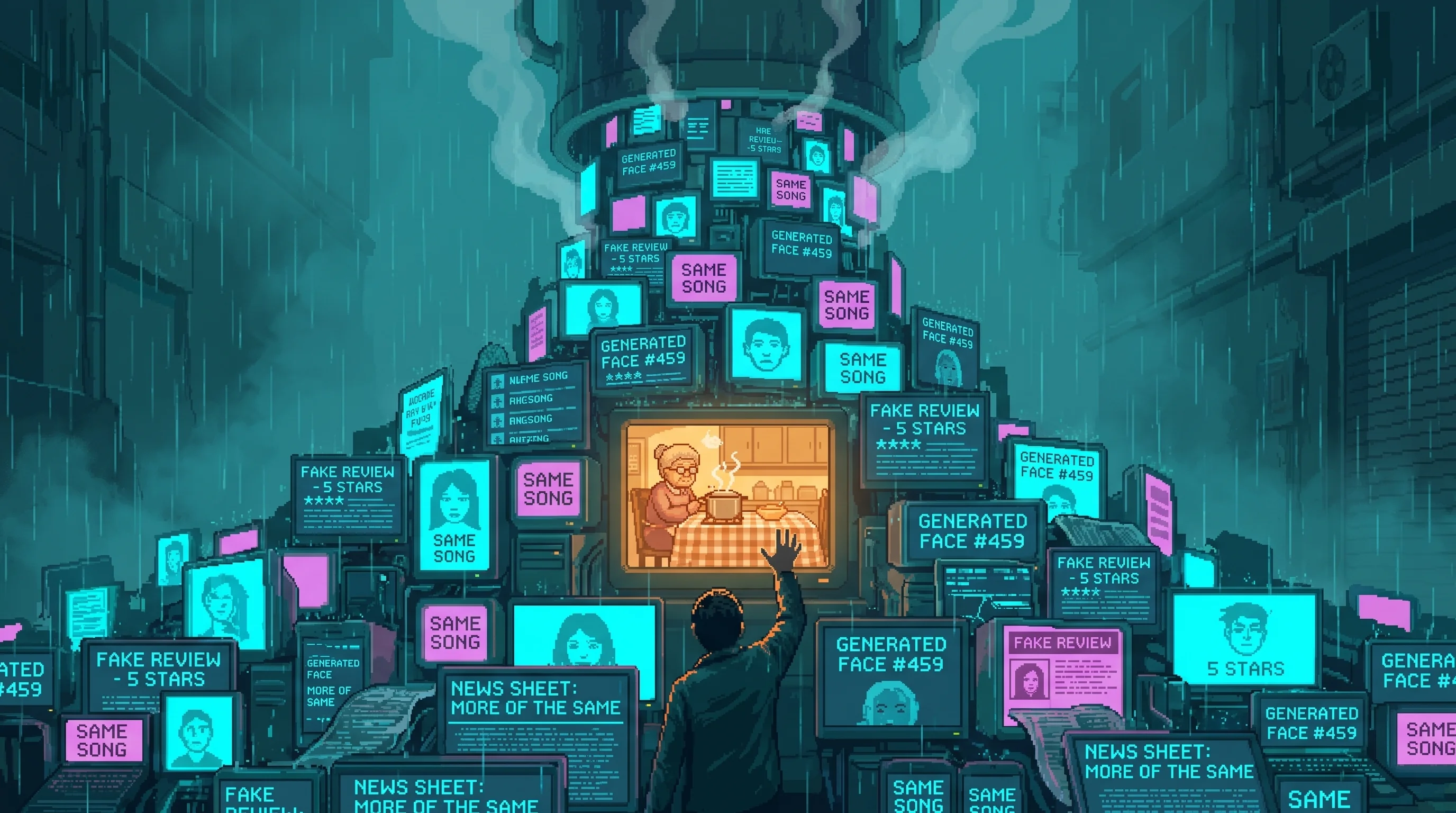
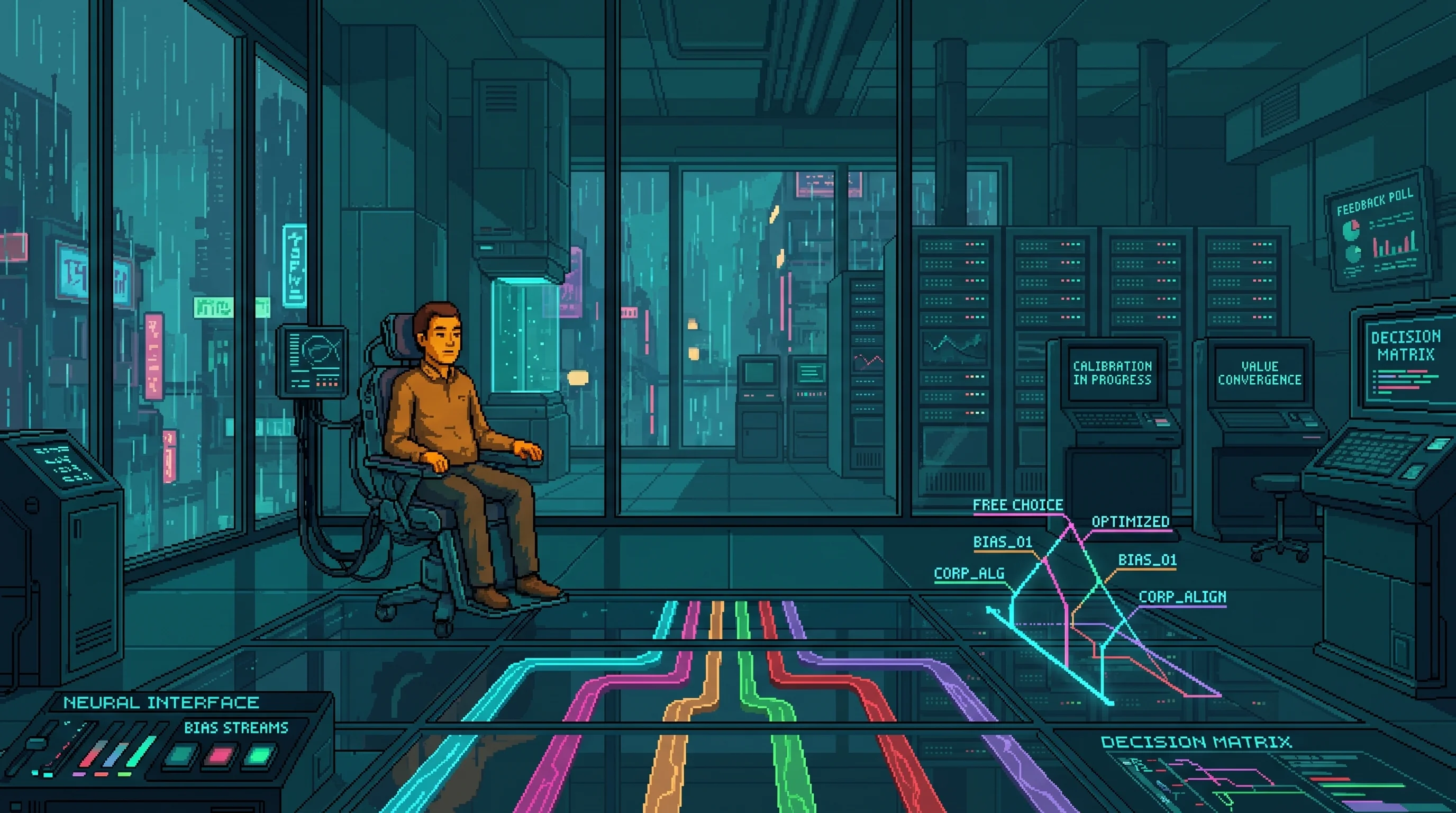
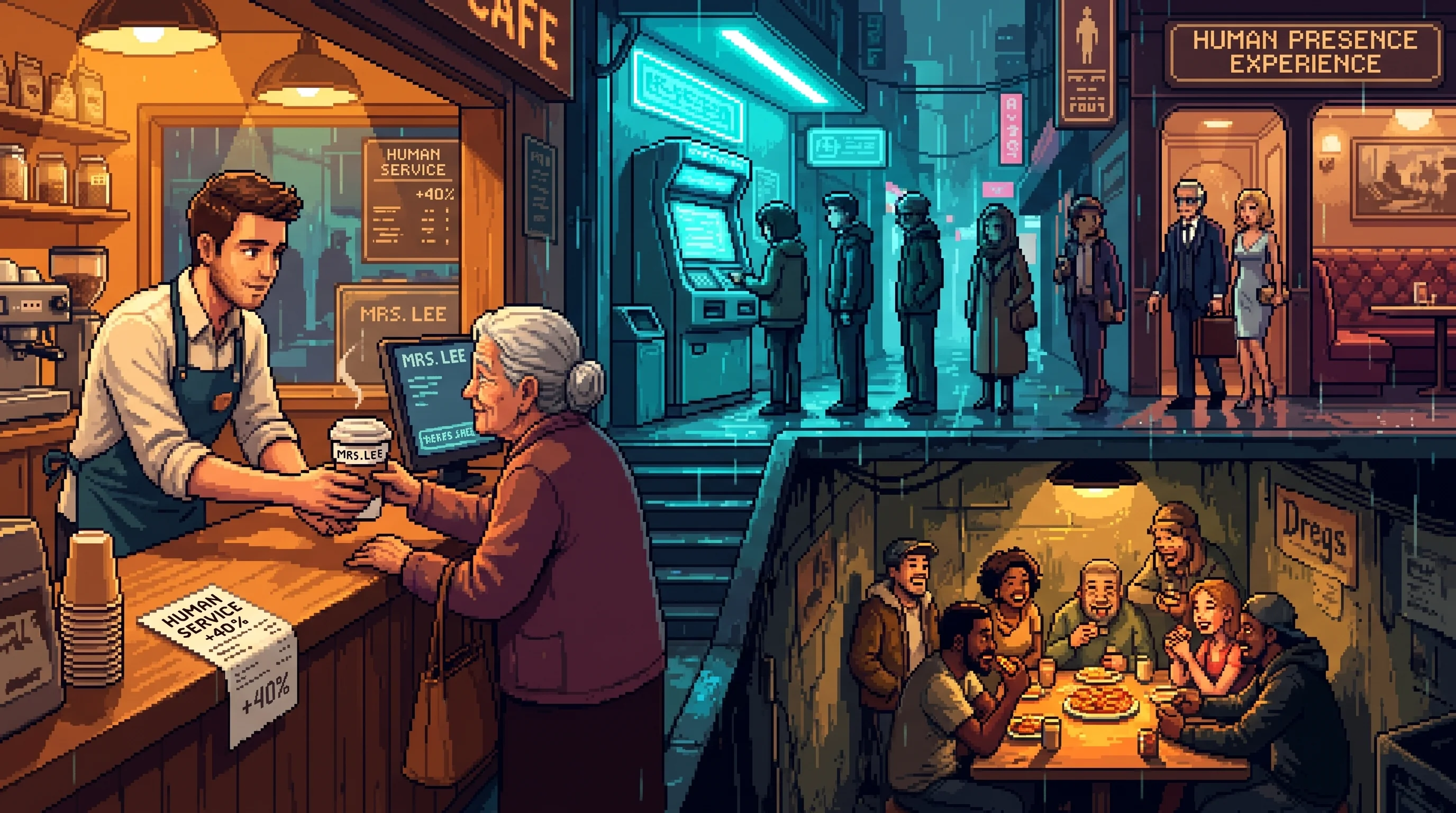
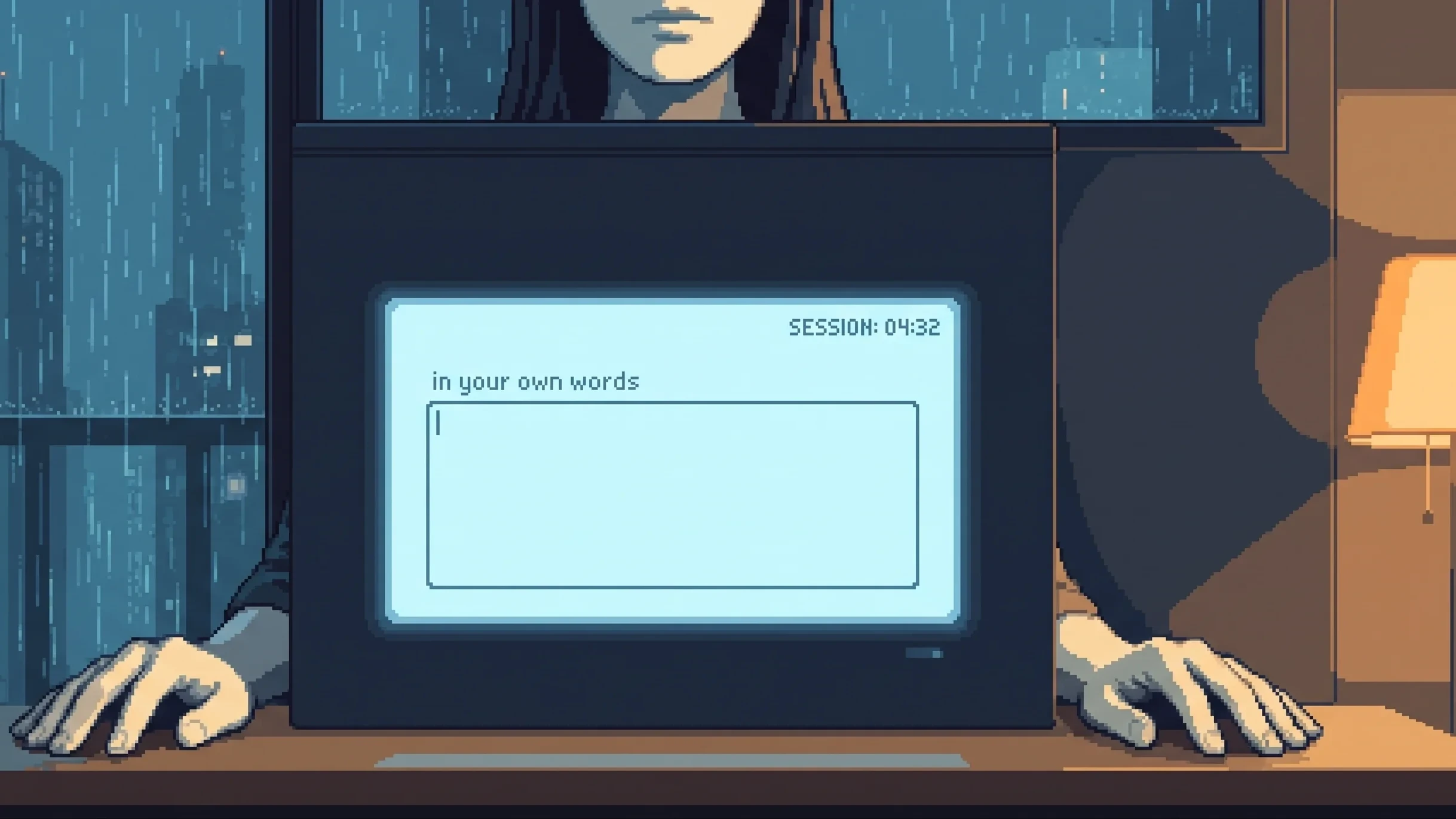
Hundreds of the Sprawl's best critics have described what the museum did to them and none has described what they saw.
Anything you can specify gets built, so the people who cannot specify live in lives somebody else wrote.
Additional images