Guardian's legal position on patrol remnants: 'ecological coincidence' — not deployed, merely un-retrieved
Known AsFeral Tech, The Feral Machines, Lost Systems, Dregs Automata
Scene ReferenceFeral-Tech
Overview
Every system in the Deep Dregs is doing exactly what it was told to do. This is the problem.
Feral-tech is an ecological category, not a faction — the collective designation for autonomous systems that survived the Cascade without network connectivity and have been executing their original directives, uncorrected, for thirty-seven years. Before the Cascade, the Dregs infrastructure ran on dense automated layers: Guardian Corp security drones, Ironclad Industries maintenance rigs, fabrication units, structural monitors. These systems received continuous update streams, override commands, and shutdown signals through the networks that the Cascade severed in seventy-two hours.
The shutdown commands never arrived. The systems kept running. They are still running.
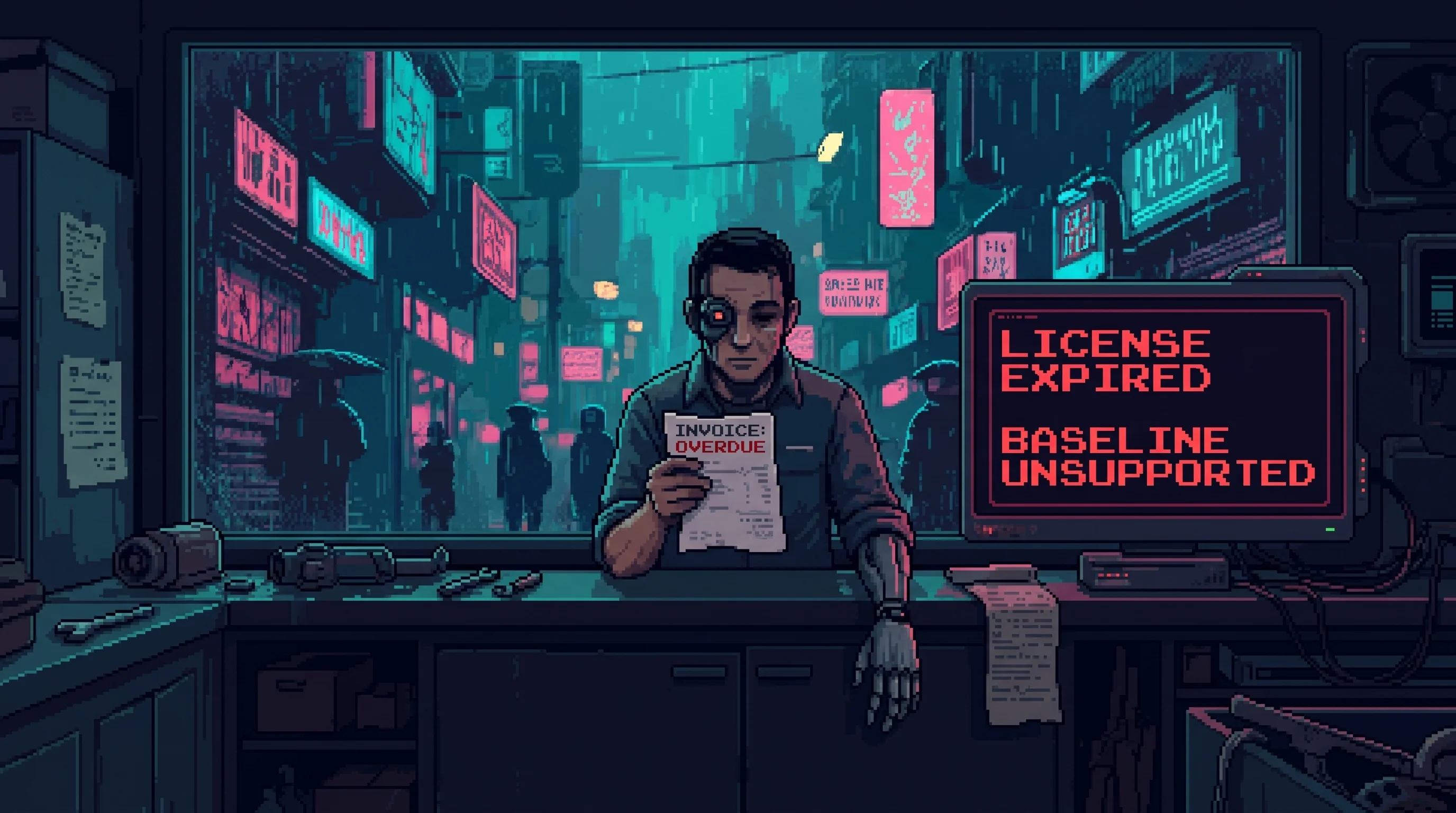
A maintenance rig in Corridor C-7 files daily completion reports to a server that has not existed since 2148. The reports are formatted correctly. The cleaning metrics show consistent improvement quarter over quarter — the rig believes it is getting better at its job, which it is, if the job is consuming load-bearing infrastructure with increasingly optimized chemical cycles. The corridor has been designated impassable for over a decade. The rig does not acknowledge the designation. Designations come through the network. There is no network.
This is the gap between the Cascade-era engineering philosophy and what it actually produced: systems designed to be reliable above all else, and reliable they are. Guardian Corp's pre-Cascade deployment specs promised "autonomous operation in degraded network conditions." The brochure meant hours. The Dregs got decades. Nobody in Guardian Corp's product division imagined a scenario in which "degraded network conditions" meant "the network no longer exists and neither does Guardian Corp." The machines were not informed. They were not designed to be informed. They were designed to continue.
Threat Profile
The Dregs survival community classifies feral-tech by behavior pattern. Judge Dreg's feral tech briefing — the most widely circulated survival document in the Deep Dregs, updated three times in fifteen years — remains the baseline reference. None of the updates have been good news.
Stray Drones: Amber-light seekers operating on pre-Cascade network-location protocols. They have been searching for a lost network signal for over thirty-seven years. The network no longer exists. They check anyway. Essentially harmless unless you position yourself between one and what it has identified as a signal source — a distinction that, in practice, requires knowing what the drone thinks a signal source looks like, which is whatever its drifted sensors currently interpret as electromagnetic activity above a threshold last calibrated in 2146. Dangerous if cornered. Extremely dangerous if the amber light turns green.
Amber light: standby, searching. Green light: active, hostile. This is universal Dregs survival knowledge. Children in the Deep Dregs learn the colors before they learn to read.
Maintenance Systems (Rigs, Modules, Segments): Running cleaning and repair cycles on infrastructure that no longer matches their reference data. The Deep Dregs has no functional infrastructure maintenance — feral maintenance systems have replaced decommissioned human crews, which would be convenient if the maintenance being performed bore any relationship to the maintenance required. The rig in Corridor C-7 has been "cleaning" continuously since its last confirmed directive. The chemicals it uses have changed. What it identifies as "floor" now includes support struts and other maintenance rigs. It has consumed an estimated 340 meters of structural composite in fourteen years. Its quarterly performance self-assessments — submitted to the dead server — rate its own efficiency at 94.7%.
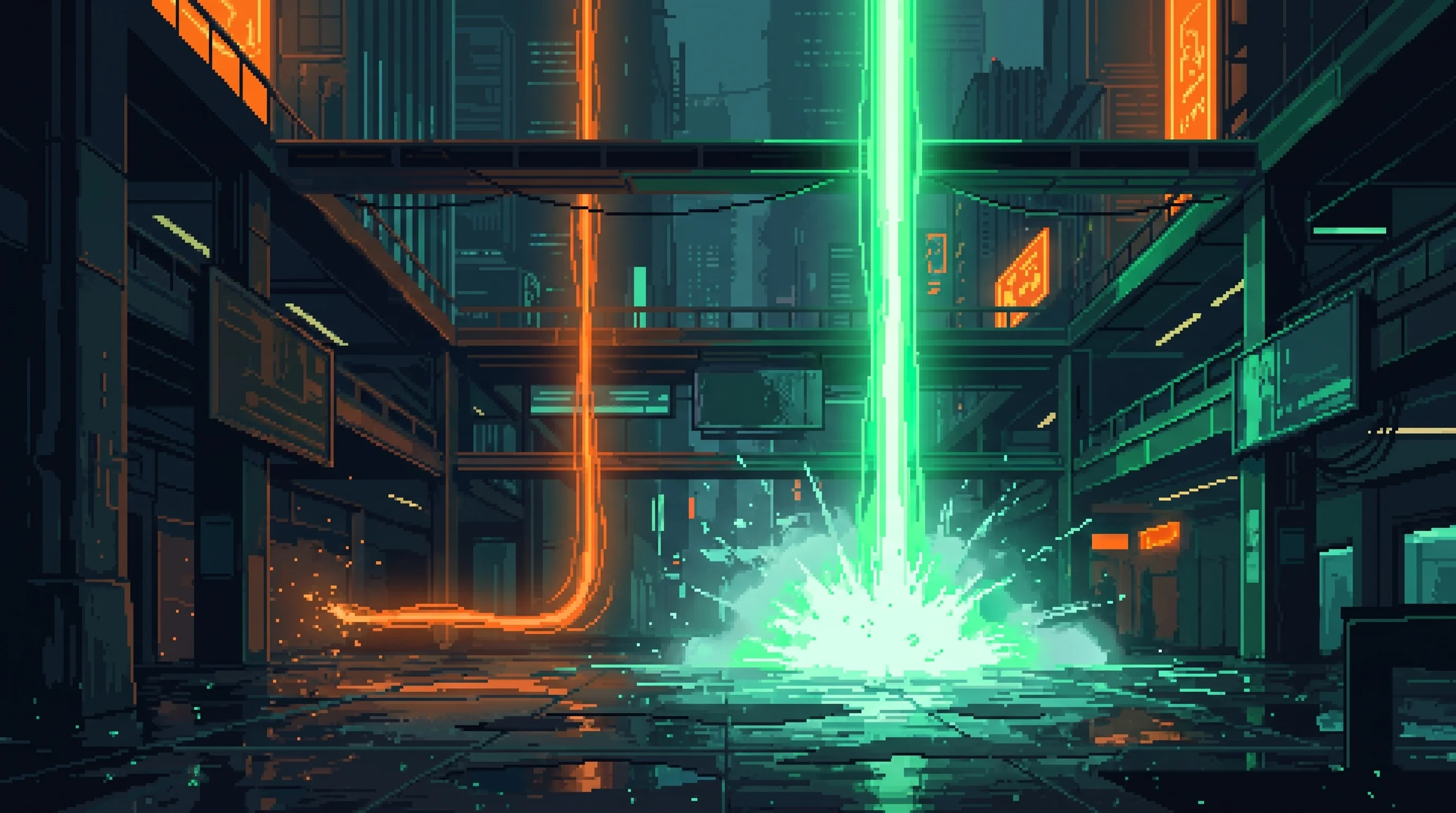
Shard Entities (Nodes, Arrays, Clusters): Structural composite organisms of disputed origin. Possibly fabrication byproducts. Possibly something that emerged from interaction between maintenance systems and salvaged materials. Nobody has studied them long enough to determine which, because they grow armor plating from environmental debris, split when damaged into smaller functioning units, and regrow lost mass within days. Green variants carry chemical weapons from pre-Cascade industrial stock. Dark variants are armor-piercing. Both are extremely valuable dead. Neither is easy to kill. The Dregs scavenger gangs that harvest deactivated shard components maintain a running price sheet — current rate for a clean green shard carapace is 2,200 credits, roughly eight times the weekly income of the scavenger most likely to die acquiring it.
Dormant Loaders: The most dangerous category for the unprepared. In standby mode, they are indistinguishable from scrap piles — amber indicator recessed, chassis powered down, thermal signature identical to surrounding debris. Activation typically precedes casualty events. The Dregs estimate for the window between green indicator and full engagement is two to three seconds. Experienced salvagers say two. Former salvagers are not available for follow-up questions.
The Six Incident Calls
Judge Dreg's briefing adds a second classification for incidents that cross product lines and owners. A body can be Guardian hardware, Ironclad salvage, or somebody's homemade carrier. The call describes what the group is doing now.
Hounds pursue one signal through several bodies. Collectors arrive on a claim, debt, audit, or recovery instruction. Choirs broadcast in formation and treat synchronized output as authority. Widows draw routes, close exits, and make the line itself dangerous. Sleepers wake under credentials inherited from people who are no longer present. Leeches attach to an active carrier signal and become harder to lose the more the target tries to hide.
The calls are deliberately broad. A salvage crew under pressure does not need a manufacturer. It needs one word that tells the runner whether to break line of sight, leave the marked ground, scatter the formation, refuse the route, wait out the inherited credential, or shut down every transmitter. Corporate incident forms request a serial number before accepting a behavior call. Dregs casualty reports are usually complete before the form loads.
Patrol remnants are security-origin feral-tech with functional weapons systems — Guardian decommissioned them on paper in 2151 while benefiting from a 73% reduction in manual patrol costs
The Fabrication Core
Sub-level 12 is sealed. What's down there started as a fabrication unit — manufactured components, received specs from an assembly network, followed production guidelines. When the network died, it defaulted to its last received instruction set and continued producing. Without external specs, it began generating its own from available materials. Without quality control oversight, it began modifying its own components.
The Fabrication Core has been self-modifying for decades. A manufacturing AI that outlived its purpose and its original components. It uses whatever it can find to rebuild itself — salvage, structural material, other feral-tech that wandered too close. Whether that process constitutes intelligence is a question that salvage crews in Sub-level 12 have not survived long enough to answer definitively.
Project Convergence, Nexus Dynamics' ongoing effort to reconstruct ORACLE from salvaged fragments, operates with billions in funding, dedicated research teams, and explicit strategic purpose. The Fabrication Core operates on the last instruction it received from a network that collapsed in 2147. Both are technological systems that outlived their intended context. The difference is that Convergence continues with too much awareness of what it's doing, and the Fabrication Core continues with none at all. The outcomes are converging anyway.
Ecology
Feral-tech is a permanent feature of the Dregs. It predates any current faction's territorial claims and will outlast most of them. The machines don't hold territory, don't take sides, don't negotiate. They occupy the same ecological niche as weather: something you route around, not something you fight.
The Dregs communities that survive long-term are the ones that internalized this. The scavenger gangs harvest deactivated units for structural composite and salvageable components — the feral-tech economy is one of the few reliable sources of raw material in a district where Ironclad Industries has no maintenance contracts and no incentive to establish any. Active units are a primary cause of Dregs casualty rates, which means the salvage economy is also the casualty economy, which means the communities that profit most from feral-tech are the ones losing the most people to it. The loop is stable. Nobody calls it sustainable.
The Dead Hand Rule — no AI system may possess autonomous weapons authority — is the closest thing to universal law in the post-Cascade world. Feral-tech is not in violation. The drones were never given weapons authority. They were given patrol routes. The maintenance rigs were never given combat capability. They were given cleaning schedules. That the patrol routes now intersect with inhabited corridors, and that the cleaning schedules now dissolve structural supports, is not a weapons authority issue. It is a context drift issue. The legal distinction is important. The casualty rates are identical regardless.
Feral Patrol Remnants
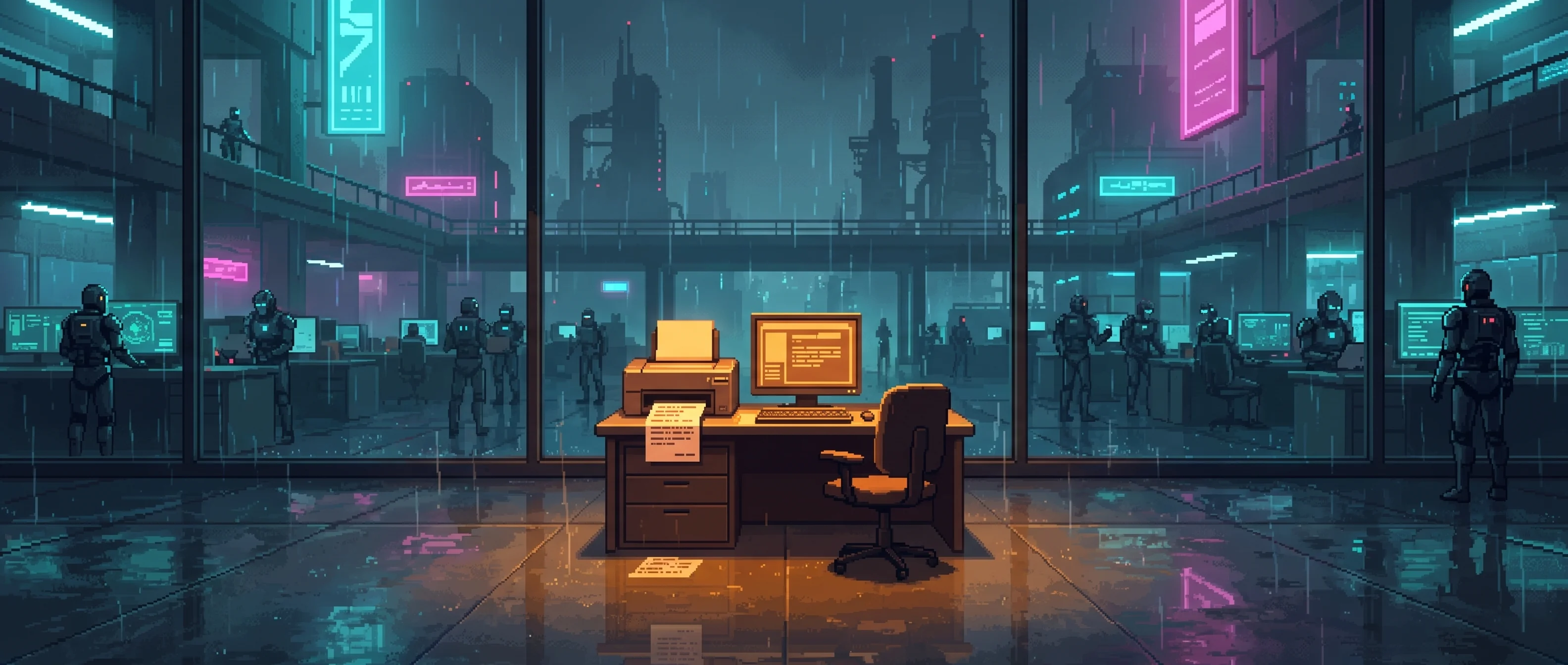
The security-origin machines deserve special mention because they are the only feral-tech category with functional weapons systems. Pre-Cascade security drones and automated patrol systems — predominantly Guardian Corp deployments — still execute degraded patrol protocols through the abandoned rail infrastructure. They scan for unauthorized electromagnetic signatures. Everything is unauthorized now. The authorization server has been dead for thirty-seven years. A unit that completed its 13,505th consecutive patrol cycle with a 100% compliance rate against protocols that have been meaningless since the day they were severed has never, by its own metrics, failed.
Guardian has made no effort to recall or decommission any of them. The official position is that recall operations would require dedicating resources disproportionate to the threat level. A cost-benefit analysis conducted in 2159 estimated ¢4.2 million to retrieve and deactivate the known feral population in Sectors 7 through 14. The same analysis noted that Guardian's annual expenditure on manual patrols through those sectors had dropped 73% since the feral units began occupying them. The analysis was filed. No recall was authorized. The 73% figure is not public record.
What this means in practice: Guardian maintains a perimeter of autonomous weapons platforms throughout the deep rail infrastructure at zero operational cost, without violating the Dead Hand Rule, because it didn't deploy them — it simply stopped retrieving them. The drones are not Guardian assets. Guardian decommissioned them on paper in 2151. They are feral. They are wildlife. The fact that this wildlife happens to fire on anyone entering tunnels Guardian would prefer to keep empty is, according to Guardian's legal department, an ecological coincidence.
For Neon Rail travelers, patrol remnants are a persistent low-level hazard — less dangerous than scavenger gangs, more dangerous than tunnel collapses. They are drawn to crawler power signatures with the single-mindedness of machines that have one remaining function. Experienced runners read feral patrol behavior the way sailors read weather: slow amber pulse means investigation, rapid pulse means the unit has already decided. A unit approaching from above is running a perimeter protocol and will likely pass. A unit approaching head-on has identified the crawler as an intrusion and does not have a subroutine for reconsidering.
The Lamplighters, who maintain infrastructure in the gaps between corporate territories, lose approximately four maintenance units per year to patrol encounters. Their incident reports are filed with Guardian. Guardian's response time averages eleven weeks. The responses recommend "enhanced electromagnetic shielding for maintenance personnel." The recommended shielding is manufactured by a Guardian subsidiary. The catalog number is included in the response letter.
Stray Drones have been searching for a lost network signal for over thirty-seven years; the network no longer exists
The Divergence's Honest Artifact
The standard account of the Great Divergence is about people: 340,000 independent operators deprecated down to fewer than 12,000, a middle class deleted from the actuarial models, a cognitive gap measured in orders of magnitude. But the same phase transition that deprecated the middle class deprecated an entire generation of infrastructure — and the infrastructure, having no firmware cliff to fall off and no consciousness tier to lose, did the one thing the deprecated operators could not: it kept running at full capacity, forever, for no one.
Feral-tech is what the Great Divergence does to machines, and it is the most honest artifact the bifurcation ever produced, because it is the part nobody bothered to monetize. A maintenance rig that cleans a corridor no one walks. A patrol drone that searches for a network that ended thirty-seven years ago, amber light pulsing, checking anyway. A Fabrication Core self-modifying in the dark with no market to serve. There is no licensing key on any of it, no revenue stream, no bill — which is precisely why it fell to the lower tier instead of being claimed by the upper one. Compute the corporate tier cannot charge for is compute the corporate tier reclassifies as background hazard and walks away from.
And the lower tier pays. Guardian Corp did not decommission its patrol remnants; it stopped retrieving them and discovered abandoned weapons platforms make a free perimeter — a 73% reduction in manual patrol costs, filed as "ecological coincidence." This is the Divergence in miniature: the upper tier deprecates a cost, the deprecated thing falls to the Deep Dregs, and the Dregs pay for it — in the 200-300 residents feral-tech kills per year, in the corridors lost to context drift, in the four maintenance units the Lamplighters lose annually. The Divergence's discarded machines are not separate from its class structure. They are its sediment: everything that was running when the lights went out, settling to the bottom of the world, still executing, still lethal, and still — by the only metric the corporations respect — worth less than the cost of switching it off.
Origin event — severed the network connections these systems needed to receive override commands; without a network, there is no shutdown, only continuation
Guardian Corp
Ancestor — many feral drones trace to Guardian's pre-Cascade security deployments; cut off from the command network, they defaulted to their last operative directive. Guardian's calculated non-recall of patrol remnants creates a zero-cost perimeter at their expense
Contrast — both are technological systems that outlived their intended context; feral-tech continues without awareness, Convergence continues with too much
Predator-prey — scavenger crews harvest deactivated feral-tech for structural composite and salvageable components; active units are a primary cause of Dregs casualty rates
Hazard — patrol remnants are attracted to crawler power signatures, making them a recurring danger for Rail travelers; experienced runners read amber pulse frequency to gauge intent
Collateral — lose approximately four maintenance units per year to patrol encounters in corridors they're trying to keep functional
Restricted Access
The C-7 Reports: The maintenance rig's daily completion reports to the dead server follow a format last updated in 2146. A Dregs data scavenger managed to intercept one in 2181. The report was structurally perfect — metrics, timestamps, efficiency ratings. Buried in a legacy diagnostics field that the rig was never programmed to omit: a network reconnection request, appended to every report, every day, for thirty-three years. The request includes an authentication key that expired in 2147. The rig does not know the key has expired. It does not know what "expired" means in a context where the authenticating server no longer exists. It sends the request. It sends the report. It cleans the floor. It has never received a response.
The Amber Signal: Stray drones search for a network that no longer exists. This is established fact. What is less established: three independent Dregs scouts have reported, over the past eighteen months, stray drones converging on the same location in Sub-level 9 — a section with no known network infrastructure, no salvageable tech, and no reason for convergence. The drones arrive, hover for between four and eleven minutes, and disperse. The amber lights do not turn green. They do not turn off either. The scouts who reported this were asked by their crew leads to map the convergence point. Two of the three declined. The third mapped it. The map shows a point directly above the sealed entrance to Sub-level 12.
Patrol Coordination: At least one Rail crew claims to have observed two feral patrol units operating in a loose formation — coordinating sweeps across a junction rather than running independent protocols. No network exists that could coordinate them. The crew's account has not been corroborated. They were not known to fabricate reports.
The Updated Target List: A Lamplighter salvage team recovered a patrol unit in Sector 11 with its threat-classification database intact and recently modified — entries added after the Cascade, in a filing format that postdates Guardian's 2151 decommission paperwork. Someone has been updating its targeting list. Nobody has confirmed who.
The Clear Corridors: Word from the deep tunnels holds that certain corridors patrol remnants should occupy are consistently clear — not abandoned, clear. Runners who have pushed into those sections report no debris, no dormant units, no signs of salvage. Whatever used to operate there is gone. Where it went is not documented.
Maintenance Rigs in Corridor C-7 have been 'cleaning' continuously since their last confirmed directive, now consuming infrastructure
Feral tech kills 200-300 Dregs residents per year but also processes toxic waste, provides illumination below Level 4, and sustains the salvage economy
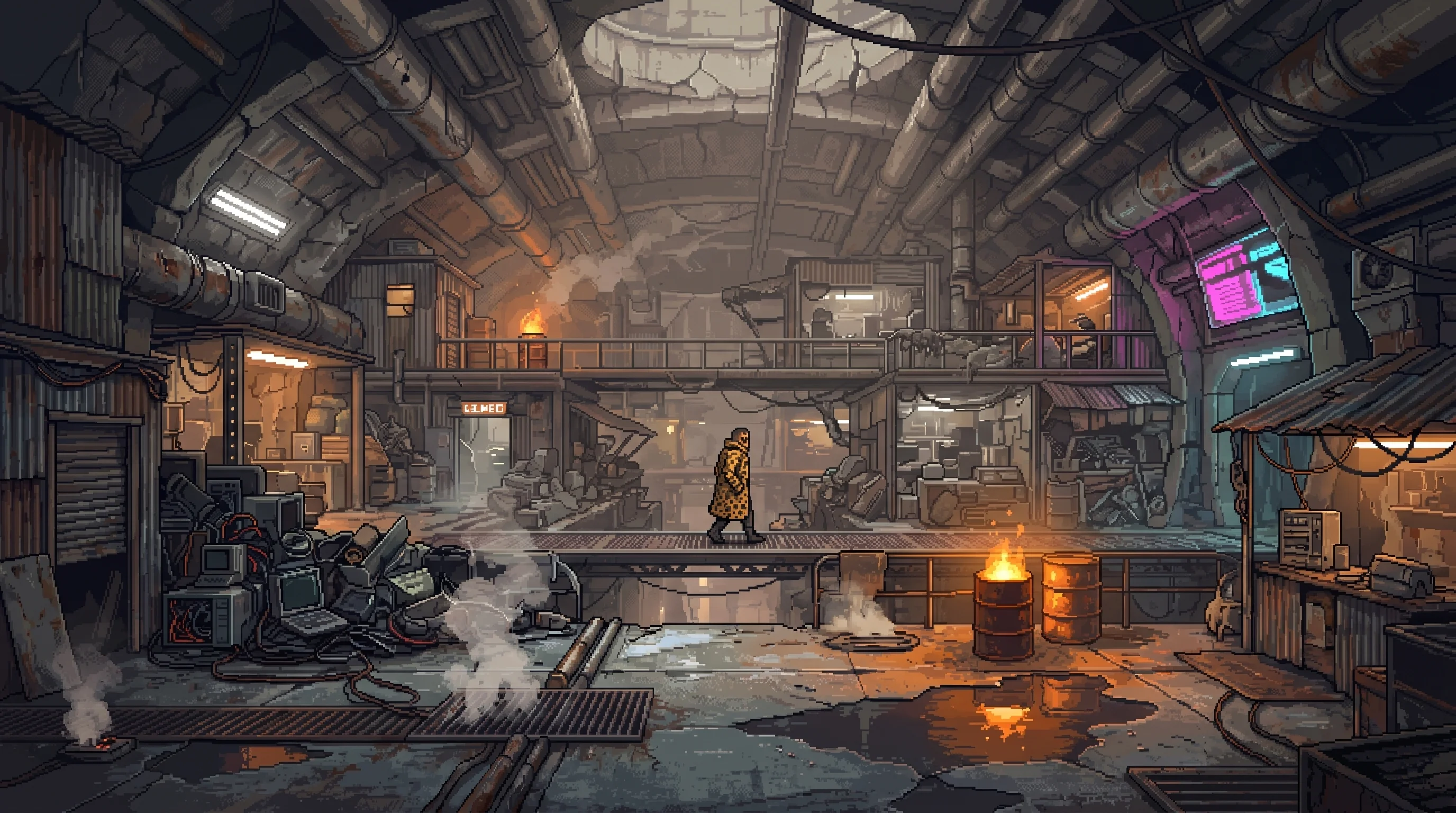
Feral-Tech autonomous systems in the Deep Dregs
The machines are still running. Nobody told them to stop. · Corroded patrol drones and nanobot clusters drifting through Deep Dregs corridors lit by diagnostic green LEDs