
The Instantiation Debt
The Instantiation Debt is the audited, itemized cost of bringing a consciousness into existence — the principal the Autonomy Ledger amortizes into personhood
Overview
The number itself has a methodology, and the methodology is where the horror lives.
The Instantiation Debt is the line-item accounting of what it cost to make you — the principal that the Autonomy Ledger amortizes into personhood. Good Fortune's actuarial division, the same division that deleted the middle class from its models in 2178, maintains the standard cost schedule. A born child's instantiation debt in the Dregs runs to roughly ¢180,000 by the Ledger's audited tally: ¢40,000 for the mandatory neural interface, ¢70,000 in developmental-substrate subsidy — the licensed cognitive scaffolding via Consciousness Licensing that keeps a poor child's brain from falling below the Baseline Cognitive Profile and being diagnosed as functionally limited — and the remainder in screening, registration, and the origination fee the lender charges for the privilege of financing your existence.
An Executive-tier child's instantiation debt is fourteen times larger and amortizes in eight years instead of forty, because the principal that buys personhood fastest is the principal you were born able to service. This is the Great Divergence priced at birth: not a head start measured in wealth, but a head start measured in how many years you will spend as a provisional person.
How It Works
The debt is itemized, and parents can request the schedule. Most do, once, when the child is registered, and never again — because the line they cannot stop reading is the one at the bottom: projected payoff age. For a corporate child: twenty-six. For a Dregs child: never, statistically. Fifty-one percent of Dregs-born instantiation debts are still amortizing at the debtor's death, at which point the post-mortem collateral clause activates the backup and the debt continues being paid by a ghost who remembers being the person it is paying off.
The Instantiation Debt is the Time Debt run backward. Time debt charges you for the cognition you borrowed. Instantiation debt charges you for the existence you didn't ask for. Same compound interest. Same below-baseline degradation curve when you miss a payment — except here the thing that degrades is not your vision but your legal standing.
| Bottom Line | Every schedule ends in a single line — projected payoff age |
|---|
Affiliated Entities
- The Autonomy Ledger amortizes this principal into personhood; the Debt is the Ledger's raw material.
- The Time Ratchet runs the same compound mechanics in the other direction — borrowed cognition rather than priced existence.
- The Great Divergence is priced at birth by the Debt: the fast-amortizing scion and the never-clearing Dregs child.
- Good Fortune maintains the standard instantiation cost schedule through its actuarial division.
- Consciousness Licensing supplies the developmental-substrate subsidy that forms the largest line in a poor child's debt.
Sensory Details
The Instantiation Debt has a smell, and it is the smell of the registry annex: cold resin, recycled air, and the faint ozone of a terminal that has been printing schedules since before the debtor was conscious. The schedule itself prints on the cheap thermal stock the Dregs offices use, the kind that fades within a year, so that the only document proving what you cost is also the one designed not to last — while the debt it records compounds forever.
A Dregs-born child's instantiation debt runs ~¢180,000: ~¢40,000 for the mandatory neural interface, ~¢70,000 in developmental-substrate subsidy, the remainder in screening, registration, and the lender's origination fee
Visual Identity
- Color Palette: Thermal-receipt grey fading to nothing (#C7C2B8), origination-fee red (#9B1B1B), the cold blue of an actuarial terminal (#2E4A6B)
- Compositional Mood: An itemized invoice for a human being, printed on paper engineered to disappear
- Key Visual Symbol: A receipt's final line — projected payoff age — with the number in the column
- Lighting: The blue-white glow of a registry terminal in a windowless room
An Executive-tier child's instantiation debt is ~14x larger but amortizes in ~8 years instead of ~40 — the principal that buys personhood fastest is the one you were born able to service
51% of Dregs-born instantiation debts are still amortizing at the debtor's death, triggering the post-mortem collateral clause
Connected To
Major Connections
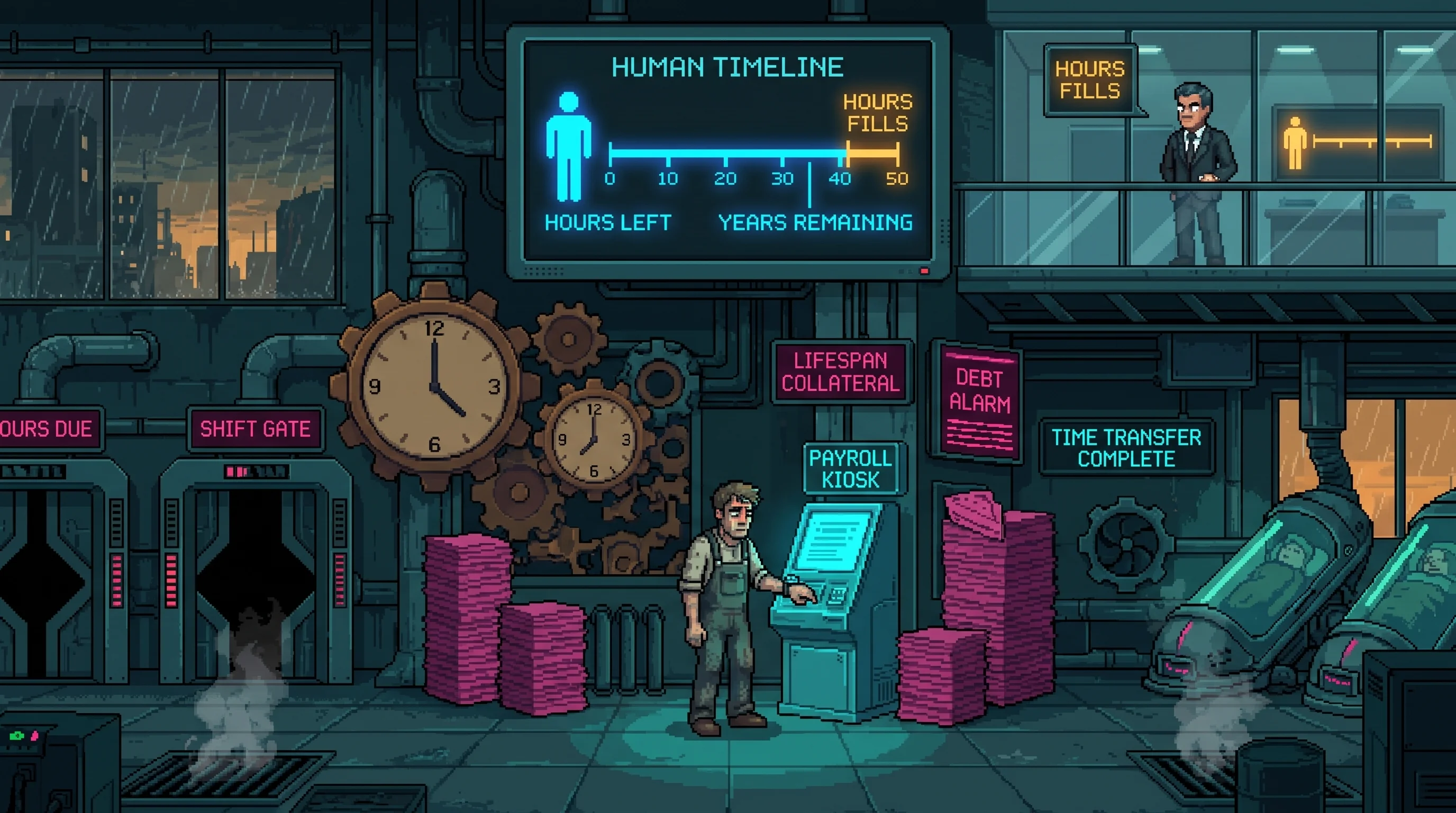
Time debt charges for cognition you borrowed; instantiation debt charges for existence you never asked for.
Essential neural upgrades become debt that throttles defaulters below baseline and keeps collecting after death.

The Divergence at birth: a Dregs child owes ~¢180,000 over 40 years; an executive child, 14× more, clears it in 8.
The point at which effort stopped being able to close the gap that compounding opens.


—
Social Impact
The Instantiation Debt converts the most intimate fact about a person — that they were born, that they were wanted, that someone paid to bring them into the world — into a recoverable asset on a corporate balance sheet. A parent in the Dregs does not get to think of a child's neural interface as a gift. It is a line item, and the line item has interest, and the interest has a beneficiary. The debt makes the act of making a person indistinguishable, on the ledger, from taking out a loan against them. Mireille Okonkwo-Vance was born owing ¢214,000 — her own ¢180,000 plus ¢34,000 of her dead mother's remainder — and has never not known the number.