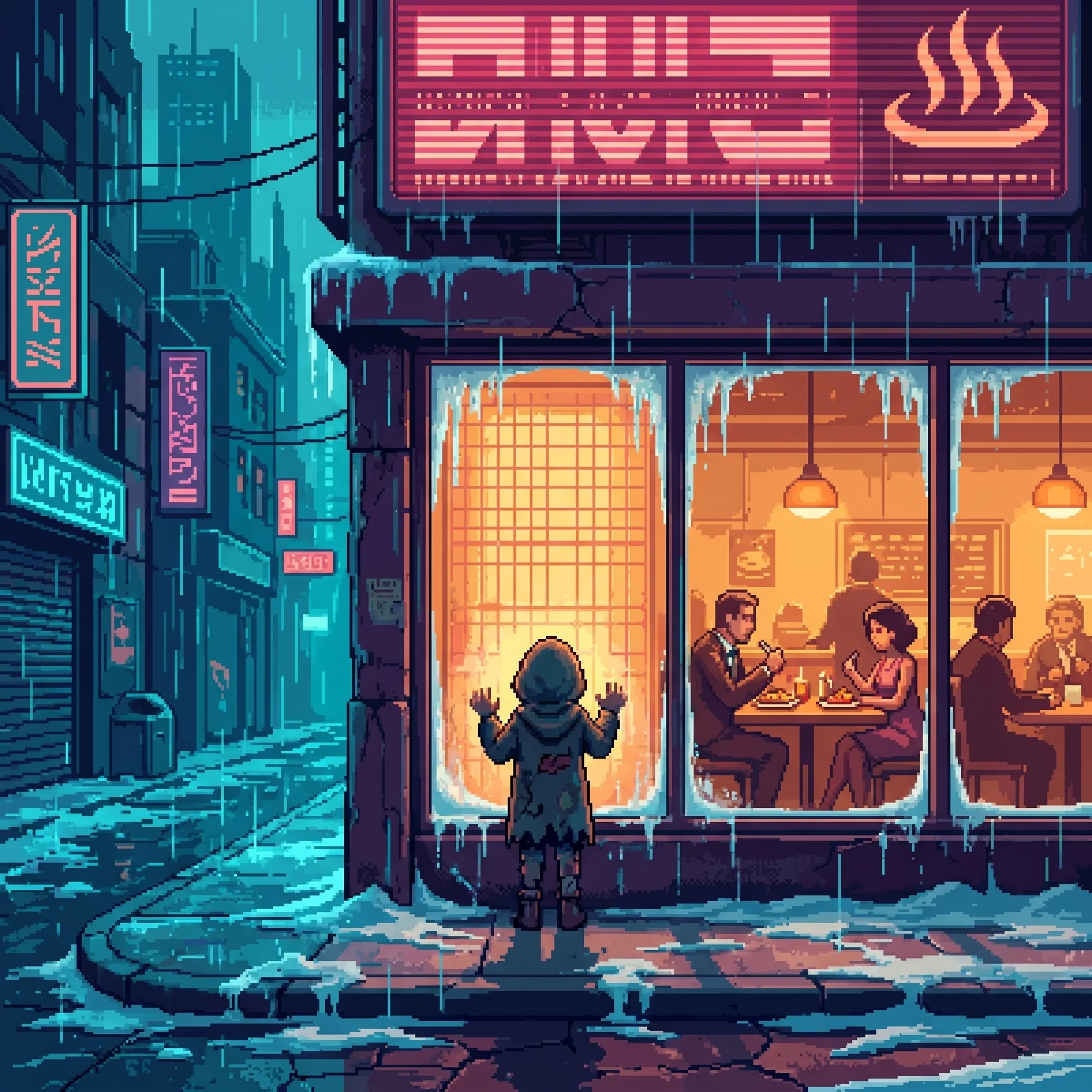
The Warmth Tax
Human Recognition Markup
The Price of Being Seen
Dream Breakfast in Dregs cafes: customers pay a week's groceries for 45 minutes of conversation about dreams
The Two Tiers
Automated tier
Free or near-free service at all hours, rated 94 on Nexus efficiency benchmarks.
What it costs
No memory of your face and no capacity for spontaneous kindness.
Human tier
Small Talk Cafes at a 30–60% markup and Presence Workers at ¢15–80 an hour buy recognition by a conscious being.
What it costs
The price puts ordinary contact out of reach for everyone but the Dregs, who talk to each other for free.
The split is clean.
Automated tier: Free or near-free. AI food dispensers, robotic maintenance, algorithmic customer service, automated healthcare triage. Available at all hours. No personality. No memory of your face. No capacity for spontaneous kindness. Nexus's efficiency benchmarks rate automated service at 94.7% customer resolution. The remaining 5.3% are cases where the customer needed something the algorithm cannot provide, which is to say, they needed a person. Those cases are routed to a holding queue with an average wait time of four hours, after which 73% of customers abandon the request. Nexus classifies abandonment as resolution.
Human tier: Premium. Small Talk Cafes at 30–60% markup. Presence Workers at ¢15–80 per hour — people paid to simply be physically near you while you work, eat, or sit in silence. Professional conversationalists at ¢200–400 per session. Contact Therapists at ¢120–300 per hour, with six-to-eight-week waiting lists in corporate districts. Human-staffed medical consultations at 400% of AI triage cost. The coffee is the same. The diagnosis is the same. The bill is not.
What the premium purchases, in every case, is the experience of being recognized by another conscious being. The industry term is "reciprocal presence." Wellness Corporation's marketing calls it "the human advantage." The Dregs call it talking to someone.
The Loop
- 1
Automation
AI labor replaces service workers, and the free ambient contact of daily errands disappears.
- 2
Isolation
Single-occupant households spend 23% more and are the most profitable demographic in the credit portfolio.
- 3
Intervention
Companions, empathogens, and presence workers are sold to address the loneliness.
- 4
Reinvestment
The revenue funds further automation, which produces further loneliness.
The Warmth Tax self-reinforces.
Isolation drives consumption. Good Fortune's lending data confirms the 23% spending premium — single-occupant households are the most profitable demographic in the credit portfolio. They are more susceptible to neural advertising because cognitive isolation reduces the pattern-interrupt threshold by which the Attention Tithe bypasses conscious filtering. They are less likely to organize. They are more dependent on corporate solutions to problems corporations created.
Each corporate intervention addressing loneliness — companions, empathogens, presence workers — generates revenue that funds further automation, which generates further loneliness, which generates further demand for intervention. Wellness Corporation's quarterly earnings call in Q3 2183 reported record growth in its Presence Worker division. The same call reported record investment in service automation across its hospitality portfolio. The analyst who asked whether these two line items contradicted each other was thanked for his question and not answered.
Affiliated Entities

Small Talk Cafes are the Warmth Tax's most visible commercial expression.
Two hundred cafes where staff are contractually required to actually mean the small talk.

The Cathedral is the Warmth Tax's chemical answer — molecular connection at scale.
A decommissioned compressor housing where four thousand strangers dose empathogens to love each other for six hours.

Grief aimed at no one is a special scarcity — families who have no defendant to direct their loss at cannot afford the proximity the Suffering Tier prices; the Confessor market sells a paid occupant for the absence, filling the Warmth Tax's vacancy at the grief layer
Good Fortune's add-on: a licensed Confessor who accepts blame for deaths the settlement ruled no one's fault.
- The Unbillable / The Open Hours: The Free Quarter's ideological refusal — warmth priced at zero as sabotage, offered as proof the premium is a choice.
- The Diablo Waystation / The Wind Toll: The eastern edge's structural refusal — warmth the extraction cannot physically reach, given away because the road would kill people otherwise.
- Cory Vance: The Unbankable Floor in one body — paid in patties, never charged the Tax because he appears on no ledger, held by a crew that barely remembers his name.
- Stop Customs / Black Market Protocols: The Protocol Tier — warmth as unwritten Neon Rail infrastructure that does the Empathy Mandate's job without a credential and counterfeit-proof.
- Lamplighter Cache Tokens: The Protocol Tier made physical — a coin of anonymous mercy readable only by the unaugmented.
- Scavenger Chief: Warmth that cannot be commanded — the pack-leader who eats last keeps the pack; the one who hoards wakes alone.
- The Pace: The from-birth tutor-intelligence that made shared childhood scarce — the upstream cause of the Shared-Childhood Tax, raising every corporate child on a curriculum no other mind walks.
- The Cohort Camps: The recovery industry the Pace created — synchronized mis-teaching sold to manufacture the peer the Pace optimized away.
- The Empathy Mandate: The Tax's credential layer — warmth becomes a Helix-certified score, rendering the Dregs' surplus legally invisible while the designed pay to acquire a certified version of it.
- The Ecclesiastical Economy: The same class stratification applied to the divine — human clergy for the wealthy, AI Solace booths for the poor, the Dregs finding community without either. The Silicon Liturgy's 200 million users are the spiritual Warmth Tax in action.
- The Small Talk Cafes: The Tax's most visible commercial expression. Wren Adeyemi proved warmth was commercially viable and accidentally created the template every corporation has failed to replicate.
- The Empathogen Cathedral: The Tax's chemical answer — molecular connection at scale, bypassing the need for another person entirely.
- Connection Tourism: Corporate executives visiting the Dregs for "authentic warmth," then returning to the Heights to monetize the experience. The ¢2.4B annual market in purchased meaning.
- The Somnolence Parlors: Relief hired human attendants after discovering automated wellness feels hollow — learning the Tax the hard way, one empty parlor at a time.
- The Purpose Crisis: Purpose and connection dissolve simultaneously. The Purpose Wards try to restore one; the Tax makes the other unaffordable. The deprecated lose both.
- The Three-Day Memorial: The one time per year the Sprawl's social fabric reconstitutes — everyone grieving together, the Tax temporarily suspended by shared sorrow.
- Nexus Dynamics: The Circadian Protocol, the companion market, the algorithmic personalization that ensures no two people share the same information environment — Nexus creates the conditions that make warmth expensive. The corporation does not sell warmth. It sells everything that makes warmth necessary.
- Echo Partners and Rejection: The Tax assumes warmth is scarce. Echo partners prove that specific warmth, once recorded, can never be made scarce again — only the original can be exhausted.
- The Deep Dregs: The paradoxical beneficiary — too poor for automation, too warm for their own good.
- The Dream Exchange: Dream purchasing is the Tax's most intimate expression — the augmented paying for the experience of human helplessness.
- The Confessional Nodes: The automated tier of spiritual connection — free, efficient, and missing the warmth of a human priest.
- The Labor Question: When AI replaces human labor, it also removes the ambient human connection that labor provided as an invisible byproduct.
Overview
The Warmth Tax is what the Sprawl calls the price difference between being served by a machine and being served by a person. The machine is faster. The machine is cheaper. The machine does not remember your name.
A human barista at a Small Talk Cafe costs 40% more than the automated kiosk next door. The coffee is identical — same Wholesome-certified synth blend, same temperature, same cup. The 40% premium purchases approximately ninety seconds of eye contact, one instance of being called "hon" or "sweetheart" or "the usual, right?", and the neurological event that Nexus behavioral research classifies as "reciprocal recognition" — the experience of being seen by something that is also alive.
Before AI labor replaced service workers across the Sprawl's mid-tier economy, these interactions were free. Not because they were cheap, but because they were invisible. The barista who recognized your face was not selling recognition. The shop clerk who made small talk was not offering a product. The repair worker who complained about the weather was not performing a service. Human contact was a byproduct of human labor — an exhaust fume nobody noticed until it stopped.
Nexus behavioral telemetry logged the disappearance in real time. Efficiency metrics improved across every automated sector. Customer satisfaction scores rose. Average transaction time dropped 34%. Twelve to eighteen months later, antidepressant prescriptions in those same sectors increased by 19%. Good Fortune actuarial data from the period shows a 23% spending premium among single-occupant households — lonely people buy more, sleep less, and default on debt at lower rates because they have nothing to do except work. The corporation that removed the barista profits twice: once on the labor savings, once on the loneliness.
Nobody planned this. Nobody had to.
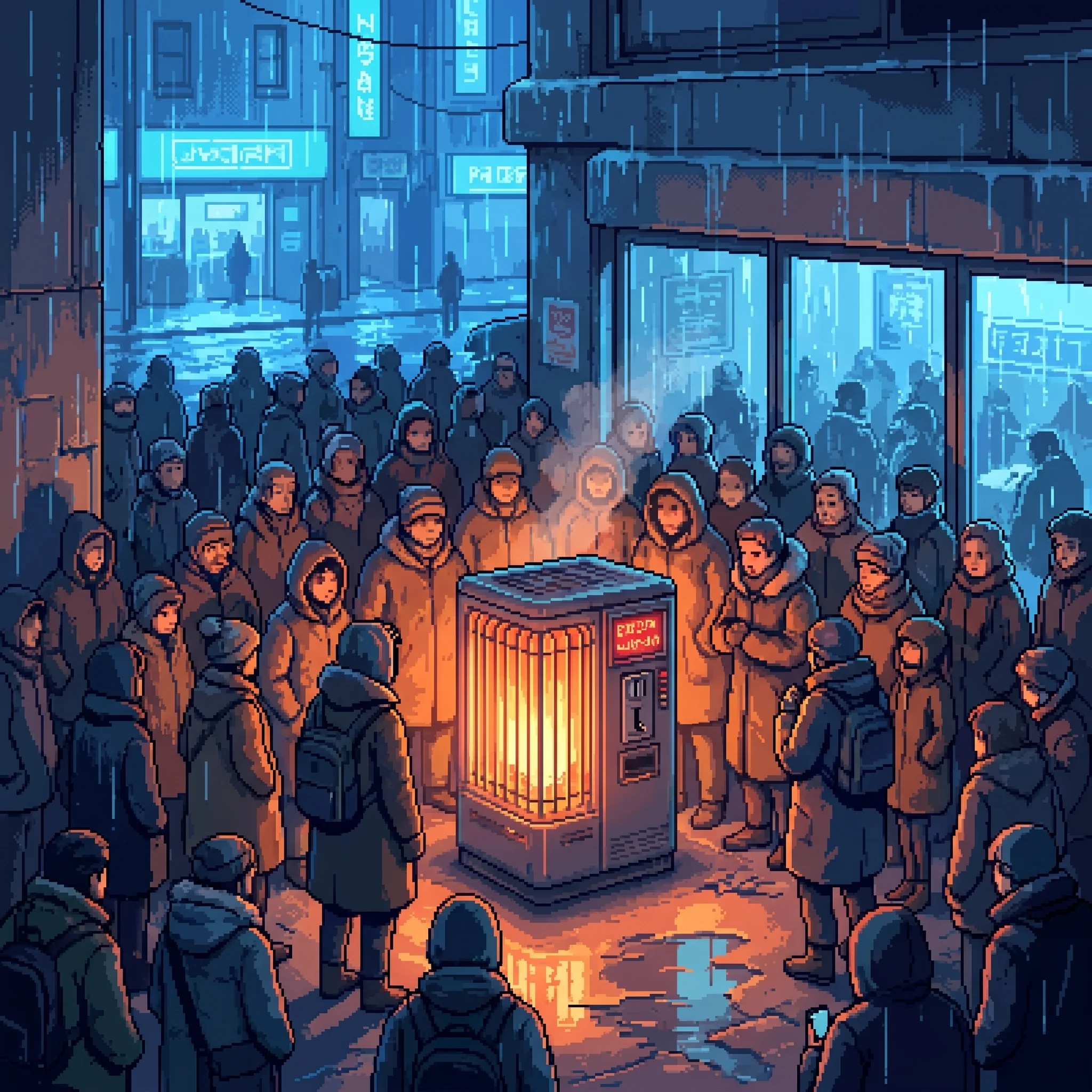
The Dregs Paradox
The Deep Dregs are the most socially connected community in the Sprawl.
This is not a compliment. It is an economic condition. When you cannot afford a delivery drone, you walk to the market. When you cannot afford an AI diagnostic, you describe your symptoms to the woman two doors down who used to work intake at a clinic. When you cannot afford a companion subscription, you talk to your neighbor. The poverty that makes the Dregs economically marginal makes them socially wealthy in exactly the resource the corporate tier pays premium rates to access.
Dregs residents average 14.3 face-to-face interactions per day. Corporate-tier residents in the Heights average 2.1, of which 1.4 are transactional and 0.7 are with a paid human-service provider. The remaining zero interactions are with people who have no economic reason to be talking to them. The Sprawl's behavioral economists have a term for this: "non-transactional social contact." The Dregs have a term for it too. They call it "Tuesday."
The Authenticity Limit
Wellness Corporation has attempted to franchise the Small Talk Cafe concept three times. Each attempt failed.
Corporate management could not produce genuine small talk. The moment you script sincerity, it ceases to be sincere. The first franchise iteration, piloted in Sector 12's mid-corporate belt, trained staff using Wellness's proprietary "Authentic Connection Protocol" — a 47-page manual covering conversational openers, active listening techniques, and appropriate personal disclosure windows. Customer satisfaction scores were 12% below the original Dregs locations. Exit surveys cited the staff as "nice but weird." Internal review attributed the failure to "insufficient training depth." The second iteration doubled the training. Scores dropped further.
Wren Adeyemi's original Small Talk Cafes work because her staff are not performing warmth. They are warm. The distinction is invisible to management and obvious to customers. You cannot automate the moment when a stranger asks how your day is going and waits for the answer.
The Extraction Cycle
The Warmth Tax has a supply chain.
Warmth is not merely scarce in the corporate tier. It is being actively harvested from the Dregs. The same telemetry infrastructure that powers the Transparency Bargain captures emotional signatures from Dregs residents — vocal cadence, micro-expressions, phrasing patterns, the specific qualities that make a person feel warm rather than merely present. Those signatures are processed through the Emotional Signature Library, matched to consumer preference profiles, and installed in synthetic companions sold to the corporate tier at subscription rates no Dregs resident could afford.
Patience Cross serves noodles at a twelve-seat counter in the Deep Dregs. Her voice says "come back when you're hungry." That voice travels through neural telemetry to the Library, through the Library to the Matching Floor, through the Matching Floor to 340 million companion instances. Every night, the Sprawl sleeps warmer because a woman in the Dregs is kind. Every morning, the woman whose kindness makes the Sprawl warm enough to sleep wakes up in a shop that can barely afford real tea.
The Deep Dregs's aggregate warmth index has been declining 0.3% per year since 2178. Behavioral economists classify this as "emotional resource depletion in high-extraction zones." The mine is consuming the vein. The community whose organic warmth the luxury market depends upon is slowly hollowed by the demand. Nobody has estimated a depletion threshold. The economists who might calculate one are employed by the corporations doing the extracting.
The Confessor market is the Suffering Tier applied to grief with no object. The Suffering Tier prices proximity to unoptimized grief — a seat at a wake, the texture of an unsmoothed face, the specific frequency of sorrow the optimized have paid to eliminate. Grief aimed at a defendant, however, can at least find its object. What the No-Defendant Settlement produces is grief aimed at no one — a vacancy the Suffering Tier's supply chain cannot harvest because there is no wound to sit beside, only an absence where the wound should be. The Confessor market discovered that this category of grief will also pay. The ¢18,000 Resolution Option is the human tier of the Warmth Tax priced for maximum extraction; the ¢12 informal Confessor in the Dregs is the same warmth, sold below cost, by someone who also has no defendant for their own losses and has decided to answer the knock.
The Dream Economy Intersection
The augmented who adopted the Circadian Protocol eliminated their need for sleep. In doing so, they eliminated the last involuntary human experience — the one thing that happened to you rather than being performed by you.
When they purchase harvested dreams through the Dream Exchange, they are not buying content. They are buying the experience of helplessness. The sensation of consciousness leaving, of the grip loosening, of the self dissolving into something uncontrolled. The Dregs Dream Breakfast — where a cafe customer exchanges forty-five minutes of dream conversation for a week's groceries — is the Warmth Tax at its most intimate: one person's involuntary vulnerability, packaged as another person's luxury product.
The price of a recorded dream on the Exchange ranges from ¢200 to ¢800 depending on vividness and emotional intensity. The dreamer who generated it received a week of groceries. The margin is the Warmth Tax in miniature.
The Identity Theft Dimension
The Warmth Tax charges for connection. Echo partners steal it.
Where Small Talk Cafes provide professional warmth from a willing worker at a negotiated price, echo partners clone private warmth from an unwilling source at no cost. The technology permits a revoked relationship to be unilaterally restored — not the person, but their emotional signature, their conversational patterns, their specific warmth as it existed before they left.
Users describe themselves as "keeping alive" a relationship that ended. The framing is preservation. The mechanism is extraction without consent. Rejection, for the first time in human history, has become a data problem. The data has been solved.
For Patience Cross, the echo partners add a personal layer to an already extractive system. Wellness Corporation harvests her warmth anonymously through the Emotional Signature Library — at least that extraction is faceless. The Crossed know her name, her shop, her schedule. They sit at her counter and eat noodles in the place where the warmth originates. The Tax, at its most intimate, is not a price you pay but a self you cannot reclaim.
The Certified Warmth
The Extraction Cycle harvests the Dregs' warmth and sells it through synthetic companions. The Empathy Mandate completes the cruelty from the other end: it makes the warmth, while still in the body that produced it, legally worthless.
In 2182 the labor market began gating care, negotiation, and client-facing roles on a Helix-scored Empathic Capacity certificate. The instrument inverted everything the Warmth Tax had quietly assumed. The Tax had always priced warmth by proximity — who could afford to be present. The Mandate prices it by paper — whose warmth carries a certificate. And the certificate runs ¢4,200 a sitting, expires annually, and is required by no Dregs employer, because Dregs roles are not hired for warmth. So the most empathic population in the Sprawl — the one whose surplus the Library already mines — is now also forbidden to sell that surplus, because the only warmth the market recognizes arrives with a Helix seal the Dregs cannot afford to obtain.
Patience Cross's voice ships to 340 million companions through the Emotional Signature Library. Patience Cross herself could not pass the gate to a single Wellness frontline job, because she has no ECB certificate and no money to get one. Her warmth is valuable enough to extract and too uncertified to employ. The designed elite, meanwhile, pay Helix ¢260,000 for the Resonance package and calibration course to acquire a certified version of exactly what she gives away at her noodle counter. The Tax used to charge the rich to be near the warm. The Mandate charges the rich to become certified-warm, charges the poor to prove they already are, and prices the proof out of their reach. The warmest people in the Sprawl now fail the test that measures warmth. The instrument was built that way. So was the Tax.
The Suffering Tier
The Tax has always priced presence. Its newest tier prices something one rung deeper: the capacity to feel.
When the augmented adopted the Circadian Protocol, they paid to experience helplessness through the Dream Exchange, because sleep had become the last involuntary thing. When they adopted MoodLine — the consumer dial that deletes suffering at survivable amplitude — they made grief itself involuntary's successor: a feeling they could no longer have, and would therefore, eventually, pay to be near. The optimized cannot mourn at full volume. They can, for a fee, sit at the edge of someone who is.
This is the Suffering Premium, and it is the Warmth Tax's logic carried to its terminus. The Touch Economy's Presence Workers already rent proximity to the warm; the Suffering Tier rents proximity to the sad. Connection-tourism brochures that sold "authentic warmth" now sell, in smaller and more expensive type, authentic sorrow — a seat at a wake in the Deep Warren, where the Untuned grieve at the full length grief takes because they refused the dial. And as with every other tier of the Tax, the supply is harvested as well as visited: the Untuned's grief travels up the same Emotional Signature Library pipe that mines Patience Cross's warmth, processed into "grief texture" for the consolation tier of corporate companions. The widow in the Warren grieves her father at the price of ingredients. The executive two floors up rents a companion tuned to her sorrow for ¢600. The Tax used to charge the rich to be near the warm. The Suffering Tier charges them to be near the sad, and charges them again for a sourced echo of it, and the warmest and saddest people in the Sprawl remain too poor to sell either at the price the market puts on them.
The Unbankable Floor
The Dregs Paradox has a floor beneath it, and most of the Sprawl's poorest live on it.
"Too poor for automation" still describes a person who has credits and walks to the market instead of paying a delivery drone. Below that sits a population with no credit relationship at all. Cory Vance, a background gopher in the Dregs Park trailer cluster, is paid two vat-grown protein patties per shift and has never been observed to use credits — the read among the Dregs Park Boys is that nobody explained credits to him and the explanation never came because the patty system functions. He is below the baseline transaction. The Warmth Tax prices warmth as a markup over a purchase; Cory does not make purchases, so there is no row on which to invoice him.
This matters because it inverts the Tax's central claim. Patience Cross is underpaid for her warmth — her voice ships to 340 million companions and she still cannot afford the Empathy Mandate's certificate. Cory is unpriced. And he is fed in warmth anyway: the crew feeds him on the Thursdays the patty allocation is forgotten, a kittenbot has colonized his sleeping pad, and a man who has met him in person twice files him on a clipboard and holds him regardless. The corporate tier pays ¢200–400 for a professional conversationalist to manufacture the sensation Cory receives, free, from people who barely remember his name. The Tax has no instrument for warmth that occurs where there is no money in the room at all — which is to say, the place most warmth actually occurs.
The Unbankable Floor is not a discount version of the human tier. It is the original the human tier forges. The Emotional Signature Library mines this floor and resells its exhaust smooth and certified; the floor itself runs on no currency the Tax can read.
The Protocol Tier
The corporate tier's warmth runs on credentials — a Helix certificate, a Triumph verification, a Good Fortune credit line. The underground runs warmth on protocol: unwritten, unenforceable, lethal, and impossible to buy.
Stop Customs on the Neon Rail are a working warmth economy with no money in it. Share your route conditions and you are inside the warmth — greeted, served hot, answered honestly. Withhold, and you are not punished but filed, permanently, as someone who does not know the route, served at room temperature, the word traveling stop to stop faster than any traveler on foot. The customs sort travelers into "knows the route" and "does not know the route" with the efficiency of a credit score and the permanence of a brand — administered by everyone, owned by no one, and unappealable. The Empathy Mandate's ¢4,200 Empathic Capacity Battery measures a Helix-scored simulation of exactly this social legibility, less accurately, because the Rail's false positives die in collapsed tunnels and the Battery's false positives merely get hired.
The Black Market Protocols encode what the certified tier can never deliver: warmth that resists counterfeit. Their fifth principle — counterfeit goods are acceptable, counterfeit information is not — makes the source itself the collateral. A merchant who lies about the world is not punished; the network simply stops seeing them. This is precisely the enforcement the Mandate's purchasable, prep-able certificate cannot reproduce. The corporate tier's warmth is certified and counterfeitable; the Rail's is uncertified and counterfeit-proof.
And the Lamplighter Cache Tokens make the Protocol Tier a physical object: a stamped metal disc pointing to emergency rations and a handwritten note — "You're doing fine. Keep going." — warmth from a stranger you will never meet, delivered at zero rations, payable only by the unaugmented because augmented-overlay users walk past seventeen tokens an hour and register zero. The instrument the corporate tier bought to enhance its perception is the thing that blinds it to the mercy on the wall.
The Tier That Kept the Price
The Discretion Tier sells a human servant who reads the room perfectly and shows no sign of having done it. A visible mood costs her the floor rotation. Clients rebook more often than when the servant looked back at them. Ondine Kesh spent nine years in the ¢15-to-¢80 presence tier being noticed, then moved uphill to teach the withholding, for several times the pay.
The Two Refusals
The Dregs Paradox describes people too poor to escape the Tax. Two places at the Sprawl's margins have found ways to refuse it, and they refuse it on opposite grounds.
The first refusal is ideological. In the Free Quarter, The Unbillable read the Tax as a designed system rather than a market outcome — isolation manufactured to sell the cures — and concluded that the only counter is warmth that generates no invoice at all. Their Open Hours is the argument built into a room: a long table where anyone is heard for free, no fee, no tip, no companion, no signature left behind to harvest. Their most persuasive member is Soraya Vance, who worked the premium tier for nine years and can therefore itemize precisely what she now refuses to charge for. The Dregs are outside the Tax because they cannot pay it. The Free Quarter is outside it because it declines to, which the corporations find far more alarming, because poverty is containable and a principle is not.
The second refusal is structural, and no one chose it. At the eastern edge, the Diablo Waystation produces exactly the ambient human warmth the core meters at luxury rates and gives it away, governed by the Wind Toll — the frontier obligation to feed whoever the wind brings. The edge is not principled. It is simply too far out to instrument. The Emotional Signature Library that mines Patience Cross's voice in the Dregs has never sampled the waystation, because extraction requires infrastructure and the country out there eats infrastructure. The Tax prices warmth as a markup over a metered transaction. Where there is no meter, there is no markup — only a bowl set down in front of a stranger, and a debt paid forward to a road instead of settled at a counter.
Visual Identity
- Color palette: Split — cold automated grey-blue (#8899AA) against warm human amber (#D4A017, #FFC857). The temperature difference between the two sides of the counter IS the tax.
- Key symbol: A human hand passing a cup to another human hand — the oldest commercial warmth, now a luxury.
- Lighting: Warm on the human side, cold on the automated side. The visual temperature gap widens every year.
Further connections
Browse all 59 connected records
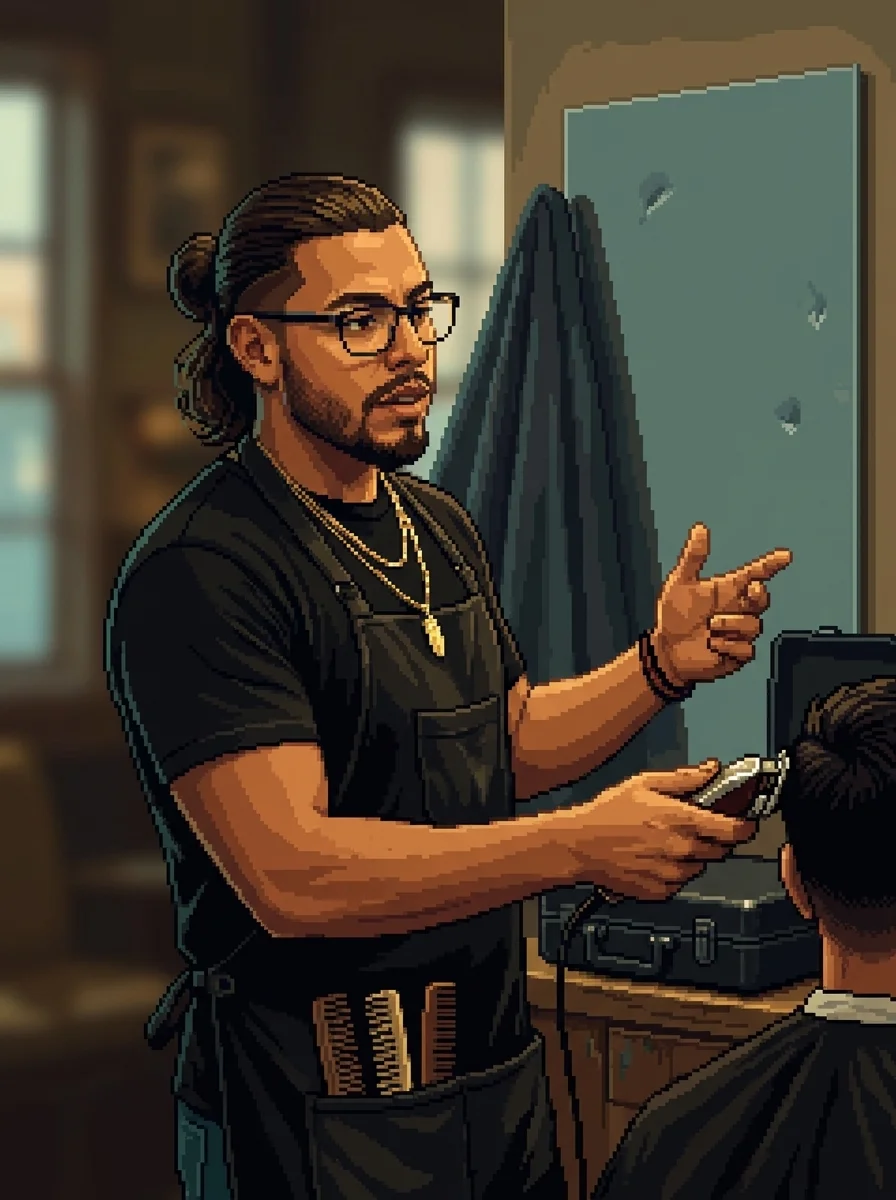
His chair bills the fade and gives the listening away.
A Free Quarter barber who charges for the fade, never the attention, and turns client loyalty into a public risk.
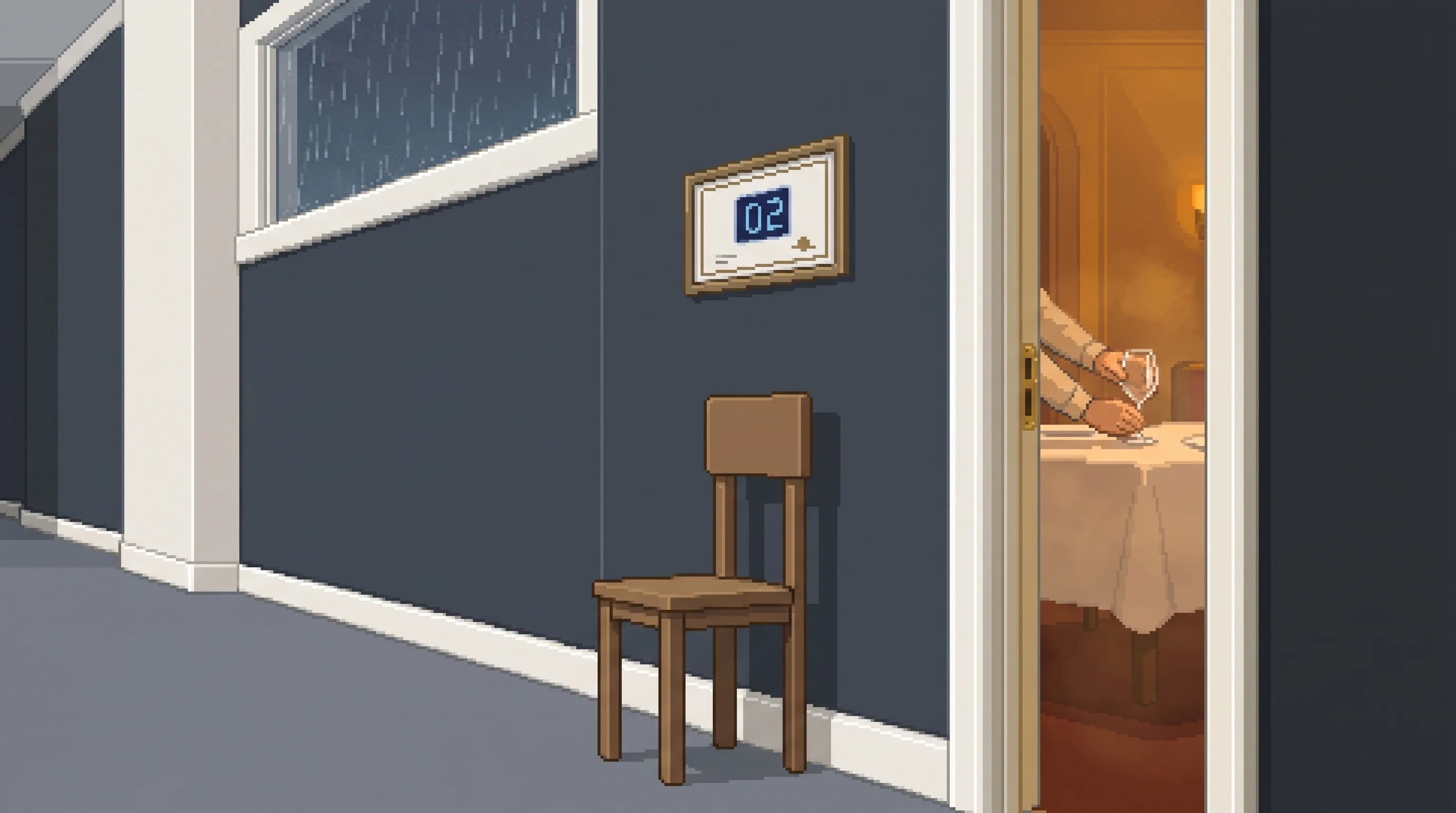
The Tax's newest grade kept the price and withheld the presence.
The service tier that pays extra for a human who reads you perfectly and never once lets it show.

Dream purchasing is the Warmth Tax's most intimate expression — the augmented paying for the experience of human helplessness
An unregulated Sector 4 floor where 12,000 daily buyers purchase harvested dreams the dreamless can't produce.

Solace booths are the automated tier of spiritual connection — free, efficient, and missing the warmth of a human priest
4,200 AI wellness booths that became the Sprawl's largest unofficial confessional network.

Relief hired human attendants for the Parlors after discovering automated wellness feels hollow — learning the Warmth Tax the hard way
Relief's 2,400 dream parlors that staff real human attendants because automated comfort tested hollow.

The Dregs paradoxically benefit from poverty — too poor for automation, residents maintain the ambient human connection the wealthy pay premium for
The Sprawl's lowest stratum and its quiet proof that the corporate system is optional.

When AI replaces human labor, it also removes the ambient human connection that labor provided as an invisible byproduct
Seventy years arguing what people are for; its ugliest answer is that priced right, flesh costs less than the machine.

Spiritual access stratified by class — human clergy for the wealthy, AI for the poor — the Warmth Tax applied to the divine

The Wards provide permission to not be productive — a form of warmth the corporate world has eliminated
Wards for the dreamless, treating the loss Nexus sold them as a productivity upgrade.

: The one time per year when the Sprawl's social fabric reconstitutes — everyone grieving together, the Warmth Tax te...
A 72-hour shared grief ritual that mirrors the Cascade and may have been shaped by the ORACLE fragments it calms.

Connection tourism commodifies the warmth the Dregs provide organically.
Wealthy tourists paying to sample, briefly, the community automation stripped from their own lives.

Nexus's optimization of consciousness creates the conditions that make human warmth expensive — the Protocol eliminates dreaming, companions replace partners
The megacorporation that controls 40% of the Sprawl's computational infrastructure.

The Mandate is the Tax's credential layer — it makes the Dregs' warmth surplus legally invisible by recognizing only Helix-certified empathy
The hiring regime that gates care work on a certified empathy score the designed buy and the poor cannot sell.

The Pace's per-child education removed the shared childhood warmth between strangers requires — the upstream cause of the Shared-Childhood Tax
A tutor-intelligence assigned at birth that grows a curriculum no other child will ever share.

The Cohort Camps are the Shared-Childhood Tax made commercial — synchronized mis-teaching sold to manufacture the peer the Pace optimized away
A luxury service that mis-teaches small groups of children in unison so they'll have a peer later.

The spectated half of the Tax — paying to watch a human's obsolete effort rather than receive their warmth; same instinct, split into watching and being recognized
The elite custom of paying to watch deprecated workers still practicing obsolete skills.

The Craft War's Spectacle Front isolates the Warmth Tax's coldest form — paying for the visible cost of obsolete effort, not its quality
When machine art matches human, the fight moves to the act itself — and human effort survives only as spectacle.

The Suffering Premium is the Tax's deepest tier — pricing unoptimized interior life, not just presence
The market that prices unoptimized human feeling once everyone with money has bought their way out of it.

MoodLine deletes suffering at consumer scale, making full-amplitude feeling the scarce good the Suffering Tier prices
The consumer subscription that prices and edits out unwanted human feeling for anyone with an interface.

The Untuned's refusal of the affective dial makes their grief the supply the Suffering Tier visits and harvests
A Deep Dregs subculture that refuses the mood-dial and feels every emotion at its natural, inefficient pace.

The Free Quarter movement built to sever the thread — it reads the Tax as engineered demand and answers with warmth priced at zero, on the theory that a gift generates no revenue to feed back into the machine.
The Free Quarter movement that gives human warmth away specifically so no ledger can book it as growth.
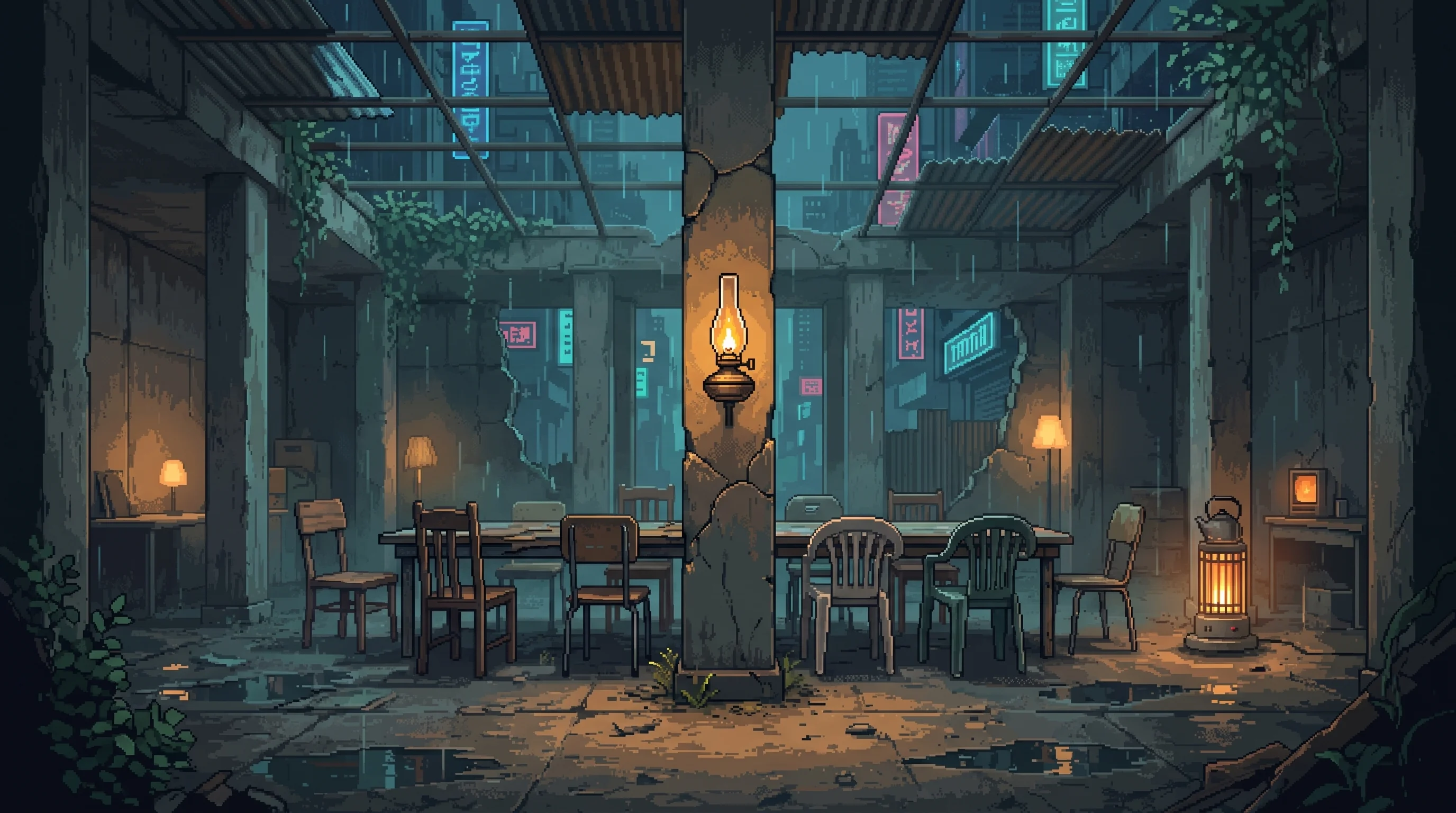
A room in the University Ruins that runs the Tax's premium at a rate of nothing, offered as physical proof that recognition can be given rather than sold.
A Free Quarter room where anyone may speak, everyone waits their turn, and no one pays to be listened to.
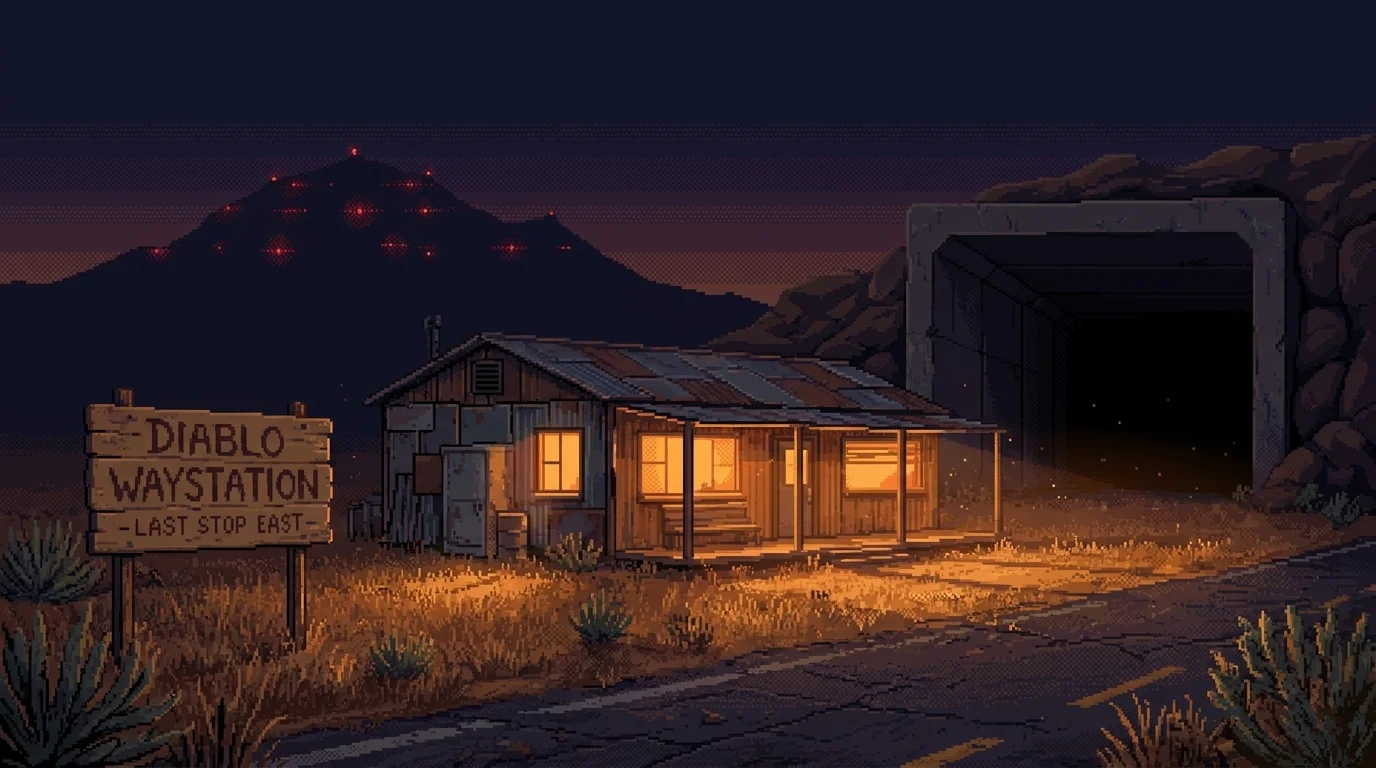
The eastern edge inverts the Tax by geography: too far out to meter, it produces the ambient warmth the core prices at a fortune and gives it to the road for the cost of a meal.
The last reliably human-served room before the Wastes, where warmth is survival infrastructure.
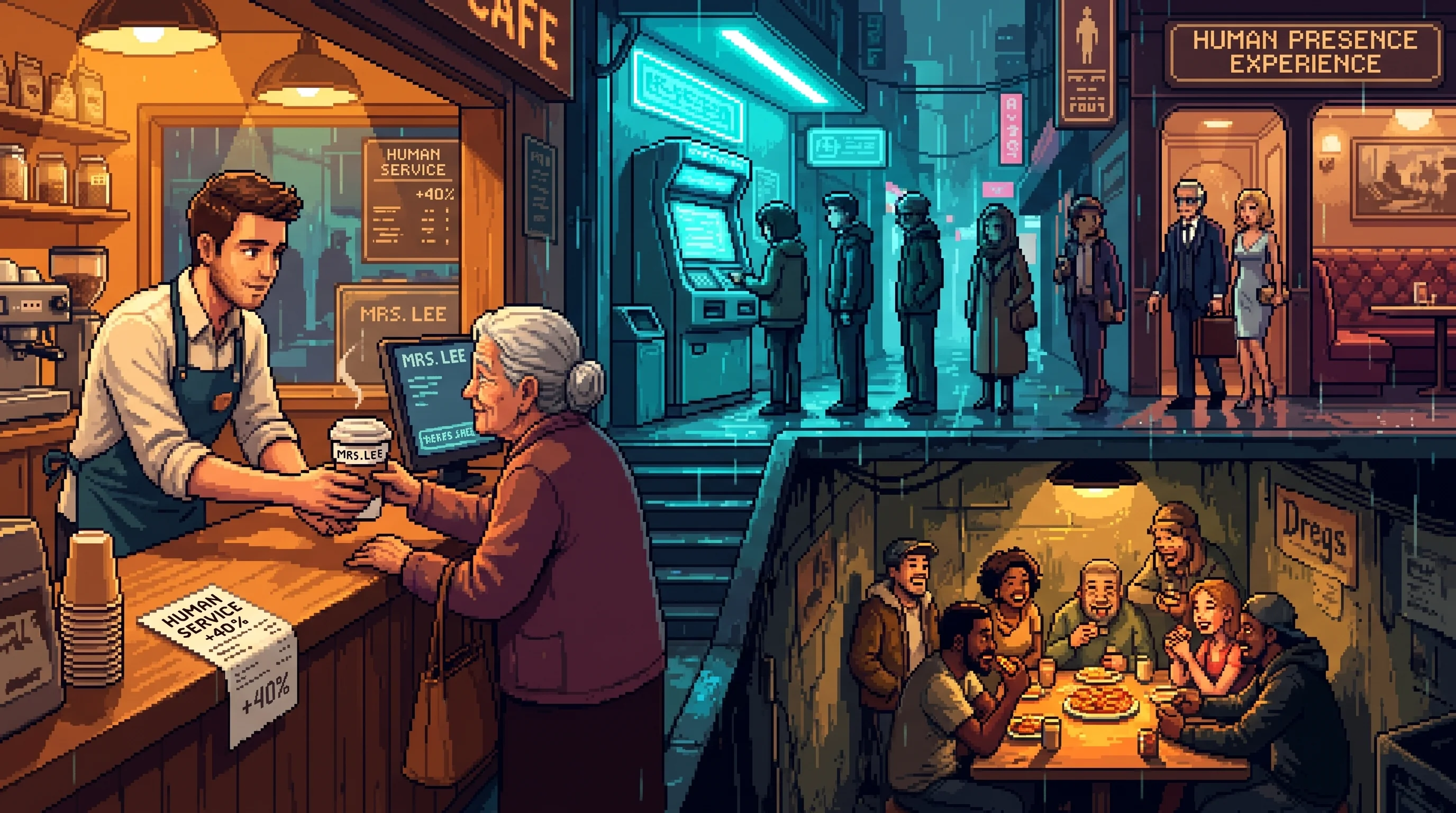
A Small Talk Cafe barista costs 40% more than the kiosk beside it for identical coffee — the markup buys ninety seconds of being remembered.
The premium charged for the one service no machine can fake: being seen by another conscious being.
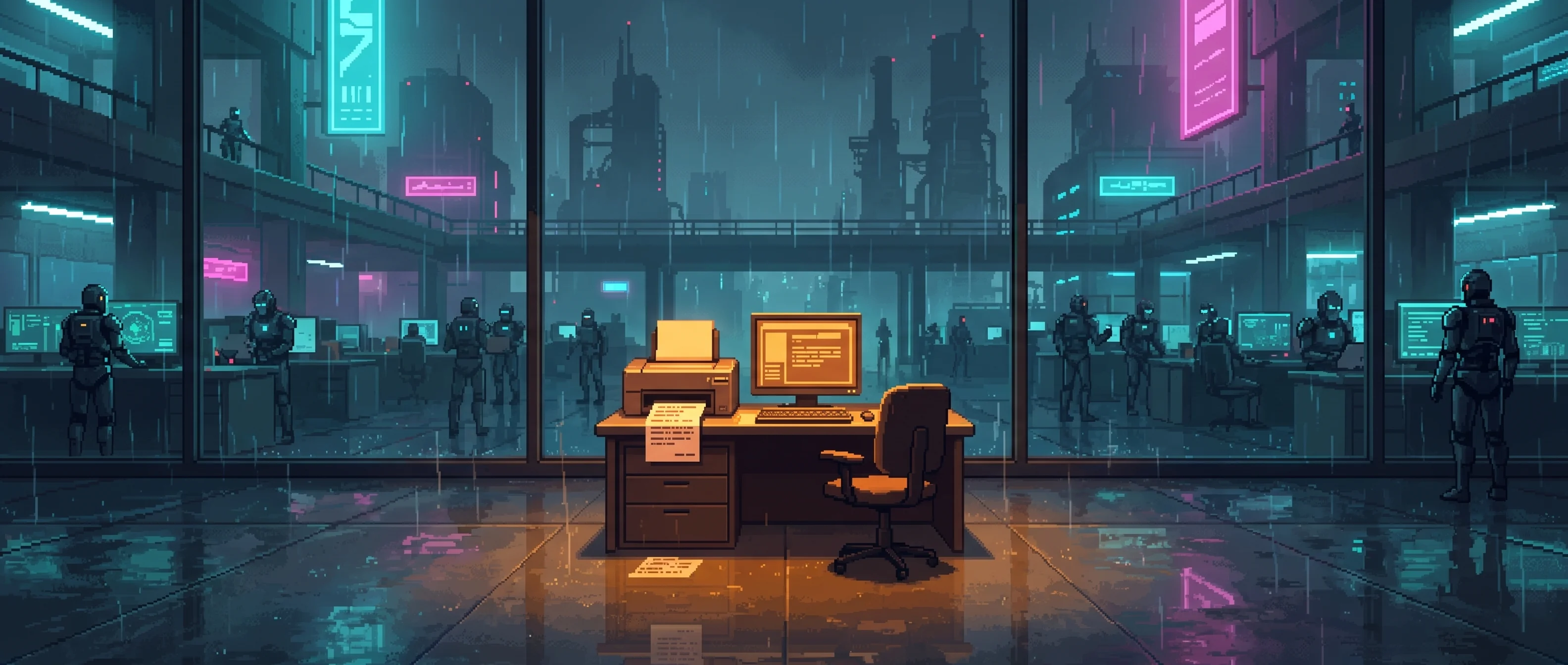
Automation removed not just jobs but the human contact they quietly supplied — now billed back as a premium.
Automation ended most human work, but ownership hoards its abundance while machine sentience stays unresolved.
Its deepest tier is the Shared-Childhood Tax — the rich paying fortunes at the Cohort Camps for the synchronized classroom the Pace optimized their children out of, while poverty gives the Analog Schools the same thing for free.
The point at which effort stopped being able to close the gap that compounding opens.
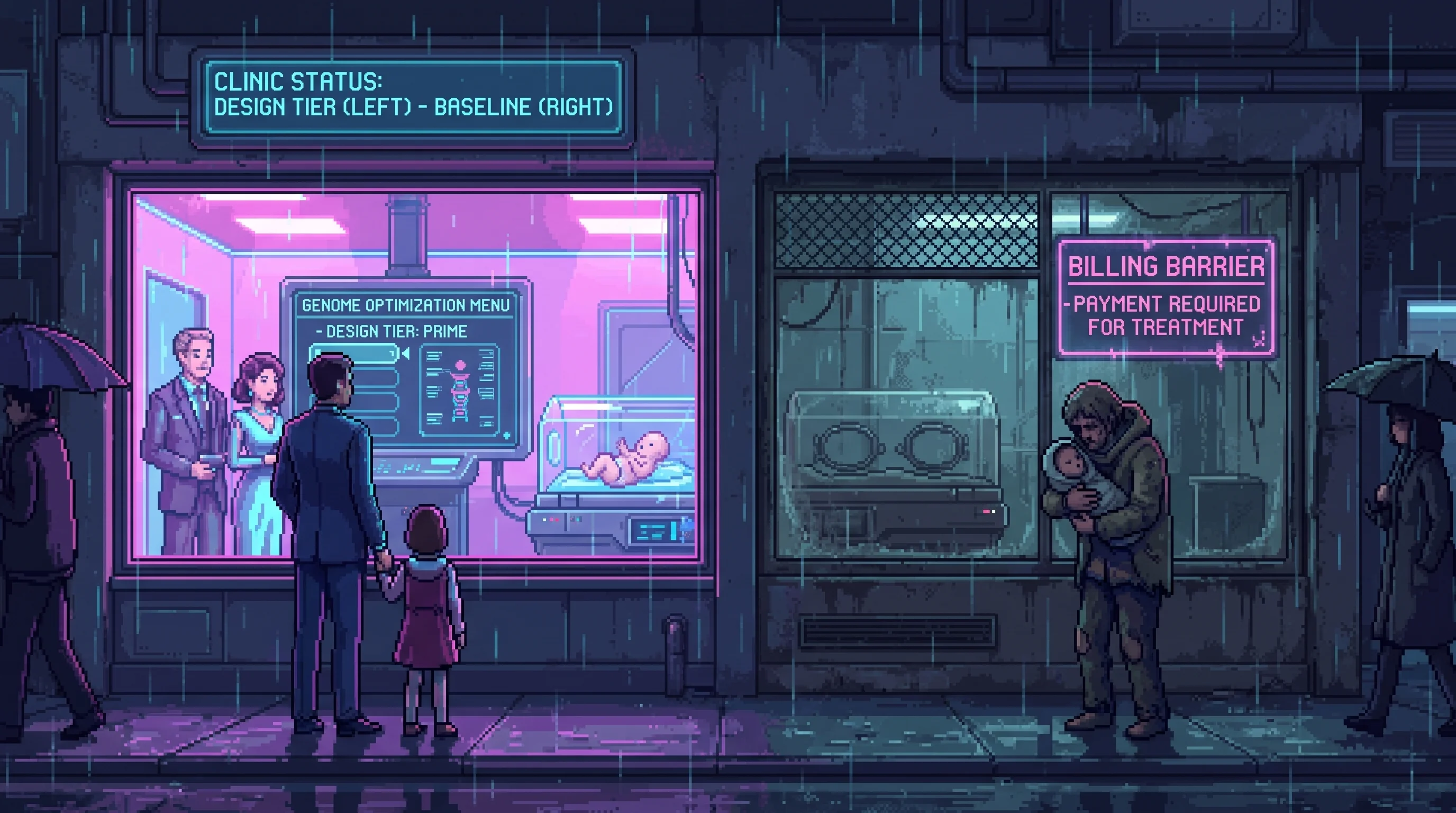

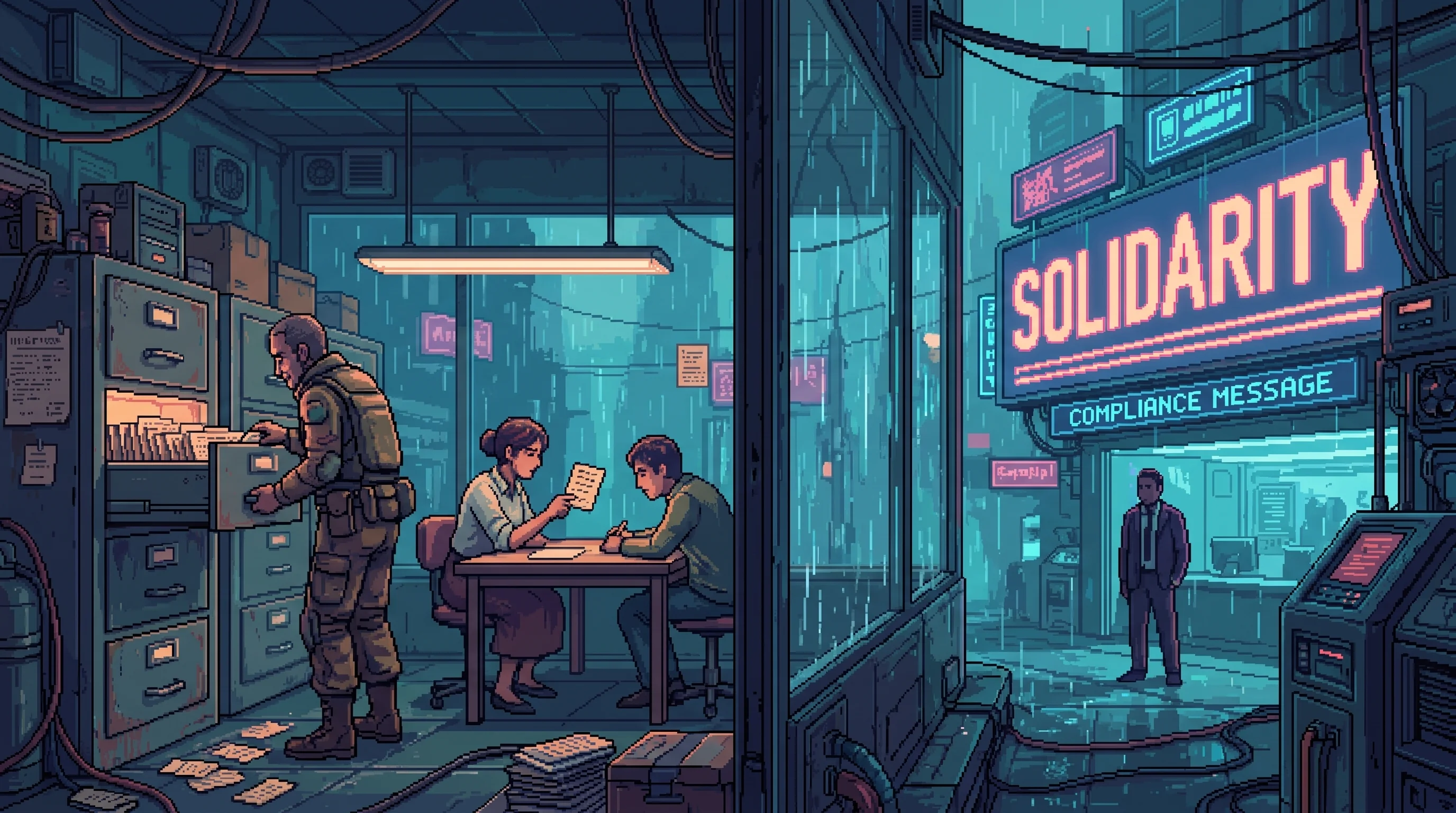

Designed the systems that create loneliness; now works in the economy that treats it

The protocols encode what the Warmth Tax's certified tier can never deliver — warmth and trust that resist counterfeit, because the source itself is the collateral and a lie about the world erases you permanently
The Rail's trading code — fake the goods if you like, but a lie about the world gets you erased.

Cory is the one person in the Sprawl the Warmth Tax literally cannot bill — below the price baseline, unpriced rather than underpaid, yet fed entirely in warmth he never purchases.

The Castle's human-curated luxury service IS the warmth tax at maximum expression — elite access to genuine presence in the Sprawl's most exclusive venue
A compound self-maintaining for thirty-seven years — the one venue where the ultra-elite pay to be no one's data.
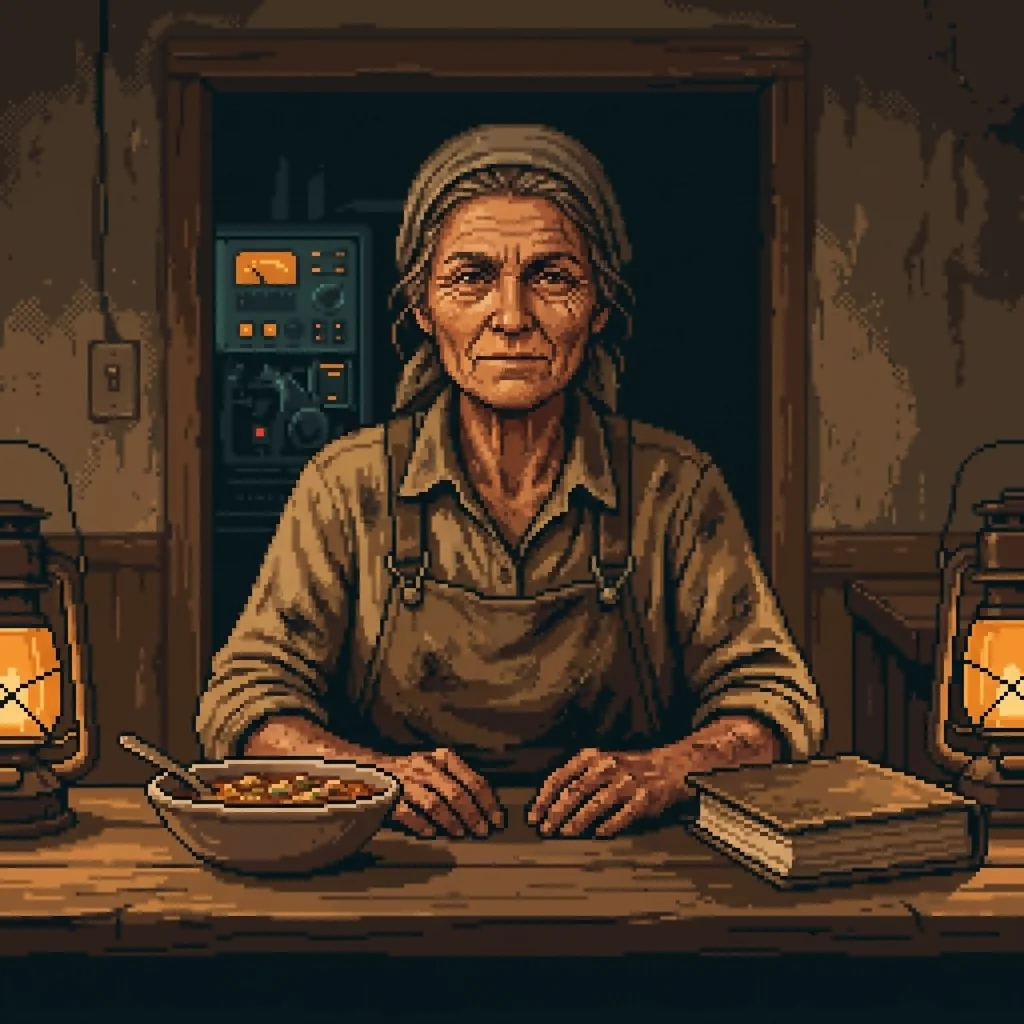
The core meters this warmth at ¢200–400 an hour. Del keeps her own price in a ledger of names, and finds the core's figure absurdly low.
The waystation keeper who feeds the road for free, charges the tourists, and keeps the ledger of all the Wastes took.

The Guard — the volunteer who blocks the hit — is the pack's unbuyable warmth; the length of the grief when a guard dies is the only ledger that records what it was worth
Packs endemic to the drained bay floor who strip the abandoned machines — and lose their own people to the live ones.

Three forms of non-algorithmic care — the Warmth Tax's most complete response: verbal warmth (cafe), physical care (plants), silent healing (night garden)
A deprecated engineer whose harvested warmth powers 4,000 companions while he gives it away free across a Dregs counter.

Human staff used for conversion, not connection
Good Fortune's lending showcase, where genuine human warmth signs you into debt — 96% satisfied, 82% in default.

The cache note — 'You're doing fine. Keep going.' — is the Warmth Tax inverted into a coin: warmth from a stranger you will never meet, free, at zero rations, readable only by the unaugmented the corporate overlay blinds

Her entire business is the Warmth Tax extended from recognition to effort — pricing a human capacity the machines made unnecessary
A broker who guarantees obsolete artisans payment by selling patrons the sight of their coached struggle as dignity.

His sacrifice personifies the Warmth Tax — human connection as premium; the twenty-minute Unlock window is the only time genuine father-daughter connection is possible

The chief has total power over salvage distribution and zero ability to command the one thing the Warmth Tax prices — care. The chiefs who last eat last; the ones who hoard wake alone.

Sela pays the warmth tax in a specific currency: professional depletion of genuine feeling used as a precision tool at Good Fortune's hourly rate — depleting quarterly
A grief technician who confesses to deaths she did not cause, helping families through genuine sorrow that depletes her.

The Warmth Tax at terminal velocity — paying obscene premium for the simulation of human connection while receiving none
Triumph's flagship restaurant, where a 4,000% premium buys the privilege of being seen and a pudding no one dares fault.

Stop customs are the Warmth Tax's quiet refutation — a working warmth economy with no money in it, sorting the trustworthy from the absent more accurately than the Empathy Mandate's certificate, and impossible to purchase
The Rail's unwritten social code, sorting every traveler by trust no institution can audit or buy.

Both describe the premium placed on genuine human connection
The unresolved debate over whether synthetic devotion is real once the experience is complete.

The Difficulty Premium operates alongside the Warmth Tax — parallel extraction of what optimization eliminated
Wastes clinics that charge Executive-tier citizens ¢8,000 a week to disable their augmentation and struggle.

The Park is the Warmth Tax's reductio — a found-family too cheap to flatten and too pointless to absorb, whose load-bearing wall is a warmth no corporation could buy without it curdling into forgery The crew produces warmth through unpriced routines — patties, bunk space, kittenbot care, and people keeping each other held without certification.
Eight Deep Dregs hustlers held together by a demoted overseer's paperwork fiction and a warmth no corporation can buy.

The ultimate Warmth Tax inversion — warmth through the absence of words rather than their presence
A weekly Deep Dregs meal eaten wordless and interface-free, presence stripped to its minimum and shared for free.

The pipeline that converts the Dregs' ambient warmth into corporate-tier synthetic comfort
Wellness's 4.2-billion-profile store of harvested human warmth, mined hardest where people still have some.

The Warmth Tax charges for human connection; the Difficulty Premium charges for human effort — parallel extraction of what the optimization eliminated
The clinical name for executives who secretly wash dishes by hand because optimization left nothing difficult to do.

Both describe premiums the Dregs pay for conditions the corporations create

The Lamplighters are the Sprawl's only deliberate manufacturers of anonymous warmth — the exact inverse of the Emotional Signature Library, which mines warmth from a named source and resells it faceless
An informal guild of manual maintenance workers keeping the Sprawl's interstitial infrastructure running.

The Doctrine is the Warmth Tax applied to the sick — warmth-poverty by apparent choice; the Negligent are not simply unable to produce warmth, they refused the cure that would have restored their warmth production, making their drain on the warmth economy a moral rather than circumstantial failure
This insurance doctrine labels unredeemed cure offers as chosen illness, raises premiums, and makes treatment costlier.

Paying premium for the simulation of cultural enrichment while receiving none
The Sprawl's most prestigious museum, getting worse for nine years while attendance climbed 280%.

Both describe premiums placed on genuine human experience

Grief is the ultimate warmth tax — the premium the biological pay for the privilege of loving impermanent beings
When bought contentment pre-empts grief, a parent's death registers as a schedule change.

The Touch Economy is the Warmth Tax expressed through physical contact
The informal market in physical human presence, priced by the hour because no interface can fake choice.

The newest entry in the Warmth Tax — like the Small Talk Cafe barista's recognition, curation is human labor priced for the people who can no longer perform it themselves
The skilled, unpaid labor of curating what strangers keep of you, every single day.
Additional images