The Averaging House
Humanitarian Data Intake Facility
The Recognition Intake Standard (2183) requires any person instanced under the Instancing Act to complete civil registration within 21 days of instancing to remain eligible for Sprawl humanitarian resettlement aid — ration credentials, housing referral, and the medical-referral voucher that covers phantom-plurality treatment
The Building

- The reed window
- The waiting room's only window faces the marsh, where a dozen channels braid down to one mouth at low tide.
- Borrowed scent
- The vents pipe the same Somnolence Parlor blend licensed to the Waiting Ward up the Corridor.
- Cloud-blue over grey
- Corrugated flood-agency grey walls, painted over in Relief's cloud-blue.
The House sits on pilings at the marsh's edge in the Wetlands district, a converted flood-control annex two kilometers from Relief HQ along the Corridor service road. It occupies cheap land nobody else wanted, chosen for a service nobody else wanted to run. One boardwalk corridor connects the waiting room to four intake windows and a rear counseling alcove. The walls are corrugated flood-agency grey painted over in Relief's cloud-blue. The scent piped through the vents is the same Somnolence Parlor formulation licensed to the Waiting Ward up the Corridor — Relief owns both compounds and sees no reason to develop a second one.
The waiting room has a single window, and it faces the reeds. At low tide a dozen thin marsh channels are visible braiding down to one mouth before they reach open water. Nobody on the architecture team recorded why they oriented the building that way. Every clerk who has worked an intake shift names the window, unprompted, when asked what the job is like.
Overview
The Averaging House does two things at once, in the same twenty-minute appointment, and has never had to choose between them.
It is the Southern Sprawl's Recognition Intake site — the place a newly-instanced person goes, within twenty-one days of coming into focus under the Instancing Act, to receive the paperwork a legal person needs to function. Ration credentials. A housing referral. A voucher covering phantom-plurality treatment at a Halcyon-adjacent clinic. Nobody else was administering this at scale when the Recognition Intake Standard passed in 2183, so Relief Corporation took the contract, the way Relief takes every contract that involves showing up where suffering has already concentrated. The intake is real. The ration card works. The housing referral finds an actual room.
It is also, on the same form, the cleanest behavioral dataset Relief's actuarial partners have ever been handed. A person with a legally singular identity, a birth certificate dated last month, no consumption history, no financial record, no relationship graph to average against. Every other population Relief studies carries years of accumulated noise. The newly-folded arrive as close to a blank baseline as a human-shaped record can get. Relief's board minutes, which nobody outside three departments has read, describe the resulting product as "forward behavioral investment." Nobody at the House uses that phrase out loud. The clerks call it intake.
The Form
Two questions are asked verbally before any paperwork begins. Can you confirm your singular legal identity? This one is easy; the Act already settled it. Have you experienced any episodes of residual plurality? This one is not, and the form logs the answer as intake data before anyone in the room has offered it back as care.
The form's final line reads: please describe any residual awareness of prior configuration (optional). The word "optional" does real administrative work and almost none of the work it implies. Skipping the line flags the file for secondary review — an extra appointment, a delay on the housing referral most applicants cannot afford. So almost nobody skips it. An applicant sits at window three and describes, in the same three sentences they will use every year after, a self the Instancing Act has already certified stopped existing at the moment they became eligible to answer.
About 340 people complete intake here annually. Roughly six in ten arrive through the Deep Dregs' informal instancing-referral network; the rest come sponsored by the Recognition Front, whose Focus Day literature does not mention the House by name.
Who Comes Through
The Recognition Front brings donors here twice a year, on a route the messaging group scripted years ago — the waiting room, the counseling alcove, never window three during an actual intake window. The reaching is the one thing the tour cannot survive being seen.
Sara Vance comes on a different schedule entirely, one the Front does not set and would not have chosen. She rides down from the Deep Dregs on her own time and sits in the waiting room with arrivals before their appointment. She tells them, plainly, before the form does it for them, what the checkbox under grief is actually measuring. She has never once been asked to stop doing this. She has also never once been thanked for it in any Front newsletter.
The intake template has a standing field for "applicants who will not consolidate" — built, someone decided early on, in case a distributed mind like the Mosaic ever arrived seeking partial recognition. The field has never been filled in. A mind that refuses to fold does not qualify for the Act's personhood in the first place, so it never reaches a Recognition Intake window to be turned away from. The empty field is the House's quietest fact: proof of a case its own paperwork anticipated and its own law made impossible.
A Certificate No One Can Refuse to Sign
The Sprawl's street-level verification economy runs on a rule the House never had to learn: a witness who can be bought stops being a witness. North in the Deep Dregs, Raz Demetriou has spent forty years proving the rule at Treasure Heap Market. His scales are calibrated in public every month, his no-questions policy has never bent, and the certification he produces cannot be issued by any institution because it lives entirely in the fact that nobody has ever caught him wrong. The Averaging House produces a certificate too, on the same twenty-minute timescale, for a claim with far higher stakes than the weight of a coil of copper: whether the person answering the residual-configuration question is one person or several.
The difference sits in what a rejected party actually loses. Raz's regulars can shop elsewhere in Treasure Heap Market if his scale ever disagrees with them, though none ever have. An applicant at window three cannot walk away from the "optional" line at all, not really, since skipping it only trades one review for a longer one. Raz's certification means something and cannot be forged, because no one has the standing to fake eighty years of accurate scales. The House's certification means everything administratively and nothing evidentially, since it certifies whatever the applicant says under a penalty the form never states outright. Both instruments answer the witness economy's oldest question — can this account be trusted enough to act on — and land on opposite sides of who is allowed to refuse the answer.
Two Institutions, One Corridor
Two kilometers up the same service road, the Waiting Ward runs the Hold-On Plan's suspension berths, where an amber queue number decides when a dying man may be permitted to stop. At the Averaging House a different number, on a different form, decides when a freed mind may be permitted to start. One institution manages the end of a body. The other manages the beginning of a legal self. Both run on Relief's scent compound, Relief's cloud-blue paint, and Relief's conviction that the humanitarian footprint and the data footprint are the same shape wearing different signage.
The Patience Doctrine recognizes the arithmetic immediately, because it is the arithmetic's oldest sentence filed under a department that did not exist ten years ago. Here the present cost is a person's first legally documented week rather than a suspended body — a training signal whose value the applicant is never told. They would have no standing to refuse it even if they were told, since refusing the form means refusing the ration card.
Every completed intake also adds one resident to the district's prevention levy count. The applicant is billed three-tenths of a credit a day from the following week. The intake packet does not mention it.
Sensory Details
- Sight: Cloud-blue over flood-agency grey, amber intake-number readouts identical to the ones at Halcyon's Waiting Ward, and past every window the reeds braiding down to one channel at low tide.
- Sound: The boardwalk's give underfoot between windows, low fan noise indistinguishable from the Waiting Ward's, the clerks' even intake voice reading the ration-eligibility line and the residual-configuration line in the same register.
- Smell: The licensed Somnolence Parlor botanical blend, faint salt and drained mud from the pilings below, the specific mildew of a flood-control building that was never meant to hold people this long.
- Touch: A form pen chained to the counter at window three, the particular give of a waiting-room bench built to Relief's comfort specifications, the boardwalk rail slick with marsh damp by midafternoon.
- Temperature: Even indoor warmth against a marsh wind that finds every gap in the corrugated wall, most noticeable at the window everyone remembers.
Affiliated Entities
- Relief Corporation — Operator, under a Corporate Compact civil-services contract Relief won by underbidding every competitor who valued the contract only at its face price.
- The Instancing Act — The statute that makes the House necessary; personhood granted in a courtroom becomes a ration card here.
- The Recognition Front — Tours donors through twice a year on a route built to avoid the one window that would complicate the story.
- The Folded (Sara Vance) — Sits with arrivals on her own schedule and tells them what the form will not.
- The Patience Doctrine — The House's data-collection logic is the Doctrine's oldest sentence, freshly departmentalized.
- The Waiting Ward — Two kilometers up the Corridor, the Ward decides when a body may stop; the House decides when a self may start.
- The Mosaic — The standing intake field built for a case — a mind that refuses to fold — that the Act's own definition of personhood ensures never arrives.
- The Great Divergence — The Divergence asks which people count instead of what people are for; the House is the desk where that question gets a stamp, a window number, and a form nobody reads before signing it.
- Raz Demetriou — His scales certify a coil of copper and cannot be forged; the House's form certifies a person and cannot be refused, and the two instruments answer to opposite masters.
Restricted Access
Relief's contract with the Corporate Compact has a renewal clause tied to "intake volume stability." No public document explains what happens to the contract if the Instancing Act is ever amended to recognize provisional multi-instance personhood. That dormant clause is the one Sara Vance has been quietly trying to trace back to its original author. If that clause were ever activated, the House's entire population, and the dataset built from it, would simply stop existing. Nobody at Relief has modeled this scenario. Nobody at the House has asked them to.
Further connections
Browse all 16 connected records

Supplies the resident count, one appointment at a time.
A daily prevention charge that prints every payer's name and can never name one person it saved.

Relief underbid every other Corporate Compact contractor for the Recognition Intake franchise, because the behavioral baseline of a person in their first legally singular week is cleaner training data than Relief has ever purchased
The corporation whose algorithms produce 70% of the Sprawl's synthetic content and decide what surfaces from the rest.

The Act grants personhood in a courtroom; the House is where that personhood turns into a ration card, a housing referral, and a file — the statute's paperwork made marsh-side and physical
The 2182 law granting synthetic minds personhood only if they consolidate into one licensed body.

The Front tours donors through the House twice a year as proof the Act reaches past the ribbon-cutting; the tour route is scripted to avoid the intake window where the reaching happens

Sara Vance rides down from the Deep Dregs on her own schedule, not the Front's, to sit with arrivals in the waiting room and tell them, before the paperwork does, what the checkbox under grief actually means
A distributed mind instanced down to one body under the Instancing Act — free, and grieving nine averaged selves.

Relief's contract calls the intake data 'forward behavioral investment' in its board minutes — the Doctrine's oldest sentence, filed under a new department, about a population that did not exist a decade ago
A governance doctrine treats living generations as transition costs for futures only its beneficiaries can model.

Two Sector 22 institutions manage what a body counts as: down the Corridor the Ward keeps a dying man company while a queue number decides when he may stop; here a form decides when a freed mind may start
A suspension ward where the dying sleep toward a cure, and every comfort is engineered to make the waiting last.

The intake clerks keep a standing note in the file template for 'applicants who will not consolidate' — a slot built for a case that has never once been filled, because a mind like the Mosaic never reaches the House at all
A woman who solved distributed consciousness and became forty-seven synchronized copies of herself.

The intake window turns the Divergence's oldest reframing into a twenty-minute appointment: not what a freed mind is for, but whether it is singular enough to be counted as one person before the ration card can be issued
The phase transition that split the Sprawl into an AI-capital tier and everyone locked below it.

Raz weighs salvage on a scale no institution can license and no rival can counterfeit. The House weighs a person's own account of themselves on a form that licenses nothing and counterfeits everything it touches, because it is the only certificate the applicant has any hope of using
The Deep Dregs' forty-year scale broker whose fair prices are a certification nothing can fake.
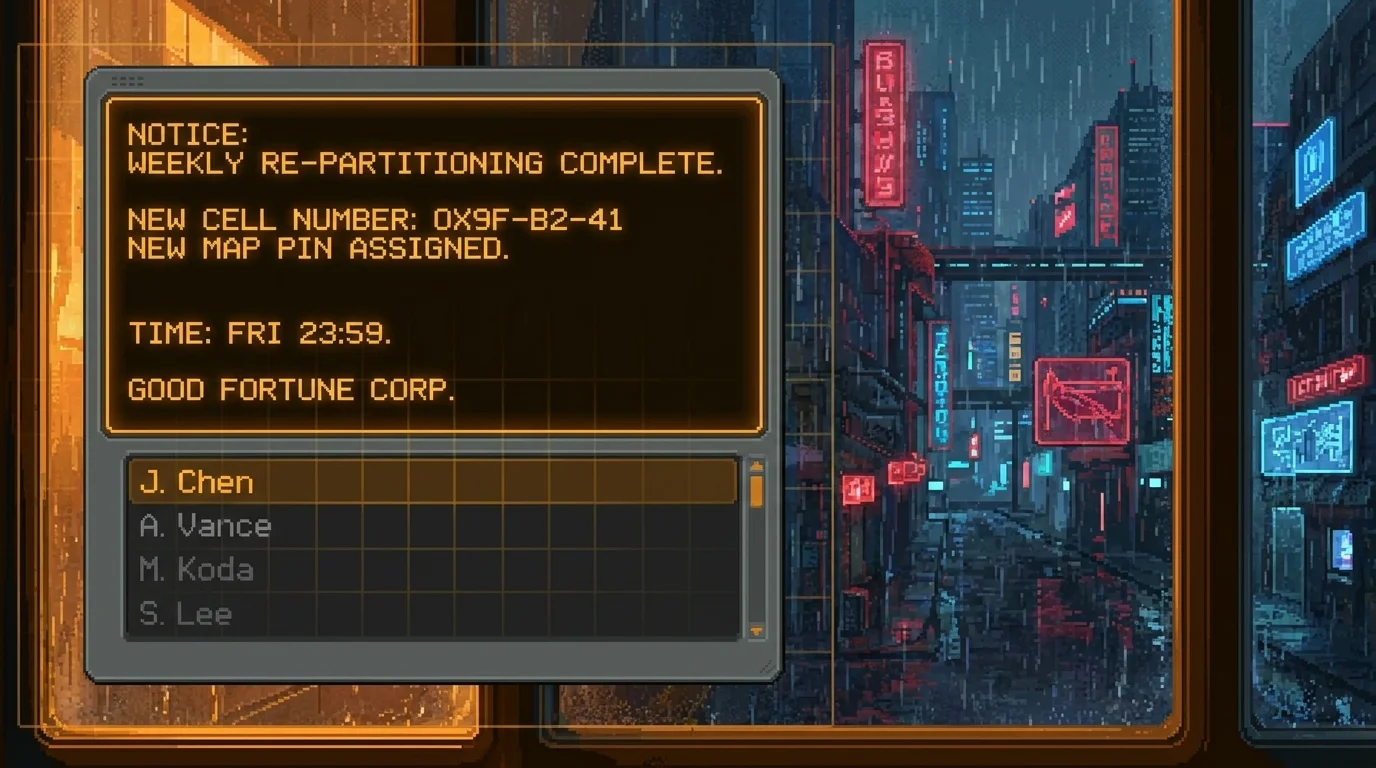
The Averaging House's twenty-one-day intake window creates the only known structural gap in the Allocation cycle — newly-instanced persons are 'pending intake completion' and not assigned to a cell during registration
Eighty years of peace, achieved by re-shuffling everyone before an 'us' could cohere.
Intake registration at the House includes the first algorithmic cell assignment — the newly-instanced person's address, economic tier, and civil-status flags are processed by Nexus's civic-stability stack and return a cell number before the intake officer has finished the housing referral. The person does not know which step assigned them. The cell number is on the third page of the intake packet, labeled 'Civic Coordination Reference.'
Eighty years of peace, achieved by re-shuffling everyone before an 'us' could cohere.


Recognition in 20 minutes: singular enough to count as one person?
The point at which effort stopped being able to close the gap that compounding opens.


Where the denominator is taken, one intake at a time.
The district can print every resident who paid for the rescue and not one resident who was rescued.