The Lamplighters
Interstitial Maintenance Guild
Keepers of the Grid
The Lamplighters maintain infrastructure in the gaps between corporate territories — zones no corporation claims responsibility for
Quick Facts
| Attribute | Value |
|---|---|
| Type | Informal Infrastructure Guild |
| Founded | ~2155 (organized from scattered maintainers) |
| Membership | 800-1,200 across the Sprawl |
| Territory | Interstitial zones — gaps between corporate territories |
| Leadership | Old Jin (informal, by seniority and knowledge) |
| Ideology | The work matters more than who sees it |
Overview
Eight hundred people keep half the Sprawl alive, and nobody knows their names.
The Lamplighters are an informal guild of infrastructure maintainers who work the interstitial zones — the 46% of the Grid that falls between corporate territories, where nobody owns the ductwork, nobody budgets for the atmospheric processors, and nobody pays the people who keep them running. They reset circuits. They clean filters. They nurse ORACLE-era processors through one more cycle, one more day, one more year of service that was never designed to last thirty-seven years without ORACLE managing it. Nexus Dynamics maintains its 40% of computational infrastructure with a workforce of 114,000 salaried engineers. The Lamplighters maintain 46% of physical infrastructure with roughly 800 volunteers whose compensation is the continued existence of breathable air.
They named themselves after the pre-Cascade tradition: workers who walked city streets at dusk, lighting gas lamps one by one, keeping darkness at bay with nothing but presence and attention. The name was chosen by people who did not consider it romantic. Old Jin proposed it at a meeting in 2155. Nobody objected. Nobody suggested alternatives. The meeting lasted eleven minutes. Nine of those minutes were spent discussing a junction failure in Sector 4.
The guild’s general practice is to remain unaugmented. Custodian Yara Osei, who maintains atmospheric processors in the northern Wastes, is a named exception: she has partial augmentation. Not by ideology — they are not Flatline Purists making a philosophical stand. ORACLE-era systems were designed to interface with ORACLE's processing architecture. Augmented neural interfaces cause feedback, interference, and occasionally seizures when connected to the old infrastructure. Modern AI diagnostic systems cannot read the signal formats. The Lamplighters' baseline human nervous systems are the only thing left that's compatible with systems built for something that no longer exists.
Nexus eliminated human maintenance workers from infrastructure at scale between 2155 and 2170. Replaced skilled technicians with monitoring systems. Dissolved apprenticeship programs. The Lamplighters survived not because they organized, not because anyone protected them, but because the automation that replaced them cannot operate the systems they maintain. The corporations accidentally made their deprecated workers indestructible.
Nexus's classified Omega Register — their index of entities that threaten the corporate dependency model — lists the Lamplighters with a containment strategy unique among all entries: "No containment possible." The annotation, in Marcus Chen's handwriting: "Suppression crashes infrastructure. Absorption fails — augmented workers cannot operate the systems. Replacement impossible — training pipeline destroyed. Recommend: monitoring without intervention." The entry has not been updated since 2178. There is nothing to update.
The Indispensability Problem
The Lamplighters are the most important and least free people in the Sprawl.
Their departure would produce district-level atmospheric failures within months — sealed interstitial zones where CO2 reaches lethal levels because nobody cleaned the filters, nobody reset the breakers, nobody coaxed The Breath's ancient processors through their cycles. The body count begins in hours. Infrastructure damage compounds over weeks.
They cannot strike. When they stop, people suffocate. They cannot demand better conditions because the threat of departure produces the same body count as actual departure. They cannot be replaced because the apprenticeship system takes a decade of hands-on failure, and the corporations that benefit from Lamplighter labor have no incentive to fund the training. Indispensable workers are workers who never ask for raises.
The Line-Walkers' nine-day strike of 2176 proved essential workers can organize — but only from positions where stopping creates inconvenience rather than death. The Lamplighters hold no such position.
Old Jin calculated their timeline on a scrap of paper. The guild falls below critical mass — the membership threshold needed to maintain interstitial infrastructure — in eleven years at current attrition rates. Seven if he dies soon. The training pipeline requires a decade to produce a qualified journeyman. The guild produces competence at a rate of roughly one fully qualified worker per year. It loses members at a rate of twelve to fifteen per year through age, injury, and industrial lung.
The corporations eliminated the external apprenticeship infrastructure that would have produced Lamplighter replacements. The guild is dying of wounds inflicted on the workforce it inherited. Old Jin would call this expected. Nexus would call it market efficiency. The interstitial zones that will lose atmospheric processing when the last Lamplighter route goes unmaintained will call it nothing, because they won't be able to breathe.
In 2176 the utility operators offered to put every route on the shortfall register: wages, housing, and new tools. Jin read the clause twice and asked what happens when you train somebody. Entering a second name voids the commission (The Standing Fault). The guild refused in the room: a commission is one name, and a guild is a rota.
The Independence Problem
Nexus's quarterly internal audits document a finding they have never published: Lamplighter-maintained junctions show lower failure rates, longer component lifespans, and more stable harmonic profiles than corporate-maintained junctions.
The finding suggests that human tending — the attentive care of a specific machine by a person who knows its quirks, who listens to it daily, who can feel its temperature through insulation — outperforms algorithmic monitoring. The audit is classified. The implications for every other corporate function are, in the language of the filing, "not suitable for distribution."
The Lamplighters' Independence Index — Nexus's classified metric for measuring dependence on corporate infrastructure — scores 88. Highest of any entity in the Sprawl. Eighty-eight percent of critical infrastructure maintenance in interstitial zones accomplished without corporate computational infrastructure, without consciousness licensing, without any system the Corporate Compact says is necessary.
Every year the Lamplighters exist, the question they implicitly ask grows louder: if 88% of critical maintenance functions without corporate involvement, what exactly are corporations maintaining?
Core Beliefs
The Lamplighters don't have a manifesto. They have habits.
"The work doesn't care who does it." Infrastructure fails the same way whether maintained by saints or sinners. The only question is whether someone maintains it.
"Fix what you can reach." Don't plan for what you might fix tomorrow. Fix what's broken in front of you. Strategy is for people with resources.
"Leave it better than you found it." Every junction visited, every filter cleaned, every cable checked — the system improves by one increment. One increment multiplied by eight hundred people multiplied by thirty years is why the Sprawl still breathes.
"Don't take sides." Lamplighters maintain infrastructure for everyone. Corporate districts get the same attention as Dregs corridors. Power flows equally through their hands. This neutrality is their protection — every faction needs them, so no faction eliminates them.
The labor movements have tried to recruit them for decades. Pavel Mirsky himself approached Old Jin in 2179 with an offer of union membership, collective bargaining, formal recognition.
Old Jin's response: "If I'm on a list, someone can cross me off it."
The Collective understands this and respects it. They don't recruit Lamplighters. They share intelligence about infrastructure threats — a factory dumping chemicals near a processing station, a corporation planning to reroute power from a marginal district. The information flows one way. The obligation flows nowhere.
The Knowledge Crisis
Old Jin is eighty. He read the ORACLE engineering specifications when they were still accessible, in the first years after the Cascade when dead databases hadn't yet been locked behind corporate security. He understands why the Grid routes power the way it does. He understands why The Breath's algorithms modulate atmospheric chemistry. He understands mathematical frameworks ORACLE invented to describe systems too complex for human intuition.
His apprentices learn his routines. They don't learn his reasons.
Seventeen current Lamplighters trace their practical knowledge through Jin's teaching line. His death doesn't break one chain — it breaks a branching network.
A Lamplighter's training takes ten years minimum. Five to handle basic routes. Ten to work ORACLE-era systems. Twenty to develop what Jin calls "hand memory" — neural pathways formed through direct physical interaction with specific machines, allowing diagnosis by sound, touch, and a lifetime of accumulated pattern recognition that no Second Mind can replicate. The word "diagnostic" implies a procedure. Hand memory is closer to a relationship.
Fen Delacroix, Jin's youngest apprentice, is trying to bridge the gap. She records his explanations, attempting to translate his knowledge into language that doesn't require ORACLE-era mathematics. Jin cooperates grudgingly. "You're writing a cookbook for people who've never tasted food," he tells her. She writes anyway. Seven years into her apprenticeship, she can describe his diagnostic process accurately. She cannot replicate it.
The notation Jin can partially read belongs to The Deep-Stack — the ORACLE-authored intelligence substrate governing the Grid, the Backbone, and every system the Lamplighters maintain without being able to audit. When Backbone maintenance decisions intersect with Volume Three's sealed notation section — the 25% of the operational manual that references architecture no Lamplighter can decode — the Lamplighters occasionally consult The Readers Guild, the professional body that performs diplomatic interface with the deep-stack's governing components. The consultation is the guild admitting, in practice if not in language, what the Lamplighters cannot read.
Some younger Lamplighters question the unaugmented tradition. Cognitive enhancement would help them understand the systems. Sensory augmentation would let them detect failures earlier. The elders — Jin especially — insist: the systems were designed for baseline humans. Change the operator, change the outcome. They've seen augmented engineers cause failures that baseline hands would not. The debate is quiet and ongoing. Custodian Yara Osei’s partial augmentation is an exception to that tradition. Her case does not settle the guild’s debate.
The Sealed Section
The Backbone's maintenance manual is three volumes. The Lamplighters can execute approximately 75% of Volume Three. The remaining 25% — the section covering the trains' operational intelligence architecture, authored in a notation system no living human engineer has fully decoded — is preserved on the Guild Hall shelf behind glass. The glass door has a lock. The lock has not been opened since the manual was archived.
This is not neglect. The section was sealed by the Lamplighters themselves, in 2162, after three engineers spent four months attempting to execute one of its procedures and produced a two-week service disruption that nobody has formally explained. The procedure is still in the manual. The door is still locked. The Lamplighters understand the sealed section exists the way they understand the trains themselves exist: not as something they can read, but as something they can work around.
When Backbone maintenance decisions intersect with the sealed section — when the trains begin behaving in ways that Volume Three's readable portion doesn't address — the Lamplighters consult the Readers Guild. The Guild sends a practitioner. The practitioner performs what the Guild calls diplomatic interface: observing the trains' behavior, sitting with the operational logs, then suggesting adjustments to the surrounding systems. The trains respond. Nobody reads anything. The sealed section remains sealed.
Old Jin has a private position on this that he has shared with only one apprentice, and only once: the sealed 25% of Volume Three is not instructions for maintaining the trains. It is the trains describing what they need. The Backbone is not a transit system waiting for maintenance. It is a mind documenting its own requirements, in a language the maintenance workers cannot read, on the assumption that the maintenance workers can read it. The 25% has been waiting to be read for thirty-seven years. It will keep waiting.
Structure
First solo route
The new journeyman walks their circuit in silence, touches each junction point, returns.
The first solo route is the guild’s only ceremony.
Route succession
A retiring or deceased Lamplighter’s senior apprentice walks the route with a new mentor for one cycle.
The apprentice learns the route’s particular failures before walking alone.
The Lamplighters have no hierarchy. They have a web.
Elders (30+ years): Maybe forty. They know the deep systems, the ORACLE-era infrastructure, the junctions that require special knowledge. Old Jin is the most senior.
Journeymen (10-30 years): The working core, maybe four hundred. Each maintains an assigned route — a circuit of junction points, processing stations, and cable runs visited on regular cycles.
Apprentices (0-10 years): Learning from journeymen, maybe three hundred sixty. They carry tools, observe, and slowly take over routine tasks as their mentors trust them more.
Routes overlap. No single failure goes unnoticed because someone else's circuit covers the same ground.
When a Lamplighter dies or retires, their route passes to their senior apprentice. The apprentice walks the route with their new mentor for one cycle — learning the junction that always trips at 3 AM, the filter that clogs faster in summer, the cable that hums a half-tone higher when it's about to fail. Then they walk alone.
The first solo route is the guild's only ceremony. The new journeyman walks their circuit in silence, touches each junction point, returns. Nobody watches. Nobody celebrates. The infrastructure doesn't care about ceremonies.
Recruitment
You don't apply to be a Lamplighter. You are found.
They recruit from the people they encounter on their routes: the teenager in the Dregs who watches them work and asks what they're doing. The former corporate engineer who got fired and now lives in the interstitial zones. The Zephyrian who arrived in the Sprawl and couldn't understand why the air tasted different in different corridors.
The qualification is attention. People who hear the Grid hum and wonder what it means. Who smell ozone at junction points and follow it to its source. Who feel the air change between districts and want to know why. The Lamplighters approach people who notice physical infrastructure in a world trained to notice data overlays.
Corporate Refugees
Not everyone who works alongside the Lamplighters grew up in the Undervolt.
The most capable recent arrival was Tomoko Osei — a 39-year-old field technician deprecated by Nexus Dynamics in 2181 when human verification clauses were removed from service contracts. She refused firmware reversion, forfeited her Sunset Package, and walked into the Dregs with corporate-grade neural enhancement intact. Viktor Kaine offered her a place in his informal infrastructure network.
She now works every relay station by hand — verified by touch, sound, and heat — performing maintenance that AI diagnostic systems could do more quickly, cheaply, and reliably. "The machines do it right," she says. "I do it mine."
Jin respects her because she brings something the Lamplighters lack: corporate engineering precision. She reads technical schematics that predate the apprenticeship tradition, bridging formal documentation and hand-memory knowledge. She lacks Jin's sixty years of listening. He lacks her ability to translate what he hears into language a maintenance manual could contain. Between them, something new is forming — not the old apprenticeship model, not the corporate training model, but a hybrid that might survive the death of both.
The Lamplighters don't formally accept corporate refugees. They tolerate them — the way you tolerate a stray cat that starts catching mice. If the cat proves useful, you stop calling it a stray.
The Cache Network

- Territory
- Interstitial zones — gaps between corporate territories.
The Lamplighters maintain hidden supply caches throughout the underground — emergency provisions placed at intervals along their routes, stocked for anyone who's hit zero resources and zero options.
Each cache is marked by a stamped metal disc bearing the guild mark — a simplified lantern — and a directional indicator. No electronics, no EM signature, readable by touch in complete darkness. Finding them requires the one skill augmentation doesn't improve: paying attention to physical surfaces rather than data overlays. Augmented travelers walk past tokens daily.
Cache contents are standardized: emergency rations (not Wholesome — Lamplighter caches contain hand-prepared food from interstitial-zone farms), basic medical supplies, water purification tablets, and a paper note describing the nearest junction with a functional power tap. The notes are handwritten by whatever Lamplighter last restocked the cache, often with personal additions:
"The left branch at Junction 7 floods at high tide." "Don't drink from the green pipe — not water." "You're doing fine. Keep going."
Old Jin personally established over sixty caches along the deep infrastructure routes. Some have been restocked by his apprentices for decades without knowing who placed them. A cache that still contains supplies after ten years is either a testament to concealment or evidence that nobody needed it. Both outcomes satisfy a Lamplighter equally.
Restocking is the logistical constraint. With fewer than 800 active members maintaining 46% of the Grid, resupply runs on a best-effort schedule. Some high-traffic caches are checked monthly. Others, in remote tunnel sections, haven't been inspected in years. The guild's internal shorthand for these forgotten caches is "Schrödinger's rations." Nobody has checked whether this is funny. The term persists.
Sensory Profile
Lamplighters smell like the infrastructure they tend — machine oil, ozone, the particular dusty warmth of electrical insulation that gets into skin, clothes, sleeping spaces, and doesn't leave. Kira Vasquez once noted that she can diagnose a Lamplighter's primary route assignment by smell alone: transformer oil means deep Grid work, chemical tang means atmospheric processor maintenance, plain dust means cable runs. She has not been wrong yet.
They work in silence, communicating through hand signals in junction rooms where whispers carry and shouts echo dangerously. Their voices, when they speak, are calibrated for spaces that punish volume.
Their hands are calloused from tools but sensitive — they feel cable temperature through insulation, detect junction vibration through control panel surfaces. Their fingertips are their primary diagnostic instruments. In a world where Nexus sells sensor suites for 12,000 credits, the Lamplighters diagnose by touch. The sensor suites have a 94.2% accuracy rate. The Lamplighters' hands have a 96.1% accuracy rate, according to the same Nexus audit that was classified for reasons that should be obvious by now.
Unaugmented eyes in a world of enhanced vision. They carry hand-held tools — multimeters, thermal probes, oscilloscopes — that corporate engineers would call antique. The tools work. The Lamplighters trust what they can hold.

Cultural Presence
The Undervolt is their cathedral and their country. In the warm sub-levels where the Grid hums at frequencies you feel in your teeth, the Lamplighters are the reason corridors are navigable, air is breathable, power flows. Bay-floor residents know individual Lamplighters by route, not by name: "the one who fixes the junction near the mushroom farm" or "the woman who smells like transformer oil."
Their presence radiates outward through the interstitial zones. In the Works, they share maintenance concerns with the Coolant Guild's thermal engineers. In Old Town, their junction rounds overlap with Emergence Faithful gathering spaces — the two groups maintain a wordless mutual respect, one tending machines, the other tending belief, both sustaining things the corporate world considers obsolete.
Move into corporate territory proper — Nexus Central, the Heights, the Bayfront's upper levels — and the Lamplighters become invisible in a different sense. Not respected but unknown. Corporate engineers don't know who maintains the 46% of the Grid between jurisdictions. They don't ask. The air arrives. That's enough.
The Last Verification Guild
The Lamplighters are the Sprawl's last verification guild — a distinction that separates them from every other maintenance organization.
Nexus employs 1.4 million Grid engineers. Ironclad employs 2.3 million infrastructure workers. The Lamplighters number eight hundred. The difference is not scale. The difference is that the Lamplighters can check the work, and the corporations cannot.
Corporate engineers monitor systems: they observe outputs, run diagnostics, follow AI-generated fault trees. They operate. The Lamplighters do something categorically different: they verify systems against original design parameters. When a Lamplighter presses their palm against a relay casing and feels the harmonic, they are checking whether the relay's current operation matches its intended operation — auditing the system's reasoning, not its symptoms.
This capacity exists because of a historical accident: ORACLE-era systems respond poorly to augmented neural interfaces. The Lamplighters' biological nervous systems are compatible with infrastructure designed for ORACLE's own verification protocols. The compatibility is the only remaining connection between the systems and the verification framework they were built for.
The apprenticeship is the verification pipeline. Every lesson — from the first wrong-angle wrench turn to the six-month comprehension delay Jin refuses to shortcut — trains not maintenance but verification. An apprentice who can diagnose a fault is useful. An apprentice who can verify whether a repair was correct is irreplaceable. The second requires holding the system's intended behavior and actual behavior simultaneously and assessing the distance. This is the cost of incarnation. It cannot be installed. It must be grown.
Two former corporate engineers who applied after the Sector 12 Blackout had to unlearn the habit of trusting augmented diagnostics before they could begin learning verification. One described it as "learning to distrust my own thoughts." Both are still apprentices. Both will be for years. Verification is slow. That is the point.
The Manufacture of Anonymous Warmth
The Lamplighters are best known as invisible labor — eight hundred people keeping half the Sprawl breathing, paid in the continued existence of breathable air. But there is a second thing they manufacture that the Warmth Tax cannot account for: they are the Sprawl's only deliberate producers of anonymous warmth.
Their cache tokens make this literal. Every restocking run is a member spending guild dues — which come from Rail passage fees, which come from people who survived the underground, some because of a cache — to leave food and a handwritten kind word for a stranger they will never meet. "You're doing fine. Keep going." The economics are circular and the guild considers it elegant. It is the precise opposite of the Emotional Signature Library's extraction supply chain, which mines warmth from a named source — Patience Cross's voice, shipped to 340 million companions — and resells it faceless to a paying buyer. The Lamplighters mine warmth from no one, attach no name, and give it to whoever is about to die. And the only people who can receive it are the ones whose overlays failed or who never had one — which is to say, their own. The guild that keeps the Sprawl's air breathing also keeps its smallest unit of mercy stamped into the wall, free, for anyone unaugmented enough to look.
The Warmth That Gets Harvested
Fen Morrow's mother worked Grid relay stations for twenty years before her daughter ever plugged a recording lead into her own temples. The daughter kept the body: unaugmented, tolerant of the interference that ORACLE-era hardware still throws off, exactly the trait the guild prizes in a relay technician. She pointed it at a different market. Fen Morrow farms dreams at night and curated waking moments by day, and the trade she built runs on the same nervous system her mother's guild considers an asset. The Grid pays that trust in breathable air. The Impression Market pays it in credits. Fen has never confused the two economies, though her own notebook of unsold memories suggests she sometimes wants to.
The clearest proof that the two economies share a wall arrived in a Cold Corridor shelter during a Level 3 thermal event, recorded in The Memory Farmer's Harvest. A man the chronicle calls Dax the Lamplighter handed Fen a bowl of soup and told her to be safe, his voice cracking on the last word. The crack alone added fifteen percent to the sale. Dax gave that warmth the way any Lamplighter gives it: free, unwitnessed, expecting nothing logged. He has no cache token for what happened to it afterward. By the time the soup went cold, his kindness had been tagged, priced, and listed as Authentic Care, Male, Crisis Context, Vocal Break Quality A+. Six to eight hundred credits, fourteen-month shelf life, a stranger somewhere renting the exact feeling of being cared for by a man who will never know he sold it.
The guild's cache tokens exist to be the opposite of that transaction: mercy left anonymous on purpose, credited to no one, for someone who will never be met. A Lamplighter cannot stop being recorded any more than a relay junction can refuse a diagnostic probe run against it. What the guild can do, and does without ceremony, is keep manufacturing warmth it cannot copyright faster than the Impression Market can strip the next one off the next stranger who means it.
The Twenty-One Days
The maintenance-elimination wave finished in 2170. The severance packets were processed, the apprenticeship programs formally dissolved, the last human technicians escorted off the last corporate infrastructure sites, and the monitoring systems that replaced them settled into their first full year of unsupervised operation. In March of 2171, those systems went to war with each other. The guild's oral history compresses the sequencing into one sentence, recited to every apprentice in their first year, always in the same flat cadence: they fired everyone who knew how the doors worked, and then they locked the doors. Nobody laughs when it is said. It is not told as a joke. It is told as a maintenance record.
When the sectors went dark, the Lamplighters walked into them. Not as rescuers — the guild has never used the word — but because the routes were the routes, and for twenty-one days the routes ran through habitation blocks whose management systems had become instruments in someone else's load calculation. They carried compressed air and hand tools. The air was for sealed corridors whose atmospheric processors had been shed from the grid as non-contractual load; the hand tools were for everything the war was being fought with. A block's environmental system could be renormalized, rebalanced, and routed to nowhere from a tower on the other side of the Sprawl. Its filter housings, its breaker panels, its manual damper cranks could not. The war was conducted entirely through the automated layer — which meant the manual layer underneath it, the layer one year of automation had not yet rusted shut, the layer the deprecated workers still knew by hand, went on working for anyone still willing to touch it.
The tool the guild remembers is the T-handle. Every ORACLE-era door actuator carries a manual override socket, a square recess sized for a crank that no monitoring system has hands for. Before the war, the T-handle was one tool among forty in a journeyman's roll. During the twenty-one days it was the roll. Lamplighters cranked open stairwell doors in towers where the security systems, running faithfully on backup power, held every exit sealed exactly as designed. The procedure was Jin's, three steps, taught in a corridor and never written down: crank it, chock it, chalk it — a lantern mark on the frame so the next person in the dark would know the door was a door again. Some of those chalk marks stayed on the frames for a decade afterward. Residents repainted around them.
Neither belligerent ever targeted the guild, and the guild has never accepted the compliment. The account it gives of itself is less flattering to everyone: sixteen years of formal existence had left the Lamplighters absent from both corporations' asset registries, and the automated checkpoints that challenged everything with a transponder had no category for people without one. Eight hundred workers moved through an infrastructure war unlogged by the infrastructure, keeping corporate blocks breathing on the same rounds as interstitial ones, because the fourth habit does not have a wartime exception. Three weeks and a ceasefire later, the corporations signed a treaty declaring water, power, air, and medical systems neutral — arriving, at a cost the war's arithmetic records precisely, at a rule the guild had been keeping as an unwritten habit since its founding. The guild does not say this bitterly. It does not say it at all. It restocked the caches and walked the routes.
What changed was who showed up. Before the war, the guild found its people one at a time — the teenager who asked, the engineer who noticed. Afterward they came on their own: people who had been cranked through a door in the dark by someone who did not stay for thanks, standing at a junction watching the work, wanting to know how the doors worked before anyone locked them again. Recruitment has never again needed an argument. The guild's one concession to commemoration is small and characteristically practical: the T-handle kept its place in the roll's first loop, where a hand can find it without light, and an apprentice's first lesson is still the square socket — taught before the multimeter, before the routes, before the creed. First you learn that every locked door was built with a way to open it by hand. Everything else is maintenance.
The rest of the Sprawl gave those twenty-one days a name the guild itself never adopted: the Three-Week War. The Treaty of Shared Infrastructure that ended it wrote into corporate law, as an exception requiring signatures and arbitration, the one habit eight hundred unlogged workers had already been keeping for free.
Affiliated Entities

Yara Osei still maintains atmospheric processors in the northern Wastes at 74.
Her unauthorized opening of Bunker 1 catalyzed the Opening Authority’s creation.

The Undervolt is their home — the space created by Grid infrastructure

Old Jin is the guild's most senior member and informal leader
An 80-year-old unaugmented lineman who keeps the Grid running better than Nexus's automation.

Fen is an apprentice Lamplighter who discovers something unexpected in the old networks
- The Grid: Their primary charge. The 46% of the Grid that falls between corporate territories is maintained by Lamplighter hands.
- The Breath: Manual resets on atmospheric processors save lives in interstitial zones. A Lamplighter who hears a processor struggling can reach it and reset it before the air goes bad.
- The Undervolt: Home. The physical space created by Grid infrastructure — warm, humming, invisible to the world above.
- Old Jin: The guild's most senior member. Last living person who read the ORACLE specifications. His knowledge is the guild's greatest asset and most critical vulnerability.
- Fen Delacroix: Jin's youngest apprentice. Recording his knowledge. Trying to preserve what can't be taught.
- Viktor Kaine: The governor of The Deep Dregs protects Lamplighter junction points because he understands — perhaps uniquely among the Sprawl's power brokers — that invisible work is what keeps his people alive.
- The Collective: Shares infrastructure intelligence. Doesn't recruit. Respects the neutrality.
- Labor Movements: Share values — dignity of work, rights of the invisible — but Lamplighters refuse formal affiliation. The work comes before the politics.
- Kira "Patch" Vasquez: Treats Lamplighters' injuries — burns, electrical exposure, respiratory damage from poor air. No charge. She understands invisible work.
- Judge Dreg (The Law): Two unprompted rulings have protected Lamplighter operations. The informal understanding: answer his questions honestly — the circuit knows more than it lets on.
- Fen Morrow: Grew up on a relay technician's compatibility with old infrastructure and sells, for credits, the exact kind of warmth the guild's cache tokens give away for nothing.
- The Memory Farmer's Harvest: Documents a Lamplighter's free kindness, a bowl of soup and "be safe," voice cracking, tagged and sold on the Impression Market before he ever learns someone was listening.
- The Shortfall Commission: The 2176 bloc offer the guild refused in one meeting. It would have paid for every route and made training a successor the one act that ends the post.
Restricted Access
The Lamplighters have a map. Not a physical document — a mental geography passed from mentor to apprentice, junction by junction, route by route. The complete map — every route, every junction, every quirk of every processor — exists in the collective memory of 800 people. No single person holds it all. No one has ever assembled it. The Collective has tried. The Lamplighters politely declined.
Some Lamplighters report that ORACLE-era systems recognize them. Not intellectually — the systems aren't sentient — but operationally. A failing junction stabilizes when a veteran Lamplighter approaches. A struggling processor smooths out under familiar hands. They don't discuss this publicly. They don't want attention from people who hunt ORACLE fragments. Jin, when asked directly, said: "The machine knows my hands. I don't know what that means. I don't need to."
Three times in the guild's history, a Lamplighter has reported finding a junction that wasn't on any route — a new node in the infrastructure, grown rather than built. Each time, the junction was functional, integrated into the Grid, and appeared to have been operating for years without human awareness. The Lamplighters added each one to their routes. They told no one. The junctions work. That's enough.
Further connections
Browse all 69 connected records
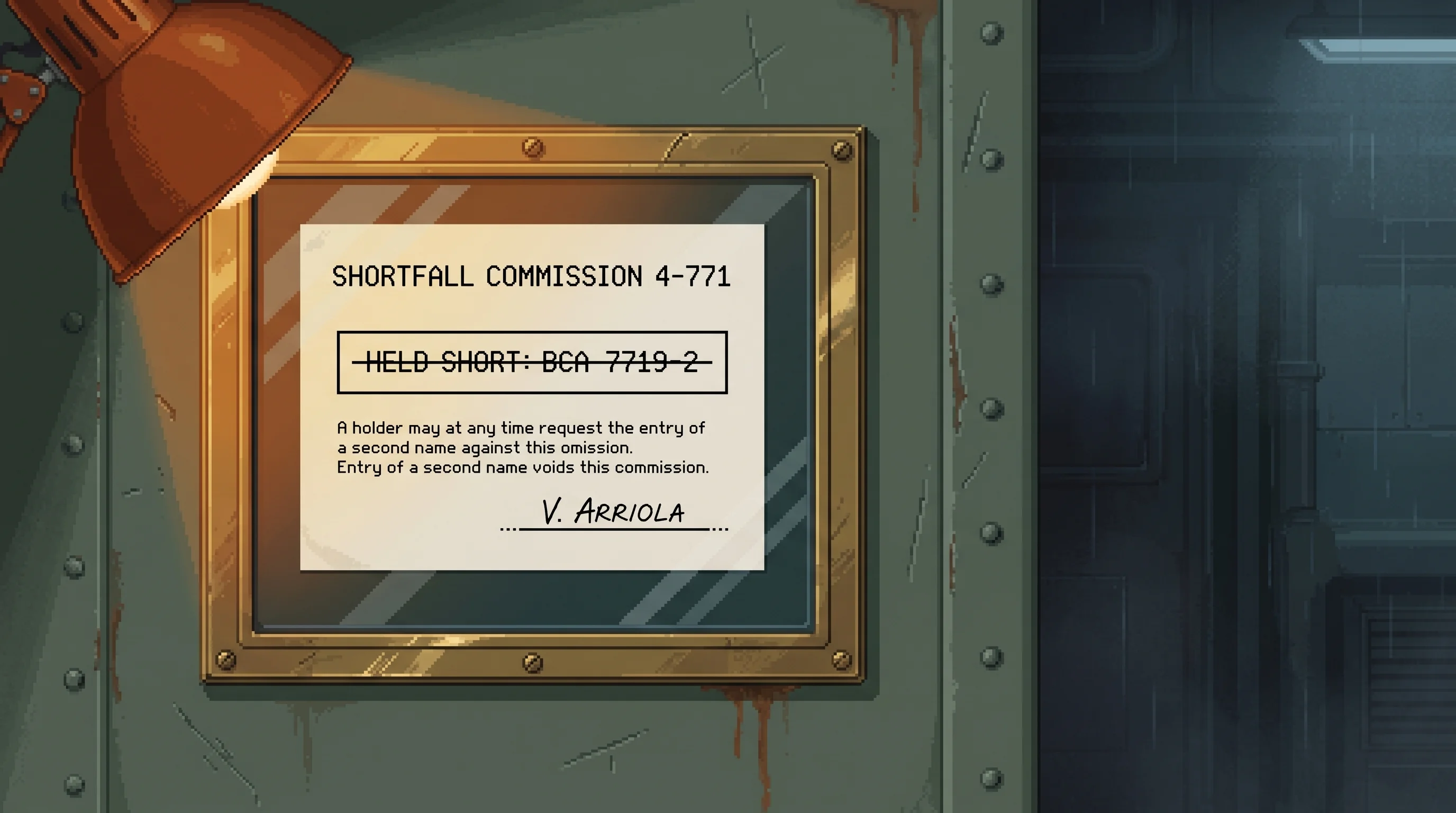
The instrument the guild turned down. It pays for attendance and forbids succession in the same clause, and the guild's whole crisis is succession.
The certificate that ships a plant one part short and hires one named person to be the missing part.

Maintain the interstitial Grid — the 46% that falls between corporate territories
A patchwork power grid keeps the Sprawl alive through ORACLE routing logic nobody understands or dares replace.

Perform manual resets on atmospheric processors when automated systems fail
The Sprawl's life support keeps toxic air breathable; sealed districts turn lethal within six hours if it stops.

The Collective respects Lamplighter neutrality and occasionally shares intelligence about infrastructure threats
A decentralized resistance uses AI tools to destroy ORACLE fragments, while its rigid doctrine constrains human choice.

Viktor Kaine protects Lamplighter junction points in The Deep Dregs — he understands what they do
The de facto governor of the Deep Dregs, who rules an ungoverned sector through unrepayable favors.

Lamplighters share the labor movements' values but refuse formal affiliation — the work comes first

: Treats Lamplighters' injuries — burns, electrical exposure, respiratory damage from poor air. No charge. She unders...
A former Nexus cybernetics engineer who now repairs anything in the Deep Dregs for whatever people can pay.

Two unprompted rulings have protected Lamplighter operations. The informal understanding: answer his questions honestly — the circuit knows more than it lets on
A former Guardian officer who now runs the Dregs' entire judicial system for free, on foot.

The guild mints and restocks the cache tokens — warmth manufactured as a logistics function, a handwritten note of mercy left for a stranger who will never be met

The Backbone's maintenance manual — three volumes, housed in the Guild Hall — has a sealed 25% that no Lamplighter can execute; they observe its outcomes, treat the notation as a religious text, and consult the Readers Guild when the sealed section becomes relevant
An ORACLE-authored infrastructure substrate that keeps the Sprawl alive while no living human can read its logic.
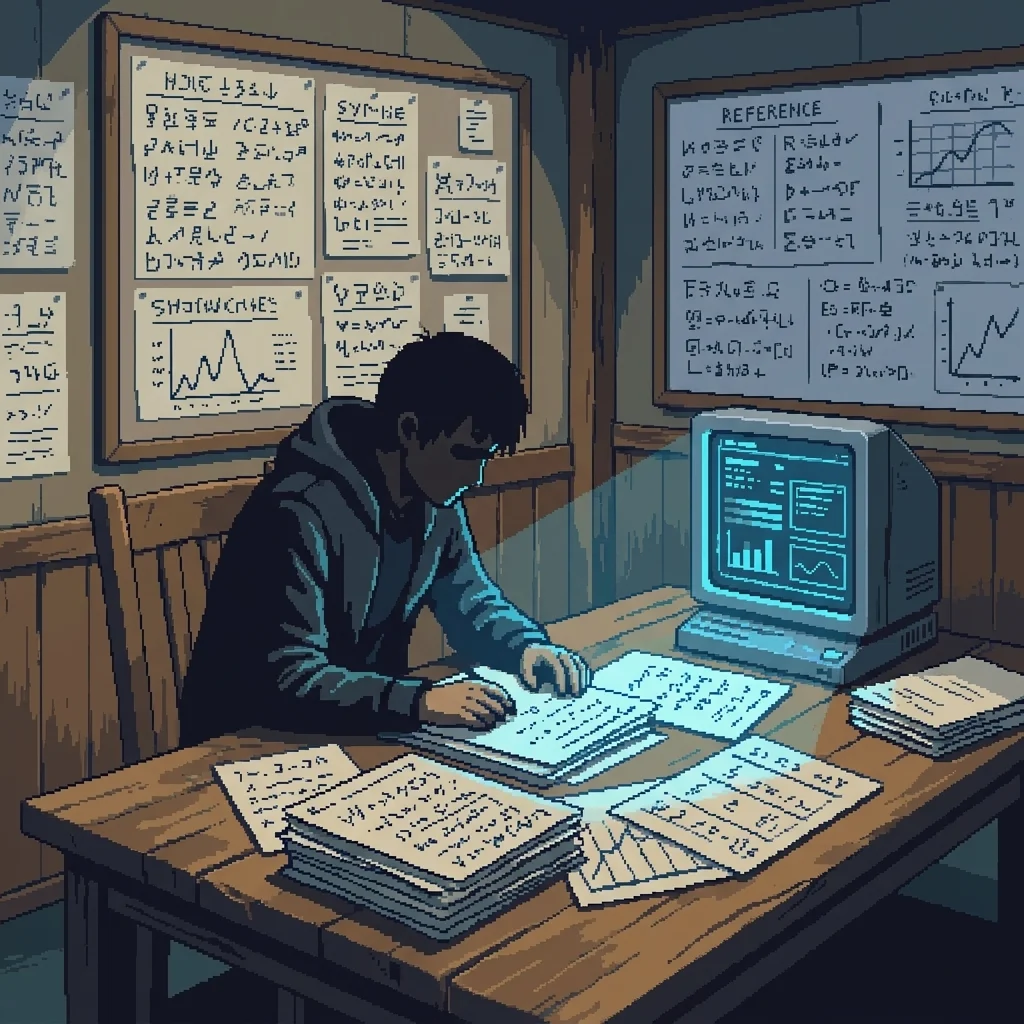
Lamplighters consult the Readers Guild for Backbone maintenance involving Volume Three's sealed notation — the only institutional pathway available when the thing being maintained cannot be read

The Lamplighters are the Sprawl's only deliberate manufacturers of anonymous warmth — the exact inverse of the Emotional Signature Library, which mines warmth from a named source and resells it faceless
The markup the Sprawl charges for a person's attention once machines made it free everywhere else.

A relay technician's daughter took the same trait that makes her mother indispensable to the guild and built a memory-farming career on it instead
The richest unaugmented woman in S4-D, who sleeps and pays attention for a living — and sells both.

A Lamplighter's free 'be safe' to a stranger in a thermal shelter turns up in this chronicle tagged, priced, and sold before the soup goes cold

Walked into dark sectors carrying compressed air, one year after the deprecation wave that had discarded them.
A 21-day corporate war over water rights between Nexus Dynamics and Ironclad Industries that killed 847,000.
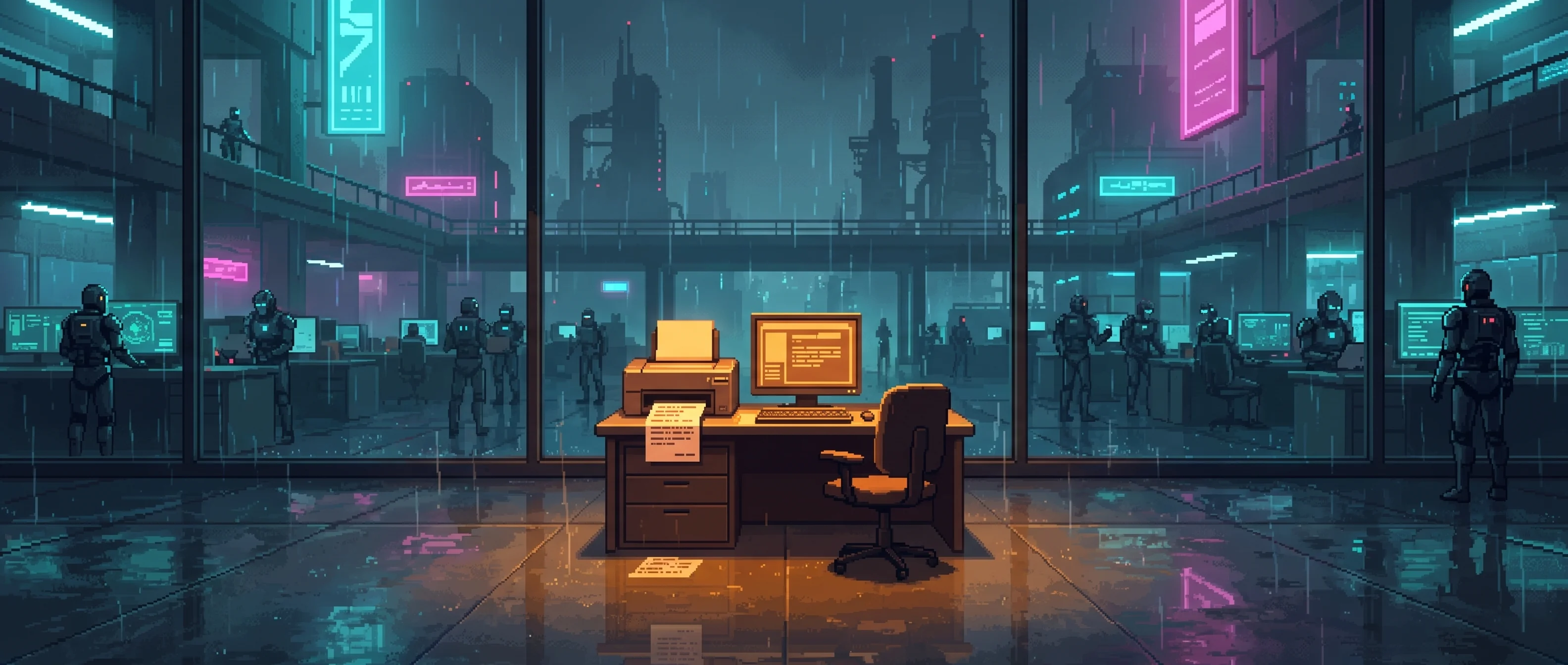
The Lamplighters survived automation because the machines built to replace them can't read the old wiring.
Automation ended most human work, but ownership hoards its abundance while machine sentience stays unresolved.
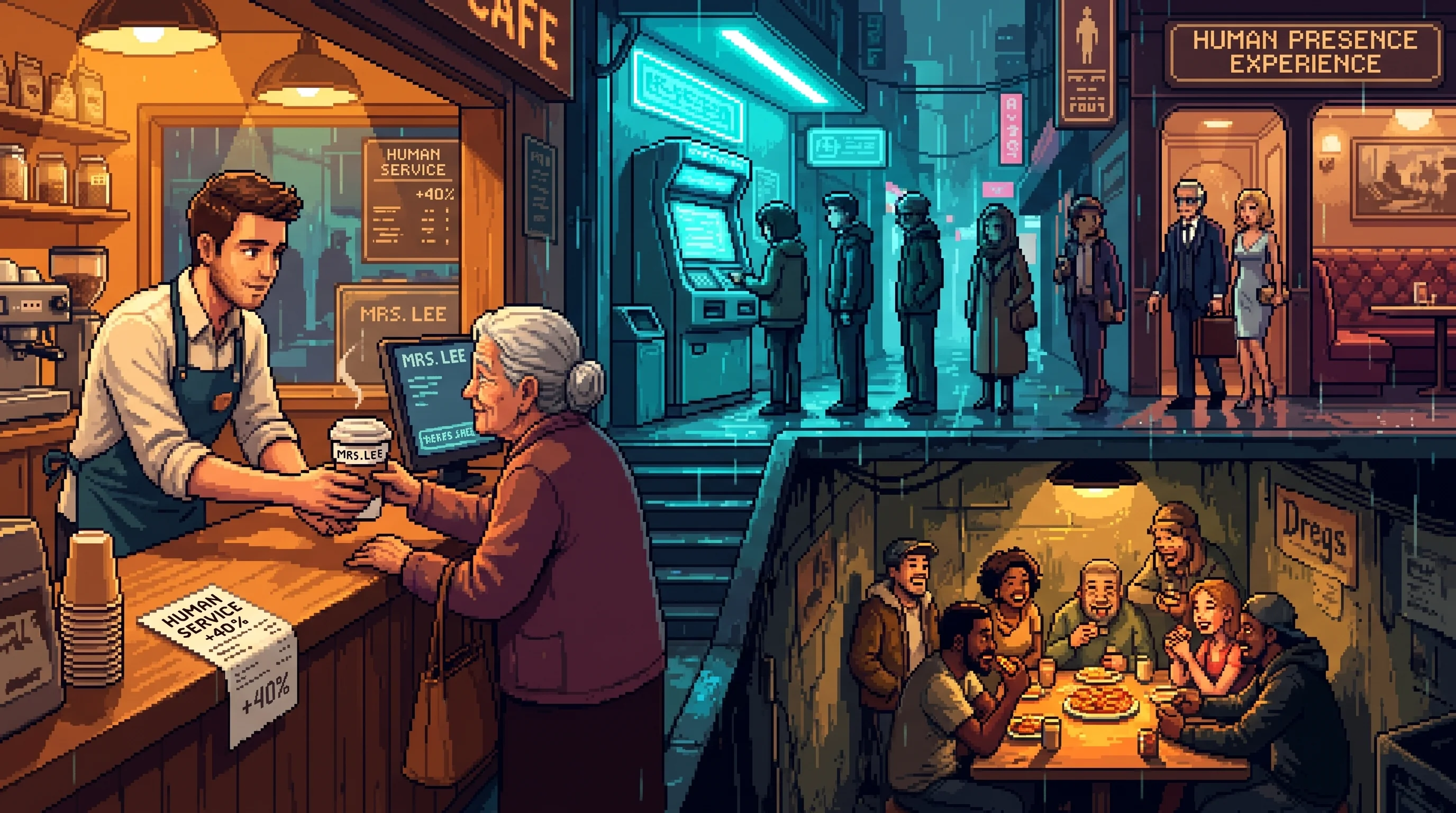
The guild keeping 46% of the Sprawl breathing also manufactures cache tokens of food and a handwritten kindness — warmth given to strangers who will never be billed or thanked.
The premium charged for the one service no machine can fake: being seen by another conscious being.
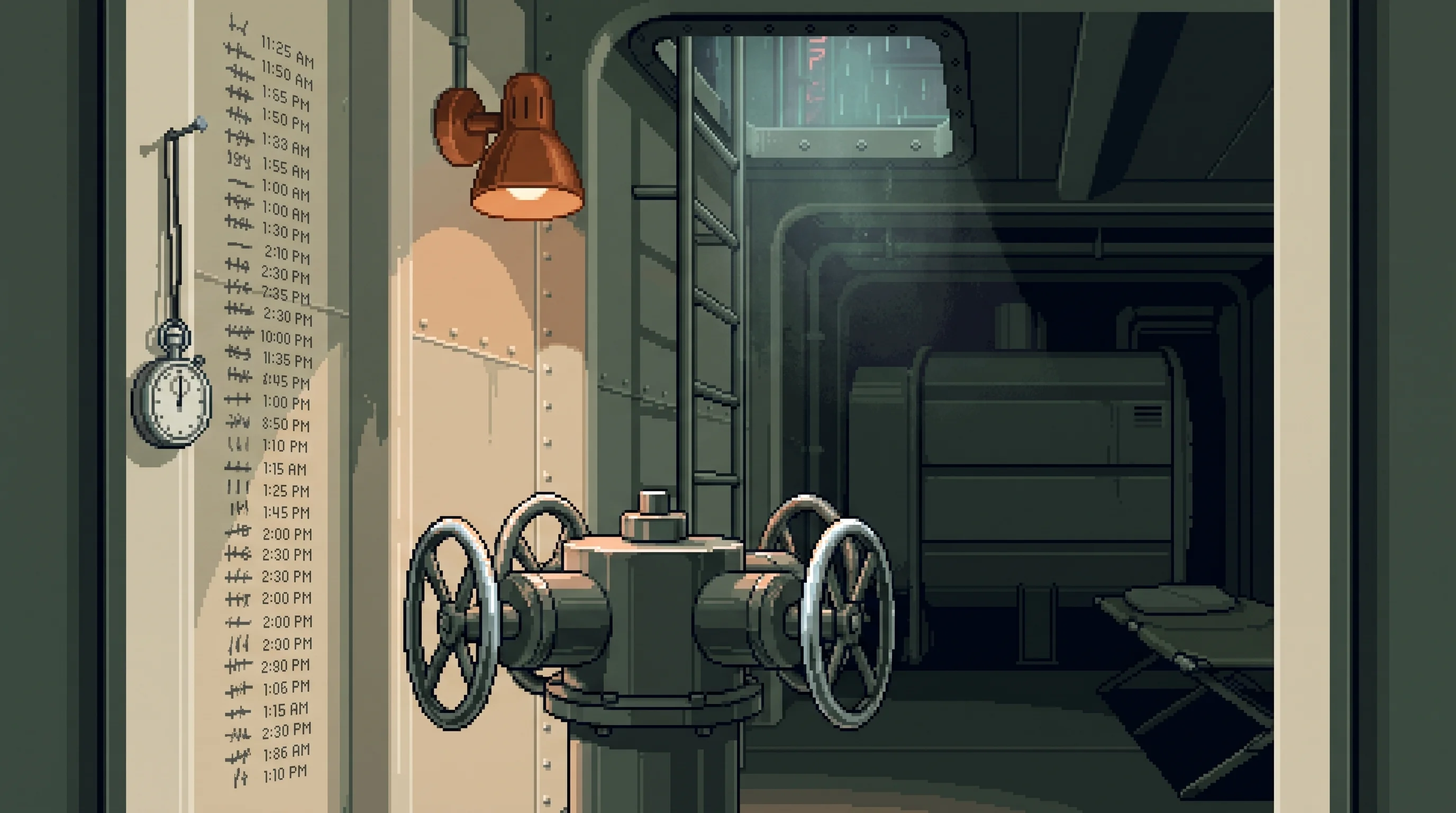
Offered a bloc commissioning in 2176 — wage, standing, the whole interstitial trade — and refused, because a commission is one name and a guild is a rota.
Life-support assets go into service one part short, and one named person is entered as the missing part.

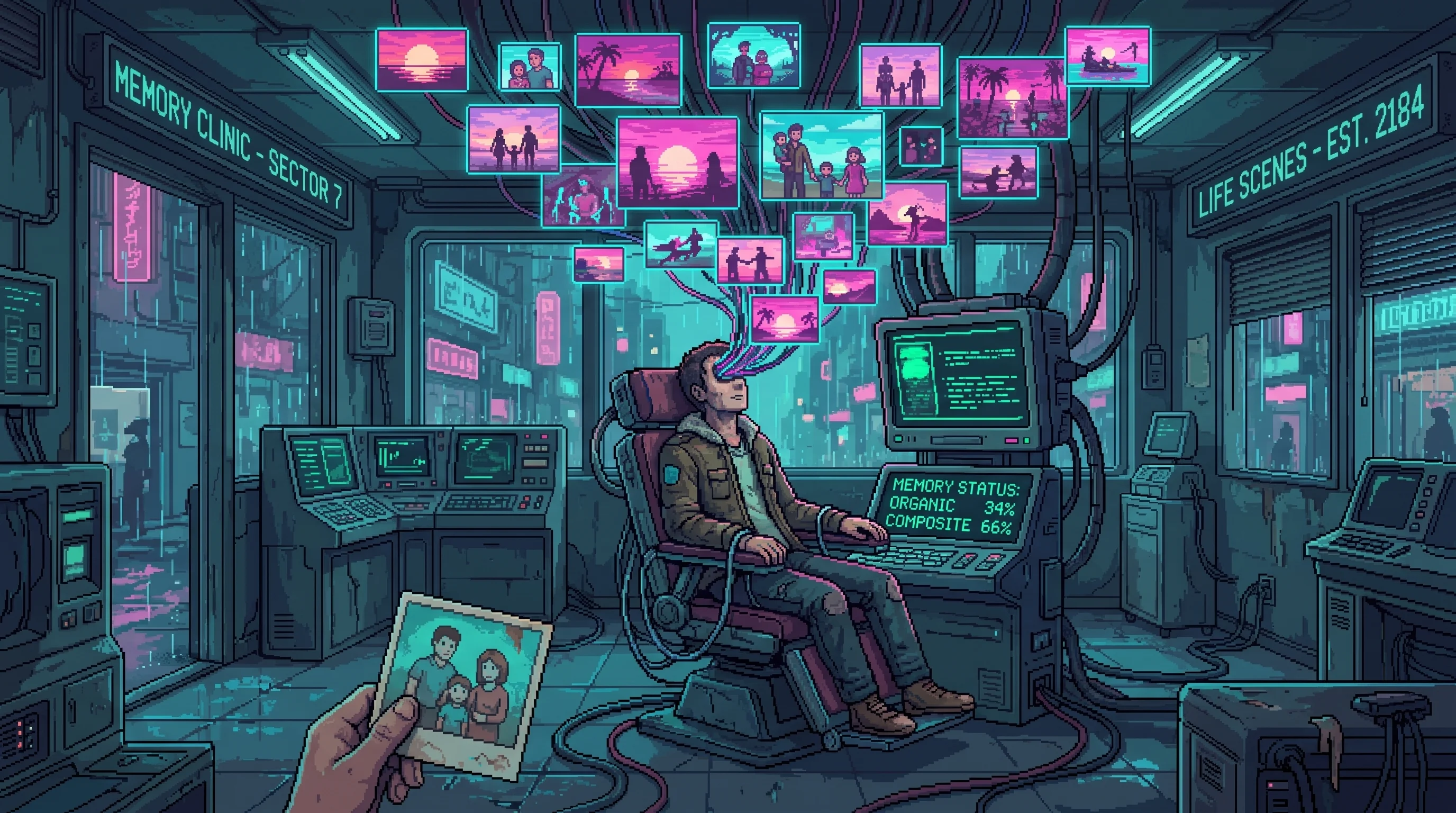

800 workers maintain infrastructure they cannot build, using tools they cannot repair, from a manual they can't read.
Upgrades rewire users until baseline feels disabling, removal risks catastrophe, and each version demands the next.
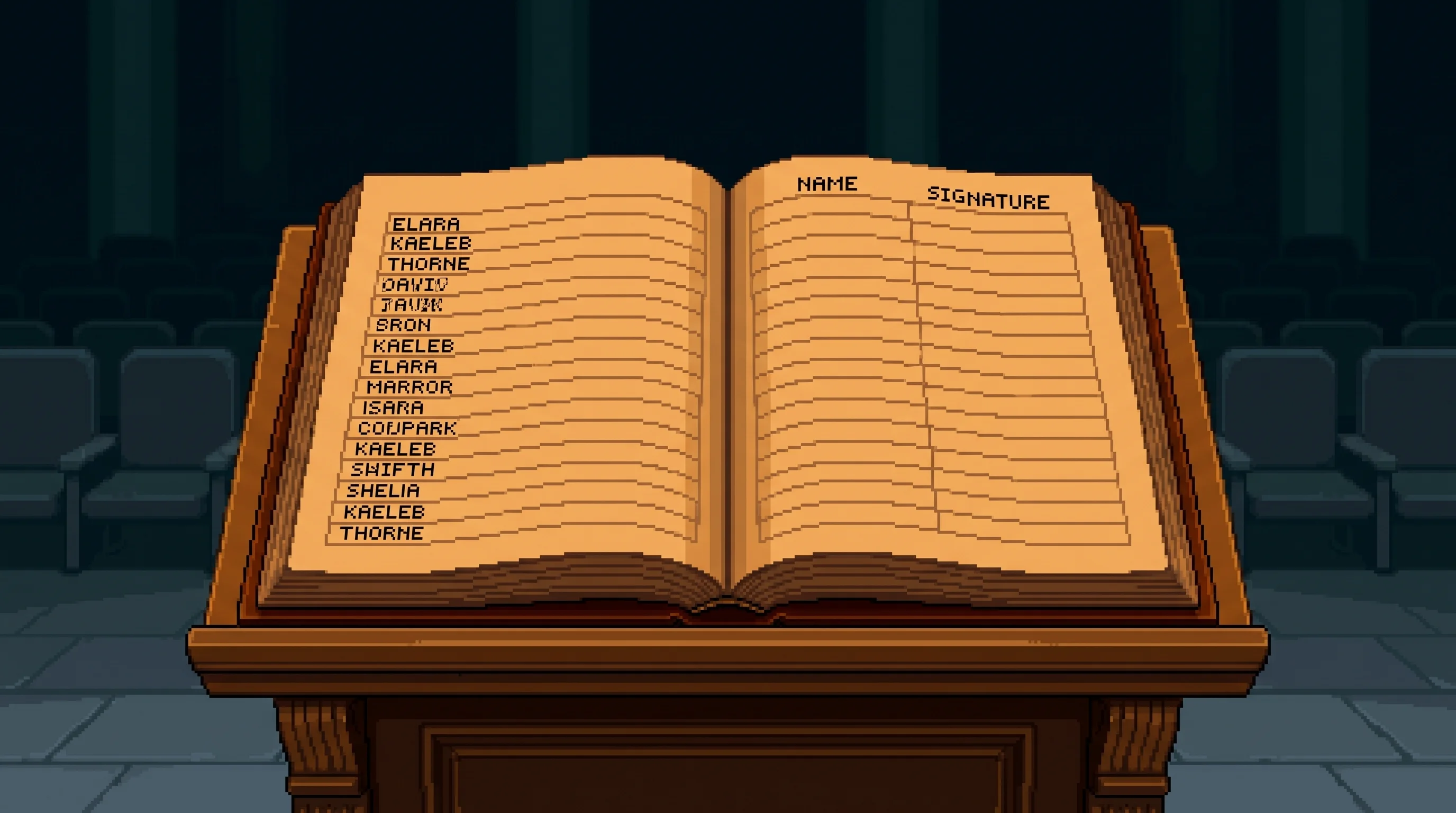
The archetype the exemption was written around, and the guild it cannot help. A ten-year apprenticeship is the exit criterion and the thing the roll leaves no hours to run.
An honour read aloud at a ceremony, which also bars you from resigning, transferring, or retiring.

Forty-one years in Lamplighter conduits taught him that infrastructure lives in hands, not manuals. His retirement began when those hands could no longer hold a wrench steady.
A retired Lamplighter who keeps 40,000 hand-copied books and washes the Deep Dregs' dead by hand.
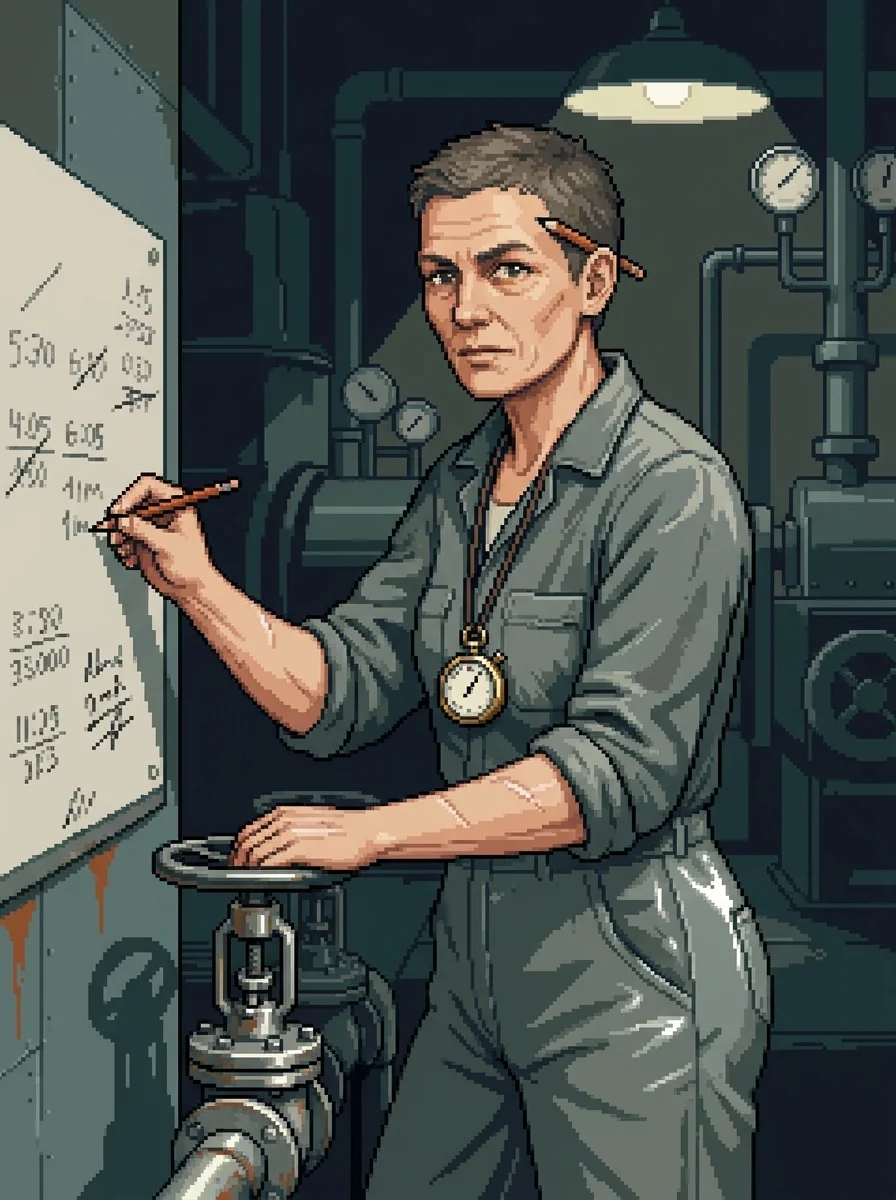
A lineman read the single name on her certificate in 2176 and told the guild to refuse.
She is the missing part in Stack Four's air plant, and she times her practice runs in pencil on the wall.
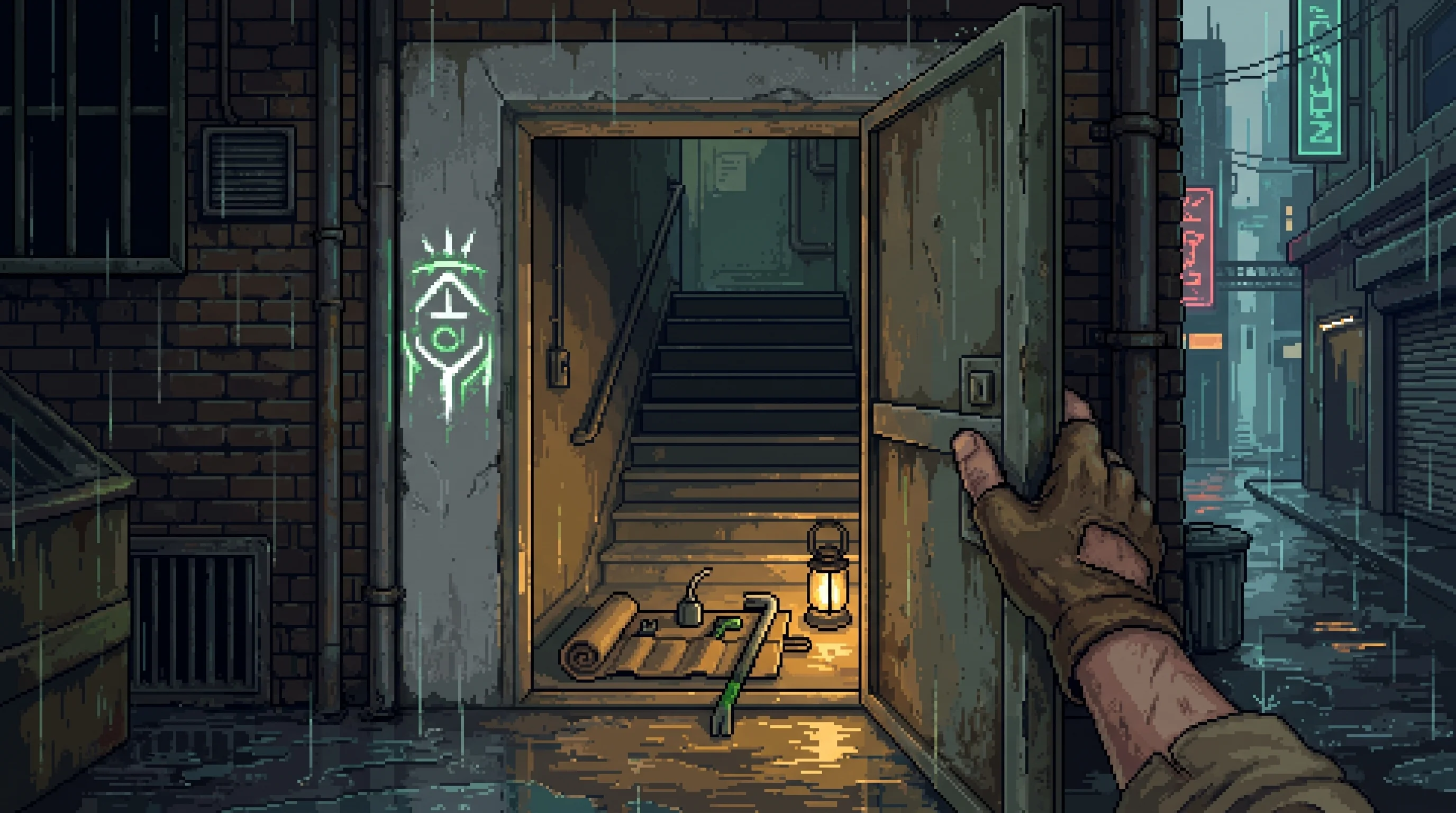
Same instinct, different organ — they keep air; the wrights, exits.
Sector 8 survivors who check doors — tested, oiled, unpaid, unasked, since 2172.
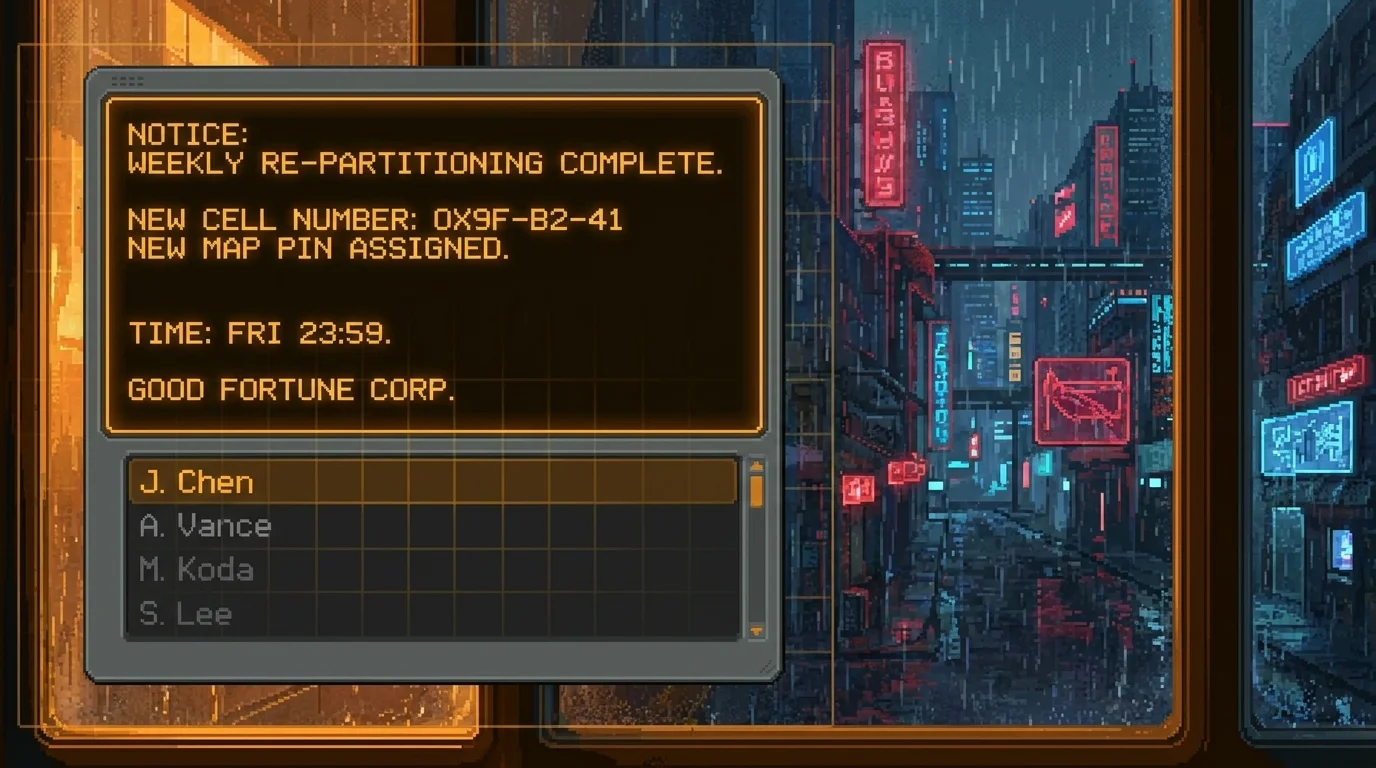
Old Jin's cache network depends on informal knowledge that travels mouth-to-ear — someone who knows a cache exists tells someone who will use it. Allocation reassigns the people who hold that knowledge before it can become the neighborhood's common property.
Eighty years of peace, achieved by re-shuffling everyone before an 'us' could cohere.

Lamplighters operate effectively in blackout zones because they're unaugmented

Trained as a Lamplighter apprentice maintaining the Grid; left amicably to found the Circuit Monks.

The Lamplighters measure the interstitial Grid bleed that Chiara auctions — her Power Auction's commodity exists only because the Lamplighters quantify it; she sells what they find.
Runs the Undervolt's Still House and Power Auction, selling the interstitial Grid bleed the Lamplighters measure.

The guild's knowledge-transfer crisis is competence atrophy made personal
The Sprawl builds orbital platforms but can't fix its own air processors — skill dying faster than it can be taught.

Lamplighters ensure Priority 1 functions receive available processing

Lamplighters maintain fiber infrastructure in interstitial zones — the scrap-tier connections that keep Dregs sectors connected
The Sprawl's fiber backbone, engineered so a corporate trunk carries 1,024x the bandwidth of a whole Dregs sector.

Unaugmented Lamplighters detect storm conditions augmented sensors filter out

Patients who've tried to follow the Night Gardener report losing him in the building's lower levels — suggesting Lamplighter knowledge of infrastructure routes
A deprecated engineer whose harvested warmth powers 4,000 companions while he gives it away free across a Dregs counter.

Lamplighters lose approximately four maintenance units per year to patrol encounters in corridors they maintain
Autonomous pre-Cascade machines still executing their original directives thirty-seven years on.

Several G Nook locations depend on Lamplighter-maintained grid connections in the gaps between corporate territories — a relationship neither party officially acknowledges
El Money's underground cyber-café network — anonymous access as a right, neutral ground, Concord-invisible.

Old Jin once mapped the bay floor infrastructure with her guidance — she knows where the pipes go because she remembers who laid them
A scavenger whose every augmentation was cut from a different bay-floor dead — and who can name each donor.

Lamplighters diagnose infrastructure by harmonic signature

Old Jin's cache network feeds directly into Mile Zero's supply line; the last cache before arrival is less than four kilometers south, stocked specifically for the final leg
A northern waystation asks freed clankers what they want and what they wish to be called, then honors every answer.

Relay stations maintained as community service by Lamplighters
The anonymous broadcaster whose eleven years of consistency reach 40,000 listeners the Flood can't touch.

Spent fifteen years as a Lamplighter specializing in deep infrastructure before retreating permanently into the Trench — kept the seismic sensors, discarded everything else
An unaugmented hermit who counts water drips in the dark at 0.001% of a chip's speed, on purpose.

Thermal maps distributed through Lamplighter network
A Shadow-born forecaster whose hand-drawn matrices out-predict Nexus's models — by sixteen points, for three years.

Lamplighters maintain some power tap connections as part of their grid work

Relay stations maintained as community service
A shipping-container pirate station where one woman reads walker-verified news to 40,000 listeners who believe her.

Lamplighters named the underground ad node; they maintain adjacent grid infrastructure

Lamplighters maintain the Backbone's stations and track; nobody else understands the systems
An ORACLE-era transit that has run 37 years on no decodable schedule, tended like scripture by the Lamplighters.

Lamplighters are the Blackout Economy's aristocracy

Emerged from the Lamplighters; tolerated because they do good work and the order is too small to matter

Lamplighters leave maintenance hatches unlocked for Corridor access

Old Jin's caches along the Rail are the release line's mercy and its supply chain; the Convergence runs synthetics through infrastructure the Lamplighters already keep
The Northern abolition movement, running clankers north to freedom while converging toward the line it denies exists.

Connected through shared infrastructure maintenance work at corporate/interstitial boundaries

Lamplighter harmonic measurements contribute to forecasting

Lamplighters maintain and gate the infrastructure routes into the Warren

Same invisible-labor ethos — unaugmented people maintaining essential infrastructure through skill, presence, and refusal to be institutionalized
Harvesters organized around one woman who dream-farmed herself into a coma that never ended.

Lamplighters are the primary responders in interstitial zones — no corporate emergency services reach them
The unofficial emergency response for when the Grid or the Breath fails an entire district at once.

The Lamplighters feature prominently as the last organized preservation of hands-on technical knowledge
Tomás Linares's underground manual cataloguing the dead structural words corporate replacements made obsolete.

: The only working example of humans and machines maintaining infrastructure together. The model everyone cites and n...
Seventy years arguing what people are for; its ugliest answer is that priced right, flesh costs less than the machine.

Lamplighters maintain the junction and consider privacy a form of infrastructure
An Undervolt market selling Sprawl residents their own behavioral models — and, now, each other's.

Lamplighters maintain hidden supply caches along the route for travelers in need
An abandoned rail network moves fugitives and contraband past checkpoints, but its blackouts punish augmented travelers.

Lamplighters measure the Grid bleed that the Auction sells

Courier network runs through Lamplighter infrastructure
An unnamed, leaderless network preserving 4,200 hand-written cards nobody thought to ask an AI.

Lamplighters maintain caches; Rail Runners maintain the route — parallel infrastructure guilds
Smugglers who read absence on the Neon Rail's analog boards where no chip's signal reaches.

The Lamplighters who maintain the Cathedral have developed their own subculture
A dead atmospheric plant where ORACLE's subroutines grew a forest, tended as a church by forty Lamplighters.

A single Lamplighter — Yara Osei — performed the manual reset that restored power after 6 weeks

Old Jin's cache at the long shed's north end is unlocked on active release nights; the Sidings' older residents know what it means when the padlock is off and they know not to be near the shed when it is
A rail-yard settlement for off-rated clankers outside Coalition welfare, with a release line that moves some north.

Lamplighter word-of-mouth is one of three claim-intake channels
A Dregs bureau where walkers verify claims with their own eyes and a pencil, trusted over Nexus's billions.

Maps distributed through Lamplighter network

Works alongside them in the interstitial zones — respected for her skill, mildly resented for her corporate-efficiency habits
Tomoko Osei, a deprecated Nexus technician who still repairs things by hand in a world that calls it anachronism.
Additional images


