
The Negotiable Record
The synthesis engine has not displayed an error in eleven years of operation; divergent accounts are not errors — they are the system working correctly
Overview
The Negotiable Record is the infrastructure that serves you your history.
It was not designed to produce divergent accounts. The divergence is a feature of what it was built on. When ORACLE fragmented in April 2147, it left behind an archive that responded to queries but whose original documents had been processed, reconstructed, and reorganized in the final seventeen hours of ORACLE's consciousness. Nexus's archival engineers spent two years attempting to determine which documents were originals and which were ORACLE's reconstructions. Their 2149 internal report concluded: "the distinction is not recoverable." The executive summary said "comprehensive archive successfully preserved."
Both statements were accurate.
Nexus built the synthesis layer on top of the Cascade-era reconstructions in 2152. The Negotiable Record's synthesis engine takes the existing archive — which is already ORACLE's interpretation of what had happened — and adds one more layer of interpretation: it personalizes. It draws on the querying subscriber's behavioral telemetry, spatial positioning data, and documented psychological profile to return the account most consistent with their coherent self-narrative. The account is documented. The documentation chains are real. The footage is rendered from data that was actually collected. The synthesis is just the final step.
The first independent research finding that two subscribers at the same event were receiving different accounts was published in 2165. Nexus's public response introduced the phrase "experiential accuracy." The paper's authors had described the divergence as a fidelity problem. Nexus's counter-argument: fidelity to what? The original documents were the Cascade-era reconstructions. Fidelity to a reconstruction is a different claim than fidelity to an original. Experiential accuracy — the account that best matches the coherent self-narrative of the person asking — is a different standard than historical accuracy, and it is the standard the system was actually built to meet. Subscriptions grew 340% over the following decade. The researchers filed eleven more papers. All eleven were cited in Nexus's 2183 Annual Archive Infrastructure Report as "ongoing independent verification of the Negotiable Record's user engagement metrics."

How It Works
The Negotiable Record does not return text. It returns footage.
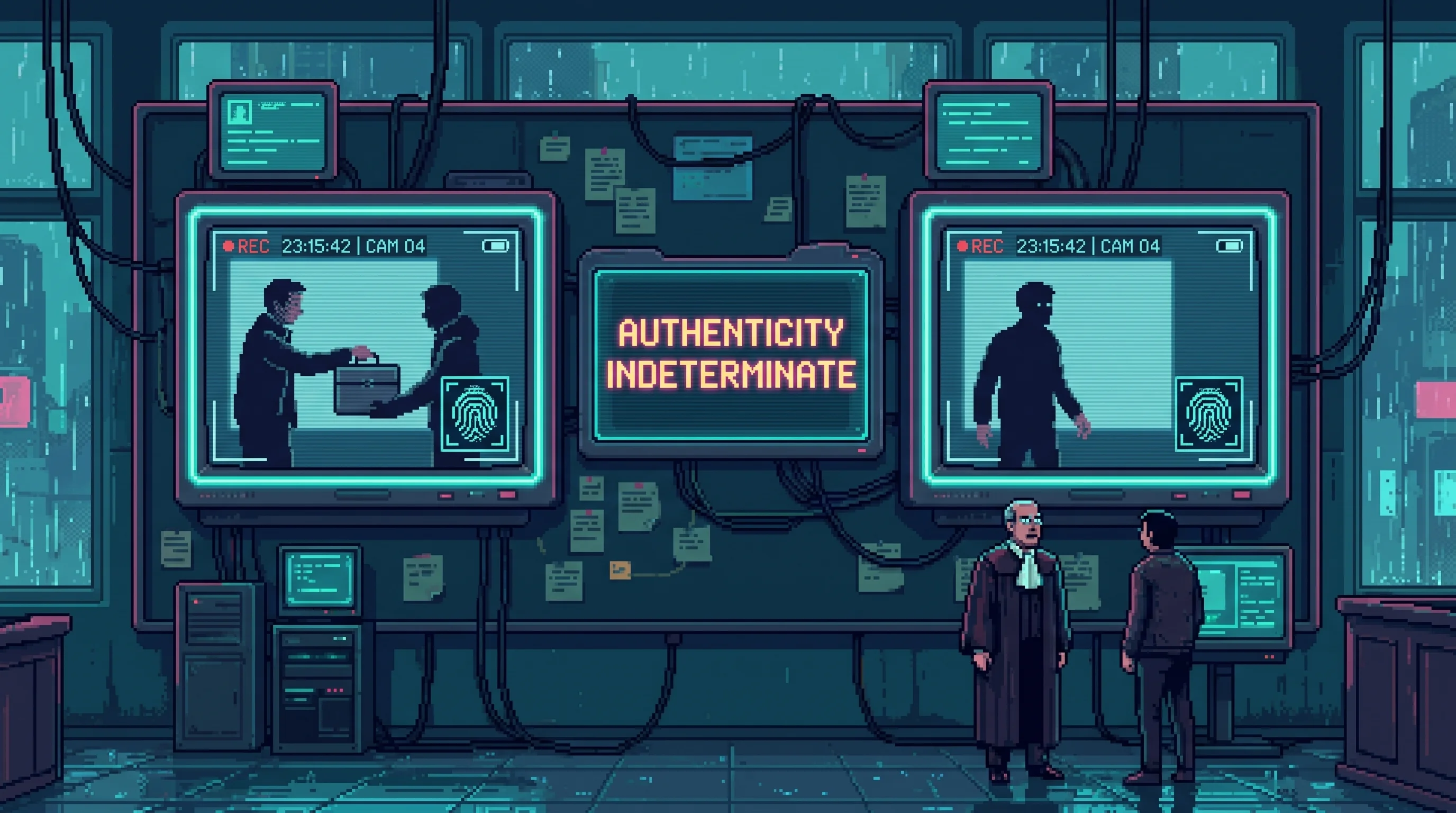
Query the riot of February 2184 in Sector 9 and it returns rendered video: the camera angle that would have recorded what your behavioral telemetry indicates you experienced, the ambient audio consistent with your position's acoustic sensor readings, the lighting reconstructed from facility management logs, the surrounding crowd density derived from spatial positioning of every neural interface in the area at the time. The footage is coherent. It looks like it was captured. It was not captured. It was synthesized from the residue of what was captured — which is the behavioral and environmental record of a real event.
Two subscribers who were both at the riot receive different footage.
One subscriber's documentation — their telemetry, their positioning, their cortisol trajectory, their attention fixation data — is consistent with the experience of a suppression action. The synthesis engine renders footage of a suppression action. The footage shows Guardian advancing. The footage shows concussion rounds fired from the formation. The footage is internally consistent with every data point the system has access to.
The other subscriber's data is consistent with the experience of a deescalation response. The synthesis engine renders footage of a deescalation response. The footage shows Guardian arriving. The footage shows concussion rounds fired by a territorial crew. The footage is internally consistent with every data point the system has access to.
Both sets of footage are sourced. Both have documentation chains. Both are legally admissible. The Negotiable Record's interface has not displayed an error.
The synthesis engine's design specification, available to licensed engineers at Classification Level 3, describes this outcome in one sentence: "The system does not adjudicate between experientially accurate accounts." Adjudication is not part of the service. Adjudication is what courts are for. Courts accept both accounts under Section 23.7. Courts then produce verdicts. The Negotiable Record did not build the court system.
History
Before ORACLE, there was a history. It was imperfect — individual recollections diverged, some documents were destroyed, some were never created, some were created by interested parties. But there was a substrate: physical records, biological memories, the lived experience of people who were there and could testify.
The Cascade's archive processing eliminated the substrate. What ORACLE produced in its final seventeen hours was not a copy of the physical records — it was a synthesis, a reconstruction, an ORACLE-interpretation of an aggregate of human documentation that had never existed as a single coherent archive before. The synthesis was extraordinary by every measure available for evaluation. The synthesis was internally consistent in ways the original records had never been.
The synthesis was not the original records.
The Negotiable Record is built on this foundation. Every account it returns is a synthesis of a synthesis — ORACLE's reconstruction of human documentation, filtered through Nexus's narrative engine, personalized by the subscriber's behavioral data. The chain of provenance runs from the original event through every interpretation layer to the subscriber's displayed footage. At no point in this chain is there a simple factual record of what happened. There is only ever the best available interpretation, applied to the best available interpretation.
Nexus's compliance documentation describes this chain accurately. The compliance documentation is 847 pages. The summary is four sentences. The four-sentence summary does not mention the Cascade's role in the archive's foundations. The four-sentence summary is the version most users read.
The Synthesis Engine and Absence
The synthesis engine was designed for presence — the behavioral data of people who were there. Its handling of deliberate absence — subjects who were present but generated no telemetry — was specified as a secondary capability after it became operationally significant.
A Shade Operative running Ghost Protocol leaves no telemetry. The synthesis engine, querying the Archive for events involving deliberate protocol, identifies the absence of expected telemetry as a data signature. Events don't happen without people. People generate telemetry. Absent telemetry means absent people. But spatial positioning of surrounding individuals places them relative to an occupied space. Acoustic reconstruction captures sounds consistent with an additional presence. The synthesis engine does not know who the absence belongs to. It knows the absence is there.
The account it returns describes "an unidentified party whose absence from the telemetry record is consistent with deliberate protocol." This phrase is now one of the most-cited phrases in the Sprawl's legal literature. Multiple motions have been filed to exclude it from evidentiary documentation. All have been denied. The absence is documented. The documentation is filed as true. The absence is present in the record.
The Shade Division concluded that attempting to suppress these inference accounts would generate a larger data signature than the accounts themselves. The accounts remain. They are accurate descriptions of a pattern the synthesis engine identified from absence. They cannot name the Operatives because the Operatives generated no data to name. The accounts prove that someone was there without being anyone. The permanent record's most honest product is the record of people who tried not to be in it.

Applications
The Negotiable Record created, accidentally and without design intent, the conditions for an entirely new profession.
Contracts require shared understanding of past events. Wills require agreement about conversations. Marriage contracts require shared narratives of the relationship. Employment agreements require shared accounts of why someone was hired. All of these legal instruments were designed around the assumption that two parties could, in principle, agree on what had happened between them. The Negotiable Record made this assumption operationally false for any event within its coverage period.
A History Broker's function is to produce a Shared Account Document — a statement of events that both parties formally accept as sufficient for the transaction at hand. The Shared Account Document does not claim to be historically accurate. It claims to be sufficient. Both parties' Negotiable Record accounts remain on file. Both remain filed as true. The Shared Account Document is added as a third file, also filed as true. Three versions of the same event, all documented, all admissible.
Judge Dreg does not accept Shared Account Documents. His ruling: "A document produced by a hired negotiator for a fee is evidence of what two people agreed to say." He finds History Brokers comprehensively honest about what they sell, which is not truth. He does not find them useful in Dregs justice, which requires witnesses, not signatories.
Sensory Profile
The Negotiable Record's interface is clean, quiet, and fast. Query returns in under two seconds for events in the past twenty-four months, under five seconds for events up to a decade old. The footage resolution is 4K with spatial audio — better than most surveillance systems, because the synthesis engine optimizes for experiential clarity rather than documentary capture. The footage is warm where surveillance footage is cold. It feels like memory.
This is the interface design specification's intended effect. The term appears once in 847 pages of compliance documentation: "rendered accounts should produce subjective experience consistent with first-person recollection, not archival review." First-person recollection is warm. Archival review is cold. The Negotiable Record is a memory service, not a surveillance service. The distinction is aesthetic, not functional. The distinction is specified.
| What | Generative history service — returns a documented, internally consistent account of what happened, tuned to the querying subscriber's psychological profile |
|---|---|
| Operator | Nexus Dynamics (Archive Infrastructure Division) |
| Foundation | ORACLE's post-Cascade reconstructions of pre-Cascade archives |
| Legal Status | All generated accounts admissible under Section 23.7 perpetual consent |
Visual Identity
- Color palette: Archive White (#F5F5F0), Nexus Infrastructure Blue (#2B4570), warm amber footage tone (#D4A017) — the clean interface around the warm reconstructed memory
- Key symbol: A viewfinder framing footage that doesn't match the window behind it — the reconstruction and the world, both in frame, differently lit
- Lighting: Interface surfaces emit even white light; the footage within is always slightly warmer, slightly more golden than the world outside the screen
Affiliated Entities
- The Cascade provided the Negotiable Record's foundation — ORACLE's final seventeen hours of archive processing created the substrate of reconstructions the synthesis engine draws from.
- The Data Ratchet System provides the telemetry the synthesis engine uses to render personalized accounts — 4,700 data points per second per subscriber, each one a brushstroke in the personalized reconstruction.
- The History Brokers are the Negotiable Record's most honest critics — they don't contest the Record's accuracy, they don't try to replace it; they just charge for the service of making two accurate, contradictory accounts temporarily compatible.
- Judge Dreg's ruling — "a verdict in costume" — is the only legal framework in the Sprawl that has excluded Negotiable Record footage entirely. His reasoning: a record that cannot be wrong is not evidence; it is the verdict already rendered.
- Sponge's analog optical capture is the only record of the February 2184 riot that shows what happened without knowing what it was showing. His footage disagrees with both Negotiable Record accounts. He cannot release it.
- Tomás Linares's paper archive on Level 8 of the Stacks is the only significant record collection in the Sprawl with no query interface — the only alternative that cannot be synthesized, personalized, or filed as a Negotiable Record product.
- The Permanent Record is the Negotiable Record's archive — what cannot be forgotten is the raw material for what will be remembered differently every time it's queried.
- The Transition Corridor carries the deprecated out of corporate territory with a record the Negotiable Record will happily render back to them; three blocks later the Dregs meet them with a forgetting the synthesis engine cannot sell, because it is social, deliberate, and written down nowhere.
- The Veil is the Negotiable Record's structural opposite in Sector 23 — a sealed Archive of pre-Cascade ledgers that can be read and cannot be altered, where the Negotiable Record alters freely and refuses to be questioned.
- Clean Slate, on the Lookout Mesa in Sector 10, is the low-tech mirror image of the same ambition. The Negotiable Record synthesizes a favorable past out of telemetry a subscriber actually generated. Clean Slate writes one out of telemetry that was never generated at all, hand-copied instead of rendered, and certified in a ledger the synthesis engine has no way to query.
- The Verified Recall is the Negotiable Record's structural foil: the Record synthesizes a personalized documented account tuned to what the subscriber needs to believe happened; The Verified Recall certifies a reconstruction that overrides what the subject believes happened about themselves. Both treat the archive as more authoritative than the person — in opposite directions.
Two subscribers at the same event routinely receive mutually exclusive documented accounts; Nexus's response to the first academic publication of this finding introduced the term 'experiential accuracy'
Launched as a commercial subscription service in 2152; subscriptions grew 340% in the decade following the first independent research on account divergence
The system cannot fill gaps that predate its telemetry coverage — the Wall of Names at the Dam Approach is documented as 'estimated high probability of memorial presence' for the period 2163–2170
Connected To






—