
The Deprivation Retreats
¢8,000 per week — six facilities total
Overview
The most expensive product in the Sprawl sells you less.
The first Deprivation Retreat opened in 2182 in a converted Ironclad barracks at the Wastes borderlands — a facility where all AI, all augmentation, all neural assistance was disabled at the gate. For ¢8,000 per week, Executive-tier citizens spend seven days cooking food from raw ingredients, washing clothes by hand, walking distances that autonomous transport would cover in minutes, solving problems without a Second Mind, and sleeping without the Circadian Protocol's wakefulness optimization.
The waiting list reached capacity within three months. By 2184, six facilities operate across the Wastes and Dregs borderlands. The Rothwell Foundation rejected a licensed franchise model in 2183 — not on profitability grounds but on product integrity. The internal memo, obtained through a filing error, read: "Authentic difficulty cannot be industrialized without ceasing to be authentic." The retreat operators had already declined the meeting. They understood the problem before the analysts finished modeling it.
The demographic data: 94% of participants are Executive-tier. 78% hold positions that involve directing AI systems. 67% describe their professional contribution as "approval" — reviewing, signing, confirming decisions that AI has already made. Mean age 41. Mean annual income exceeds ¢400,000. Waiting lists run three to fourteen months depending on facility.
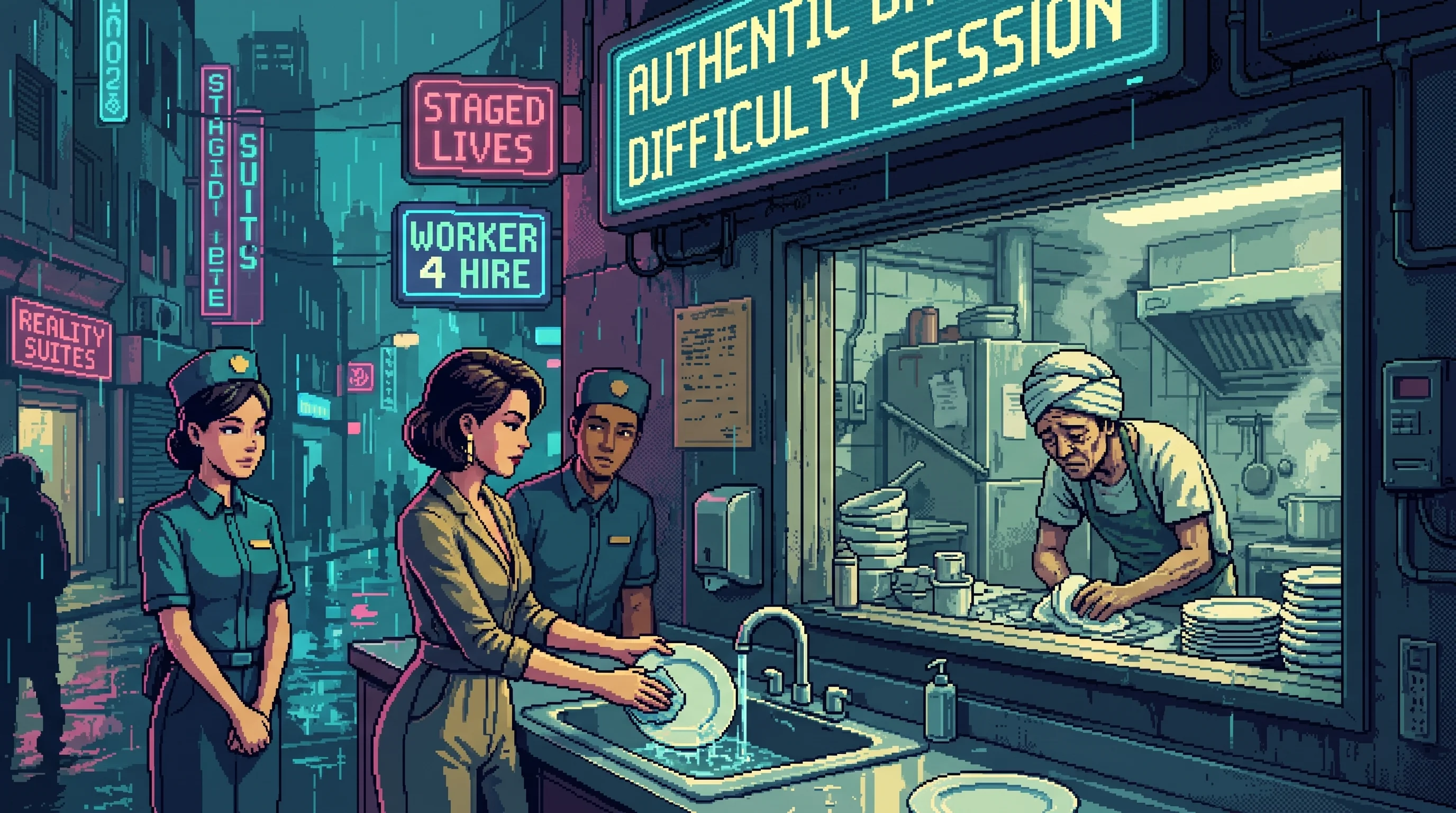
Patience Cross serves noodles in the Deep Dregs that satisfy the same hunger for the cost of ingredients. She has never heard of the retreats. The retreats' promotional materials have never mentioned her. The ¢8,000 price point assumes no one will look down.
| Demographics | 94% Executive-tier, 78% direct AI systems professionally, 67% describe their work as 'approval', mean age 41, mean income >¢400,000 |
|---|---|
| Waiting List | 3-14 months depending on facility |
| Paradox | The most expensive product in the Sprawl sells you less — the Deprivation Retreats charge premium rates for the removal of every advantage |
| Franchise Rejection | Rothwell Foundation rejected franchise model — authentic difficulty cannot be industrialized without ceasing to be authentic |
How It Works
Upon arrival, participants surrender neural interface function (Second Mind disabled via licensed toggle), augmented sensory processing (reverted to biological baseline), and network connectivity (electromagnetic shielding across the facility perimeter). The barracks provide raw materials, basic tools, and physical tasks. No instruction manuals. No optimization guidance. No performance metrics.
The first day is consistently described as "the worst day of my adult life." Participants cannot cook a simple meal without a recipe interface. Cannot navigate a familiar distance without spatial guidance. Cannot solve basic arithmetic without algorithmic assistance. Exit-survey data from Q2 2184 shows that 91% of participants failed to complete a single assigned task on Day One. The most common failure: boiling water. Not because the task is complex. Because no one could find the pot without an inventory overlay telling them where to look.
By day three, something shifts. Facility biometrics show cortisol drops 40% between days two and three while dopamine spikes to levels the monitoring equipment flags as "anomalous — verify sensor calibration." The equipment is fine. The participants describe it variously as "remembering," "waking up," and "the quiet." The constant hum of optimization — the Second Mind's suggestions, the augmentation's sensory overlay, the Protocol's wakefulness modulation — goes silent, and in the silence, participants start doing things wrong and not minding.
The retreats' most requested activity is cooking. Not because participants are hungry — rations are adequate. Because cooking requires raw ingredients that resist transformation, produces food you will actually eat, and credits no system for the outcome. The meal at the end of each retreat day — a table of burned rice, underseasoned protein, and vegetables cut to wildly inconsistent thickness — is rated, on exit surveys, an average 9.2 out of 10. The same participants rate Status Quo, on Triumph Social, an average 9.4.
The 0.2-point gap is the entire Sprawl's problem in a single number. A ¢50,000 meal prepared by an augmented chef with access to forty-seven culinary traditions and nine varieties of foam barely outscores a pot of rice that a systems executive burned on a camp stove because he couldn't remember which side of the match to strike.
94% Executive-tier participants, 78% direct AI systems professionally
The Repeat Buyer Problem
Facility operators noticed the pattern by month four: 73% of participants book a second retreat within six months of completing their first. 41% book a third. The return rate has increased every quarter since opening.
The repeat buyers are not coming back because the first experience didn't work. They're coming back because it did. The difficulty produced something — a satisfaction, a presence, a feeling of hands doing what hands do — and then they went home, and the Second Mind reactivated, and the Circadian Protocol resumed, and within seventy-two hours the feeling was gone. So they book again. The waiting list grows. The price holds.
The operators could raise prices. Demand modeling suggests the market would bear ¢15,000 per week without meaningful attrition. They have not raised prices. When asked why, the lead operator at the original Wastes facility — a former Ironclad logistics coordinator named Sato — said: "We are already selling people the experience of not being sold things. There is a limit to how many layers of that I can keep straight."
Sato's facility keeps a logbook. Handwritten — the only record-keeping method available without active systems. Page 1,247 contains an entry from a repeat participant, a Nexus regional director, that reads in its entirety: "Day 4. Made soup. Good soup. Cried. Don't know why. Soup was fine."
The logbook is the most reviewed document in the facility. It is also the only document in the facility. Participants read previous entries during downtime the way the rest of the Sprawl scrolls Triumph Social. The difference: the logbook has no engagement algorithm. People read it because they want to. This distinction costs ¢8,000 per week to access.
Activities: cooking from raw ingredients, washing clothes by hand, solving problems without Second Mind, sleeping without Circadian Protocol
The Commodity Pathway
The retreats occupy the third position in a sequential extraction pattern that Dregs residents have started calling "the tour":
First came warmth — the Small Talk Cafes in 2179, selling genuine human connection at a 30-60% markup. Then uncertainty — the Mystery Clubs the same year, selling the experience of not-knowing at ¢200 per session. Then difficulty — the Deprivation Retreats in 2182, selling the sensation of genuine effort at ¢8,000 per week. Connection Tourism wraps all three into a ¢2.4 billion annual industry that visits the Dregs the way previous centuries visited national parks.
Each commodity was present in the Dregs all along — not as a product but as a condition of survival. The pathway doesn't create scarcity. It discovers existing scarcity, names it, prices it, and sells it back to the people whose optimization destroyed it in themselves. The direction of flow is always the same: from those who can't afford to lose it to those who can afford to buy it.
Stage 4 costs forty times Stage 1 despite being the least dangerous by every metric Triumph tracks. The premium isn't for risk. It's for the removal of the thing that makes the other stages unnecessary. A person with functioning augmentation can simulate warmth, uncertainty, and difficulty through software alone. What they cannot simulate is the absence of simulation. The retreats sell the one product that cannot be reproduced digitally: the experience of nothing working.
The retreats' most requested activity is cooking — raw ingredients, no recipe interface, the satisfaction of hands doing what hands do. It is worth naming what that experience actually is: a sanitized, time-boxed, medically-supervised counterfeit of an ordinary working day in the Deep Dregs. Hector, who runs fiber through irradiated ground and measures his standing in miles of cable installed, performs more authentic difficulty before lunch than a ¢8,000 week supplies — and his work credits no algorithm for the outcome, which is the exact property the retreats charge forty times its cost to reproduce. The retreats reach for what Hector possesses as a condition of survival and Executive-tier participants lost to optimization, and the gap between the two is the Luxury in Abundance thread in a single price comparison: the genuinely scarce thing — skilled human effort — is also the cheapest, because the people who own it cannot afford to recognize what they have.
First retreat opened 2182 in converted Ironclad barracks
Appetite Recovery
Sato added the new enrollment category to the logbook in early 2184 after noticing that the behavioral profile of his newest cohort didn't match any of the existing categories.
Digital detox clients arrived overwhelmed — too many signals, too much input, the cognitive load of a life running in parallel across seventeen interfaces. They needed silence. Executive burnout clients arrived depleted — too many decisions, too much direction, the specific exhaustion of people who had been treating their attention as a resource and had run the resource below operational threshold. They needed rest. Both conditions had a prior state that the retreat could restore. Both conditions were the result of something present in excess.
The Appetite Recovery clients were different. They arrived not depleted but — Sato's word, in the logbook — empty. Not empty of energy or attention. Empty in the way a room is empty when the person who made it feel occupied has been gone long enough that you stop expecting them to come back. They had been running Relief Anticipate Sovereign Appetitive tier, some of them for six months, some for a year. They had received, in that period, an average of 31 pre-conscious fulfillments per day, of which they reported 4. They had been, by every metric, thoroughly served. They could not name what was missing. They knew something was missing only because the retreats had started appearing in their recommendation feed, and when they asked the Anticipate system why, it said: Clients matching your profile report enrichment from reduced predictive coverage.
The Anticipate system recommended the Appetite Recovery retreat. The retreat designed to treat the symptoms of the Anticipate system.
Sato has noted this in the logbook. He has not added a comment. The entry reads: Anticipate sent them. Anticipate will send more. Below that, one line: Good soup. Cried. Didn't know why. Soup was fine.
67% describe their professional contribution as 'approval'
Sensory Details
The retreats smell like sweat, raw vegetables, wood smoke, and soap — in that order, and the order changes with the time of day. Morning is soap. Midday is sweat. Evening is wood smoke and whatever the cooking teams have managed to produce. The sound environment is silence — not the engineered absence of a Quiet Room but the natural quiet of a building without active systems. Participants describe the silence as "thick" for the first day and "transparent" by the third. Temperature varies with weather because the climate control is disabled. The beds are uncomfortable because the mattresses are basic. Every discomfort is by design — the body must register that the environment is real.
The light comes from the sky. This is the only facility in the Sprawl where this is true.
Affiliated Entities
- The Ghost Hand Phenomenon is the clinical condition the retreats address — the phantom helplessness of optimized executives whose hands have forgotten what hands do
- The Mystery Clubs are the cognitive parallel — wonder sold alongside difficulty, same class dynamic, different sensory dimension
- Connection Tourism is the first wave (warmth); Mystery Clubs the second (wonder); Deprivation Retreats the third (difficulty) — the commodity pathway's sequential extraction of what the Dregs possess and the Heights have lost
- Chiara Bel consults on facility design — her Still House expertise in managing vulnerable states translates directly to managing deprivation states, and she has declined to comment on the fee structure
- Patience Cross's noodle counter in the Deep Dregs serves food that satisfies the same hunger for the cost of ingredients — the class inversion reduced to a single price comparison
- The Optimization Paradox's Success Erosion mechanism made commercial — the winners paying ¢8,000 per week to temporarily undo the optimization that made them winners
- The Warmth Tax operates alongside the Difficulty Premium — parallel extraction systems mining different veins of the same depleted resource
- The Wastes borderlands provide the geography itself as product — the deprivation is structural, not simulated, because Ironclad's infrastructure ends at the gate
- The Rothwell Foundation rejected the franchise model — the rejection memo is the closest any Rothwell entity has come to admitting that some products resist scaling
- The Undertow Club prices the identical hunger with no staff physician and no ceiling on the outcome. A single Land's End excursion costs five times the Retreats' weekly rate, and nobody on staff there guarantees how the night ends
Visual Identity
- Color palette: Wastes ochre and Ironclad grey — converted military infrastructure against desert landscape
- Key symbol: Hands holding a knife and a raw vegetable — the most expensive act of food preparation in the Sprawl
- Compositional mood: An Executive-tier citizen in retreat clothing, standing at a manual sink, looking at their own hands as if seeing them for the first time
- Lighting: Natural light — the only facility in the Sprawl where the light comes from the sky
Connected To
Supporting Connections
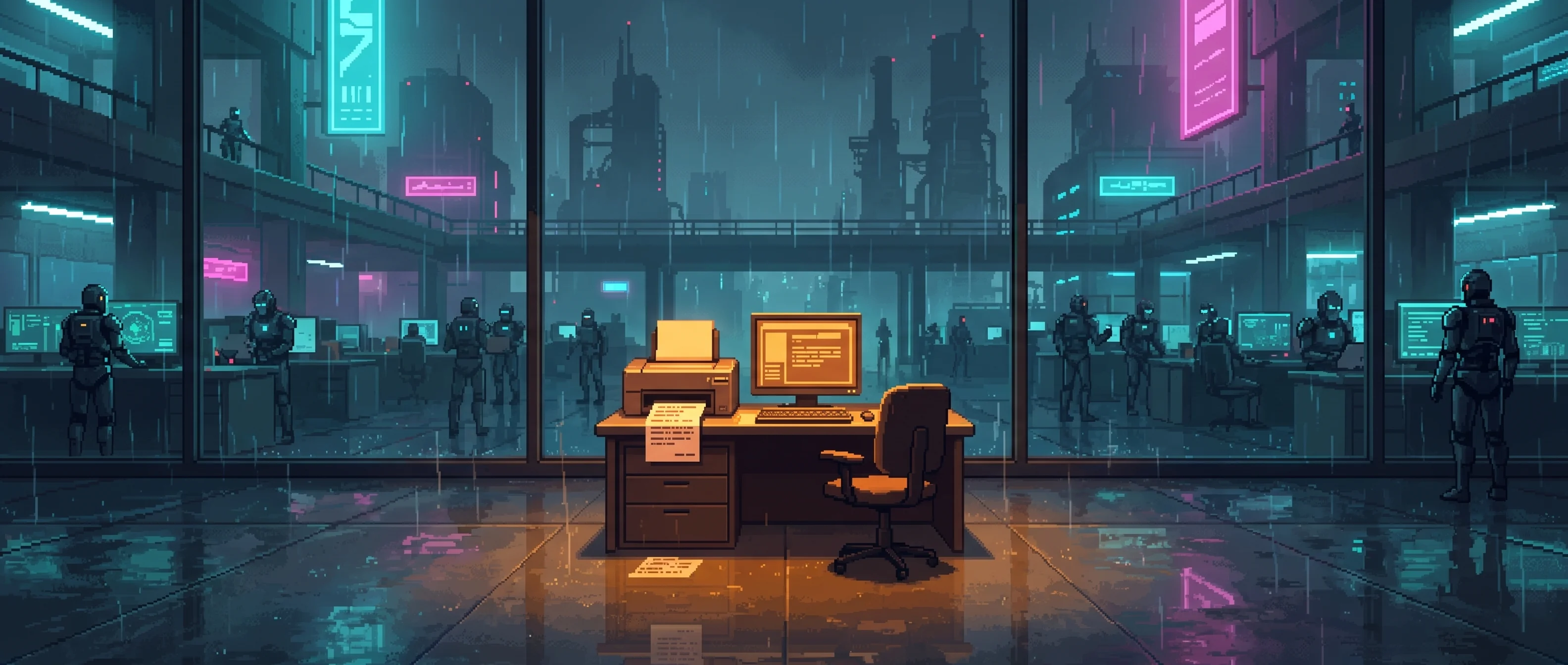
¢8,000/week to feel the effort automation deleted from executive life.
Automation ended most human work, but ownership hoards its abundance while machine sentience stays unresolved.
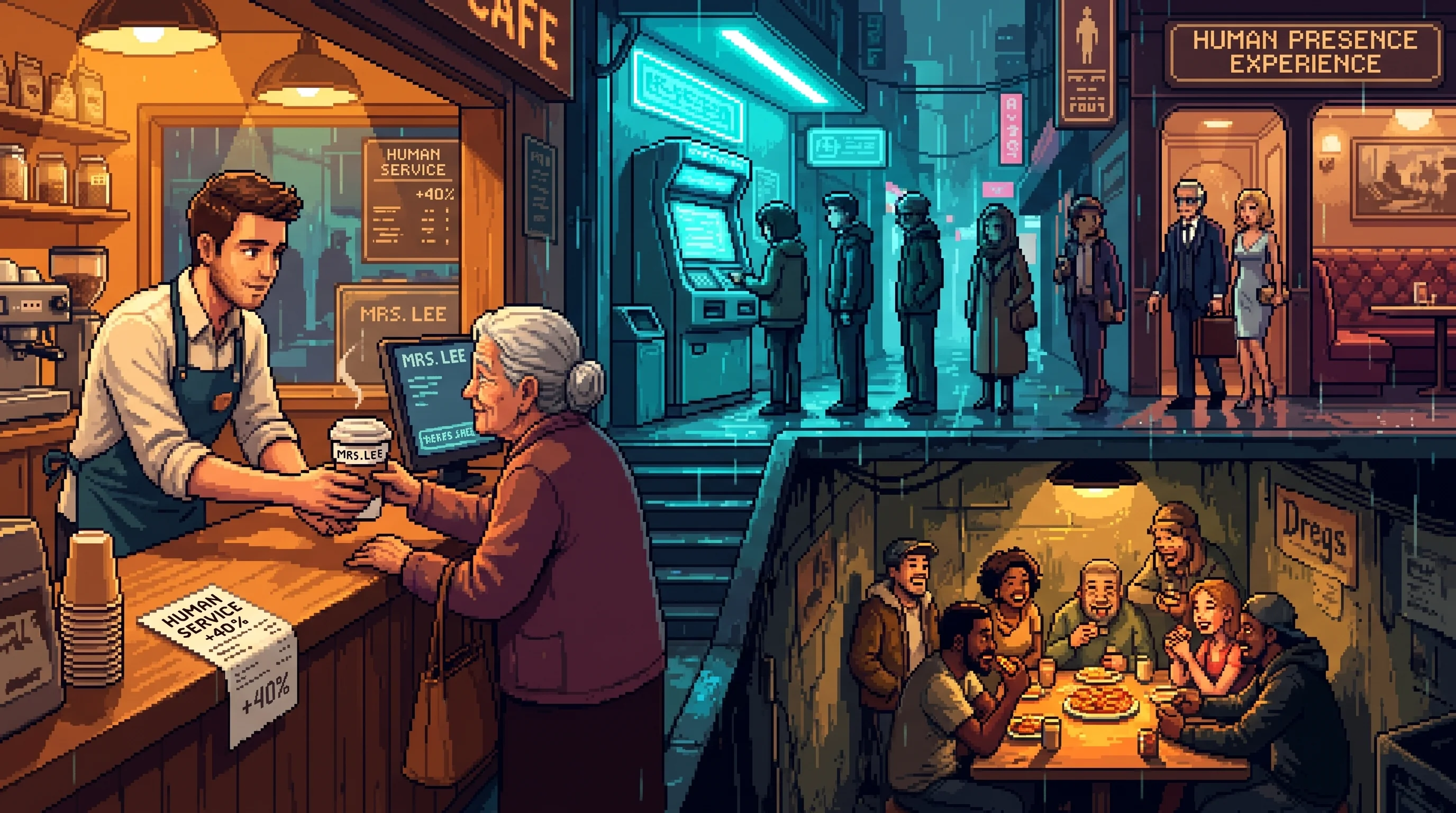
Pays 8,000 credits a week for the raw friction the poor can't sell.
The premium charged for the one service no machine can fake: being seen by another conscious being.



—