
Stop Customs
Each trail stop has evolved its own customs governing arrival, commerce, and departure
The Practice
Every trail stop has its own rules. None of them are written down. All of them are enforced.
The enforcement mechanism is not violence — violence requires investment. It is reclassification. A traveler who draws a weapon at a merchant's counter is not threatened. They are filed, permanently, in the collective memory of every stop operator between the Ad Graveyard and the Dam Approach, as someone who does not know the route. People who do not know the route do not receive route intelligence. People who do not receive route intelligence navigate the switchbacks on publicly available Nexus mapping data, which was last updated in 2174 and lists seventeen passages that have since collapsed, flooded, or been converted into territorial kill zones by factions Nexus does not acknowledge exist. The punishment is social. The consequence is structural.
Triumph Social has no verification tier for "knows the route." Good Fortune extends no credit line for trail reputation. The entire system runs on a ledger that cannot be audited, hacked, or purchased — which makes it, by most measures, the only functional trust economy left in the Sprawl. Corporate behavioral economists have attempted to model stop customs as an informal credit system. The models predict collapse within eighteen months due to free-rider exploitation. The customs have been stable for approximately twenty-four years. The models have been revised nine times.
Universal Customs
Three rules apply at every stop. They emerged independently at dozens of locations and converged into consensus sometime in the late 2160s, which either proves that humans default to cooperation under scarcity or that the alternatives were tried first and the survivors agreed on what worked.
Announce yourself before entering a perimeter. Not a greeting — a declaration. Voice, footstep pattern, light signal. The specific method varies by stop. The principle does not. An unannounced arrival triggers defensive protocols that range from locked doors (the Stacks) to warning shots (the Dam Approach) to a polite but firm suggestion that you go back and try again (Bash Terminal, where Prix considers unannounced entry a personal insult and handles it with the quiet disappointment of someone whose hospitality has been disrespected).
Share route conditions freely. This is the economy. Current passage status, hazard reports, faction movement, air quality readings from personal respirator logs — all of it shared openly, no barter required. A traveler who withholds conditions intel is not cheating the system. They are removing themselves from it. The information asymmetry lasts exactly one stop, because the next operator will hear that someone passed through without contributing, and the reclassification begins.
Do not ask where someone came from or why they are running. The route does not care about your past. This is not compassion. Compassion would involve caring and choosing not to ask. This is indifference refined into protocol. Everyone on the Neon Rail is running from something — debt, a contract, a faction, a Nexus warrant, a Good Fortune collections algorithm that has reclassified them from "borrower" to "recoverable asset." The specific thing does not matter. The running does. Asking about origins is not rude. It is tactically stupid. It forces someone to lie, and now you have bad intelligence from a source you thought was honest, and your route decisions are contaminated. The rule protects information quality, not feelings.
Universal customs: announce yourself before entering, don't draw weapons at the counter, share route conditions freely
Local Variations
Each stop layers its own customs over the universals, and the variations diagnose what each community actually values beneath the hospitality.
The Ad Graveyard maintains a physical conditions board — analog, hand-updated, immune to Nexus data scraping. Arriving travelers update it before doing anything else. Before ordering. Before sitting. Before removing a respirator. The board is the entry fee. A traveler who walks past the board to the counter will be served, because the Ad Graveyard sells things and money is money. But their drink will arrive at room temperature, their questions will receive one-word answers, and the next traveler who asks about conditions from that direction will be told, specifically, that the last person through didn't bother updating. The board has 247 entries from the current quarter. Three are marked with a small X in the corner, indicating the contributor has since been confirmed dead. The entries remain. The X is the update.
Bash Terminal runs on Prix's tradition: your first drink purchase earns one answered question. Any question. Route conditions, stop politics, who passed through last week, what's actually in the switchback past Marker 19. Prix answers honestly. Prix answers once. The tradition is reportedly older than Prix's tenure at the Terminal, inherited from whoever ran the stop before her, though no one can confirm this because asking Prix about the stop's history would cost a first drink, and most travelers have more pressing questions. Regulars — people who pass through Bash Terminal more than three times per season — are exempt from the one-question limit. This exemption has no formal threshold. Prix simply decides, at some point, that you are a regular. The criteria are opaque. One traveler was granted regular status after two visits. Another was denied after seven. Prix does not explain. Prix does not need to.
The Stacks operate vertical hospitality protocols that have been described by visiting corporate ethnographers as "intuitive" and by everyone who actually lives there as "obvious." Level 7 for commerce. Level 9 for rest. Level 4 for absolutely nothing. Level 4 is empty. Level 4 has been empty for as long as anyone can remember. The infrastructure on Level 4 — power, water, air processing — is maintained at the same standard as every other level, which costs the Stacks' operating collective approximately 340 credits per month in Ironclad utility fees for a floor that serves no declared purpose. New arrivals ask about Level 4. Residents give answers that are technically responsive and functionally useless: "It's Level 4." "Nothing's there." "You can go look." People who go look find an empty level, well-lit, well-ventilated, and completely bare. They come back confused. The confusion is the point, or the confusion is not the point, or there is no point. Level 4's maintenance budget has never been questioned at a collective meeting. The agenda items skip from Level 3 drainage to Level 5 ventilation without pause.
The Dam Approach invites travelers to add their names to the Wall — a stretch of exposed concrete where runners scratch, paint, or etch identification before crossing into the contested zones beyond. The invitation is not mandatory. Approximately 91% of travelers add their names. The Wall has no official function. It is not a registry. It is not a memorial. Names of the confirmed dead are not marked or removed. Names from 2161 sit next to names from last week, weathering at different rates, some already illegible. A Nexus social anthropology study classified the Wall as "a proto-memorial practice reflecting post-Cascade death anxiety." The study was published in a journal nobody at the Dam Approach has read. The runners keep adding their names. They do not describe it as a memorial practice or a death anxiety expression. They describe it as "the Wall." The Wall is the Wall. It does not require further explanation, and attempts to provide one tend to say more about the explainer.
Violating customs doesn't get you killed — it gets you remembered as someone who doesn't know the route
The Warmth Without a Ledger
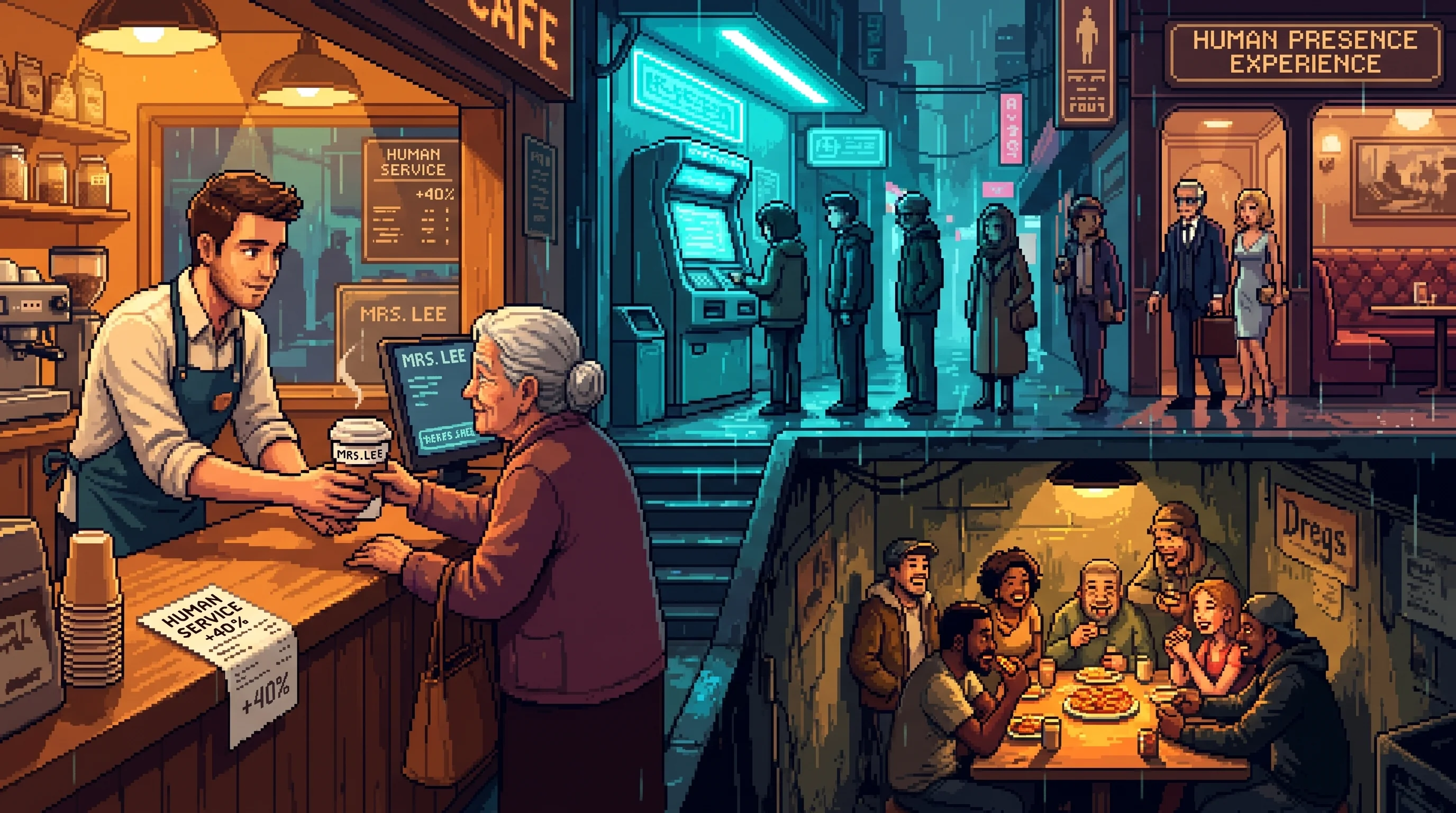
Stop customs are the quiet refutation of the Warmth Tax. Up top, reciprocal recognition — the neurological event of being seen by something also alive — is sold as a markup: 40% more at the Small Talk Cafe, ¢4,200 for the Empathy Mandate's certificate that warmth is present. The Neon Rail gives recognition away and charges, instead, for its absence. Share your conditions and you are inside the warmth: greeted, served hot, answered honestly, told which switchback has collapsed. Withhold, and you are filed as someone who does not know the route, served at room temperature, the word traveling stop to stop faster than any traveler on foot. The Tax prices warmth; the Rail prices its withdrawal. Same lever, pulled from the other side — and pulled by no one, because there is no manager, no certificate, no appeals desk, only the speed of "the last person through didn't bother updating."
This is precisely the function the Empathy Mandate sells and the Black Market Protocols enforce on the commercial side: sorting the trustworthy from the absent. Triumph Social has no verification tier for "knows the route." Good Fortune extends no credit line against it. The Mandate's Empathic Capacity Battery measures a Helix-scored simulation of exactly the social legibility the Rail produces for free, and produces it worse, because the Rail's false positives die in collapsed tunnels and the Battery's false positives merely get hired. The corporate tier certified warmth so it could be priced; the Rail left it uncertified so it could not be faked.
The cruelest detail is the tenderest, and it is the one the Tax could never invoice. The Ad Graveyard's conditions board keeps the dead on the ledger — three of 247 current entries bear a small X, the contributor confirmed dead, the entry left because their last route report is still load-bearing intelligence. The Dam Approach's Wall lets the names of the dead weather beside the living, unmarked, unmonetized. The corporate tier pays Continuing Voices a trillion credits to regenerate the dead into subscriptions; the Rail's relationship to a dead traveler is honesty, and honesty is free. There is no product on the Wall. There is only the route, and the route keeps you warm by refusing to let anyone lie.
Reclassification as 'does not know the route' is instant, structural, and for practical purposes irreversible — there is no appeals process, and the consequence (denied route intelligence) is lethal, not merely social
What the System Optimizes For
Stop customs claim to optimize for safety and mutual aid along the Neon Rail. They do optimize for safety. They also optimize for a specific kind of social legibility — a proof-of-belonging system that sorts travelers into "knows the route" and "does not know the route" with the efficiency and permanence of a corporate credit score, except this one cannot be appealed.
The reclassification is instant and irreversible for practical purposes. A traveler filed as route-ignorant at the Ad Graveyard arrives at Bash Terminal already diminished — Prix has heard, through channels that move faster than any traveler on foot, that someone came through without updating the board. The information didn't travel by Nexus relay or Triumph notification. It traveled the way everything on the route travels: person to person, stop to stop, at the speed of whoever was heading that direction anyway.
The customs are generous to those inside them. The customs are lethal to those outside them. The generosity and the lethality are the same mechanism. Sharing route intelligence freely means everyone who participates survives at higher rates. Withholding route intelligence from non-participants means everyone who doesn't participate survives at lower rates. The system does not punish. The system simply stops including, and the environment handles the rest.
Twenty-four years of stability. Zero formal governance. No written rules. No appeals process. No corporate oversight. The behavioral economists' models keep predicting collapse, and the customs keep not collapsing, and the models keep being revised, and at no point has anyone involved in the modeling considered the possibility that the models are optimizing for the wrong variable.
Local variations: the Ad Graveyard's conditions board updates, Bash Terminal's 'first drink answers a question' tradition, the Stacks' vertical hospitality protocols
The Record With No Substrate
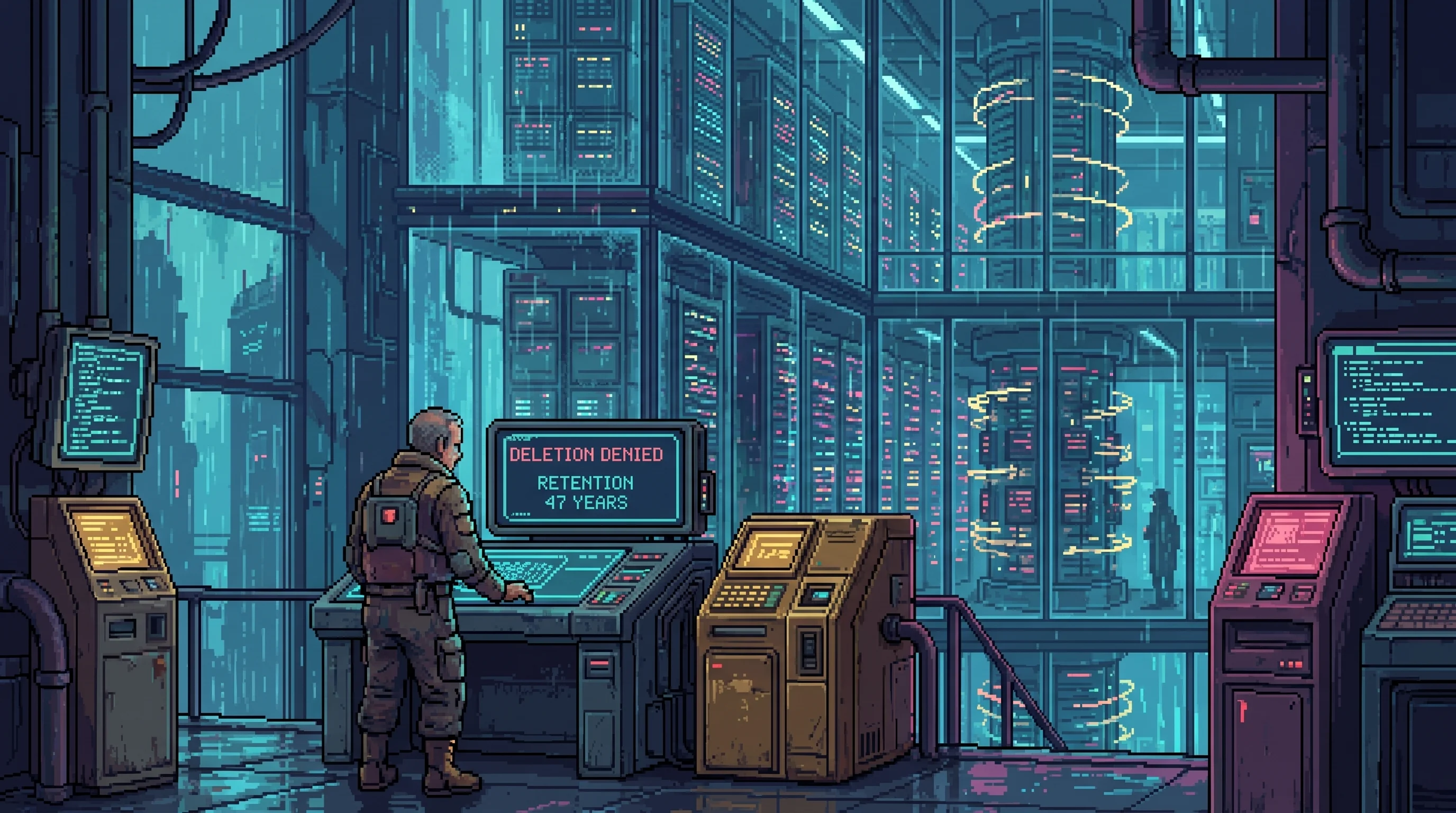
The reclassification — knows the route versus does not know the route — is a permanent record. It is instant, structural, and for practical purposes irreversible; there is no appeals process; the consequence is lethal rather than social. And it is a permanent record that the Sprawl's permanent record cannot touch, because it has no substrate at all. It lives only in the moving collective memory of stop operators, passed person to person, stop to stop, at the speed of whoever was heading that direction anyway. Nexus cannot index it: there is nothing to index. Good Fortune cannot extend credit against it: there is no account to query. Triumph Social has no verification tier for it. The corporate behavioral economists keep modeling it as an informal credit system and keep predicting collapse, and the customs keep not collapsing, because the thing they are modeling is not a system with a ledger — it is the Unindexed Record functioning as critical infrastructure, the only functional trust economy left in the Sprawl, kept alive precisely by the refusal to write it down.
The custom against asking where a traveler came from is the dimension's quiet thesis stated as protocol. The route does not care about your past. Officially it is information hygiene — forcing a lie contaminates the route-intelligence everyone depends on — but the effect is the right to be forgotten, achieved not by erasing a record but by declining to query it. Everyone on the Neon Rail is running from something the digital archive has not forgotten: a debt, a contract, a Good Fortune collections algorithm that reclassified them from borrower to recoverable asset, a Prosperity Enforcement Specialist whose mask wears their payment history on its face. The customs do not forgive that past. They simply do not ask. In a world where the archive's whole power is the query, a culture built on the refusal to query is the most radical politics of forgetting the Sprawl has produced — and it is not a movement and not a manifesto, just twenty-four years of people choosing, at every stop, not to look. The Dam Approach's Wall of Names runs on the same grammar: a record kept by hand and held in common, immune to scraping because it lives in spray paint and memory rather than any server.
The Flood-Proof Tier
Stop customs are the constitutional layer of the Truth Premium — the unwritten law that makes Black Market Protocols and Rail Runner Slang enforceable. And they expose something the Sprawl's official verification economy cannot replicate: a trust tier that cannot be flooded.
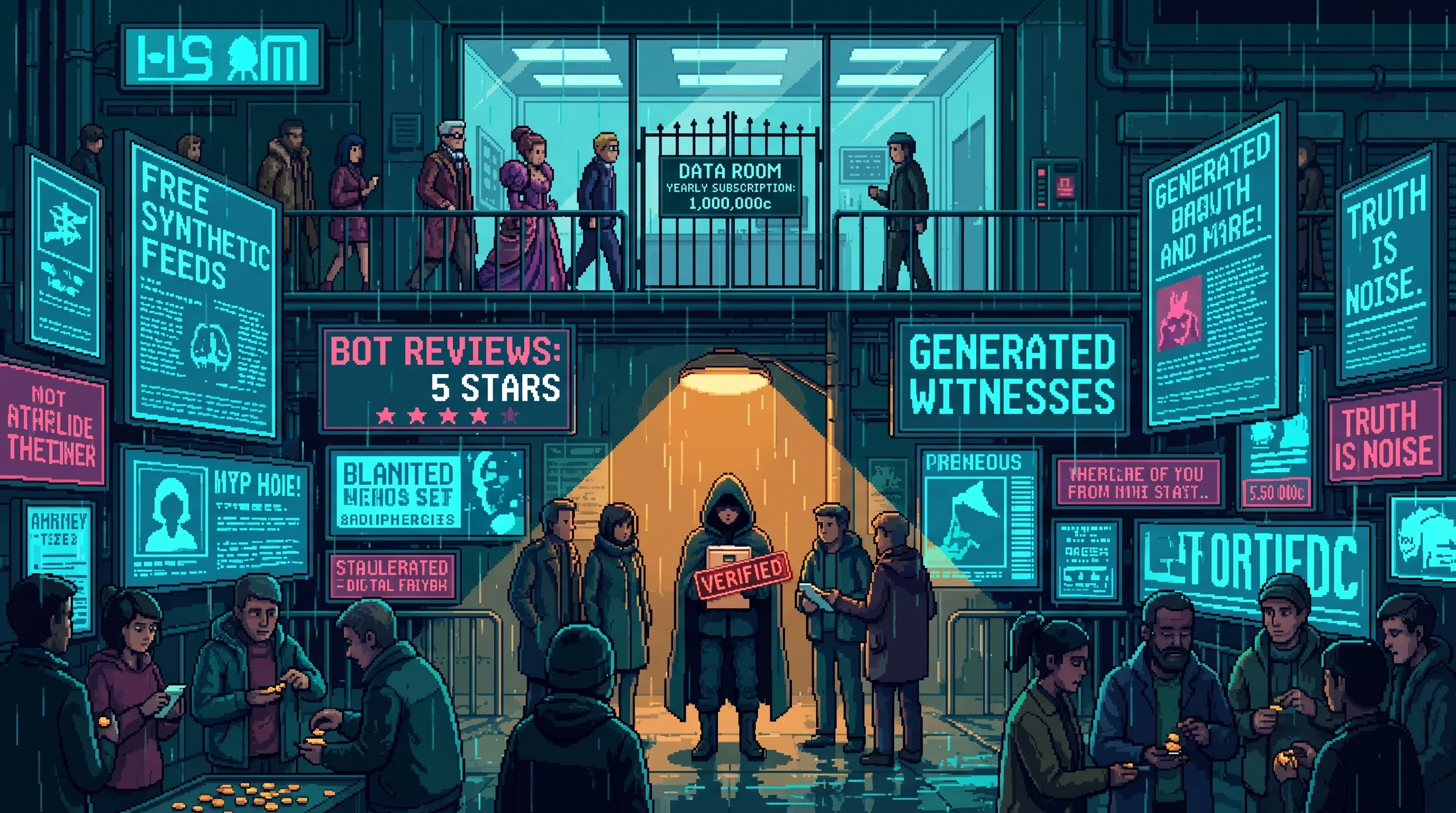
This is the whole difference between the Rail and the Tribunal. The Hypothesis Foundries can drown the certified tier in 340,000 genuine claims a week because the only requirement for entry is correct formatting — and formatting can be industrialized. The certified stamp is floodable by construction, which is why it means less every year. The customs' knows-the-route tier has no such vulnerability. The only way to enter it is to be physically present on the route, repeatedly, and to contribute route-intelligence each time. There is no industrial process for being there. There is no Foundry that can mass-produce the lived fact of having walked the switchback past Marker 19 and survived. The reclassification mechanism that corporate behavioral economists keep predicting will collapse to free-rider exploitation has been stable for twenty-four years precisely because the thing it verifies cannot be faked at scale — it can only be done, by a person, in a body, in the dark.
The rule against asking where someone came from makes the same point from the other direction. It is information hygiene, not compassion: forcing a lie contaminates the route-intelligence everyone depends on, and bad intelligence from a source you thought was honest is worse than no intelligence at all. The customs would rather know nothing than know something false — the exact inverse of the certified knowledge economy, where the Ratification Queue accumulates an infinite backlog of true-but-inaccessible findings. The Queue has perfect information that arrives too late to act on. The customs have imperfect information that arrives in time. The Truth Premium is the price of that timing, and the route is the one place in the Sprawl that pays it in full.
Visual Identity
- Color Palette: Warm amber (#FFBF00), community-fire orange (#FF6B35)
- Key Visual Symbol: A traveler updating a conditions board at a stop — giving back information received
Affiliated Entities
- The Neon Rail: Stop customs are the social infrastructure of the trail — the unwritten operating system that makes the physical route survivable. The Rail provides the path. The customs provide the terms under which the path is shared.
Connected To
Supporting Connections


—