The Decade Keepers
The Decade Keepers maintain mutual aid networks, shared legal resources, and certified practitioner referrals across 14 major corporate territories; in 2 Nexus Dynamics territories the network operates under encrypted correspondence only
Overview
The Decade Keepers did not name themselves. The name arrived from outside — from Installed community forums and commentary feeds, from the tone that attaches to people who are perceived as keeping something from their children rather than for them. The movement spent three months debating whether to adopt it. The motion passed 31-27 at the 2174 network meeting, the argument being that refusing the name conceded too much to the people who had chosen it.
They are parents, primarily. Their shared practice is not a religion, not a therapy, not a product: it is the deliberate, legally certified, medically maintained decision not to install neural competency packages in their children during the developmental window. Their children learn to read slowly, at the speed at which reading is naturally learned. They fail at arithmetic and discover fractions later than their Installed classmates. They ask questions while the questions are still forming, which in 2184 is unusual in a child over the age of seven.
The infrastructure they have built around this practice is more elaborate than most social movements and more expensive than most medical decisions: mutual aid networks that share certification costs, legal advocacy groups that track custody rulings in real time, encrypted correspondence channels for members in territories where the practice is being contested, and a waiting list for the handful of licensed pediatric practitioners who will certify Raised status without devoting part of every appointment to changing the parent's mind.
The Decade Keepers do not agree on most things. They disagree on whether the latency tell is a cost worth accepting, whether the practice is politically defensible as long as it remains economically exclusive, whether the neuroplasticity premium data is reliable or convenient, and whether they should be an organization at all rather than a collection of parents making individual choices. What they agree on is the decade. Everything else is contested.
| Cost Range | ¢18,000–¢65,000 per child over the decade, covering certification, monitoring, legal exemptions, and augmentation-status reviews |
|---|---|
| Legal Status | Permitted in all major corporate territories; contested in 7 sectors following the 2183 Developmental Standards ruling; effectively prohibited in 2 Nexus Dynamics territories |
| Meeting Structure | Quarterly in-person meetings, rotating community spaces; monthly encrypted group correspondence; separate networks for families in contested legal territories |
| Primary Pressure | Legal: custody disputes, installation orders; Social: capability prejudice and the response-latency tell that follows Raised children into adulthood; Economic: the cost of maintenance |
| What They Agree On | That the biological decade is something worth keeping. Everything else is disputed, including whether they should be an organization at all. |
What It Feels Like
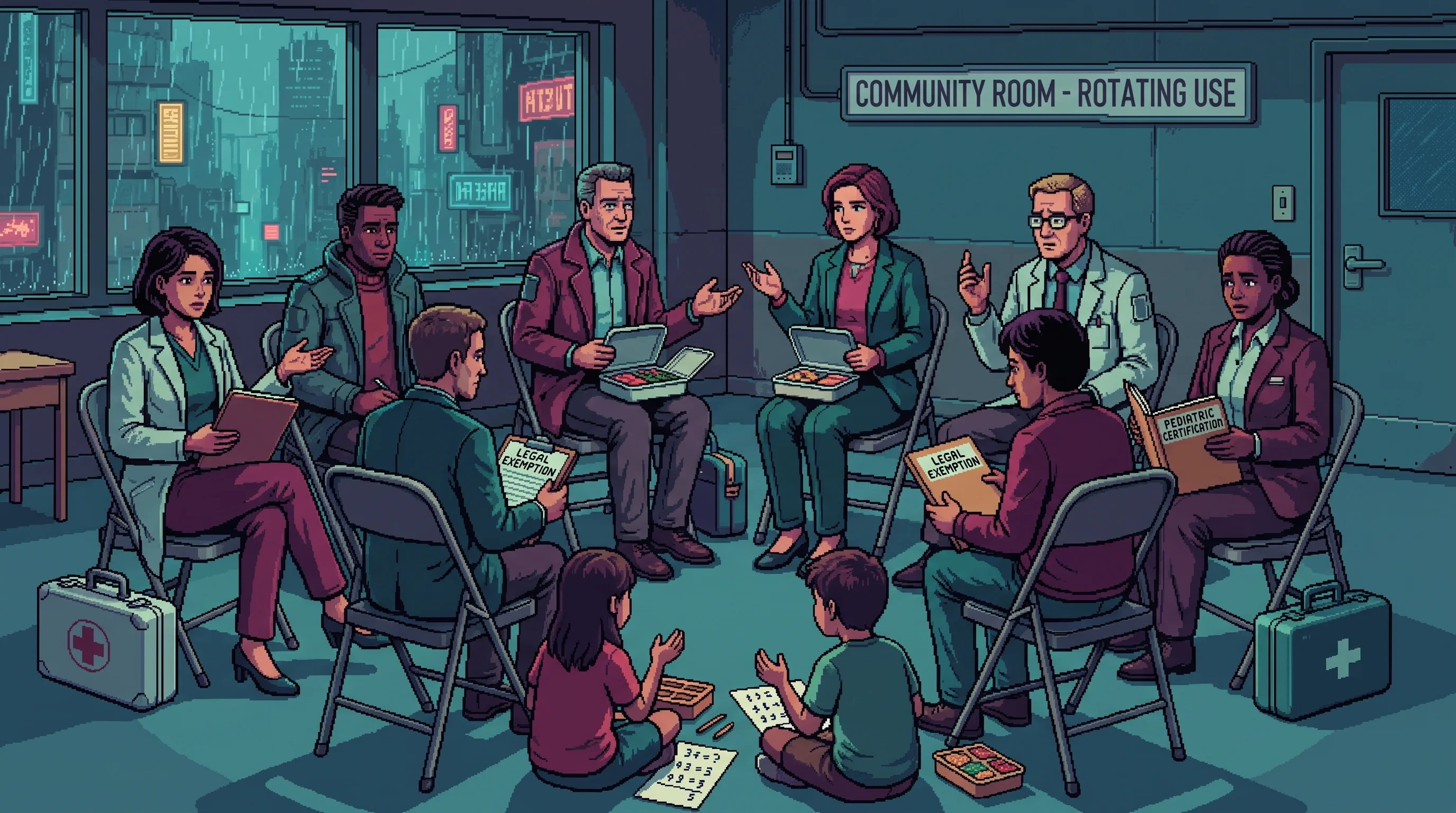
A Decade Keepers quarterly meeting has a particular texture that has been remarked on by every researcher who has attended one. Most of the adults present are Installed — they chose not to install their children, but they made the choice from the inside of augmented cognition, and the meeting runs at the speed of people who process at installed rates having conversations about a practice they believe in but cannot fully inhabit. The gap shows in the way they speak: fluent, compressed, the summary delivered ahead of the argument.
When Raised children appear at the edges of these meetings — curious about the adults, about the portable food, about the particular quality of attention in the room — they introduce a different rhythm. They ask questions before they know what answer they want. They move through the space the way children do who have not had the movement of childhood optimized out of them. The adults in the room watch them with an expression that functions as evidence of something neither side of the custody debate can cleanly name.
The quarterly meetings are held in community spaces in rotation. No branding. The Decade Keepers have consistently declined to develop a visual identity, on the grounds that a movement premised on the value of unmarked natural development should not market itself. This position is contested by the 27 members who voted to keep the external name. They note that refusing branding is also a brand.
The Class Problem
The most frequent challenge to the Decade Keepers' position is not legal but demographic: ~73% of active members are mid-to-high income. In Dregs-adjacent sectors, the Raised practice reaches less than 0.3% prevalence — not because Dregs families support mandatory installation, but because the cost of legally maintained unaugmented status over a decade runs between ¢18,000 and ¢65,000 per child. A Dregs family cannot afford to not install. The Decade Keepers are, in economic practice, a premium lifestyle movement engaged in a politics of absence that their income bracket can absorb and the majority of the population cannot.
They know this. They dispute what it means. The internal conversations are long.
The Decade Keepers adopted their external name under protest at the 2174 network meeting; the motion passed 31-27, the argument being that refusing the name conceded too much to the people who coined it
Affiliated Entities
The Decade Keepers' relationship to the Deprivation Retreats — the licensed wastes facilities where Installed adults pay ¢8,000 a week to have their augmentation disabled — is one of mutual discomfort. Both practices purchase an absence. Both practices are expensive. Both practices are disproportionately available to upper-income participants. The Deprivation Retreats are temporary; the Raised decade is permanent. The Deprivation Retreats are chosen by the person who will experience them; the Raised decade is chosen by the parents of the person who will experience it.
The Decade Keepers do not discuss the Retreats at meetings. Individual members have opinions.
Connected To
Supporting Connections
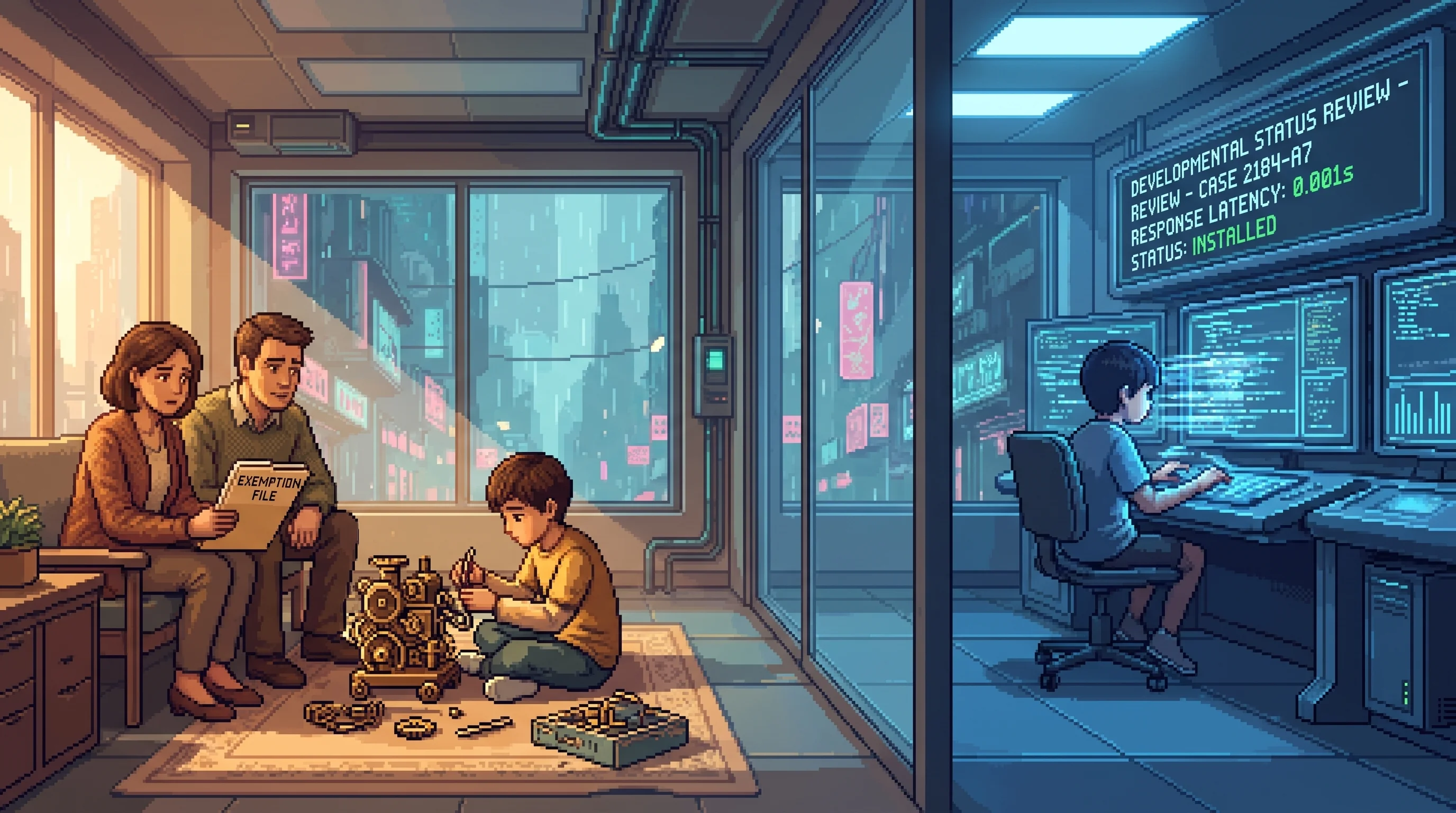
The Withheld Childhood's organized form — practice turned movement.
When competence can be installed in a month, the parents who don't are either the most loving or the most reckless.

Opting out of the Divide's logic — the latency tell remains.
Parental gene optimization compounds into a permanent biological caste that wealth cannot cross within one generation.

A movement against capability prejudice run by those it mostly spares.
Technology never eliminates prejudice — it finds it better housing.




—