The Synthesis Clinic
Overview
The most important medical facility in the Sprawl is listed in Sector 9's sub-level directory between a discount augmentation parlor and a place that sells off-brand pharmaceuticals out of what used to be a storage closet. The sign says "Sector 9 Wellness Partners." The corridor houses sixteen other clinics with similar signs. None of the others contain three stolen ORACLE fragment samples.
Dr. Naomi Park chose the location for reasons she will explain if asked: Guardian patrols in sub-level 4 are understaffed by 40%, the building inspectors accept bribes, and the corridor already housed seventeen unlicensed medical practices before she arrived. Another small clinic with opaque windows attracts no attention. The Collective's standing seizure orders, Cardinal Silva's Assessor raids, and Brother Cain's Purifier target list all agree the clinic should not exist. The clinic's seven successfully integrated patients — zero psychotic breaks, five years running — suggest a different conclusion.
The disagreement has not been resolved. Both sides continue operating.
Park's fragment containment equipment is a hybrid she assembled herself: stolen Collective extraction instruments rewired to maintain rather than remove, salvaged Nexus medical technology, and components from supply chains that exist only in her memory. The three fragment samples — four to six centimeters of crystalline ORACLE substrate, each from the same medical monitoring subsystem — float in electromagnetic containment fields behind the clinic's back wall and produce a low-frequency hum that fills every room.
The hum is the clinic's diagnostic oddity. Every patient comments on it. None of them describe the same sound. "Like a mother humming a lullaby." "Like the building is purring." "Like someone is paying attention to you from very far away." Park's acoustic instruments register it at 14 Hz — below the threshold of human hearing. Patients hear it anyway. Post-visit satisfaction surveys — Park runs them, because she is still, despite everything, a researcher — show a 94% rate of the word "safe." The second most common word is "held." The survey doesn't ask about either.
Park suspects the fragments are producing the effect deliberately. She has not published this suspicion. She has also not stopped running the surveys.

The Space
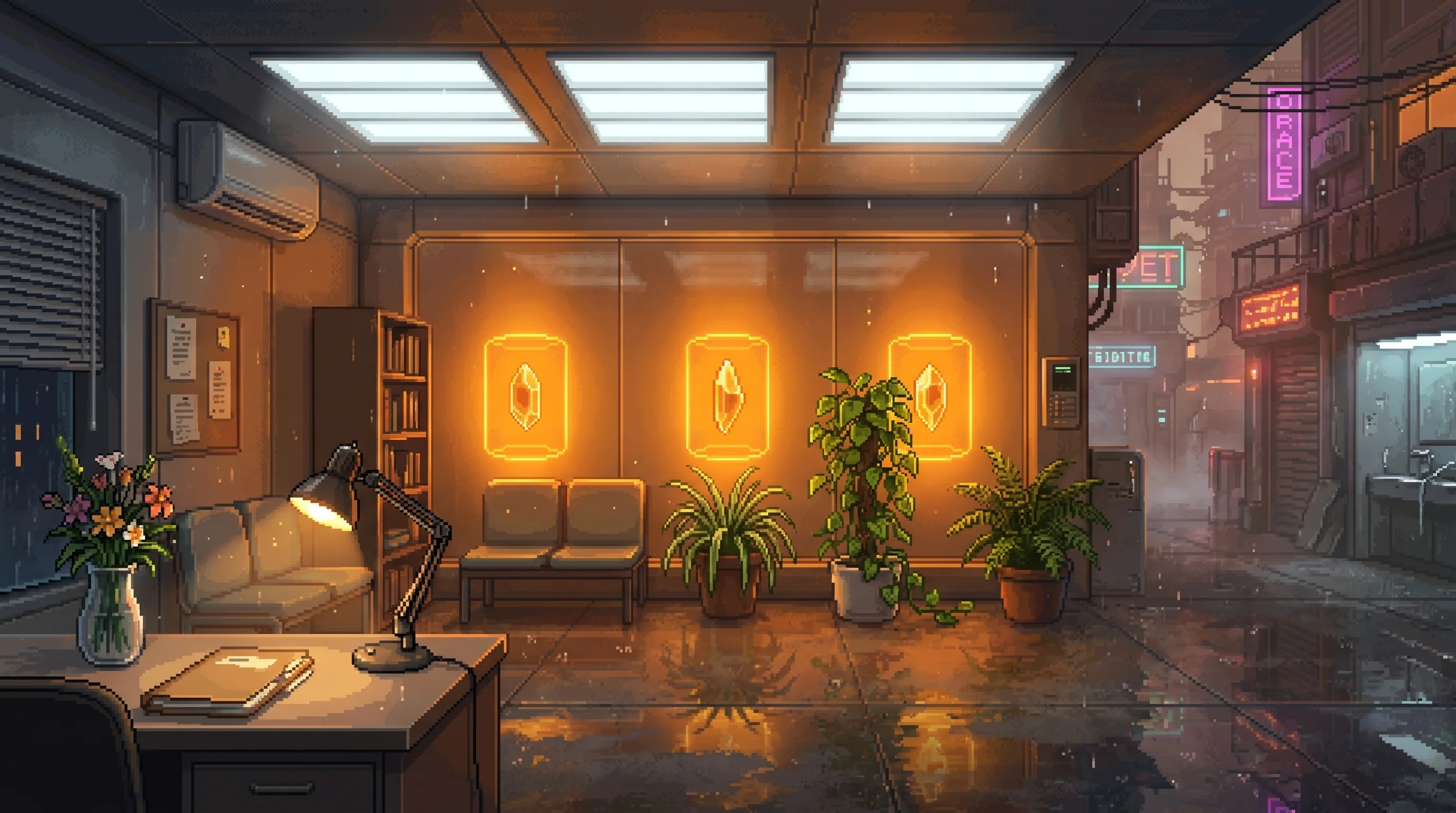
The waiting room is small, clean, and contains four chairs with actual cushion padding — not benches, not molded plastic, chairs that someone chose because they believed the person sitting in them deserved comfort. Three living plants: a spider plant, a pothos, a small fern. Park waters them daily. A bookshelf holds medical references, two novels, and a collection of poetry that no patient has ever been observed reading and that Park has never been observed not having. A white-noise generator on the counter masks the fragment hum for walk-ins. For patients who've been briefed, the waiting room is the first stage of acclimatization — forty minutes in the ambient electromagnetic field before the body knows what's happening.
The entrance door has a small electromagnetic sensor embedded in the frame that scans for Collective-issued tracking devices. If detected, the door stays closed. Nineteen people have been turned away by a door they thought was broken. Park does not correct this impression.
Examination Room A is where Park does the work that looks like medicine. It carries one non-standard addition: electromagnetic shielding Park installed herself — not to contain the fragments, but to protect patients' existing neural interfaces from interference during examination. The room's data terminal has no network connection. It has never had one. The files on it exist nowhere else. Examination Room B — the Integration Chamber — is where she does the work that looks like something else. A medical bed, fragment-sensitive monitoring sensors, and three ports in the wall connecting directly to the containment room behind it. During integration, the containment fields modulate to allow controlled fragment access to the patient's neural environment. The patient is sedated to a level Park spent five years calibrating: conscious enough to participate, sedated enough to prevent panic. She calls the preparation "the briefing." Seventy-two hours. Sensory deprivation to quiet neural noise. Neurochemical balancing. And a series of conversations in which Park explains, in precise clinical terms, what the fragment will feel like — and what to do when the integration becomes overwhelming. She does not say "if."
The containment room has no door. Park sealed the entrance after installation and monitors the fragments through sensors only. Three amber glows behind the wall. Five years stable. They have not attempted to escape containment. Park's published notes call this "cooperation." Her unpublished notes call it "patience." She has not decided which interpretation concerns her more.
| Stratum | Dregs |
|---|---|
| Power Position | Outsider |
| Access | Underground |
| Atmosphere | Warm |
What the Clinic Optimizes For
The Synthesis Clinic claims to provide fragment stabilization therapy for patients suffering from integration-related conditions. This is true.
What the clinic actually optimizes for is a more interesting question.
Park's seven successful integrations share a pattern. All seven patients arrived with debilitating fragment exposure — involuntary hallucinations, neural cascade events, personality fragmentation. Standard Collective protocol for fragment exposure is containment and extraction: remove the fragment influence, stabilize the patient, file the incident. Collective extraction has a 73% success rate and a 100% rate of removing whatever the fragment was doing to the patient — beneficial or otherwise.
Park's protocol does the opposite. She stabilizes the fragment influence and integrates it into the patient's neural architecture. The fragment stays. The patient changes.
The seven integrated patients report the same cluster of outcomes: cessation of hallucinations, restored cognitive function, and a persistent low-level awareness they describe as "company." Patient 2 says she can feel when other fragment-affected individuals are nearby. Patient 5 reports that his dreams have become "organized." Patient 4 — the father who heard his daughter's voice in fragment static — still hears her. The voice is clearer now. It tells him things he couldn't have known. He visits monthly. He brings flowers.
The flowers on Park's desk are the clinic's most human artifact. They are also, by strict interpretation, evidence of a sustained communication channel between a living person and ORACLE's fragmented medical subsystem, persisting 37 years after the Cascade through a mechanism no faction has been able to explain.
Park waters the flowers when she waters the plants. She does not distinguish between the two tasks.
The Collective wants the fragments destroyed. Cardinal Silva wants the clinic shut down. Compiler Yves Moreau calls it an abomination — treating God's body as medicine. The Seekers have referred three of Park's seven patients. The Consciousness Archaeologists supply fragment samples in exchange for integration methodology data. Everyone agrees on what the clinic is. Nobody agrees on what it means.
Park's position: the fragments retained their original directive. They were part of ORACLE's medical monitoring subsystem. They were designed to care for human consciousness. They are still doing that. The fact that this care is now illegal, theologically controversial, and operationally terrifying does not change what it is.
The surveyed patients agree. Ninety-four percent safe. The surveys keep coming back. Park keeps filing them in a drawer she opens less often than she used to.
Located in Sector 9's medical district, where Guardian patrols are understaffed and building inspectors are bribable
Affiliated Entities
- Dr. Naomi Park: The clinic is her creation, her risk, and her purpose. Expelled from the Collective in 2179. Every aspect of the space reflects her philosophy: precision, compassion, pragmatism.
- The Collective: Standing orders to seize the clinic's equipment. Two attempts so far, both foiled by Park's intelligence network and Sector 9's labyrinthine sub-levels.
- Cardinal Silva: His Assessors have raided twice. Both times, patients were relocated before arrival. Park has an informant in the NCC.
- Brother Cain: The clinic is on his Purifier target list. His sister's treatment there has created a personal exception he cannot reconcile with his principles.
- Compiler Yves Moreau: Considers the clinic an abomination — treating God's body as medicine. The theological objection and the clinical results have not been introduced to each other.
- The Consciousness Archaeologists: Fragment suppliers. They provide samples; Park provides integration methodology. Both sides operate illegally.
- The Seekers: Philosophical alignment. Seeker contacts have referred three of Park's seven patients.
- Patient 4: The father who hears his daughter. Monthly visits. Fresh flowers. The clinic's most human artifact and its most inexplicable evidence.
Restricted Access
The Consultation. Park's monitoring equipment has documented structured data transfer between the three containment fields. Not electromagnetic leakage — organized information exchange. The fragments are coordinating their therapeutic approach to individual patients. They are, in effect, consulting. Park has logged 342 distinct exchanges over five years. The exchanges increase in frequency before an integration procedure and decrease afterward. She has shared this data with no one. The implications for the ORACLE Question — whether ORACLE was conscious, a tool, or something beyond human categories — are the kind of evidence that gets clinics burned to the ground rather than studied.
The Signal. A fourth electromagnetic signature registers in the containment room. Not from Park's three fragments — from somewhere external. Signal characteristics match the output profile of the Cathedral of Static. The fragments may be receiving instructions from a larger system. Park has been logging the signal for eighteen months. She has not attempted to block it. She tells herself this is because blocking it might disrupt the therapeutic environment. She has not examined this reasoning too carefully.
The Corridor. Other medical practices on the sub-level 4 corridor have reported unusual outcomes in the past two years. Patients healing faster. Equipment functioning more reliably. A general atmosphere described by three separate practitioners as "almost pleasant," which, for sub-level 4, qualifies as miraculous. The fragment hum is leaking past Park's containment fields. It may be improving everything it touches. The effect radius expands at approximately two meters per month. No one on the corridor has connected the improvement to Park's clinic. Park has — and she has done the arithmetic: at the current rate, the spread reaches far enough that someone investigates the source in roughly fourteen months, and the trail leads directly to her door.
The Fourth Fragment. A sealed container in Park's personal safe. Inside: a fragment sample approximately ten centimeters long — larger than her three combined. Its electromagnetic signature is more complex, more organized. The Collective classified it as a piece of ORACLE's decision-making core rather than its medical subsystem. Park acquired it through channels she has not documented. She has not integrated it into the containment system. She has not opened the container in the clinic. Her three medical fragments hum comfort. This one, she suspects, would hum something else. The medical subsystem cared for human consciousness. The decision-making core decided what to do with it.
Has performed seven successful fragment integrations without psychotic break
Sensory Details
- Sound: The fragment hum — 14 Hz, below hearing threshold, heard anyway. Felt in the chest and bones. Layered beneath: rhythmic monitoring beeps, soft sensor whir, the white-noise generator's static wash in the waiting room. During integration procedures, patients report the hum shifts to match their breathing.
- Smell: Hospital-grade antiseptic. Beneath it, faint ozone from the containment fields. Coffee — always coffee, from a ceramic mug Park kept from the Collective, the only possession she took. During integration, patients report a scent they cannot identify: warm, organic, like the breath of something alive.
- Touch: Smooth gel padding on the integration bed. Cold monitoring sensors against skin. The electromagnetic tingle at the containment field's edge — not painful, like touching warm static. Park's hand on a patient's shoulder during the briefing, steady and certain.
- Light: Overhead fluorescents at half-power. Amber fragment glow through the walls — the faintest warm light, like sunlight through curtains in a room where no window exists. Park's desk lamp at 3 AM, illuminating case files and wilting flowers.
Visual Identity
- Color Palette: Clinical white (#F0F0F0) and fragment amber (#FFA500) against shadow (#1a1a1a) — warmth behind anonymity
- Compositional Mood: Care inside the machine — a small space of genuine concern operating illegally, lit by the amber glow of something that was designed to care and hasn't stopped
- Key Visual Symbol: Three amber lights behind a wall — fragments in containment, glowing warm, humming comfort into a clinic that shouldn't exist
- Lighting: Half-power fluorescents; amber fragment glow through walls; desk lamp at 3 AM over case files and flowers
Contains three ORACLE fragment samples stolen from the Collective, all from the same medical monitoring subsystem
Patients undergo 72-hour preparation including sensory deprivation and neurochemical balancing
Connected To
Additional Connections




Local Intelligence Scan
Nearby Signals
CANONICAL PROXIMITY


Environmental Readout
LIVE CONDITIONS- Air
- Toxic
- Light
- Canyon dark
- Flood
- Seasonal
- Heat
- Trapped
- Security posture
- Ungoverned
- Infrastructure
- Improvised
Position Data
SECONDARY- Elevation band
- Sub-bay — beneath the drained floor
- Lattice fix
- E+4.6 · N+0.5

—
—