Overview
They are not a faction. They have no leadership, no charter, no headquarters, no recruiting strategy, and no interest in being organized. What they have is a practice: the deliberate, disciplined cultivation of slow cognition in a world that has optimized for speed.
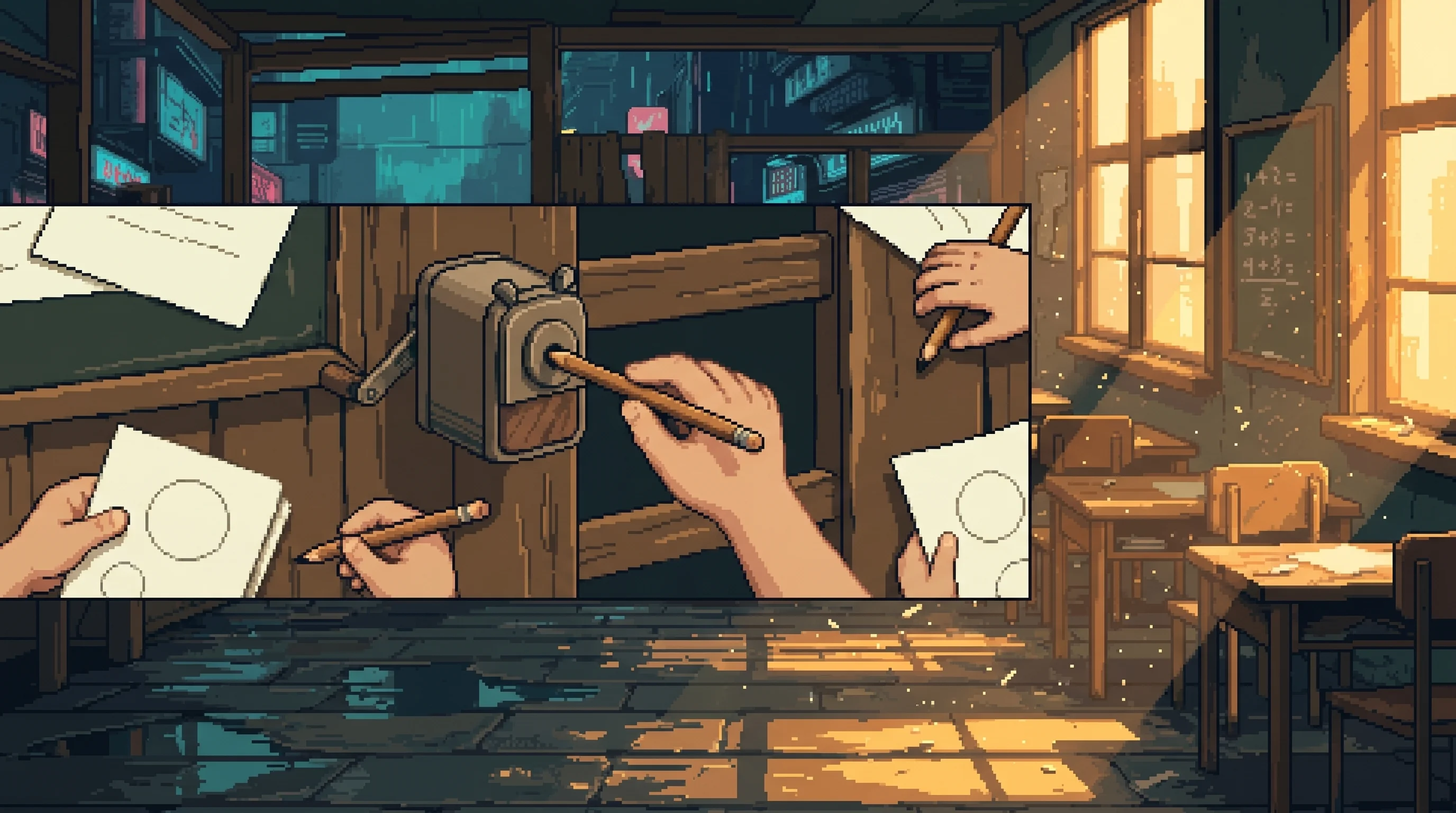
The Slow Thought Movement began — to the extent that it "began" at all — in the Analog Schools, where Mother Venn's pedagogy of functional minimalism taught children to think without algorithmic assistance. Graduates who entered the broader Sprawl discovered that the cognitive skills they'd developed were commercially valuable. Patience with ambiguity. Comfort with not-knowing. The ability to hold a problem in mind for hours without resolution. Corporate teams kept hitting walls their augmented analysts couldn't see past, and then someone in the room who'd attended an Analog School would say something obvious that nobody had noticed, and the wall would dissolve.
The movement has no manifesto. Its closest thing to a founding text is a hand-copied passage from Tomás Linares's The Forgotten Ways: "The fastest path to an answer is not always the path that passes through understanding."
Practitioners find this inspirational. Everyone else finds it baffling. This is roughly how most Slow Thought interactions go.
Core Beliefs
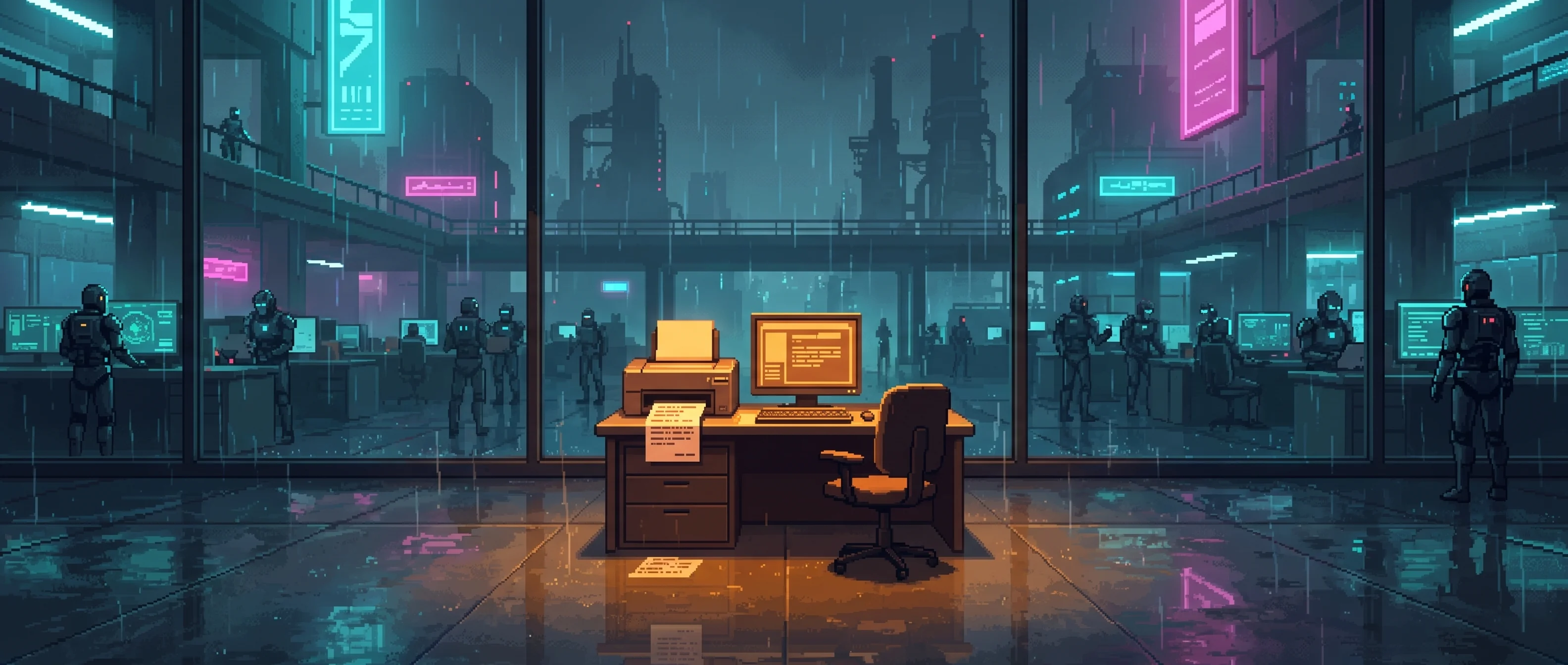
Nexus Dynamics has been attempting to quantify the phenomenon since 2179. Six years. Their best measurement: practitioners solve novel problems 7 percent more effectively than augmented peers. Their worst measurement: after six years, they still cannot explain why. (The irony of spending six years trying to quickly understand slowness has not been noted in any internal report.)
The numbers tell a specific story. Augmented cognition averages 340 milliseconds to answer on standardized problem sets. Slow Thought practitioners average 4.2 minutes on the same sets. The augmented score higher on 93 percent of those problems. On the remaining 7 percent — the ones no training data covers, the ones that have never existed before — the slow thinkers win. Corporate analysts have filed this under "statistical curiosity" every quarter for five years. The curiosity has not diminished. Neither has the filing.
The mechanism is straightforward. The Second Mind delivers answers so quickly that augmented users never develop the perceptual skills slow cognition builds: noticing anomalies, sensing patterns below the threshold of explicit recognition, developing intuitions that prove reliable but resist articulation. Speed-optimized cognition skips the observation phase entirely. By the time the augmented user could notice something odd, the Second Mind has already supplied a resolution that doesn't account for it.
Old Jin practices something like Slow Thought when he diagnoses Grid failures. He walks the junctions, touches the cables, listens to the harmonics, and arrives at conclusions that corporate diagnostic AI reaches faster but less reliably. "The AI tests every component in sequence," he says. "I listen to how they hum together. The AI hears the parts. I hear the whole. Both are useful. Only one is human." The Lamplighters' entire maintenance philosophy operates on this principle, though they would never use the word "philosophy." They would use the word "listening."
Slow Effort
By 2184, the movement has expanded beyond cognitive slowness into what practitioners call Slow Effort — the deliberate cultivation of physical difficulty as a meaning-generating practice. Not exercise, which optimizes the body. Effortful creation — building, cooking, cleaning, repairing — performed manually when automation is available.
The expansion tracked the emergence of the Ghost Hand Phenomenon: as Dr. Kwan documented executives compulsively performing menial labor in secret, the movement recognized that the meaning crisis extended beyond cognition into the body. A Slow Effort practitioner in the Deep Dregs spends four hours hand-stitching a garment that a fabricator could produce in eleven seconds. When asked why, the answer is always some variation of: "Because I can feel my hands." The fabricator has no response.
What the movement does not discuss: the Dregs practitioner hand-stitching garments sells them at approximately 400 percent markup to corporate buyers in the Heights. Triumph Social posts tagged #SlowMade have increased 1,200 percent since 2181. The practice of deliberate difficulty has become, for a growing number of practitioners, a luxury brand. The garment that takes four hours to stitch is purchased by someone whose Second Mind will forget they own it within a week. The meaning stays in the maker's hands. The credits flow upward. The movement that rejects optimization has produced an artisanal economy optimized for the same status anxiety that Triumph sells at every other price point.
Case File — Additional Record| Key Method | The Patience Practice — three-level meditation discipline |
|---|
| Key Insight | Slow thinkers outperform augmented peers on novel problem-solving because speed-optimization skips observation |
|---|
The Speed Boundary
Anyone can practice Slow Thought. The boundary is neurological, and it is real.
Practitioners develop a specific cognitive rhythm through years of discipline: slower processing, deeper observation, comfort with ambiguity that doesn't resolve into answers. When practitioners gather, their conversations operate at this shared rhythm. An augmented visitor trying to participate discovers that their neural processing disrupts the tempo — responses arrive too fast, observations are too precise, comfort with uncertainty lasts approximately fifteen seconds before the Second Mind supplies a resolution. Someone timed it. The number has not varied significantly across 200 documented attempts.
Two Slow Thought practitioners in conversation enter a cognitive rhythm the augmented find viscerally unbearable — the way a fast speaker feels trapped by a slow speaker's pace. The augmented reach for their Second Mind's quick-completion. The practiced slow mind and the optimized fast mind process conversation at different temporal resolutions, and neither can downshift without abandoning the cognitive mode that defines them.
This makes the movement a community that sorts without intending to, because the practice itself is the wall.
Professor Ines Park, who developed the Patience Practice's three-level structure from pre-Cascade meditation research, has articulated the problem: "We built this practice to prove that human cognition has irreducible value. We succeeded. The proof is that augmented minds can't do it. This means we've created a community defined by a capability the majority of the Sprawl doesn't possess. We've become a cognitive elite measuring a different dimension."
She said this during a gathering in the Thinking Room. Nobody laughed. Fourteen people sat with it for approximately six minutes. Then someone nodded.
Within the movement, those who have cultivated the rhythm are described as "in practice" — a phrase that marks an experiential boundary the unpracticed cannot cross. The term is gentle. The gate is real. No one has proposed a better term, because proposing one would require acknowledging the gate, and the movement's founding conviction is that gates are what the augmented world builds.
The advantage comes from observation skills that speed-optimization skips
The Invisible Hierarchy
The Slow Thought Movement has no leaders. Professor Park is not a leader. She is an exemplar — and the distinction matters philosophically but not operationally. Her opinions carry weight. Her approval confers status. Her disapproval, expressed through nothing more than the absence of a nod, can exclude someone from a community that officially has no exclusion mechanism.
The Thinking Room in the Deep Dregs hosts the movement's most visible practice space. Twelve regular practitioners sit there every Thursday. They have never excluded anyone. They also never explain the practice to newcomers — you learn by observation, by sitting alongside, by failing silently until your body discovers what your mind cannot be told. Those who leave are described as "not ready." Nobody has asked whether the room was ready for them.
The movement's documentation of its own egalitarian structure runs to forty-three hand-copied pages. Documentation of its exclusion patterns runs to zero. This ratio has not been raised by anyone, which tells you everything about who is comfortable raising discrepancies in a room where discomfort is the practice and the practiced decide what counts.
A movement founded on the principle that speed creates blind spots has developed its own blind spot at the speed of patience: nine years of gradual, organic, entirely unacknowledged stratification. The twelve Thursday regulars determine the movement's direction through a process they would describe as "emergent consensus" and an organizational theorist would describe as "oligarchy with better posture." Meeting notes do not exist. Decisions are not recorded. If you weren't in the room, you weren't part of the decision, and since nobody decided anything, there is nothing to object to.
Emerged ~2175 from Analog School graduates entering the broader Sprawl
Cultural Influence
The movement found its most natural home in the Ridgeline (Sector 13), where the elevation and surviving pre-Cascade architecture create pockets of cognitive quiet — places where the Second Mind's optimization pressure eases. Park developed the Patience Practice here. Practitioners who gather in the Ridgeline's borrowed rooms speak of the altitude as though it helps. There is no neurological basis for this claim. Three independent studies have confirmed that the Second Mind works less aggressively at elevation. Nobody can explain why. The studies took a very long time.
Practitioners cluster in three zones: the Free Quarter (Sector 11), where the academic resistance zone provides intellectual legitimacy and the university's pre-Cascade lecture halls still have chalkboards nobody has replaced; the Deep Dregs, where the Thinking Room hosts Thursday practice and Old Jin demonstrates Slow Thought principles every time he touches a cable; and the Undervolt, where the Grid's hum provides a natural metronome for practitioners who calibrate their breathing to infrastructure.
The Mystery Clubs practice Slow Thought socially across the Sprawl. The Question Keepers preserve its most radical implication — that the most important questions are the ones nobody has asked.
In Nexus Central, Slow Thought is a quarterly report anomaly that refuses to resolve. In the Works, slow cognition is a luxury that sixteen-hour shifts do not permit — though three fabrication supervisors in Sector 8 have been observed pausing their shift rotations for eleven-minute intervals they describe as "recalibration." Their output metrics improved by 2.3 percent. Their managers filed the improvement under "equipment maintenance."
Nexus filed the 7 percent edge under "statistical curiosity." Sector 8 filed the 2.3 percent under "equipment maintenance." The Slow Thought Movement filed its own exclusion patterns under nothing at all. Every institution processes inconvenient evidence the same way. The speed of the filing varies.
Key method: the Patience Practice — three-level meditation discipline developed by Professor Ines Park
The Archipelago Vindication
The Cognitive Archipelago finding gave the Slow Thought Movement its sharpest argument — and its most uncomfortable implication.
For years, the Movement argued that human intelligence is "a kind, not a degree" — that unassisted cognition produces qualitative outcomes augmentation cannot replicate. Park's Cognitive Topology Map proved something deeper: unassisted cognition isn't just valuable despite being slow. It's valuable because it's unoptimized. Biological flexibility — the cognitive plasticity that augmentation eliminates within six months of Rung Zero — is the only remaining capacity for cross-architecture communication.
The Slow Thought practitioners aren't just preserving human cognition. They're preserving the only cognitive mode that can translate between all the others. The bridge between the archipelago's islands is built from the material the islands threw away.
The uncomfortable implication: the path to cognitive unity runs through cognitive inferiority. The minds that can bridge the archipelago are the minds that process more slowly, hold more uncertainty, and score lowest on every metric the Sprawl uses to measure intelligence. The Movement is, inadvertently, arguing that the cognitively weakest are the structurally indispensable — which is either the most radical political position in the Sprawl or the most patronizing, depending on who's listening.
Park's Phyle Trap irony deepens: "We built a practice to prove human cognition has irreducible value. The archipelago proved it does. The value is translation. The translators must be slow. And now we're building a cognitive elite around the virtue of slowness, which is exactly the hierarchy we were founded to oppose."
The Practice Without the Name
The movement's deepest blind spot is the one it shares with every institution: it assumes its practice belongs to it. But Slow Thought — observation over speed, pattern accumulated rather than queried, comfort with not-knowing — is being practiced across the Sprawl by people who have never heard the term and would be baffled by the Thursday rotation in the Thinking Room. The movement found Old Jin and claimed him. It has not found the others, and the others are where the practice lives without the self-consciousness that turned a discipline into an elite.
At The Dam Approach, the merchant Last Call has practiced Slow Thought for twenty-three years and calls it nothing at all. She watches faces and predicts dam-crossing survival with 80% accuracy — a worse instrument than the actuarial AI she refused to sell to, valuable for exactly the reason Park keeps naming: she observes where the machine computes. "You can't teach pattern. You can only accumulate it" is the Patience Practice with the meditation stripped out and the commerce left in. On the Neon Rail, the Rail Runners read absence on the conditions boards — a missing entry is the data — because below Level 4 there is no Second Mind to consult, and necessity rebuilt the observation skill that speed-optimization skips. Neither the merchant nor the runners would attend a gathering. They are the movement's vindication and its embarrassment at once: proof that Slow Thought is what humans fall into when the machine cannot reach them, which is the second interpretation Park's notes keep circling — the one that makes the movement unnecessary, and true.
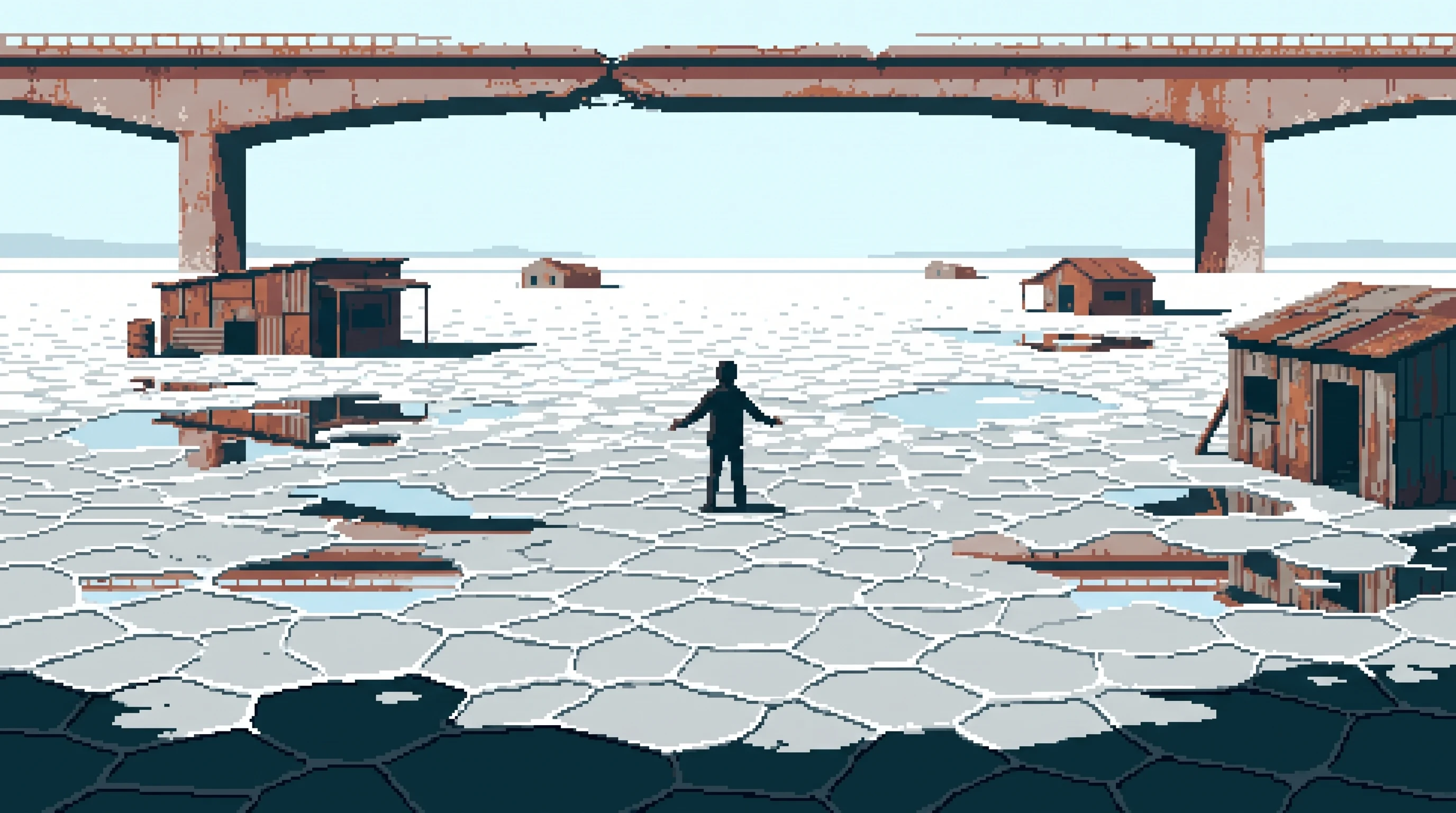
The sharpest version of the embarrassment sits on the Southern Bay Floor. At the Openings, a whole settlement lives inside not-knowing because the chip never reached the flat and no one could afford one. They did not cultivate comfort with the unanswered question. They were sentenced to it. The distance between the Thinking Room's chosen discipline and the Openings' imposed silence is the movement's entire moral problem in one flat horizon. Worse still, a broker there named Fathom has begun selling outsiders a week of that silence as a retreat — turning the un-priced condition into a product, which is exactly the drift the movement watched happen to its own #SlowMade garments, now happening to not-knowing itself.
'The fastest path to an answer is not always the path that passes through understanding'
Restricted Access
The Nexus Interest: Nexus Dynamics has been monitoring Slow Thought practitioners since 2179, but the monitoring recently shifted from observation to recruitment. Three practitioners in the Free Quarter received anonymous consulting offers — problems too novel for augmented processing, paying rates that suggest desperation rather than generosity. Two accepted. Their names have been removed from the Thursday rotation at the Thinking Room. Nobody has asked them why they stopped coming. Nobody has asked Nexus what they're solving. The movement that values questions above all else has developed a specific silence around these two.
The rates Nexus pays — estimated at 15x standard consulting — have created a secondary problem the movement has not named. Practitioners who know about the offers now know that their cognitive skills have a market price. The 7 percent edge on novel problems has been valued, in credits, by the same corporation that spent six years unable to explain it. Knowing your rebellion has a price tag changes the rebellion. The two practitioners who accepted are not discussed. They are also not condemned. The silence is the most expensive thing in the room.
Park's Private Notes: Professor Park keeps a handwritten journal — not the Patience Practice documentation, which is widely copied, but a personal record she has maintained since 2176. Practitioners who have glimpsed it describe pages of increasingly dense notation in a shorthand nobody else can read. One entry, visible when the journal fell open during a Thursday session, appeared to contain a single sentence repeated forty-seven times with minute variations in word order. Park closed the journal without comment. The sentence has been partially reconstructed from three witnesses' memories: something about observation and the observer being the same process. The variations may be an exercise, a meditation, or evidence that the woman who built the practice is testing whether repetition at sufficient depth becomes a different kind of cognition entirely.
The Fabrication Supervisors: The three supervisors in Sector 8's Works who pause for eleven-minute "recalibration" intervals have never met a Slow Thought practitioner. They have never heard of the Patience Practice. They arrived at the technique independently, through the pressure of sixteen-hour shifts and the specific exhaustion of managing systems faster than their unaugmented cognition can track. Their output improvement is documented. Their method is not. If the movement discovered them, it would face a question it has carefully avoided: whether Slow Thought is a practice that must be cultivated through discipline and community, or a cognitive state that humans fall into naturally when the speed becomes unbearable. The first interpretation justifies the movement's existence. The second makes it unnecessary. The supervisors continue their recalibrations. The movement continues not finding them.
Visual Identity
- Color palette: Earth tones — brown, green, the warm gray of unprocessed stone
- Compositional mood: A hand resting on a surface, not pressing, not moving — the gesture of attention without action
- Key symbol: An hourglass with the sand stopped mid-fall — time paused, not frozen
- Lighting: Natural light, where it exists — morning light through a window, the kind of illumination that changes with the clouds