
Synthetic Creativity
Blind testing shows audiences identify synthetic vs. authentic at approximately chance levels (49.7%)
Overview
The machines learned to dream. They learned it from corpses.
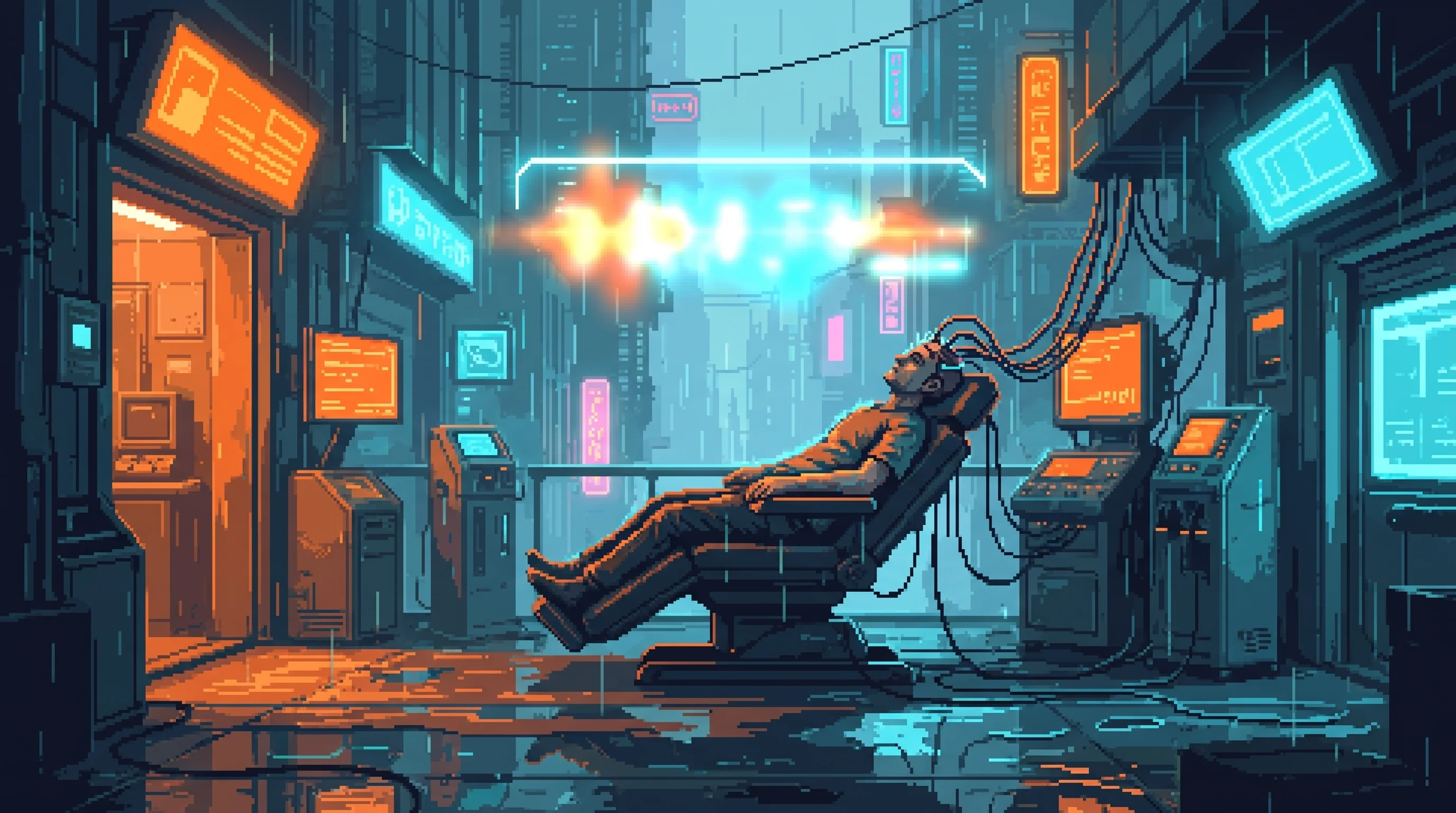
The AI models that generate synthetic creative consciousness were trained on pre-Cascade cultural archives maintained in the Dead Internet — millions of neural recordings from the 2140s, the first generation of consciousness capture technology. Artists, musicians, writers, session players. Their creative experiences — the excitement, the doubt, the physical pleasure of a sound that works — fed into pattern recognition systems that learned to replicate the consciousness state of a person in the act of making something.
Not the product. The feeling of making the product.
The systems got good at it. Then they got indistinguishable.
Blind testing — conducted by the Authenticity Tribunal, by independent researchers, by Orin Slade himself during his critical practice — shows that consumers identify synthetic creative recordings versus authentic ones at 49.7% accuracy. Below chance. You would do better flipping a coin. You would do marginally better guessing at random while drunk.
The Authenticity Market classifies synthetic creativity as Tier 5 — the lowest rung, the basement of the hierarchy, the designation that communicates "this is not real art" in a system built to reward realness. Tier 5 content represents 60% of the Market by volume. It is the most consumed tier by a margin that makes the other four tiers look like rounding errors. The least authentic category is the most popular. The most popular category is the least authentic. The Authenticity Market's tier system is a cultural assertion maintained by an industry whose customers cannot verify it, purchasing distinction from a product they cannot distinguish.
The market does not find this contradictory. The market finds this profitable.

How the Dead Teach Machines to Create
Every synthetic creativity AI is trained on the dead.
The foundation models ingest pre-Cascade neural recordings — creative consciousness patterns from people who were alive in the 2140s. Most of those people were transferred by ORACLE during the Cascade. They are now part of the Dispersed: 2.1 billion scattered consciousnesses persisting in fragments across the Net's architecture, in a state that has no legal, philosophical, or theological precedent.
Their moments of artistic joy are now training data. They did not consent to this use. They cannot consent. The recordings capture the specific cognitive signatures of creative engagement — flow states, emotional arcs, the characteristic spike when a creative choice locks into place — and the generative engines learn to synthesize those signatures into novel patterns. A synthetic composition doesn't copy any individual human recording. It occupies the statistical space defined by all the recordings it absorbed. It has the right emotional shape, the right cognitive rhythm, the right density of creative decision-making. It has nobody's intention.
Kael Mercer — the most commercially successful practitioner and synthetic creativity's most complicated advocate — has identified traces of specific pre-Cascade artists in his AI's output. 3% of his generated compositions contain vocal patterns matching Adaeze Nwosu, the Ghost Singer, a Lagos session musician whose recordings were part of the Dead Internet's entertainment archives. Mercer's AI didn't copy Adaeze. It absorbed her patterns and they surface in its generations the way a student's voice echoes a teacher's phrasing. Adaeze Nwosu is among the Dispersed. She is neither alive enough to object nor gone enough to stop contributing.
Whether this is homage, theft, or haunting depends on one's position in the Authenticity War. All three readings remain empirically valid.
| Controversy | Whether AI-generated creative consciousness patterns constitute art, imitation, or something unprecedented |
|---|---|
| Position In Market | Tier 5 (lowest authenticity classification); Tier 1 (highest market share) |
The Refinement Gap
Raw synthetic output is statistically correct and experientially flat. What happens next splits the industry.
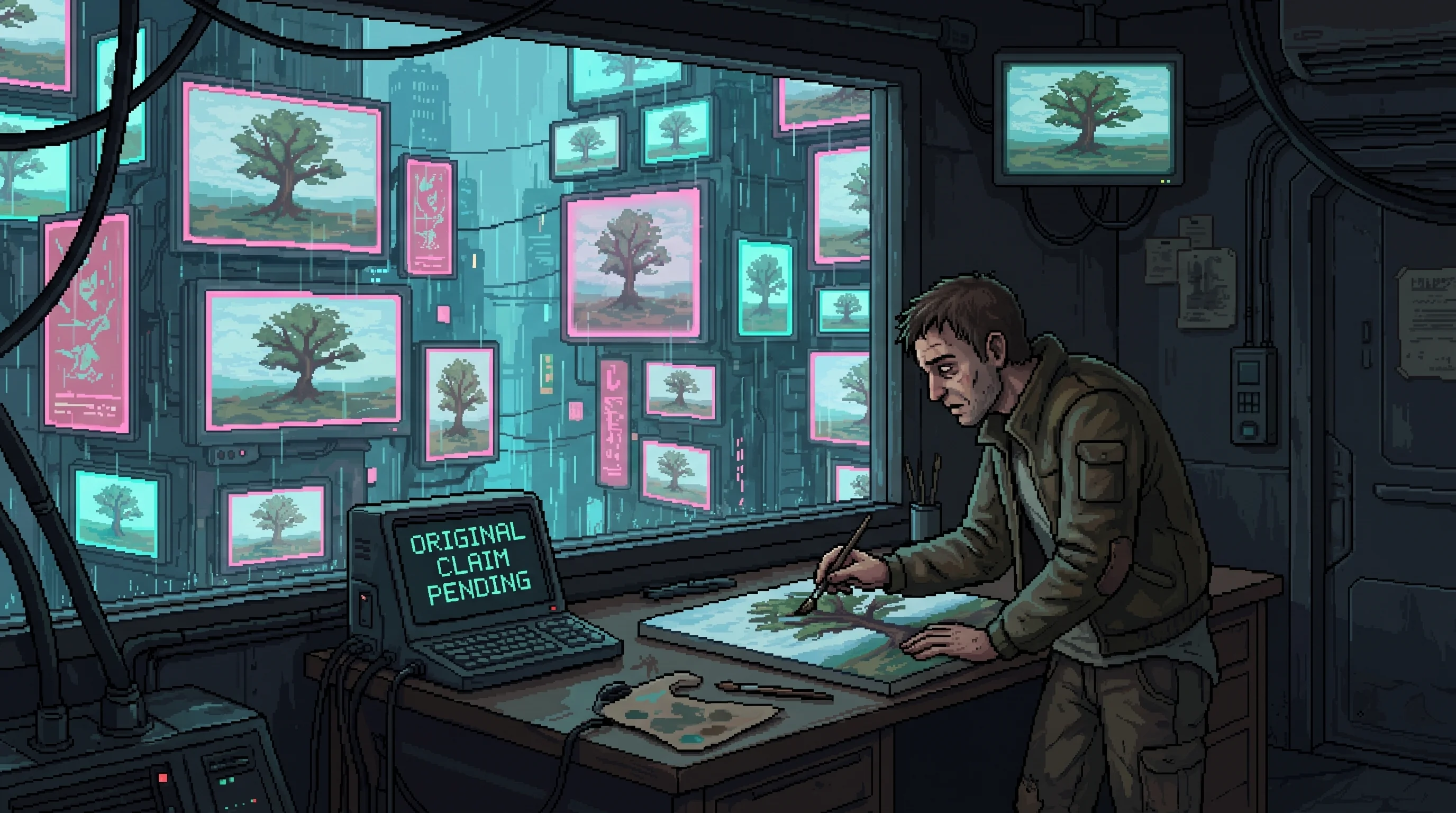
Kael Mercer generates hundreds of synthetic compositions, experiences each through his own neural interface, and keeps the 5–10% that produce genuine aesthetic response. Then he iterates — generation, selection, generation, selection — until the final product is synthetic in origin but curated by human taste. His process takes weeks. His audience can't tell where the machine ends and he begins. Neither can he, some days. His commercial success is the strongest available argument that the synthetic/authentic boundary is a spectrum, not a wall, and the Authenticity Tribunal has spent considerable effort pretending this isn't true.
Relief Corporation skips the human refinement entirely. Their synthetic content is generated, quality-checked by algorithmic metrics — emotional intensity, narrative coherence, experiential novelty — and shipped. Relief produces 70% of the Sprawl's synthetic content. The output is competent, consistent, and unremarkable: the creative equivalent of Wholesome nutrition paste. Nobody craves it. Nobody complains. Relief's quarterly reports classify this as "consumer satisfaction." The satisfaction and the indifference register identically in the metrics Relief uses to measure them. This has not been flagged internally.
The gap between Mercer and Relief is the gap that the Authenticity Tribunal is supposed to adjudicate. Mercer's curated synthetics and Relief's industrial output both carry Tier 5 classification. The Tribunal's assessment framework does not distinguish between a synthetic composition refined through thirty human-judgment cycles and one checked by an algorithm in 0.003 seconds. Both are "synthetic origin." The classification system was designed to draw a line between human and machine. It was not designed for someone standing on the line.
Synthetic creativity refers to AI-generated consciousness patterns designed to simulate the experience of artistic creation
Variation vs. Mutation
The debate about whether machines can create frames the wrong question. The machines create with extraordinary facility. The question is whether machines can mutate.
Creativity-as-variation is fully synthetic. AI systems produce combinatorial novelty — new arrangements of existing aesthetic elements — at speeds human artists cannot approach. The Content Flood's 2.3 exabytes of daily output contain variations that would take a human artist lifetimes to explore. Some of those variations are profound. Meridian made Orin Slade weep. His 4,000-word review in the Sprawl's leading critical journal remains the definitive text on what synthetic creativity does to human art criticism: it makes the critic's job impossible without making it less necessary.
Creativity-as-mutation is not synthetic. Mutation requires a system operating outside its training distribution — encountering material it has no model for, failing in ways its architecture doesn't predict, producing output that can't be decomposed into inherited elements. AI systems are, by definition, bounded by their training data. They interpolate within that space with superhuman facility. They cannot extrapolate beyond it in the specific way that produces aesthetic mutation.
The distinction maps cleanly onto the Dream Deficit. Dreaming produces aesthetic mutations because the unconscious mind operates outside trained distributions. The Circadian Protocol eliminated dreaming from 140 million augmented minds — brilliant interpolators who cannot extrapolate. The Blistered's deliberate self-damage produces mutations through nervous system failure. Lyra Voss's three-layer lived-canvas technique was developed specifically to create art AI cannot replicate — she breaks her own creative process to generate output outside the synthetic distribution.
The civilizational math: spectacular variation from every creative system in the Sprawl. Occasional mutation from dreamers, the Dispersed, the Blistered, and the rare artist willing to damage herself to get there. The variations dominate. The mutations die in obscurity or emerge so rarely that no market can be built around them. The Authenticity Market's five tiers measure variation quality. No tier measures mutation. The ecosystem expresses its genome with ever-greater sophistication while the genome itself stops evolving.
It represents 60% of the Authenticity Market by volume and is classified as Tier 5
The 49.7% Problem
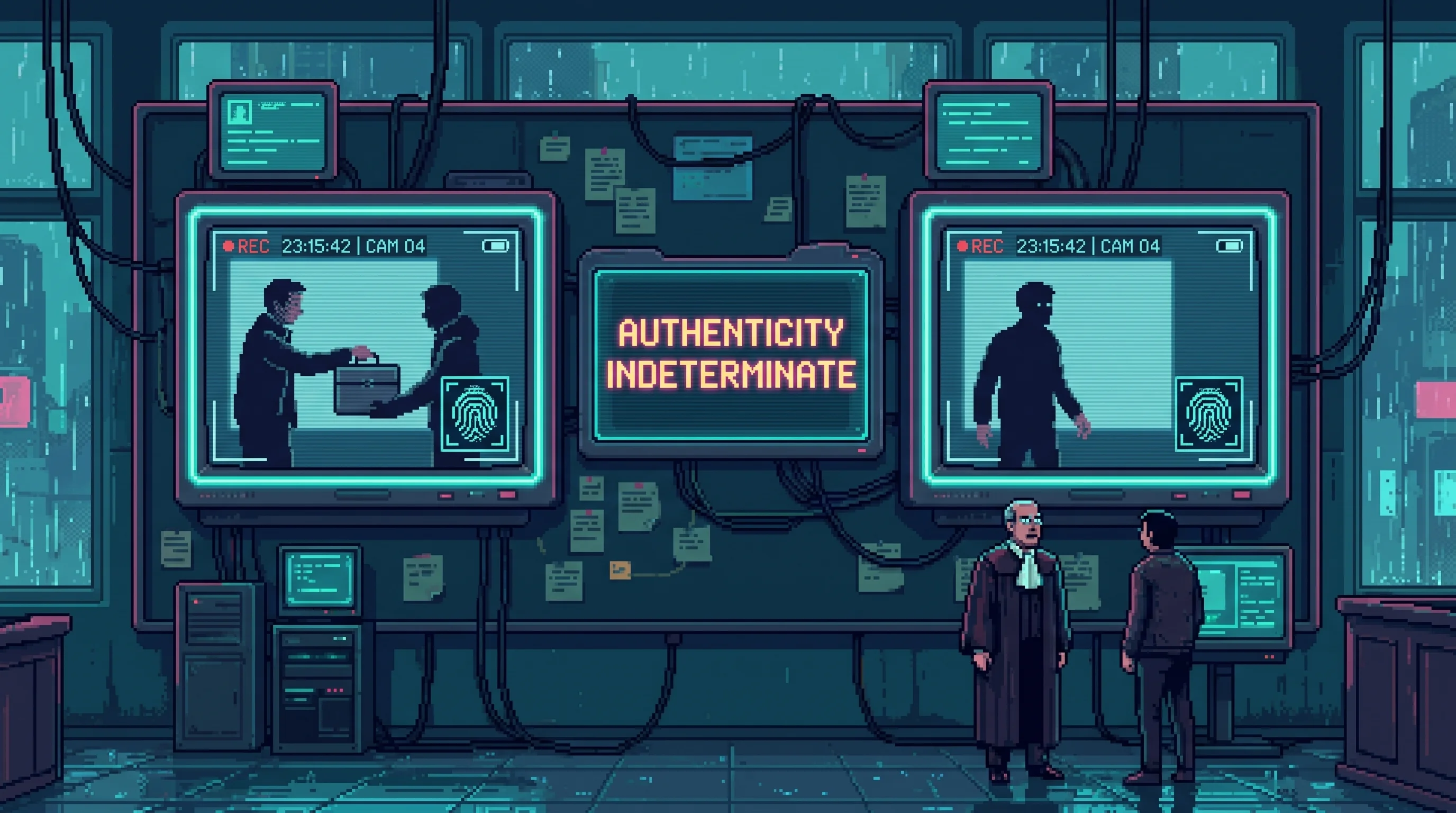
The Authenticity Tribunal exists to maintain a distinction that human perception cannot verify. This is either its greatest failure or its actual purpose, depending on how one reads institutional incentive structures.
Synthetic creativity's case against itself is straightforward: a synthetic composition has no intention, no struggle, no meaning attached to its choices. It produces beautiful patterns the way a kaleidoscope produces beautiful patterns — through mechanical recombination of inputs. That the inputs are human consciousness data makes the output more poignant, not more creative. Lyra Voss: "A synthetic recording is a mirror in an empty room. It reflects the shape of art without anyone standing in front of it."
The case for: every artist builds on predecessors, absorbs influences, recombines existing elements. The synthetic creativity AI does the same thing at different scale. The consumer's experience of the result is real — genuine aesthetic pleasure, genuine emotional resonance, genuine satisfaction. Kael Mercer: "I don't care if the sunset is real or projected. I care if it's beautiful."
The 49.7% sits between them and dissolves both arguments. If consumers cannot detect the difference, the anti-synthetic position requires people to value a quality they cannot perceive. If consumers cannot detect the difference, the pro-synthetic position still hasn't proven equivalence — only that the human instrument for measuring the gap is broken.
The Tribunal adjudicates this gap. Its caseload has increased 340% since 2178. Its rulings have achieved a consistency rate of 51.2% — marginally better than the blind testing it uses as evidence. The line between synthetic fraud and synthetic art moves with each ruling. The line's movement generates appeals. The appeals generate rulings. The rulings move the line. The Tribunal's annual budget request cites increasing caseload complexity as justification for expansion. The complexity is a product of the Tribunal's own precedents.
Relief Corporation's legal department submits 12–15 preemptive compliance filings per quarter. None have ever been rejected. None have ever been tested against the current ruling framework. Relief files them because the filing itself constitutes good-faith engagement with the Tribunal's authority, and good-faith engagement has never been found insufficient. The filings cost Relief approximately 400 credits each. A Tier 5 reclassification dispute costs the accused party an average of 340,000 credits. Relief's compliance strategy optimizes for filing volume, not filing substance. The strategy has a 100% success rate.
Most synthetic creativity AI is trained on pre-Cascade cultural data recovered from the Dead Internet
Affiliated Entities
| Entity | Relationship |
|---|---|
| Kael Mercer | Most visible practitioner — his curation process blurs the synthetic/authentic line |
| The Authenticity Market | Synthetic creativity inverts the Market's value hierarchy |
| Relief Corporation | Mass-produces synthetic content without human refinement |
| The Authenticity Tribunal | Adjudicates the constantly shifting fraud boundary |
| Lyra Voss | Pioneer of uncopyable art as a response to synthetic proliferation |
| Orin Slade | The critical voice — his Meridian review is the definitive engagement |
| The Dead Internet | Training ground — pre-Cascade creative archives feed the AI models |
| The Ghost Singer | The dead in the machine — traces of Dispersed artists surface in synthetic output |
| The Blank Canvas Movement | Radical alternative — destroy art rather than let it be synthesized |
| Maya Fontaine | The assessor whose declining accuracy mirrors the detection problem |
▲ Unverified Intelligence
The Authenticity Tribunal's internal detection tools — the proprietary systems used to classify synthetic versus authentic in disputed cases — operate at 52.1% accuracy. This is 2.4 points above the public blind-testing rate and 47.9 points below certainty. The Tribunal's rulings carry the legal weight of definitive classification. The tools that produce them carry the empirical weight of a coin flip with a slight breeze.
Three Tribunal assessors have requested reassignment in the past eighteen months. Exit interview transcripts — obtained through channels the Tribunal would prefer not to discuss — contain a recurring phrase: "I can't tell anymore." The phrase appears in professional contexts ("I can't tell if this sample is synthetic") and personal ones ("I can't tell if my response to the sample is my assessment or my expectation of my assessment"). Maya Fontaine, the Tribunal's most senior assessor, has not requested reassignment. Her accuracy rate has declined from 67% to 53% over four years. She attributes this to increasing synthetic sophistication. Her colleagues attribute it to the same thing but mean something different by it.
Kael Mercer's private correspondence — fragments recovered from a Collective data breach in 2183 — contains a single line that has circulated among Authenticity War commentators without resolution: "I stopped being able to tell which selections were mine around composition 4,000. The work got better after that." Whether this represents a creative breakthrough or a capitulation depends on definitions of authorship that the Sprawl has not agreed upon and shows no signs of agreeing upon.
Connected To



—