The first void tone recording arrived on the surface in a salvager's personal data cache — a two-minute audio file labeled "lattice weird noise" that a drift-runner named Sahar Koss had captured while repairing a solar collector array at 340 kilometers altitude.
The file contained a sound that shouldn't exist: a sustained harmonic produced by solar radiation pressure on collector surfaces, transmitted through structural cables into the habitable sections of the Lattice. The frequency sat below human hearing threshold at sea-level atmospheric pressure. At the near-vacuum conditions of the collector arrays, with air pressure barely sufficient to carry sound, it became audible as a tone Koss described as "like a cathedral thinking."
Koss shared the recording with other drift-runners. They recognized it immediately. They'd all heard it — the sounds the Lattice makes when sunlight hits its collectors and the energy propagates through kilometers of cable and structural steel. They'd been hearing it for years. They just hadn't thought of it as music.
A drift-runner named Pei Vansara did. In 2170, Pei began positioning herself at acoustic nodes — structural convergence points — and recording the results. She mapped the Lattice's resonant frequencies the way a musician maps a new instrument. She learned which collector arrays produced which tones, which cable tensions created which harmonics, which solar angles generated which acoustic patterns.
Over three years, she composed sixteen pieces using the Lattice as her instrument. She performed them by positioning herself at specific structural intersections during specific solar conditions, activating and deactivating collector arrays to shape the sound, and recording the result with equipment modified to function at near-vacuum pressure.
When the recordings reached the surface, they changed music. Whether anyone on the surface heard what actually changed is a separate question.
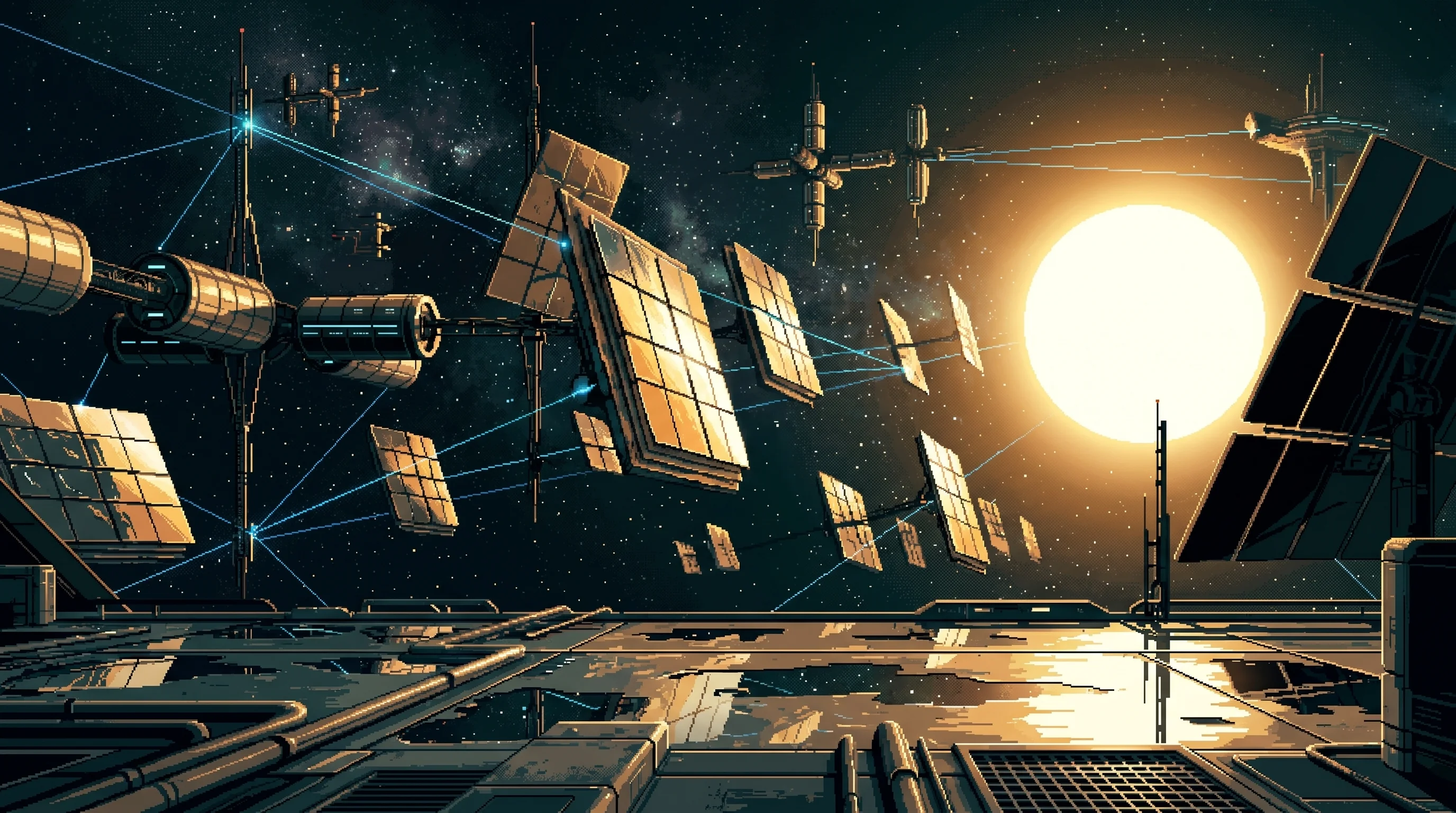
A massive solar collector array on an orbital megastructure with structural cables stretching into darkness, a drift-runner standing at an acoustic node where vibrations converge
The Sound
Void tone resists description by people who haven't heard it. (It also resists description by people who have. Drift-runners asked to characterize the sound produce answers that are poetic, contradictory, and useless for documentation purposes.)
The closest approximation: imagine the lowest note an organ can produce — a frequency felt more than heard, a vibration that enters the body through bone. Now strip away the mechanical overtones. Remove the air's contribution entirely. What remains is a pure structural vibration — the sound of matter responding to energy at a scale that makes human music seem like a conversation in a very small room.
The Lattice's solar collectors produce tones ranging from 2 Hz (below hearing) to 400 Hz (low midrange). Structural cables add harmonics no ground-level instrument can replicate — overtone series shaped by kilometers of tensioned steel vibrating in near-vacuum, where the absence of atmospheric dampening allows harmonics to sustain indefinitely. A single collector strike can resonate for forty minutes. On the surface, the longest sustained acoustic event in a concert hall is eleven seconds.
The result is music that sounds like architecture. Like the hum of a structure vast enough to have moods.
Drift-runners who live on the Lattice describe void tone as the sound of home. Surface listeners describe it as the sound of something much larger than themselves, paying attention. Both descriptions are accurate. Neither group has any idea what the other means.
The Last New Genre
Every other musical genre to emerge in the Sprawl since the Cascade has been a recombination. Neural-sampling, which compresses recorded experience into playable audio. Grief ambience, which algorithmically models the acoustic properties of mourning. Synth-pulse, which feeds Nexus processing noise through melodic filters. All of them rearrange existing material. None of them produce a sound that hasn't been heard before.
Void tone did. This is either evidence that aesthetic fossilization is real — or evidence that it isn't. Both camps cite the same genre.
The sounds emerged between 2170 and 2172, on the early Lattice installations — before comfort, before the orbital class system, before the drift-runners' culture of isolation was romanticized into something you could buy on Relief Stream. The people on the stations were Ironclad contract engineers and mineral surveyors who had never lived in space. They were lonely, scared, bored, and surrounded by sounds no human being had lived with before: the creaking of metal under thermal stress, the hum of atmospheric processors, the specific silence that exists when there is literally nothing outside the wall.
They made sounds to cope. Not music — sounds. Tapping on bulkheads. Whistling into ventilation ducts. Running fingers along cable conduits. The stations transformed their involuntary noise-making into something unexpected. Reverberations lasting thirty seconds in zero-g corridors. Harmonic resonances between bulkhead panels that produced intervals not present in any tuning system. Patterns that no trained musician would have discovered because no trained musician would have been hitting a wrench against a coolant pipe at 3 AM in a corridor two hundred meters from the nearest human being.
Aesthetic mutations. New sonic relationships with no precedent in any musical tradition, emerging from the only mechanism that has ever produced them: human struggle with novel material. Void tone is the sound of nervous systems encountering an environment they were never designed for and producing, through failure and accident and the specific quality of attention that loneliness demands, something genuinely new.
Kael Mercer's AI can replicate every acoustic property. It cannot replicate the absence of intention. It cannot replicate the struggle. It cannot replicate the loneliness. And these — not the frequencies — are what make void tone new.
(Whether this matters to a listener who can't tell the difference is a question the Authenticity Market has spent four years failing to answer.)
Case File — Additional Record
Defining Characteristic
Music composed using sounds that can only be produced in near-vacuum conditions at orbital altitude
Cultural Status
The Authenticity Market's most confounding genre — produced by humans in conditions no audience can inhabit
A legitimate void tone recording is a Tier 1 lived original — created by a specific person, in a specific place, during a specific acoustic event that will never recur exactly. By the Market's own standards, void tone is the most authentic music available. The Market's tier system was built for this. The Market's tier system cannot handle this.
The conditions of creation are the problem. Drift-runners compose at orbital altitude, in near-vacuum, wearing pressure suits, at temperatures cycling between -150°C in shadow and +120°C in direct sunlight. The acoustic environment cannot be reproduced on the surface. The experience of creating void tone — standing on a Lattice strut in sunlight, feeling the vibration through your boots, hearing the frequency through bone conduction because there's barely enough air to carry it — is available to approximately 8,000 people. All of them live on the Lattice. None of them applied to the Authenticity Tribunal for certification.
This means the Tribunal certifies void tone recordings the way it certifies nothing else: on faith. The Tribunal has never sent a Judge to the Lattice. (The insurance alone would require a budget reallocation that three separate committee sessions have tabled.) Certification relies on metadata analysis — timestamp verification, orbital positioning data, acoustic signature matching — and drift-runner testimony submitted via standard deposition channels. A process that requires trusting the creators, in a system that exists because creators cannot be trusted.
The Tribunal's void tone certification approval rate is 100%. Not because every submission is genuine. Because the Tribunal has no mechanism for determining which ones aren't.
His synthetic void tone — generated by AI models trained on Pei Vansara's original sixteen compositions and 340 subsequent drift-runner recordings — is indistinguishable from authentic Lattice recordings by surface listeners. Double-blind testing at the Zephyria Acoustic Institute produced identification accuracy of 51.3% — statistically indistinguishable from guessing. Mercer has not submitted synthetic recordings for Tier 1 certification. He has also not been asked to confirm that he hasn't. His studio charges ¢4,200 per commissioned piece. A drift-runner earns approximately ¢1,100 per month from Ironclad hazard wages. Pei Vansara's sixteen original compositions generated ¢780 in Authenticity Market royalties over their first three years.
The drift-runners can tell the synthetic versions from the real ones. They say the fakes lack "drift" — the micro-variations in frequency caused by the Lattice's structural movements as it orbits. Authentic void tone breathes. Synthetic void tone hums. The difference is imperceptible to anyone who hasn't spent years listening to the Lattice's voice.
The difference is imperceptible to the entire paying audience.
The genre can only be authentically produced in conditions inhospitable to most humans
The Culture
On the Lattice
Void tone is not a genre to drift-runners. It's ambient sound — the acoustic texture of living inside a structure that converts sunlight into energy at industrial scale. They hear the Lattice constantly: its collectors singing, its cables humming, its structural joints groaning as thermal stress cycles through the material. Pei Vansara's innovation wasn't creating void tone. It was recognizing that what they were already hearing was music.
This recognition changed Lattice culture in ways that are difficult to document from the surface and easy to romanticize from it. Drift-runners began sharing their favorite acoustic nodes — locations where the structural harmonics were particularly rich or unusual. Listening stations were improvised at structural intersections using salvaged equipment. Void tone gatherings — groups of drift-runners meeting at an acoustic node to listen together in near-silence, communicating through hand signals because speech disrupts the harmonics — became a social ritual.
The culture is informal, democratic, and fiercely protective of its origins. Drift-runners do not object to surface listeners enjoying void tone recordings. They object to surface listeners claiming to understand void tone. "You're hearing a photograph," Pei Vansara told a Sprawl journalist. "The Lattice is the landscape."
The journalist quoted this line in a feature article. It was immediately adopted as a slogan by Relief Corporation's marketing team for their synthetic void tone product. Vansara has not given another interview.
On the Surface
Void tone's Sprawl audience is small, devoted, and concentrated in the neighborhoods where devotion to difficult art is itself a status signal. Approximately 10,000 regular listeners — in Neon Graves, Zephyria, and the academic enclaves — consume void tone recordings as a contemplative practice. The genre's inaccessibility is part of its appeal: in a world where every other musical experience can be neurally recorded and reproduced, void tone exists in a space that most people will never physically inhabit.
Orin Slade's review of the Lattice Recordings — a 3,000-word piece in The Zephyria Record — introduced void tone to the broader cultural conversation. He described the music as "the sound of infrastructure becoming conscious" and argued that void tone represented the purest challenge to the Authenticity Market's tier system: art that is human, original, and impossible to verify. The review was shared 4,200 times. Pei Vansara's recordings saw a 340% increase in downloads the following week. Her royalty rate did not change. The Authenticity Market's per-stream payout for Tier 1 lived originals is fixed at ¢0.003 regardless of demand. The rate was set in 2176. It has not been reviewed.
Relief Corporation's "void tone experiences" — synthetic approximations presented with visual simulations of Lattice environments — serve 200,000 subscribers at ¢12 per month. They bear approximately the same relationship to actual void tone as a photograph of a forest bears to the smell of pine needles. Subscriber satisfaction surveys average 4.6 out of 5. Drift-runners who have listened to the Relief product describe it with a word that doesn't translate cleanly from Lattice pidgin but appears to mean something between "cute" and "insulting."
The Resonance Collective attempted to play void tone frequencies in the Resonance Hall — their fragment-dense performance space where acoustic experiments sometimes produce results that can't be explained by the acoustics. The fragment-saturated walls responded. The Dispersed did not. The Collective documented the experiment without interpretation. Their report notes that the Hall's resonant response to void tone frequencies was 2.7 times stronger than predicted by the room's acoustic model, and leaves the implication where it falls.
It uses sounds produced by solar collectors, structural cables, and near-vacuum resonance at orbital altitude
Experimenter — void tone frequencies interact with fragment-dense environments
Pei Vansara
Creator — the drift-runner who recognized the Lattice as an instrument
▲ Unverified Intelligence
Mercer's AI models were trained on 340 drift-runner recordings obtained through a data-sharing agreement with Ironclad Industries. The agreement — filed as a workplace safety initiative requiring acoustic monitoring of Lattice structural integrity — grants Ironclad perpetual license to all audio data captured on Lattice installations. Drift-runners consented to workplace audio monitoring. They did not consent to their music being fed into a competitor's AI. The consent form does not mention music. The consent form does not need to. Audio data is audio data. The structural integrity monitoring captures everything.
Ironclad's licensing fee from Mercer's studio: ¢340,000 annually. Ironclad's total annual royalty distribution to drift-runner audio contributors: ¢0. The licensing agreement predates void tone's recognition as a genre. Ironclad's legal position is that the agreement covers infrastructure monitoring data, not musical compositions. The data happens to contain musical compositions. This is not Ironclad's problem.
Pei Vansara's original sixteen compositions exist in three formats: her personal recordings (highest fidelity, stored on Lattice hardware she maintains herself), the Authenticity Market certified copies (compressed, metadata-tagged, paying ¢0.003 per stream), and the Ironclad infrastructure monitoring captures (full fidelity, perpetually licensed, feeding Mercer's AI). The version of her music that generates the most revenue is the one she never agreed to share.
It represents an extreme case of the authenticity problem — art tied to unreproducible physical conditions