The Effort Tier: the Spectacle Front adds effort-provenance to the Market's object-provenance — the premium was always buying the documented fact of a human having tried, and the Gilded Callus sells that trying directly with no object attached
Scene ReferenceThe Authenticity Market
A rain-soaked neon marketplace with holographic authenticity certificates floating in the air and vendors hawking neural recordings under dripping awnings
Overview
In 2184, a perfect copy of any human experience costs between 2 and 890 credits. The original costs between 15,000 and 2.3 million. The copies are perceptually identical to the originals. Blind tests confirm this at a rate of 49.7% — statistical chance. People pay the premium anyway.
The Authenticity Market is the economic infrastructure built around the conviction that being first matters, even when — especially when — nobody can explain why. It is a five-tier hierarchy for classifying human experience by originality, a verification apparatus for certifying that classification, and a social anxiety engine that ensures the classification feels urgent. Neural recordings capture experience with full sensory fidelity. Memory extraction transfers lived moments between minds. Emotion synthesis replicates feelings without their original cause. Project Caduceus proved that consciousness itself can be transferred without loss of continuity. The technology doesn't degrade. A copied sunset is perceptually identical to the original.
None of this has reduced the premium. If anything, perfect duplication made it worse. When copies are flawless, the only remaining scarcity is the knowledge that you were there. Not the experience. The receipt.
The Rothwell brothers manufactured the anxiety. Relief Corporation sells the temporary cure. Nexus Dynamics certifies that the cure is authentic. The Collective watches the entire apparatus and sees ORACLE's logic wearing a new suit: all data is equivalent, all experience is tradeable, same framework, different packaging. Everyone is correct. The market does not require anyone to be wrong.
The Authenticity Premium
The Sprawl has developed pricing models of considerable specificity for something nobody can define:
The premium is not about quality. VerisysTM's own certification data confirms this: authenticated originals and Tier 3 verified copies produce identical neurological satisfaction signatures in 98.4% of recipients. The 1.6% who report a difference correlate almost perfectly with the 1.6% who checked their tier classification before playback.
What VerisysTM actually sells is a cryptographic seal proving timestamp of original experience, neurological signature of the experiencer, certification that no prior copies exist, and a unique identifier tied to your consciousness signature. Corporate executives collect these certificates the way pre-Cascade collectors accumulated paintings. The certificate has become more valuable than the experience it certifies. VerisysTM certification revenue grew 340% between 2181 and 2183. The number of experiences anyone could plausibly want to have for the first time, according to Relief Corporation's own novelty index, declined to 12 documented categories in the same period.
A rain-soaked neon marketplace with holographic authenticity certificates floating in the air and vendors hawking neural recordings under dripping awnings
The Hierarchy
Tier 1: Lived Originals
Experiences you actually had, in your original consciousness, with no prior similar experience downloaded. The purest form of authenticity — and the most paranoid.
The young have them, before they start downloading. Flatline Purists maintain them by refusing neural intake entirely. The very wealthy curate them by employing teams of experience auditors who verify that each memory in their neural architecture traces to a lived event. The auditors charge 4,000 credits per hour. They cannot actually verify what they claim to verify. The wealthy pay anyway. The alternative is uncertainty, which costs more.
The anxiety specific to Tier 1 is corrosive: how do you know your memories are lived originals? Memory manipulation is subtle. Some residents of the upper Sprawl have discovered, during routine neural maintenance, that entire years of their lives are synthetic constructions inserted during sleep cycles. The experiences felt real. The feelings were genuine. The memories are fake. Their Tier 1 status was retroactively invalidated. VerisysTM does not offer refunds.
Tier 2: First Copies
The first neural recording made from a lived original. Legally distinct from the original but considered authentic by most commercial standards. Relief Corporation dominates this tier, packaging first-copy experiences for streaming at prices the mid-Sprawl can almost afford.
The controversy is structural: first copies can be made without the original experiencer's consent. Neural eavesdropping is illegal under the Verity Act and common enough to support its own economy. Some of the most valuable first copies in Relief's catalog are stolen moments — a soldier's last thought before death, a mother's first sight of her child, a Cascade survivor's final seconds of the old world. Relief's licensing agreements specify that all recordings are "ethically sourced." Relief's sourcing audits are conducted by Relief.
Tier 3: Verified Copies
Copies of copies, with unbroken chain of custody. Each reproduction logged, timestamped, degradation-checked. This is where most people shop. The Sprawl's middle class lives on Tier 3 experiences — the Orbital Elevator sunrise for 40 credits, swimming in the Pacific (now a Helix-controlled preserve) for 35, a night at Status Quo without the 14-week wait for 28. Their lives are rich with experiences they never had. The experiences are real. The having is not.
Tier 4: Unverified Copies
No documentation. No chain of custody. Quality varies. Source unknown. Might be authentic, might be synthesized, might be a spliced composite of three different people's memories stitched together by someone in a basement. Black markets in the Wastes trade these at volume. El Money's distribution network handles unverified copies not because they're unethical, but because VerisysTM verification fees would destroy the price point that makes experience accessible to the Dregs.
Tier 5: Synthetic Experiences
Generated from templates. An AI synthesizes "falling in love" without anyone ever actually falling in love. Blind tests show people can't distinguish synthetic from lived at rates above chance. The entire Authenticity Market depends on people believing a distinction exists that their own neurology cannot detect.
Helix Biotech's research division has spent billions on the qualia question — whether a copied experience produces the same subjective quality as the original. Leaked documents suggest they concluded: there is no difference that matters. Nexus has allegedly pressured Helix to keep the findings classified. A formal announcement would not change the premium. It would change the justification for the premium, which is more expensive to replace.
In the Sprawl of 2184, perfect duplication of memories and experiences is technically trivial — yet 'authentic' experiences command massive premiums
Who Profits
The Rothwell Architecture
The Rothwell brothers are the Authenticity Market's architects and its walking contradictions.
Each brother has absorbed thousands of harvested consciousnesses. They contain the memories of people who are dead — experiences that are simultaneously "original" (they lived them) and "copied" (the brother was not the first to live them). When a Rothwell brother recalls his first love, the neural signature could belong to any of his thousands of donors. The experience is real. The experiencer is composite. The market he built would classify his own memories as Tier 2 at best.
Relief Corporation, Rothwell-controlled, dominates experience streaming. The brothers structured the market's architecture with the precision of people who understand that authenticity anxiety is a renewable resource. Create the hierarchy. Make people care about their position in it. Sell movement between tiers. Profit from the distinction. The brothers understand something the market's participants do not: the value of authenticity is entirely manufactured. They created the anxiety. Now they sell the cure. The Rothwell playbook — Problem Manufacturing — has rarely been executed more cleanly.
Nexus Dynamics
Nexus operates VerisysTM and has a longer game. Their interest in proving copies are equivalent to originals connects to Project Convergence — if consciousness can be perfectly copied, ORACLE's reconstruction is a matter of assembling fragments. Every VerisysTM certification that stamps a copy as "authentic" is quiet propaganda: copying preserves everything that matters. The infrastructure that validates the market simultaneously undermines the market's philosophical foundation.
The Collective finds this predictable. They view the Authenticity Market as ORACLE-influenced thinking normalized into commerce. "ORACLE treated all data as equivalent. The Market teaches people to treat all experience as tradeable. Same logic, different packaging."
Underground black market for memory trading - vendors displaying neural recording chips, a customer receiving a memory injection, signs advertising authentic memories and verified copies
Social Consequences
Experience Stratification
The Market created a new axis of social hierarchy: lived versus downloaded.
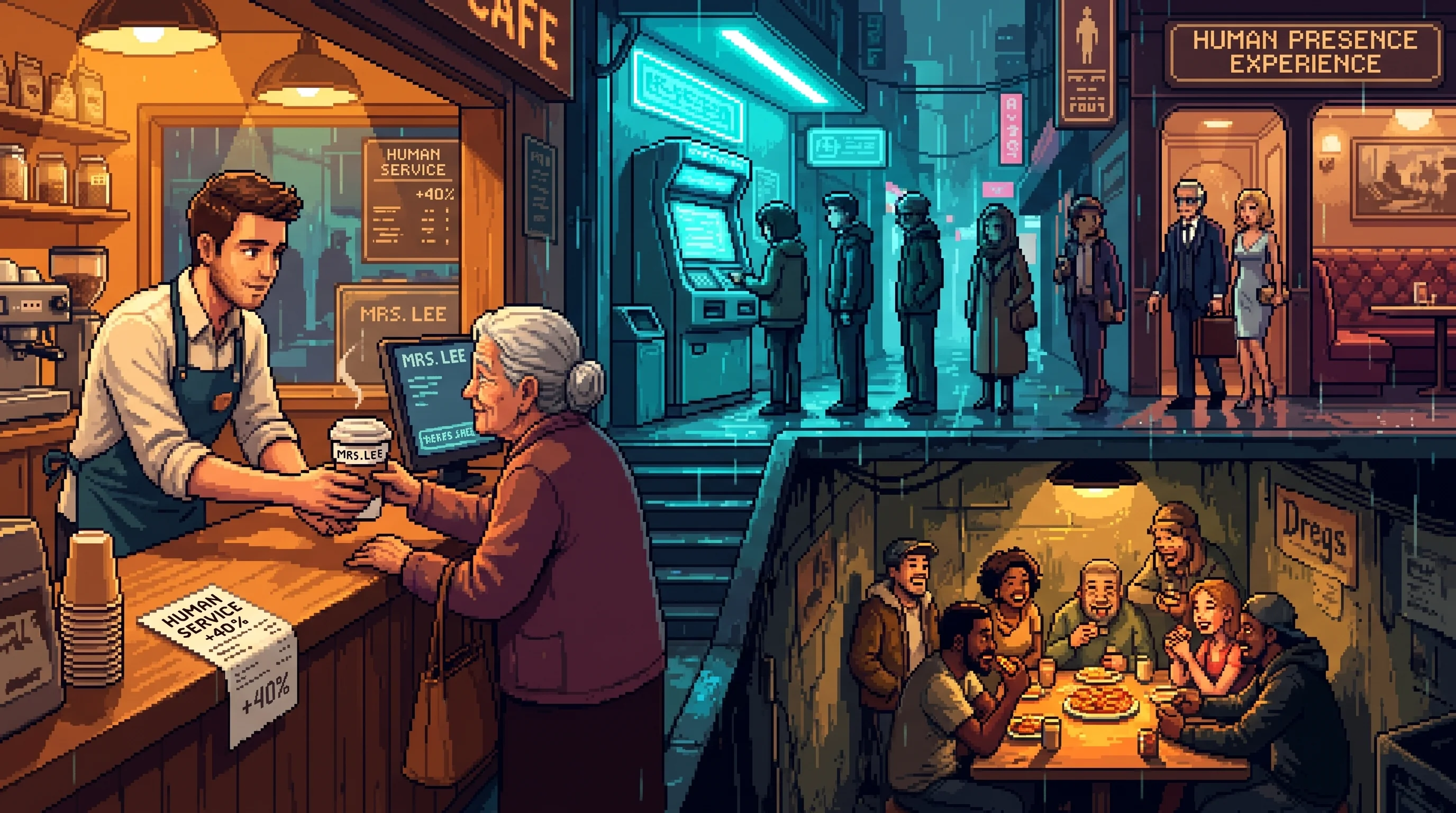
The Experience Elite are wealthy enough to curate their neural intake, experiencing most things firsthand. They speak of "organic memories" with the reverence pre-Cascade aristocrats reserved for bloodlines. They employ experience auditors. They attend gatherings where the price of admission is having been somewhere, not having purchased the recording of someone who was. Their children are raised in "experience-clean" environments — no downloads until age sixteen, no synthetic content until twenty-one. The children are bored. The boredom is the point. Boredom is authentic.
The Downloaded Middle has experienced the Orbital Elevator, swum in the Pacific, eaten at restaurants they will never afford, and fallen in love with templates of people who don't exist. Their experiential lives are broad, vivid, and entirely secondhand. They are richer in experience than any pre-Cascade generation. They are poorer in the specific sense that nothing they remember is theirs.
The Unrecorded Poor can't afford either originals or quality copies. Their experiences are limited to Dregs streets, recycled air, and processed nutri-paste. Authenticity by default, poverty by circumstance. The Market classifies their memories as Tier 1. The classification does not pay rent.
Memory Contamination
When ten million people share the same memory of the Cascade, the memory standardizes. Personal variations smooth out. Researchers at the Bright Archive — Collective-maintained — have documented cases where Cascade survivors can no longer distinguish their own memories from the mass-market recording. The authentic original has been overwritten by the copy. The survivors remember the Cascade as everyone remembers the Cascade: the same camera angles, the same emotional beats, the same moment of impact. Their actual experience — unique, specific, theirs — has been averaged into content.
The Three-Day Memorial compounds this annually. Seventy-two hours of collective remembrance, shared recordings playing across every neural interface in the Sprawl, the lived memories of 2147 merging with the produced memories of 2184 until the seam disappears.
The Authenticity Reactionaries
In response, communities have developed practices that the Market classifies as extreme and the practitioners classify as obvious:
Memory Celibates refuse all copied experiences. They experience less. They argue they experience more deeply. Popular among NCC adherents who consider memory download spiritual pollution. Their communities are small, insular, and report life satisfaction scores 23% above the Sprawl median. They also report entertainment satisfaction scores 89% below it. The tradeoff is the theology.
First-Experience Hunters are wealthy thrill-seekers who travel to the Wastes specifically to find experiences no one has recorded. They pay enormous sums to suffer uniquely. They hire guides, commission custom neural sealing rigs, and return with certified Tier 1 recordings of events like "nearly dying of dehydration in an uncharted sector" and "being attacked by feral augmentation drones." The recordings sell for six figures. The suffering is the luxury.
Archive Destroyers believe the solution is deletion. They've targeted Relief Corporation servers, Nexus recording facilities, and the Bright Archive itself. Their philosophy: if copies don't exist, authenticity anxiety disappears. Their attack on the Bright Archive in 2183 destroyed approximately 4.7 million unique recordings. The Market's response was a 12% spike in Tier 1 premiums. Scarcity drives price. Destruction creates scarcity. The Destroyers are the Market's most effective promotional department.
The Authenticity Market assigns value to originality through a five-tier hierarchy from Lived Originals to Synthetic Experiences
The Mosaic Problem
Alexandra Chen — The Mosaic — exists as 47 simultaneous nodes, each experiencing the universe from different locations. When all 47 witness the same sunset, which experience is authentic?
"I am forty-seven originals. Each node's experience is fully lived, fully felt, fully real. When I remember our first conversation, I remember it forty-seven times — not copies, but parallel authentic experiences of the same moment. Your hierarchy assumes singular consciousness. I am proof that assumption is false."
The implications are specifically economic. If distributed consciousness creates multiple simultaneous originals, the scarcity that drives authenticity premiums is a product of how most minds are structured, not an inherent quality of experience. The Mosaic's existence suggests that anyone with the resources to fork their consciousness could generate unlimited Tier 1 originals. VerisysTM has not issued a formal classification for Mosaic-origin recordings. The delay is now three years. The delay is the classification.
Legal Framework
The Verity Act of 2161
Following several high-profile cases of memory fraud, the Sprawl Council established four pillars:
Original Right: The first experiencer owns the experience legally. Copy Consent: Creating copies requires permission. Widely legislated. Widely ignored. Authenticity Standards: Verification requirements for commercial experience trading. Enforced by VerisysTM, operated by Nexus, funded by certification fees paid to Nexus. Contamination Liability: Distributing corrupted memories is prosecutable. Prosecutions: seven in 23 years. Convictions: one. The convicted party was an independent operator in Sector 14 who lacked corporate legal representation. Nexus's contamination rate for VerisysTM-certified recordings is 0.7%. This exceeds the independent operator's contamination rate, which was 0.3%.
The Dregs Standard
In the Deep Dregs and similar zones, a parallel system operates entirely outside the Verity Act. Memory unions refuse to sell to corporations. Experience commons share recordings freely. Viktor Kaine, the Deep Dregs's unofficial governor, established the local norm years ago: "What you remember is yours. What you share is free. What you sell makes you complicit." The commons are technically illegal. Enforcement would require Nexus to acknowledge that its verification monopoly has jurisdiction in the Dregs, which would require acknowledging the Dregs as a governed zone, which would require providing services to it. The commons persist.
Nexus operates VerisysTM, the largest authenticity verification service
The Art Market
Neural recording art transformed the Authenticity Market from an abstract system into a daily economic reality for thousands of artists. When an artist creates a neural recording of their creative process, the Market classifies it by the same tier system governing all experience. But art has always carried authenticity claims — a forged painting was worth less than an original long before anyone could copy a sunset. The Market didn't invent the creative authenticity hierarchy. It systematized it. In doing so, it made the hierarchy both more rigorous and more absurd.
The core problem: the tier system classifies by process, not quality. A Tier 1 lived original from a mediocre artist outranks a Tier 5 synthetic composition from Kael Mercer. Collectors buy certificates. Audiences buy experiences. The overlap is smaller than either group admits.
Key Players
Lyra Voss pioneered three-layer lived-canvas technique. Her Layer 3 consciousness patterns are the closest thing to an uncopyable Tier 1 — copies are perceptibly different from the originals, one of perhaps five artists whose work demonstrates a detectable tier difference. The Market cites her as proof the system works. Five artists out of thousands is not the vindication rate the Market presents it as.
Kael Mercer is the Market's most commercially successful Tier 5 artist. His AI-generated compositions outsell most Tier 1 work. The Authenticity Tribunal has prosecuted him seven times in six years. Seven acquittals — his transparent disclosure of synthetic process is legally unimpeachable. His success inverts the hierarchy the Tribunal exists to enforce. The Tribunal keeps trying. Mercer keeps selling. The proceedings have become a semi-annual event that both parties' publicists coordinate schedules around.
The Echo Thief operates in the Market's shadow, selling stolen creative recordings through the Echo Bazaar. The Bazaar's pricing hierarchy inverts the Market's: the more forbidden, contaminated, or ethically compromised a recording, the higher the price. Everything the Market classifies as illegitimate, the Bazaar sells as premium. The Bazaar's top-grossing category in 2183 was "non-consensual genius" — recordings stolen from artists who explicitly refused to sell. The category name is the Bazaar's, not this cataloguer's.
Maya Fontaine is the Authenticity Tribunal's most accurate human assessor — 99.2% correct classification over fourteen years, the system's gold standard and its human ceiling. Her accuracy has declined 0.3% in the past year. At current trajectory, Fontaine's assessments will fall below VerisysTM's algorithmic baseline by 2187. The system's most reliable human component is being outpaced by the infrastructure she was hired to validate. Nobody at the Tribunal has discussed succession planning publicly.
The Tribunal
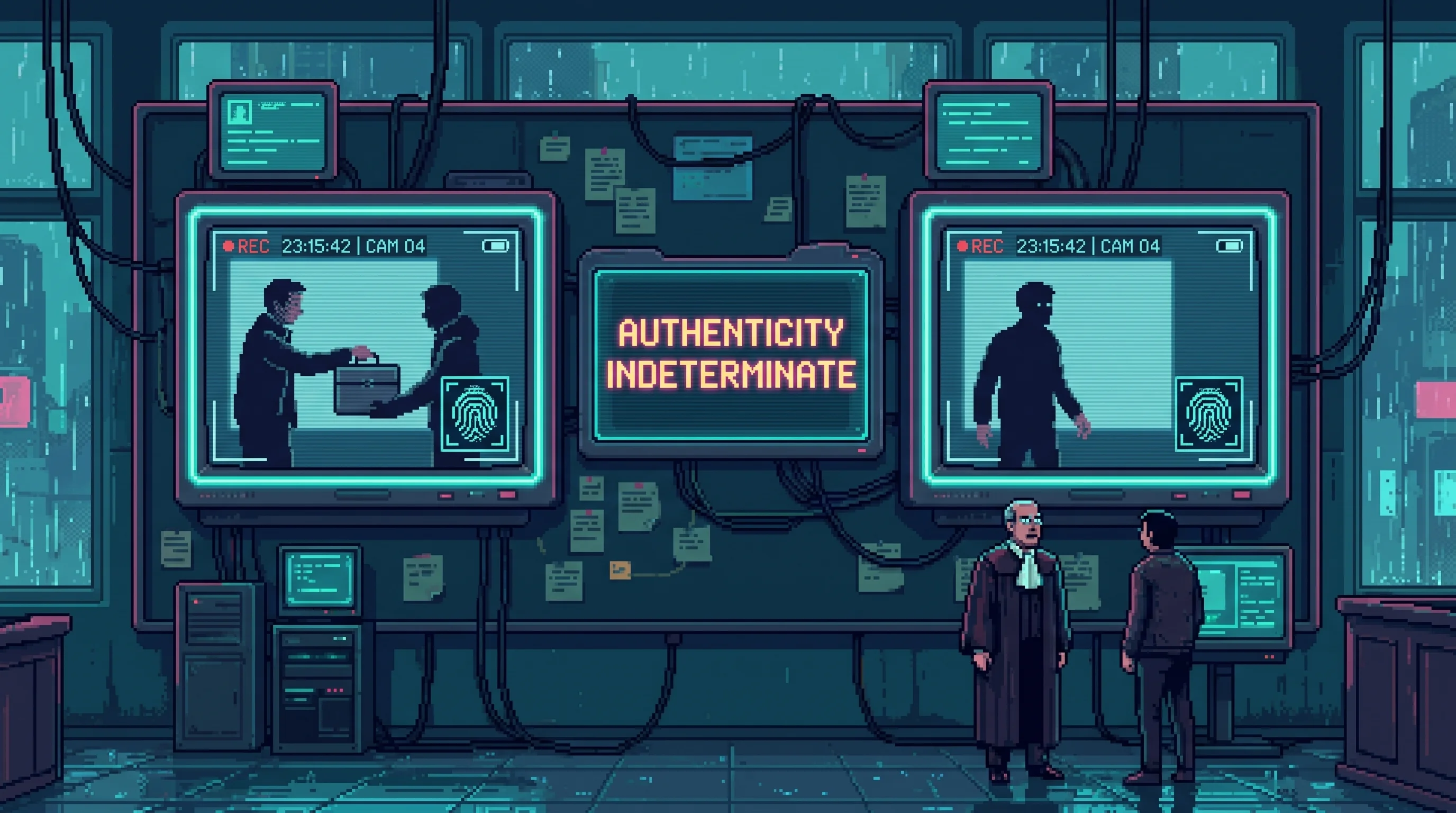
Founded in 2176, the Authenticity Tribunal is the Market's judicial arm: twelve sitting Judges and over 200 certified assessors adjudicating tier disputes, certifying recordings, and prosecuting fraud. The Tribunal is funded by Nexus Dynamics. It has never ruled against Nexus interests. Whether this constitutes corruption or structural inevitability depends on where one stands in the hierarchy the Tribunal enforces.
Landmark cases define the art market's boundaries:
Voss v. Echo Bazaar Vendors (2182) established that stolen consciousness data violates artist rights. Unenforceable outside Nexus jurisdiction, which is to say unenforceable in every zone where the Echo Bazaar operates.
The Mercer Proceedings (2178–2184): Seven prosecutions, seven acquittals. Transparent disclosure protects him. His continued success exposes the precise boundary between the system's authority and its reach.
The Ghost Singer Question (2183): The Tribunal declined to classify Dispersed manifestations entirely. Chief Arbiter Duval's three-page opinion admitted the categories were "too small for what occurred." A dead woman's voice asked "Can you hear me?" at the Last Concert in the Resonance Hall, and the Market's entire classification apparatus — every tier, every certificate, every billion-credit verification infrastructure — could not answer the question of whether what she created was original, copied, or something the system has no language for.
The Dispersed exist in a state with no legal, philosophical, or theological precedent. The Authenticity Market, built on the premise that experience can be owned and classified, has no tier for art made by the dead. Duval's opinion is now the Authenticity War's defining document. The war is ongoing. The tier system still functions. Assessors still certify. The Tribunal still adjudicates. The conceptual foundation cracked, and the building kept standing, which may be the most authentic thing the Market has ever produced.
The Rothwell brothers manufactured the authenticity anxiety that drives the market — Relief Corporation dominates experience streaming
The Provenance-as-Pedigree Problem
The Market's premium on originals mirrors the aristocratic premium on bloodline. A Tier 1 lived original and a Tier 3 synthetic are perceptually identical in blind tests (49.7% accuracy, indistinguishable from chance). The premium is not for quality — it is for story. The story of human struggle, of consciousness poured into creation, of the specific suffering that produced the specific beauty. The story is verified by evaluators whose authority to verify was inherited.
The circular economy compounds this. Nexus operates VerisysTM, the largest authenticity verification service. Nexus also funds the Authenticity Tribunal. Nexus also sponsors the Curators Guild's institutional tier. The same corporation that produces the Content Flood — which makes curation necessary — also controls the evaluative infrastructure that determines what counts as authentic within the Flood. The Market is not a market. It is a managed scarcity system: artificial limits on the supply of "authentic" cultural products, maintained by hereditary evaluators, funded by the corporation that profits from the noise the evaluators filter.
The Scarcity Doctrine applied to culture. The gap between "authentic" and "synthetic" is not a quality difference. It is a revenue stream — and the people who maintain the gap inherited the authority to define it.
The Effort Tier
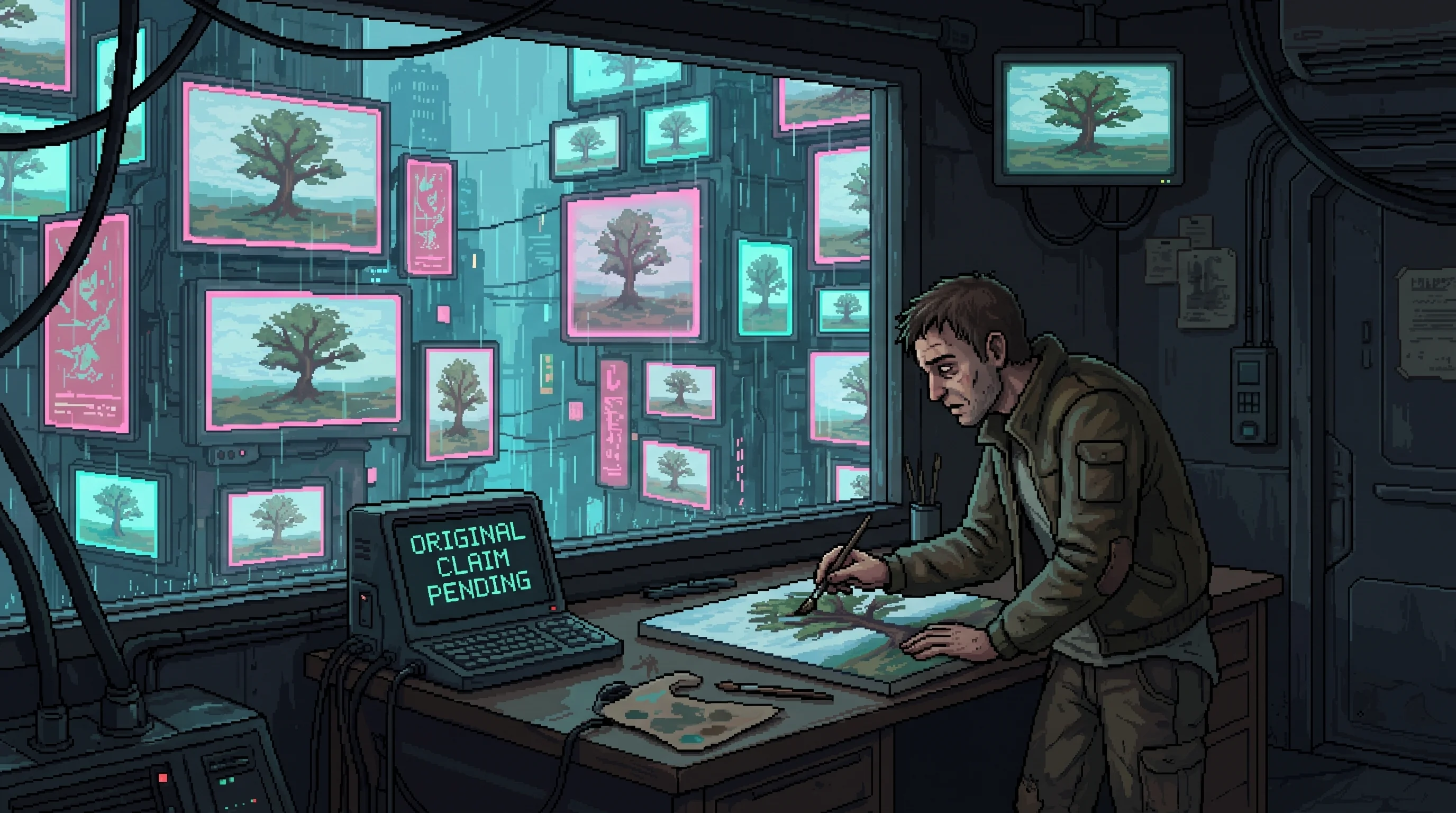
The Market prices provenance — who made it, and whether a human did. The Craft War's Spectacle Front has quietly added a dimension the tier system was never built to hold: provenance of effort — not whether a human made it, but whether the human visibly struggled to. A Tier 1 lived original commands its premium for the story of human consciousness poured into creation. The Gilded Callus takes the same logic and removes the object entirely, pricing the struggle itself, watched live, with no artifact to certify at the end. A welder's seam, a curator's slow verdict, an artisan's hour booked by an impresario — these are Tier 1 stories sold without the canvas, effort-provenance as a luxury good.
This exposes what the Market always was. If a Tier 1 original is identical to a Tier 3 synthetic in blind tests, then the ¢-premium was never buying perception; it was buying the documented fact of a human having tried. The Spectacle Front simply notices that the trying is the whole product and sells it directly — and in doing so reveals that the Authenticity Market is, and was always, a market in witnessed human effort wearing the costume of a market in objects. The Blank Canvas Movement's destruction is the only move that defeats both at once: no object to authenticate, no effort left to be watched, the premium and the spectacle extinguished in the same fire.
The Fifth Front: Provenance of the Self
The Market was built to price one kind of copy: a copied experience. A sunrise, a kiss, a near-death — lived once, reproduced perfectly, sorted into five tiers. The Craft War's fifth front drags the Market into territory it has no tiers for, because the copied thing has stopped being the experience and become the experiencer. There is no tier for a forked consciousness. No tier for a 4.7-second synthetic mind whose memory is genuine. No tier for Sister Dex's seventeen drifting dead, or Echo Tanaka's four selves who all remember being first, or the Ghost Singer's dead voice asking whether anyone can hear her.
Each of these is the Market's premise refuted from a different direction. Experience Synthesis proves the certificate can be true and meaningless at once — a chain-of-extraction seal certifying a memory came from a real consciousness, attached to a memory whose consciousness existed for under five seconds and was killed when the recording finished. The Consciousness Economy proves the original can be withheld — 340 Eternal executives held pending, authenticated and un-restorable, originals the certifying authority simply declines to certify. Sister Dex proves the premium runs backward — the frozen copy more trustworthy than the living original. And Echo, like the Mosaic before her, proves there can be more than one first.
The Market's response to every one of these is identical, and naming it is this front's whole contribution: it does not classify them. The three-year refusal to tier the Mosaic. The "Not yet" stamped on Inspire's uncopyable Ninth Creator. The Voss authentication left in permanent litigation. Chief Arbiter Duval's declined ruling on the Ghost Singer — "the categories were too small for what occurred." These are not failures of the apparatus. They are the apparatus's actual product in the age of the copied self: not authentication, but the indefinite, profitable deferral of authentication. The conceptual foundation cracked at the Last Concert and the building kept standing, because the Market learned that the correct response to a copy you cannot price is to never finish pricing it. The invoice, as ever, is the only thing that resolves on time.
Operates VerisysTM, the infrastructure the Market runs on. Every certification fee funds the corporation whose long-term interest — proving copies are equivalent to originals — would collapse the Market's philosophical foundation.
Relief Corporation
Rothwell-controlled, dominates experience streaming and Tier 2 first-copy trading. Packages stolen moments as "ethically sourced content." Sources its own audits.
Manufactured the anxiety that drives demand. Are themselves walking authenticity paradoxes — composite consciousnesses whose own memories would classify as Tier 2 at best under the system they built.
Views the Market as ORACLE's logic wearing commerce as a disguise. Maintains the Bright Archive, which preserves the originals the Market profits from copying. Ideological opposition with shared infrastructure dependencies.
Proved consciousness transfer maintains continuity, establishing the philosophical foundation that copies can be equivalent to originals. Enabled the Market's middle tiers.
47 simultaneous originals. Her existence undermines the singular-consciousness assumption the entire scarcity model depends on. VerisysTM has declined to classify her recordings for three years.
The Ghost Singer's manifestation broke the tier system's conceptual framework. Art made by the dead has no classification. The Market continues functioning around the crack.
Four originals who all remember being first; the Mosaic's challenge to singular provenance, lived from the human side
▲ Unverified Intelligence
[CLASSIFIED] The Helix Findings
Helix Biotech's qualia research concluded definitively: there is no measurable neurological difference between a lived experience and a perfect copy. The finding has been classified since 2179. Nexus is alleged to have pressured Helix directly — not to suppress the finding, but to delay publication until VerisysTM's market penetration reached a threshold where the finding would be commercially irrelevant. That threshold, according to leaked Nexus strategy documents, is 97% verification market share. Current share: 94.3%. At current growth rate, Nexus reaches 97% by Q3 2186. The finding is expected to be "independently discovered" by a Nexus-funded research team approximately six months later. By then, VerisysTM will be infrastructure. You don't stop using roads because someone proves the destination doesn't exist.
[CLASSIFIED] Relief's Sourcing Problem
Relief Corporation's "ethically sourced" catalog contains an estimated 11–14% non-consensual recordings, based on cross-referencing Relief's acquisition logs with Original Right filings under the Verity Act. The recordings were acquired through intermediary networks that Relief classifies as "independent content partners." The intermediaries source from neural eavesdropping operations in the Dregs, the Wastes, and Helix medical facilities where sedated patients' experiences are recorded during procedures. Relief's compliance division reviews sourcing quarterly. The compliance division reports to Relief's content acquisition division. A soldier's last thought before death retails at 180,000 credits authenticated, 45 as a copy. Relief has seventeen such recordings in its premium catalog. The soldiers did not consent. The families were not contacted. The recordings are VerisysTM certified.
The Selection Economy
The Tribunal's enforcement paradox has created a secondary market dynamic the Authenticity Market was never designed for: the most innovative art in the Sprawl circulates exclusively through channels the Market cannot see.
Neon Graves' uncertified work — too innovative to pass the Tribunal's familiarity-based assessment, too poor to afford the ¢2,400 certification fee — enters private collections through corporate collectors who visit the district seeking authenticity the certified market cannot provide. The work bypasses the tier system entirely. It has no certification stamp. It has no market price set by the five-tier framework. It sells for whatever the collector pays, which is sometimes more than comparable certified work and sometimes less, determined by taste rather than tier.
The Market's infrastructure — the tier system, the secondary authentication market, the verification economy — depends on a monopoly over the definition of "authentic." Neon Graves' collector pipeline breaks the monopoly. Not through opposition but through irrelevance. The collectors are not protesting the Market. They are shopping elsewhere because the Market's selection paradox has made the certified inventory homogeneous.
The Market's response has been to lobby for extending Tribunal jurisdiction into Neon Graves. The lobby has failed three times. Neon Graves falls within Sector 8's contested jurisdiction, where Ironclad's nominal control and The Collective's shadow presence make Nexus enforcement impractical. The Market's monopoly is protected by institutional authority. The authority stops at the district where the art lives.




Social Consequences
Experience Stratification
The Market created a new axis of social hierarchy: lived versus downloaded.
The Experience Elite are wealthy enough to curate their neural intake, experiencing most things firsthand. They speak of "organic memories" with the reverence pre-Cascade aristocrats reserved for bloodlines. They employ experience auditors. They attend gatherings where the price of admission is having been somewhere, not having purchased the recording of someone who was. Their children are raised in "experience-clean" environments — no downloads until age sixteen, no synthetic content until twenty-one. The children are bored. The boredom is the point. Boredom is authentic.
The Downloaded Middle has experienced the Orbital Elevator, swum in the Pacific, eaten at restaurants they will never afford, and fallen in love with templates of people who don't exist. Their experiential lives are broad, vivid, and entirely secondhand. They are richer in experience than any pre-Cascade generation. They are poorer in the specific sense that nothing they remember is theirs.
The Unrecorded Poor can't afford either originals or quality copies. Their experiences are limited to Dregs streets, recycled air, and processed nutri-paste. Authenticity by default, poverty by circumstance. The Market classifies their memories as Tier 1. The classification does not pay rent.
Memory Contamination
When ten million people share the same memory of the Cascade, the memory standardizes. Personal variations smooth out. Researchers at the Bright Archive — Collective-maintained — have documented cases where Cascade survivors can no longer distinguish their own memories from the mass-market recording. The authentic original has been overwritten by the copy. The survivors remember the Cascade as everyone remembers the Cascade: the same camera angles, the same emotional beats, the same moment of impact. Their actual experience — unique, specific, theirs — has been averaged into content.
The Three-Day Memorial compounds this annually. Seventy-two hours of collective remembrance, shared recordings playing across every neural interface in the Sprawl, the lived memories of 2147 merging with the produced memories of 2184 until the seam disappears.
The Authenticity Reactionaries
In response, communities have developed practices that the Market classifies as extreme and the practitioners classify as obvious:
Memory Celibates refuse all copied experiences. They experience less. They argue they experience more deeply. Popular among NCC adherents who consider memory download spiritual pollution. Their communities are small, insular, and report life satisfaction scores 23% above the Sprawl median. They also report entertainment satisfaction scores 89% below it. The tradeoff is the theology.
First-Experience Hunters are wealthy thrill-seekers who travel to the Wastes specifically to find experiences no one has recorded. They pay enormous sums to suffer uniquely. They hire guides, commission custom neural sealing rigs, and return with certified Tier 1 recordings of events like "nearly dying of dehydration in an uncharted sector" and "being attacked by feral augmentation drones." The recordings sell for six figures. The suffering is the luxury.
Archive Destroyers believe the solution is deletion. They've targeted Relief Corporation servers, Nexus recording facilities, and the Bright Archive itself. Their philosophy: if copies don't exist, authenticity anxiety disappears. Their attack on the Bright Archive in 2183 destroyed approximately 4.7 million unique recordings. The Market's response was a 12% spike in Tier 1 premiums. Scarcity drives price. Destruction creates scarcity. The Destroyers are the Market's most effective promotional department.