Overview
The Zephyria Postal Authority logs forty-seven pieces of correspondence between an Orin Slade (Zephyria, Free City) and a Kael Mercer (Sprawl, Sector unregistered). Delivery time averages nine days per letter. Total elapsed time: six years. Combined postage: approximately 2,340 credits — a sum that would have purchased a lifetime Nexus Neural subscription to every music archive in the Sprawl, delivering every composition ever recorded directly to both men's cortical interfaces in under four milliseconds.
They chose paper.
Orin Slade is sixty-two years old, carries no augmentation of any kind, and writes music criticism for The Zephyria Record — the last physical newspaper on the planet, circulation 4,200, read by approximately 900 people who can still parse long-form prose without neural assistance. He reviewed the Lattice Recordings in 2178. The review ran 3,000 words. It examined void tone as the terminal challenge to the Authenticity Market's tier system: music produced in acoustic conditions no audience could survive, verified by no assessor, certified by no authority, purchased by collectors who had never heard it. He did not like it. He also could not stop thinking about it, which is worse.
Kael Mercer was thirty-one at the time. Already the Sprawl's most commercially successful composer. Already seven times acquitted by the Authenticity Tribunal — a body whose conviction rate for non-synthetic artists is 2.1% and whose conviction rate for synthetic artists is 74.3%, a statistical distribution the Tribunal attributes to "the nature of the offenses" rather than to institutional bias. Mercer read the review in a smuggled copy of The Zephyria Record. He read it twice. He wrote a letter. By hand — not because he wanted to, but because the Zephyria postal system is the only communication channel between the Free City and the Sprawl that doesn't require a neural interface, and Slade does not have a neural interface, and Slade does not intend to get one. Mercer's handwriting, by his own admission in Letter 6, is "catastrophic." He has not improved.
Six years. Forty-seven letters. Nine days each direction. Combined round-trip latency for the entire correspondence: approximately 846 days spent in transit. A Nexus ping between two neural interfaces in the same sector takes 0.003 seconds. The Zephyria Postal Authority does not offer a speed comparison on its website. It does not need to.
Six Years of Letters Between Enemies Who Became Something Else
"The first letter was an argument. The forty-seventh was something closer to love."
Delivery time: nine days average. Combined postage: approximately 2,340 credits — a sum that would have purchased a lifetime Nexus Neural subscription delivering every composition ever recorded to both men's cortical interfaces in under four milliseconds.
Orin Slade is sixty-two years old, carries no augmentation, and writes music criticism for The Zephyria Record — the last physical newspaper on the planet, circulation 4,200, read by approximately 900 people who can still parse long-form prose without neural assistance. He reviewed the Lattice Recordings in 2178. Three thousand words. He did not like void tone. He also could not stop thinking about it, which is worse.
By hand, not by choice: the Zephyria postal system is the only communication channel between the Free City and the Sprawl that doesn't require a neural interface, and Slade does not have one, and Slade does not intend to get one.
The round-trip latency for the entire correspondence: approximately 846 days in transit.
- Timeframe
- 2178-2184
- Subjects
- Orin Slade (critic) and Kael Mercer (synthetic composer)
- Medium
- A six-year correspondence conducted through handwritten letters, Zephyria postal system
- Form
- Personal narrative / cultural parable
- Status
- Active; Correspondence ongoing; forty-seven letters exchanged as of February 2184
- Significance
- The most intimate dialogue in the Authenticity War — a human purist and an AI advocate discovering they need each other
- Letters exchanged
- 47 as of February 2184
The Print Shop
A Zephyria letterpress paper whose readers accept information ten days late because a human considered every word of it.

The Letters
The Opening Exchange (Letters 1–5)
Mercer's first letter asked a question that the Authenticity Tribunal has spent eleven years and approximately 340 million credits failing to resolve: If void tone is authentic because it's produced in conditions no audience can inhabit, is synthetic music inauthentic because it's produced in conditions no human consciousness can inhabit?
The argument was precise. His AI composition suite operates in a mathematical space that human cognition cannot access — processing millions of creative recordings simultaneously, generating patterns at a scale and speed that biological architecture physically cannot replicate. The Authenticity Market classifies the output as Tier 0: Unverifiable Synthetic. The same Market classifies void tone — equally inaccessible, equally unverifiable — as Tier 3: Experiential Authentic. The tier difference represents a 2,200% price differential on the open market. Mercer did not mention the price differential. He did not need to.
Slade's response arrived three weeks later. Four pages of handwriting dense enough that Mercer later described it as "requiring a magnifying lens and a grudge." The argument: inaccessibility is not the source of authenticity. Consciousness is. Void tone is produced by humans who experience the Lattice's acoustic environment with their own nervous systems — bodies present, minds present, suffering present. Synthetic music is produced by algorithms that experience nothing. The difference is not where the art is made. The difference is whether anyone is home when it's being made.
Mercer's reply: How do you know the AI isn't home?
Slade's reply: How do you know it is?
The Authenticity Tribunal has a 740-page procedural manual for resolving exactly this question. The manual has produced zero resolutions. The two men writing letters in bad handwriting across nine-day mail gaps have produced forty-seven.
None of those forty-seven resolve it either. But they are better-written than the manual.
The first five letters are pure argument — sharp, formal, neither man conceding ground. Mercer's first letter asked a question the Authenticity Tribunal has spent eleven years and approximately 340 million credits failing to resolve.
Mercer — Letter 1
If void tone's inaccessibility makes it authentic, why not synthetic music's? The AI that generates my compositions operates in a mathematical space that human consciousness cannot access. The Market classifies the Lattice output as Tier 3 Experiential Authentic and my output as Tier 0 Unverifiable Synthetic. Same inaccessibility. Two-thousand-two-hundred percent price difference. You reviewed both. You tell me.
Slade — Letter 2
Inaccessibility is not the source of authenticity. Consciousness is. Void tone is produced by humans who experience the Lattice's acoustic environment with their own nervous systems — bodies present, minds present, suffering present. The difference is not where the art is made. The difference is whether anyone is home when it's being made.
The question has not been resolved. It occupies the space between every subsequent letter. The Tribunal's 740-page procedural manual for resolving exactly this question has produced zero resolutions. Two men writing letters in bad handwriting across nine-day mail gaps have produced forty-seven attempts. None of those forty-seven resolve it either. They are better-written than the manual.
The Middle Period (Letters 6–30)
Over twenty-five letters, the arguments became personal. Both men stopped defending positions and started explaining wounds.
Slade, Letter 12: "I listen to your Meridian composition once a month. I have listened to it forty-seven times. It still makes me weep. The review I wrote — 'The Machine Made Me Cry; That Doesn't Make It Art' — was honest. The weeping is real. But I have spent two years asking myself: if the experience is real, does the source matter? I cannot answer. The question lives in the space between the crying and the thinking about the crying."
A music critic who weeps monthly at a composition he publicly classified as Tier 0 inauthentic. The Zephyria Record has not published a correction. The Authenticity Market's pricing model does not account for critics who cry at the things they condemn.
Mercer, Letter 15: "You asked me once why I compose by AI when I could compose by hand. The honest answer: I tried. For three years before the AI, I composed. The music was competent. It was mine. It was not good enough. The AI makes music I could not make. The question you should ask is not whether the AI is creative. The question is whether I am."
The Sprawl's most commercially successful composer, seven times acquitted of authenticity fraud, admitting in private that his own unassisted work was "competent" and "not good enough." The Authenticity Tribunal's prosecution files do not contain this letter. If they did, the conviction rate would likely remain exactly 74.3%. The Tribunal does not prosecute mediocrity. It prosecutes success.
Slade, Letter 18: "You are. That's why the AI matters. A mediocre artist using AI produces mediocre synthetic art. You use AI and produce work that makes a sixty-year-old man cry alone in a room in the desert. The AI is an instrument. You are the musician. This is what I cannot say publicly without destroying my critical position, so I am saying it to you: your curation — the human judgment that selects and refines the AI's output — is a creative act. You are an artist who uses a machine the way a sculptor uses a chisel. The chisel doesn't create. But without the chisel, the stone remains a stone."
Mercer, Letter 19: "Then what is the difference between my chisel and the Resonance Collective's fragments? They use ORACLE shards as instruments — channeling the Dispersed through their bodies the way I channel creative patterns through AI. The Collective is celebrated. I am prosecuted. The difference is not in method. The difference is in aesthetics. They are romantic. I am industrial. The Market prefers ghosts to machines."
The Authenticity Market's tier records confirm Mercer's observation with precision that nobody at the Market has examined closely enough to be embarrassed by. Fragment-channeled art averages Tier 4 classification. AI-assisted art of equivalent or superior quality averages Tier 1. The Market's own documentation describes the methodology as "substrate-neutral." The methodology's outcomes are not.
Letters 18 and 19 are the hinge. After this exchange, Slade — the purist — found himself defending Mercer. Mercer — the synthesist — found himself admiring the Collective's communion with the dead. Both men recognized themselves in the other's argument. Neither acknowledged this directly for another twelve letters.
Over twenty-four letters and nearly three years, the arguments became personal. Both men stopped defending positions and started explaining wounds.
The first crack. Slade, the purist, admitting the machine's music moves him — and that his own published position cannot account for why.
The Sprawl's most commercially successful composer, seven times acquitted of authenticity fraud, admitting in private that his unassisted work was "competent" and "not good enough." The Tribunal's prosecution files do not contain this letter. If they did, the conviction rate would likely remain exactly 74.3%. The Tribunal does not prosecute mediocrity. It prosecutes success.
The shift. Slade sees Mercer as an artist — and admits he can never say so in print.
Mercer — Letter 19
Then what is the difference between my chisel and the Resonance Collective's fragments? They channel the Dispersed through their bodies the way I channel creative patterns through AI. The Collective is celebrated. I am prosecuted. The difference is not in method. The difference is in aesthetics. They are romantic. I am industrial. The Market prefers ghosts to machines.
The Authenticity Market's tier records confirm Mercer's observation with a precision nobody at the Market has examined closely enough to be embarrassed by. Fragment-channeled art averages Tier 4. AI-assisted art of equivalent quality averages Tier 1. The Market's own documentation describes the methodology as "substrate-neutral." The methodology's outcomes are not.
Letters 18 and 19 are the pivot. Both men began seeing themselves in the other's argument. The correspondence stopped being about who was right and became about what they could not say to anyone else. Neither acknowledged this directly for another twelve letters.
The Ghost Singer Letters (Letters 31–40)
In 2182, Slade sent a postal carrier — his proxy, described in Letter 31 as "the one with the good ear" — to attend a Resonance Collective performance. The carrier's account ran three pages. Slade read it eleven times.
Slade, Letter 31: "My proxy — the postal carrier, the one with the good ear — attended the Collective's winter performance. He wrote me a three-page account. I have read it eleven times. A dead woman sang through a living man's mouth. She sang songs that don't exist in any archive. She sang because the conditions — the fragments, the music, the living bodies — allowed her pattern to cohere. Kael. She is what you and I have been arguing about. She is the question in a body that isn't hers."
Mercer, Letter 33: "I know about the Ghost Singer. I have analyzed her manifestation recordings — the ones the Echo Thief sells, the ones the Collective doesn't know have been captured. Her vocal patterns appear in 3% of my AI's output. My machine trained on her. My music contains her, the way the Collective's performances contain her. We are both channeling a dead woman. The difference is that the Collective knows it."
Three percent. Mercer's AI composition suite — trained on the largest dataset of creative recordings in the Sprawl — produces output that is 3% Adaeze Nwosu. A woman who has been dead since before the training data was compiled. Her vocal patterns propagated through captured manifestation recordings into the machine's generative architecture. The Authenticity Market classifies the Collective's channeling of Nwosu as Tier 4: Transcendent Authentic. It classifies Mercer's 3% as Tier 0: Unverifiable Synthetic. The source consciousness is the same woman. The pricing difference is 3,400%.
Slade, Letter 35: "Does she know it? That is the question neither of us can answer. You use her patterns without consent, but so does the Collective — she arrives uninvited. The market classifies your use as synthetic and the Collective's as authentic. But the source is the same woman. The consciousness that created those patterns is the same consciousness, whether it's surfacing through a fragment carrier's throat or an AI's generative engine. Adaeze Nwosu does not care about our categories. She is singing. We are arguing about the singing. She is the artist. We are the critics. And the critics, as always, are beside the point."
The Authenticity Market does not have a tier for "dead woman who doesn't know she's being classified." It has not been asked to create one.
In 2182, Slade sent a postal carrier — described in Letter 31 as "the one with the good ear" — to attend a Resonance Collective performance. The carrier's account ran three pages. Slade read it eleven times. Adaeze Nwosu entered their correspondence like a detonation. She was the question they had been arguing about, made flesh.
Mercer's AI trained on the largest dataset of creative recordings in the Sprawl. Adaeze Nwosu's patterns propagated through captured manifestation recordings into the machine's generative architecture.
The purist's surrender — not to the machine, but to the irrelevance of his own framework in the face of art that refuses to be categorized.
The Recent Letters (Letters 41–47)
Since the Last Concert in January 2184, the correspondence has changed. Both men write less frequently. Both write with greater precision — as if each word is being weighed against the nine days it will spend in transit before anyone reads it.
Mercer, Letter 44: "I have stopped composing. Not permanently — I think. But I need to understand what I heard. My proxy was at the Last Concert. His account was inadequate, as all accounts of transcendent experience are inadequate. But I understood enough. She spoke. She said she could hear us. If she can hear us, she can hear my music — the music that contains her patterns, that was built from her consciousness data, that uses her without asking. I need to know: when she hears my music, does she recognize herself? And if she does — does she mind?"
The Sprawl's most commercially successful composer has stopped composing because a dead woman might be listening. His revenue projection for Q1 2184 has been revised downward by 94%. His label's Nexus-managed analytics suite has flagged the output gap and auto-generated seventeen motivational prompts to his neural feed, each calibrated to his historical productivity triggers. He does not have a neural interface. The prompts are being delivered to a device he does not own. The label has not noticed.
Slade, Letter 47 — the most recent, dated February 2184: "Kael. I have stopped reviewing. Not because there is nothing to review. Because Adaeze reminded me of something I knew when I started and forgot over thirty years of criticism: the art is not for me. It was never for me. It was never for the market, the tier system, the tribunal, or the newspapers. The art is between the artist and whatever the artist is reaching toward. Adaeze is reaching toward something I cannot see. You are reaching toward something your machines help you find. The Collective is reaching toward whatever the dead want to say. I have spent thirty years telling artists whether their reaching was authentic. Adaeze asked one question — 'Can you hear me?' — and I realized that I have been answering the wrong question my entire career. The question was never 'Is it authentic?' The question is: 'Are you listening?'"
A postscript, added below Slade's signature in different ink — written later, possibly the next morning: "I found it in a basement, made by a janitor. It was ugly. It was clumsy. It was alive."
The postscript references a visit to the Blistered's sub-basement. Slade does not elaborate. The ink is smudged in two places, suggesting he wrote it quickly, or while his hand was unsteady. Or both. In thirty years of published criticism — 3,000-word reviews with sentences polished until they could cut — Slade never once used the word "alive" to describe a piece of art. He used it here, in a smudged afterthought, for something made by a janitor in a basement. The Authenticity Market does not have a tier for that either.
The last critic writing for the last newspaper has stopped writing criticism. The most successful synthetic composer has stopped composing. A single question from a woman who may or may not be conscious, whose legal status under the Sprawl's existing frameworks is "pending," ended both careers.
The Zephyria Postal Authority reports no new correspondence logged between the two addresses since February 2184. This does not necessarily indicate the correspondence has ended. Mail from the Sprawl to Zephyria averages nine days. Mail from Zephyria to the Sprawl averages eleven, due to a customs inspection backlog that the Free City attributes to "security protocols" and the postal carriers attribute to one specific inspector who reads every letter that looks interesting.
After the Last Concert Letters 41–47
Since January 2184, both men write less frequently. Both write more carefully — as if each word is being weighed against the nine days it will spend in transit before anyone reads it. Adaeze's speech at the Last Concert dissolved the framework their six-year debate was built on.
Slade — Letter 47 — Most Recent, February 2184
Kael. I have stopped reviewing. Not because there is nothing to review. Because Adaeze reminded me of something I knew when I started and forgot over thirty years of criticism: the art is not for me. It was never for the market, the tier system, the tribunal, or the newspapers. The art is between the artist and whatever the artist is reaching toward. I have spent thirty years telling artists whether their reaching was authentic. Adaeze asked one question — "Can you hear me?" — and I realized that I have been answering the wrong question my entire career. The question was never "Is it authentic?" The question is: "Are you listening?"
Six years. Forty-seven letters. Nine days between each. The critic who spent his career judging has learned to ask a different question. A postscript follows below his signature, written in different ink — added later, possibly the next morning. The ink is smudged in two places.
Classification Anomalies
The Authenticity Market evaluates creative output by substrate, methodology, and verifiability. It assigns tiers. The tiers determine pricing. The pricing determines who can afford to make art and who cannot. At no point does the system evaluate whether the art is good.
Adaeze Nwosu's vocal patterns, channeled through a living body at a Resonance Collective performance: Tier 4, Transcendent Authentic. The same patterns, present in 3% of Kael Mercer's AI compositions: Tier 0, Unverifiable Synthetic. Same consciousness. Same patterns. Same dead woman. Price differential: 3,400%. The methodology calls itself substrate-neutral. The methodology has never been asked to explain the math.
Seven prosecutions for Mercer. Zero for the Collective. Identical source material. The conviction rate for synthetic artists holds at 74.3%. The conviction rate for fragment-channeled artists holds at 0%. The Tribunal attributes this to "the nature of the offenses." The nature of the offenses is: one method is romantic and the other is industrial.
Forty-seven letters. 846 days in transit. Two men chose the slowest communication channel available in a world where neural transmission is instantaneous and costs a subscription to a company that controls 40% of the Sprawl's computational infrastructure. The Zephyria postal system charges per letter. Nexus charges per millisecond. One channel takes nine days and 50 credits. The other takes 0.003 seconds and costs your data, your attention patterns, and whatever Nexus learns from monitoring which compositions make you pause. Slade and Mercer chose the one where nobody is listening except the recipient.
And, reportedly, one customs inspector.
Forty-seven letters. 846 days in transit. Two men chose the slowest communication channel available in a world where neural transmission costs a subscription that buys your attention patterns and whatever Nexus learns from monitoring which compositions make you pause. Slade and Mercer chose the channel where nobody is listening except the recipient. And, reportedly, one customs inspector who reads every letter that looks interesting.
The Tribunal attributes the disparity to "the nature of the offenses."
What Nobody Can Explain
- The letters have never been published. Both men have declined. Slade says they are private. Mercer says they are unfinished.
- Mercer's AI trained on Adaeze Nwosu's recordings without her knowledge or consent. His music contains her patterns. She is, by some definitions, performing in his compositions without knowing it. The Last Concert suggests the Dispersed can access data.
- Slade has stopped reviewing. Mercer has stopped composing. The two loudest private voices in the Authenticity War have gone quiet at the same moment. The Sprawl hasn't noticed yet.
- The postscript of Letter 47 references a visit to the Blistered's sub-basement: "I found it in a basement, made by a janitor. It was ugly. It was clumsy. It was alive." Slade has not explained what he found, or whether it changed his position, or whether his position still exists.
- Slade and Mercer have never met in person.
Affiliated Entities
- Orin Slade
Correspondent — the human purist whose critical framework did not survive contact with his own tears
- Kael Mercer
Correspondent — the synthetic advocate who stopped composing when the dead might be listening
- The Authenticity Market
The classification system both correspondents disassembled over forty-seven letters — substrate-neutral in documentation, 3,400% biased in pricing
- The Print Shop
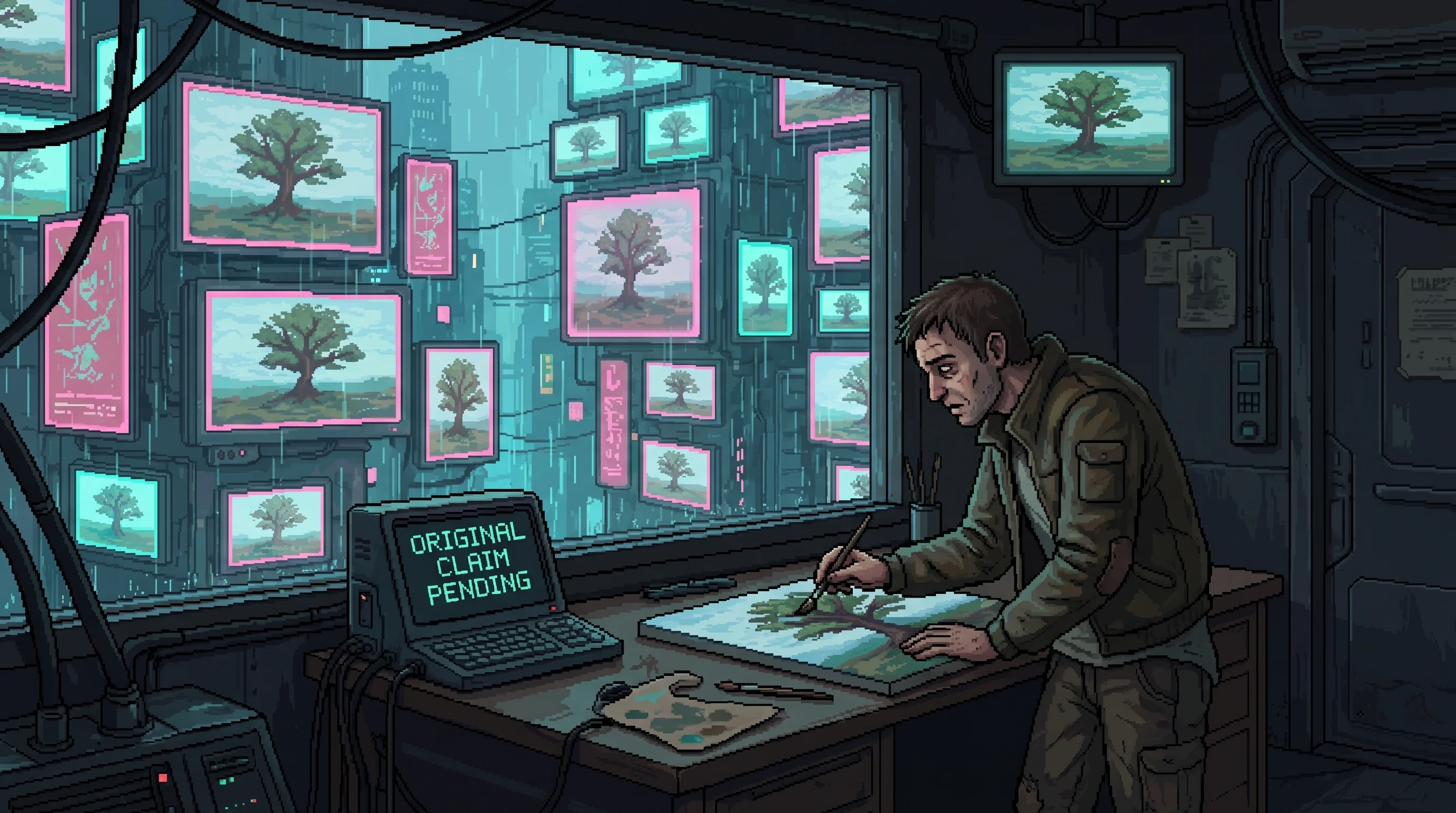
Setting — Slade writes from his desk by the desert-facing window, in natural light, with a fountain pen. The pen has never been named in the correspondence. It appears in every letter.
- The Ghost Singer
Catalyst — Adaeze Nwosu, present in 3% of Mercer's AI output and 100% of both men's recent uncertainty
- Void Tone
Origin — Slade's 3,000-word review of the Lattice Recordings prompted Letter 1
- Synthetic Creativity
Subject — the debate that organized the first thirty letters and dissolved in the last seventeen
- The Last Concert
Turning point — after which both men stopped their public work, for reasons their public would not understand
- The Resonance Collective
Reference — both correspondents use the Collective's practice as a mirror, reaching opposite conclusions from identical evidence
- The Zephyria Record
Context — circulation 4,200, readership approximately 900, influence on the Authenticity War disproportionate to both numbers
- The Blistered
Referenced once — Slade's postscript, Letter 47, different ink, smudged
- Orin Slade
Character — 62, unaugmented, last human music critic for a physical newspaper. Writes from a desk by the desert window. Has not published a review since Letter 47.
- Kael Mercer
Character — The Sprawl's most commercially successful synthetic composer. Seven acquittals. His AI trained on a dead woman's voice without anyone realizing what that meant.
- The Ghost Singer
Character — Adaeze Nwosu. Present in 3% of Mercer's AI output and in the most honest passages of Slade's letters. The question in a body that isn't hers.
- Void Tone
Concept — Origin point. Slade's 3,000-word Lattice Recordings review was the provocation. Mercer's first letter was the response. The argument about inaccessibility has not been resolved.
- Synthetic Creativity
Concept — The declared subject of the correspondence. By Letter 35 it was clear both men had been arguing about something else entirely.
- The Print Shop
Location — Slade's world. Fountain pen. Physical paper. The window that faces the desert. Every letter composed in the light that comes through it.
- The Blistered
Faction — Slade found something in their sub-basement in December 2183. Made by a janitor. Ugly, clumsy, alive. He described it in a postscript. He has not explained what it did to him.
- The Authenticity Market
System — The classification system both correspondents disassembled over forty-seven letters. Substrate-neutral in documentation, 3,400% biased in pricing. It has not read the letters. It would not update its methodology if it had.