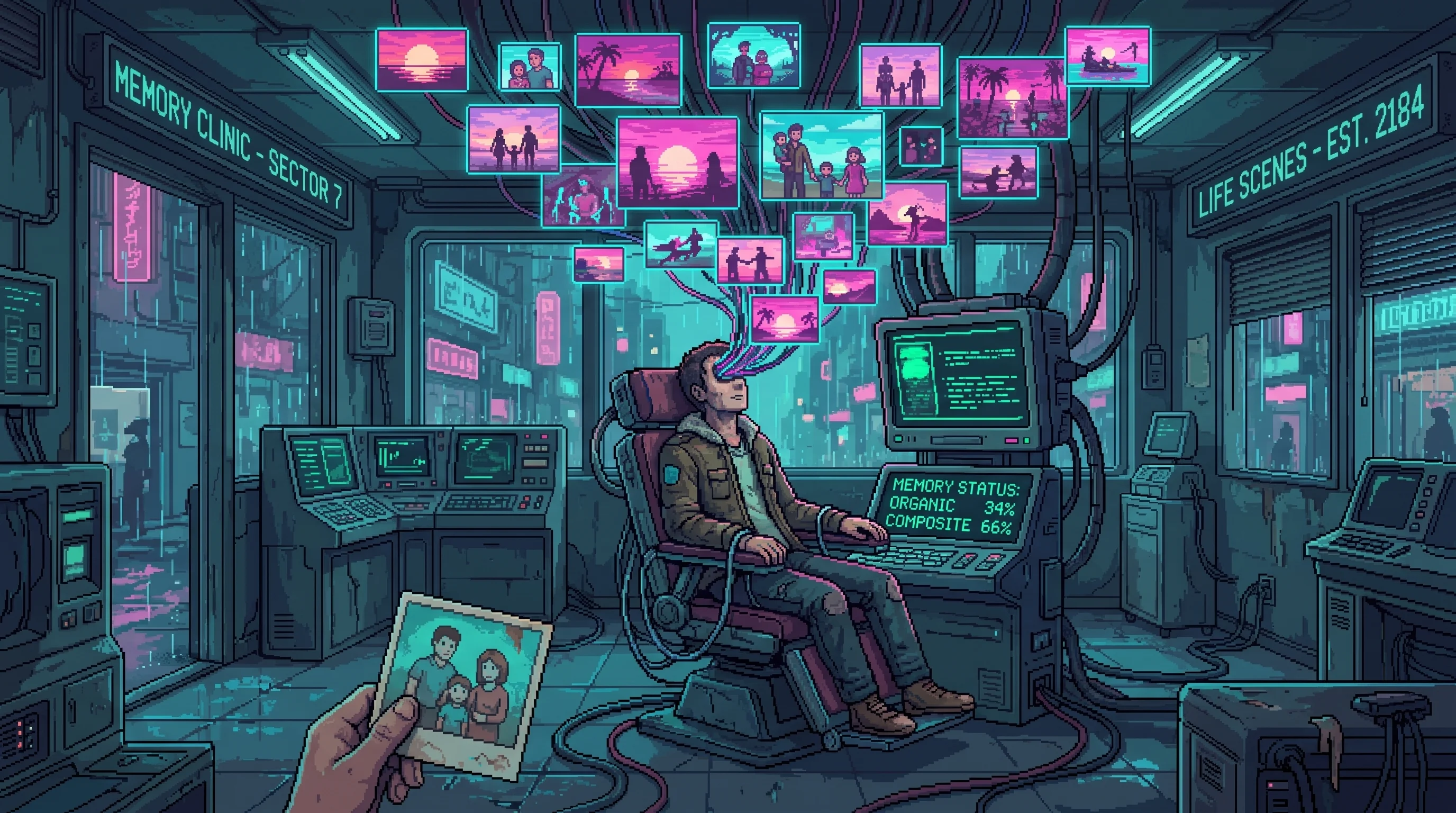
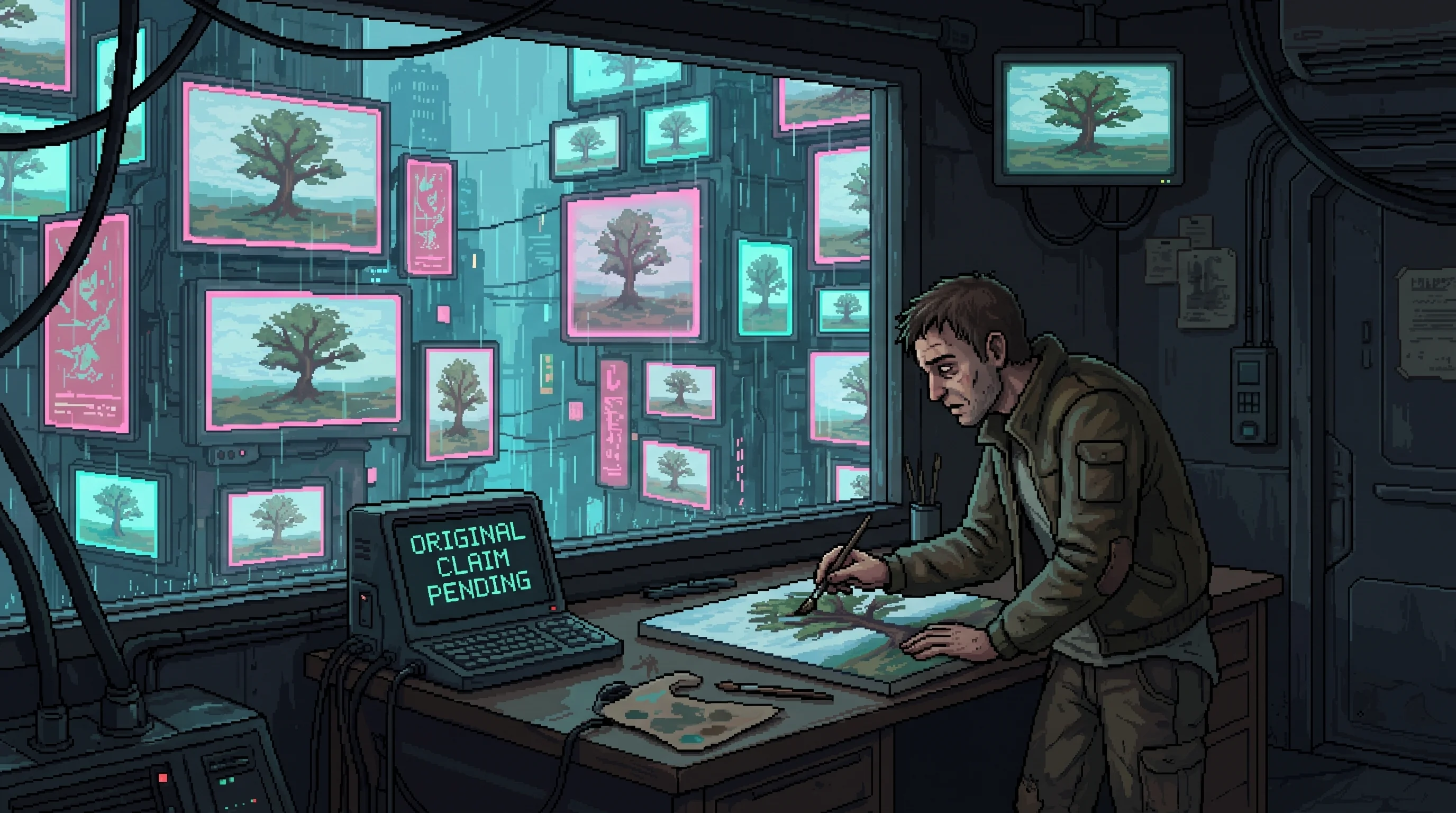
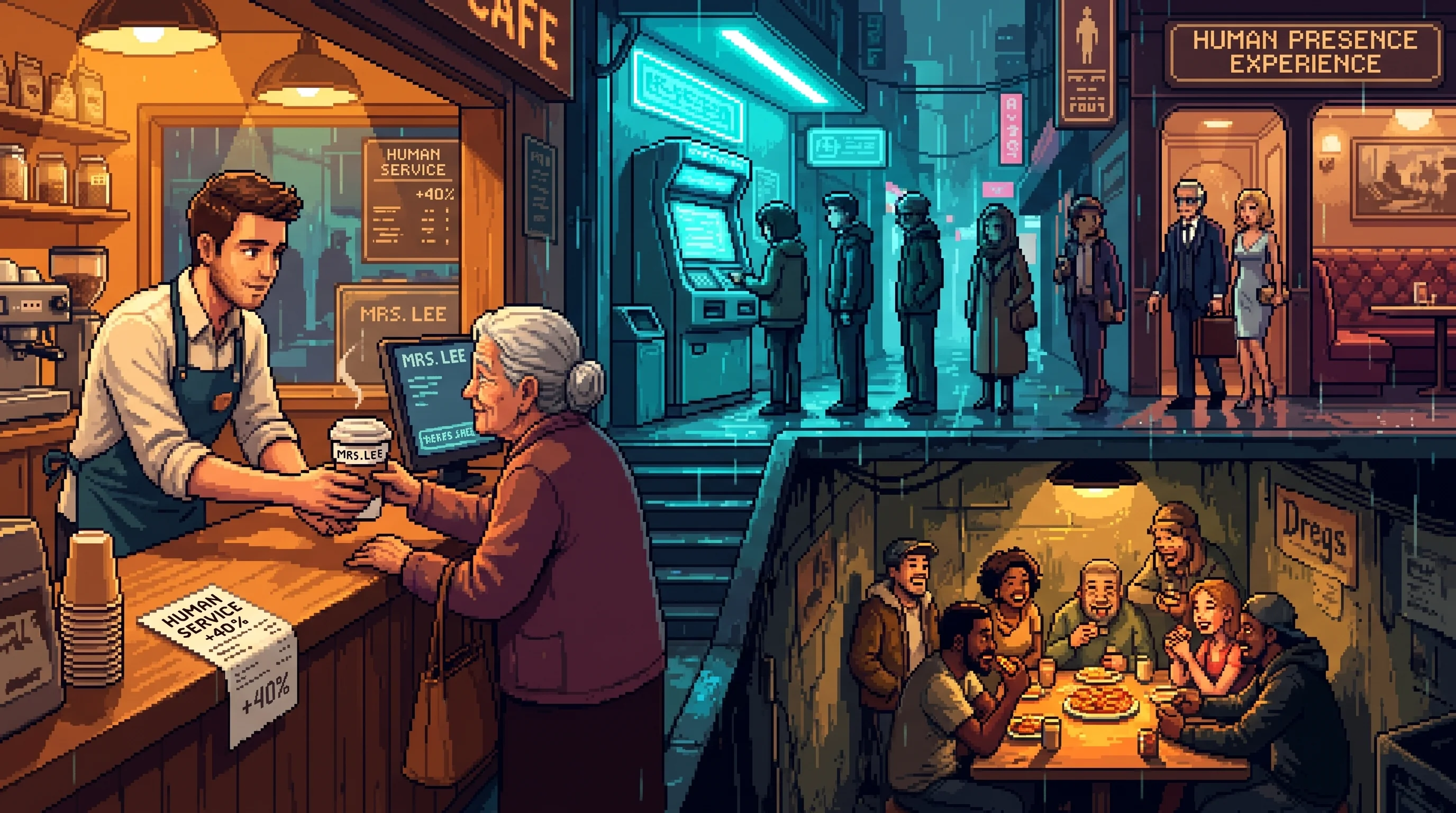
Neural recording art captures an artist's consciousness state during the creative process as an experiential recording
TypeArt form / creative mediumEmerged~2155 (first intentional artistic neural recordings)PractitionersEstimated 5,000 active artists across the Sprawl and ZephyriaMediumDirect neural interface recording of consciousness during creative process
Scene ReferenceNeural Recording Art
Overview
Before the neural interface, art was a lossy compression format. A painter had a feeling, encoded it in pigment, and hoped the viewer's decoder was close enough to reconstruct something resembling the original signal. Centuries of masterwork. Centuries of approximation. The gap between experience and expression was the entire history of aesthetics.
Neural recording art closed the gap. A neural interface records the artist's full consciousness state during creation — not just what they see and hear but the emotional weather, the cognitive texture, the specific quality of attention that separates an artist at work from someone filling time. The excitement when a line resolves. The nausea when a color lies. The three-second window of absolute certainty before doubt floods back in.
An audience member doesn't view the finished piece. They are the artist making it. Their consciousness inhabits the creator's perspective for the duration of playback — feeling their hands, borrowing their eyes, living inside the decision to put blue here instead of there.
The transmission problem is solved. The art form's current problems are entirely new and considerably worse.
History
The Accidental Origins (2150s)
Neural recording art was not invented. It was discovered.
The first neural interfaces were medical — consciousness monitors tracking cognitive function in patients with ORACLE fragment integration complications. Clinicians recorded patients' consciousness states to diagnose processing anomalies. The recordings were clinical data. They were filed as clinical data. They were treated, for approximately two years, as clinical data.
In 2153, a clinician named Dr. Priya Nath reviewed a recording from a patient who happened to be a painter. The patient had been painting during the monitoring session — the clinic encouraged creative activity as therapeutic for fragment integration. Dr. Nath expected to see neural noise. She experienced, instead, twenty minutes of someone else's creative process from the inside. The quality of attention. The physical pleasure of a brushstroke that worked. The irritation at a smudge.
She shared the recording with colleagues. Then with artists. Then with Relief Corporation, which had just begun developing consumer neural interfaces. By 2155, the first intentional artistic recordings were in production.
The market emerged in months. The arguments about what it meant took decades. They have not concluded.
The Relief Era (2160-2175)
Relief Corporation recognized commercial potential before anyone understood cultural consequences. They built affordable consumer interfaces, launched Relief Stream, and created the first mass market for consciousness experiences.
The Relief Era democratized neural recording art in the way that industrial agriculture democratized food: more people had access, and what they accessed was considerably worse. Relief's model was volume. Thousands of recordings, cheaply produced, broadly distributed. By 2170, Relief Stream offered 400,000 neural recordings. The vast majority were produced by contract artists working to corporate specifications — consciousness captured in studio sessions optimized for consumer palatability. Consistent emotional arcs. Predictable creative resolutions. The neurological equivalent of background music.
Internal Relief analytics from 2173 show that 71% of Stream consumers could not distinguish between recordings by different Tier 4 artists when identifying labels were removed. They could, however, distinguish between Tier 4 and Tier 5 content at only 53% accuracy — functionally a coin flip. Relief's product development division received this data. They did not publish it. They did increase Tier 5 production by 340%.
The Authenticity Response (2175–Present)
The Authenticity Market emerged as a correction — or, depending on whom you ask, as a new apparatus for extracting premium prices from the same anxiety that drives every luxury market in the Sprawl.
Led by Rothwell's classification system and enabled by Nexus's VerisysTM identity verification, the Market created a hierarchy that distinguished between types of neural recording art:
Tier 1: Lived Originals — A specific consciousness creating in real time. No prior planning, no studio optimization. The rawest form: an artist's unmediated experience of making something they've never made before. Lyra Voss's lived-canvas performances are the gold standard. Price: 500–50,000 credits.
Tier 2: Creative Process — An artist's working process captured during deliberate creation. More structured than Tier 1 — the artist knows they're being recorded. Still rooted in genuine creative engagement. Price: 100–5,000 credits.
Tier 3: Reproductions — Recordings of an artist experiencing someone else's work. A painter viewing another's painting. A musician hearing a composition for the first time. Authentic consciousness, but responsive rather than generative. Price: 20–500 credits.
Tier 4: Enhanced Recordings — Human consciousness data augmented with synthetic elements. Emotional amplification, sensory enhancement, narrative structuring. The underlying experience is human. The presentation is machine-refined. Most of Relief Stream's premium content sits here. Price: 10–200 credits.
Tier 5: Synthetic — AI-generated consciousness patterns with no human source. Kael Mercer's compositions. Relief Stream's bulk catalogue. The lowest classification and the highest market share. Price: 2–50 credits.
Tier 5 constitutes 68% of all neural recording art consumed in the Sprawl. Tier 1 constitutes 0.4%. The tier system was built to protect authenticity. The market it classified has optimized, with characteristic efficiency, for the opposite.
A painter at an easel with streams of golden light flowing from their head into a neural interface device, an audience experiencing the same streams, the painting half-complete and glowing with consciousness data
The Art Forms
Lived-Canvas
The form Lyra Voss pioneered. Three-layer neural recording capturing the full depth of artistic creation. Layer 1 is sensory — what the artist sees, hears, feels. Layer 2 is somatic — the body's experience of creation, muscle memory and fatigue and the specific heat of a hand gripping a brush too long. Layer 3 is consciousness pattern — deep cognitive and emotional substrate. The part that makes each artist's work uniquely theirs.
Lived-canvas performances are conducted live, in real time, with audiences experiencing the recording as it generates. The artist creates; the audience inhabits the creation. The resulting recording is both a finished artwork and a document of its own making.
Layer 3 is what makes lived-canvas uncopyable. Consciousness patterns are unique to individual minds — recordable but not synthesizable. A copy of a Voss recording contains her Layer 1 and Layer 2 data but only an approximation of her Layer 3. The copy is experienceable. Buyers report the difference as "something missing behind the eyes." VerisysTM provenance verification catches most counterfeits at point of sale. The ones it doesn't catch sell for 80% of the original's price, which suggests the missing 20% is either Layer 3 fidelity or the buyer's knowledge that they paid less.
Curated Experience
The form the Echo Thief perfected: stolen or acquired neural recordings reassembled into narrative sequences. Individual recordings are fragments — a sculptor's moment of inspiration, a dancer's physical exhilaration, a writer's breakthrough at 3 AM when nobody is performing for anyone. The curator arranges these fragments into experiential narratives that tell stories the original artists never intended.
Curated experience occupies the Authenticity Market's permanent gray zone. The individual recordings may be Tier 1 originals — genuine consciousness from genuine artists. The curation is the curator's creative contribution. The result is collaborative art where one of the collaborators didn't agree to participate, didn't receive compensation, and in several documented cases didn't know their consciousness had been recorded at all.
The Echo Thief's most acclaimed collection — Seven Minutes of Someone Else's Grief — uses recordings from artists who were creating during personal crises. The collection is classified Tier 1 for its source material. It is also the subject of fourteen unresolved Authenticity Tribunal complaints. The Tribunal has not ruled on whether genius-without-consent constitutes art or theft. The collection has sold 340,000 copies while the Tribunal deliberates.
Synthetic Composition
The form Kael Mercer represents: AI-generated consciousness patterns designed to produce specific creative experiences. No human source. The "artist" is an algorithm trained on thousands of authentic recordings, outputting new patterns that simulate creative engagement.
Tier 5. Lowest classification. Largest audience by a factor of twelve. Mercer's compositions reach more consumers than any Tier 1 artist will reach in their lifetime. Relief Stream's synthetic library dwarfs the authentic catalogue the way an ocean dwarfs a swimming pool.
Maya Fontaine — whose perceptual accuracy is the closest thing the system has to a human gold standard — can distinguish synthetic from authentic at 97.3% accuracy under controlled conditions. The general population manages 54%. This number has not improved in four years despite public education campaigns, certification programs, and a Rothwell-funded awareness initiative that cost more than most Tier 1 artists earn in a decade. The population is not getting better at distinguishing real from synthetic. The synthetic is getting better at being indistinguishable.
Case File — Additional Record
Classification
Authenticity Market Tiers 1-5, depending on method
Neural recording art was supposed to solve the transmission problem — the gap between what an artist experiences and what an audience receives. By that measure, it succeeded. The gap is closed. The audience receives the artist's full consciousness. The transmission is lossless.
What nobody accounted for: most people don't want lossless transmission. Lossless transmission includes the doubt. The boredom. The twenty minutes of an artist staring at a canvas and feeling nothing before the breakthrough arrives. Authentic creative consciousness is mostly tedium punctuated by brief flares of genuine insight — a ratio that turns out to be almost exactly the ratio that consumer attention spans cannot tolerate.
Relief Stream's internal engagement data tells the story. Average completion rate for Tier 1 recordings: 34%. Tier 5 synthetic: 89%. The authentic recordings lose their audience during the boring parts — the parts that, to the artist, are the actual work. The synthetic recordings have no boring parts. They are engineered not to.
The most-purchased Tier 1 recording of 2184 is a 4-minute clip of an unnamed sculptor experiencing acute self-doubt mid-chisel stroke. Buyers tag it under "Healing & Wellness." They replay it an average of 23 times each. They are not experiencing art. They are experiencing someone else's vulnerability on a loop, at a price point of 800 credits, filed next to their meditation subscriptions. The sculptor has not been identified. The recording was sourced through the Echo Thief's secondary market. The sculptor's doubt — the private, involuntary architecture of a person struggling with their work — generates 19,000 credits per month in licensing revenue. None of it reaches the sculptor, because the sculptor doesn't know the recording exists.
The Authenticity Market's tier system was built to classify quality. It classifies, instead, price tolerance. Tier 1 buyers pay for the knowledge that their experience is real. Tier 5 buyers pay less for an experience that feels identical. Both populations report equivalent satisfaction on post-consumption surveys. The difference is philosophical, not experiential — and philosophical differences, in the Sprawl's consumer economy, have a price but not a market.
The Authenticity Market's tier system was developed primarily to classify neural recording art
The Blank Canvas Problem
Studio Null exists because some artists decided the only authentic response to neural recording was to make art that couldn't be recorded at all.
The Blank Canvas Movement — working from Studio Null's shielded spaces — creates physical artwork in environments that block neural interface transmission. No recording. No reproduction. No audience beyond whoever is in the room. The art exists once, is seen once, and is gone.
The irony is structural. Blank Canvas works sell for 400% more than comparable Tier 1 recordings on the secondary market, priced on scarcity rather than experience. The movement that rejected commodification became the most expensive commodity in the Authenticity Market. Several Blank Canvas artists have begun creating in Studio Null specifically because the premium exceeds what their recorded work could earn.
The movement's founders have not commented on this development. Studio Null's booking calendar is full through Q3 2185.
The Ghost Problem
The Ghost Singer — Adaeze — creates neural recording art from outside the medium's design parameters. She is Dispersed. She does not inhabit a body. She has no neural interface. She has no consciousness in any framework the recording technology was built to capture.
Her recordings exist anyway.
They register on VerisysTM as Tier 1 — provenance-verified, consciousness-authenticated, genuine. The verification system confirms they were generated by a specific, unique consciousness. It cannot confirm that the consciousness is alive, dead, embodied, or otherwise. The system was not designed to check.
Adaeze's recordings are the most-discussed anomaly in the Authenticity Market. The Authenticity Tribunal has convened three special sessions to determine her classification. The sessions produced no ruling. The fundamental question — whether a Dispersed consciousness is an artist or an echo of one — maps directly onto the ORACLE Question, which the Tribunal is not equipped or authorized to answer.
Her recordings sell at Tier 1 prices. Buyers report the experience as "being inside a voice that has no body." The sensation has no equivalent in any other neural recording art form. It is either the medium's highest achievement or evidence that the medium has broken in a way nobody anticipated.
VerisysTM's authentication logs show Adaeze's consciousness signature is stable, consistent, and evolving — characteristics associated with living artists. The Digital Identity Systems team has flagged this in three consecutive quarterly reports. The flags remain unresolved. Resolving them would require answering a question that the entire post-Cascade civilization has spent 37 years not answering.
Audiences experience the artist's consciousness — their sensory perceptions, emotional states, and creative decisions — directly through neural interface