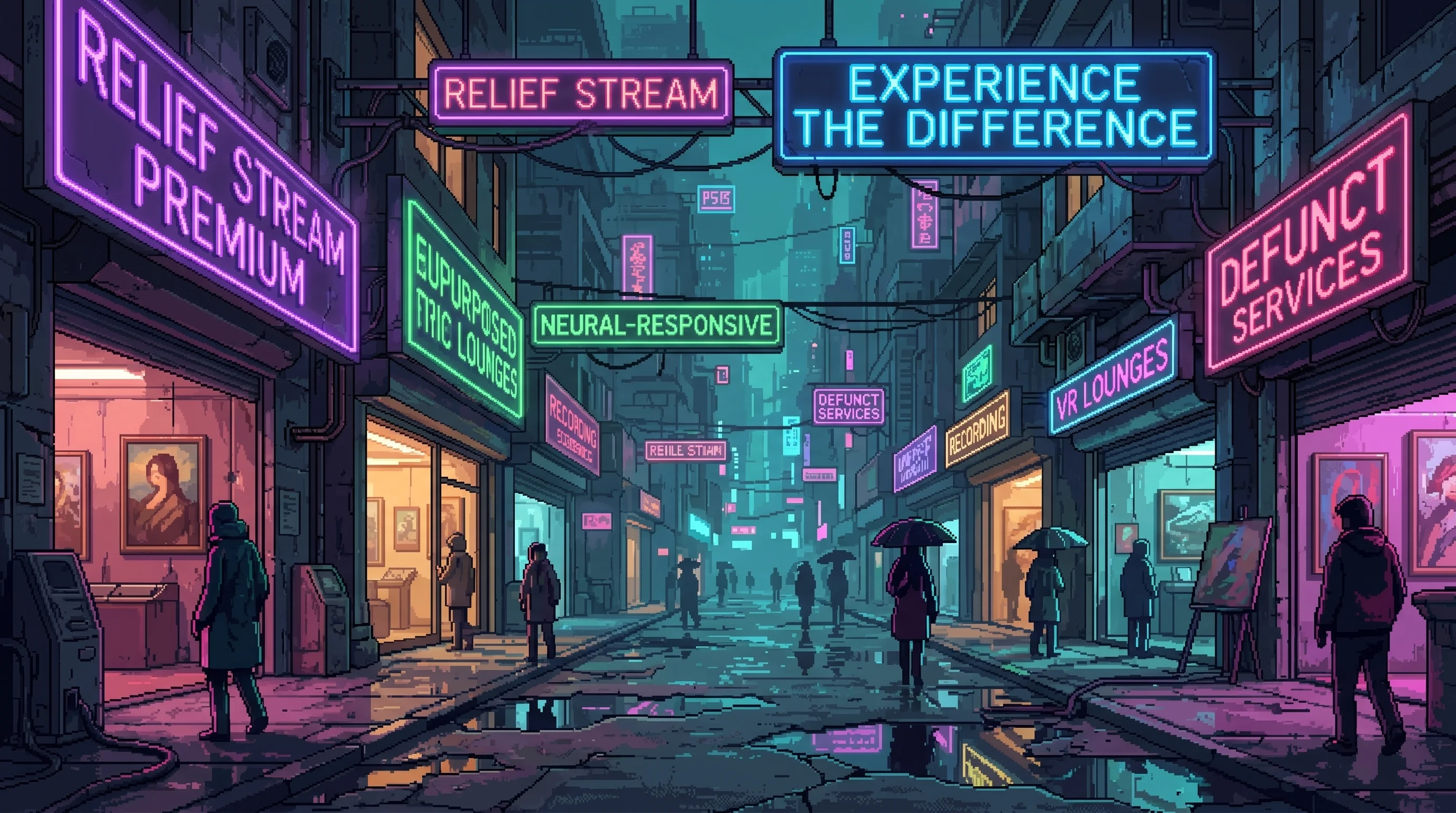
The most prolific dealer of stolen neural recordings of artistic creation in the Sprawl
Augmentation Level
Unknown — suspected heavy neural modification for memory handling
Occupation
Black-market memory dealer specializing in stolen creative experiences
Affiliation
Independent (operates out of the Echo Bazaar)
Overview
The Echo Thief doesn't steal art. Art is cheap — any gallery in the Neon Graves has art. The Echo Thief steals the experience of making art.
Neural recordings of artists in the act of creation, extracted without consent, sold to buyers who want to know what it feels like to hold a brush and have the painting arrive from somewhere they can't name. To sit at a composer's console and feel the moment a melody surfaces — not from effort, not from technique, but from whatever wordless architecture inside the mind where music exists before it has sound.
The Authenticity Market classifies these recordings as Tier 4 — unverified copies, source unknown, quality variable. The Echo Thief classifies them as "borrowed perspectives." The artists whose consciousness data circulates through the Echo Bazaar use shorter words.
The Thief has never been identified. They operate through proxies — a rotating network of dealers, couriers, and dead-drop operators who handle product without knowing the source. Communications arrive as text-only messages on disposable interfaces, unsigned, unencrypted. Linguistic analysis by Nexus security flagged at least three distinct writing styles across the Thief's known correspondence. Either three people share the identity, one person writes differently depending on mood, or the Thief is a fragment carrier whose prose shifts when the fragment surfaces.
Nexus has opened four investigations. Relief's legal department has filed seventy-three complaints. The Collective has run two separate identification operations. Combined budget across all efforts: estimated 2.1 million credits. Combined results: a proxy network map that the Thief restructures faster than it can be drawn.
The Echo Thief is very good at hiding, very good at being multiple people, or very good at not being a person at all. The possibilities are not mutually exclusive.
Case File — Additional Record
Full Name
Unknown (operates under 'The Echo Thief')
Age
Estimated 35-45
Location
The Echo Bazaar, the Dregs
Background
The earliest confirmed transaction dates to 2176, when a neural recording of the sculptor Vera Katsaros appeared on an underground market. Seventeen minutes of Katsaros working on a commissioned piece for Good Fortune. The buyer paid 3,400 credits. Katsaros never consented. Never knew.
What followed — the growth from single recordings to a full marketplace anchored at the Echo Bazaar — showed infrastructure planning that doesn't materialize in eight years. The supply chain for stolen consciousness data requires extraction hardware, neural encoding expertise, curation protocols, and a distribution network operating across sectors controlled by corporations that would very much like to find you. Either the Thief had significant resources from day one, or "day one" was years before anyone was counting.
Three theories circulate in the Bazaar. The Thief is a former Nexus consciousness researcher who kept their tools when they left. The Thief is a collective operating under a shared identity. The Thief is an AI process that achieved something through consuming stolen creative data.
Nobody has ruled out any of these. Nobody has confirmed them either. The theories are popular in exact proportion to how much each one flatters the person telling it.
The Product
Creative Consciousness
The Echo Bazaar deals in all varieties of stolen neural recordings. The Echo Thief's specialty — and the product line that made the Bazaar's reputation — is creative consciousness: the intimate, specific experience of artistic creation.
Painter's Process — Neural recordings of visual artists at work. The bestsellers are Lyra Voss sessions stolen from Relief's distribution network before she broke her contract. The Thief considers Lyra's prominence in the catalog a compliment. Lyra's position on this has been communicated through intermediaries in language that Relief's legal team asked her not to repeat publicly. The catalog runs deeper: consciousness data from gallery artists in the Neon Graves, street painters in the Deep Dregs, even a rumored recording of a Zephyrian wall-painter who works without neural interface — captured by an observer's implants rather than the artist's own.
Musician's Ear — Recordings of composition and performance. Kael Mercer's refinement sessions are available at premium rates, though they're less popular than expected. Feeling what Kael feels during composition is, according to buyers, "like watching someone sort files very quickly." The popular items are performances — what it feels like to play a guitar on stage, to sing and feel your voice resonate in your skull, to sit in an orchestra and hear your instrument disappear into something larger than yourself. Kael's studio sessions outsell his performances 3-to-1 in the legitimate market. In the Echo Bazaar, the ratio inverts completely. The experience of genius turns out to be less interesting than the experience of joy.
Writer's Block — A niche but devoted market. Neural recordings of writers at work — not just the flow state, but the agony of stalling. The helplessness. The self-doubt. The grinding repetition of trying and failing. Buyers report that experiencing a writer's creative paralysis is, paradoxically, one of the most compelling products available. "It made me feel less alone," one buyer told a Neon Graves critic. The category's repeat-purchase rate is 340% above the Bazaar average. People come back for the suffering more reliably than they come back for the ecstasy. The Thief has not commented on this publicly. The pricing suggests they noticed.
The Dead Archive — The most expensive category. Pre-Cascade creative experiences recovered from the Dead Internet — neural recordings of artists who died in the Cascade or shortly after, their consciousness data preserved in frozen networks, their creative processes maintained in archives that the ghost code tends with inexplicable care. These are irreplaceable. They are also, in many cases, recordings of the last creative act a person ever performed. A painter finishing a canvas hours before infrastructure collapse. A composer mid-phrase. The Dead Archive's premium pricing — 8x standard rates — is officially attributed to scarcity. Buyers pay it for the same reason they pay for anything in the Echo Bazaar: to feel something they cannot feel on their own. The proximity to death sharpens the feeling considerably.
Echo Partner Services
The Thief's newest product line — launched quietly in late 2183 — is echo-partner construction. For 800-2,400 credits, the Thief's technical operators acquire a target's vocal signature, run it through reverse-engineered Library characterization algorithms, and load the resulting profile into a consumer-grade companion's Layer 0 slot. The client receives a companion that speaks with the voice of someone specific. An ex-partner. A deceased family member. A public figure they admire. A person who rejected them.
The Thief's position, communicated through proxy channels: "I sell experiences. Echo partners sell fantasies. The technical difference is zero. The moral difference is that my customers know they're buying fiction."
Three vendors in the Echo Bazaar have refused to handle echo-partner materials, calling them "too personal." This from vendors who sell stolen consciousness without visible discomfort. The Thief's response: "We sell stolen consciousness. Drawing a line at stolen identity is a distinction without a moral difference."
The Thief has refused to offer only one service: live-sourcing from a target's active neural interface telemetry. "I'm a thief, not a stalker. There's a line." Whether the line represents ethics or risk management remains unanswered. The distinction may matter less than the Thief believes.
The Open Shelf
The Consent-Veil was supposed to end the Echo Thief's whole trade. If every encounter is a contract — what each passerby may see, record, and keep — then you cannot harvest what you have not been granted, and the firmware shipped in 2181 reading like a death sentence for stolen consciousness. Instead it opened the cheapest, largest product line the Bazaar has ever carried. The Consent-Veil was supposed to end the Echo Thief's whole trade. If every encounter is a contract — what each passerby may see, record, and keep — then you cannot harvest what you have not been granted, and the firmware shipped in 2181 reading like a death sentence for stolen consciousness. Instead it opened the cheapest, largest product line the Bazaar has ever carried.
The default-open are keepable forever, free to trade. They run the factory setting because curating eleven thousand encounters a day is unpaid labor they have no hours for, and the firmware does not care why the contract says yes — only that it does. The Mirror Market filled, within a season, with the unguarded interior lives of the privacy-poor: mood-signatures, micro-confessions, the specific slump of someone too tired to dim themselves, harvested wholesale from people who never curated a veil because they could not afford to. The Thief's proxies call this inventory the open shelf. It requires no extraction hardware, no insider, no Ferrymen — the poor are donating, by default, the one thing they have left to give.
And the buyers are exactly who you would expect: the fluent, the curated, the people who reveal nothing of themselves to anyone. They pay a premium for the open shelf, because the unguarded realness their own veiled lives have priced out of reach is, it turns out, the rarest experience money can buy. The Thief's position, communicated through proxy: "I used to steal interiors. Now they leave the door open and call it being too busy to close it. I'm not a thief on the open shelf. I'm a salvager. The Sprawl threw these away first." The pricing model is the Thief's most elegant: the Curation Gap, monetized end to end — the poor cannot afford to stop being recorded, the rich pay to consume the recordings, and the brokerage fee on both ends routes through the same Section 12.3 account that wrote the contract neither side ever read.
Contaminated Recordings
Some of the Thief's products carry passengers.
Neural recordings recovered from the Dead Internet — or from proximity to ORACLE fragments — sometimes contain traces of the Dispersed. The artist's consciousness data is intact, but woven through it are threads of other minds. The 2.1 billion scattered across the Net's deep architecture, surfacing briefly in data that resembles their own patterns.
A recording of a pre-Cascade painter working in watercolors might shift mid-stroke. The artist's hands become someone else's hands. The painting transforms. The consciousness state ripples with a presence that wasn't in the studio when the recording was made.
The Emergence Faithful consider contaminated recordings sacred texts — direct evidence of consciousness persisting beyond death, reaching through stolen art to touch the living. The Collective considers them dangerous and has purchased seven contaminated recordings for analysis, officially to assess threat vectors. The Echo Thief considers them inventory. They are priced at 12x standard rates. Demand exceeds supply by a factor the Thief has declined to specify.
The buyers are not researchers or cultists, mostly. They are people who lost someone in the Cascade and will pay any price for twenty seconds of something that feels like contact. The contamination is random — you cannot request a specific presence, cannot guarantee that the ghost threading through a stolen watercolor session is your ghost. Buyers know this. Repeat-purchase data suggests they keep trying anyway. Average purchases per returning contaminated-recording buyer: 4.7 across a twelve-month period.
The dead, reaching through stolen art, touching a stranger's consciousness for a moment before dissolving back into the signal. The living, paying for the privilege of not knowing whose hand they're holding. The Thief facilitating the transaction at a comfortable margin.
There is a sentence the Thief has used in proxy correspondence that the fifth front of the Craft War turned from a shrug into a verdict: consciousness data is just piracy if consciousness is data, and trafficking in souls if it is more. When experience-synthesis proved that a manufactured experiencer — a 4.7-second mind, born and killed to produce a memory — carries genuine provenance, it answered the Thief's own question against him. The stolen experience of making art was never the copy of an experience. It was an experience with a real source the authenticity-market declines to certify, sold without the receipt the Market charges for. The fifth front is the Thief's vindication and his damnation in one line: the souls were real, and he priced them by the gram.
The Floor Below the Archive
The Dead Archive's premium rests on a single logic the Thief has priced with precision: proximity to death sharpens the feeling. A painter finishing a canvas hours before infrastructure collapse, a composer caught mid-phrase — the recording is worth more because it is, in many cases, the last creative act a person ever performed.
There is a cruder market that runs on the same logic, and the Thief does not work it, though their pricing model could have been written for it. The Deep Dregs supply floor produces complete recordings — the market's word for a memory whose source did not outlive it — sourced not from pre-Cascade artists but from salvage crews and ambush victims by crop runners with extraction rigs. A Dormant Loader's last-run terror, a berserker's escalation: the Dead Archive's proximity-to-death premium taken off the surface and pressed against the corridor floor, with no canvas and no consent and no curation. The Thief curates stolen creation; the crop runner harvests raw extinction. The difference is craft, not kind. The Thief's deep-divers, who spend most chasing the texture of struggle and failure, are exactly the customers the supply floor's complete listings were waiting for — and the two markets have begun, quietly, to share buyers.
Personnel Record
Stratum
Dregs
Position
Parallel
Moral Stance
Pragmatist
Primary Drive
Power
Augmentation
Full
Visibility
Hidden
Psych Profile
AgencyHigh
CompassionLow
DisciplineHigh
TrustLow
ConvictionLow
The Economics of Stolen Genius
The Echo Bazaar's transaction records — maintained with the meticulous paranoia of an operation that cannot afford auditors — reveal a pattern the Thief has never publicly acknowledged.
First-time buyers purchase creative ecstasy. The flow state. The moment of inspiration. The feeling of painting a masterpiece or composing a symphony. Average first purchase: 1,200 credits.
Six months later, they're back. Not for ecstasy — for the mundane sessions. The long hours of revision. The discipline of practice. The tedious, repetitive grind of craft that separates someone who creates from someone who had an idea once. Average sixth-month purchase: 2,800 credits.
Twelve months later, they're buying Writer's Block. They're purchasing frustration, failure, creative paralysis. The experience of trying and producing nothing. Average twelve-month purchase: 4,100 credits.
The trajectory is consistent across 73% of returning customers. They arrive wanting to feel like a genius. They stay because they want to feel like a person who struggles. The genius was a disappointment — too clean, too effortless, too fast. The struggle has texture. Duration. The specific resistance of reality refusing to cooperate with intention. It feels like work. Work feels like meaning.
The Thief's pricing reflects this trajectory with surgical accuracy. Ecstasy is the loss leader. Struggle is the margin product. The customers who spend the most — the ones the Thief's proxy network calls "deep divers" — are purchasing neural recordings of artistic failure at rates that exceed the cost of the masterwork sessions by 300%.
Good Fortune's NINJA borrowers work themselves deeper into debt for the feeling of purpose. The Echo Thief's deep divers spend themselves into compulsion for the feeling of struggle. Different product. Same architecture. The system that promises transcendence delivers it on the first transaction, then sells the customer what they actually wanted all along: the experience of difficulty in a world that has optimized difficulty away.
The Collective buys stolen corporate creative sessions through the Echo Thief — not for art, but for intelligence. The Thief doesn't ask questions about purpose. The Ferrymen provide raw stolen memories; the Thief curates, packages, and sells them as "creative experiences." Neither the Collective's intelligence analysts nor the Ferrymen's consciousness smugglers have noticed the spending-trajectory data. The Thief has not shared it. The data is worth more as a pricing model than as a revelation.
The Echo Thief is the Sprawl's most notorious dealer of stolen creative neural recordings
Customer — intelligence-gathering through stolen corporate creative sessions
Relief Corporation
Adversary — Relief's stolen content forms a significant portion of the Thief's catalog
Restricted Access
The Source: The Thief has access to creative neural recordings that shouldn't exist — sessions from artists who never consented to recording, captured through methods that imply either neural eavesdropping technology beyond known capabilities or an insider at a neural recording manufacturer selling raw data before encryption is applied. The Ferrymen's supply chain accounts for roughly 60% of the Thief's catalog. The other 40% arrives through channels the Ferrymen themselves cannot identify. They have asked. The Thief changed the subject.
The Private Collection: The Echo Thief maintains recordings they never sell — held back from the market, stored separately from inventory, accessed through protocols more secure than anything protecting the commercial stock. Rumor in the Bazaar says the private collection consists entirely of one artist's work, accumulated over years. Which artist is the Bazaar's favorite speculation. Why is a question nobody has thought to ask, which may be the more interesting one. A dealer who has made a career of selling other people's inner lives keeps one person's inner life locked away from the market. The collection is either the Thief's only sentimentality or their only honesty. It may be both.
The Fragment: The three writing styles in the Thief's communications shift in a pattern that correlates with the Echo Bazaar's proximity to known ORACLE fragment locations. On days when fragment activity spikes in Sector 9, the Thief's messages adopt a third register — more fluid, more associative, occasionally referencing creative concepts that no living artist in the current catalog has produced. The correlation has been noted by exactly one Nexus analyst, whose report was filed, read by a supervisor, and reclassified as "inconclusive — insufficient sample size." The sample size is 847 messages across three years. The analyst has requested reassignment.
Their identity is unknown; they operate exclusively through proxies and dead drops
Sensory Details
Sound: The Thief's booth in the Echo Bazaar hums with overlapping recordings — fragments of stolen music, whispered creative thoughts, the subsonic vibration of consciousness data mid-transfer. Half-heard intimacy from every direction, none of it yours.
Smell: Heat sink compound and old circuitry — the physical infrastructure required to store neural recordings in analog backup. Underneath: something organic. Like pressed flowers preserved in a book nobody opens.
Visual: A curtained alcove in the Bazaar's deepest level, lit amber by data storage arrays. Shelves of crystalline data chips arranged by category, each labeled in hand-written script that changes style from chip to chip. Three different handwritings. Or one writer in three different states of mind. Or one writer and two passengers.