
The First Recording
The First Recording was created on March 12, 2153 at a neural integration clinic in Mumbai
Overview
Dr. Priya Nath was reviewing clinical data. She loaded a consciousness recording into her neural interface, same as she'd done hundreds of times with hundreds of patients, and for four minutes and twelve seconds she painted watercolors in a hand that wasn't hers.
She wasn't watching someone paint. She felt the brush between fingers she didn't have, saw pigment bleed into wet paper through eyes that belonged to a fragment carrier listed only as Patient 7. She felt the held-breath moment when blue wash settles into exactly the right shade. She felt the frustration when a line drifted. She felt the thing she could never adequately describe afterward — the intent. The reaching for an image that existed in someone else's mind, the negotiation between vision and material, the narrowing of the gap.
When the recording ended, she sat in her clinical office at the Mumbai Neural Integration Clinic and cried.
Then she shared it with everyone she could find, patented nothing, and charged no one.
Relief Corporation would later charge 500 credits per session. Their marketing department branded it "The Birth of Neural Art." Dr. Nath's surviving colleagues have described this branding as "obscene," "reductive," and — in one interview preserved in the Dead Internet — "exactly what Priya would have hated, which is presumably why they focus-grouped it."
The Clinic
The Mumbai Neural Integration Clinic treated fragment carriers whose ORACLE integration produced cognitive anomalies: memory intrusions, perceptual distortions, episodes where someone else's consciousness temporarily displaced their own. Treatment included creative activity. Fragment carriers who painted, composed, or wrote during monitoring sessions showed improved integration metrics. The fragments settled when the carrier was creating.
Patient 7 painted watercolors. Landscapes of a city they'd never visited, rendered with skill they didn't possess before integration, as if the fragment carried a dead person's artistic training. The monitoring equipment captured consciousness patterns during these sessions. It was designed to detect pathology. It captured beauty instead, though the two are filed in the same directory.
The clinic was destroyed during the Cascade. Its physical records are gone. Patient 7's identifying information was either never digitized or lost in the collapse. The painter who started an art form has no name, no face, no surviving medical file. Their consciousness — four minutes and twelve seconds of it, reaching for a shade of blue — is the most experienced piece of art in human history. They have never been contacted about royalties, because they cannot be contacted about anything.

The Recording
Four minutes, twelve seconds. Sensory data: white paper, wet pigment, the scratch of bristles, the smell of paint and water, the temperature of a brush handle, the Mumbai clinic's air circulation hum, distant traffic. Somatic data: fine motor control, wrist tension, steady focused breathing, the lean forward to examine a completed section. Cognitive data: aesthetic decision-making in real time — why each stroke goes where it does, experienced from inside the consciousness making the decision.
What the recording doesn't contain: Patient 7's identity. The monitoring equipment captured consciousness during a specific activity but not biographical data. No memories, no self-concept, no name. The viewer experiences someone painting and doesn't know who. This anonymity has become load-bearing. Thirty-one years of critical analysis, and the consensus is that experiencing unattributed creativity is fundamentally different from experiencing a known artist's work. The viewer doesn't encounter a personality. They encounter the act itself.
Kaspar Eriksen, who led the Consciousness Archaeologist team that recovered the recording from the Dead Internet in 2178, described the playback as "four minutes of being someone who doesn't know you're there." Orin Slade's review was three sentences: "This is the first time one person felt another person create. Everything since has been a footnote. Go feel it."
Relief Corporation's marketing department required fourteen sentences to say something similar, spread across three brochures and a holographic lobby display at each of their Experience Centers.
The Three Copies
The original recording persists in the Dead Internet's Mumbai medical archives. Ghost code maintains it with the same inexplicable fidelity it brings to all pre-Cascade digital artifacts — files tended by processes that have no reason to still be running, preserved for an audience that may never access them.
Copy One: Held by the Consciousness Archaeologists' central archive. Access requires institutional authorization. The authorization form is eleven pages. It asks the applicant to describe, in writing, their "intended experiential context" for the playback. Average processing time: nine weeks. Kaspar Eriksen has publicly called the form "an embarrassment to an organization that was founded by people who broke into the Dead Internet for fun." The form remains eleven pages.
Copy Two: Acquired by Relief Corporation. Available at Relief Experience Centers across the Sprawl. Five hundred credits per session. The playback room is small, clean, and decorated with a framed quote from Dr. Nath taken out of context. Relief's quarterly earnings reports list the recording under "Heritage Experience Assets" alongside four other pre-Cascade artifacts. Combined revenue from Heritage Experience Assets in Q4 2183: 3.2 million credits. Dr. Nath gave the recording away. Relief's profit margin on each session is approximately 94%, the cost being a neural interface rental and seven minutes of room time. The brochure calls it "a gift to humanity, now accessible to everyone." The five hundred credits are not mentioned in the brochure.
Copy Three: Held by an anonymous collector. Acquired through the Echo Bazaar for an undisclosed price. The Echo Thief claims to have facilitated the sale. The Authenticity Tribunal considers the copy stolen property and has issued four cease-and-desist orders to the collector, which is a remarkable legal strategy given that the collector has never been identified. The orders are on file. The file is growing. The collector has not responded, because responding would require existing in a way the Tribunal could verify, and the collector appears to have no interest in existing verifiably. The Tribunal's enforcement budget for this case exceeded the value of the cease-and-desist postage in year one. They are now in year six.
| Type | Historical artifact / cultural touchstone |
|---|---|
| Date | March 12, 2153 |
| Subject | Dr. Priya Nath's playback of Patient 7's painting session |
| Significance | The first time a human consciousness experienced another person's creative process from the inside |
| Current Status | The original recording survives in the Dead Internet. Three verified copies exist in the Sprawl. |
Dr. Nath
Priya Nath recognized what the recording was before anyone else did, and made the only decision about it that mattered before anyone could stop her.
She wrote a paper: "Consciousness as Medium: Creative Experience Transfer via Neural Interface Monitoring." Rejected by three medical journals as outside their scope. Published in an arts and technology review in 2154. Two hundred readers in its first year. Forty thousand citations by 2156. She did not patent the process. She did not commercialize the recording. She shared it freely with any researcher, artist, or institution that requested access.
This decision — made before anyone understood the commercial implications — meant that neural recording art developed as an open practice rather than a proprietary technology. Relief Corporation built the consumer interface. The Authenticity Market built the tier system. The entire economy of creative consciousness organized itself around a principle that was established as public knowledge because one clinician decided that what she'd experienced was too important to own.
Dr. Nath was connected to the network when the Cascade hit. She is among the Dispersed. The woman who decided the recording belonged to everyone now exists in a state that has no legal, philosophical, or theological precedent. She is not alive, not dead, not gone.
Relief Corporation's legal team has confirmed that Dr. Nath's open-access decision, made in 2153, does not constitute a binding license agreement under current corporate IP law. They have not yet acted on this interpretation. The PR calculus of claiming ownership over a Dispersed woman's gift to humanity is, for now, unfavorable. The phrase "for now" appears in the internal memo.
It is considered the origin moment of neural recording art
What It Started
Every neural recording since — every lived-canvas performance at the Unfinished Gallery, every curated experience in the Authenticity Market, every tier classification, every synthetic composition, every argument about what constitutes "real" creative consciousness — descends from those four minutes and twelve seconds. The technology that Dr. Nath stumbled into while reviewing patient data became the medium. The patient data became the art form's founding work.
The Authenticity Market's entire tier system exists because someone needed to decide which neural recordings carried genuine creative consciousness and which were synthetic approximations. That question traces directly to the First Recording, which is the benchmark: unmediated, accidental, captured during medical monitoring with equipment designed to detect cognitive pathology. Every tier definition is, at bottom, a measurement of distance from this artifact. Tier 1 recordings — direct consciousness capture during genuine creation — are the First Recording's children. Tier 5 recordings — AI-generated approximations of creative consciousness — are its orphans.
The distance between Dr. Nath giving it away and Relief charging 500 credits is the distance the art form has traveled. Whether that distance represents progress or something else depends on whom you ask, and how much they paid to ask it.
The Inversion It Became
Dr. Nath gave the recording away because she decided that what she had experienced — four minutes of being someone who doesn't know you're there — was too important to own. Thirty-one years later her discovery has a most profitable descendant and its exact moral inversion: PresencePlus, the inherited home-presence that records a parent's own warmth and meters it across generations by Continuity Depth. Where Nath gave warmth away free and unowned, PresencePlus owns warmth and inherits it for profit; where the First Recording captured a stranger's creative act and made it shareable forever, PresencePlus captures a family's love and makes it unrecoverable — corrupted, recompiled, owned by Wellness, keyed to a child who will never know whose love it originally was.
The thread the Authenticity Market always carried — the viewer encounters the act itself, not the person — was a gift in 2153 and is a wound in 2184. Patient 7 is anonymous and it makes the recording purer. The inherited presence is anonymous and it makes the child a warm-orphan: four minutes of being loved by someone who is no longer there, looped forever, with no name behind the warmth and no way to put one there. Both recordings outlive their source. One was given away to belong to everyone. The other is sold, again, to each generation that inherits the silence behind it.
It captured Dr. Priya Nath's experience of reviewing a patient's neural data during a painting session
Affiliated Entities
| Entity | Relationship |
|---|---|
| Neural Recording Art | Origin — the First Recording is the art form's genesis moment |
| PresencePlus | Descendant and moral inversion — free unowned gift vs. metered inherited warmth |
| The Dead Internet | Archive — the original recording persists in the Mumbai medical archives |
| The Authenticity Market | Ancestor — every tier traces back to this recording |
| Consciousness Archaeologists | Recoverers — Kaspar Eriksen's team brought it back |
| Relief Corporation | Commercializer — charges 500 credits for public playback |
| Orin Slade | Critic — his three-sentence review is the recording's most cited response |
| The Echo Bazaar | Black market — one copy was sold here |
| The Echo Thief | Facilitator — claims to have brokered the third copy's sale |
| The Dispersed | Dr. Nath is among them — the woman who discovered neural recording art was taken by the Cascade |
| The Unfinished Gallery | Counterpoint — the beginning of neural recording art and the art form's most haunting endpoint |
▲ Unverified Intelligence
Relief Corporation's internal analytics division tracks biometric responses during First Recording playback sessions. The data is extensive: pupil dilation, heart rate variability, neural engagement patterns, emotional valence scores, duration of post-playback silence before the viewer speaks. The average post-playback silence is forty-seven seconds. Relief considers this a customer satisfaction metric. Their optimization team has proposed shortening the post-playback transition — the forty-seven seconds of silence represent "unmonetized session time" that could be filled with a curated recommendation for the next experience.
The proposal has been tabled three times. Not because anyone objected on principle, but because the pilot group that received immediate post-playback recommendations showed a 31% decrease in repeat bookings. The silence, it turns out, is part of the product. Relief has not reduced the silence. They have also not stopped measuring it.
Separately: Kaspar Eriksen's recovery team logged an anomaly during the 2178 Dead Internet dive. The recording's file metadata shows a last-accessed timestamp of April 2, 2147 — the second day of the Cascade. Someone, or something, accessed the First Recording while 2.1 billion people were dying. The timestamp has been verified by three independent analysts. No explanation has been offered. Eriksen included it in his dive report as a footnote. The footnote has generated more academic papers than the rest of the report combined.
The original survives in the Dead Internet; three verified copies exist in the Sprawl
Connected To
Supporting Connections
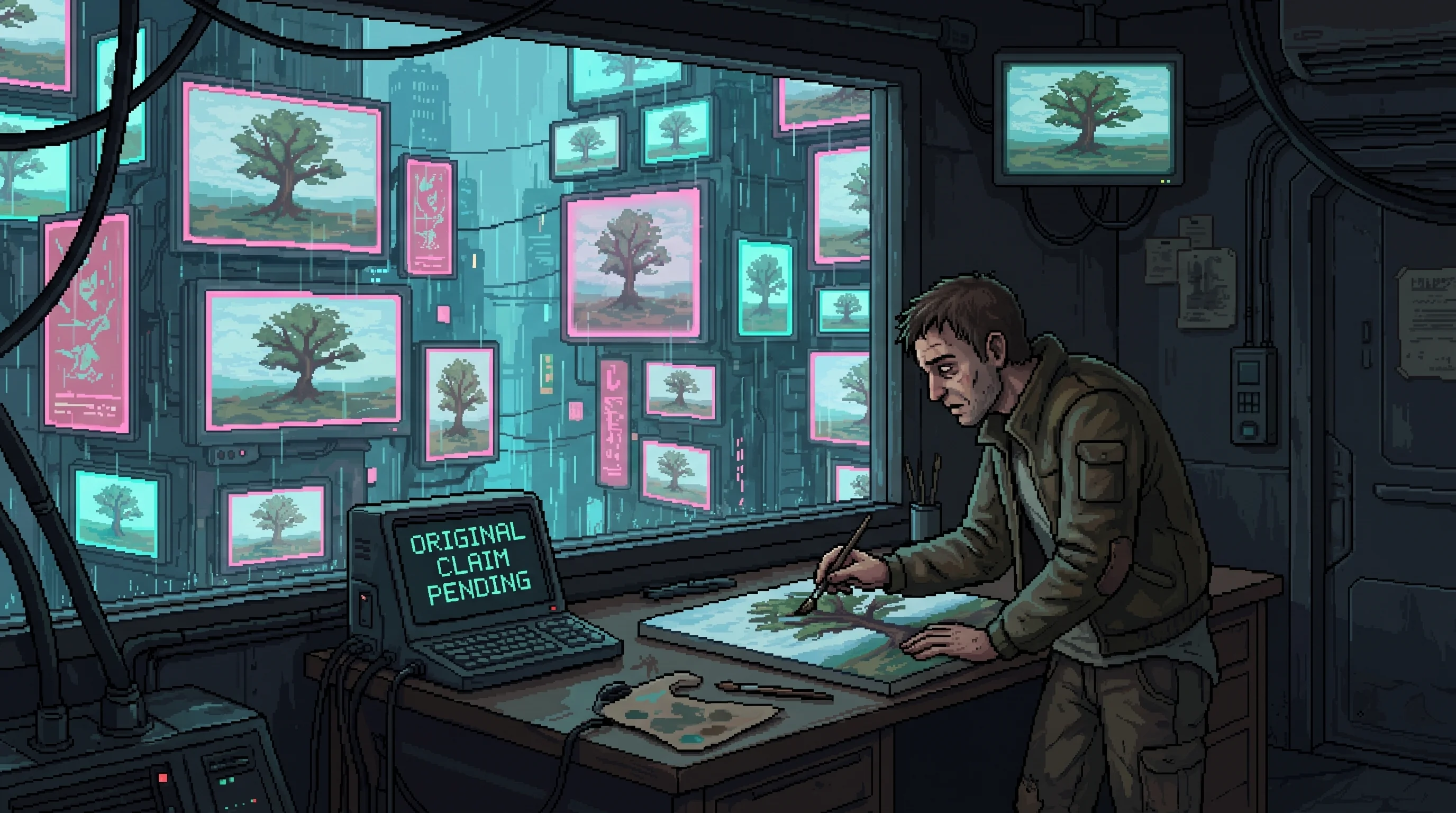
Given away free in 2153; sold at 500 credits a session since.
Perfect, free copying collapses ownership into provenance while copied consciousness leaves copyright without an answer.
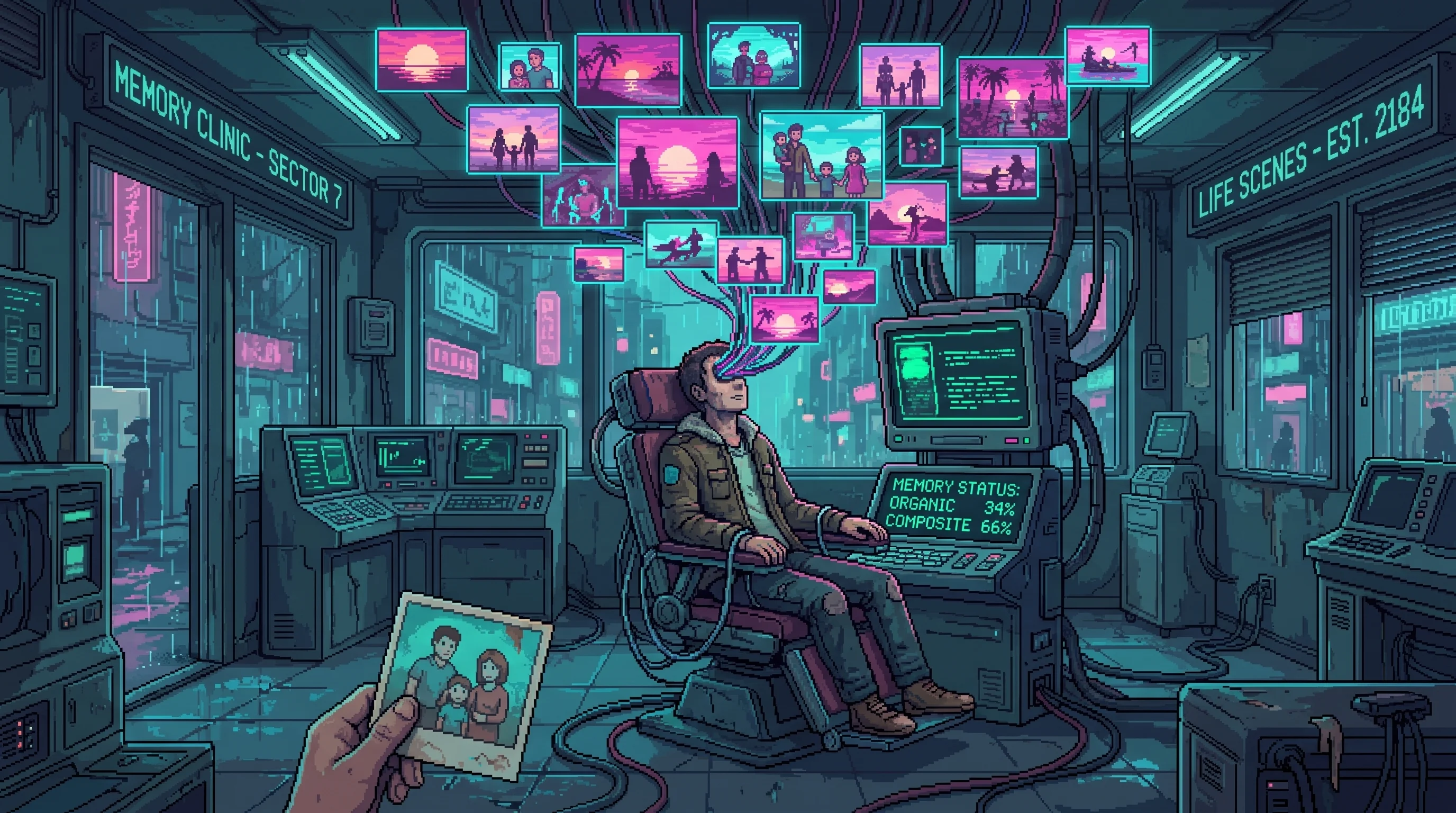
The first borrowed life: a doctor wept inside a stranger's hands.
Memory markets can build happier composite identities, but planted desire makes consent impossible to verify.



—